Category Archives: Lake District

Pottering on the fells.

In his chapter on Potter Fell, in the Outlying Fells guide, Wainwright states – “it behoves a walker subject to sudden maladies to endure a companion on this expedition” As I seem to be now inflicted with ‘sudden maladies’ I called upon Sir Hugh to accompany me, besides he has a more suitable car for navigating the presently troubled lanes in The Lake District. So we parked on a lane north of the River Kent near Staveley. A flooded beck [a lovely north country term] had devastated a bridge on its way to join the Kent; we have just experienced storms Desmond and Eva. Today is clear, but tomorrow, along comes Frank!

A man and his dog were walking by. I broached the subject of the local flooding; shaking his head, he told me of the farmer from the fellside above who, whilst tending his sheep, had slipped into the said beck and was washed away into the Kent. His body was found near Kendal – a sobering thought to start the day. Our walk started up the lane to his remote farm, and as we passed, I would have doffed my cap if I had been wearing one. It’s a hard life farming these fells.

Its a hard life.

It’s a hard life.

The first top was surprisingly craggy [a taste of things to come], and we gazed south to Sir Hugh’s house at Arnside.
Onwards to Brunt Knott, we met a local  Christmas family outing, stopped for pleasantries and were soon quite rightly involved in discussing the problems of overgrazing and lack of trees contributing to the serious flooding. Everyone up here is becoming concerned and is conscious of a lack of guidance or even sensible practical will from our southern politicians.

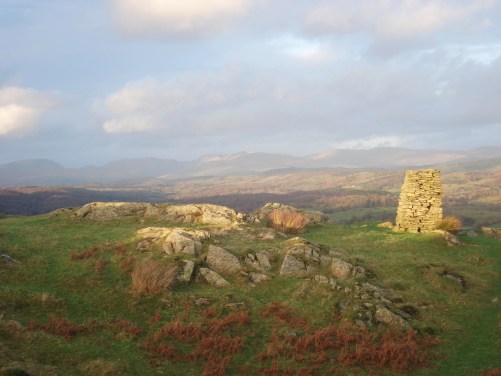
There was a stone trig point on Brunt Knott [427m] from where we tried to identify the surrounding hills of Kentmere and Longsleddale. One has a different perception of the supposedly familiar landscape from these lesser fells. Looking north, we couldn’t figure out why he hadn’t included a higher top of 429m in Sleddale Forest in this round; miles later, we were glad we hadn’t.

Approaching Brunt Knott.

Approaching Brunt Knott.

The whole area is rough, with craggy fellsides, which we found challenging to navigate, even with Sir Hugh’s electronics. Intervening walls, unfortunately, had to be climbed, our increasing inelegance becoming a source of mirth. Photos deleted.  Passing over an unnamed summit on the list, we focused on the prominent cairn on Ulgraves and eventually reached it. What a surprise. It is perched on the edge of these Potter Fells and looks straight down and up into an unfortunately mirky Longsleddale.  To the south, the Howgills were prominent once we had orientated ourselves in this complex terrain.

Longsleddale.

Longsleddale.

Distant Howgills.

Distant Howgills.

Things became easier as we picked up tracks to picturesque Gurnal Dubs, with its boathouse and then onto Potters Tarn. These waters are both dammed and originally supplied the paper mills at Burnside.

In the maze towards Gurnal Dubs.

In the maze towards Gurnal Dubs.

We found a way down alongside a rampant beck to the road and a rendezvous with our transport as the daylight disappeared. So much for an easy half-day; this was a proper Lakeland Fell walk. I had forgotten my altimeter but reckoned on climbing 1500ft.  Tomorrow, I could be clinging to Preston climbing wall or shopping in the sales as Frank passes by; guess which wins.

As usual, check out  https://conradwalks.blogspot.com/search?q=potter+fell  for the true story.

Don’t let the sun go down on me – Knipescar.

Knipescar.

                                                                            Knipescar.

Having descended to Askham from a good half day’s walk on Heughscar Hill I was not keen to risk again the flooded lanes around Penrith and chose to drive south to Shap. The distinctive Knipescar appeared up to my left, I pulled into a layby  to consult Wainwright and the map – an ideal quickie. Parked at the bottom of the lane to Scarside Farm I was in too much of a rush in the late afternoon and had gone well up before realising I’d forgotten my camera. Running back down I greeted four others going up for a late visit. Once camera reunited and relaxed on the lovely limestone promenade along the scar I could take in views of Haweswater, Cross Fell and now distant Blencathra. To my right was a substantial wall, the boundary of Lowther Castle estate. I soon reached  the summit in a maze of limestone pavement with several contrasting erratic boulders dumped by retreating glaciers. Those other four seem to have disappeared – where could they have gone at this time of night?

Erratic boulder, Knipescar and distant Blencathra.

                                          Erratic boulder, Knipescar and distant Blencathra.

My search in the limestone pavements for the stone circle/enclosure marked on the map was fruitless, I couldn’t even locate the Ministry of Works sign mentioned by Wainwright and as the light faded I didn’t fancy braking an ankle up here. So I headed back as the shadows lengthened and the temperature dropped. The sun went down as I reached the farm lane.

Where is the 'stone circle'?

                                                          Where is the ‘stone circle’?


Evening Shadow.

Evening Shadow.

The sun goes down.

                                                The sun goes down.

The end of a beautiful day.


HEUGHSCAR ANTIQUITIES.

The Summit Of Heughscar looking to Ullswater.

                                                     The Summit Of Heughscar looking to Ullswater.

Escaping from local flooding on the Calder and Ribble I headed up the M6.  It wasn’t as easy to get to the little village of Askham as I thought, every lane after the motorway seemed to be closed due to floods or damaged bridges. I was doubting my wisdom of driving into the Lakes, such was the devastation from the recent heavy rain. But the day was sunny and dry and an ideal time for more limestone walking amongst Wainwright’s Outlying Fells, my project for this winter. I avoided the quick dash to the summit and back and enjoyed his suggested walk around Heughscar Hill. The area had abundant Bronze Age cairns,  stone circles, a Roman Way and medieval quarries to explore. Paths went everywhere which helped the wandering. From the summit and a limestone escarpment were views into Ullswater and surrounding mist topped hills. Blencathra’s ridges could just be discerned.   As it was the Sunday after Xmas the area was popular with crowds of friendly walkers, going in all directions, and despite Wainwright promoting this Fell for old gits like me families and young children were in the majority.

A wet Roman Road, Heughscar and distant Pennines.

                                              A wet Roman Road, Heughscar and the distant Pennines.

Moor Divock with a couple of Bronze Age picnickers.

                                                   Moor Divock with a couple of Bronze Age picnickers.

Blencathra.

                                                                          Distinctive  Blencathra.

I ended up at The Cop Stone, a standing stone, with views down to Shap with the Howgills behind. As I returned to Askham the ornate Lowther Castle acted as a foreground to Cross Fell throwing off its mantle of cloud, the Radar station on adjacent Great Dun Fell shining in the sunshine. As an aside I remember well as a teenager camping up there on The Pennine Way and experiencing the full force of the local Helm Wind. I survived the night, or rather did my Black’s Tinker cotton tent, but I retreated the next morning with my tail between my legs. This area also brings to mind an expedition I did along that Roman Way, High Street, between the forts of Brougham and Ambleside, a 25mile stroll worth doing if you can sort out the transport logistics.

The Cop Stone with distant Shap and the Howgills.

                                                    The Cop Stone with distant Shap and the Howgills.

'Burial site' with Heughscar Hill above.

                                                               ‘Burial site’ with Heughscar Hill above.

Askham, Lowther Castle and the Cross Fell group.

                                        Descending to Askham, Lowther Castle and the Cross Fell group behind.

So for pleasant walking, all-round views and interesting antiquities Heughscar takes some beating, a real Lakeland gem. Let’s just hope the worst of the rain is over and this part of Cumbria can start to return to normal.


A quickie -CARTMELL FELL.

Having dropped out of the gale from Hampsfell

‘Calm’ before the storm – HAMPSFELL.

I was rattled and in no mood to go high again. Scanning my map I thought the lowly outlier Humphrey Head would be ideal for a quick ascent. Having driven towards it I realised the flooded access road was no place to be in my low clearance car.  A quick turnaround and I was navigating the complicated narrow lanes up to Cartmell Fell Church. This is an isolated church built in about 1504 as a chapel of ease to Carmel Priory. It has a squat functional construction, at one with the surrounding fells. The interior is welcoming with notable ornate wooden pews.    On the walls of the chancel are boards painted with the Lords prayer, the Creed and the Ten Commandments.

From here it was an easy dash up the rough fellside to the prominent stone cairn [The Old Man] on Raven’s Barrow. The highest point of the fell was a few metres SW. There were views to the Coniston Fells and over the still waterlogged Winster valley. The sun was beginning to set and the wind becoming colder so I didn’t linger. Better get home for Christmas and before little Eva arrives.


‘Calm’ before the storm – HAMPSFELL.

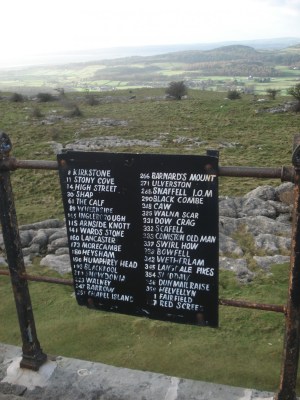
Desmond has passed but left its toll of flooding in Cumbria, and now little Eva is approaching. After a night of more rain, the day improved so I had a late drive up to the Lakes. Consulting my Wainwright Outlying Fells I chose Hampsfell as today’s destination. I now realise there is a ring of limestone to the south of the Lakes and in this rain-soaked month they hold the promise of better walking underfoot, several of Wainwright’s Outlying Fells occupy this region. Having said that there were some muddy paths out of Lindale but once on the fell things improved. This was a land of limestone pavements and miniature edges with paths going everywhere. I chose one that led me to the summit and walked up into a gale, with constant battering I wondered whether any of my photos would be in focus. There were birds’ eye views down to the Kent estuary with Arnside and Ingleborough in the distance. The highest point has an unusual ‘Hospice’, built-in 1846 under the instruction of a vicar of Cartmel as a shelter for travellers. The substantial structure has a flight of steps leading to the roof and an unusual viewfinder, an alidade, which act as a pointer to the surrounding fells. Today it was virtually impossible to stand on the roof let alone line up the views. Back in the calm interior of the shelter I was able to read the cryptic poems displayed on the walls. Above the entrance is a Greek inscription which translates as ‘rosy-fingered dawn’, a phrase apparently used by Homer referring to Eos, goddess of dawn.  According to Greek mythology, Eos’s task was to open the gates of Heaven each morning to allow the sun to rise, a romantic idea which could be put to the test by spending a night in here and witnessing the phenomenon. Today I could only view Morecambe Bay to the south and the misty Lakeland Hills in the rest of the compass.  I forced my way along the ridge in the gale-force wind in a northerly direction, the Cumbrian Fells in front of me. Dropping off the ridge field paths took me back to Lindale. My only problem was a large bull in one field, I trespassed in the adjoining field to avoid it, I would rather face an angry farmer than an angry bull.

SCOUT SCAR – limestone highway.

Wainwright’s  Outlying Fells  –  Cunswick Scar and Scout Scar.

Scout Scar.

Scout Scar.

I mused about starting to complete Wainwright’s Outlying Fells a couple of weeks ago and it hasn’t stopped raining since. The Lake District has had some dreadful flooding and it’s been best to avoid travelling there. This weekend there was heavy rain again on Saturday but the forecast for Sunday was for frost and clear morning. Hence we found ourselves parked up in Kendal adjacent to Serpentine Woods, the higher western side of town which has some pleasant housing. We simply followed the master’s guide from then on [Chapter 1]. An old tramway took us past its limestone quarry into the fells, or more correctly into a golf course. Tracks led everywhere but we just followed the crowds. A large proportion of Kendal’s population seemed to be heading for the heights,  is that normal for a Sunday or are they all going up to survey the surrounding floods?  They were the usual dog walkers and casual walkers but also a fair proportion of runners enjoying the firm dry tracks, the whole area is Limestone. Everyone gave a friendly greeting. Before we knew it we were atop Cunswick Scar on the edge of the escarpment with views all round of snowy Lakeland peaks.

Kendal below.

Kendal below.

Approaching Cunswick Scar.

Approaching Cunswick Scar.

A path followed the edge southwards towards a communication tower and crossing a road we were on the continuation ridge to Scout Scar. The prominent summit structure is called ‘the mushroom’ or ‘the umbrella’, it is, in fact, a shelter with a built-in viewfinder. It was built in 1912 commemorating the coronation of George V and has had several refurbishments. A perfect spot for refreshments and viewing, the Howgills looked close and splendid in their winter coat, as did the Langdale Pikes. The continuation along the edge gave us views over the Lyth Valley sadly still underwater. In the past I have climbed on the cliffs below, memories of loose trad climbs and some poor sport climbs [bolted] but from up here you had no impression of the crag face. I did spot one lower off and a couple of bolts. The day had been freezing with watery sunshine but clouds were building from the south as we descended through junipers to the outskirts of town. It started raining as we reached the car.

'The mushroom'

‘The mushroom’

Distant Langdale Pikes.

Distant Langdale Pikes.


Distant Morecambe Bat and the flooded Lyth Valley.

Distant Morecambe Bat and the flooded Lyth Valley.

A perfect little walk in these conditions, good underfoot with wide-ranging views.


Wainwright Outlying Fells postscript – Desmond.

Storm Desmond has been causing  lots of trouble in the NW this weekend and Cumbria has been hit hard. There were reports of flooding and roads closed throughout the area. I’d planned a start on some of those Wainwright Outliers but thought I’d better wait and see what this morning brought. The A590 into the southern Lakes was closed, Kendal was in trouble, so I wisely cancelled.

My heart goes out to all those people with flooded houses.

WAINWRIGHT’S OUTLYING FELLS.

My copy of Wainwright’s The Outlying Fells of Lakeland is dated 1974 [£1.50] and I’ve hardly used it in those 40 years.  ‘a pictorial guide to the lesser fells around the perimeter of Lakeland written primarily for old age pensioners and others  who can no longer climb high fells but can still, within reason, potter about on the short and easy slopes of the foothills

I’ve covered a lot of ground in the Lakes over the years, walking and climbing, and I now avoid the overcrowded central areas. I also, unfortunately, come into the old age pensioner category. So when I fished this volume off my bookshelves and dusted it down this week a plan materialised. I daren’t venture abroad at present because of some unresolved medical issues so why not attempt to complete the outlying fells this winter?

The book is not as well laid out as his Lakeland Fell Guides and I found it a bit difficult to actually find the locality of some of the walks and their relationship to others. The internet helped out on that account with some lists and decent outline maps of the selected fell areas. Plans rapidly develop.

I have noted in my copy a few walks I have completed, namely 10, but suspect I traversed many more. so that leaves me with 46 chapters to go.  Each chapter is actually a walk.  As he often groups several fell tops into the same chapter/walk there is a larger number of Fell tops. Another list is produced on pages 270 – 271 of the 110 individual tops but this incorporates some inaccuracies, duplications and omitted nameless ones. I’ve marked down 24 of these I’ve visited, can’t believe I’ve not done more.

A more realistic list of 116 tops appears here https://en.wikipedia.org/wiki/The_Outlying_Fells_of_Lakeland   Better just start again, I told you it was complicated.

Chris Jesty has published an updated edition which might help but that would be straying from Wainwright’s original. As I want to read and follow his accounts –  I’ve bitten the bullet.

Little How Crag.

Have you seen the forecast – dry, sunny, warmish and no wind, though as you will see from the pictures it didn’t live up to its promise.This is the end of September in the Lakes. So I put into plan a trip I’ve been hatching all this variable summer. Friend Alan had been climbing here earlier in the year in poor conditions but still raved about the quality of the rock. Rod and I had never climbed at Little How Crag in 50 years of Lakeland exploration and this was the weekend to put things right. We managed to find our way up Walna Scar Road to the parking spot above the fell gate but were surprised by the sheer number of parked cars. We seemed to remember from our last trip to Dow Crag only a few rough parking places, today it was more like Asda’s carpark. Coniston Old Man must be inundated. The clouds were still low as we picked up the track leading to Levers Water and soon left the crowds behind. The whole area is full of mines, slate and copper, and numerous risky sites are fenced off. We passed the stream coming down from the high Small Water combe under Coniston Old Man and on through Boulder valley. Once level with Levers Water the misty clouds lifted partially to reveal our crag 300ft up the hillside. Despite being ‘fit’ from my recent Stubai Walk I found the last steep bit trying. Though soon we were unpacking at the base of a lovely sweep of rock which looked mainly dry.  Geared up I set off on the start of Sunshine Arête despite the lack of sunshine – the first few feet seemed rather tricky for a Diff!

photo

Photo – Andrew.Thompson

After that it was a romp up easy angled slabs on perfect rough rock.A traversing last pitch had me wandering upwards to find a belay. We had to scramble up a hundred feet more before we could access the steep descent gully. Whilst we were contemplating a slippy down climb into the gully we spotted an abseil point on a spike of rock – it looked fairly solid so we used it for a good section of the said gully.

Abseiling the slippy gully.

Abseiling the slippy gully.

More down climbing and traversing brought us back to the sacs. Yachts laboured on Coniston Water far below and a few walkers descended Levers Hawse to our right.   Refuelled Rod soon made quick progress up the immaculate rock of more interesting Thunder Slab HS with a direct finish. We used the same way off and called it a day, 5pm. The evenings walk back was a delight in the low sunshine. Trickles of backpackers went past us up to some lovely spots in the hills, I felt quite envious.

Wetherlam above Levers Water.

Wetherlam above Levers Water.

Nonetheless we were glad to arrive back at the car. Several other parties were coming down from Dow Crag and we contemplated on our more isolated venue. A couple of easy routes on perfect rock on  a little visited crag but with a highly traditional feel.


RETURN TO RAVEN.

You have to grab the better days of this summer and so we found ourselves driving into Langdale. That famous view of the Pikes brings back so many memories of Lakeland days, early days camping and walking in the area and many days on the crags of the valley. The car parks have become busier over the years as our population has increased mobility, we used the NT one at New Dungeon Ghyll and enjoyed the field paths to the Old. The scree path up to Raven Crag hasn’t lost it’s steepness but stabilisation work has improved the line of the path.The whole slope below the crag is on the move. Middle Fell Buttress was busy as usual but otherwise the crag was quiet for such a lovely day.There were a scattering of climbers around the base and a couple high on Centipede, visible in the right amphitheatre. The debate on the survival of traditional climbing on mountain cliffs goes on with the new emphasis on indoor climbing walls and bouldering in our sport. Out of perverseness we chose Evening Wall as our morning climb. Rod first climbed this in 1968. Our memories of this route, which I have climbed numerous times, were vague and I was not sure of my route finding on the second pitch. Eventually worked out a leftwards traverse at about the right grade, severe. There was no doubt where the start of the third pitch went – an airy unprotected step right to gain the arete – I was glad it was Rod’s lead. Great rock all the way to the top.

Rod past the crux on Evening Wall.

Rod past the crux on Evening Wall.

Whilst I was belaying/daydreaming I had a good view of a climber running it out on Mendes on the lower Middle Fell Buttress.  The descent route above Raven has one awkward rock step down, and it seemed very awkward today. There is the story of a well known lady climber slipping here only to land in the tree below. If you know the crag you will realise how lucky she was to survive. Don’t know why I didn’t take a photo of this airy spot.  Anyway safely down we next choose a fairly recent addition to the crag – Elevation – finding a way up the left side of the Revelation buttress. This sustained one pitch route covers some rough rock and I thoroughly enjoyed the trip.

High on Elevation.

Highly recommended if you have done everything else.

The Revelation.

The Revelation.

A classic Lakeland’s day climbing  – I’ll shall return.

A QUICK LAKES VISIT – Gummers How.

My son and grandson are camping in the Lakes this week. It has not been the best of summer weather but they have made the most of it. I arranged to join them this afternoon and drove up the motorway in the low damp cloud, not exactly encouraging. However, when we met up at Newby Bridge there was a hint of brightness in the sky so I suggested a quick ascent of Gummers How nearby. This is a relatively low hill, 321m, and is made even easier by starting from  Astley’s Plantation car park, itself at over 200 m. A Lakeland Fell in miniature.

Wainwright included this summit in his Outlying Fells book –  “it is an old man’s mountain, and  when ancient legs can no longer climb it know ye that the sad day has come to hang up the boots forever and take to slippers”   So it was satisfying for our three generations to make the ascent together.  In the trees low down the path was rather muddy probably due to the Luing cattle, imported to maintain balanced flora. Higher the path has been stepped with Lakeland stone in parts and there are bits of scrambling to keep the youngster [and oldster] interested. Before long we were standing at the trig point in the strong wind. The celebrated views over Windermere were there but with overhead cloud.

Coming down we found a different way through trees which were made for climbing especially if you are 7 years old. Back at the campsite, there was more climbing on some glaciated boulders. The wind didn’t abate and it felt miserable, despite games of Frisbee, so I made my excuses and left them cooking supper. The joys of camping in an English summer. Back home to my slippers.

SOMEWHERE NEW.

There is always somewhere new to go. I don’t often say that about climbing in the Lake District after years of exploring. There are places you don’t go to because of their poor reputation or difficulty, but others just escape your radar. Today we visited Bramcrag Quarry for the first time. Tucked away in St. John’s Vale it has been climbed on for some years but has suddenly had a revival of interest from the local lads. Many new lines have been cleaned and because of the lack of natural protection possibilities bolts have been placed and good lower-offs added. The rock looks like slate but apparently is fine grained granite.

A new selective Lakes guidebook has just been published and gives plenty of space to this venue. So we found ourselves parked up in the valley but there was no view of the crag, a winding track however led up to the quarry rim. First impressions were not good, almost an industrial atmosphere with a timber merchant in one half and rubbish in the other. The rock itself looked sombre in the shadows, tip – the sun comes onto the face about lunchtime.  We crossed to the Center Parc sector as it promised a good selection of low grade slab routes. Without the help of the guide’s photo-diagram we would have struggled to identify anything.

Dave set off up the slab in front of us and was soon slowed down by the holdless compact rock which was difficult to read, the spaced bolts didn’t help. I was just happy to follow. It would take us a route or to to get used to this place. But the sun came out and we enjoyed some better lines. By now a trickle of climbers had arrived, all Lakes lads of a certain age including Colin Downer who had done most of the recent bolting  and was busy prospecting a new area. One can imagine Bramgrag Quarry becoming more widely known and popular with the new guide out.  A pleasant warm afternoon drifted on. There were inspiring views from our terrace across to Skiddaw and Blencathra,  below in the Vale farmers were using the dry weather for grass cutting. We noted climbs for next time and returned to the car quite satisfied with our ‘somewhere new’.

For the record –

The Comfort Zone   5                       The Rookie   5                                  Whicker’s World   5                            Blencathra Badger   5+                               Goodbye Mr. Major   6a

SAM_3363

Climber at the top of Whicker’s World.

Finishing the fine arete on Goodbye Mr. Major.

Highlight of The Rookie.

Distant Skidaw and Blencathra.

Getting better – Gouther Crag climbing.

Gouther Crag.

                                                                   Gouther Crag.

June continues. The forecast was even better for Thursday, less wind and cloud with warmer temperatures. I’ve just realised how many of my posts commence with a reference to the weather, how dependent on the forecast are ‘we outdoor types’?  So I couldn’t resist another day in the Lakes whilst the dry weather lasts and found a willing accomplice in Dave. The lanes leading into the secluded Swindale don’t seem to know whether they are in the Lakes or the Dales but were a delight this morning. The limited parking before Truss Gap Farm was even more limited today as major engineering work was being undertaken to improve water catchment in the valley. With help from the workers we squeezed into a space amongst the white vans. A little bridge crossed the stream to a track up the valley but as we packed a digger came along and lifted it up discarding it onto the bank as the river was being diverted. A new way will be found in the future no doubt.

The crag looked scruffy and vegetated on the hillside above and we found the indistinct track steep and strenuous, not encouraging. But all changed when we arrived at the Fang Buttress, there hidden up a gully and just coming into the sunshine was a magnificent wall and an ominous hanging slab.

Fang Buttress.

                                                           Fang Buttress.

I relished  the rough steep rock of Kennel Wall and Dave travelled the amazing situations on The Fang. Lakeland climbing at it’s best.


Kennel Wall up the centre crack.

                                  Kennel Wall up the central crack.


High on The Fang.

                                                      High on The Fang.

We had time to relax and enjoy the sunshine with views of the valley. No one else appeared. Two routes were enough, we walked down past Truss Buttress with routes for another day and then it was roof down for the drive home.

Truss Buttress.

                                                        Truss Buttress.

Almost Summer – Wallowbarrow Climbing.

This has been a favourite venue of mine for decades. Driving along the narrow lane  brought back memories of days climbing here with many good friends, some sadly no longer with us, camping in the fields below the crag and pints in the Newfield Inn across the river. One is still allowed to park near the characterful farm which over the years has had a varied human and animal population.  Gone are the Nepalese pheasants which used to chase you up the track. I notice there is now a camping barn available.

The morning was overcast and definitely cool, not what we had expected. The short walk up through the trees brought us under the empty West Buttress but we traversed over to the popular East Buttress, round the corner were a cheerful group experiencing multi pitch climbing for the first time.

We shivered our way up the clean  Digitation VS and Trinity Slabs VD [my first lead for two years]. The sun came out later and Paradise VS was obviously more pleasurable. Sitting on the top opens up the views down the valley and behind you the Coniston and Bowfell hills which were now in brighter light. A good end to the day.

Looking up Digitation.

Looking up Digitation.

Looking down Trinity Slabs.

Looking down Trinity Slabs.

Dunnerdale.

TREASURE HUNTING ON SIMPSON GROUND.

FAIRY TREASURE.

FAIRY TREASURE.

This post is tagged under  ‘walks’  but that only reveals a  small part of the outing. This is not a true or accurate account of the day as I am still bruised, tired and disorientated. Read the true version on  –   http://conradwalks.blogspot.co.uk/2014/12/its-who-you-are-with-that-matters.html

A glorious day, for December, was promised and I was glad I’d arranged to meet Conrad for a trip out. Foolishly I had suggested over the phone that he would organise the itinerary to suit his progressive recovery from his leg injuries. As I drove up the motorway, with the morning sunshine highlighting the distant Lakeland Fells across Morecambe Bay – a view to stir the heart of any outdoor enthusiast, I was looking forward to a leisurely stroll.

Without much ado we were parked up at the busy car park for Gummer’s How at the south end of Lake Windermere. That was the last we saw of humanity for the rest of the day. Conrad [or shall I call him Livingstone] set off with a missionary zeal, GPS in hand, onto the mysterious Simpson Ground. He has recently taken up the dubious hobby?, pursuit?, obsession?, addiction?  of Geocaching and had planned a six ‘cache’  navigation search for us.

The hidden caches were plotted on his map and from clues we had to find them.  This is easy I thought as the first one  ‘in tree roots next to the path’  was unearthed  –  a little Tupperware box containing a few trinkets and more importantly to Livingstone a log for him to sign as proof of our visit. The last person logged in here was dated in August.

Coming from an orienteering background I eagerly set off through the forest on a bearing to the next  ‘under a stone by an outcrop’ –  simple. I doubted the need for the GPS as we discussed the merits of map navigation, electronic aids and even dead reckoning.

under a stone at the back of a stone building’ seemed a little more challenging as the impenetrable forest showed no obvious evidence of any such structure. After thrashing through the trees and vegetation, mainly in circles, a small stone hut emerged. The roof had collapsed but there was an intact fireplace and chimney, I reckoned it would make an ideal small bothy. The little box was there. Time for a leisurely lunch by a tarn sat on an upturned boat!  I would like to commend Livingstone’s soup making skills.

Our last three challenges were grouped around an area of tarns and their associated bog. Things deteriorated quickly as we attempted to take short cuts through the morass, ski poles plunged into the depths and ominous gurgling noises accompanied us. Having previously being scathing of the ‘unnecessary’  GPS device I was soon imploring Livingstone to take a fix. Forgot to check when the ultimate amphibious cache had last been visited. SAM_5827Why had the ‘hider’  ventured into this floating jungle for us ‘seekers’  to try and follow. There lies the conundrum of this geocaching game and I hesitate to provide an answer, at least a polite one.

Won’t show a map of our tortuous explorations, suffice to say that what felt like 10 – 12miles in five hours was only about 5miles. We did make it back to the car just as it was getting dark.

Livingstone seemed pleased with his explorations and I have to thank him for a well organised day.  I’m not sure about my conversion as I don’t even own a GPS. Navigating back down the M6 was a breeze.