Monthly Archives: July 2016

NORTH WALES PATH – Day 5.

Kinmel Bay to Prestatyn.  More surprises.

First of all an addition to yesterdays walk – at the start in Rhos I passed the Caley Arms pub but didn’t realise the significance of the name or the sign.

The Caley family were prominent landowners in the area as well as in Yorkshire, One member of the family, Sir George Cayley, was an eminent inventor. He designed a practical flying machine 50 years before the Wright brothers. In 1853 he built a machine that could carry the weight of a man. This glider, the “Cayley Flier”, paved the way for the Wright brothers’ powered flight in 1903, as the Wrights acknowledged.                                                                                       The “Cayley Flier” flew for about 275 metres across Brompton Dale (in Yorkshire) before crash-landing. This was the first recorded flight in history in a fixed-wing aircraft, so it is fair to describe Sir George Cayley as the true inventor of the aeroplane. Sir George, 80 years old at the time, didn’t risk flying the plane himself, ordering his coachman, John Daley, to fly it for him. After the alarming experience, the coachman promptly resigned.                                                                                        Llandudno & Colwyn Bay History Society

_____________________

As I crossed the railway at the start of the day I noticed a man with a large lensed camera waiting on the bridge – that usually means a steam train is due. So I stopped and chatted and soon it came full steam down the track. LMS 46115 Scots Guardsman running tender first. As a kid I used to watch these magnificent engines powering through Crewe. 

I set off more sedately on a cycle path alongside the River Clwyd and marched to Rhuddlan with its famous 13thC castle. The town’s main street had a few shops and for my morning coffee the small but friendly Farmhouse Kitchen. With all these diversions I was making slow progress but speeded up on the little lanes out of town. I was now in agricultural land, sweetcorn and grains, and not many people use these paths. Waymarking was poor and I guessed my direction across most fields. The edge of one field was virtually impossible to walk without trampling the crop. Eventually I emerged in a village called Dyserth which seemed exceptionally busy for its size, turns out it is the site of a famous 70ft waterfall. Leaving the NWP I scramble up beside it and follow paths in the woods above to suddenly emerge at a rock face overhanging the stream. A couple are just pulling their ropes down having done a fine bolted crackline up the side face, they tell me name of the rock – unsurprisingly Waterfall Buttress.

Some creative walking [trespassing] finds me back on the NWP which follows an old railway line into Prestatyn. But for a final flourish I divert on steep paths to climb Graig Fawr a limestone hill 151m high and giving excellent 360 views. Again curiously the NWP avoids it.

Across Colwyn Bay to the Ormes.

Across Colwyn Bay to the Ormes.

Prestatyn the end of the NWP/

Prestatyn and the end of the NWP.

Over to my right are the hills we followed when finishing backpacking Offa’s Dyke many years ago. I remember on reaching the beach in Prestatyn we just stripped off and rushed into the waves and were probably lucky not to be arrested. Today I meekly caught the train.

So the North Wales Path – over 60 miles of mainly good paths and cycle-ways from Bangor to Prestatyn; giving a fair balance of coastal and hill walking, as the logo depicts. Larger scale mapping would be a great help. I’ve thoroughly enjoyed the last five days and think this short route should be better publicised to be appreciated and used by more walkers.


NORTH WALES PATH – Day 4.

Rhos to Kinmel Bay. Highs and lows.

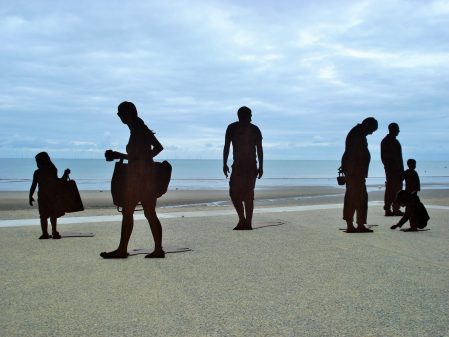
That should really be ‘lows and highs’ as I started the day on the front at Colwyn Bay, all a bit drab with its disused pier, overwhelming concrete and lack of facilities. Very few people ventured onto the sands. A poster probably reflecting the fading past. There was however a stunning art work of metal figures.I must have switched off walking along the bay as I went past the inland diversion and had to retrace to find paths up ‘Fairy Glen’, a green corridor following a stream up through Old Colwyn. This gave a chance for a break as I passed the high street. Old style, no frills, Gillian’s Kitchen – coffee and toasted teacake for £1.70, long may these places survive. Back into the glen to climb higher.  The next couple of hours passed in a different world in the hills around Llysfaen. I wandered through golf courses, untracked woodlands, village lanes with tiny cottages, open meadows and limestone escarpment. To be honest I felt lost most of the time, could have done with a 1:25,000 map, but I somehow stayed on the NWP as I kept coming across the infrequent waymarks. All the while there were views across the rolling countryside.  Don’t think many people venture up here. I eventually returned to the coast through an arch of a public house, The Valentine, in Llanddulas. The inn sign gives the wrong impression as the pub is really named after Lewis Valentine [born in Llanddulas] one of the founding members of Plaid Cymru. Then it was back on the coastal walkway/cycleway for 5 miles. The start wasn’t so bad at Abergele, I even found a fairly civilised cafe for beans on toast and a pot of tea. But from then on it was a continuous line of drab caravan parks separated from the beach by the railway. The wind farms out at sea didn’t seem over-intrusive in these surroundings. The few people braving the beach were huddled out of the wind, an epitome of English seaside holiday. As were the passing families with beefburgers, candy floss and cans of beer. The obese amongst these seem to have devised a certain ‘waddle’ to progress, much in evidence. I’m sure I looked just as strange to them with my boots and walking poles. Nobody stopped to chat. From time to time  screaming above the sound of  pop music announced a mini fun fair. Having said all that there were always extensive views; back to the Ormes and forward to the hills dropping to Prestatyn, the end of the NWP.There were a few passing aspects to improve my mood… I’d had enough at Kinmel Bay and found my way through a new marina to the River Clwyd where I’ll start tomorrow. Reflecting now this was a quite a varied days walking.


NORTH WALES PATH – Day 3.

Deganwy to Rhos.  Round the Great Orme and over the Little.

I thought today’s post would read – ‘walked round the Orme in rain and mist’

Well for the first hour or so that was the case and I was soaking by the time I stopped for a rest and was thankful for a coffee in the cafe.

Conway Mountain seen across the estuary before the rain.

Conway Mountain seen across the estuary before the rain.

Llandudno West beach - how many memorial seats do you need?

Llandudno West beach – how many memorial seats do you need?

When I reappeared the rain had stopped for the day so I started to enjoy myself and see the surroundings. Limestone cliffs above and below, I was searching out climbing lines and spotting mountain goats. Eventually found both.Near the end/beginning of the road there is a cave called Parisella’s [named after an ice cream parlour] where hard hard bouldering problems abound and always dry! It must be nice to be good enough to be sponsored. I digress. Now for some history …

Not long after …The pier is next to the fading Grand Hotel but the rest of Llandudno is thriving, ‘No Vacancy’ signs everywhere. It was busy on the prom…… my best advice is to catch a bus to Little Orme.

For some reason the North Wales Path misses out the summit of Little Orme, a great mistake. It was one of the best viewpoints yet.

Westwards

Westwards

Eastwards.

Eastwards.

There was only another lady and her daughter [locals] up here and they were lost and panicking, I walked down with them. The 5yr old asked where I had been in the world so I queried where she would like to go –  Abergele was high on her horizon! I had other random conversations today – a couple on the beach told me they were searching for the perfect sea-washed stick for a perch for their pet gecko – a man fishing for mackerel off the beach but waiting for high tide 4hours hence [why didn’t he start later?] – another fisherman hoping to go out later for sea-trout, he always wanted to fish the Hodder near my home.

I managed to get lost also in a mining area on the edge of the mountain, till the salmon fisherman showed me the steep way down, which was in fact signed, the post top left.

The steep quarry.

The steep quarry.

Ended the day back on the prom at Rhos on Sea where I found the delightful St Trillo’s Chapel. its altar stands over a spring and was established in the 6th C but has been rebuilt many times. Services are still held for a congregation of six.


NORTH WALES PATH – Day 2.

Abergwyngregyn to Deganwy. The hilly day.

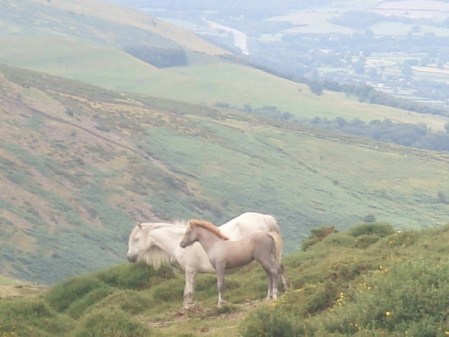
A hot and sweaty 250m climb up a steep lane was a jolt at the start of the day. The little car park at the top was already full as we are on the edge of the Carneddau. a popular walking area. Having said that I saw no one for the next few miles.  The track heads up alongside ugly pylons presumably taking hydro electricity to England. I was musing on their incongruity and how it could have been avoided when I saw men hanging from one of the pylons – repairs underway, looked very scary as I know they don’t always disconnect first. DSC02627   From up here there were obviously good views to the coast and Anglesey and  down to the A55 corridor. I was feeling quite superior that I had chosen the high route. Then it was steeply down to the edge of Llanfairfechan where farmers were repairing a wall with awkward angular rocks, they commented on the easier ‘flatter’ stones we use in the Pennines.                   A complicated series of tracks through sheep country gained height once more for a couple of hours of exhilarating walking on snaking green paths through heather and gorse. Waymarking was sparse and I needed to keep referring to the OS map. Stone circles, lonely farms, idyllic streams, wild ponies, buzzards overhead, stonechat chatting. The old Penmaenmawr  stone quarries were skirted where once stone was lowered to jetties on the coast and apparently in their heyday dust covered the local villages. 

As I approached the Sychnant Pass there were more walkers in the hills. On the other side multiple paths cross Conway Mountain but curiously the NWP chooses to traverse below its summits. I couldn’t miss out the high point and was awarded with stunning birds eye views down to the boats at Conway, the Great Orme at Llandudno and the Carneddau foothills I’d been traversing.  Surely a mistake to bypass the ever so close summit on a North Wales walk. At one point I looked straight down to a caravan park cut of by roads and railways, I wouldn’t have though the ideal holiday. The walled town of Conway is always busy and today there was a fair in full swing. The day was sunny and warm so I continued past the Castle and over the bridge to walk the promenade to Deganwy, this deteriorated in new housing developments denying coastal access – who allows this? A sour end to a wonderful day’s walking.

NORTH WALES PATH – Day 1.

Bangor to Abergwyngregyn.  Aber Falls.

Couldn’t get that tune ‘The Day We Went To Bangor’ out of mind all morning. If you can’t remember listen here –

This rendition probably sums up the North Wales seaside resorts then and ?now. As an aside Jasper Carrot had a splendid parody involving Blackpool.

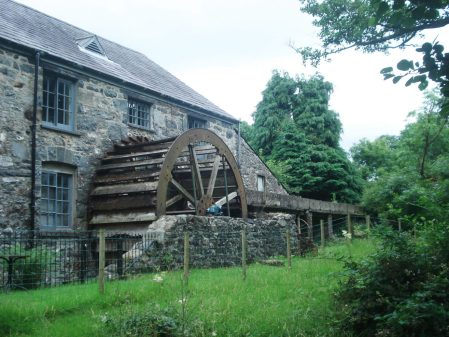
Anyhow to get back to this morning, industrial outskirts of Bangor led to country lanes and my route left the Coastal Path near the entrance to Penrhyn Castle. Walking up the Ogwen valley I came across what appeared to be a fairly well preserved mill  with an under flow wheel. Further on I passed Cochwillan Old Hall, a late 15th century house, apparently one of the best examples of a Welsh medieval estate houses. A good start. On a more mundane note many of the fields and lanes here have slate stone ‘hedges’.Buzzards were occupying the airspace above the rough fields. Little used lanes took me up into the foothills of the Carneddau and onto an old track traversing at about 250m above the coast. There were good views back over Penryhn Castle, Bangor, the Menai Straits and Anglesey.The diminutive Puffin Island off Anglesey was ever present.Turning a corner the view changed from the coast to the hilly interior and ones eyes are drawn to the twin Aber waterfalls. The North Wales Path crosses directly below the falls, the larger easterly one being the most visited from the valley. Up till now I had met no one but suddenly there were throngs of tourists.I had my quick fix of photos with the crowds and the quickly descended the wooded valley for a coffee in the excellent community Yr Hen Felin cafe in Abergwyngregyn, that’s a mouthful to pronounce.


NORTH WALES PATH – Croeso i Cymru.


My welcome to Wales was a Midlands’ accent spoken by mine host at a B and B in Llandudno. The heat wave had passed and I was looking forward to 5 days walking on the North Wales Path, running 62 miles from Bangor to Prestatyn. Not sure whether it is ‘The’ or ‘A’ North Wales Path but it has made it onto the OS Maps and is waymarked.DSC02511

It seems to take a more interesting route than the coastal path as it keeps dipping into the hills above the coast and avoiding the holiday excesses of the promenades.  A chance remark on Ruth’s Coastal Walk blog had me looking into this route a couple of weeks ago.   https://coastalwalker.co.uk/2016/07/04/bangor-to-aber/#more-14204

There is a Web site where you can download the mapped route at 1:50,000 which I hoped would be sufficient.

As the holiday season is in full swing I had difficulty finding last minute places to stay at the end of each day so plumped for this B and B in Llandudno, Rosedene Guest House to give them a plug. [PS They were excellent, good room, brilliant breakfasts, one of the best B and Bs I’ve stayed in.]        http://www.rosedenellandudno.co.uk

I realised that public transport was all I needed as there is an excellent service Arriva Cymru Coastliner connecting all the villages on the North coast. The buses talk to you, in English and Welsh, telling you the next stop which is also displayed – so you can’t go wrong. My lodgings turn out to be a couple of minutes from the Llandudno bus terminus at The Palladium [another imaginative Wetherspoon’s conversion, here from a 1920’s cinema] – so beer and bus on tap. The B and B has its own cat which sits on the pavement outside and greets all passers-by, I think it is a local celebrity.

PS – as well as the nationalistic Welsh Dragons I noticed a few blue EU flags flying today!

CREAKING GATES ON ROLLING GATE.

Climbing at Rolling Gate.

It’s the hottest day of the year with temperatures in the 30s. This high Yorkshire crag faces NW and seemed an ideal choice for the conditions and so it was. A sweaty walk deposited us in the shade of the scattered rocks which form a rather broken edge.                                                      The obvious start was Veterans Flake which wandered about to eventually surmount the large flake, all a bit of an anticlimax. It was however pleasant to belay on the top in a breeze with views over Grassington into upper Wharfdale.                                                                                  Next up was Long Crack a proper gritstone thrutch around several noses in a corner, sweaty work today. The descent  brought us to the foot of The Main Buttress and the start of Rolling Gate Buttress the starred route of the crag. The first steep and bold 10ft seemed hard, my left hand reluctant to leave a decent slot for small slopers above with only slanting footholds – surely not severe. Eventually a hand on the arete enabled my feet to move higher and the ‘better’ hand holds above reached, heart in the mouth stuff. Then large ledges were shuffled onto and left insecurely round bulges with no protection, I’d not brought the big friends. Don’t seem to remember it being this hard 40 years ago!

Rolling Gate Buttress.

Rolling Gate Buttress.

We retreated to a shady corner for lunch and composure, our gates were certainly creaking and our resolve weakening in the heat. However to the left was a rib leading to a cracked wall which looked inviting, The Pillar, and we couldn’t resist. Easy climbing up the right side of the lower rib was almost alpine in nature. A stance was taken below the top wall which close up looked steeper and longer.  Once committed a lovely sequence of slots, ledges and cracks led to the top on perfect gritstone – the best of the day. We only wished it could have gone on for another 50ft but life is not like that.

I finished with a quick solo of Six Metre Wall, there are lots of other good looking boulder problems hereabouts.

Fortunately we arrived back at the lane just as the farmer was wanting access for contractors with oversized trailers. [they were in a rush before tomorrow’s potential heavy rain] We thought we had parked responsibly but could now appreciate his problem and were soon on our way. What a change however to meet a pleasant and chatty farmer, in the circumstances, to round off our great day out.

SHARP HAW – Skipton.

Sharp Haw.

Sharp Haw.

Sharp Haw is not quite the Matterhorn of Skipton but it is an eye catching shapely fell standing like an island in the Aire Valley. Driving across from the west this morning its numerous peaks promised a day of exploration. Dragging The Pieman away from his garden we parked at the start of the track saving a couple of miles walking in the day. On our last visit we had just walked out of his house in Skipton but I think we were both feeling lazy today. Instead of following the bridleway over Flasby Fell we headed over rough ground to the rocky ridge overlooking Gargrave to make the most of the views. All around are familiar hills, nearby is the Embsay/Crookrise/Rylstone ridge whilst Waddington Fell, Longridge Fell and Pendle are prominent to the west. There is a birds eye view down the Aire Valley with its enclosing hills. As we made our way along the crest gritstone boulders littered the ground and there was evidence of chalky visits, UKC now lists over 200 boulder problems for this fell. The Pieman showed me a particularly nice slab which he used to solo as he passed on his regular fell run. A quick ascent had me pleased. Next stop was across some boggy ground to the shapely summit and trig point, this was already occupied by two girls so we dropped down through the woods and found a classy metal bench for lunch and putting the world to right. [Memorial to a Helen Handley a local artist and politician].

Pendle, Longridge Fell and Waddington Fell with Gargrave below.

Pendle, Longridge Fell and Waddington Fell with Gargrave below.

Coming out of the woods we went through Flasby hamlet, all of six houses, and into the parkland of the Hall. All well manicured English scenery.  A short stretch on the road took us past the stately Eshton Hall  where my guide for today had attended when it was a school, he thinks it is apartments now. After a few fields we were on the towpath of the Leeds – Liverpool canal for a couple of miles back towards Skipton. A friend lives on a barge here but I think the other side of Gargrave. Uphill lanes were followed through the scattered houses of Thorlby and Stirton where most of the farms have been upgraded to exclusive living. More interestingly by the road side is a ‘Tin Tabernacle’, a disused Methodist chapel built with corrugated iron probably at the beginning of the 20th century. The Pieman can remember his father auctioning off the harvest festival products for chapel funds many years ago. I wonder how long this building will last and if it is listed, you don’t see many now.

Eshton Hall.

Eshton Hall.

So if you are in this area maybe eschew the higher hills and explore this rocky island.


A plethora of bilberries.

As I parked up at Kemple End  little groups of bending figures dotted the fell side, they are clutching  plastic containers and their purple fingers announce their activity – bilberry picking. We are all eating a lot of BLUEBERRIES these days, they are commercially grown, are widely available in our shops and keep for several  days. Their close relative the BILBERRY [WHINBERRY or WHORTLEBERRY]  Vaccinium sp. grows wild and being much softer doesn’t keep so is better known by the foragers amongst us. From July onwards on Longridge Fell the low bushes are covered in purple berries which I must admit are fiddly to pick but are delicious to eat.


In southern France they are known as myrtille, in Italy mirtillo and are commonly found in local markets and delicious tarts. Professional collectors are seen out in the hills using wooden combs to quickly harvest large amounts which are pooled in large canisters which are carried down later in the day. It all looks hard work.

I drop down into the quarry where the other collectors don’t venture and am able to pick at leisure on laden bushes. I quickly fill a small container before a spot of bouldering on rather damp rock this morning. Mouthful’s of berries intersperse problems. The bell heather is just coming into flower and the flowering blackberries promise abundant fruit in a month or so.


I remember summer days’ climbing in the Lakes on multi pitch routes where every belay ledge was covered in ripe bilberries, scrumptious.

Oh it’s started to rain again, better get home and bake that pie.

STANAGE SHORTS.

They call it the Popular End for good reason, we sit on the top of the edge along with several other climbers belaying and watch a snake of maybe 30 children/guardians walking noisily up through the bracken, thankfully not to climb but just out for a ramble. A ring ousel cries out its distress. A constant stream of walkers past along the top. The line of cars parked below is not as long as on a weekend and the instructed groups are further along the edge, Grotto Slab area.

So we are able to pick at will climbs in the short Mantelpiece Buttress area. Rod has brought his friend, Pete, from way past along for an easy day on gritstone. We have two guide books, mine from 20 years ago with climbs described awkwardly left to right and Rod’s [2002 ed.] right to left but with useless diagrams. Things have moved on with guides and the later BMC editions are much better along with Rockfax. It is interesting to see how the grades have changed between our two editions, when I was soloing around innocently in this area all those years ago everything was diff – severe whereas now the routes are recorded a grade or two harder. They certainly felt it today.

Mantelpiece Crack.

Mantelpiece Crack.

Right Mantel.

Mantelpiece Right.

Top of Zip Crack.

Top of Zip Crack.

Right Edge.

Right Edge.

A whole catalogue of gritstone techniques were employed – jamming, bridging, udging, knees, slopers, laybacking, manteling etc etc on the climbs we selected. Which other rock type gives you such variety. We had a limited trad rack, no ‘friends’, so everything felt a bit bold. By tea time we’d had enough and soon were in the motorway jams on the way home. That’s another thing that’s changed in the 20 years – the amount of traffic, no wonder our visits to the Peak are becoming less frequent.

HASLINGDEN GRANE – THREE RESERVOIRS’ ROUND.

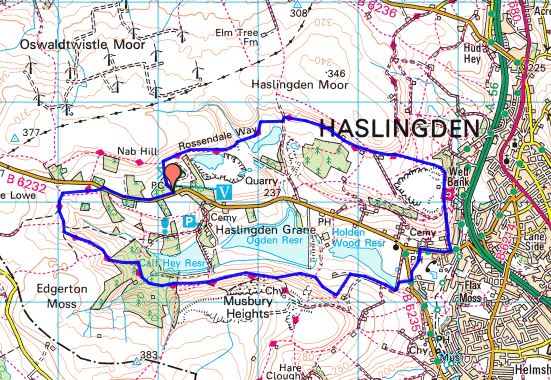
A meeting with ‘ the plastic bag man‘ was due. First draw a line between our abodes and roughly choose the halfway point, get out the map [West Pennine Moors] and devise a circular walk of reasonable length trying to avoid previous walks which is becoming increasingly difficult. At our 10am rendezvous in a car park off the Grane road  it was good to see  ‘the teacher‘ joining us. People were calling in at the cafe for breakfasts or coffee but few seemed to venture into the hills. We could hear loud bleating of sheep from the car park and as we climbed the hillside the reason became obvious – an industrious team of shearers were rapidly working their way through the flock and lots of silly looking naked sheep were running around. Above were whirling wind turbines, they seem to crop up on most of my walks now. We soon gained the waymarked Rossendale Way, RW, which traversed the hillside above a series of extensive abandoned quarries, two of which were water filled – nature parks in the future?Further on we must of passed above Troy Quarry, a previous climbing haunt of the three of us, so talk was of epics in the past. A massive worked out quarry was circumvented on the way down to Haslingden, ?Hutch Bank, where we had no knowledge of any climbing but there looked as though there were possibilities.  The next few footpaths are best forgotten –  unwaymarked, overgrown and unwalked, but we did emerge onto the road above Helmshore thankfully. A leisurely lunch was taken by the dam of Holden Wood Reservoir. Tracks led us back onto the RW and we enjoyed a fantastic traverse of the valley above Ogden and Calf Hey reservoirs. Is this really Lancashire?   Some  lovely stretches through woodland followed.  Above us was Musbury Heights which is mainly quarried, at one point a steep quarry incline came down from the heights and uniquely our path went under it in a small tunnel. Old crumbling farmsteads were passed, a reminder of the marginal agricultural activities before the reservoirs. Many farmers supplemented their income with hand loom weaving, mining and allegedly whiskey distilling. Apparently a 1000 people lived in the valley at one time.

A short section of road walking unfortunately brought us back to reality.


THE LANCASHIRE WITCHES WALK – Caton Moor to Lancaster Castle.

Our final stage of this fascinating walk began high on the Caton Moors. The well known, when  viewed from the motorway, wind turbines were rotating rapidly in the strong wind as we passed. Up here today we had extensive views of the Bowland Fells, Ingleborough and Pennine fells north, the Lune Valley and Morecambe Bay, an exhilarating start to the day. In a picnic area we found our first tercet of the day, No 6. A lane coming from nowhere brought us down into Brookhouse and we explored the back lanes and pretty houses of the village, roses seem to be a specialty of the gardens here.

Across the main road we joined the Lune Valley Ramble into Lancaster along an old railway. All of a sudden humanity appeared – dog walkers, joggers and cyclists supporting the idea of good exercise and being able to participate in a safe and beautiful environment. Well done Lancaster with the help of European money!  Two men were setting off  cycling coast to coast  to Bridlington, a route my son speaks highly of. They were an odd couple one young and fit on a classy bike, the other hoping to rely on his electric motor to get across the Pennines. I hope their enthusiasm saw them through although I suspect they will have been very wet at the weekend. We crossed the famous Crook Of Lune [painted by Turner] on an impressive bridge. More cyclists were passing the next tercet. For a break we sat on the banks of the river below a weir near Halton old station. A fisherman engaged us in conversation about all things Lancashire, No fish were caught. it was about at this time that the zip on Sir Hugh’s shorts malfunctioned causing great hilarity to the fisherman and great embarrassment to the wearer. Apologies to anyone in Lancaster whom we shocked or offended.

A pleasant stretch on a lane parallel to the motorway followed, large puddles where evidence of recent rainfall. We were heading for the castle but first we visited the prominent hill forming part of Williamson Park thought to be the site of the witches’ gallows, and now the site of the 9th tercet.  We wandered through attractive parkland and climbed up the baroque Ashton Memorial for views over Lancaster and the surrounding areas. Then it was down busy streets across town passing the Golden Lion pub where the witches were supposed to have been offered a final drink on the way to be hung – an unlikely tale. Incongruously two walkers in shorts, with walking poles, marched through the shopping area and eventually climbed up to the impressive castle gates and the last tercet. A lot of restoration work is going on so we didn’t linger.

Thus we had completed a trail full of interest which deserves to be better known.

The complete poem

‘The Lancashire Witches’ by Carol Ann Duffy

One voice for ten dragged this way once
by superstition, ignorance.
Thou shalt not suffer a witch to live.

Witch: female, cunning, manless, old,
daughter of such, of evil faith;
in the murk of Pendle Hill, a crone.

Here, heavy storm-clouds, ill-will brewed,
over fields, fells, farms, blighted woods.
On the wind’s breath, curse of crow and rook.

From poverty, no poetry
but weird spells, half-prayer, half-threat;
sharp pins in the little dolls of death.

At daylight’s gate, the things we fear                                                                                               darken and form. That tree, that rock,
a slattern’s shape with the devil’s dog.

Something upholds us in its palm-
landscape, history, place and time-
and, above, the same old witness moon

below which Demdike, Chattox, shrieked,
like hags, unloved, an underclass,
badly fed, unwell. Their eyes were red.

But that was then- when difference
made ghouls of neighbours; child beggars                                                                                              feral, filthy, threatened in their cowls.

Grim skies, the grey remorse of rain;
sunset’s crimson shame; four seasons,
centuries, turning, in Lancashire,

away from Castle, Jury, Judge,
huge crowd, rough rope, short drop, no grave
only future tourists who might grieve.

Sir Hugh’s own blog tells a similar tale of our progress –  http://conradwalks.blogspot.co.uk/