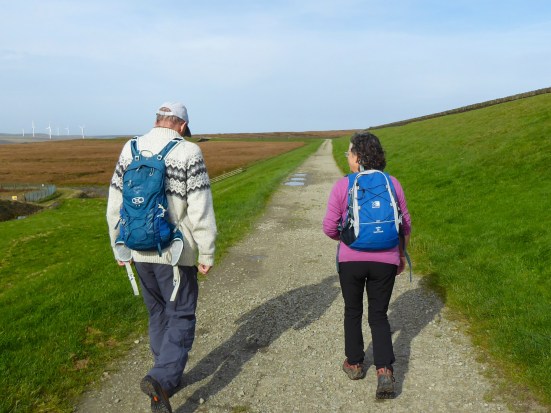
It is difficult to plot a flat five-mile walk in this part of the Ribble Valley. At least if you want to make it interesting. Sir Hugh is a connoisseur of trails, so I have to make this one at least appear interesting and at the same time without too much uphill.
He has kindly offered to come down from Cumbria in order to drive me to a walk I can’t easily reach otherwise. He left the choice to me.
The morning is misty, so we linger and catch up over coffee before leaving. A low-level walk is probably best in these conditions. Half a Tolkien is what I’ve named it. I could probably just about walk it blindfolded.
The Tolkien Trail is a walk around the area inspired by J R R Tolkien’s writings during his stay at the college in the late 1940s. A number of names which occur in ‘The Hobbit’ and ‘The Lord of the Rings’ are similar to those found locally. The tourism people have made as much cudos from it as possible.
Leaving Hurst Green, the much-improved footpath drops steeply down to the Ribble. As we happily descend, I have nagging doubts at the back of my mind that we will have to climb back up at some stage. I need not have worried; Sir Hugh is a true soldier. 
Peace is all around. There is no wind, and the Ribble flows sedately by, one of the great rivers of the North. The still, misty conditions add atmosphere to the banks. The stately aqueduct, 1880 era, carries a water pipe to Blackburn, but I can’t remember where it originated. ? Langden Intake at Dunsop Bridge. 
We are now on an ‘astro turf’ path. At some stage, a plastic sports pitch has been taken up and relaid as a strip along the river bank, creating the perfect walking surface which blends in with the surroundings. It could be used to advantage on other popular/eroded paths. I think Sir Hugh has stepped offside at this point. 
The trail further on has been surfaced with slate chippings, equally resistent but not as visually pleaasing. I wonder which will survive the longest? 
Jumbles, where the river has a little dance, comes and goes.
Upstream, fishermen are trying their luck.
I point out Hacking Hall across the way, just visible in my header photo (garderobe was the word I was trying to bring to mind). The Calder joins in here at the site of the old Hacking Ferry, which would have been in operation in Tolkien’s time. 
I have a secret up my sleeve. We are always looking for a comfortable seat to have lunch, but there is never one when needed. Today, I hone in on a fisherman’s bench just above where the Hodder, itself a sizeable river, joins the Ribble. Perfect, with extra brownie points. 
Close by is the Winkley Oak, that magnificent ancient tree. I am always reassured to see it still standing after the winter storms. 
The diverted path is no problem. However, I’m still not sure whether it is official.
As we slowly climb the lane, I mention that the tall trees nearby are a heronry at this time of year. They have nested here for generations. Peering up into the roof canopy, we fail to spot any nests. But then a couple of herons on the ground take to flight and land in the highest branches. They tend to lay early, so they are probably building nests at the moment. Their rasping cries break the general silence.
I find a group of Oyster fungi on a fallen tree, enough for a snack on toast later. (I’m still alive) 
The path across the fields has been improved, and we are soon at that bus stop on the road junction. It is too misty for the classic view of Pendle Hill or Cromwell’s Bridge down below. More of him later. 
I try to ignore the steep bit of road climbing up to Stonyhurst College grounds. Sir Hugh hardly stops for breath.
We take a back route through the college grounds, past all those terrets and observatories, until there in front of us is the magnificent St. Peter’s Church. 
The front of the college is inspiring. The road leading to it is dramatic. The public right of way now goes elsewhere, but I remember walking straight up to the college years before security stepped in. In ignorance and encouraged by Sir Hugh, we walk out on that entrance drive between the ornamental ponds. I wonder whether the security cameras picked us up.
Once safely out of the gates, we have time to turn around and admire the college’s frontage. 
The long road leads to the tacky, all-seeing Column of the Immaculate Conception on a mound. More interesting is a large wayside stone. After staying the night in Stonyhurst, Cromwell allegedly stood on this stone and described the mansion ahead of him as “the finest half-house in England”; the symmetry of the building was, at that time, incomplete. He fought the Preston battle the following day, 17th August 1648, against the Royalist army. 
From here, it is a simple stroll back into Hurst Green just as the sun is breaking through.
An excellent five-mile walk full of interest and, as usual, with Sir Hugh full of bonhomie. His version will be available soon at https://conradwalks.blogspot.com/