Tag Archives: River Hodder

DEEPER INTO CHIPPING VALE.

The Lazy Loud River.

There was a beautiful sunrise today which heralded good weather to come.

I’d arranged with JD to continue our intimate exploration of Chipping Vale by following as close as possible the little River Loud on its way to join the Hodder. My route was ambitious as from previous experience I know some of these paths are rarely walked. I was hoping for an easy day because of my recent stiffness and should have been concerned with the first stile we encountered off the road, awkward and overgrown.

Dr. Livingstone I presume.

To be honest we never really found a convincing path through the fields to the limestone Knainsley Quarry and once we were in its extensive area compass work was needed to get out. We emerged onto a lane bounded by expensive property conversions, lots of Range Rovers – that sort of place.

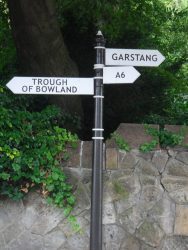
The next stile was impossible to negotiate, guarded by brambles and sloes, [reported to the authorities] but fortunately a gate took us into the same field to link up with a path that kept coming to more awkward overgrown stiles, but we slowly made progress to emerge probably on the wrong drive way at Loud Carr Side. All along this stretch we had wonderful views of the Bowland Fells to the north. Their road led us to Gibbon Bridge over the Loud. A substantial stile gave access to the river bank  here populated with Himalayan Balsam and more worryingly Japanese Knotweed, The river is small and flows along at a snail’s pace. Pushing on through the vegetation we made progress down stream, despite acrobatic stiles, to the stepping-stones  across the river. A few days ago there would have been little water here after the drought but we have had a lot of rain since and our crossing was a little tricky as some of the stones were submerged. A gentler stretch through fields and we emerged at Loud Mythom Bridge. What are these  iridescent beetles ‘feeding’ on dock leaves?  We walked on to Doeford Bridge where the Loud joins the much wider Hodder. A fisherman was casting in the Hodder below, a popular fishing river. We ate lunch at the bridge and watched many cyclists coming through from  the Trough of Bowland, and also speeding motorists having close shaves on the bends.

The Loud joining the Hodder just above Doeford Bridge.

We had considered continuing across the stepping-stones at  Stakes Farm but walkers coming in the opposite direction confirmed that they were impossible with missing stones and high water which is a regular problem. So we backtracked up the lane and onto a track heading for Greenlands, as we walked through the farmyard a, fortunately chained, dog leapt out of its kennel narrowly missing JD. That raised our heart rates.  More poor tracks and awkward stiles eventually brought us back to Gibbon Bridge. Cars were arriving for a wedding reception at the hotel. We didn’t have the heart to find the footpath through their grounds and spent the next half-hour or so lost in the fields which host the annual Chipping Steam Fair every May. Today turned out to be the Chipping Show held in fields on the edge of the village and we could hear loudspeaker announcements in the distance. The day was perfect for the show. From this side of the Loud we now had uninterrupted views south to Longridge Fell. A complicated series of fields, all thankfully well signed, took us from Pale Farm to the road and back over the Loud Lower Bridge to our car. We had achieved our idea of following the Loud but had found the walking difficult, in my condition, with overgrown paths and broken or blocked stiles.

*****

BOWLAND AT ITS BEST.

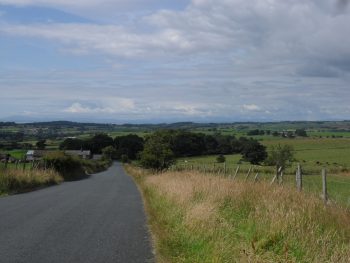
Looking up past Dunsop Bridge into the heart of Bowland.

14th June 2018. UK weather: Storm Hector batters Britain with winds of up to 100mph.

The above headlines in today’s papers were not encouraging but delving a little deeper and being three brave fellows we arranged a walk. We being ‘the rock man’, JD and myself. The idea was to stay low and leave late morning to avoid the worst of the storm. Leaving late was easily accomplished as the rock man was late anyhow. We parked up near Leagram Estate above Chipping avoiding any overhanging suspect trees. There was no sign of the wind abating.

Entering a windy Leagram Park.

Country lanes were used to weave through the fields bordering the fells. More and more barns have been converted into desirable residences and expensive 4×4’s kept pushing us into the hedgerows. The public road to the remote Burnslack was reached and followed before cutting off on the rougher track across the base of the fells. This is open country and felt wild today with the wind. Lickhurst was the next farm complex with new developments. The tenant, who was one of the last remaining true farmers, apparently has recently died. I had a long conversation with him when I last passed when he was telling me of his plans for retirement, sad news.

Lickhurst Farm.

Moving on we crossed the footbridge and headed up onto limestone pastures. These looked very dry as we’ve had virtually no rain for six weeks. The track down to Dinkling Green was found. JD and I had recollections of vicious dogs chained up here which would suddenly jump out as you passed through the farmyard. None today as the farmsteads have been gentrified. A nice stretch alongside a brook and we arrived at Higher Fence Wood, the farm with all those wooden hen houses.The rooster cockerel was proudly parading in front of his hareem. Free range eggs were advertised for £1.50 a dozen but unfortunately the cupboard was bare.

We were now in limestone country and relying on the rockman’s expert knowledge. There were limestone outcrops and signs of quarrying everywhere. We lunched under a limestone rockface of a long abandoned quarry. There were signs of chalk on the rock from modern-day boulderers.

Our lunch spot.

By now the sun was getting a little stronger but the wind was still bitterly cold. Tracks took us to New Laund Farm above the Inn at Whitewell which can be reached across the Hodder on stepping stones. Today however we stayed high and went into secretive mode for a little trespassing into the woods to locate Fairy Holes Caves. Once found we explored using our phone torches which proved far better than the old flashlight. I saw crinoid fossils which I had missed on previous occasions. The location is recognised as a Bronze Age burial site, probably dating to around 1800 BC.

The Inn at Whitewell.

Forbidden land.


We scrambled out onto the public right of way to Fair Oak , this gives some of the best views down into the Hodder Valley in both directions as it crosses a small col. See title picture for view NE. and below for River Hodder and SE to Longridge Fell.

‘Scrambling out’

From here on we wandered past old farmsteads all in a state of modern repair, Delightful residences but all so remote from anywhere. The old bridleway down from Greystoneley was followed over the ford.

Towards the end of the walk I wanted to explore a footpath I’d never used and it turned out perfect. From an old limekiln and quarry we went cross-country, unfortunately missing a crucial footbridge, back into the Leagram Estate. Delightful walking under the Fairsnape Fells with views across to Longridge Fell. The wind was still blowing strong when we reached the car but had detracted little from a grand day out.

My ‘new path’

Fairsnape Fells.

Longridge Fell.

*****

A SOUTHERN CIRCUIT ON LONGRIDGE FELL.


I’ve been up Longridge Fell three times this week, all from different directions. This lack of originality is partially based on my reluctance to drive far, partly on the weather [torrential rain on alternate days put boggy Fairsnape out of the question] and mainly on my slow re-acquaintance with hilly country. Anyhow it is a great little fell, the most southerly named fell in the UK with the easy to remember 350m height.

Today, Thursday 5th April, was fantastic, you couldn’t have wished for a better Spring like day. Blue skies, no wind and warmish sun [that’s that round yellow thing in the sky]. Of course the paths were still muddy and slippy but that’s par for the course at this time of year in Lancashire. A few groups were out on longer rambles and the dog strollers were making the best of the day.

I parked at Higher Hodder Bridge and  tackled the steep Birdy Brow road head on, One gains height quickly and just past Kemple End the forest track leaves the road zigzagging into the trees. I was already sweating as the morning warmed up. The forest track on a day like this reminded me of walking through Southern Spain on the GR 7 where there is much forest. I was going to say ‘wish I was there now’ but on a day like this you can’t  beat Lancashire. A hidden little path through the trees brings one out at a lovely open viewpoint with the Bowland Fells full on, the frosty Yorkshire peaks off to the East and Chipping Vale at your feet,

Higher on the fell I came across forest workers hand planting thousands of spruce saplings in rough ground that had been felled a couple of years ago. These are disease resistant ones and I will watch their growth over coming years.

Knowing that the track was blocked ahead with fallen trees I again took to smaller paths through the trees some of which are old Scots Pines, an enchanting place. I’ve been known to bivy in this secret place with the bonus of deer wandering past in the night. Further on is the ‘wall path’ leading towards the summit.  Years ago this path was hardly visible but has become more used and hence more boggy, most of the wall that ran alongside it has been now used as infill for the path.

Once out in the open the white trig point was clearly seen ahead with more stunning views of Chipping Vale and the Bowland Hills. If I had kept walking down the ridge I would have been home in an hour but I had a circuit to complete so headed south on forest roads, with Pendle Hill dominant ahead above the Ribble Valley, to come out at the road above Crowshaw Quarry where I had a bite to eat in the sunshine.

The bridle way down past Green Gore to Hurst Green is very familiar but I realised I nearly always walk it in the opposite direction. One of my favourite places is Dean Brook as it descends off the fell and through old mill placements at Hurst Green. The bridge there is a great launching pad for poo sticks.

I came out at the Almshouses which somehow were brought down from Kemple End. The Bayley Arms pub seems to be closed so I carried straight across on Smithy Lane through muddy fields and into the grounds of Stoneyhurst College.

I took the private road to Hodder Court where I picked up the popular footpath alongside the Hodder river. This is a roller coaster of a path in the trees above the river as I headed back to  Higher Hodder Bridge. A delight with the fast flowing Hodder below, emerging Wild Garlic under my feet and expectant bird song in the air.

That was 5 hours of my life well spent.

*****


STOCKS RESERVOIR – THE LONG WAY ROUND.


There is a ‘new’ circular walk around Stocks Reservoir, promoted by United Utilities, from the Gisburn Forest car park and judging from the amount of people seen today very popular. I came across it on a walk from Slaidburn. New paths have been created giving a varied route with fantastic views and close to the water wildlife viewing hides are available. Stocks was constructed in the 1920/30s by the Fylde Water Board by flooding the upper Hodder valley, the surrounding farmland and the hamlet of Stocks-in-Bowland. 500 men worked there and a narrow-gauge railway was built to transport materials. According to the information boards, numerous attractive houses were lost but the church was rebuilt above the water. For more fascinating reservoir facts click here. 

I always enjoy the Roman road from Cow Ark to Newton, I drive this way to reach the Slaidburn area and as a scenic route to Yorkshire. As you crest the hill the Bowland Fells are prominent to the west and straight ahead is unmistakable Ingleborough, if you are lucky and the day clear. Today I was debating a walk up Croasdale to Bullstones but I knew I would be tempted onto the boulders which wouldn’t be good for my shoulder so I opted for a walk up to Stocks reservoir.

Slaidburn is an interesting old village to wander around. Most of the property has been owned by one family for over 200 years and little has changed, narrow streets, hand-loom weavers’ cottages, an historic pub, village shop, YHA, war memorial and the River Hodder. I must admit to have not visited the C15th church on the outskirts.

This morning I used the village car park and adjacent cafe as my starting point and walked out on a lane heading to Bentham which seemed very popular with cyclists who have a lot of climbing ahead. A style leads into a field and a climb over a hill which you realise is Limestone, there are a lot of Reef Knolls in the area. A string of Dale’s like meadows parallel the Croasdale Brook, each having a stone barn in various states of repair. These reminded me of the phrase “were you born in a barn?” that was constantly directed at me as a child for leaving doors open.

The farmer from Croasdale was proud of his new concrete access road as he drove around on his buggy with trusted sheepdog.

Climbing out of the valley the views across Bowland improved with every step. Newly sheered sheep were out in the fields creating a loud communal baaaa. The short stretch of road walking was virtually traffic-free and there seemed to be a ditch and dike running alongside, no idea of its origin. Up on Merrybent Hill, Ingleborough raised its head again and the vast extent of Gisburn Forest was spread out below.

Bowland Fells.

Ingleborough.

Gisburn Forest.

A line of Alder Trees followed a stream downhill off the road and this is where I met up with the Stocks Circular walk and a stream of people. Flags had been laid over a boggy stretch and where last time I had precariously crossed the Hodder on stepping stones there was a new [2008] footbridge. Shamefully the stepping stones seemed to have disappeared.

Onwards and upwards past the deserted New House with its outside well. The lane leading down from here gave views of Stocks Reservoir with Totridge Fell in the background. All to soon I was into the forest but the path has been improved and winds its way nicely through mixed woodland.

Alongside the start of the water I went into one of the hides, opening up the flaps I had a perfect view of the Hodder snaking into the lake; unfortunately without binoculars, I struggled to identify most of the birdlife except for the numerous Cormorants. Nonetheless it was a good place to eat my lunch.

Continuing on I reached the car park with all the information boards and more people doing the circuit. The causeway was crossed, on the water little boats used by fishermen seemed to be having a hard time in the brisk wind. In the past I’ve walked on the road past the re-sited church but now a path winds off through the trees to keep closer to the reservoir. The next mile on open ground above the water gave magnificent views across the reservoir with the Chipping Fells ahead and behind to the forest. The signed walk brought me up close to the dam wall with the splendid waterboard house above. Not wanting to cross the damn I found a bit of a path upwards to join the track down to Hammerton Hall, a commanding three gabled Elizabethan house. After Holmehead Bridge crossing the Hodder fields headed towards Slaidburn. I was reminded of a previous trip down the Hodder when not checking the map we forded the Croasdale Brook in a direct line under the view of the farmer who said we were on private land and sent us, humiliated, back across the river. Today I found the correct path to the right to reach the bridge and road back into the village.

Sorry, this has been a long-winded blow by blow account of today’s walk but there was so much of interest. I have every intention of returning soon, with binoculars, to walk that shorter signed Stocks circular.


CYCLING THROUGH ‘THE TROUGH’

It had to be done. This is the classic ride from the Preston area. After recent trips on my bike, slowly building up strength, I knew that the next challenge was to cycle through The Trough of Bowland. Had not done this for 20 years, too busy climbing and walking. Set off today at lunchtime. The fells which I had to circumvent had ominous black clouds above them as I left Longridge. Was soon into Garstang and on to Scorton where the traditional stop at The Priory for coffee and cake was duly taken.   Got chatting to a fellow cyclist [I have put myself into that bracket now] turned out he was staying in Longridge for a couple of days and had escaped the family to ride today. I was glad of the cake as I followed twisting, undulating lanes towards the fells.

One particularly steep little hill climb caught me out and had me standing on the pedals. Once on the Trough road at Marshaw I just had to keep going at a steady pace and I was at the summit before I knew it. Set at 968ft is the Grey Stone of Trough marking the pre1974 boundary between Lancashire and West Riding of Yorkshire.

Heading towards Marshaw.

Wonderful scenery abounds up here in the Bowland Fells and today the conditions were perfect, clear warm and sunny and most important – no wind.  Great swooping descent to Dunsop Bridge.

Onwards by the Hodder to Whitewell, with it’s celebrated Inn.

The River Hodder.

I enjoyed the trip down the valley to Chipping and the short stretch back to Longridge in the late afternoon sunshine.

Feeling rather smug tonight with my modest achievement and dreaming up longer and longer cycling days.  LE to JOG?  Hang about — I’d better try 50 miles tomorrow first!

BOWLAND HISTORIC RAMBLE AND RANT.

Sunny Wednesday was a day made for the hills. After several dull and damp days recently, often spent laboriously at a climbing wall, it was good to be driving out to Bowland. I parked in the small village of Dunsop Bridge, which has been designated as at the centre of the Great Britain. The 100,000th BT phone box, on the green, proclaims this. Parking is now pay and display but £1 for 4hours didn’t seem extortionist, and Ribble Valley Borough Council seem to be keeping the place tidy. I do however feel these pay and display machines seem out of place in countryside car parks. They are everywhere now and I’m not sure what one does if needing an overnight stay for an extended camping trip.

The walk I set off on today is partly one of the sections of my Longridge Skyline Walk, see previous posts, leading out of the Hodder Valley over the little trodden Kitcham Hill on Birkett Fell.

Crossing the Hodder by a bridge brings you to the houses of Thorneyholme opposite where the river Dunsop joins the Hodder. A delightful stroll south by the river soon had me in good spirits, with clear views over to Totridge Fell and Mellor Knoll. Despite the ground frost the ground was still fairly boggy.

Totridge Fell and Mellor Knoll across the Hodder.

Soon I was climbing alongside a beck in Fielding Clough above Burholme, despite the low air temperature I was soon sweating in the sunshine. The rough climb in heather, up alongside the wall, onto Kitcham Hill [283m] made things worse and I was glad of a break at the top to admire the 360degree views and get my breath back. The top is marked with a few stones near a stunted lone pine. I always enjoy time spent up here enjoying the peace and wandering in the pine and beech trees surrounding the summit. Today a pair of buzzards were crying and circling above me. Ingleborough and Penyghent were just visible in the haze to the north.

From the hill top I went south on rough ground, this whole area is access land created under the 2000 CRoW act, see the latest OS maps for areas covered. As one reaches the plantation to the south the access land finishes 200m before a public right of way/footpath. This is one of the annoying anomalies of some areas of access land – you end up trespassing to get out of them! Not that worries me as I end up climbing walls to reach the footpath into the plantation. Already, though, because of this problem I feel a little annoyed. Will write to Ribble Valley about it.

Looking back to Kitcham Hill.

 Once onto the public footpath things get worse, there have been a lot of trees blown down, presumably this last winter, making the path almost impossible to follow by most people. My climbing skills were needed to force a way through. Another letter to the Ribble Valley.

Jungle

Once through, at great risk to my appendages, there is a lovely stretch across open hillside with views to the north. I was now approaching Crimpton Farm and was confronted with signs suggesting a rather lengthy, muddy, diversion around the premises but in small print stating that the right of way still existed onto the lane through the ‘farm’. Now I knew this property was of historic and architectural interest and used the right of way to look at it.      After the reformation a wooden image of Our Lady Of White Well was brought to the isolated Crimpton for safety. Hence, the farm was well known to Roman Catholics as ‘Our Lady Of The Fells’. Apparently there is also a sulphur spa here with miraculous healing powers, so the locality has historic importance. Also the building is grade 2 listed with interesting seven hand loom weaving windows.  I ask why a diversion is being suggested, apparently with official approval, away from this important house. A third letter to Ribble Valley!!

  I would ask that anyone else following this public right of way ignores any suggestion of diversion and writes to the authorities in protest. John Dixon in his excellent Aussteiger Guide book to Bowland is of the same persuasion. Such was my anguish that I forgot to photo the interesting house and the parked up obligatory Range Rover! While on my high horse how did they get planning permission for the ‘porch’  extension on  a GRADE 2 LISTED BUILDING.  I have little faith in the planning authorities.

Crimpton.    John Dixon

Progressing onto the old Roman road  across Marl Hill I took off to the left on a wild path down to Birkett Farm and down to Giddy Bridge over the brook. What was the purpose of the stone projections on either side below the bridge?

Giddy Bridge

 Now I  was able to follow a well signed concessionary path through the grounds of Knowlmere Manor  [a contrast to the restrictions at Crimpton].  Try counting the chimneys on the manor….

Knowlmere Manor

Onwards in the sunshine brought me above the Hodder River back to Thorneyholme where I came across a chain saw massacrer [artist]  working on a tree stump to create a Rodin masterpiece. A lengthy chat ensured about art, recession, medicine and the state of the world. This bloke is very talented.

Masterpiece in the making.

Back through the tall Wellington Pine avenue  gets me to the car within the 4hour, £1, fee!!  It shouldn’t have to be like this.  A day of stunning scenery and spring weather to hopefully come. But there  are some sour tastes left regarding access. I’ll get over it.

LONGRIDGE SKYLINE WALK.

Today was cold but sunny so there was no excuse not to get out in the countryside. All the snow from last weekend had disappeared, though this morning’s frost had firmed up the fields.

There have been some recent footpath diversions north of Longridge and these were affecting a route of mine, The Longridge Skyline Walk. I therefore took the opportunity to walk some of these paths to update my route description.

Parlick with Fairsnape brooding in the background.

Having brought my route description up to date I felt it was time to re-publicise this excellent route. I would love to see one of you keen fell walkers complete the circuit in a day! Here is my original, rather lengthy article………
                             LONGRIDGE SKYLINE WALK.
 Standing anywhere in the Loud Valley [The Vale of Chipping] north of Longridge one is aware of the beautiful surrounding scenery. Out to the west is space towards the coast but the remaining skyline consists of hills. Starting in the northwest is the well known Beacon Fell, and going clockwise around the horizon are Parlick, Fairsnape, Totridge, Birkett, Waddington and Longridge Fells. You will notice that these hills are all named using the northern word Fell, it is an interesting fact that Longridge Fell is the most southerly named fell in Britain.
Skyline and horseshoe walks have a fascination and draw for fell walkers, think of the many well known examples in our mountainous regions. They are usually fairly obvious in conception and provide a ready made visual and physical challenge. So it was for me, for many years living within sight of this round, and I have taken up its challenge on several occasions in the past, from the 70’s onwards. I soon realised the beauty, variety, relative isolation and rewarding views this walk provides.
However there was always a problem with my rounds, I was often trespassing!  Large tracts of the moorland areas in the east were private, often with shooting interests, with limited rights of way. So the walk was for private consumption only, but always very satisfying allowing one  knowledge of these ’hidden secrets’ of our northern hills.
However times change and with the implementation of the CRoW act nearly all the walk was either on Public Rights of Way or the newly created Access Areas. With the publication of O.S.maps showing the newly opened areas I was able to revisit more freely some areas of the walk and realised that a challenging circuit was now more feasible in design and description, if still no easier in physical execution.
Thus the 60Km / 37.5miles Longridge Skyline Walk  [LSW] was reborn.
Much of the Forest of Bowland is designated as an Area of Outstanding Natural Beauty and rightly so. Hence many areas are well known to walkers and country lovers alike, but you will find following this round many new corners to be enthralled by and whole areas of rough fell rarely walked in the last few decades. When were you last on Kitcham Hill or Waddington Fell?
Bowland’s diverse landscape – heather moorland, blanket bogs, wooded valleys and lowland farms – make not only for interesting walking but also provide a rich habitat for flora and fauna. The area is nationally renowned for its upland birds, so providing one with an opportunity of sighting many species on the walk. Red Grouse, Golden Plover, Lapwing, Curlew, Short Eared Owl, Ring Ouzel, Redshank, Merlin, Peregrine, Kestrel and the Hen Harrier. The latter has become the symbol of The Forest of Bowland. Take a small pair of binoculars.
By the nature of the ground to be covered, this walk should not be undertaken lightly, access land in the AONB offers some of the roughest and most remote walking in Lancashire. A sound experience of rough fell walking and the relevant navigational  skills are needed. Several miles are trackless and heavy going in the peat bogs. These areas are particularly difficult in the wetter months and are possibly best avoided at those times, not only for your progress but to lessen damage to the fragile terrain. Clear weather is a must really to help with navigation and to enable you to fully enjoy the outstanding views that the walk provides. The access areas may have seasonal restrictions which will be posted locally or found in advance from the usual sources. [Try Lancashire County Council] It would not be possible to take dogs on the whole route.
If the walk is started in Longridge the village of Dunsop Bridge makes a good halfway stopover if split into two days. There are limited bus services in the rural areas but Dunsop  Bridge is serviced from Clitheroe. Other smaller stages  over three or four days can be planned with the limited B&B accommodation in the area.  Completing the walk within a day would be a severe challenge for the fittest of walkers and maybe not the best way to appreciate the scenery. There are a few refreshment stops notably Beacon Fell Visitor Centre, Dunsop Bridge Café/PO, Bashall Barn and of course Longridge itself.
Longridge — Beacon Fell.  10km / 6m
Starting from the Millennium Cross in Longridge one is soon out into the countryside with early views of the skyline task ahead. After a short stretch of road walking the route goes onto a series of pleasant paths through farming land, both arable and stock. The agricultural changes in recent years are evident with the loss of hedges, expensive barn conversions, diversification with fishing lakes and a new golf course. As the ground rises to Beacon Fell views open up across the Fylde. Beacon Fell was opened in 1970 as one of Lancashire’s first Country Parks and has proved very popular with its easy access and good tracks suitable for all. The information centre is worth a visit as you pass on the way to the summit [266m] with its viewfinder. This summit is the first of the day and hopefully the weather will be clear for the extensive views.
Beacon Fell — Fairsnape Fell.  7km / 4.5m
Northwards the land now begins to change to rougher pastures approaching the higher fells, again the paths are clear and fairly well used. A wonderful area in spring for the sound and sight of Lapwings. Soon the bulk of Parlick is in front of you, but a winding old peat-sledge track takes you up the quieter side of the fell. The area is popular for gliding, parapenting and model planes so there is usually something in the sky to keep you distracted on the climb. Once at the top the fells stretch out before you and a good walking surface, enjoy it while you can, enables an easy section up to Fairsnape Fell with its shelters and trig point [510m] although the true summit [520m] is further on to the northeast.
Fairsnape Fell — Dunsop Bridge.  10.5km / 6.5m
The enjoyment of the next couple of hours along the ridge to Totridge Fell [496m] will depend on recent rainfall. Although there is a fence to guide you most of the way do not underestimate the difficulty underfoot and detours around the worst peat bogs are unavoidable. On a day of good visibility this is an exhilarating stretch with views to the Lakeland Hills, the vast uninhabited area of desolate fells to the north, the Three Peaks area, Pendle and the Lancastrian Fells to the south. The last legs of this walk over Waddington and Longridge Fells become clear. At the end of the ridge the beauty of the Hodder below you can be appreciated before the steep descent into the valley. The Trough of Bowland road can be busy at weekends but fields lead past a pheasant breeding farm to follow the River Dunsop into the village by its bridge. This a popular destination and after the solitude of the fells the number of trippers can come as quite a surprise, but the ice cream is great!
Don’t forget to look at the unique telephone box celebrating being at the centre of Great Britain.
Dunsop Bridge — Waddington Fell.  9.5km / 6m
This section of the walk covers new ground for most people and being trackless in parts will feel longer than the map suggests. It starts pleasantly along by the idyllic Hodder and then climbs to the exquisite wind blown, untrodden and heather clad top of Kitcham Hill [283m] From here rough moors are crossed to emerge through trees at the historic farm of Crimpton [Our Lady of the Fells] More rough trackless ground is crossed over Marl Hill [311m] heading for the mast [if you can see it!] on Waddington Fell. At one point navigation is helped by an old ditch once serving as a deer boundary for the important Browsholme Estate. Reaching the summit of Waddington Fell [395m] is a relief and most of the harder work is behind you. Once again you have stunning views from an unusual angle particularly good westwards down the length of the valley you have navigating round.
Waddington Fell — Higher Hodder Bridge.  9.5km / 6m
Downhill all the way! From the trig point you follow the obvious ridge southwards by the wall and continue down the mapped access area until it stops 0.5km short of the next Public Right of Way. Having overcome this problem field paths lead to the delightful Talbot Bridge, on past an old packhorse bridge and close to the old Bashall Hall. Soon you will be enjoying refreshments in Bashall Barn, the type of farm diversity I appreciate. More field paths bring you to The Higher Hodder Bridge.
Higher Hodder Bridge — Longridge Fell.  5.5km / 3.5m
A short stretch by the River Hodder and then you climb up to Kemple End a well known viewpoint over the Ribble Valley and Pendle. Now for a contrast you enter the sometimes gloomy forest leading uphill. Clearings are reached overlooking the Loud and Hodder valleys for relief until eventually you reach the final top of Longridge Fell [350m]. From the trig point enjoy the views northwards of patchwork fields below and the background of the route you have followed.
Longridge Fell — Longridge.  8km / 5m
The long descent to complete the round. If you have been blessed with good weather you will be able see Snowdonia ahead and pick out the Isle of Man Hills across Morecambe Bay with a background of the setting sun. Or then again it may be raining! Following the very edge of the fell you will come to the road at Jeffrey Hill car park. Here there are interesting  information boards about the area. There is the suggestion that the river Ribble may have reached the sea through the vale of Chipping at one time, being diverted by glacial deposits to it’s present more circuitous route to the south of Longridge Fell. The road has to be followed past the golf course for a couple of kilometres until you can take field paths towards Longridge. Near the end join the route of the old railway line which took stone from the extensive quarries to supply many Lancashire cities. Soon you are back at the Millennium Cross and maybe enjoying a pint in the Townley Arms reflecting on the last 60km!
Contact me if you would like detailed directions.

TOLKIEN COUNTRY. Stonyhurst, Crosses and the Hodder.

A beautiful day starts with a sharp frost, but bright and sunny again!

To keep this post topical, I had been listening to the radio about a new film on release, The Hobbit, which is sure to be a big success after The Lord of the Rings. The premier was in New Zealand where I believe some of the locations were filmed. However it is well known that  J R R Tolkien, the author, spent many days walking around the Hurst Green countryside, whilst his son was studying at Stonyhurst College. The area was said to have given him inspiration for the fantasies of Lord of the Rings.

So after lunch, I don’t know what happens to the mornings!, I set off to drive up to Kemple End on Longridge Fell to take in some of the Tolkien rambles. The road up Longridge Fell had been quite icy and tricky even after noon.

Ground frost

Parked up at Kemple End [SD 688 404] and was rewarded with views across the still misty Ribble Valley towards Pendle and Boulsworth Hill.

Distant Boulsworth Hill

Couldn’t resist a look into the quarry where there is some good climbing. A couple of Roe Deer ran off when I descended into their territory. The rock faces were dry as they always seem to be, sheltered from any prevailing weather. This quarry had provided stone for the village of Hurst Green and Stoneyhurst College.

I realised that photography today would be difficult with the low sun. One was either shooting into the sun or having your long shadow cast across the picture.

Birdy Prow

Walking through the delightful houses, that comprise the small settlement of Kemple End, I picked up a sunken track across the hillside. This was probably some constructed rail or sledge way to transport stone from the quarry down the hill.  Dropping down lanes I came into the grounds of Stoneyhurst College which one is able to traverse on public rights of way. Putting aside thoughts of the privileged classes one cannot but admire the grandeur of the place. Building started in 1523 for the Shireburn family and from 1794 the Jesuits ran it as a college. Today it is a renowned, and no doubt a very expensive, RC boarding school. Girls as well as boys now attend. The college is very proud of some of its past pupils including a certain Arthur Conan Doyle, actor Charles Laughton and Mark Thomson ex director general of the BBC.

Stoneyhurst Chapel

Stoneyhurst College

Moving on through the grounds I dropped down through fields to arrive at the Lower Hodder road bridge which is sited next to the ancient, arched, packhorse bridge over the River Hodder. This is better known as Cromwell’s Bridge as it is thought that Cromwell’s parliamentary army crossed it before defeating the King’s men at the Battle of Preston in 1648. Sorry but the picture below is poor…

Now I embarked on the delightful  path leading up river to the Higher Hodder bridge. The river was quite low as we had not had rain for a few days. Because there are few leaves left on the trees it was easier to spot the bird life. Robins, Wrens, Blackbirds, flocks of Blue and Long-tailed Tits, a flash of a Kingfisher, a nod of a Dipper and lots of Herons poising patiently above the cold waters.

The path passed  first the base of a damaged cross and then an intact relatively modern cross. These must be connected in some way to the college but I’ve been unable to discover their history. Any ideas?

The path through the woods next to the River Hodder is popular and well maintained with steps and good footbridges over side steams. Whenever I use these Lancashire County Council bridges I have to say a quick ‘hello’ to a deceased, dear, friend who worked in the bridge department of the council. He much preferred the challenge of a humble footbridge project in the countryside to being in his office.

Lancs County Council Footbridge.

Soon I was approaching Higher Hodder Bridge and the path doubles back and starts to climb in zigzags up the hillside to Kemple End. Pausing for breath gave me chance to survey the scene over the Ribble Valley towards Waddington Fell and Pendle — the changing light from the low sun was magical. This route up from the river is part of my Longridge Skyline Way [from now on LSW] which I mentioned whilst crossing Beacon Fell.

Pendle in Evening Sun from Kemple End

As there was plenty of light left I crossed over the wall by the road at Kemple End to investigate a nearby cross a couple of hundred yards away in the field. This is the so called  Paulinus Cross dating from the 7th century when St. Paulinus, Bishop of York, was supposed to have preached here on his mission [1619-1633] to convert us heathen Lancastrians  to Christianity. It is a rather strange looking cross!

Paulinus Cross

Quite a long post today, but for a short afternoon walk there was a lot to be included.

Nearby on a lane is another cross dating from 1934 with the haunting inscription — WATCH FOR YOU KNOW NOT THE DAY, NOR THE HOUR.

I’ll leave you with that thought.