Monthly Archives: January 2018

LANCASTER CANAL 6. Carnforth to Holme.

A highlight of the day was a flash of turquoise – the first Kingfisher I’ve seen for a year.

Progress up the canal is being made slowly with my self imposed limit of 8miles flat walking, however there is no deterioration in the hip ligaments which are improving with my physio exercises. fingers crossed. I have just realised that in 60 years of walking and climbing this was the first time I’d sought the help of a physiotherapist.

Today’s companions were Peter and Denise again. My car was left at Holme and the bus taken back to Carnforth. I’m making good use of my bus pass on this walk, maybe this could be developed into a theme. There is one blogger I’ve come across who ticks off the Wainwrights using only public transport, well not the summits themselves but just getting to the areas.

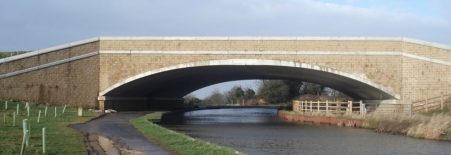
We meander out of Carnforth with interesting road and railway bridges. The first bridge as we leave the town has been sympathetically widened at some time to accommodate more traffic. Bridges under the motorway are more brutal.

Rural calm returns as we reach the aqueduct over the River Keer, the converted mill below has a restored waterwheel and was coincidentally almost purchased by Peter and Denise when they moved to the area. Looked a bit dark and damp to me. Old milestones are visible along this stretch, 17miles to Kendal!

At nearby Capernwray we were entertained by a tractor trying to manoeuvrer a mammoth caravan down the lane under the railway bridge. The attached holiday site is in an old limestone quarry, Wegber, with cranes still visible and a little further a short canal branch into the quarry area for loading the limestone.

We passed by Borwick Hall, just visible through the trees on the other side, an Elizabethan manor house. And then we were at Tewitfield a significant location on the canal. So far I’ve walked 42 miles dead level on the 70ft contour but today things change and the canal, now defunct, rises 75ft in half a mile. This northern section to Kendal was opened in 1819 and was closed in 1968 with the building of the M6. 8 locks lifted the canal from the basin before level going to Kendal. The basin where the canal navigation now ends is a holiday complex with not particularly well-designed apartments.

END OF THE NAVIGATION.

Creeping alongside the motorway we reach the start of the ascending lock system. Plans have been muted for years to restore this northern section but they have come to very little.

At the top of the lock system the motorway delivers the final ‘coup de grâce’ …

We find a way across the M6 and resume our stroll along the towpath as if nothing had happened. Ahead was the distinctive outline of Farleton Fell, once one of our popular evening climbing venues on less than solid limestone.

Passing the settlement of Holme Mill we saw the millpond supplying a once industrious linen mill. Flax was grown in the area for the production of linen before King cotton took over.

We didn’t enjoy the boggy stretch of ‘towpath’ ahead…

However, there was a final triumphant flourish on arriving in Holme with the appearance of well-preserved coke ovens on the far bank. I mentioned these in my last post when we were unable to identify any. The ‘beehive’ ovens were used to produce better firing smokeless fuel from coal for the use of blacksmiths and bakers, and later for iron smelting.

Turned out to be an interesting day. Will be back to bridge 149 as soon as possible to complete the journey.

There were few boats on this section of the canal so my ‘Corniest boat name of the day’ has become ‘corniest boat of the day’

‘Sheds R Us’

LANCASTER CANAL 5. Lancaster to Carnforth.

Another change of personnel today,  JD joined Peter and I on a windy morning. The highlight of the day was crossing the Lune Aqueduct on the edge of Lancaster. The walk from the pedestrian bridge [103] in town was through the rather dull suburbs but by the time we reached the aqueduct open countryside was visible, or at least a golf course. Rennie’s aqueduct opened in 1797, after 5years construction, to much acclaim. There are five arches scanning 70ft 50ft above the Lune. Recently there has been a significant refurbishment with improvements to the lining and the stonework. We should have descended the steps to view the structure from the river bank. Instead  we strolled over the exposed towpath made safer by the ornate balustrade. Lancaster castle was glimpsed downstream. Lunesdale upstream.

The next landmark was the new ‘milestone’ bridge carrying the M6 relief road to Morecambe.  This was a massive structure compared to the usual arched stone bridges. One of the latter in the vicinity has been widened more sympathetically to accommodate the road, a date of 1921 is visible.

Along side the canal every 6-7 miles or so were stables for the fleet of horses enabling the ‘fast’ passenger boat from Preston to Kendal, done in 8 – 9 hours. The masonry remains of one is next the towpath, easily missed.

Through Hest Bank and Bolton-Le-sands we seemed to hover drone-like above the houses with views across Morecambe Bay. At one time ships would harbour on the Morecambe Bay coast here with goods to be transferred up to the canal, the opening of the Glasson Dock branch in 1826 superseded this. Somewhere between the two villages is a good example of a swing bridge, now leading to private houses. We contemplated on how it would be interesting to withdraw access to unwanted visitors by a swing of this bridge.

I was on the lookout for old coke ovens at two sites into Carnforth, bridges 125 and 127, but disappointed with the outcome. No real sign of the beehive structures across the other bank, the low sun making visibility difficult. The ovens were used to produce better firing smokeless fuel for blacksmiths and bakers and later for iron smelting. They are supposed to look like this…

The basin to the south of Carnforth was busy with boats and dog walkers but before we knew it we were back in a rural setting before the children’s playground announced bridge 128 on the Kellet road. Time to find a bus back.

Corniest boat name of the day…

LANCASTER CANAL 4. Galgate to Lancaster.


Today Peter’s wife, Denise, joined us for a shorter walk along the canal into Lancaster. It didn’t turn out as short as expected. Having completed our walk we caught an early bus back from Lancaster. As we were leaving the city several police cars, ambulances and a fire engine overtook us with lights flashing and sirens blaring. There was obviously trouble up ahead, possibly on the motorway but soon we were stopped and the A6 closed due to a serious accident. We were going nowhere. Students alighted from the bus and started walking up a side road and cycle path into the University. There was no choice but to follow and soon we were wandering through the extensive campus hoping to bypass the closure and walk into Galgate. This proved an interesting diversion, even getting a close up view of the silk mill there. The Air Ambulance helicopter was in action so I hope those involved in the accident are not seriously injured. Will donate to their charity on the next occasion.

Anyhow to get back to the start. Smoke was drifting up from several residential boats moored in the basin at Galgate. I noticed on a wall a bank of post boxes for the boaters, I suppose you need some sort of address for communication if you are permanently living on a barge. The usual gentle meandering walk took us into the countryside on what was a dull day so views to the hills were limited. Conditions under foot varied. Occasional roundels indicated we were sharing the route with a named walk, A Breath Of Fresh Air, which takes in interesting areas of the Lune, coast and canal around Lancaster. http://soulfulhorwich.org.uk/abofa/index.shtml

After just over a mile we entered the wooded Deep Cutting which takes the canal through glacial deposits to avoid a long detour, quite a contrast to the open land. Apparently this is the place to see kingfishers but not today.

At its northern end the outskirts of Lancaster are reached. On the left at the entrance to a new development, Aldcliffe, the old gate house has been left to rot, shame. On the contrary there are some splendid houses on the other bank. Glimpses of the castle came into view. After passing under the main railway line city centre wharves were  reached. On the right was the converted boat house where packet boats were repaired after being lifted into the upper floor. On the adjoining ex British Waterways yard are new developments with the old crane preserved. The tall chimney is the hospital incinerator. At one point we have to cross over to the other bank for a short distance, the bridge is constructed to allow the horses over without unhitching. Student accommodation has been built alongside the canal and with a few pubs in old warehouses the area has a good ambience. A lot of money has been spent in Lancaster in the last few years and by look of things quite wisely. There is a fine bridge bearing the name of a local blacksmith at the time, 1876, when the bridge was widened.Leaving the canal at a pedestrian bridge, we wander through streets to board the ill fated bus.


The Silk Mill back at Galgate …


Corniest boat name of the day…

The forecast is not good for the next few days so I’m not sure when I’ll be out again for episode 5, anyhow I think my hip needs a rest. I’ll just stick to the exercises my physiotherapist has given me.


And for completeness our homeward detour…

LANCASTER CANAL 3. Garstang to Galgate.

My friend Peter from Forton got wind of my travels up the canal and volunteered to accompany me on the next stretches, he has a wealth of historical local knowledge so I readily agreed. I came away far better educated but with less photographic evidence due to all the chatting!

As I descended from the bus, there is an excellent service linking Preston with Lancaster on the A6, he was there and understood my need to retrace my steps along the Wyre to the aqueduct to regain the canal up the steps. Nearby they were dredging the canal, a continuous task I presume, some of the detritus was on display.

On the far side was Garstang Basin, now a marina. The Tithe Barn building, converted to a pub, predated the canal and was brick built.

A pipe bridge carries water from Barnacre reservoir to Blackpool.

The canal was busy with a few boats moving about between the smart marinas and moorings, the towpath also seemed popular with dog walkers. Not all boats are equal.

Peter was keen to find the site where the Garstang to Pilling railway line crossed the canal – I think we found it at bridge 65, now demolished. This line was known as the Pilling Pig from a locomotive whose whistle squealed like a pig. It connected the agricultural land of this part of the Fylde with the railway network until the 1960’s. The remains of the bridge…

We were soon into pleasant wooded countryside, lots of curves guided us through the nebulous area of Cabus. All very pleasant. Despite the temperature being just above zero we were soon taking off layers as there was no wind and hence no chill. We reached Ratcliffe Wharf another busy marina but at one time important for shipping of coal and lime. Just north are mounds, the ‘obvious’ remains of lime kilns responsible for this trade.

Forton lies a mile southeast of Bridge 79. Apparently it became the richest village in England due to the payments received when the M6 motorway was built. The small basin at Richmond Bridge was constructed for transporting stone from the nearby quarry, which is now disused.

The bridge leading to Ellel Grange is more ornate in keeping with its stately surroundings. There is a strand of lovely trees by the canal at this point – all very picturesque.

A little further, the miles go quickly on this flat terrain even with my poorly hip, is the junction with the Glasson Branch. This links via 6 locks to Glasson Basin and into the sea through Glasson Dock. This was a vital link into the canal when Glasson was an important port, superseded by Preston in due course. I should return sometime and walk this section. At the junction a graceful bridge carries our towpath over the branch. Close by is the lock keeper’s cottage and today his wife was tending the garden and gave us a potted history of the area in that lovely Lancashire drawl.

Soon we were in Galgate, another canal basin, and waiting for the bus home, the pub by the bus stop sadly closed as is the lot of many village inns these days. Galgate was the unfortunate scene of severe flooding of the river Condor just before Xmas and many of the cottages are drying out – a long process.


Corniest boat name of the day…


LANCASTER CANAL 2. Woodplumpton to Garstang.

Overnight frost has frozen the surface of the canal, ducks are flying in and giving impromptu off balance ballet displays. Sets me thinking about hard winters when thick ice would have closed down commercial travel on the canal. The sodden towpath is a little firmer though. From the start this is countryside walking with the canal weaving its way on its 70ft contour. There has been little need for cuttings or embankments. To the east are the rounded Bowland Hills, when will I be back up there looking down on this landscape?

The peace is broken now and then by cars using their horns on the approach to the humped  narrow canal bridges, I’ve never really understood this – why not just drive slowly in the first place. A few bridges show signs of damage where there has been a collision with speeding honking motorists.

There have been several designs of bridges with variation in the pitch of the arch. All are in local stone and some have railings on the parapets. Some have been built as a purely functional road bridge. There are a few wooden swing bridges serving farms and fields. As mentioned they are all numbered in sequence from the south.

An hour’s walking brings me to Guy’s ‘thatched hamlet’ with its eateries and leisure facilities, somewhere to be avoided in the warmer months when it is overrun with families. Today is all peace and quiet as I pass by on the now well surfaced and well used towpath through Bilsborrow  to arrive at the next tourist trap, Barton Grange garden centre, marina and the new ice rink in construction. The latter looks completely out of place and scale next to the canal, though the pink insulation will be covered in more sympathetic cladding.

From now on the canal runs in close proximity to the A6 road, the main railway line and the motorway so there is constant noise. Also in this communications corridor are many power lines, the anglers attention is drawn to them by signs on the bank. I am surprised at the number of lines encountered and presumably hardly noticed in daily life.

So far today the canal has used three aqueducts to cross over rivers coming down from those Bowland hills. Each has its own unique architecture and I marvel at the ingenuity of the early canal engineers. The three arched Hollowforth over Barton Brook…  the larger Brock…

and the plain Calder…

The canal has some gentle curves and passes attractive woodlands as it loops around to pass Greenhalgh Castle before entering the suburbia of new housing.I escape at a final aqueduct over the River Wyre, dropping down to pass under the canal arch to follow the river through converted mills to catch my bus in Garstang.


Corniest boat name of the day…


LANCASTER CANAL 1. Preston to Woodplumpton.

As the crow flies this section would only be about three and a half miles but the canal does a large loop towards the Fylde, an extension to Fleetwood was originally planned. My plan was for an easy level walk on the towpath and this worked well until out in the country where the boggy terrain was extremely troublesome, why didn’t I anticipate that. I was trod in lightweight trainers which quickly became sodden as I slithered around in the mud cursing my stupidity. But the sun shone and it was a glorious day to be out so the benefits outweighed the negatives.

Dismissing the Ribble Link and the Tramway across the Ribble the canal now starts in Aqueduct Street, that’s a clue to its former route through Preston Town centre. Some inauspicious steps lead to a grubby basin with no room to swing a cat never mind turn a boat. I guess no one comes this far on the water. A finger post gives distances, there is only one way.

The towpath is on the left bank and I think remains so for the length. On the far side are waterside houses. In the background is the iconic St. Walburge church spire, the third tallest in England. Housing lines the cutting and above is another iconic Preston site Tulketh Mill with its towering brick chimney – cotton was king.

The first bridge is numbered 11 so a lot have been lost. I creep under Blackpool Rd. reputedly a good place to see kingfishers and on to the edge of Haslam Park. Bridge 13 is the first aqueduct, here above a diminutive Savick Brook which remarkably hosts the Ribble Link further on whose basin and locks are soon encountered. I’ve been this way before.

More pleasant housing on the right bank is passed, I could well imagine canal side living with a canoe to take me shopping. Bridge 17 gives access to a lovely cafe and the busy UCLAN sports grounds. Massive housing developments are taking place on the far side, Cottam. At last open countryside is reached. a former farm swing bridge has been removed with little trace. Salwick Hall is seen across the fields to the right, what must they have thought of the construction of Springfields BNFL plant nearby. One of my climbing partners spent most of his working life there producing Nuclear Fuels. ‘Reassuringly’ signs by the canal tell you what to do when there is a nuclear catastrophe.

A cutting takes me safely past and at bridge 26 is The Hand and Dagger Inn, not yet open this morning and I suspect with a change of name no longer a canalside pub but an eating ‘place’. The mud kicked in by now as I ducked under the busy M55 with distant views of the Bowland Fells.

The milestones are not all intact but those that are prove useful.


Further on there is a marina hiring out and selling boats, a friendly worker is busy cleaning his stock. Further on a dog walker and I agree grumpily about the devastation all the excessive house building, often on flood plains, is having on the local area. I dare not mention fracking.  Crossing Woodplumton Aqueduct I drop down to examine Rennie’s design, apparently no two aqueducts on the canal are alike. At one point I’m listening to a tuneful bird call I don’t recognise, eventually I spot high in the branches a tree-creeper. I then struggle in the mud to complete the section to bridge 35 near Woodplumpton and a bus. Enough for today, if my hip is OK I’ll be back tomorrow.


Corniest boat name of the day…


THE LANCASTER CANAL. The Black and White.

As I said in my last post ‘I have a plan’.

I like a challenge and an objective. Since the beginning of November I’ve shelved trips abroad because of painful musculature around my left hip – brought on by excessive stress on the Cornish coastal path and in La Palma mountains last year.  My physio appointment today was positive and I’m armed with exercises to re-balance my muscles. So fingers crossed.

The Lancaster Canal is a good project in the circumstances. Flat walking and easily accessed from public transport. Walking on the flat seems to be no problem so over the next couple of weeks I hope to explore this canal system in easy sections..  I’ve never walked the full length so why not complete now.

The Lancaster Canal was a project from the 18th century to connect Kendal and Lancaster to Preston and ambitiously to the rest of England’s canal system. At the time Preston was a major port and the link north would provide coal and supplies to booming industries and limestone in the opposite direction, hence its nickname The Black and White. By 1797 a lock-less 42-mile section of the canal was constructed from Preston to Tewitfield. John Rennie was the engineer.  The extension to Kendal was completed in 1810 and a spur to Glasson Dock added in 1826. Passenger traffic on this section was much quicker than stage coach.  The southern link was complicated by the River Ribble, a tramway was built across it to gain access to the  Leeds – Liverpool system and thus an aqueduct was never built. As trade declined the last cargo was transported in 1947. The canal at its southern end now terminates in Ashton basin with a section lost in Preston’s housing. At the northern end the canal terminates effectively at Tewitfield locks as the M6 has disrupted further progress, a short-sighted but economical decision. The line of the canal can be followed northwards to Kendal.  This whole isolated canal was finally connected to the rest of the English canal network in 2002 by the opening of the Ribble Link.

https://en.wikipedia.org/wiki/Lancaster_Canal

https://www.lctrust.co.uk/the-canal/history


WALKING OFF SAD – NEEDS MUST.

Introduction…
Seasonal affective disorder (SAD) is a type of depression that comes and goes in a seasonal pattern.
SAD is sometimes known as “winter depression” because the symptoms are more apparent and tend to be more severe during the winter. The symptoms often begin in the autumn as the days start getting shorter. They’re typically most severe during December, January and February.

Symptoms of SAD can include:

  • a loss of pleasure or interest in normal everyday activities
  • irritability
  • a persistent low mood
  • feelings of despair, guilt and worthlessness
  • feeling lethargic (lacking in energy) and sleepy during the day
  • sleeping for longer than normal and finding it hard to get up in the morning
  • craving carbohydrates and gaining weight.
The exact cause of SAD isn’t fully understood, but it’s often linked to reduced exposure to sunlight during the shorter autumn and winter days. The main theory is that a lack of sunlight might stop a part of the brain called the hypothalamus working properly, which may affect the:
  • production of melatonin – melatonin is a hormone that makes you feel sleepy; in people with SAD, the body may produce it in higher than normal levels
  • production of serotonin – serotonin is a hormone that affects your mood, appetite and sleep; a lack of sunlight may lead to lower serotonin levels, which is linked to feelings of depression
  • body’s internal clock (circadian rhythm) – your body uses sunlight to time various important functions, such as when you wake up, so lower light levels during the winter may disrupt your body clock and lead to symptoms of SAD                                                                                            
  •   Treatments for SAD

  • lifestyle measures – including getting as much natural sunlight as possible, exercising regularly and managing your stress levels
  • light therapy – where a special lamp called a light box is used to simulate exposure to sunlight
  • talking therapies – such as therapy.
  • antidepressant medication.
      from  nhs.uk


Why am I telling you all this – well most winters I disappear to sunnier climes as I’ve found over the years that it prevents all of the above. As well as the improved climate I am usually involved in some semi-challenging walk giving me loads of exercise. This year I’ve been grounded because of my hip problems brought on by excessive exercise. Recent posts will have shown how I’ve partially dealt with it, sorry for the maudlin tone to those. Why don’t I just go abroad for a couple of weeks you say – well I’m not good at ‘lazy’ holidays by the pool, would probably just eat and drink too much.

Thus I’m still battling on, physio next week. So when the sun shone this morning I needed to get out. Luckily JD, of GR131 fame, phoned and within 30 mins I was at his house with a plan to do a relatively easy walk to Ribchester and catch the bus back. Off we went with bus passes at the ready.

The watery sun shone, as planned, whilst we walked past the extensive Longridge reservoirs.

The stroll down the quiet Hothersall Lane was a pleasure, as it warmed up I could feel all that lovely Serotonin fighting off the nasty Melatonin. The usual  juxtaposition of irreverent [me] and intellectual conversation [JD] bowled us along and soon we were dropping down the steep escarpment to Hothersall Lodge an outdoor centre run by Lancs County Council. Nobody was about but signs of activity were everywhere, climbing wall, zip wire, grounded canoes, archery ranges, nature walks etc. A great place to introduce people to the outdoors. We were now following the Ribble Way, a flawed route due to private fishing interests unnecessarily diverting the path higher up stream.

Further on was Hothersall Hall, a Gothic style building refurbished and providing privileged accommodation to some persons.  I tried in vain to relocate the Hothersall Boggart – a slightly grotesque stone head in the fork of a tree with associated legends. No luck today but I know its there somewhere.

All was going well with the walking until now, a good surface and fairly flat going. I had forgotten the little hill to be crossed on muddy fields – it was not a pretty sight as I struggled to cope with the terrain. Thankfully I’d brought my tracking poles, not to be separated from them these days. There were good views down to the River Ribble.

That hill!.


We had time to look across the Ribble to the extensive Osbaldeston Hall on the south bank. A path led off towards it and presumably some ancient ford crossing. JD remembered wading the river here on some previous walk but not today thank you.After that it was a stroll to walk into Ribchester, were we on a Roman Road?

Eschewing the Roman artifacts and other attractions of the village we headed past the now closed White Bull with its ‘Roman columns’ to the friendly Black Bull where we enjoyed a quick slurp of Bowland Brewery’s Buster before catching the rattly bus to Longridge.

Needs must so SAD can SOD off.  I’ve plans for the next week or so if the weather is good.


FIRST WALK OF 2018 – Longridge Fell.

January 1st 2018 – I have to start somewhere.

The phone goes late in the morning and I realise my head is still heavy. The forecast shows a two hour window break in the rain.  A quick breakfast and Mike and I are parked up with scores of others on Longridge Fell. Everyone greets us and friends are encountered. Dogs are in the majority most of them small inquisitive, nonthreatening, breeds, I can cope with.

To be honest the walking was not that great,the distant Ribblesdale views limited, the forest tracks are fortunately dry and with my poles we made good progress. The detour up to the trigpoint was not taken in view of the sodden conditions. Some recent tree felling has confused me as to our whereabouts. Eventually we wind down on the right track and head back to the carpark in cold sleet at the end of the two hours weather window. Such is the nature of walking in this part of the county. At least I’ve been out on the first day of the new year. Back to the Aga and mince pies.