Tag Archives: Long Distance Walks

THE THAMES PATH – Day 14. A morning stroll.

Maidenhead to Windsor.

Today I was going to see Mel who should, if not for his health problems, have been walking with me. I’m hoping to get to Woking from Windsor by train although the service is poor on a Sunday.

Never heard a thing of the live music in the night, bird song woke me. The best breakfast of the trip in the simplest hotel, why can’t those starred hotels do better. Well done the Thames Hotel.

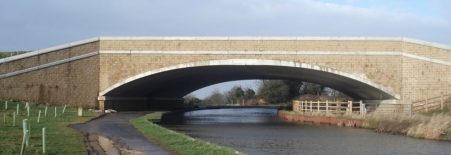
I crossed the road bridge and onto the towpath which then ducked under a railway bridge, not just any railway bridge. The bridge was designed in 1838 by Isambard Kingdom Brunel. The railway is carried across the river on two elliptical brick arches which were the widest and flattest in the world. Where I came through is known as the Sounding Arch, because of its echos.

Being Sunday morning many oarsmen were out on the river, here and further on. This seems a popular stretch for rowing clubs.

Across the river at Bray in amongst the luxurious houses are the renowned restaurants of Heston Blumenthal. They are booked up for months. The Fat Duck was recently closed temporarily following an outbreak of norovirus – if you must eat oysters then this is the risk. Visible is The Waterside Inn another top restaurant, this one run by Alain Roux.

For a while the path was quite rural with cherry and blackthorn trees flowering. Peace was interrupted by the M4 roaring overhead but the arches were quite photogenic.Another road bridge later on had some splendid graffiti/murals. These turn out to have an interesting background. Painted for the 2012 Olympics by Cosmo Sarson “Talking Heads”, apparently if you download an app to your phone and point it at the various faces they ‘talk’ back to you.

Further along an adventure centre was training a group of stand up paddleboarders, this looks a curious unnecessary sport but I liked the guy with the dog.

On my landward side a running race with lots of participants  was progressing around a track adjoining the Eton Rowing Course. This was the basin built for the London Olympics 2012. Across the way was bust Windsor Marina and Windsor horse racing course though no activity today.

This was the largest boat I’ve seen on the Thames…

Suddenly a little church appeared – a flint built structure with a timber tower.St. Mary Magdalene.  Inside the wooden frames of the tower are prominent. The pews look ancient. The base of the church is 12th century the tower being added in the 15th century. It served bargemen on the Thames but now seems a little isolated. A beautiful site nonetheless.

Ahead were the ramparts of Windsor Castle. The whole area whether you live in a ridiculously expensive residence or are purely a tourist is destroyed by the noise of aircraft heading into Heathrow. I timed one every minute. And they are getting lower and lower as they cruise in over the castle. If they are thinking of moving the homeless out of Windsor for a forthcoming wedding will they be rescheduling flights?

I pushed my way past the Japanese tourists to reach the station. Windsor and Eton will have to wait for further exploration. Would you believe it railworks have diverted all main line trains through Staines so I was in Woking within half an hour. Met Mel at the Lightbox to look round the Picasso exhibition. An afternoon of catching up and an evening of indulgence lay ahead. Then I’ll have to return and continue to the Barrier.

*****


THE THAMES PATH – day 13. Mainly mud.

Hurley – Marlow – Maidenhead.

It had rained in the night. I skipped breakfast and bought a sandwich in the little village shop. A bus was leaving for Maidenhead, it would be there in 10mins! Only about 5miles direct whereas I would be doing over 10. One of those beautiful wooden arched bridges took me over to an island at Hurley Lock. There seemed to be channels everywhere with boatyards tucked down side inlets. A boat passing through was heading to the Kennet and Avon. It was good to see more boats moving now the river was calmer. After the next lock, Temple, the path became a quagmire and I was glad of my poles for balance. It continued like this into Marlow. Bisham Abbey and Church looked impressive on the south bank, apparently the buildings and grounds are now used as a National sports training facility. There were oarsmen on the river this morning. The approach into Marlow was stunning and I saw more people out walking by the river than I’d seen all week. 

Marlow was busy with Saturday morning shoppers and I struggled to get a table in Burgers for my morning coffee and croissant. Before leaving I pottered about in the churchyard of All Saints by the bridge where I came across a memorial to T S Eliot who had briefly lived here. The quote from the poem  Burnt Norton, one of his Quartets,  struck a note with me.

A Time past and time future.
What might have been and what has been
Point to one end, which is always present.

A curious walled path, must be an ancient way, twisted and turned through town and then the way by the river was closed for flood prevention measures. One tends to forget how badly some of these Thames towns have been flooded in the last decade. The diversion was badly signed and I ended up climbing over barriers and in even worse mud. Eventually parkland opened up with a popular path running through. The adjacent rugby pitches seemed to have a tournament in progress. The muddy paths continued all the way to Bourne End which was a haven for boaters. People were out tinkering ready for the spring launch. The path was often squeezed between fencing, private houses and gardens to the left and private river frontage to the right.

A footbridge attached to the railway took me to the opposite bank where I had been recommended a diversion to the characterful Bounty Pub. To be honest I was disappointed, it was rather scruffy with unfriendly bar-staff. Obviously for the well healed boaters its quirkiness  must be something out of the ordinary. They did serve the local Marlow Rebellion beer and their terrace must be a great spot to watch the river activity in summer, but can you imagine the crowds.

The next muddy stretch through meadows to Cookham was busy with families. Pretty Cookham is one of the richest villages in Britain with many houses well over a million pounds. Artist Stanley Spencer has a gallery here and author Kenneth Grahame lived here when young deriving inspiration for Wind in the Willows. Ignoring the posh shops and gastropubs I popped into the quaint Teapot Tea Shop, they don’t make them like this any more.

The next couple of miles once back on the river were surprisingly rural. I was amazed at how wide the Thames had become in the last few days. A few more house spotting opportunities and then road takes over into Maidenhead with a flurry of interest at Boulters Lock.

My hotel for the night, right on route, was of course ‘The Thames’, and very good it seems. It took me some time to get the mud off my boots before entering. They are advertising live music every Saturday night so it will be interesting how much noise there is.

*****


THE THAMES PATH – day 12. Posh and posher.

Sonning – Henley – Hurley.

High expectations of a scenic day and the forecast was good, it always seems to be down here.

Over the lovely brick bridge and onto a muddy path along the north side of the Thames. Hand painted signs add a little character to the route. Nothing much happened until Shiplake where there was one of those exclusive schools charging £10,000 a term basic fees. They had rowing facilities on the river naturally. The village itself seemed doomed to mass development with building proceeding everywhere. There was a great corner shop selling coffee and pastries, perfect for elevenses. Posh houses kept the path away from the river for awhile. One particular grand house had a miniature railway through the gardens. Lots of gates and cameras – who lives here?

Back on the river the area around Marsh Lock was fascinating. Wooden bridges weaved in amongst the lock and weirs. Volunteers were busy painting the lock fixtures ready for the season. Marsh and Mill Meadows had popular paths leading into Henley. Rich houses abounded with their boat houses and moored cruisers. No barges here, the size of your house determines the size of your boat. I don’t understand why you would need an ocean going yacht to potter up the Thames. The marina as you enter Henley is full of tourist boats offering river trips  all seemingly run by one organisation – Hobbs of Henley.

I found a basic cafe riverside, Chocolate Cafe, for the usual fillip. It seemed popular with cyclists, maybe the cheapest in town. The town itself was busy with shoppers and all the usual shops – best avoided. There are classic riverside properties. I did peep into the churchyard at Dusty Springfield’s simple grave.

On the other side of the river my onward journey took me past lots of rowing clubs, the Leander is one of the oldest in the world, 1818. The Remenham had a smart clubhouse.This is the site of the annual Henley Royal Regatta races downstream over a virtually straight 2000m course from Temple Island. I assume champagne takes as much importance as rowing. Anyhow I could see the Temple over 1mile ahead of me for the next up river section. Exclusive houses lined the route. At the bend before Hambleden Lock was Greenlands Mansion  once owned by W H Smith of newsagent fame, it is now  the business faculty of Reading University and very nice too. There is a plaque on the lock commemorating the first ever boar race in 1829.

I was diverted, yet again, away from the river into the little village of Aston and then into the Culham Estate. I don’t know what goes on here but they don’t really want you there, lots of officious signs and cameras in trees, woe betide if you step off the path – I expect you would be shot. There is a big house in the grounds and something that looks like a mausoleum on the hill. The deer seem to be white. The sky is full of free flying kites.

Eventually back on the river I escape from the estate and conversely walk through a humble caravan site. Above on the opposite escarpment is a large ostentatious white building, Danesfield House, now a hotel I could have stayed in for £300.

I walk into the quiet village of Hurley to my more modest evening in the 800yr old The Olde Bell, still costing an arm and a leg. The church had been a priory and the whole village has a monastic feel to it. One of the quietest and most delightful villages on the Thames so far.

A jolly evening was spent in the bar of The Olde Bell.

*****

THE THAMES PATH – day 11. Round Reading.

Pangbourne – Reading – Sonning.

I was a little apprehensive about today as the map showed mainly the city of Reading. The morning was also rather dull but I was soon on my way along the meadows by the river, a popular promenade for the Pangbourne dog walkers. Out into the flat countryside the railway was still very close and regular GWR trains flashed by, this continued all day. The trees being leafless showed up the balls of parasitic mistletoe which grows well in the south.

The latest craze of children painting stones and leaving them to be found has reached the Thames.


Hardwick House across the river is thought to have been an inspiration for the illustrations to Wind in the Willows. Mapledurham is a picturesque hamlet inaccessible on the far bank further on. The weir here, as others, has a fish ladder incorporated surprisingly only since the late 20th century. According to plaques they seemed to have been installed with the aid of local sponsors. Before the locks were constructed boats were hauled up basic weirs and took their chances floating down.

A curious walk through the streets of Purley eventually came back to the river and railway at Tilehurst. People are living on boats moored up along the next stretch as they can cycle the towpath, I was disappointed by the amount of rubbish some of them left.

A promenade led towards the outskirts of Reading. At Caversham Bridge I braved the traffic to reach a great little ‘transport’ cafe I’d been recommended, The Gorge. It was worth it for the usual tea and teacake. More of the same promenade continued through parks with varied architecture on view. The junction with the River Kennet was crossed on a horse shoe bridge. That route gives a link into the Kennet and Avon canal system. I passed a Tescos just as a couple appeared with their shopping bags and climbed into a small boat to motor back to their marina base, brilliant. Benches along the way had Thames related poems and stories inscribed.

Tesco shopping at its best.

The suburbs were left and rural walking resumed. Passing by the extensive  grounds of Reading Bluecoat School there was this poignant gate in memory of a drowned master. Sonning was a pretty village, lots of old cottages and an interesting church. Flint is used a lot in the walls. Next to the church is a Lutyens house with a Gertrude Jekyll garden but unfortunately hidden by high walls.

Staying at a The Great House tonight. The accommodation was superb but the dining arrangements poor. One big noisy party room full of pretentious diners and out on the terrace were plastic igloos for some sort of experience, I think food comes second here, who in their right mind would sit in a plastic dome all evening?

At 11pm the phone rang ” This the Olde Bell – are you coming to us tonight?”
“No I’m at The Great House in Sonning, I’m with you tomorrow night.”
I’d mixed up my dates but they were very understanding and re-booked me, fortunately without charge.
Of course when I did arrive the following night there was much hilarity at my mistake.

*****


THE THAMES PATH – day 10. Through the gap.

Wallingford – Goring – Pangbourne.

                                          Heading towards the gap.

The Thames pre ice-age flowed north through the area of East Anglia, when its exit was blocked it forced a way through the chalk at Goring Gap and hence to what is now London. On its north side now are the Chilterns and to the south Berkshire Downs. I had been here before on the ancient Ridgeway Path. Today busy road and railway share the gap with the Thames, frequent high speed GWR trains sped past and there was a constant traffic roar.

A gentle rural stroll out of Wallingford on a frosty morning, the mud was still frozen in the fields. A few oarsmen were out on the river, singles, doubles, coxed and coxless fours and even the odd eight. I watched with fascination as they sculled and rowed rapidly through the water. I have just learned that in rowing you have one oar and in sculling two – it adds up. There were several rowing clubs alongside the river including Oxford University from their state of the art Fleming Boathouse.


Passing under a beautiful bricked railway arch the path was diverted onto roads around schools and private properties. The Ridgeway I remember had a better route on the opposite bank. I dropped back down to the river at The Beetle and Wedge restaurant. They were preparing for a busy lunchtime, expensive riverside eating is popular, but the lads were happy to sell me a decent coffee. I sat outside with my muddy boots before the well healed arrived. The restaurant is in what was the boathouse to the original Beetle and Wedge. The unusual name refers to a beetle, an old term for a hammer used with a wedge to split wood.

From here on the path was a good surface through a well manicured landscape with the gap in the hills visible ahead. Moored boats becoming more luxurious, gardens more ornate and houses impressive. Birds were making their presence known as Spring approaches with lots of noise. The Kites, ever present in the sky, make a more whistling sound than the Buzzard’s cry. The geese, Canada and Greylag, are honking incessantly. Grebes, Cormorants, Coots, Waterhen and Swan get on with life on the water in a quieter manner. Herons seemed less common.

The bridge over the Thames at Goring gives good views of the lock and extensive weirs. I knew of Pierreponts Cafe on the far side and enjoyed a quiche and salad in the sunshine. Chance conversations with strangers, they are curious about the muddy boots and trekking poles, alerted me to the fact that George Michael’s house was just across the road. I couldn’t believe the amount of floral, memorabilia, flags and other tributes adorning the whole of the property.

Back on the river was a popular little promenade for locals and tourists. I was amused by two young au pair girls racing their charges in all terrain baby buggies along the next muddy section, I warned them of tossing the babies into the river. Again the railway was in close proximity.

A diversion away from the river had me walking through mature woodlands on the edge of the Chiltern escarpment. And what was this – a steep hill to climb as the path went higher, all a bit of a shock on the Thames Path. A private road was joined past gated and camera watched houses. This brought me out onto the road into Whitchurch and then down across a toll bridge [ pedestrians are now free ] over the river into Pangbourne.  The evening commuter rush and school run was underway – chaos. in a different age Kenneth Graham author of ‘Wind in the Willows’ was brought up on the Thames and retired to Pangbourne. Shepherd’s illustrations to his book are thought to have been inspired by the local riverside.  And lets not forget ‘Three Men in a Boat’ by Jerome K. Jerome which covered the Thames from Kingston to Oxford. I always was a Kenneth Graham fan when I was 5 or 6,  I think due to the illustrations and later in life felt that ‘Idle Thoughts of an Idle Fellow’ was Jerome’s better work.

My old coaching Inn for the night was bang in the middle of town with the railway on one side and the main road the other. A stroll out reveled a Lamborghini showroom next to a Bentley, next to an Aston Martin one. The local estate agent had houses advertised at over £3 million.

And there was an elephant round the corner, feels like Alice in Wonderland.

*****


THE THAMES PATH – day 9. Back on the trail.

                                                                Distant Dorchester Abbey.

Clifton Hampden – Dorchester – Wallingford.

In May 2016 Mel and I enjoyed a lovely few days walking from the source of the Thames to here. It is with some sadness that I am continuing alone. Mel’s health has deteriorated further and he probably won’t be tackling anything strenuous in future.  My plan is a few more days on the route before visiting him and his wife. I will need some good photos to show them.

Getting back to the thatched village of Clifton Hampden was not as easy as expected, since we were here they have stopped the bus from Abingdon. This hasn’t pleased the locals and I wasn’t that happy about forking out £10 for a taxi.

The day is murky, the Thames is running high but without flooding. The paths are muddy as the recent snow melts. I soon get back into stride alongside the river. There are few people about but within a mile I stop for a chat with a friendly couple walking up the Thames. She’s from Finland and he’s from Oregon they make an interesting pair and have travelled the world including sailing round it!

The moles are on the march also…

Ahead are the Sinodun chalk hills capped by ancient beech trees hence the name Wittenham Clumps, They also were known as Mother Dunch’s Buttocks, named after an unpopular local lady who was Oliver Cromwell’s aunt.  An Iron Age fort tops one of them and there have been other Bronze age and Roman discoveries.

Wittenham Clumps.

In the distance is Didcot power station a landmark we had  passed on the previous trip. It has the unenviable history of a collapse being prepared for demolition in 2016 killing 4 men, Grimly it took 6 months for their bodies to be recovered.

A little further and it’s the first Lock, Days Lock. An environment employee is checking the state of the river, there has been a red warning when no boats are allowed to move as the current is too strong. A vast amount of water is coming through the weir gates where they can regulate the flow to help prevent flooding.

The name Dorchester-on-Thames conjures up a vision of an ancient Wessex city. Iron Age Dykes partially surround it and are very obvious on the ground. It was a Roman town on the navigable river and later a Christian centre with an important Abbey.

Iron Age Dykes.

So I thought I’d better make the short diversion to have a look around. The place was so sleepy, presumably a commuting town now, the shop had closed, the cafe was shut and the old coaching inns had few customers. The highlight was the Abbey.

Back on the river for a while before being diverted annoyingly away onto the busy main road into Shillingford. Here by an old wharf is a wall charting flood levels – 1809, the highest, was about 8ft whilst 1768 beat 1947. Global warming or natural variation. You may need to click for clarity.

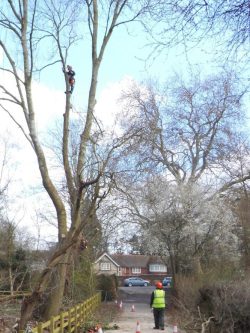
Near by some tree surgeons were in death defying situations.

A quiet stretch of river led to a busy mini marina at Benson Lock. The Waterfront Cafe here provided tea and teacakes. It even provided blankets for those wanting to sit outside in the hazy sunshine. Actually that sunshine was stronger than I thought and by the end of the day I was looking a bit red and going to the chemist for sunblock which I hadn’t brought.

It was just a stroll into Wallingford past the remains of a former Norman castle, later a Royalist stronghold eventually destroyed by Cromwell. There is a lot of history in this area. The town, once the largest Saxon fortified town in England, was full of interesting old buildings. A good start to a few days walking.

Seen along the way  – many wartime pill boxes defending us from attacks by boat, the first of many ornate boat houses, the first of very many Red Kites.

My airbnb was a time warp of 60’s music and a shrine to Dusty Springfield [more of her later].

*****


SOUTH PENNINE RING – Marsden/Diggle to Ashton-under-Lyne.


Deja vu today.

This was probably the worst section of the ring, it started off well in the Pennines but became a dreary trudge after Mossley.

The Standedge Tunnel has no towpath so after a good breakfast in The New Inn, Marsden, I caught the bus over to Diggle. It has only just started going into the village after all the snow and ice they’ve experienced up here. This felt like cheating and I should go back one day and work out the route over the summit moors that the canal horses took to connect either end of the tunnel, it would only be about 4 miles. I’m told that in Summer boat trips can be taken through, that would be an experience. Anyhow this morning I’m at the southern gated tunnel entrance and setting off down the Huddersfield Narrow to Ashton. The surface of the canal is lightly frozen over but it is beautiful weather and the dog-walkers are out enjoying the sunshine.

Flights of locks head downhill quickly. This flight has uniquely single paddles top and bottom and on this side side of the Pennines have the suffix W denoting west. Local mills proclaim their names proudly from their chimneys or towers reminding one of the dominance of weaving in these hills. Shout it from the rooftops. Wool, cotton, coal, limestone were transported on the canal. Before long I was down eight locks and passing through Dobcross.

Just past was the old transhipment warehouse for transferring goods to mules prior to the Standedge Tunnel opening. I believe it is now used as the headquarters of the Huddersfield Canal Society. The smaller building was thought to have been a smithy. Also on the other side were old weaving sheds which have been transformed into unique accommodations.A massive railway viaduct looked familiar and further down stepping stones across the River Tame jogged my mind even more  – I had been here recently but couldn’t remember why. Uppermill was passed without realising it, a L&NW marker was a reminder of the railways takeover. A straight section had me alongside Tesco’s in Greenfield where the marina was backed by Alderman’s Hill with its obelisk. Snow patches clearly visible. I definitely had been here before but remember going off to the hills to the East. This time I kept to the towpath.

Woodend Mill and its chimney adjoining a lock at last jogged my memory – I had come out of the woods here on The Tame Valley Way just over a year ago.

At Mossley a mill building above me hissed, moaned, whistled, crunched and groaned like a Schoenberg symphony. apparently it is a timber recycling plant. Worth a listen…


Scout Tunnel could be traversed on a towpath in the dark before the countryside ran out.  The enclosed valley with canal, river, electricity lines, rail and road became increasingly grim. Past industries have left waste lands, an old coal conveyor bridge hangs above the trees in ruins, electric substations all a bit too close, And then you are in or mostly under Stalybridge, a lot of work was needed to reconstruct the canal through the centre of town.Rather grubby urban walking through a corridor of industry and dereliction followed and after a narrow cut the final lock,1W, joined The Ashton Canal at a small basin.  A couple were taking their barge for a spin, 10 years of restoration work on it so far – a labour of love. Disappointingly I was soon diverted away from The Ashton’s towpath as it disappeared underground somewhere. I found myself in an Asda car park with no obvious way out, not the end to the walk I’d imagined. However with a little improvisation and without getting run-over I found a way through and back down to the towpath just as it entered Portland Basin. This was a much more lively and pleasant place with a beautiful bridge over the joining Peak Forest Canal. The Ashton continues into Manchester but I’d walked that section in the past so my circuit of the South Pennine Ring was complete. I’d had 6 days exercise, varied scenery and lots of interest but I think I’ve had enough of canal walking for now.

*****


SOUTH PENNINE RING – Huddersfield to Marsden.


As the train emerged from Standedge Tunnel into Marsden the world changed to white. The roads around Huddersfield were treacherous with the snow that had fallen and frozen. It was all gone by lunchtime. Whilst at Huddersfield station I would recommend the little station buffet on platform 8, used mainly  by railway workers, providing cheap coffee and basic eats. Fortified I retraced my steps down to the Locomotive Bridge over the Huddersfield Broad Canal. The statue of Sir Harold Wilson [local boy made good]  by the station wore a hat of snow.

A short last piece of the Broad Canal took me to Aspley Basin with all its moorings taken. I shared the path with students from the surrounding University and the transition to the Huddersfield Narrow Canal occurs on campus.

Work building the Narrow Canal commenced in 1794 and though it was largely completed some five years later, the construction of 3.1 miles of Standedge Tunnel took a further eleven years. It runs 20 miles to join the Ashton Canal in Ashton-under-Lyne. Passing under the Pennines between Diggle and Marsden, the Tunnel is the longest, highest (above sea level) and deepest (underground) canal tunnel in Britain. The long narrow boats on this canal couldn’t access the shorter locks on the Broad, hence the need at Aspley basin for offloading and transfer. The Canal operated until 1944.  Many sections were infilled by the early 1960s and later developed. What remained of the Canal fell into dereliction. A major effort has restored it to navigable status.

Some of this major restoration has taken place in the city itself with several tunnels being rebuilt. I soon have to take to the streets to avoid one such section where there is no towpath. Heading out now all the usual canal side developments are underway. The River Colne runs alongside and is crossed from time to time. The river provided the power for the mills, supplanting handloom working, and the canals subsequently improved transport before the railways came.

Britannia Mil 1861.


One stretch had been drained to allow workers to repoint the walls, the sad looking canal exposing its normally hidden treasures. This area, not sure where I was, was all a bit run down. Not much civic pride and ne’er do wells hanging about under bridges. I was glad to pass through and head for the hills.

A whole series of narrow locks gained height. A design feature was just one paddle on the upper side yet two on the other end, I couldn’t understand the logic to this, opening one paddle is simpler than two but why not both ends. Incidentally the E on the lock number denotes East side of the system.

Fields opened up at Linthwaite and across the way was the massive woolen mill – Titanic, an iconic building in the Colne Valley. It was built the same year as that fated vessel,1911. It has been restored as apartments and a health spa.

The canal enters Slaithwaite in a narrow channel rebuilt to take it through the village. It has become an integral part of the central area which today was busy with shoppers and visitors enjoying the afternoon sunshine. The old Spa Mill and the Globe Worsted Mill look down on the bustle. There are locks right in the middle of town. All very pleasant and what’s more I was directed to the Handmade Bakery and Cafe in the Upper Mill where I enjoyed soup and a basket of their famous bread. The other half of the mill is occupied by a microbrewery, Empire, which I wisely did not visit as there was more climbing up to Marsden 3 miles away.

The River Colne was always in close proximity with its weirs and mill races. Trains kept rumbling by heading for their Standedge Tunnel.Near Sparth Reservoir, one of ten built to ensure the canal’s water supply, were pleasing cottages and their ruined mill, Cellars Clough.

Marsden, to which I will return to, was glimpsed down below and now in close proximity to the railway Standedge Tunnel was a short distance away. It’s entrance has been described as a Mousehole in the Pennines. The trains to and from Manchester have their own tunnels above. When they were horse drawn barges were ‘legged’ through the tunnel, taking up to three hours. The horses fol owed trails over the hill. The nearby information centre in an old canal warehouse is full of canal history and worth a visit.I walked back down to the surprisingly busy Marsden, a typical gritty Pennine town, to find my accommodation for the night – the welcoming New Inn. Yet another varied walk on this circuit.

*****


SOUTH PENNINE RING – Sowerby Bridge to Huddersfield.

As I stepped off the train in Sowerby Bridge I was face to face with an old climbing friend, Sandy, whom I’d not seen for a few years. A brief chat before the doors closed and he was on his way to Leeds. One of life’s unusual coincidences.

My walking trip around the South Pennine Ring was interrupted last week with the arctic weather which cut off this area.

From Sowerby’s main street the last section of the Rochdale Canal is reached and a couple of locks go down into the town’s basin. This morning I was pleased to see a barge coming up, a couple had taken 6 months leave to follow an ambitious circuit of the country’s canals. In the historic basin itself little moved. This was the beginning of a short section on The Calder and Hebble Navigation which travels to Wakefield and is part canal and part River Calder, hence the name ‘Navigation’. It was engineered by a renowned 18th century canal builder, John Smeaton. The work started in 1759 and the canal opened in 1764, much earlier than the others.

Walking out of town I was surprised by the amount of house building on low ground between the canal and the river- watch this space in a few wet winters’ time!  A long level towpath, popular with walkers and cyclists, brought me to Salter Hebble locks where previously a branch ambitiously climbed up to Halifax. Lots of interesting canal architecture on display as I dropped under busy road intersections to a calmer stretch. An electric guillotine lock lies at the bottom.  Down here are the usual grouping of canal, river, rail and road. There are some impressive arched bridges constructed by the railway companies.  More industrial heritage followed, some ruinous others renovated and reinvented. Balconies on mills mean apartments. I lost my way a bit in Elland where roads have blocked the towpath which swaps sides, a short diversion over a bridge and down Gas Works Lane had me sorted. Elland was noted for the production of Gannex Macs, a favourite of Sir Harold Wilson. More of him later.  High heeled office staff from canalside offices were walking to lunch, I was heading to Brighouse, The river was in close proximity ready to join in the action.

Two tall towers, disused wheat silos of Sugden’s Flour Mill, greet you at Brighouse. They are now unusual climbing walls.  My excellent lunch was taken at the busy No 43 cafe, canals get you to the heart of these Yorkshire industrial towns. The canal basin is alongside shops and car parks. Unfortunately soon my way was blocked and I took to the desert of an industrial estate, is this what keeps Brighouse alive?  Interspersed with the metal sheds were remnants of workers back to back cottages.Where do the workers live now, not in the luxury mill apartment conversions I bet.

Canal trust workers were busy tree cutting and lock mending but I squeezed past to a surprisingly rural section. Up to now the towpath had been a metalled walkway but from here on after the M62 was a muddy path, soon to get worse. Lancashire and Yorkshire Railway markers remind one that as the canals lost their influence the railways took over. The River Calder joined the canal for several sections. The path alongside became dangerous and I had doubts that I could reach Cooper Bridge where the Calder goes off to Wakefield and I would join the Huddersfield Broad Canal heading back up west. Opened in 1776 it was known as Sir John Ramsden’s Canal, a wealthy Huddersfield landowner at the time. Coal was carried from  East Yorkshire to power stations until 1953. A friendly man lives in the lock-keepers cottage at the start of the canal.

The canal immediately starts climbing. Industry reappeared, its never been far away in these valleys, with a mixture of derelict structures and modern sheds.  The light was fading as I entered Huddersfield, dubious characters and graffiti appeared so I cut short the day at the elaborately engineered  Locomotive Lift Bridge, a vertical lifting bridge from 1865 now under electric operation, and climbed past the seven storey Brierley mill to the station for a quick trip back to Manchester. Things will look better in the morning.


A long walk and hence a long post – two canals in one day.


*****


SOUTH PENNINE RING – Todmorden to Sowerby Bridge.

When I was a youngster I would travel alone across the Pennines by rail to stay with an Aunt and Uncle in Manchester. A whole new world would appear to me as the steam train travelled down Calderdale, I have a long lasting vision of steep sided enclosing valleys, running streams and tall weaving houses with mullioned windows. All very atmospheric.  Well I was here again today –  stepping out of the train, albeit a diesel rail car, onto a platform deep in the valley.

Notices told me that Todmorden was Incredible-edible, an initiative focusing on local food and growing vegetables for the community. Throughout the town are plots planted up by locals with information on eating and crops to pick, well there wasn’t much at this time of year. An applaudable venture but I wonder how successful.

Everywhere was quiet as I slipped back onto the towpath in the town centre where there is a watering station for the boaters. Immediately there were boats, I should really be calling them barges, which had been conspicuously rare on the previous sections of the Rochdale Canal in the last two days. A basin full of lived in boats, alternative lifestyles are common in this valley.

Many mills have been demolished and replaced by anonymous industrial sheds.

I caught a glimpse of Stoodley Pike high up on the moor but most of the day was hemmed in by the valley sides, it was bitterly cold when in their shadow.

A canal barge chugged by with jolly occupants, the first vessel I’ve seen in motion. Obviously this area will be busy in the better months with canal traffic. I noticed there were several companies offering canal trips.The river Calder runs alongside the canal and severe damage was caused by the catastrophic floods of Boxing day 2015. A lot of repair work has been carried out in the intervening years.

Approaching Hebden Bridge are Stubbing Locks and Hebble Mill, the workers cottages here are classic ‘back to back’. Hebden Bridge’s centre is a crystals throw from the canal and is thronged with tourists visiting the new age emporiums. Thankfully I find a cafe on the edge, it turned out to be far superior to what its appearance suggested. Cool music, excellent coffee and tasty homemade quiche. Its long list of fancy teas betraying the town’s hippy roots. Back on the canal all was peace and quiet man.       Mytholmroyd was virtually bypassed.  It was the area where counterfeit ‘coiners’ operated in the 18th century, the industrial revolution brought many mills and foundries to the town and it was the birth place of Ted Hughes, the late poet laureate, whose early work was influenced by local nature. A cast iron statue by Kenny Hunter of a hawk  commemorates Hughes’ poem Hawk Roosting and has  connotations to the nearby Hawksclough Mill.        Sympathetically renovated mills and warehouses contrast with the sheds further on.       The canal continues with the River Calder alongside. In the area of Luddenden Foot there must have been vast mill workings judging from the amount of derelict land. A large complex of weaving sheds are being used for other purposes. The surrounding country side is surprisingly green and the canal is a popular recreational pathway in Calderdale.Approaching Sowerby Bridge mills crowd in and then suddenly the canal comes into a town centre car park where I mingled with shoppers. In front is the prominent parish church.The deep Tuel Lane Lock takes the canal under the main road on its way to join the Calder-Hebble canal – but that’s for tomorrow. That prominent Wainhouse Tower in the distance on the edge of Halifax is the tallest folly in the world. The nostalgic Jubilee Refreshment Rooms at the train station provided a good beer whilst I waited for my train.

A couple of extras …

Don’t feed the birds.

Good use of an old mill.                                                                                

***

As I write this the weather forecast for tomorrow is dire. Siberian winds bringing in snow, subzero temperatures and a significant wind chill factor. Maybe the east side of the Pennines isnt the place to be.

***


SOUTH PENNINE RING – Rochdale to Todmorden.

Three lovely  ladies were clearing litter from the tow path this morning.  They do it twice a week and there is always bagfuls.  To cover the optimum length they are riding bikes!       A Canal and River employee is also walking the banks checking for any problems. So it seems that this stretch is well looked after but why are there no boats? Apparently the locks this side of the Pennines are difficult to operate, some moorings are unsafe and there is often low water due to reservoirs previously being sold off. That all seems a shame considering all the work and expense to reopen the Rochdale.  The more you think about it the more audacious does the plan in the late 18th century to take water in a canal over the Pennines become.

Today’s walk had started by a side branch serving the town itself though only a short length remains. Close by is a fine bridge. A few more derelict mills and some housing developments  are passed and then the countryside is reached through bridge 56 with the Pennines in the background.

The inspection man.

This seems a popular stretch. Alongside runs the Manchester to Leeds railway with a boundary stone evident. The towered Firgrove Mill has workers cottages attached… … its redundant steam engine is in the Manchester Museum of  Science and Industry,  watch

Ahead at Clegg Hall there are some well kept former weavers’ cottages and a refurbished mill with apartments.I am heading towards Littleborough but my attention is drawn to a clock tower in the NW, it belongs to the closed Birch Hill Hospital which was built as a workhouse and opened in 1877. It had wards for ‘imbeciles’ and ‘fever’ patients, in addition to an infirmary block.The canal slides past Littleborough but I need a coffee so make the detour into a town bedecked with Lancashire red rose flags, maybe they don’t like being part of Greater Manchester. A busy little place and I find a great little cafe frequented by locals, Rebecca’s, for coffee and toasted teacake. Back streets lead me to the canal where new houses are being built.

I’m now heading for Summit the highest point of the Rochdale Canal by a series of locks in open moorland.There are bays where stone from the quarries was loaded and more mills, mostly derelict. I got chatting to a man who’d worked in Rock Nook Mill, originally a cotton mill but diversifying under Fothergills to high performance textiles.  A fire in 2015 devastated the mill and it now stands forlorn and open to the elements.An abandoned mill further up is unexpectedly the base of a theatrical scenery production firm supplying the whole country.

A few more locks and I arrive at the west end of the Summit basin at 600ft. At the top lock there is a lock-keepers cottage and then the canal widens and contours through rough moorland for about about a mile to the first lock going down the east side of the Pennines.The train line has disappeared into a tunnel.

Passing into Yorkshire 8 locks take the canal down to Walsden, whose church spire is prominent from a distance. The industrial landscape reappears with mills and weaving sheds canalside.

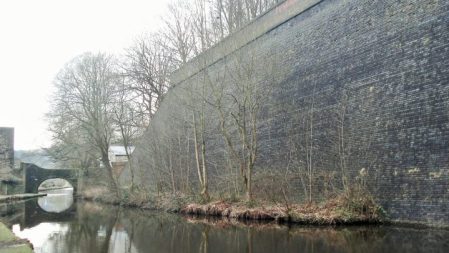
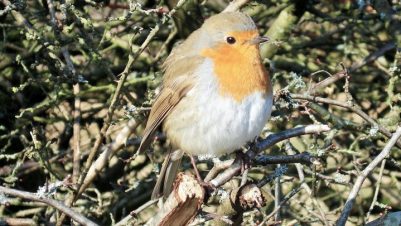
A little group of post war ‘prefab’ bungalows seem out of place. One of their owners, of a similar vintage, is proud they have lasted this long. Nearby are a couple of modern rabbit hutches – wonder how long they will last.At Gauxholme warehouses and boats appear and the canal passes under a cast iron railway bridge with Gothic abutments. More locks drop the canal down quickly passing back to back cobbled streets and then in front of you is ‘The great wall of Tod’. This massive wall of blue brick supports the railway high above, quite dramatic and hidden away from the rest of the world. How many millions of bricks? A Dipper, that iconic northern water bird, was passing up the canal, a Waterhen taking a lift on a plank and a Robin singing its heart out on this sunny day.

The canal entered  busy Todmorden at the main street with an abrupt guillotine-like lock dropping it down on its way, without most of the tourists knowing its there.. I had a train to catch so exploring the town will have to wait.

*****


SOUTH PENNINE RING – Manchester to Rochdale.

This was a 12 mile day full of interest with old mills coming at me thick and fast. The Metrolink tram took me to Piccadilly and I quickly found my way onto the canal basin where the Rochdale Canal emerges from the depths having already passed 9 locks since Castlefield. 3 years ago Sir High and I had braved these subterranean passageways on our Cheshire Ring jaunt.

Today my way was blocked by a locked gate meaning I had to retrace my steps and try again on the opposite side. The numbers on the bridges didn’t seem to tally with my map until I realised I was confusing lock numbers with bridges.  Not a good start, you shouldn’t get lost on a canal!

The Ancoats area of Manchester where the Rochdale Canal next passes through is known, tongue in cheek, as The New Islington because of all the new buildings many which utilise the old mills and warehouses in luxurious conversions. Marinas dot the developments. It is good to see this rather than dereliction, vandalism and demolition. The cranes are busy again with city centre living.

Some famous buildings are passed – Brownsfield Mill the old AVRO factory for aircraft manufacture;  the Royal  Mill a rebuilt 20th century cotton mill now under residential use, originally named New Old Mill a plaque commemorates a royal visit in 1942 and hence the name change;  the Beehive a former cotton mill connected with Sankey’s soap at a later date now earmarked for commercial use. There are many more. Names allude to the past – Cotton Fields, Coal Pits Lock etc.

But before long I’m back amongst average housing, urban sprawl and litter. The honking Canada Geese are everywhere fouling the towpath. Even the graffiti is not up to standard. But the sun is shining, there are few people about and I feel glad to be setting off on a new exploration.

To compensate there is the fine 19th century Victoria Mill canal side, a former cotton spinning mill. It was designed as a 6 storey double mill with a shared central chimney. Now office and residential use.

The next area is Newton Heath which had an industrious past associated with the canal – die works, bleach works, a tannery, rope works, glass works, brick works as well as the textile mills. A row of maisonettes is named after one of the young Man United players killed in the Munich air crash, 1958, I wonder if the other 7 are likewise nearby, I wish I’d looked.

I nip up a side street for a morning coffee with toast and jam in a basic cafe frequented by locals lingering over their fried breakfasts. Modest housing fronts onto the canal in contrast to the large Regent Mill whose brickwork is exquisite.It bears the names of Russell Hobbs and Remington and I believe they are still trading there.

Failsworth arrives with Aldi, Lidl, Tesco and KFC, the latter temporarily closed due to lack of chickens which has almost reached a national disaster according to some news outlets. The canal continue obliviously to pass the large Ivy Mill. This cotton mill was converted for aircraft assembly during WW2 and is now office space.A brief stretch of ‘countryside’ was passed through before the canal is squeezed under the M60 without a towpath, an elaborate foot bridge over the motorway reunited me on the other side heading for the Boat and Horses pub. A name recollecting the passage of hundreds of horse drawn cargo boats, it did not look inviting today having become a rotisserie and carvery for roadside travelers. The  nearby J.W. Lees Greengate brewery has produced real ale since 1828 and is still family run. I couldn’t pass through the area without sampling their product so at the next more modest canalside pub, Rose of Lancashire, I had a quick half. This inn opened in the early 1800’s as the canal was being developed and was a haunt of local radicals and reformers trying to influence parliament to improve the lot of the working class. The Peterloo Massacre 1819, in Manchester, was a defining moment in that struggle. The canal winds its way through the outskirts of Oldham with the railway a constant companion. This is the Manchester to Leeds engineered by George Stephenson and opened in 1841, I was to become well acquainted with its course in the next few days.  In the vicinity the railway crosses the canal on a beautiful cast iron bridge.

Over the River Irk, past the open spaces of Chadderton Park before more locks rise at Slattocks.

The next barrier is the M62 where the canal has been diverted under a culvert with an ingenious floating towpath. The original line is a boggy passage to the left. A lad was fishing for pike with a large lure which he expertly cast down the water. A previous fisherman told me that it was too cold for the fish, there was almost a layer of ice on the water.

The way into Castleton was enlivened by a cheery mural from a local primary school.

Just when you thought you’d had enough mills the massive Arrow appears. Cotton has given way to storage. I’m not sure how the canal goes under the M627 but I was diverted through retail parks to meet up with it for the last pleasant mile into Rochdale where I was accompanied by many dog walkers. Well the canal, despite its name, ironically doesn’t go into Rochdale but skirts the town at a discreet distance. Things have changed in Rochdale since the mills closed.

The train journey back on that line to Manchester Victoria only took 15mins.

*****


SOUTH PENNINE RING – A CANAL WALK.

I can’t get away from canals at present. Family duties will see me down in Manchester for a few days so I decided to look at this circuit which I’ve had on the back boiler for awhile.

The South Pennine Ring is a 71mile circuit north of Manchester combining parts of the Rochdale, Calder & Hebble, Huddersfield Broad and Narrow and Ashton Canals.

Completion of the circuit by boat has only been possible since 2002 with the restoration of the Rochdale and of the Huddersfield Narrow. Enthusiastic and dedicated pressure groups made this feasible but major engineering work was needed, particularly where motorways crossed the defunct system. Money came from many sources and various plaques reflect the Millennium  Lottery Charity funding.There are a large number of locks, needed to cross the Pennines twice, and the highest and longest tunnel [Standedge] in Britain. The original canals played an important role in the area’s industrial and weaving heritage. Several interesting towns are visited and  there are reminders of the past everywhere. Obviously the only canal traffic now is pleasure boats but the towpath gives the additional benefit of a long distance circular walk.

The Canal & River Trust was launched in 2012, taking over from British Waterways, to oversee    canals, rivers reservoirs and docks in England and Wales. Throughout the walk there will be much evidence of their work, aided by volunteers, to maintain this important heritage.


I had previously walked most of the Ashton from Piccadilly to Portland Basin three years ago.  So the plan was to walk the rest in a clockwise direction over a few days using my son’s house in  Stretford as my base, taking public transport at the beginning and end of each day. An economical and fairly practical way of completing the ring. This would be another step towards my fully fit walking rehabilitation since overuse damage to my left hip’s ligaments last year.

An excellent map is available –


LANCASTER CANAL 8. Sedgwick to Kendal.

For our last day the sky was blue, the ground hard with frost and the surroundings covered in snow – magic. Of course this was all planned.

We were soon back up to the line of the canal and making good progress through the fields on the edge of Sedgwick which seemed to have some pleasant housing tucked away from modern hectic life. The village first enlarged due to the nearby gunpowder works on the River Kent, subsequently residential properties have been built in what was probably the estate of Sedgwick Hall mentioned in my last post. The canal crosses a road on a skewed aqueduct in the middle of the village, these were built for strength.

Lovely countryside was traversed with drumlins to our right, isolated bridges and then woodland giving variety.

Looking to the east above St. Marks Church in Natland was an attractive Fell I didn’t recognise, looking on the map it is named The Helm and has an Iron Age Fort [Castlesteads] at its southern end. Yet another place to explore on a return visit.

Onwards under more isolated bridges with the lower Kentmere fells  in the background. This area is well walked being just a stroll out of town.One can see why Kendal is a popular place to live – a lively historic town in beautiful surroundings.

And then we were into the streets and parks of Kendal, the line of the canal still walk-able with frequent signs. A walking cycling corridor out of town. Passing behind the leisure centre the site of old coal wharves has been utilised by local schools to provide environmental studies. 


One renovated bridge had iron work alluding to the history of rope-making  hereabouts.

A crossover bridge is encountered and duly crossed, there have only been three on the whole of the canal. Obvious old mills are passed, the castle is up to the right somewhere. More filled in wharves at Lound, with informative interpretation boards,  and then the main terminal basin is reached, now only identified by warehouses. These are now used for other purposes though some have links back to the past. A small building is signed as being the original ticket office for the packet passenger boats. In the last warehouse, now modernised, is the head quarters of Gilkes manufacturing turbines on this site since 1856. Apparently inside are some original features of the basin.One can only imagine the industry and flow of goods right in the centre of Kendal in the 19th century. A return visit is needed to explore this industrial heritage further.

Below is an old aerial shot of the terminal basin [Stricklandgate House Trust]


Our way across Gooseholme Bridge was closed due to flood damage, so we braved the traffic on a road bridge to reach Baba Ganoush for a welcome bowl of delicious soup. This was followed by the three of us ‘running’ to catch the 555 bus, thanks to the driver for waiting for us.

So my journey up the canal from Preston is completed. It has been a very pleasant stroll helping my hip ligament rehabilitation but more than that has been full of interest and kindled my desire to explore this area further.


LANCASTER CANAL 7. Holme to Sedgwick.

We were the only ones stood waiting for a bus on the deserted slip road off the busy A590 roundabout but sure enough the 555 appeared and took us back to Holme and bridge 149 on the canal. Driving up the motorway this morning the snow covered Lakeland mountains looked majestic, blue skies and bright sun promised a good day – on the Lancaster Canal not those mountains.  I have just realised we are now walking in Cumbria so ignore my tagging of Lancashire, somebody moved the boundaries.

Today’s stretch is along isolated truncated parts of the canal which in its demise suffered at the hands of the road builders, notably the M6. Despite this there were some beautiful stretches of countryside as well as awful noise from the motorway.

The start on the edge of Holme is dominated by Farleton Fell to the East. we could trace defunct tracks used to bring limestone down from quarries to the canalside basins. Over to the west the cliffs of Whitescar were prominent with the Coniston range behind. Soon the canal was blocked by the M6. A diversion through fields alongside the motorway to a crossing meant backtracking, for the sake of completeness, to the point where the canal emerges from a culvert under the road. Swans were starting to nest build on this watery cul-de-sac. I recall the kingfisher that flashed past somewhere back near Galgate, haven’t seen much else but ducks, oh and the odd Heron.

Through Farleton remains of one of the stables used for the ‘fast’ packet boats was passed, horses were changed every 5 to 7 miles to maintain momentum. Remember, as the cars speed by on the M6 and trains on the nearby main line, the 57miles from Preston to Kendal took passengers 8 hours. The industrial haulage was more like a week for the round trip.

A little further on and there was an aqueduct over Farleton Beck, I dropped down to view the structure and found what appeared to be a fish ladder next to the beck, but I think is just an overflow from the canal.  Notice the first use of beck, a Norse word for stream used mainly in the north of England.

Another stretch by navigable water ended at a culvert under the A65, we used the underpass and again a short while later at the M6 again. There is no way the Northern Reaches of this canal will be restored. History is littered with bad, short sighted planning decisions. We are still making plenty of them unfortunately. In between on the short section of canal swans glide regardless of the situation. 

From here on to Stainton the canal is navigable if you can get a boat into it. The only craft we saw was the Lancaster Canal Trust’s small boat moored at Crooklands. The main canal feeder from Killington Reservoir enters, disappointingly as a mere trickle through a fence bordering an industrial unit. Killington Lake is known to many for its M6 service station on the way south. Up to 17 million gallons of water a day enter the canal here!

There is an aqueduct over the Peasey Beck which supplied the gunpowder factory mentioned below and is interconnected to the Killington supply. In the vicinity we passed a canal side coal wharf and the larger Wakefield’s wharf which was connected by a tram-way to a nearby gunpowder factory at Gatebeck, yet another place to explore. Saltpeter and sulphur came from foreign lands but the charcoal and water power were local.

Wakefield’s Wharf.

Lunch was taken at the Canal Trust’s restored packet stables but was interrupted by a short hail storm  on an otherwise sunny cold and clear day. Looking back on our meandering route Farleton Fell looked surprisingly close.

The section northwards was through glorious English countryside and would be a joy to canoe.

Another small feeder comes in and then an aqueduct over Stainton Beck. Storm Desmond two years ago caused serious damage to the stonework and repairs will be costly.

The semi functioning canal finishes  finally at a damn where the water no longer exists. The next length of canal, optimistically named First Furlong, is being cleared and re-puddled with the hope of returning to water. But a few volunteers will be no match for the hundreds of navvies working two centuries ago.

A dry section can be followed to the entrance to Hincaster Tunnel, the only one on the canal, When built to go under the hill there was no towpath so horses had to be taken over on the path we now follow. There is much interesting stonework associated with the canal structures here and the modern railway goes overhead. How often do the railways parallel the canal? Down the otherside is another packet stable.

A short stretch by the dry overgrown canal course is made interesting by installations of models, figures and other artifacts introduced no doubt by some local children who may have been involved in the clearing of the ‘towpath’. A nice touch much appreciated.

The canal has been demolished by the A590 and a lane is taken. Below is the estate of Levens Hall, which is well worth exploring. A short climb brings us up to the course of the canal, now in filled, and a field crossed to the obvious isolated canal  bridge,177. We are above the interesting Gothic like Sedgwick Hall which was previously a school and now converted to individual living accommodations.

Our car is not far away leaving us a short section of ‘canal’ to complete into Kendal.

Corniest boat name of the day category. We only saw one boat all today … Waterwitch, it will have to do.


LANCASTER CANAL 6. Carnforth to Holme.

A highlight of the day was a flash of turquoise – the first Kingfisher I’ve seen for a year.

Progress up the canal is being made slowly with my self imposed limit of 8miles flat walking, however there is no deterioration in the hip ligaments which are improving with my physio exercises. fingers crossed. I have just realised that in 60 years of walking and climbing this was the first time I’d sought the help of a physiotherapist.

Today’s companions were Peter and Denise again. My car was left at Holme and the bus taken back to Carnforth. I’m making good use of my bus pass on this walk, maybe this could be developed into a theme. There is one blogger I’ve come across who ticks off the Wainwrights using only public transport, well not the summits themselves but just getting to the areas.

We meander out of Carnforth with interesting road and railway bridges. The first bridge as we leave the town has been sympathetically widened at some time to accommodate more traffic. Bridges under the motorway are more brutal.

Rural calm returns as we reach the aqueduct over the River Keer, the converted mill below has a restored waterwheel and was coincidentally almost purchased by Peter and Denise when they moved to the area. Looked a bit dark and damp to me. Old milestones are visible along this stretch, 17miles to Kendal!

At nearby Capernwray we were entertained by a tractor trying to manoeuvrer a mammoth caravan down the lane under the railway bridge. The attached holiday site is in an old limestone quarry, Wegber, with cranes still visible and a little further a short canal branch into the quarry area for loading the limestone.

We passed by Borwick Hall, just visible through the trees on the other side, an Elizabethan manor house. And then we were at Tewitfield a significant location on the canal. So far I’ve walked 42 miles dead level on the 70ft contour but today things change and the canal, now defunct, rises 75ft in half a mile. This northern section to Kendal was opened in 1819 and was closed in 1968 with the building of the M6. 8 locks lifted the canal from the basin before level going to Kendal. The basin where the canal navigation now ends is a holiday complex with not particularly well-designed apartments.

END OF THE NAVIGATION.

Creeping alongside the motorway we reach the start of the ascending lock system. Plans have been muted for years to restore this northern section but they have come to very little.

At the top of the lock system the motorway delivers the final ‘coup de grâce’ …

We find a way across the M6 and resume our stroll along the towpath as if nothing had happened. Ahead was the distinctive outline of Farleton Fell, once one of our popular evening climbing venues on less than solid limestone.

Passing the settlement of Holme Mill we saw the millpond supplying a once industrious linen mill. Flax was grown in the area for the production of linen before King cotton took over.

We didn’t enjoy the boggy stretch of ‘towpath’ ahead…

However, there was a final triumphant flourish on arriving in Holme with the appearance of well-preserved coke ovens on the far bank. I mentioned these in my last post when we were unable to identify any. The ‘beehive’ ovens were used to produce better firing smokeless fuel from coal for the use of blacksmiths and bakers, and later for iron smelting.

Turned out to be an interesting day. Will be back to bridge 149 as soon as possible to complete the journey.

There were few boats on this section of the canal so my ‘Corniest boat name of the day’ has become ‘corniest boat of the day’

‘Sheds R Us’

LANCASTER CANAL 5. Lancaster to Carnforth.

Another change of personnel today,  JD joined Peter and I on a windy morning. The highlight of the day was crossing the Lune Aqueduct on the edge of Lancaster. The walk from the pedestrian bridge [103] in town was through the rather dull suburbs but by the time we reached the aqueduct open countryside was visible, or at least a golf course. Rennie’s aqueduct opened in 1797, after 5years construction, to much acclaim. There are five arches scanning 70ft 50ft above the Lune. Recently there has been a significant refurbishment with improvements to the lining and the stonework. We should have descended the steps to view the structure from the river bank. Instead  we strolled over the exposed towpath made safer by the ornate balustrade. Lancaster castle was glimpsed downstream. Lunesdale upstream.

The next landmark was the new ‘milestone’ bridge carrying the M6 relief road to Morecambe.  This was a massive structure compared to the usual arched stone bridges. One of the latter in the vicinity has been widened more sympathetically to accommodate the road, a date of 1921 is visible.

Along side the canal every 6-7 miles or so were stables for the fleet of horses enabling the ‘fast’ passenger boat from Preston to Kendal, done in 8 – 9 hours. The masonry remains of one is next the towpath, easily missed.

Through Hest Bank and Bolton-Le-sands we seemed to hover drone-like above the houses with views across Morecambe Bay. At one time ships would harbour on the Morecambe Bay coast here with goods to be transferred up to the canal, the opening of the Glasson Dock branch in 1826 superseded this. Somewhere between the two villages is a good example of a swing bridge, now leading to private houses. We contemplated on how it would be interesting to withdraw access to unwanted visitors by a swing of this bridge.

I was on the lookout for old coke ovens at two sites into Carnforth, bridges 125 and 127, but disappointed with the outcome. No real sign of the beehive structures across the other bank, the low sun making visibility difficult. The ovens were used to produce better firing smokeless fuel for blacksmiths and bakers and later for iron smelting. They are supposed to look like this…

The basin to the south of Carnforth was busy with boats and dog walkers but before we knew it we were back in a rural setting before the children’s playground announced bridge 128 on the Kellet road. Time to find a bus back.

Corniest boat name of the day…

LANCASTER CANAL 4. Galgate to Lancaster.


Today Peter’s wife, Denise, joined us for a shorter walk along the canal into Lancaster. It didn’t turn out as short as expected. Having completed our walk we caught an early bus back from Lancaster. As we were leaving the city several police cars, ambulances and a fire engine overtook us with lights flashing and sirens blaring. There was obviously trouble up ahead, possibly on the motorway but soon we were stopped and the A6 closed due to a serious accident. We were going nowhere. Students alighted from the bus and started walking up a side road and cycle path into the University. There was no choice but to follow and soon we were wandering through the extensive campus hoping to bypass the closure and walk into Galgate. This proved an interesting diversion, even getting a close up view of the silk mill there. The Air Ambulance helicopter was in action so I hope those involved in the accident are not seriously injured. Will donate to their charity on the next occasion.

Anyhow to get back to the start. Smoke was drifting up from several residential boats moored in the basin at Galgate. I noticed on a wall a bank of post boxes for the boaters, I suppose you need some sort of address for communication if you are permanently living on a barge. The usual gentle meandering walk took us into the countryside on what was a dull day so views to the hills were limited. Conditions under foot varied. Occasional roundels indicated we were sharing the route with a named walk, A Breath Of Fresh Air, which takes in interesting areas of the Lune, coast and canal around Lancaster. http://soulfulhorwich.org.uk/abofa/index.shtml

After just over a mile we entered the wooded Deep Cutting which takes the canal through glacial deposits to avoid a long detour, quite a contrast to the open land. Apparently this is the place to see kingfishers but not today.

At its northern end the outskirts of Lancaster are reached. On the left at the entrance to a new development, Aldcliffe, the old gate house has been left to rot, shame. On the contrary there are some splendid houses on the other bank. Glimpses of the castle came into view. After passing under the main railway line city centre wharves were  reached. On the right was the converted boat house where packet boats were repaired after being lifted into the upper floor. On the adjoining ex British Waterways yard are new developments with the old crane preserved. The tall chimney is the hospital incinerator. At one point we have to cross over to the other bank for a short distance, the bridge is constructed to allow the horses over without unhitching. Student accommodation has been built alongside the canal and with a few pubs in old warehouses the area has a good ambience. A lot of money has been spent in Lancaster in the last few years and by look of things quite wisely. There is a fine bridge bearing the name of a local blacksmith at the time, 1876, when the bridge was widened.Leaving the canal at a pedestrian bridge, we wander through streets to board the ill fated bus.


The Silk Mill back at Galgate …


Corniest boat name of the day…

The forecast is not good for the next few days so I’m not sure when I’ll be out again for episode 5, anyhow I think my hip needs a rest. I’ll just stick to the exercises my physiotherapist has given me.


And for completeness our homeward detour…

LANCASTER CANAL 3. Garstang to Galgate.

My friend Peter from Forton got wind of my travels up the canal and volunteered to accompany me on the next stretches, he has a wealth of historical local knowledge so I readily agreed. I came away far better educated but with less photographic evidence due to all the chatting!

As I descended from the bus, there is an excellent service linking Preston with Lancaster on the A6, he was there and understood my need to retrace my steps along the Wyre to the aqueduct to regain the canal up the steps. Nearby they were dredging the canal, a continuous task I presume, some of the detritus was on display.

On the far side was Garstang Basin, now a marina. The Tithe Barn building, converted to a pub, predated the canal and was brick built.

A pipe bridge carries water from Barnacre reservoir to Blackpool.

The canal was busy with a few boats moving about between the smart marinas and moorings, the towpath also seemed popular with dog walkers. Not all boats are equal.

Peter was keen to find the site where the Garstang to Pilling railway line crossed the canal – I think we found it at bridge 65, now demolished. This line was known as the Pilling Pig from a locomotive whose whistle squealed like a pig. It connected the agricultural land of this part of the Fylde with the railway network until the 1960’s. The remains of the bridge…

We were soon into pleasant wooded countryside, lots of curves guided us through the nebulous area of Cabus. All very pleasant. Despite the temperature being just above zero we were soon taking off layers as there was no wind and hence no chill. We reached Ratcliffe Wharf another busy marina but at one time important for shipping of coal and lime. Just north are mounds, the ‘obvious’ remains of lime kilns responsible for this trade.

Forton lies a mile southeast of Bridge 79. Apparently it became the richest village in England due to the payments received when the M6 motorway was built. The small basin at Richmond Bridge was constructed for transporting stone from the nearby quarry, which is now disused.

The bridge leading to Ellel Grange is more ornate in keeping with its stately surroundings. There is a strand of lovely trees by the canal at this point – all very picturesque.

A little further, the miles go quickly on this flat terrain even with my poorly hip, is the junction with the Glasson Branch. This links via 6 locks to Glasson Basin and into the sea through Glasson Dock. This was a vital link into the canal when Glasson was an important port, superseded by Preston in due course. I should return sometime and walk this section. At the junction a graceful bridge carries our towpath over the branch. Close by is the lock keeper’s cottage and today his wife was tending the garden and gave us a potted history of the area in that lovely Lancashire drawl.

Soon we were in Galgate, another canal basin, and waiting for the bus home, the pub by the bus stop sadly closed as is the lot of many village inns these days. Galgate was the unfortunate scene of severe flooding of the river Condor just before Xmas and many of the cottages are drying out – a long process.


Corniest boat name of the day…


LANCASTER CANAL 2. Woodplumpton to Garstang.

Overnight frost has frozen the surface of the canal, ducks are flying in and giving impromptu off balance ballet displays. Sets me thinking about hard winters when thick ice would have closed down commercial travel on the canal. The sodden towpath is a little firmer though. From the start this is countryside walking with the canal weaving its way on its 70ft contour. There has been little need for cuttings or embankments. To the east are the rounded Bowland Hills, when will I be back up there looking down on this landscape?

The peace is broken now and then by cars using their horns on the approach to the humped  narrow canal bridges, I’ve never really understood this – why not just drive slowly in the first place. A few bridges show signs of damage where there has been a collision with speeding honking motorists.

There have been several designs of bridges with variation in the pitch of the arch. All are in local stone and some have railings on the parapets. Some have been built as a purely functional road bridge. There are a few wooden swing bridges serving farms and fields. As mentioned they are all numbered in sequence from the south.

An hour’s walking brings me to Guy’s ‘thatched hamlet’ with its eateries and leisure facilities, somewhere to be avoided in the warmer months when it is overrun with families. Today is all peace and quiet as I pass by on the now well surfaced and well used towpath through Bilsborrow  to arrive at the next tourist trap, Barton Grange garden centre, marina and the new ice rink in construction. The latter looks completely out of place and scale next to the canal, though the pink insulation will be covered in more sympathetic cladding.

From now on the canal runs in close proximity to the A6 road, the main railway line and the motorway so there is constant noise. Also in this communications corridor are many power lines, the anglers attention is drawn to them by signs on the bank. I am surprised at the number of lines encountered and presumably hardly noticed in daily life.

So far today the canal has used three aqueducts to cross over rivers coming down from those Bowland hills. Each has its own unique architecture and I marvel at the ingenuity of the early canal engineers. The three arched Hollowforth over Barton Brook…  the larger Brock…

and the plain Calder…

The canal has some gentle curves and passes attractive woodlands as it loops around to pass Greenhalgh Castle before entering the suburbia of new housing.I escape at a final aqueduct over the River Wyre, dropping down to pass under the canal arch to follow the river through converted mills to catch my bus in Garstang.


Corniest boat name of the day…