Monthly Archives: November 2019

A LANCASHIRE MONASTIC WAY. 6. Red Scar to Ribchester.

                                                                      Roman Ribchester.

The bus drops me off at the Preston Crematorium, and I stroll down the remembrance avenue. The land to the right is industrial units on the site of the former Courtaulds Mill, which produced Rayon. This was a large operation on the edge of Preston with its own power plant and railway, a branch of the Preston-Longridge line. Over 2000 jobs were lost when it closed in 1979. Its prominent chimneys and cooling towers dominated the landscape until demolition in 1983, when lots of the population of Longridge went to view the explosive event.

Lancashire Evening Post.

I was now on the top of Red Scar, a steep escarpment dropping to a horseshoe bend of the Ribble. I’ve joined the Ribble Way, which goes eastwards high above the river,  glimpsed through the trees. Worryingly, I start to notice ‘Footpath Closed’ signs, but continue to see what the problem is and not wanting an unnecessary detour. I climb over barriers. The path drops to cross Tun Brook, and there have been landslides damaging the footbridge and its abutments. I can’t drop into the stream bed as the mud is too steep and unstable, but can I cross the bridge?  The stepped way to it is impossible, but with a little sidetracking, I reach the edge of the bridge, which has been further damaged by a falling tree. Tentatively, I make my way onto the creaking structure, thinking that if it fails, nobody will find me here. I’m relieved once across the other side. Satisfying but foolish.

Moving on after I’d climbed out of the ravine, I was on country lanes and in wet fields well above the Ribble. Distant views were rather dull. Coming the other way, you wouldn’t have been too pleased by this sign…

Hereabouts was a Roman road marked on the map, but not much evidence on the ground. I passed close to Alston Hall and the Observatory previously attached to it. There was plenty of evidence of horses ruining the fields.

A succession of ups and downs finally brought me out onto Hothersall Lane, which drops dramatically down to the River Ribble near the outdoor centre.

A curiosity I am aware of is the ‘Hothersall Boggart’. A buried stone head was found on the land and placed in the fork of the tree, leading to tales of fairies and boggarts. Heads are found in this area and were often placed on buildings to ward off evil spirits. [see more in the Roman Museum to follow]

Along the lane is Hothersall Hall rebuilt in 1856 in the Gothic style and looking resplendent today. I sat on a nearby stone to eat a sandwich which set off a dog barking in the garden; a few crusts seemed to please him.

Across the river was Osbaldeston Hall, another place with a long ancestry.

.

I was alongside the river now, which today was meandering slowly, but this area is prone to flooding, and Ribchester often makes the headlines on those occasions.

Ribchester is famous for Bremetennacum, the Roman fort strategically situated on the banks of the river at a crossroads of several important routes. Not only was there a cavalry fort, but also a vicus, a village community surrounding it. It was time to visit the Roman Museum…

The phrase ‘good things come in small packages’ applies to this excellent little museum. The Roman history of the area is comprehensively explained, and artefacts displayed and interpreted well. One of the first findings [1796] of Roman occupation was by a schoolboy in a ditch – The Townley Hoard – now displayed in the British Museum. As part of this hoard is a well-preserved helmet, and there is a replica on display here.  Of great interest are the more mundane items on display – combs, leather shoes, brooches, glassware, slingshot balls, etc. Oh, and there are some more stone heads.

Replica Roman Helmet.

Tombstone of Asturian Cavalryman.

Well worth a visit.

Behind the museum are the excavations of a Roman granary and nearer the river, a Roman Bath House [heading photo]. How much more must be lying beneath the present-day Ribchester?

Granary.

Built on a site close to the Roman Fort is the C13 St. Wilfrid’s church, stones from the fort most likely being used in its construction.

Inside, the Dutton Chapel contains a small C14 wall painting of St. Christopher and some medieval coloured glass pieces in one of the windows. There is a recorded mass burial from the Black Death in the C14 when the chapel was added.  Black Death wiped out a large percentage of the population, and following it, there were not enough peasants to work the land, the feudal system fell apart, and it became more economical in Lancashire to graze the fields with sheep. Hence, the wool trade gave way to the cotton trade, where spinning and weaving skills existed, leading in turn to mills and urban industrialisation.

In the porch is a beautifully carved tombstone of obvious antiquity from a grave of a Knight of St. John of Jerusalem, an order once based at St. Saviour, Stydd – but that’s for tomorrow’s walk.

One of the gravestones in the churchyard has the following inscription…

Here lieth the body of
Thos. Greenwod who
died May 24 1776
In ye 52 year of his age
Honest, industrious
seeming still content
Nor did repine(?) at what
he underwent
His transient life was 
with hard labour fill’d
And working in a
makle(?)pit was kill’d.

The nature of Thomas’ death seems clear – he died in an accident, probably a marl pit, of which there are many in the area. They were dug to obtain lime-rich mud, which was used to improve the land; most are now small ponds.

Nearby is a C17 sandstone sundial…

Church Street is lined with weavers’ cottages, many of them listed but spoiled with all the parked cars. The White Bull, an iconic inn with its porch supported by columns possibly from a temple to Minerva,  a place of worship in Roman times.  The attached sandstone mounting block is cut into three steps.

Further on is the Black Bull inn and nearby my bus stop where I was preparing for a half an hour wait when up pulled one of my neighbours with the offer of a lift home, a good end to a satisfying day.

*****

A LANCASHIRE MONASTIC WAY. 5. Preston to Ladyewell.

Guild Wheel and Ribble Way.

I was back in Preston bus station, and a short walk, including Winkley Square, had me in Avenham Park. It wasn’t supposed to rain, but I was donning waterproofs under the old railway bridge before setting off along what was mainly the Preston Guild Wheel shared with The Ribble Way. The weather remained dull and damp all day.

The 21-mile Guild Wheel cycle and walking path  [National Cycle Route 622] was opened in 2012 as one of the projects of that year’s Preston Guild. Established by royal charter in 1179, the Preston Guild of Traders was initially held every few years on an irregular basis but has taken place every 20 years since 1542, except 1942 when it was cancelled due to World War II, resuming in 1952. It circles the city of Preston, mainly on off-road trails, and is very popular with cyclists.

In the park, a group of Cromwell’s soldiers were preparing to re-enact the Battle of Preston.

I normally cycle this route, so it was a different experience on foot, but I was able to make fast progress. I was soon on the banks of the river opposite Cuerdale Hall, the site of the Cuerdale Hoard discovery in 1840. The hoard was a vast collection of Viking silver coins and jewellery now displayed in the British Museum.

Cuerdale Hall

The trail became busier once it entered the Brockholes Nature Reserve, a large wetland area. I didn’t have binoculars with me, so there was no lingering. The steep track up into Red Scar Woods was easier without having to push a bike. Leaving the Ribble Way, the Guild Wheel goes through the grounds of Preston Crematorium.  The diversion to Ladyewell Shrine involved roads and tracks very close to the motorway, so the traffic noise was ever-present. The lane leading up to the shrine is thought to have been a pilgrim route for centuries and continues to be so. The present Ladyewell House incorporates a chapel from 1685, which was used until St. Mary’s Church was built up the road in 1793. [I have photos of my children in a nativity play in the present-day church when they attended the neighbouring Fernyhalgh infant school, now closed.] Our Lady’s Well remains the object of pilgrimages to this day, pressing a button serves you with water from the well. There is also an ancient cross base here amongst the modern Catholic shrines and religious tat. I’m not sure why the Ladyewell Shrine has become so popular as a pilgrimage destination.

*****

A LANCASHIRE MONASTIC WAY. 4. Longton to Preston.

The Ribble Way.

I’m late setting off today, and my bus gets me into Longton just before 12, but I only have to walk back to Preston on The Ribble Way. As I arrive on the route, having walked down Marsh Lane, another walker appears and asks about the whereabouts of the RW. I know where he went wrong, as the signage was very poor. We walk down the lane to join the riverside way, it turns out he is in training for a long Camino route next year. To be honest, there is not a lot of interest in this flat, featureless stretch, so we fall into step and conversation. Having cycled the Camino from Le Puy-en-Velay in France to Santiago de Compostela, I took great interest in his plans and pledged to support his chosen charity. Today, he was planning to pick up the Guild Wheel at the docks, but hadn’t realised there was no bridge across the Ribble until Penwortham – thus giving him some extra training. Along the way, I pointed out on the far bank the dug out Ribble Link enabling a link-up from the Lancaster Canal to Leeds-Liverpool Canal and the rest of the system. I’m not sure how often it is used, as you need a pilot boat to take you down the Ribble to enter the Douglas. The entrance to Preston Docks was passed without a bridge. The tide was out and the river did not look its best.

The Ribble Link.

Preston Docks entrance.

Past Penwortham Golf Club, we entered a parklike space which was the former Penwortham Power Plant, demolished in the 80s. I realised I needed to leave the river to seek out the monastic sites above, Penwortham Priory, so we went our separate ways, and I wished him the best with his efforts. I climbed out into Castle Walk, there was a Norman ‘motte and bailey castle’ hereabouts until 1232. The castle was built to control a ford across this important waterway. I marched around Castle Walk until directly below the present church, but the developers had defended it well there was no way through. Backtracking, I encountered several ‘Priory’ road names all related to a Benedictine priory and subsequent mansion situated here until demolition in 1920. All is now new housing. [One of my climbing friends lived in Priory Crescent until recently; he has made a good choice by moving to France.]

No way through.

Around the corner was St. Mary’s Church, which I approached down an avenue of trees. Nearby was the base of a stone cross for which I can find no information. The prominent Lych Gate was surprisingly locked, a less-than-welcome sight; nonetheless, I worked my way around into the extensive graveyard. Somewhere is the tomb of John Horrocks, the noted C18 Preston cotton manufacturer.  The church itself dates back to the 15th century. To the north of the church is the mound on which the Castle was probably built.

The river was just below, but the defences, present-day wire fences, were impregnable until I found a chink in the armour and escaped onto the river embankment, thus saving a long walk out on the busy road. Now back on the Ribble  Way, I was aiming to cross the river on the ‘old Penwortham bridge’; there are newer bridges downstream. A cobbled way took me over to the north bank.  Alongside the old bridge are the remains of a dismantled railway bridge; this was the former West Lancashire Railway from Southport leading to its terminus at the bottom of Fishergate Hill. Nearby, one of the cottages is named Ferry House, suggesting the presence of a ferry before the bridges were constructed. Ahead was the present mainline rail bridge, and seen beyond it, the redundant East Lancashire Railway bridge previously bringing trains from Blackburn into platforms alongside  Butler Street goods yard, which is now The Fishergate Shopping Centre. So that is three rail bridges entering Preston from the south.

The two C19 parks, Miller and Avenham, offer a wonderful recreational facility on the edge of central Preston and have been smartened up in recent years. I managed to get lost in roadworks on East Cliff and reappeared in the rail depot alongside the station. I’d only been walking for 3 hours.

Miller Park.                                                                                                 

Within Preston, Convey mentions three other religious sites which are not visited, saving me some legwork.

Preston Friary, in what is now Marsh Lane,  was established in 1260. Friars were different from monastic orders in that they spent their time in the local community preaching and engaging in missionary work.

Tulketh Priory, a Cistercian abbey established in 1124, but moved to Furness soon after. Tulketh Hall was built on the site and demolished in 1960 to make way for housing.

St. Mary Magdalen’s hospital for lepers,1177, run by monks. Its chapel became a site of pilgrimage until the Dissolution. St. Walburge’s church was built on the site. This church is famous for its 309-foot steeple, seen from all the surrounding areas. The notorious Fred Dibnah’s last job was working on this steeple back in 2004.

A distant view of St. Walburge’s steeple.

*****

A LANCASHIRE MONASTIC WAY. 3. Rufford to Longton.

                                                           Marshy Lancashire.

I’m back on the rattly but reliable train to Rufford, along with the regulars, and I find out that a token is still used between Midge Hall and Rufford on the single-track section, failsafe.

I’m straight onto the canal, the branch of the Leeds Liverpool destined to merge with the River Douglas and the Ribble Estuary, from where The Ribble Link connects to the Lancaster Canal. Here it is wide and stately, reminding me of the Canal du Midi. The old hall of Rufford is just visible through the trees, started in 1530 and associated with the Hesketh family for generations. Now in the hands of the NT and only open weekends in winter. The canal here traverses low-lying drained lands, made more sombre by today’s low, weak sunlight. There is no one else about and only a few boats are moored up. With no distractions, I soon reach Sollom Bridge, where the towpath seems to run out and the canal has wilder rushy borders. I come inland to the small hamlet of Sollom, on a corner is a medieval cross base. The cottages and barns here have been sensitively restored, and it is an oasis of calm just off the hectic A59. Whilst I was walking down the next track, my camera somehow switched onto an ‘artistic’ mode.I was able to disable it by the time I reached St. Mary’s Church. I have driven past here many times on the main road and wondered about its origins and unusual architecture. There had been a chapel on this site from early C16, but the present church was erected in 1719, the bricks would have been handmade. It was extended in 1824 when the rotunda was added to the tower. Apparently, the interior has many original items, box pews and oil lamps, but it was closed today and I could only peep through the keyhole. The church is no longer in use and is administered by the Churches Conservation Trust.

Through the keyhole.

I crossed the canal and river, soon to be united on their way into the Ribble, and noticed this old warehouse.

Hidden in the trees to the right is Bank Hall.  C17 Jacobean, under restoration. All I could see was a possible gate lodge.

Up the road is Bank Hall Windmill, built in 1741, now converted into private living accommodation.

On a busy junction, again hidden in the trees, is Carr House. It is commonly thought that Jeremiah Horrocks made his observation of the transit of Venus across the sun, on 24 Nov. 1639, while living at Carr House. More of this soon.

Glad to leave the busy A59 onto a little lane leading towards Much Hoole. Ahead was another interesting church, St. Michael, an early C17 building. The church has connections to the above Jeremiah Horrocks, who may have been a curate there at the time of his important astronomical observations. There is a marble tablet commemorating him as well as some of the stained glass windows. The church has a two-decker oak pulpit and a long upper gallery.

I next crossed boggy fields towards the River Douglas. There were some new ‘No Public Right of Way’ notices on the public footpath, which annoyed me and have been reported to the appropriate authorities.

The tide was out, so the river was more of a mud bath than a waterway. Ahead was only a vast flood plain marsh, though the sheep seemed to know their way around. Following the sea wall, I eventually arrived at the renowned Dolphin [Flying Fish] Inn. We used to come drinking here in the seventies, shrouded in mist and at risk of flooding, the place had a certain atmosphere for late-night carousing. It’s been gentrified since, but the public bar was welcoming, with plenty of locals enjoying a lunchtime pint. I like to give as much prominence to the pubs as well as to the churches.

A walk into Longton and a bus back to Preston.

*****

A LANCASHIRE MONASTIC WAY. 2. Burscough to Rufford.

                                                                            Glorious Lancashire.

My day starts rattling along on the NothernRail train to Burscough. The morning mist is lifting off the fields, and blue skies promise a good day. I’m starting a loop around this unfamiliar area, hoping to spot more religious sites than on my first outing on this Lancashire Monastic Way. One of the first streets I turn down in suburban Burscough is Chapel Lane  – a good start. And yes, there at the end is the C19 church. Next to it is the rebuilt Burscough Hall Farmhouse, which dates from the early C16/17 and where services took place before the church was built.

The hoar frost defines the path across marshy ground whilst giant diggers joist on a nearby landfill site, all very romantic.

I’m aiming for the remains of Burscough Priory, in a private garden, but visible in the winter months – just.

The priory was established in the late C12. and followed the Augustine order, named after St. Augustine of Hippo, an early Roman African theologian. Apart from being a religious institution, the priory looked after the needy and the traveller until its dissolution. All that remains are two massive Gothic pillars from the central church tower.

Next door is a large residential caravan site where this unusual car was seen ? self-built cross between a Nissan and a 2CV.  From the sublime to the ridiculous.

On the corner of the lane is Cross House, and there is the base of an ancient cross suggesting a pilgrim route.

Along the lanes that I followed through the Lathom estate were these two cottages – the cruck-framed farmhouse…

…and a Keeper’s Cottage, 1868 in the Jacobean Style…

More of the Lathom Estate followed across the road at a gateway to the estate, where there are two octagonal gatehouses, one occupied and the other up for sale.

The gates themselves have very ornate stonework…

My main objective was the Lathom Park Chapel, established in 1500 by Lord Stanley, 2nd Earl of Derby, from benefits received after the Battle of Bosworth. It escaped suppression at the Dissolution of the monasteries. Attached are some delightful almshouses.

Nearby, in fields below the remaining west wing of Lathom Hall, was a nostalgic remembrance statue. Let us not forget…

This has a particular significance as the Lathom Estate played a key role in the British war effort during the First World War as a Remount Depot. Lathom offered his land so that horses and mules could be prepared for their duties at the front line. Horses came to West Lancashire from all over the world. After unloading, they  ‘drove on the hoof’ through the country lanes to Lathom. The park was divided into ‘squadrons’ of 500 horses, each with its own superintendents, foremen and 150 grooms. The War Office statistics indicate that between September 1914 and November 1917, 215,000 horses and mules passed through Lathom Park. A recent stone memorial was dedicated to these forces.

I found a way out of the estate on an unmarked path…

… to yet another war memorial to Lathom residents…

I was not looking forward to the walk alongside the busy B5240, but it soon passed, and I came across a few interesting properties of unknown origin.

I was then back on the Leeds Liverpool Canal with a long-distance view of Ainsworth Mill, a mid-C19 steam-powered corn mill conveniently located next to the canal.

I was soon at the junction with the Rufford branch, my way ahead, which leads to the River Ribble and the Ribble Link to the Lancaster Canal.

After the top lock, I came face to face with a blocked towpath; they were replacing the railway bridge over the canal ahead. A massive crane was being used to lift sections of the bridge, and there was obviously no way I could sneak through. However, a little lateral thinking and a few fences climbed had me back on my way.

The flat fields hereabouts are perfect for growing turf, and I watched a clever machine ‘harvesting’.

Fast walking followed along the towpath towards Rufford. I was surprised to see in the far distance the Bowland Fells, Longridge Fell and Pendle. Winter Hill was a little closer.

I crept past these sleeping swans and went through the stone bridge circle.

As you arrive in Rufford, there are busy marinas on either side of the canal.

I had time before my train to look at the Church of St. Mary the Virgin, built in 1869 on the site of a 1736 Chapel. The church was closed, and I wandered around the graveyard looking for a C11 preaching cross. Luckily, a churchwarden appeared from nowhere and pointed out the said cross base [with an incongruous addition] along with a mass grave from when the church was extended. He pointed out one more gravestone with the words  Richard Ally  Bassoon
The inscription was a reminder of the time when the choir, stationed in the west gallery, sang Psalms to the accompaniment of Instruments of Music, which included a bassoon,  played by Richard Alty. Apparently, the said bassoon is preserved in a case in the church – I wish I’d had time to see it. Inside the church are also several monuments to the Hesketh family, closely associated with the nearby Old Rufford Hall.

Bassoon player.

‘Mass grave’

‘Preaching cross’

I caught my train and was back in Preston before dark.

*****

A LANCASHIRE MONASTIC WAY 1. Upholland to Burscough.

Stunning Dean Brook.

A train to Wigan, a bus ride, and I’m in West Lancashire armed with my latest walking guide, A Lancashire Monastic Way. Not the best of starts – my first monastery, the remains of Upholland Priory, is a wall in the car park of the local Conservative Club.

I was exploring the grounds of St. Thomas the Martyr Church in Upholland. The church grounds were extensive, and I’m always amazed by the number of graves in some of these old churches. In fact, there were so many graves that the stones have been used to pave the area around the building. The Benedictine monks established a priory here in 1319. Monasteries served as hospitals, schools, and places of refuge for the needy and homeless, but by the Dissolution, the priory here was only helping two elderly individuals and two schoolchildren. The chancel of the priory became the nave of today’s Parish Church, and the rest of the monastery dispersed, apart from that wall. Due to my early start, I was unable to see the interior of the church, which apparently has a window made from medieval glass found in the ruins.

As this is a ‘Monastic Way’, I’d better educate myself on the Dissolution of the Monasteries.

The Dissolution of the Monasteries was a process instituted by Henry VIII  between 1536 and 1541, when monasteries, priories, friaries and convents were appropriated by the Crown.  Henry wished to divorce his first wife, Catherine of Aragon, for failing to give him a male heir. The Pope refused to grant the divorce, so Henry established the Church of England, breaking from Rome along with the Reformation throughout Europe. Apart from religious changes, the idea was to increase the income of the Crown. Much monastic property was subsequently sold off to fund Henry’s military campaigns in France and Scotland. The gentry and merchants, Henry’s sympathisers, who bought the land, prospered.  At the time, there were nearly 900 religious houses in England, housing thousands of monks, nuns, and friars. The majority of these were given money or pensions.   Some abbots refused to comply and were executed, their monasteries destroyed. The fabric of English society was changed almost overnight.

Back to the walk  – a lot of cottages in the surrounding streets appeared quite ancient, one in particular. Derby House, with mullioned windows and the Stanley ‘eagle and child’ crest, 1633.

The usual suburban, hemmed-in paths led to a deserted golf course and out into fields with a misty view across the flat landscape to Winter Hill. A ravine appeared alongside the track, and I dropped down to the water below, Dean Brook. All was autumn colours and splashing waters, a joy for the next mile or so. At one point, I climbed out of the valley only to drop back down to a muddier path crisscrossing the Brook. A hidden, unexpected gem that makes these walks memorable. The Brook discharges into the River Douglas, where I have a little detour under the motorway and railway at Gathurst to join the Leeds-Liverpool Canal. The Douglas rises on Winter Hill and goes into the Ribble estuary near Tarleton. Back in 1794, it was made navigable between Wigan and its mouth for small boats mainly carrying coal. It was soon superseded by the Canal opened in 1783, although apparently the remains of several locks can be found on the way to Parbold. The Navigation Inn here has suffered the ignominious name change to The Baby Elephant.

River Douglas.

I’m on the towpath for the rest of the day, and once under the motorway and railway into open countryside. I had to think which direction I was going in. Several swing bridges in varying states of repair were passed, the minor ones still giving access to farmers ‘ fields. I was welcomed into West Lancashire, although I thought I was already there.

Once past Appley Bridge, there were double locks built to speed transit when the traffic was heavy, now only the one is in use. On the map nearby is Prior’s Wood Hall, a C17 listed building with possible associations with  Upholland Priory; I am kicking myself for not diverting to see it.

At the next stone bridge, a cobbled lane goes between cottages to reveal a stone cross marking the site of Douglas Chapel. There was a chapel on this site from the C13, rebuilt in 1420, possibly by the Knights Hospitallers as a Catholic place of worship. It continued in service until 1875 when its replacement, Christ Church, higher in Parbold, was consecrated. Around that time, it was demolished and its pulpit and font moved to the new church. I  found some old pictures before demolition, notice the wooden pews. Further along the canal, Parbold was bustling with a cafe and pub alongside an old windmill, built at the time of the canal, now an interesting art gallery. Shortly afterwards, the River Douglas, which has been running parallel, goes off under the canal towards the Ribble. I caught up with these two…The countryside here is flat and fertile, and there was an almost surreal view across fields with the remains of the recent pumpkin crop. Nearby was the “Lathom Fish” by the talented Thompson Dagnall which provided a good seat for a brew.

Leaving the canal at the Ring O’Bells, I had a minute to spare before a bus arrived taking me to Burscough Junction, where my mad rush down the forecourt was watched by the guard of the waiting train; he kindly held things up until I’d collapsed aboard. Who says we can have trains without guards?

*****

A LANCASHIRE MONASTIC WAY.

I have stumbled across a guidebook written by John Convey for this walk through Lancashire. A two-section walk linking medieval monastic sites of Lancashire and South Cumbria, beginning in southwest Lancashire at Upholland, and making its way up to Furness Abbey in what is now Cumbria. The first section finishes at Sawley Abbey. The second starts at Cockerham Priory and continues to Furness Abbey. The author has researched the area thoroughly and writes a lively account of the history of the various localities. A third of his guide consists of references and sources to his research, lending authenticity to the places visited.  Time will tell if his walking route is worthwhile.

The guide gives good public transport information, and I intend to eschew my car for the duration. Out with the bus pass and Senior Railcard. I will hopefully complete the way on an ad hoc daily basis, with regard to the winter weather and other commitments. It should be ideal for the short daylight at the end of the year.

Convey has an obvious liking for the variety of landscapes in the ‘old’ Lancashire. As well as the monastic houses from Medieval times, he includes many other religious places of note along the way. As he says –

“Every time I see a church

  I pay a little visit

So when at last I’m carried in      

 The Lord won’t say ‘Who is it’?

*****

WAINWRIGHT’S WAY. 14. HONISTER TO BUTTERMERE.

  Haystacks.

Haystacks didn’t make it into A Wainwright’s top ten fells but he loved the place so much that he had his ashes scattered by Innominate Tarn on its flanks. And so our journey through his life and works comes to an end. Looking back on Nick Burton’s Wainwright’s Way, from Blackburn to Buttermere, I can say every day has been enjoyable and would highly recommend it to anyone regardless of the AW associations. A journey through northern hills as varied as any.

The car park at Honister is packed, people having left early to reach the summit of Great Gable for the Fell and Rock Climbing Club remembrance service. We have the track up into the abandoned mines virtually to ourselves. At 11am we hear the atmospheric bugle call from Gable.

Across the way are more abandoned levels and inclines next to the rather spooky climbing venue of Buckstone How, in centre of the picture. Looking back snow-topped Helvellyn shone out.

Our way came past an MBA bothy in an old mine building, Dubs Hut. We wondered if it had been occupied the night before. We did meet one chap who had spent the night camped atop Fleetwith Pike, seen going down the track. As we followed the old mine tramway we got our first glimpse of Haystacks with Pillar and High Crag behind.

There was a drop in height to cross Warnscale Beck and then begin the winding path up the flanks of Haystacks. Top of Haystacks arrowed.

From time to time to distract us, there were stunning views down to the Buttermere valley.

A Wainwright. 1973.

The way was rough and undulating until suddenly we were on the shores of Innominate Tarn, AW’s last resting place, his ashes having been carried up by his widow, Betty, with Percy Duff and his two sons. March 22nd 1991. A beautiful place with Gable and Pillar as a background. His famous quote from Fellwanderer reflecting his often hidden humour – “And if you, dear reader, should get a bit of grit in your boot as you are crossing Haystacks in the years to come, please treat it with respect. It might be me.”

A Wainwright. 1973.

Cleaning our boots we scrambled up onto the summit ridge of Haystacks to be joined by many more enjoying the splendid clear November day. There were paths everywhere through the rocks and there was, surprisingly, a tarn almost at the summit. An unexpected view down Ennerdale from the top. Most people had come up from the Buttermere Valley via Scarth Gap and several scrambles to the top. We were now faced with this steep dropoff which Sir Hugh’s two mechanical knees objected to. As stoical as ever he made the descent slowly but surely, onlookers were impressed.  Once down the worst, we stopped in Scarth Gap for a bit of lunch.

Crowds going up.

Sir Hugh coming down.


The long descent from Scarth Gap, across the side of High Crag, went on forever but our route around the west side of Buttermere Lake was a joy. Eyes kept looking back to the rocky Haystacks and its neighbour Fleetwith Pike.

Our final destination was to be the little church of St. James to view the Wainwright Memorial window but we were thwarted by a remembrance service taking place.

VisitCumbria image.

VisitCumbria image.

We were content to stand outside listening to that evocative bugle call –

*****

WAINWRIGHT WAY. 13. ROSTHWAITE TO HONISTER.

A wintery interlude.

This was a short walk, not necessarily in sequence, bridging a gap in our WW progress through the Lakes. It had been a wild night with snow falling on the tops and we were in full waterproofs when we left the tiny village of Rosthwaite following AW’s Coast to Coast Walk. 

Field paths soon had us alongside the River Derwent at Longthwaite. All these ‘thwaites’ in the area derive from the Norse meaning of clearing or meadow. In the meadow here were some camping pods alongside the YHA as well as a collection of boots.

There was a short stretch of rocky scrambling by the river protected by chains, not quite a Via Ferrata. You have to go up to Honister for a full Via Ferrata experience.


Autumn colours accompanied us to Seatoller. We passed above the Glaramara Hotel where we had spent a very comfortable night. In the background were Glaramara Fell itself and Seathwaite Fell leading to Esk Hause in the clouds.

Seatoller was sleepy and the 17th Century Yew Tree Inn seems to have become holiday accommodation. Cottages here were occupied by German miners back then digging for graphite seams.

A Wainwright. 1973.

We were to join the old toll road leading to the Honister Green Slate mines. A steep stepped path gained height quickly and we were then above the modern road making good progress against the wind and rain.

The old road was intact for most of the way and lead us straight into the quarries at the pass.

Honister Mine still produces green slate but has diversified into an ‘adventure experience’ with mine trips and Via Ferrata. That steep track ahead is our way up to the final day on Haystacks.

*****

WAINWRIGHT’S WAY. 12. LANGDALE TO ROSTHWAITE.

Zigzagging to Borrowdale.

I walked the Cumbria Way with one of my sons in 1988. It follows a mainly low-level route for 70 miles through the Lake District from Ulverston to Carlisle. We had enjoyed a traditional, comfortable night in the Old Dungeon Ghyll Hotel and then the next day walked over the Stake Pass down into Borrowdale and on to Keswick. The route passes from what was Westmorland into Cumberland and that is what we had in store for today, albeit only as far as Rosthwaite. The clocks have gone back and day light is getting short. Add to that we have created for ourselves an awkward drive for two cars – one at either end of Borrowdale and Langdale. Sir Hugh loves to be up and away before light but I’m a night owl and like my mornings to start slowly, preferably after a cup of coffee at 9am. So it was a shock for my system to be getting out of bed at 5am and on the road 30minutes later.

Once again beautiful early light shone on the Langdale Pikes as we started the route up the valley.

The last time we were both here was the sad occasion of scattering our friend Tony’s ashes. A little ‘ceremony’ involving flasks of tea and muesli bars with family and friends in the valley bottom below Gimmer Crag had some of his ashes duly scattered. This was followed by myself and Sir Hugh taking Tony’s son, Robert, with the remaining ashes in his rucksack, up a climb on Gimmer, Tony’s favourite Lakeland crag. I chose what I thought was an easy route for the occasion, a three-star VD, Oliverson’s Variation and Lyon’s Crawl. A long rising traverse in a superb position. We placed Robert in the middle and set off on what turned out to be an exciting exposed and in parts tricky climb right across the West Face. To help progress Sir Hugh says he had to pretend he wasn’t frightened as we coaxed an ashen-faced Robert across and up. Nevertheless, we accomplished our mission, and Tony is up on the top of Gimmer looking down upon us today.

Pike O’Stickle with Gimmer Crag further right.

Our route continues along the valley floor for about two miles and then starts a zigzagging ascent alongside the beck on a well-reconstructed stone path, Stake Pass.

Great Langdale with Bowfell up left, Rossett Gill centre and our route Stake Pass in mist right.

Heading to Stake Pass.

Looking back down Langdale was a geology lesson – U-shaped glacial valley with moraine debris.

A Wainwright. 1974.

We reached what we thought was the top just as clouds piled in from the west. There followed a strange endless hummocky plateau before we finally crested the pass and looked down into Langstrath. Down we went on a series of superb zigzags taking us right into the valley bottom. I have no recollection from the Cumbria Way of this unique path.

Alongside the path, as we descended was the lively Stake Beck cascading down rock slabs.

Sitting on rocks, enjoying lunch, we tried to make out features across the valley, there were crags everywhere but we only identified Cam Crag Ridge correctly. The track down the valley was rough and we made slow progress, enjoying the scenery and reminiscing. I had forgotten how much of a slog up the hillside on the right it was to reach Seargent Crag Slabs and lower in the valley BleakHow Buttress seemed to be disappearing under vegetation.

Bleak How.

.

A Wainwright. 1973

Another enjoyable day on our Wainwright Way, not so many AW connections today but he would have appreciated those zigzags.


*****

A SOUTHERN INTERLUDE.

Three ‘off the radar’ galleries.

My mate Mel always came up to Lancashire in November for a short walking, drinking and eating break. Alas, he is now on kidney dialysis three times a week so it is simpler for me to make the trip down south to visit him and Pat. Trains from the north were delayed by sheep on the line so I jumped on a train to Crewe and picked up an express train from Liverpool to Euston.

Across the road to the Wellcome.

Across the road from Euston is the Wellcome Collection an oasis of calm away from the busy road. This is a fascinating gallery with ever-changing exhibits related to medicine, health and the human condition. Today there was a gallery exploring our experiences of illness and mortality through the diaries of Jo Spence dying of leukaemia, a rather depressing experience. Alongside was a video installation from artist Oreet Ashley again exploring illness and our reactions to it in the digital age. Soft furnishings to recline in whilst watching the challenging films made me feel uncomfortable.

Moving into another gallery was an exploration of how as humans we affect climate change and its effects on the importance of water. One stunning video showed a quick food outlet slowly being submerged with flood water, the result of our planet pollution, with plastic straws and takeaway dishes floating through the screen. You get the idea.

In the same room was a Shonibare Refugee Astronaut, another comment on climate change and the forced immigration that will follow. ” as witty as they are terrifying”

Moving on the next morning we were in the fantastic Lightbox in Woking admiring a collection of paintings from The Scottish Colourists. 

I must admit I’d never come across their works before. S.J. Peploe (1871 – 1935), J.D. Fergusson (1874 – 1961), G.L. Hunter (1877 – 1931) and F.C.B. Cadell (1883 – 1935). A group of painters influenced by Post-Impressionism but moving into Modernism.

Wonderful landscapes, portraitures and vibrant still life. A splendid exhibition.

Still Life. S J Peploe

Villa Gotte Garden.   J D Fergusson.

Ben More from Iona.  F C B Cadell.

Alongside was a contemporary exhibition from the Royal Institute of Painters in Watercolours, all available to purchase.

My favourite.

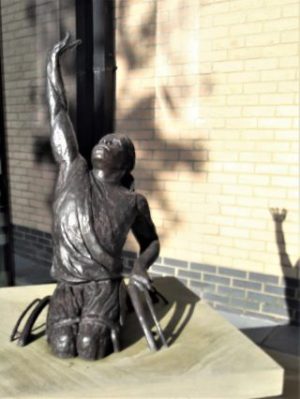
Outside in the shopping mall was a Christine Charlesworth bronze of the disabled basketball player Ade Adepitan.

Sunday gave us a break as we visited the parkland in Windsor Great Park and Savill Gardens. We strolled around the lake and polo grounds. There was filming taking place in one area so we never saw the totem pole but nearby amidst stately cedar trees was the Cumberland Obelisk, in honour of the Duke of Cumberland [1721 – 1765] of Culloden fame, son of King George II.

The Guards Polo club has 160 playing members and 1000 social members. They play from April to September on Smiths Lawn [an airfield until 1945], that would be worth a visit. There is a bronze statue representing a polo player about to strike.

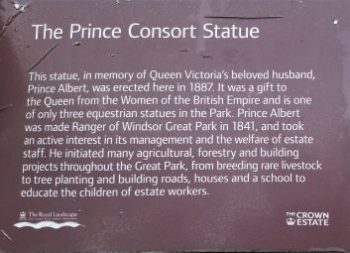
Another equine statue on our slow perambulation was in memory of Prince Albert.

We concluded our modest circuit of the lawns, Mel was pleased with his two and a half miles walk so I treated them to an expensive coffee in Savill Garden’s cafe.

Monday morning was set aside for a visit to Watts Gallery and Artists Village at Compton on the North Downs. I first came across this whilst walking the North Downs Way with Mel in 2011, [what a difference a few years make] it was closed for restoration then but somehow we enjoyed a cup of tea from them. This little complex of galleries is based on the home and studio of Victorian artist G F Watts and his ceramicist wife, Mary Watts, highlighting their work and offering workshops and other exhibitions. The North Downs Way which Mel and I had traversed follows in parts a pilgrimage route from Winchester to Canterbury and Mary created a Celtic-style cross was in memory of her husband George. The memorial was made from terracotta dug from the surrounding land and was moulded at the Compton Pottery. The cross bears a variation of a Celtic shield-knot, protection from evil spirits or danger.


First port of call was the Watts restored studio up at the Watts house, Limnerslease, where two guides gave us an insight into their methods and ideology. There were numerous artefacts from their time illustrating their artistic skills.

Limnerslease the Watts house with attached studio…

…studio.

Of particular interest was a reproduction of Mary’s method of communal tile manufacture for the Arts and Crafts Chapel down the hill [visited on the North Downs Way]. Alongside this was a vivid installation from a demolished Military Chapel in Cambridge, rescued just in time, which was meant to uplift the spirits of wounded soldiers.

Back in the main gallery, there is an outstanding space devoted to George Frederic Watts [1817 – 1904]  I am not a big fan of flamboyant Victorian artists but this exhibition won me over. First, his portraits of contemporary notables were striking, then there were several studies of beautiful wistful ladies which served as figures for him in his later grand allegorical canvases displayed in the gallery.

A smaller gallery of his sculptures didn’t really show off the massive plaster cast model for his equestrian statue, Physical Energy, for the best. A bronze cast of this is in Kensington Gardens and a newer cast is to be erected at Compton. More accessible was a plaster statue of Lord Tennyson and his dog, cast for a statue in Lincoln Cathedral.

If that wasn’t enough a temporary exhibition downstairs highlighted paintings by John Frederick Lewis [1804 – 1876] who became famous for his Oriental paintings. Some of his colourful depictions of street life in Cairo, where he lived for several years, could be replicated today. I have wandered through some of his markets. Yet another artist that I knew nothing about until this weekend.

We retreated to their excellent cafe for a rest before a bit of retail therapy in the shop where I was seduced by huge price reductions on many books. There is much more to see here and it will be worth another visit next time I’m ‘down south’.