GREBE UPDATE.

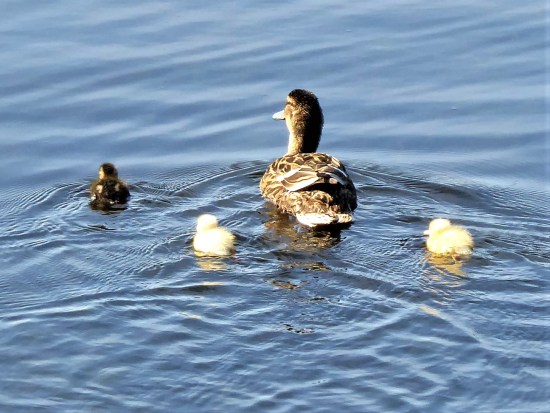
Following my post about a week ago I have kept visiting the Upper Dilworth Reservoir in Longridge to check on the progress of our Great Crested Grebes and their two chicks. I am glad to report that the chicks are doing well and swimming independently of their mother, no longer hiding on her back. I was slightly concerned that there was no sign of the male today.

June 3rd. Happy family.

June 6th. Where’s dad?

Where did mum go?

FLAG WAVING IN BLACKPOOL.


I was confused by the rash of Bank Holidays and Jubilee Festivities and found myself in the midst of Blackpool’s celebrational party, and they know how to party here. The crowds were too thick to cycle through safely, I was returning from Lytham to Fleetwood on the promenade. This was my first time out on the bike since my collision here which resulted in torn knee ligaments. I was being extra careful. 

I had accomplished my mission to visit the Mussel Tank which I’ve passed so many times without realising it was there, thanks to Shazza for highlighting it. There is some purpose to blogging after all. The tanks, built in 1934, were used for cleaning the mussels harvested from the muddy Ribble Estuary. By the mid 1950s the beds closed down, mainly  because of changes in the Ribble channel affecting restocking. There were three tanks. A cleansing tank now the RNLI, a chlorination tank now the Ribble Cruising Club and the storage tank now the Mussel Tank which has been given a face lift as an open space for public enjoyment. There are interpretation plaques about the mussel trade, an art wall displaying ceramic tiles portraying local features produced by students at Lytham Sixth Form College. There’s also a large-scale mussel sculpture by a Martyn Bednarczuk which I thought resembled a smiling dolphin rather than a mussel.


One of the original tanks. Lytham St Annes Civic Society

I was glad to see that they had restored the sails on the iconic windmill.

Nearby was an installation by Tom Dagnall reflecting on the diversity of the SSSI Ribble Estuary.

It was time for an excellent coffee break in St. Annes.

There seemed to be an awful lot of people on the prom in the vicinity of the tower. I just assumed Jubilee celebrations but as I cycled on there were more and more camera clutching folk by the tram line.

I stopped to enquire and was informed of a parade of trams from the past. Nothing seemed to be happening, so I cycled on keeping to the higher way alongside the tramline. Eventually the parade arrived. A motley collection of Blackpool trams and an exquisite turn of the century Bolton tram. There was a lot of flag waving from the passengers, they must have thought me a misery. The photos may mean something to someone.

I made it back in one piece, quite pleased with the 30 odd miles I’d cycled.

I BELONG TO GLASGOW – Part 4.

*****

Kelvingrove Art Gallery and Museum.

First stop on arriving in the immense baroque red sandstone Kelvingrove Art Gallery and Museum was their café where we relaxed and enjoyed a light lunch whilst the organ concert was taking place above.

This place is like the British Museum, Science Museum,  the V and A, Natural History Museum and the Tate all rolled into one. It’s immense, one needs a battle plan to find a way around the multiple galleries on two floors. The entrance hall is large enough for concerts with the organ at the north end.

We were most interested in the art galleries in the east wings. We were straight into another Mackintosh exhibition. Lots of examples of his work and that of his collaborators. There was a partial reconstruction of a Glasgow Tearoom which he designed for Miss Cranston who owned several tearooms in the city. There was metalwork and glass from the same era. I was struck by the design of the leaded window as it was almost identical to those in my parent’s inter-war semi-detached.

The next gallery was devoted to an extensive collection of The Glasgow Boys. Encountered earlier in the University this group of local artists rebelled against Victorian sentimentality and revolutionised Scottish painting at the end of the C19th. Outdoor naturalistic painting of local scenes and people with strong brush strokes and later French-inspired techniques bordering on the abstract. 

Time for coffee and cake, 

Now on the first floor.  Scottish landscapes, French art, Scottish Colourists and Dutch art. Quite a variety.

Lavish Scottish landscapes.

***

Large French display – mainly impressionists.

Renoir.

Monet.

Signac.

***

The Scottish Colourists, a colourful modern French style for Scotland at the start of the C20th.

J D Ferguson.

***

Classic Dutch paintings.

***

And in a room of its own ‘Christ of St John of the Cross’ by Salvador Dalí. This iconic painting was purchased by the gallery in 1952 for £8200 and now estimated to be worth £50million. Dali said he had dreamed the scene of Christ looking down on a shoreline from the cross, no nails or blood.

We had only seen a fraction of the displays in the Museum. In the west wings were a multitude of history, science and nature which we didn’t explore.  There were some outstanding paintings on the landings surrounding the first floor and from up here one had a view into the two courts.

A bus back into town, a pint in the Counting House (Witherspoon’s superb use of an old bank) and back home to Preston in a few hours.  Glasgow is certainly worth a visit whatever your interests.

I BELONG TO GLASGOW – Part 3

*****

Mainly Mackintosh.

A taxi was used after breakfast to take us quickly up to the Hunterian Art Gallery in the University. The taxi fare of about £13 was almost as expensive as our train tickets from Preston to Glasgow, £15 for the two. From the outside the gallery was a big block of concrete, brutalistic Mike said. But inside is a hidden gem – The Mackintosh House.

Charles Rennie Mackintosh (1868-1928) was a renowned architect, designer and artist creating modern Art Nouveau buildings with the interiors and furnishings complementing his minimalistic ideas. His wife Margaret was a talented artist/designer and collaborated on many of his works.

One of their projects was to transform the interior of the house they were living in from 1906 to 1914, 78 Southpark Avenue.  They had a vision for light clean lines, often taken from nature, and designed everything from the furniture to the curtains to create integrated spaces for living in. “the room as a work of art”  Subsequent owners kept the interior and eventually Glasgow University took it over in 1945. The furnitures were put in storage and when the house was demolished in the 1960s the interiors were preserved along with drawings and photographs of the house. By 1981 the interior of the house had been carefully replicated inside the university art gallery and the original furnishings installed. Carpets, curtains and soft furnishings were produced from drawings and photos.

So we found ourselves stepping into the Mackintosh’s entrance hall from over a century ago. The adjoining dining room was more of a sombre hue with distinctive Mackintosh chairs. On the next floor up elegant stairs was the L-shaped drawing room created from two rooms, As soon as you enter you are transfixed by the white decoration, flooded with light from windows which replicate the original house’s orientation. All was sublime. Delicate details from Margaret compliment the distinctive furniture of  Charles. Up a floor, and you were in the bedroom, again an L-shaped area. All white with furniture inspired by plant and bird forms.  Everything was exquisite.

For an in depth look this video is recommended.

The adjacent art gallery had more of Mackintosh’s work, complemented by his wife, and fellow artists and collaborators, the husband and wife James and Frances McNair. This included a reconstruction of one of Mackintosh’s last interior schemes from Derngate, Northampton, 1916, pictured in the heading photo.

Adjacent galleries highlighted the painter James A M Whistler. I don’t remember seeing any of his works before and was particularly impressed by his long portraits, delicate impressionism.  No sign of his mother.

The university gallery had several of the paintings of the Glasgow Boys and the Scottish Colourists.

The ‘Boys’ – an informal group of 20 Glasgow artists that came together in the early 1880s – they challenged Victorian Scottish painting, and developed a distinctive style of naturalist painting. Outdoor painting of local scenes and people with strong brush strokes and later French-inspired techniques bordering on the abstract. Whistler’s work was an influence.

Hornel, Henry and Gauld.

The ‘Colourists’ – four painters – Francis Cadell (1883–1937), John Fergusson (1874–1961), George Hunter (1879–1931) and Samuel  Peploe (1831–1935).  They used vibrant primary colours and simplified avant-garde forms. I first became aware of them at an exhibition in Woking in 2019.

Still Life . Cadell.

There will be more of these Scottish painters in the Kelvingrove Art Gallery and Museum this afternoon. Time for a break.

I BELONG TO GLASGOW – Part 2.

*****

The Burrell Collection.

A good buffet breakfast set us up for a full day. The bus took us south of the Clyde  alighting at the entrance to Pollock Park. A pleasant walk through the grounds and we were  outside the Burrell Collection building, reopened in March after a major refurbishment. It originally opened in 1983 to house the vast collection of the Burrell family, gifted to Glasgow in 1944. Sir William Burrell, (1861–1958) a wealthy shipping merchant, devoted more than 75 years of his life to amassing one of the world’s greatest personal art collections, renowned for its quality of Chinese art, exquisite stained-glass and intricate tapestries, as well as its breadth of fine art. The galleries are built with a warm sandstone and lots of glass, situated in the middle of all the greenery of Pollock Park.

We were in for a bumper day. 9000 objects from 5000 years.

Burrell collected just about everything from all over the world and the first we noticed were the many medieval doorways from monasteries and country houses, they have been carefully incorporated into the building giving access between the galleries. The interior is a pleasing blend of stone, wooden beams and glass giving a beautiful light for the visitors.

In the covered courtyard is the Warwick Vase. It was found in the C18th in fragments in the villa of the Roman Emperor Hadrian outside Rome. It was restored and given to the Earl of Warwick. The Vase stood in the courtyard of Warwick Castle for almost two centuries until it was purchased for The Burrell Collection in 1979. A large marble sculpture in the form of a two-handled drinking cup, with motifs to the Roman God of wine Bacchus. So one of the star exhibits was not actually collected by the Burrells.

Off we went around the ground floor outer galleries with exhibits scattered throughout the rooms. Burrell started collecting Chinese antiques around 1910, Jades, porcelain and furniture from all dynasties. 


Egyptian artefacts were well represented, and I was particularly pleased to see the lion head of the goddess Sekhmet, 1390BC. My cat Seth is named after this goddess, the name change when the vet pointed out his sex. 


Suits of armour were everywhere,  I was amazed at their intricate artistry and the fact that somehow they had survived intact from the C16th.


.

The museum is home to more than 700 ecclesiastical stained-glass panels from across Europe, and the outer galleries are ideal for displaying them with natural light.

You will all recognise this bronze Rodin statue.

Time for a coffee from the pop-up café in the entrance.

Now we delved into the inner galleries where pictures were protected from the outside light. I thought that the fantastic collection of master painters, Degas, Rembrandt, Manet etc needed more space to show them at their best.

There was an informative section on carpets, mainly Islamic designs.   The  C17th  Garden Carpet from Iran was displayed with its animated video representation bringing  it to life, showing how far museums have become more interactive and accessible

Upstairs were several galleries delving into the secrets of creating the masterpieces. Printing, lace making, woodcarving, metalwork, glassblowing, bronze casting etc etc. We should have left more time for these fascinating insights, but we were coming to the end of our visit and a restorative tea and cake in their café was called for.

I think we missed far more than we saw, and a return visit would be warranted. Once outside we decided to have a walk around Pollock Country Park and see the house where the National Trust for Scotland was started. We did not know what to expect but were surprised at the Georgian grandeur of the house. It had closed for the day, so we only admired it from the courtyard which was full of colourful azaleas. Walking through the stables we found a path following the river, White Cart Water, and skirting the gardens, with a view of the house frontage. The gardens were resplendent with blooming rhododendrons. We wandered back past the estate sawmills, closed for refurbishment, a cricket pitch and Highland cattle in the fields.


Back in town we enjoyed a pint in one of the oldest inns in Glasgow. The Scotia Bar established 1792. A friendly place with a good selection of ales – we had the session Belhaven. All around were pictures of old Glasgow and you could imagine the sailors of the past from the nearby docks sipping their pints in here. The subsequent Turkish restaurant was unfortunately a let-down.

A good night’s sleep is needed before tomorrow’s excursions.

I BELONG TO GLASGOW. Part 1.

*****

The city.

As we sip our pints in the unique Counting House, a Wetherspoons pub created from an old bank in the centre of Glasgow, the words in the title come to me. If we had stayed too long in the friendly, but toxic atmosphere of this drinking emporium Glasgow would have belonged to me. Sensibly we cut the session short and went off in search of some food. We found the busy Madras Café and enjoyed some good Southern Indian food before returning to our hotel for the night.

Mike and I had travelled up from Preston to Central Station on the train this morning at a ridiculous £7.50 single fare. Our plan was to explore some highlights of central Glasgow and over the next couple of days visit the outstanding art galleries. Having an architect along would give extra value for me.

The ‘Merchant City’ area of Glasgow was developed from Medieval periods but came to the fore in the C19th when merchants’ money from shipping  (tobacco, sugar, tea  and slaves) created impressive Neoclassical buildings. Everywhere we looked were historic properties. Mike had a list. First up was the City Chambers (opened in 1888 by Queen Victoria) headquarters of various city councils over the years. All was marble, mosaics and mahogany. Unfortunately only the entrance chamber was accessible (post Covid regulations) giving some idea of the opulence.

On the outside wall of the Chambers were the official Imperial Linear Measures. Not normally of great moment but since our crazy government is thinking of resurrecting them in place of the Euro metric I thought a photo would be of historical interest. They may have an armed guard on them by now.

We were in George Square surrounded by imposing buildings and full of statues of notable Scots. Sir Walter Scott was 80ft up on his pedestal, towering over Robert Burns, James Watt, Victoria and Albert and several more.

As you can see we had a damp start to the afternoon. Our next objective, on the other side of the square, was the Gallery of Modern Art (GoMA) housed in a Merchant’s building, whose history was as interesting as the art. Built in 1778 as the town house of William Cunningham a wealthy Glasgow tobacco merchant who made his fortune through the triangular slave trade. It had been enlarged considerably over the period,  namely the Corinthian pillars to the Queen Street facade, the cupola above and the large hall to the rear of the old house. Outside is the most photographed statue in Glasgow – The Duke of Wellington resplendent with traffic cones, four today! The council have given up on removing them. 

The entrance opened out into a stunning oval stairwell illuminated from a distant skylight.

The art on show included black artists who have been in the minority in Scottish culture, yet their post-colonial legacy is important today. Tam Joseph’s Timespan was intended to be a representative leap forwards in racial equality and human rights.

On the next floor were recognisable modern paintings.

The top floor, Domestic Bliss, was less recognisable with contemporary installations.

Ready for a coffee and a sit down we headed downstairs to the café in the extensive library.  I recognised this from a previous visit, but I couldn’t think when!  They had just reopened after all the Covid restrictions that Scotland had imposed for longer than England. Good coffee and cakes.

Mike wanted to visit The Lighthouse,  the former offices of the Glasgow Herald newspaper. Completed in 1895, it was designed by the architect Charles Rennie Mackintosh. The first of his designs we visited on our trip. Yet again delayed post Covid problems meant we couldn’t access the higher floors and the famous spiral staircase leading to the viewing tower. 

Mike thought that the Cathedral, the oldest building in the city, C12th, would be a good place to visit, so we set off in the rain to walk up there. My camera didn’t like the moisture and refused to work, so I switched to my phone for the rest of the day.

The Cathedral was a massive Gothic structure – inside and out. Noticeably was a central pulpitum, a richly carved stone screen between choir and nave added in the early 1400s. The cathedral had survived the reformation intact.  Somewhere in the crypt was a shrine to St. Mungo, we missed it. Some lovely stained-glass.

We re-emerged just as the rain stopped and were attracted to the Necropolis on a hill behind the Cathedral. Reached by a bridge this large Victorian cemetery has 50,000 graves, many of them with ornate mausoleums. Wandering around was like something out of a horror film, I was expecting bodies to creep out of some of the shrines. From up here the copper roof of the cathedral was very obvious, copper having replaced the over heavy lead. It was worth coming up here.

A restorative coffee in a fish bar, and we were on a train to the western dock’s area. The last time I stayed in Glasgow was here next to the Armadillo and the Finnieston Crane. We had a walk on both sides of the river, BBC on the south bank, as crowds queued for a Russel Brand concert.

Then it was back to the centre for that drink and meal, quite a busy afternoon. 

CICERONE’S LANCASHIRE – Lunesdale and Kirkby Lonsdale.

***

This is my latest route from Mark Sutcliffe’s guide to walks in the Red Rose county, although this one starts in Cumbria. Kirkby Lonsdale is a bustling market town in south Cumbria, My journey here had been slowed by several convoys of horse-drawn travellers probably heading to Appleby Horse Fair to be held next month. I park near the Devil’s Bridge where I know the parking is free, his suggestion of central parking is probably unwise.

The medieval Devil’s Bridge has three graceful, ribbed arches and is closed to traffic. I was in no hurry and in fact on arrival cross the bridge on foot to buy a coffee from the mobile stall, a favourite with motor cyclists, when at weekends up to a hundred may congregate here. It has also been the scene of youngsters ‘tombstoning’ into the river below, not to be advised. Chatting to a cyclist, of the bicycle genre, it transpires he has ridden from Preston in a time not that much more than double my car journey. The bridge has a legend relating to the devil, I liked this version…(ignore the plugs towards the end)

So it’s getting late when I start my walk downstream alongside the Lune. For two miles along this stretch all is peace and quiet, only a few dog walkers. The air is however full of rapidly flying Sand Martins, I’m almost mesmerised by their acrobatics. I suspect that this year’s juveniles are boosting the numbers. On the opposite side is a long low sandbank with obvious nesting holes visible. Ahead in the distance are the Bowland Hills, just visible in the rather cloudy sky. Behind are the Barbondale group of lower fells and there across to the east is the distinctive Ingleborough. Once he has attracted your attention you are hooked and spend the rest of the day taking more and more duplicate photographs. I make an effort today to avoid that trap, unsuccessful as you will see later.

Before long I’m heading away from the river on a flooded track up into the village of Whittington. Mark’s route takes a path parallel to the village road, but I am curious to see the old houses so take a slight diversion up the main street. I’m glad I did as there are some interesting properties many from the C17th, most of them listed.

Barn at Low Hall, late C18th…

…with pigeonholes and an owl opening.

Malt Kiln House.

The pub is closed.

The Old School. 1875.

Manor House.

The grand Whittingham Hall from 1831 is hidden down a private drive.

Eventually up the hill I reach the parish church of St. Michael with its early C16th tower. The rest having been largely rebuilt in 1875 by Paley and Austin, well known for their church architecture in Lancashire. Internally there is an elaborately carved chancel screen. The church is built on the motte of an earlier castle, where I sat in the sunshine enjoying a sandwich, The path I should have approached the church by was clear to see ahead of me. Whilst admiring the view I witnessed something I’d never seen before – an angry blackbird was chasing at low level a squirrel across the field. Presumably the squirrel had been attacking the bird’s nest.

Rest over I tackled the very steep lane heading north, it appeared to be a ‘green’ lane but was in fact a highway though I doubt few motorists would tackle it from the bottom. All was in fact very green and shady.

Once at the top I took diverted paths around Sellet Hall with views across to Barbondale and of course Ingleborough.

Sellet Hall. C17th much modified.

Down a meadow full of contented cows to Sellet Mill, a former water powered corn mill where the iron mill wheel has been preserved.

Sellet Mill. C19th much modified.

The continuing bridleway back up the hill was rather strange, behind the mill was the original millpond (now a leisure pond) and coming down into it a rocky stream. The bridle way took me straight up this stream, in parts the old cobbles were visible, but most will have been washed away. After heavy rain this way would be impossible.

At the top I came out into meadows above Kirkby Lonsdale with excellent views over the valleys and to, yes you’ve guessed it, Ingleborough. Again strangely the RofW went straight across the middle of a rugby pitch, what are your rights when there is game on?

Then it was through the middle of the Queen Elizabeth high school, I felt I was trespassing.

I found Kirkby over touristy. There are lots of interesting buildings and alleyways, but the town suffers from a traffic problem with cars everywhere, even though my photos seem to show an absence of them!. I was glad I’d parked out of town – be warned. The flags are out for the Queen’s Platinum Jubilee later this week, in case you are from another planet.

I made my way towards St. Mary’s Church. The oldest parts of the church are Norman, doors and pillars, but the structure has had numerous alterations over the centuries. Inside there are three Isles and the nave, so the church appears grand. Some of the Norman pillars have incised decoration similar to Durham Cathedral. I missed a ‘green man’ carved on one of the C12th columns. There is a C13th piscina in another.

The graveyard is extensive with some impressive memorials and at one corner is an unusual octagonal stone gazebo from the late 18th century which was formerly in the vicarage garden.

I’d come over here to visit Ruskin’s View, a celebrated view of the Lune as it curves gracefully in the wide valley with the hills beyond. Turner had painted this scene in 1822 and Ruskin, art critic, painter and poet had this to say about it – “I do not know in all my country, still less in France or Italy, a place more naturally divine.” Kirkby Lonsdale’s tourist jewel was set forever. Unfortunately there has been a land slip below the path which has therefore been closed for safety reasons. There was no way round it, so I give you this picture from the tourist board.

Disappointed I descended the steep Radical Steps to the river. The steps were built in 1820 for Dr Francis Pearson, a political radical, to divert the existing public footpath from his garden – a radical step. A level walk along the riverside, popular with locals and tourists, lead back to the Devil’s Bridge.

In its six miles an excellent walk, one of the best I have done from the book so far

*****

NATURE NOTES.

*****

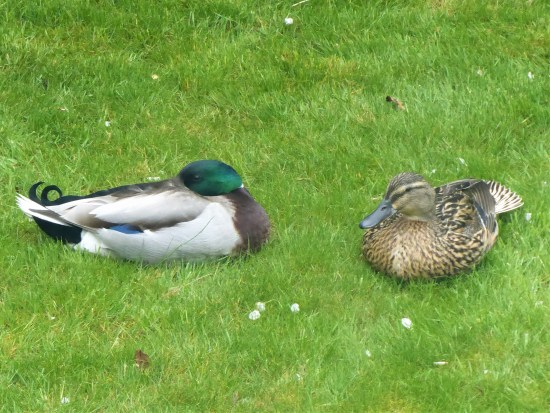
Every day I see a pair of Mallards sitting on my lawn. They were attracted no doubt by my small pond and the bird food I spread on the ground every morning. The fact that they are together suggests that the duck hasn’t laid any eggs yet, I cannot see any sign of a nest.

I made a rough home for a hedgehog out of reeds, twigs and leaves earlier in the year hoping to attract them into my garden. Yesterday at dusk a hedgehog wandered across the lawn. It is probably around when I’m in bed. Let’s hope for a family.  My photograph is not that good,I missed its snout.

The male pheasant who used to come for food has gone elsewhere. There is an abundance of blackbirds, robins, sparrows, starlings, great and blue tits all busy feeding their young scattered in hidden nests around the garden. A pair of magpies are no doubt doing damage to the smaller birds eggs.

These three were less welcome visitors.

Meanwhile, up on the Upper Dilworth Reservoir where I park to go bouldering in Craig Y Longridge there is quite a lot of activity. The Mallards had chicks a while back, not sure how many will survive.

The Canada Geese are showing off their youngsters.

The Tufted Ducks are just swimming around though they have nested on the island in previous years.

But the highlight of this week was watching the pair of Great Crested Grebes on the water. I have been keeping an eye on them for several weeks, I missed their mating dance. I saw them building a nest in the reeds, but the foliage growth had camouflaged it, so I didn’t know if she had laid any eggs.  I can see now that she has two chicks and is carrying them on her back whilst the male goes off diving for fish. They are quite a way out on the water, so my camera struggled to cope. The  two young are virtually invisible on her back from this distance, just a flash of white feathers, but when the male returns their heads pop up, and sometimes they take to the water. He feeds her small fish, and I’m sure he was also giving titbits to the young. What a privilege to be able to watch their family life.

While I’m bouldering in Craig Y I often hear a Wren’s alarm call, and today I saw her fly out from low down in the rock face. On investigating there was the domed mossy nest in a crack. I kept well away for the rest of my session.

Oh! And I thought my garden was looking very green. You can’t see the weeds.

PS. I called in to see some friends today after a walk, they have a rough patch of grass in front of their house, and it was full of orchids –  I’m not sure which variety, but I liked them.

NEW PATHS AT HURST GREEN.

I’ve probably walked out of Hurst Green dozens of times. The Tolkien Trail takes you along the River Ribble and going the other direction towards Longridge Fell you have the delightful Dean Brook and Stonyhurst College. Today I was walking with a group whom I first met at Haigh Hall a month ago – they always walk the last Wednesday in the month.

It was still raining when we met up at The Shireburn Arms at 10am. The forecast said it would stop at 12. I didn’t bring my camera partly because of the weather but also because in a group there are limited chances for photography. Of course, we all have our phones these days with functional built-in cameras. Anyhow, I didn’t expect to tread new territory.

As we walked up through the village and down into Dean Clough I contented myself with idle chatter. The interesting mill weirs and races in Dean Brook went unnoticed to most. The quarry, Sand Rock, where the building materials for many houses in Hurst Green originated passed us by. Greengore, a medieval hunting lodge of the Shireburns was duly admired. It is currently up for sale £1,250,000.

Onwards up the bridleway and I realise it has stopped raining which is a bonus for the assembled crowd, although it is very muddy underfoot. We are on the edge of woodland belonging to Stonyhurst College where they have their own private lake as a water supply and fishery. I have trespassed many times into those secret  lands where there is a hidden cross, Park Cross, with a history going back possibly to a Maria Shireburn, whose body may have been carried past here on the way to her burial at Mitton in 1754. It is one of nine  Stonyhurst crosses I incorporated into a walk from Hurst Green. I digress.

To my delight our leader takes us off on a bridleway through Hudd Lee Woods an area I had never knowingly trodden. The bluebells were over but the greens of the beeches and ferns were splendid, as a little sunlight filtered through. My spirits were lifted.

On down to the main road where we saw the remains of the C18th grade II listed Punch Bowl Inn. It is said to have been visited by the highwaymen Dick Turpin and Ned King in 1738. They stayed for three days after which Turpin travelled to York while King attacked travellers on the local roads. King was executed in 1741 and his ghost was reputed to haunt the pub. The pub had been closed for many years and the new owners tried to get planning permission for several schemes which were turned down so last year they demolished it without permission. An investigation followed, leading Ribble Valley Council to instruct the owners to rebuild it! I can see them appealing the decision and getting away with a slap on the wrist. We seem to have lost any sense of duty and honesty in this country as exemplified by the findings of the Sue Gray report published today on the goings-on of our ‘honourable’ Prime Minister.

Back onto the quieter Shire Lane with views over the Ribble Valley. Just when I thought we were cruising into Hurst Green we were taken through a farmyard and into fields trampled by a herd of frisky bullocks. While most of us tried to avoid the worst of their  excrement a brave member of the group held the beasts at bay with his walking poles.  “They weren’t here yesterday – honest” was the plea of our leader.

A bonus was one of those Peak & Northern Footpaths Society green signs erected in 2016.

A couple of awkward high stiles slowed the less agile of the party, but they were the only ones uncounted all day. Then we were heading downhill quickly and slipperily back to Dean Brook. At the bottom we found ourselves in the garden of a couple of stone built properties, one had been originally a bobbin mill supplying bobbins and shuttles to the Lancashire cotton mills  using power from a mill race taking water from Dean Brook. Again this is something I had missed in the past.

We had come full circle and retired to the excellent Shireburn Arms for lunch.

Greengore.

The Punch Bowl 2019

Now.

Heading down to the old bobbin mill.

That had been an excellent circuit and I regretted not bringing my camera.

.

CICERONE’S LANCASHIRE – Cockerham Coast and Canal.

The day was gloomy and so was I – perhaps I overdid the whisky last night. I was still mooching around the house late morning. But I keep trying to push my walking that bit farther. As you know I’m slowly working my way through Mark Sutcliffe’s Cicerone guide to Walking in Lancashire. In this I’m mirrored by Phreerunning Martin who always gets an interestingly different take from me, the pleasures of blogging. I needed something not too long and preferably as flat as possible. Walk 15 seemed perfect. I know the Glasson Dock area well and have done several variations of this walk before, probably most recently on my Lancashire Monastic Way. But looking at Mark’s  route I spotted some paths I had never walked. I might struggle to say something original about this walk.

I was a little embarrassed to leave my car in The Stork’s private car park, but the other space was taken by Travellers and their caravans. The channels of the Condor don’t look at their best during low tide. Following the old railway I came into Glasson, busy with people visiting an outdoor market. I couldn’t go past the little shop without buying a coffee, this time to drink as I climbed the minor hill to the viewpoint. The views were disappointing but the coffee good, sorry about the environment polluting cup.

I worked my way around the coast. The tide was out, so Plover lighthouse was accessible, it was previously maintained from the shore before becoming automatic. The incumbent keeper was based at Lighthouse Cottage where there was another light atop a wooden scaffold to line up ships coming into the tricky Lune channel. Across the channel I could see Sunderland Point at one time the major port on the Lune.

A sign talks of plovers nesting on the shoreline, but I wonder about this as the tide comes in fully most days.

Lots of walkers were converging on Cockersand Abbey, of which the only remaining building is the octagonal Chapter House. This has survived because it was used as a mausoleum by the Daltons of Thurnham Hall (see later) during the 18th and 19th centuries. The red sandstone rocks on the shore  line  show where the building blocks of the Abbey originated.

Continuing around the coast on the sea embankment passing several caravan parks which looked very vulnerable to high tides. It will be interesting to view this area in the coming decades as sea levels rise.  Those are the Bowland Hills behind.

Tree of the day.

Small planes kept taking off from somewhere on Cockerham sands, disappearing into the dark clouds only for tiny parachutes to fall from the skies. They were from the Black Knights centre. Was the sign for parachutists that had gone astray on their descent?

I left the coast and followed bridleways through drained lands up to Thursland Hall where one is corralled into narrow ways to bypass their fishery. Change of scenery.

A kilometre of tedious walking brought me to Thurnham Hall, a C17th country house converted into a spa hotel. It looked very smart and there were plenty of people staying in the attached residential block. Walking through I reflected that my life seems very simple compared to others. Escaping by a gate into a field I was wary of proceeding through the large herd of frisky bullocks, so I resorted to an outflanking manoeuvre bringing me back to an ancient green lane. A bridge gave access to the Glasson branch canal.

Herons are a common sight on waterways, staring motionless into the water. I have never seen one catch a fish, but today I was lucky this heron had just caught an eel and was having difficulty trying to swallow it whole. The highlight of the day.

*****

CADSHAW – FAIRY BATTERY.

By the time I arrived they were setting up the ropes – yes we have succumbed to top roping with the excuse of our too many birthdays. I was roped in, literally, when Dave phoned at 9am to say he and Rod were heading for a short day’s climbing at Cadshaw in the hills south of Darwen. I always enjoyed climbing there. By the time I had breakfasted, boiled an egg for a sandwich, cut my toenails, found my rock boots, filled my flask and put petrol in the car I was behind schedule, but no matter I was not expecting to climb for very long.

Motorways are becoming busier and busier and Darwen town centre was a nightmare. I eventually parked up alongside their cars. The OS map shows the ?natural crag as the Fairy Battery. Fairy Buttery or Fairy Buttress the origin is unknown. I decided to walk in a slightly longer way than usual to cross the sometimes tricky Cadshaw Brook by a footbridge downstream. This was a mistake as the path on the north side of Yarnsdale was overgrown and little used. Colourful bluebells diverted my attention. A cuckoo was calling in the woods above. I eventually made it through to below the rocks, there wasn’t a fairy in sight.

Not to be repeated.

I tied on and made my way up the first easy route – West Buttress, this was first climbed back in the 1930s certainly in big boots. The rock has become much more polished over the years. The route further to the right was a classic hand jamming crack – I noticed a few scars on the back of my hands as I relaxed in the post climb bath. I had to be lowered off the next climb, unable to hold on long enough to get my legs up without straining my left knee ligaments. I’m climbing basically with one leg!

West buttress.


Hand jamming.

Time for lunch.

The next two climbs on the higher east face were enjoyable on more positive rock where one could move around finding the best hand and footholds.

I used to solo all these routes before turning to harder things – how times change. Looking at an old guide book I see that I have led all the climbs here but one – Druids Direct E3 6a. How times change indeed.

Those harder routes, Druids Face.

I didn’t retrace my difficult inward route but joined Dave and Rod crossing the stream dry footed, walking out well satisfied with the day.

*****

CICERONE’S LANCASHIRE – Blackburn’s countryside.

                                                                            Glorious May.

Walk no 36 from Mark Sutcliffe’s guide combines the hills of Billinge with the River Darwen.

The River Darwen winds its way through the urban environments of Darwen and Blackburn and then has a glorious run in the countryside to eventually empty into the Ribble. I first met it today as I followed Mark’s route from Pleasington Station into Witton Country Park. Here it flows quietly through the meadows and playing fields. Walking upstream I met lots of families, dog walkers and picnickers in the afternoon sunshine. The park s very popular and well-used by the multinational people of Blackburn.

Billinge Hill above Witton Park.

Butler’s Bridge on the River Darwen.

Soon after leaving the river I was climbing steadily for what seemed ages but was only a mile or so. There are paths everywhere in Billinge Woods, there is even a tunnel, and I do find them confusing, so it was with some surprise that I found myself at the summit without any problem. The instructions in the guide were spot on. The OS map shows this as a viewpoint, but that was long ago before the trees took over. Maybe a bit of forest management by the council is needed. The plaque commemorating a court up here in 1429 is looking worse for wear also.

I headed west to find my way out of the woods and onto the ridge of the Yellow Hills (named after the Gorse that flowers here most of the year) pausing at the toposcope dedicated to Alfred Wainwright who needs no introduction. There were views over the nearby towns, but it was too hazy to see his beloved Lakeland. There are several links to walks to the memorial  For more details.

Paths, now following The Witton Weavers Way, led down through bluebell woods, lush meadows,  inquisitive cattle, newly cut fields, into the wooded gorge to meet the River Darwen once again. This I followed on familiar ways through the old mills at Hoghton Bottoms, under the railway arch and past the weir into meadows alongside the river. The last time I was along here the paths were almost impassable with mud and water, today the ground was bone dry.

Ford through the Darwen, oh there is a footbridge.

I didn’t enjoy the stretch alongside the busy A road and was glad when I turned off on the lane back to Pleasington. A seat in the garden of the parish churcof Feniscowles, Immanuel, was ideal for a break and snack. The River Darwen was crossed for the last time at Walk Mill, and I was back at the station where the local bowls club was in full swing as was the pub opposite.

Remains of Old Feniscowles Hall down by the Darwen.

Immanuel Church Feniscowles.

One for the archives.

I had seen a sign for Pleasington Priory and realising it was just a little farther up the lane went to investigate this Grade I listed Catholic Church. Trees in the grounds prevented a good view of the exterior with its tall front elevation. Above the arched entrance doorway was a prominent rose window. Gargoyles and statues seemed to be everywhere.

A well thought out and varied walk, apart from the short unavoidable A6061 stretch. The day was perfect with the countryside at its late spring best, making me feel truly alive. The modest 7 miles took me nearly four hours against the three suggested in the guide, I wasn’t rushing as I tried to protect my knee ligament and there was a profusion of colourful flowers to photograph.

*****

A RIGHT GOOD TRUNDLE.

When I started writing this blog nearly 10 years ago I called myself ‘bowlandclimber’. My first post incidentally was information on the climbing at Kemple End Quarry on Longridge Fell. I was out climbing most days, either in the mountains of Wales or the Lake District, the edges of the Peak District or Yorkshire, the Lancashire quarries or the bouldering in Bowland. What great friendships shared. As somebody said – “we had it all”

Time moves on, life evolves I’ve lost a great many friends in those years, that is the worst thing. My climbing unfortunately has taken a back seat for all sorts of reasons – OK I’m getting old and the joints aren’t what they used to be. But I’m not giving up that easily.

Today I find myself hanging from an abseil rope doing a spot of ‘cleaning’ in Kemple End. I love it up here. Those views over the Ribble Valley, the deer hiding in the quarry floor, the fresh green growth of bracken, the barn owl roosting across the other side, the thrill if anybody else is climbing here, the first chalked up handhold and the familiar movement across the rough rock, brushing off any loose dust.

Someone has reported, on a climbing forum, concerns about a hanging flake on one of the climbs – Birdy Brow for those familiar. I’ve soloed up and down this route, perhaps recklessly, for many years enjoying the positive layback moves on the flake’s edge. It has never moved.

I went back up there a few days ago and all seemed well but when you examined the flake carefully it was only balanced there by a bit of soil. There was no direct attachment to the quarry face. I felt a pang of conscience – what if someone was injured or worse, killed on this route. I was responsible for finding the route and publishing it to the climbing network. There it was in print in the Lancashire guide book, it even has a star.

Here’s a great photo of Phil Gillespie soloing it – (?copyright UK Climbing)

I’m back today intending to remove the flake which must weigh a ton. Hence, the abseil rope. I’ve brought a crow bar, but it only moves the flake a little, Maybe it is more secure than I thought, but once started I may have made the situation worse. Huffing and puffing I realise I don’t have the strength to prise it from its resting place. My car is only 50 m away and in the boot is the jack – never used in earnest before. Is this a job for the AA? 

I return and carefully place the carjack between rock and flake, a few turns of the screw and I can see results. Slowly the gap is widening, and I have time to ensure my safety and recover the jack intact as all that rock crashes to the ground. With a touch of sadness I realise the flake is no more. But there is one hell of a mess of broken rock on the quarry floor and some revision due to the climbs here.

All looks well on Birdy Brow.


Well maybe not.


That’s a lot of rock to fall down on you.


Jack in place. Does this photo make you feel dizzy?


Going.

Gone.

Down below.

A new scar to climb.

As I said my first post ever was about climbing at Kemple End, so it was fitting that this, my 1000th post, was on the same locality. Unfortunately I managed to delete a past post into the ether yesterday, so technically this post no 999, but I’m not having that. 

This is my 1000th post – maybe it is time to stop?

CLITHEROE – CROSSHILL QUARRY AND THE SCULPTURE TRAIL.

After my pleasant interlude in the Primrose Nature Reserve I drove across town to visit the Cross Hill Nature Reserve, managed by the Lancashire Wildlife Trust.

“Colonised by orchids and teaming with butterflies, Cross Hill Quarry is a shining example of how nature reclaims the relics of our industrial past.”

I found parking difficult on the road used by all the lorries visiting the cement works but eventually found a quiet spot on the Pimlico Road.  The area is dominated by the works, limestone Cross Hill Quarry was apparently abandoned in the early 1900s. I entered by the path next to the railway to walk round in a clockwise direction.  What struck me most was the notice board for the Ribble Valley Sculpture Trail. in  This was established in 1993 to make art accessible to all whilst enjoying the walks in the park. Artists liaised with the local community to produce works relating to the specific environment. I had previously passed a few of them on the riverside walk, part of The Ribble Way through Brungerley Park. There have been many newer installations, so why not follow the whole trail today?   Download your own leaflet here.

The first sculpture is one of several by Halima Cassell,  a flower head of  Great Burnet, 2009. Made up of many ceramic bricks it displays strong  patterns reflecting her Islamic heritage which you will recognise in her other works.

To start with the path was very close to the industry on the left, but one soon lost oneself in the greenery. I diverted to see the Tawny Owl Seat, 2018, created out of sandstone by the prosaic Ribble Valley Stonemasonry. I wasn’t impressed, but it did have a good view of the Ribble and distant misty Bowland.

There was a good showing of Cowslips in the meadowland here, but I realised I was probably a month too soon for the orchids and butterflies, although I did spot a solitary male Orange Tip.

Back on the peripheral path were a stunning pair of Sika Deer, 2007, by Clare Bigger. These life-sized minimalistic animals sprang out of the woodland in a flury of movement.

A little farther and there was another of Halima Cassell‘s geometric ceramics – Fir Cone.  Very grand and distinctive.

In contrast, was the diminutive stainless steel Butterflies, 2007, the first of three waymarks by David Appleyard. He developed these in collaboration with local schools.  The symbolic nature of the cutouts demand a much closer attention.

A little farther is another of his installations – Ivy, 2007.

The higher path led into the more formalised Brungerley Park. A workman was busy blowing the leaves off the paths, work I always think of as lazy and ultimately unproductive when the next winds blow. Here was the strangest of sculptures in the park. The Cook House, 2000, Helen Calaghan.  Apparently depicting a pan of boiling  tripe, is there a history of this in the quarry?  She has incorporated fossils, as found locally, into the goo.  Very strange.

Back to the more familiar at the gate – Common Comfrey, Halima Cassell, 2009.

I left the park through the ornate gates with a Latin inscription beyond me…

…only to re-enter the park lower down near Brungerley Bridge.

Again a comforting installation from Halima Cassell welcomed me back – Alder Cone, 2009.

This path now was closer to the river. The garden blower was still at work but had time to explain to me how at one time there was a landing stage for pleasure boats here and long before the bridge was built hipping stones across the shallows, with links to Henry VI’s capture in the C15th.

Disappointedly I couldn’t make much of Tom Dagnall‘s  Two Heads in an elm tree from 1993. I know the artist but couldn’t see one head never mind two. I think they must be on the other side or have rotted away.

Down some steps to the riverside I found Fish Mobile, 2007, by Julie Ann Seaman. Depending on where you stand the fish either swim in the Ribble or leap above the water. Mine did neither.

Onwards I retraced my steps on the outbound route and then dropped to the river again where I found another of David Appleyard‘s steel waymarks, Brook, 2007. Symbolic of flowing water.

Down here was also As the Crow Flies a compass feature in wood by David Halford from 1994.  Wooden sculptures don’t seem to last long in the damp NW. The next ceramic mosaic was inspired by Victorian shop doorways in Clitheroe,  Wildlife,  from Louise Worrell,  2000. It looked more  Roman than Lancastrian.

Another Halima Cassell brick creation Lords and Ladies, 2009. Nearby were the real flowers.

Alongside the riverside track were three Mosaic Waymarkers created by Paul Smith in collaboration with Clitheroe primary schools in 2005. They depicted wildlife found in the area with glass and ceramic mosaics.


My side trip into the quarry was not a great success, I forgot to look for Thomas Dagnall’s Footprints as I examined the slanting strata of the limestone. I was too soon for most flowers, though the delph was alive with birdsong.

Where the Ribble Way leaves the park to follow the river there was a striking sculpture of an Otter in white limestone, Fiona Bowley, 2007. I don’t know why, but it reminded me of the Little Mermaid on the waterfront in wonderful Copenhagen. I have yet to see an otter on the Ribble.

Down by the river was the jolly The Ribble King an imaginative piece created by Matthew Roby, 2007, from recycled materials. At least I often see Kingfishers on the Ribble.

Fittingly, as her geometric representative floral statues composed of multiple ceramic bricks have been a highlight of the trail, my last as I left the reserve was Halima Cassell’s Thistle. Again this had been installed in  the relative recent 2009 which explains why I had not seen them on my infrequent visits.

An eclectic collection of statues all having some relevance to the Ribble Valley environment. I like the way schools have been involved in some installations but from a purely visual impact the more professional statues had the most impact on my limited appreciative sensibilities. My favourite has to be the Sika Deer.

I appreciated the bench in the park and the sentiment.

Back at the car and looking at the map there was another disused quarry on the other side of the road with a green public right of way around it. I couldn’t resist it, but unfortunately the quarry has been in filled and the path is fenced in most of the way, so there was little to see. At least I tried.

Salthill Geological trail will have to wait for another day, perhaps in early June when those rare orchids may appear.

*****

CLITHEROE – A SURPRISE IN PRIMROSE NATURE RESERVE.

Clitheroe is just down the road from my home and at the back of my mind was an excellent  post from Shazza regarding a nature reserve in town. Three in particular I wanted to visit; Primrose, Crosshill Quarry and Salthill. 

I got away at lunchtime and eventually found somewhere to park adjacent to the newish Primrose Nature Reserve. I remember the excellent Primrose Nursery which used to trade across the road – now an Aldi. There is a bridge above the lodge dam and below is the new fish ladder allowing fish and eel access to Mearley Brook. The mill buildings are being converted to apartment living spaces. Work has been carried out to improve the water environment and access to it. Community And Wildlife | Primrose Nature Reserve | Clitheroe (primrosecommunitynaturetrust.org)

The lodge was created to supply Primrose Mill, opened for cotton spinning in 1787, the  arrival of the Industrial Revolution in Clitheroe Subsequently the mill was used for calico printing and later became a paper mill. The paper mill at Primrose had a relatively short life until1890, but the lodge continued to feed a Lower Mill which ultimately became a bleaching and dying works and continued to operate until 1963. The lodge became silted up. 

I stood at the bridge for some time intrigued whether the heron was real or not, it didn’t move an inch.  

I found a way into the reserve and down to a viewing platform – a few ducks only. The path through the reserve strip was followed with Blackbirds and Chiffchaff noisy in the canopy somewhere. I stopped at the ‘Manet’ bridge to view some water sluices when along came along a black Labrador which I thought I recognised from Shazza’s posts – Hugo. Of course, he was with Shazza herself, so I bravely introduced myself. What an amazing meeting of bloggers. She was as charming as her posts, and it was a joy to meet her.

I let her carry on with Hugo’s exercise as I left the reserve on to the main Whalley Road. The trustees and volunteers have created a vital green space in the centre of Clitheroe which will only improve as it matures.

Ahead of me was St. James Church looking almost as an L S Lowry painting in its starkness.

I walked back along the road and on crossing the lodge bridge once more I saw that the heron had changed its stance proving its existence.


  I next went to explore Crosshill Quarry Reserve but became distracted by the Ribble Valley Sculpture Trail, so I think I will leave that to another post.

CICERONE’S LANCASHIRE – Whalley Nab.

Whalley Nab from the station.

Another walk below 5 miles from Mark Sutcliffe’s excellent Lancashire guide, this will be the last of his easy walks to test out my knee. The train took some of the strain today. I parked up outside Whalley rail station next to the impressive many arched brick viaduct. This is the longest railway viaduct in the county. It has 48 arches and two have been built to reflect the Abbey in architecture. It took seven million bricks, and they were all made on site of local clay. I hope it will show up later on my photos from on high. The platform slowly filled with shoppers and football fans heading to Blackburn. Being a Bank Holiday I was anxious that the trains would be running but the 11.30 arrived almost on time. It trundled slowly across the viaduct with the River Calder way below. Five minutes later I was the only one alighting at Langho station. The village had a small but colourful floral display.

My walk nearly came to an abrupt end on the narrow clough leading on from Whinney Lane. The enclosed path ran alongside a stream and a storm damaged tree blocked the route. I was glad no one was able to see me crawling through the fallen branches. I only just made it and then realised a family above were watching my antics with interest. Somewhat disillusioned the father made an effort to get through but then decided it was too difficult for his wife and children, and they retreated – I pushed on.

Jungle warfare – there’s a man crawling in there somewhere

Lanes then led up to York, a cluster of houses and an inn, which seems to have had a renaissance as a gastropub. Open ground with gritstone outcrops formed a ridge which would have been good to follow, but my way took me over and down to the dam of Dean Clough Reservoir and across to farm lanes weaving through these hidden valleys. Ahead was always the distant Pendle Hill but nearer at hand was a pointed peak which I later identified as Bowley Hill, there was no obvious way up it and as my knee was hurting I didn’t feel like adventuring.

Bowley Hill.

The ongoing lane was closed due to works on the bridge over Dean Brook, more contortions were needed to outflank the blocked way. Fittingly I next passed Sunny Bank Farm as sheep and lambs were relaxing in the warm sunshine. Just emerge yourself into Lancashire’s finest. A bit of naughty signage, Private No right of Way, had me doubting the onward path but there was an obvious track up to a stile and out onto more open moor. I could have reached this point easily, and possibly more scenically, from the reservoir dam. I took the less obvious way through the woods and emerged onto Moor Lane. I thought I had been here before on either Wainwright’s Way or my Lancashire Monastic Way. Pendle was again prominent ahead as was the transmitter on Whalley Nab. Over to the left was Kemple End on Longridge Fell and the hazy Bowland Hills behind.

The lucky young occupants of the cottage above Nab Side Farm were chatty despite being engrossed in their extensive hillside garden. A little farther round the hillside I took a break overlooking Whalley and its viaduct.

An enclosed and steep monk’s trod challenged my knee ligaments on the way down to the elegant bridge over the Calder.

I passed the old Abbey corn mill, now an apartment block and I noticed for the first time the water wheel preserved within. Somehow I missed the Abbey’s gateways and went through the streets, past the ancient parish church, back to the Station to complete my afternoon’s stroll.

Now could I do something similar tomorrow?

*****

HAIGH HALL SAMPLER.

At the risk of sounding unappreciative or even worse, condescending I’m not one for walking in large parties. One can miss so much of the nature and environment you have come to experience unless led by an experienced historian, geologist or biologist. Today however I was invited to join a group on their short walk from Haigh Hall near Wigan, of which I had no knowledge, They meet once a month for a walk and a pub lunch to follow. Sounded just right for a non committing outing.

The sat-nav negotiated unfamiliar lanes to state that we had arrived at our destination in the large car park of Haigh Woodland Park. (£3.50 all day parking) Our merry group of 12 assembled, I knew three or four of them. Two hours later we were back having followed our leader of the day on what appeared an interesting three-mile circuit. Most of the interest however was passed by as conversation took preference between the friendly crowd. We retired to a local eatery for more of the sociable chat and an excellent meal, a pleasant way to spend a few hours, and I was very grateful for being included.

There was not much opportunity to take photographs as the hoard marched on.

On my return home perusing the maps and  websites here  and here I found so much more to occupy a repeat visit, probably alone. The area is full of history. Bah humbug, mea culpa.

This was roughly our circuit from memory.

CICERONE’S LANCASHIRE – A regular Ribble ramble.

A walk I must have done dozens of times. I was looking for a short flattish walk to test out my knee. Walk 22 in the Cicerone guidebook fitted the bill, and I was anticipating the woods full of bluebells. It turned out to be a day of bright sunshine but with a violent wind out of the east.

The Shireburn Arms in Hurst Green was busy with the sunny weekend weather. I didn’t use their car park but found a spot in the village near the war memorial. Lambing Clough Lane took me down past the C17th Trough House (they have a fetish for weighing scales) to the new Dinckley bridge over the River Ribble. The river was running low with the exposed pebbly beaches accessible.

This stretch seemed to be popular with dog walkers today – but doesn’t everyone own a dog or two now. Entering Marles Wood the path threads between the trees often awkwardly over the exposed roots. The bluebells were only just starting, but there was a good display of  Wood Anemones and the Lesser Celandines were hanging on. The new beech leaves were the greenest of greens.

At Sales Wheel the river was completely placid, compare with conditions when running high – SALES WHEEL – THE RIBBLE POST-FLOOD.

One of the problems with this circuit is the kilometre of road walking from Salesbury Hall to Ribchester bridge. The road however was quiet and my attention was directed to the wayside plants. The blooms of the Blackthorn are fading to be replaced by the emerging Hawthorn. Yellow Dandelions and white Dead Nettles covered the verges. Soon I was crossing the elegant bridge which has seen some recent damage from vehicles.

Onwards past the farm and into the riverside woods where flood debris is always piled up, but thankfully someone has been collecting the plastics. Unfortunately the right of way leaves the river, what a shame – if only access could have been obtained all the way back to Dinckley Bridge. I have in the past persisted in trespassing alongside the river but remember it being difficult. On this day in 1932, hundreds of folk marched on the famous Kinder Scout protest, and we are approaching a time when we may need to resist the Tory’s crackdown on our access to land.

I’ve always found navigating the fields here a bit of a challenge and Mark’s  directions didn’t really help. The bluebells in the woods at Starling Brook compensated for my previous disappointment. Wild garlic was also showing well, I must pick some for a delicious meal with poached egg.

There are good views of Pendle and the Ribble Valley from these hills. With luck, I arrived at the bridge over Dean Brook, the stream I followed to find Raven Lumb Falls last April.

A steep climb led back to Lambing Clough Lane and into Hurst Green.

As an aside on the way home I spotted another of those evocative slate poems next to St. John’s Church.  Poignant thoughts.

Anyone wanting to follow this walk could shorten it by parking at Marles Wood and avoid the loop into Hurst Green.

*****

NO GO AT NOGGARTH.

I’m resting up with my latest injury – a medial ligament tear of my knee suffered in a cycle accident on the promenade at Blackpool. For the boring details read here.

Dave phones to say he and Rod are going climbing at Noggarth this sunny afternoon. I can’t resist even if only to meet up with my mates.

Dave should be in France at The Fell and Rock Club’s Easter climbing meet. As he and his wife left the hotel at 6am to board the ferry in Portsmouth she fell onto her right elbow, they made light of it and drove onto the boat. On reaching their cabin the elbow was hurting more and stiffening. A visit to the ship’s nurse confirmed that it was more serious than first thought and a recommendation that rather than travel to France a visit to the local A and E would be sensible. They disembarked to take a taxi ride to hospital, their car by now deep in the hold, irretrievable and shortly on the way to France. I’ll pass over the gory details of her surgical treatment involving plates and screws only to say they are safely back in Lancashire – hence the unexpected phone call today. The car had travelled back by itself.

We arrive at the cemetery parking simultaneously. There is no church in the vicinity, but we surmise, rightly or wrongly, that a cemetery must be attached to a religious seat. The short walk up to the extensive quarried area is a time to catch up with our various happenings. There are a couple of climbers already at work on the main slab.

I’m only here for the beer if there was any and take a back seat as they decide on our first route. Dave takes longer than usual working his way up the smooth often holdless slab. We don’t know the grade or name as it is a newcomer to our guide which has been rapidly put out of date by new developments here. I have a feeling, that I try to suppress, that this is going to be awkward.

It’s my turn, I struggle to bend my knee sufficiently to slip on my rock shoes. Not a good start. The first 10 feet are easy, but then most holds disappear, One has to put faith in one’s feet and bravely stand on minutiae to make progress. OK, in other situations, I’ve done all this before but my rustiness today is evident. Bloody hell I’ve got a rope above me guaranteeing my safety – just stand up. Slow progress is made as I protect my left knee and it’s ligaments from excessive strain. There comes a point halfway up when the only illusionary foothold, I’ve nothing for my hands, is high up on the left. I ask for a tight rope and slowly weight my left leg, the pain starts to impinge and is only relieved by standing on a handy nearby bolt. That is what is called cheating, and I’m not proud of it. No Go truthfully. The top is gained without further ado.

Dave high on the lead of route X.

We decide to move across to the main slab and the classic route, Garth, we’ve done before. I even soloed it in the past. Things have changed and where there was previously little protection bolts drilled into the rock have magically appeared. What was once a soul-searching lead has now been reduced to simple gymnastics with no real fear of harming oneself.  The jury is out on the ethics of this ‘levelling up – or down’ All I know is that the experience is not the same but as we are becoming creeping gates it is good to reach the top.

Our hero on Garth VS 4b.

I leave the others to more climbs whilst I slink off to ‘rest my knee’ and have a stroll across the quarry base to find more slabs uncovered  in recent months. They become smaller as I traverse right but even steeper and holdless. The other pair of climbers are trying a hard route. One for another time, I’m satisfied with my efforts today, even if I didn’t climb either route cleanly.

Something a little harder.

We wander back down the path past a magnificent apple blossom that I hadn’t noticed on the way up. It is good to be out on a beautiful spring day.

We were here last year also – NOGGARTH 35 YEARS LATER. | bowlandclimber

EASTER PARADE.

To mark the Easter visit of my family from Manchester a Chinese noodle lunch was enjoyed; and then whilst the physiotherapist was diagnosing my knee problem, resulting from that cycling incident last month, they exercised the dogs up on Longridge Fell. Back at home after coffee my three grandchildren were keen to do a little outside bouldering at the local unique Craig y Longridge. Where they live in Stretford is a bouldering gym, The Depot, which they regularly visit so a chance to get outside was eagerly anticipated. Despite the recent damp weather I was able to find dry rock to climb on and in my senior and injured role was happy to point them at the problems. Great to see them enjoying themselves.

By the time we got back the washing up had all been done. Perfect.

HAPPY EASTER.