Monthly Archives: September 2021

ROUND AND ROUND AND UP AND DOWN I GO AGAIN.

   Another trip around the Preston Guild Wheel.

  Over the years I have posted several reports of cycling The Preston Guild Wheel. The last one was Dec. 2020. Now that I’m back in (enforced) cycling mode it was time for a revisit.

  As usual, I park at the Red Scar Industrial Estate and unload my bike thus avoiding the increasingly busy road through Grimsargh. Going anticlockwise, I seem to pass most cyclists coming the other way, all with a cheery hello. There is a new stretch of tarmacked cycleway leading to Durton Lane in amongst new developments, avoiding the traffic on Haighton Lane. From now on it is one new housing development after another, some have been completed since my last visit with others half finished with brave new owners living amongst the mess. Frighteningly, any other available space, green or not, is fenced off ready for the bulldozers. It is all very depressing.


  I enter the mature estates of Cottam  where the cycleway weaves between houses. As usual, I’m not paying attention and come up against a gate I don’t remember, of course I was lost and had to backtrack to pick up the route. Along here I almost had my first ‘road kill. — a squirrel ran as close to my front wheel as possible without being squashed.

The wrong gate.

   On through the University playing fields and out along the Ribble Link Canal. Here are more diversions where the M55 link road is being constructed, it doesn’t seem to have progressed much since my last visit.

  I notice men with big camera lenses alongside the dock railway and with a little luck as I cycle the Ribble Embankment along comes a steam train for some extra excitement.

  Preston’s Parks whizz by and I’m soon leaving the Ribble into Brockholes Nature Reserve, I didn’t stop to visit the ‘getting to know snakes’ encounter advertised for this afternoon. I’m always glad to get out of the saddle for a while for the push up the steep hill of Red Scar back to the crematorium and my car. But today on a whim I went round again, another 21 miles, albeit more slowly, there are more hills than you realise. I have a secret plan and I need to see if I’m getting cycling fit, the answer is not quite yet.

*****

  In my head were the lyrics “round and round and up and down I go again” which I couldn’t place. Once home Google soon unearthed Let’s Twist Again, a big hit for Chubby Checker in 1960.

  This is not to be confused with Twist and Shout which became a Beatles hit. They performed it at The Royal Variety Performance in 1963 when famously John Lennon said “For the people in the cheapest seats clap your hands and the rest of you just rattle your jewellery” much to the amusement of the Queen Mum. But I digress.

BRING ME SUNSHINE.

    I hadn’t intended to come to Heysham but the day seemed suited to exploration. I had parked up again at Halton station and cycled into Lancaster on the old line, as I did last week on my trip to Glasson and beyond. My plan today was to continue on the 69 cycle way into Morecambe and then explore the coast northwards. I was soon crossing the Lune on the Millennium Bridge and then taking another old railway line, still cycle route 69, westwards. Two thirds along here I noticed a marked turning perhaps towards Heysham and on a whim diverted off onto what must have been a branch line of the railway. I was now in the hands of the sign setter. At first, I was on a cycleway between horse paddocks, but then I was directed into suburban streets, thankfully traffic free. Signs were followed until I lost them, and then I followed my nose into the inevitable cul-de-sac in Higher Heysham. A bit of backtracking and then a bit of the main road past the C16th Old Hall Inn down to the ferry terminal.  Not the best way into Heysham.

At last the sea was now in sight. The road came to an abrupt end, but I was able to cycle through on a rough path to arrive at Half Moon Bay where there was a café, but every seat was taken. An advantage of cycling over walking is that it is easy to continue on to the next source of refreshment, though that didn’t quite work out.

Half Moon Bay.

Onwards and I found myself in Heysham Village. Lots of quaint alleyways, I remember from years ago a house selling potted Morecambe Bay shrimps, but couldn’t see it today. Soon I’m alongside St. Peter’s Church. It is thought that a church was founded on this site in the 7th or 8th century. Some of the fabric of that church remains in the present church. In the graveyard is an Anglo-Saxon cross and a stone grave. A track goes up onto Heysham Head to the ruined C8th St. Patrick’s Chapel. Most people come here to view the ‘stone tombs’ — a group of six rock-cut tombs and a separate group of two rock-cut tombs. Each tomb has an associated socket, probably intended for a timber cross. I have to say that today with a perfect blue sky and clear views they were magical.

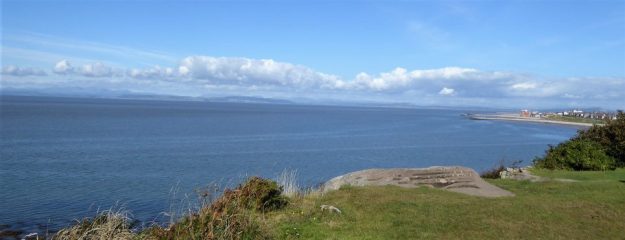
  I found my way back onto the promenade around Morecambe Bay. Views across the water to the Lakeland Fells held my attention as I approached the West End of Morecambe. I was soon alongside the 1930s art deco Midland Hotel. Somewhere along here is the proposed site of the Eden Project North, which is expected to bring back prosperity to this ageing seaside resort. I’d never been down the ‘stone jetty’ to the old lighthouse, it was along here that a fellow blogger described what she thought was the ugliest sculpture, I’m inclined to agree with her.

  Also on the jetty is a bell that only rings at certain high tides. This bell is one of several around the coast of Britain  connecting us with our maritime heritage and a timely reminder of climate change. https://timeandtidebell.org/#

Bay surging, channels filling, sun setting, I ring, I sing. Listen in.”  written by the local artist community is going to be engraved onto the bell.   I must come back one day at high tide.

   The promenade is wide all along the front so cycling was possible without endangering the crowds enjoying views. I don’t stop at every attraction, I came this way back in 2109 whilst walking A Lancashire Monastic Way, but I have to visit Eric Morecambe’s statue on a sunny day like this.   

Commander C G Forsberg. Master Mariner and Marathon Swimmer.


  From time to time I stop and gaze across the water to the Lakeland silhouettes and as I round the Bay, Arnside Knott and Grange become more prominent. “Best view in Britain” one of the locals tells me. I knew of a café at the far end of the promenade where I thought I would get a snack, but time had flown, it was now 3.30 and they had closed.

   The main road had to be used to enter Hest Bank where I found a garage that sold coffee and pies. I sat outside, still enjoying the warm sunshine. It’s always a mistake to ask a local motorist for directions when you are walking or cycling. ‘Go down the road until the traffic lights‘ – no mention of how far that is. ‘Follow the signs to Slyne and at the T-junction turn left to Halton’. After the lights half a mile away, I ended up on the busy A6, there wasn’t a T-junction and I was almost back to the garage where I started. At least I was on higher ground and had a good run down over the M6 into Halton, with the Bowland Fells in the background, and over the narrow bridge to my car, the last in the car park.

  There may not be many more days like this as Autumn draws in — bring me sunshine any day.


*****

SOIXANTE NEUF.

    I thought I’d give this post a sexy title to boost readership. Not that I look at all sexy in my fading Lycra cycling shorts. There should be an age limit for appearing in public wearing Lycra, and whatever it is I am long past it.

  I’ve driven up the motorway, coming off at Junction 36 and found the narrow lane leading down to a car park at the redundant Halton station. This is on the old Morecambe to  Wennington line which closed under The Beeching Act in 1966.  Route 69 of the National Cycle Network connects Hest Bank on Morecambe Bay with Cleethorpes on the East coast and uses this section of line from Morecambe to Caton.  Off I pedal westwards on the 69 into Lancaster. The River Lune is mainly hidden and I don’t recognise much until the Millennium Bridge where the 69 crosses the river. I’m heading to Glasson Dock, so I stay on the south side of the water. There seem to be a multitude of cycle paths in Lancaster and just following my nose I end up under the castle with the priory church looking down on me. A few streets later and I find my way back to the river which is not looking its best, the tide is out exposing lots of mud. I’ll locate the correct way next time.

Halton station.


Soixante neuf.


Under the M6.

The canal aqueduct.


The new Greyhound and Millennium Bridges.


Priory church — getting lost.


Lost.

   Eventually I’m safely on the old railway track heading to Glasson. Lots of cyclists are using this route, I keep leapfrogging various parties as we go at different speeds, and I’m frequently stopping to take pictures of the Lune estuary. I have walked this stretch in the past when I was connecting a Lancaster Monastic Way. It is interesting to contrast walking a route and cycling it. One misses the little details as you ride by and although everyone says hello there is no chance to chat, that is until you reach a café and then can delve into gears and stems. As I don’t know one stem from another, I avoid the busy cyclists’ rendezvous at Glasson and cross over to the little shop which has freshly baked pies and good coffee. Here I can talk to the mature couples who have motored here for a good old-fashioned afternoon out. And of course there are the fishermen with their ready tales of yesterday’s catch.

Glasson across the marshes.

Up the creek?


Lost forever.


Smell that coffee.


Pike?

   A lot of the cyclists head back the way they came, but I’m in for exploring different options that I’ve spotted on the map. So off I go along the rough narrow track, you couldn’t call it a towpath, alongside the Glasson Branch Canal to meet up with the Lancaster Canal. Ahead are the Bowland Hills, looking splendid in today’s sunshine. An easy option would be to follow the canal back to Lancaster, but I’ve walked that stretch many times.

The Glasson Branch

Endless games of fetch the stick.


Junction with the Lancaster Canal.

  So again I go my own way again, threading through Galgate and onto lanes crossing the motorway and leading into the hills. There is only one bit I have to walk up, and then I’m onto the lovely high level road to the scattered houses of Quernmore. From up here are views across Morecambe Bay to the Lakeland Fells with the Bowland hills rubbing at my right shoulder. I sweep down past the isolated Quernmore  church and on to the entrance to Quernmore Estate at Postern Gate which I recognise from our  ‘trespass’ on the straight line from my house to Sir Hugh’s in Arnside.  I daren’t risk cycling through today so I take the busy road down to Caton and am soon back onto  that rail line  — Route 69.

Lancaster University, Morecambe Bay and Black Coombe.

Grit Fell.


Quernmore Church.

Postern Gate — tempted.


Down to Caton.

  This last section back to Halton is impressive by dint of passing over two viaducts above the Crook Of Lune built in 1849 to carry the railway. This is a popular spot today with tourists, walkers and cyclists. There are stunning views up the Lune towards Hornby Castle and Ingleborough. Turner’s painting of the scene, pre railways, shows  the original Penny Bridge carrying a road. This road bridge was rebuilt in 1889 and stands just below the East Viaduct. A long stretch in trees with little sight of the river has me back at Halton Station.

Eastern viaduct.

The Lune valley eastwards.

Crook of Lune road bridge.


Western viaduct.

Halton Bridge.

I go down to the river near the wrought iron lattice bridge built in 1911 from the remains of the Original Greyhound Bridge in Lancaster. Sitting quietly in the sunshine, contemplating the slow flow of water before hitting the motorway. I didn’t need that sexy title  — this landscape has no need of titillation.

*****

HOW MANY LIVES DOES A CAT HAVE?

  Seth doesn’t appear Wednesday night, no sign of him. Thursday morning. I go round my neighbours checking garages and sheds. No sign of him along the road. The road that at the moment because of closures has become the main through route in Longridge. The traffic is non-stop, a cat doesn’t stand a chance of crossing the road — I should have kept him in.

  Seth is named after the Egyptian goddess Sekhmet. So why a female goddess? Well, when I took ‘her’ as a kitten thirteen years ago to be spayed, the vet announced she was a he. Oh! So I quickly changed her/his name to the masculine Seth and then he was neutered.

  Historians say the Egyptians revered the number nine because they associated it with their sun god, Atum-Ra. According to one version, Ra gave birth to eight other gods, (including Sekhmet). Since Ra often took the form of a cat, people began associating the nine lives (Ra plus eight) with feline longevity. In truth, they only have one like the rest of us but their agility often gets them out of serious situations.

  I went to bed Thursday night fearing the worst. Friday morning there he was curled up at the bottom of the stairs. But he was not happy, a quiet moan and a tired look in his eyes showed he had a problem. I  picked him up and realised the right back leg was hanging at an unusual angle, he showed distress if I moved the limb. How had he managed to drag himself home? Nine lives. A phone call to my local vet arranged an appointment that afternoon. They thought his hip was dislocated and would have to sedate him to try to relocate it. I was asked to come back at 7pm. 

  7pm. The receptionist explained they were still trying to manipulate it. Her concern was obvious. I sat in the waiting room, it felt like being in casualty at a hospital. I read all the notices on the walls. (I never knew lily stamens were deadly to cats and dogs)

  7.30pm. Nigel, the vet, appeared with sweat on his brow  “we are struggling to get the joint back into place”. It felt even more like casualty.

  8.00pm. Nigel came back looking much happier, he had been successful. All I could do was thank him for his skill and persistence.

  8.30pm. Seth had come round from his anaesthetic and was back in his basket. There had been no other injuries. I was given instructions for the next 24hours or so, and  took him home. We both slept well.

  Over the weekend he was placed in a roomy cage in the kitchen to give him space but avoid over movement. He slowly showed his indomitable spirit and demanded food. I gave him some chicken pieces as a treat. When he stood up, both rear legs seemed supportive. He complied with his restriction with a knowing look.

  Back at the vets for a check-up on Monday morning. All the staff seemed pleased, and no doubt relieved to see him well. The star took it all in his stride (no pun intended) Keep him in the cage for a month to ensure there is no strain on the joint was the advice. He will need lots more treats! Thankfully, I have no plans to be away, or at least I can postpone them, so I can give him all the attention he deserves.

  He can’t tell me what had happened — just another of his nine lives.

A RURAL RIDE FROM LONGRIDGE.

  Not a footpath in sight, not a stile climbed, not a fell summited, and you will be pleased to hear not a church visited. Oh! Well, maybe just one. My heel is playing up just when the weather is bucking up. Not to be defeated, I drag my bike out of the garage and do a few short rides around Longridge. So today I was ready for a longer ride. Out to Bashall Eaves, Cow Ark, Chipping, Whitechapel and back, about 29 miles (47 km) or so.

  Cycling brings a different aspect to one’s locality. No flowers to identify, no birds to watch, no passing conversations. Just the tarmac ahead and that steep ascent looming. Today I concentrate on the inns that I pass, past and present. In the Ribble Valley and Bowland we have been lucky to have had an excellent selection of quality establishments. Rural inns have a long pedigree, their names tell us much of the local history. Unfortunately the country inn has suffered from economic pressures and several hostelries have bitten the dust.  Covid has had a serious effect on the hospitality business.

    On my corner is the Alston Arms, now The Alston which has had several reincarnations since its establishment in 1841. It has survived the COVID lockdowns and  seems as busy as ever with locals, a large outside seating area has helped. Strange that I have not visited since over two years ago, when it was the favourite venue of my friend developing Alzheimer’s disease. She always ordered the same — fish, chips and mushy peas. And they were good!

  The second one encountered on the road is the Derby Arms, recently reopened after a period under a fish franchise, The Seafood Pub Company,  It looked open today for lunch, so all is well, hopefully. The area around here was part of the Derby Estate. The Stanley Family, Earls of Derby, established lands in Thornley here, hence the pub’s name.

  Along the way through Chaigley I pass the former Craven Heifer Hotel. The Craven Heifer became a popular pub name, particularly in the Craven area, so I don’t know how one popped up in Bowland. This hotel was a regular eating place at the end of the last century, it closed Christmas Eve 2008. Since then, it has been a private residence.

  On the way down to the Hodder I passed these gates which are normally locked. Today they were open, and I had a quick peep into their lands, with a lake and a large house in view. No idea who lives here. Chadswell Hall.

  I stopped off at the Higher Hodder Bridge, the river was as low as I’ve seen for a while. Just up the road is the former Higher Hodder Hotel. This was another hotel with a long period of serving good food and ales. It became well known to the fishermen casting in the Hodder below. I noticed on an old photograph a petrol pump in its forecourt, those days are long gone. Its demise came in 2001 with a severe fire from the kitchen. Bought by a local businessman and converted into apartments. It still has problems with erosion from below where the Hodder flows, undermining the banks. One day it may all fall into the river.

  At the next crossroads I knew of an ancient milestone but had never stopped to investigate, Today I had a good look at it. There was lettering on two sides with mileages.  On the West face  To Preston 10M. To Gisburn M8. On the North face
To Lancaster 16M. To Whalley M3.  1766. It turns out that this is Grade II listed.

  The next pub is the Red Pump in Bashall Eaves. This had been closed for some time when it was resurrected by the present owners in 2014, who turned it into a ‘gastropub’ with accommodation including recently added Glamping Yurts and Shepherd Huts.  I notice that it has restricted opening hours, so calling in for a pint is not always possible. The pub has a connection to a murder mystery  that was never solved.

  Some serious pedalling has to be done climbing the road towards Browsholme Hall who have got in on the café scene. No time to visit today. On through the strangely named hamlet of Cow Ark and soon I’m freewheeling down the road which follows the line of the Roman Road from Ribchester to Carlisle and back over the Hodder at Doeford Bridge.
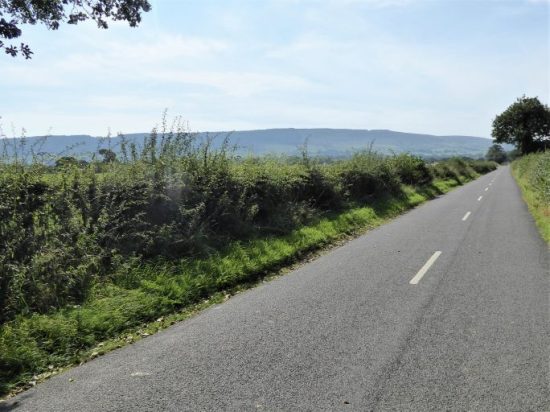
  The Gibbon Bridge Hotel is a little farther on and has a history only going back to 1982 when the family diversified from farming to catering. Over the years the hotel has grown and particularly in recent times with the focus on weddings. They still do a good lunch in the dining room, with magnificent views over the gardens and Chipping Vale.

  Chipping at one time had three pubs in the village. The Talbot has been closed  for years and is looking in a sorry state. Opposite, the Tillotson’s is now open again but has annoyingly random hours, they were missing trade today as lots of tourists were wandering around the quaint village.

  The Sun has had a renaissance and is now thriving both as a locals’ drinking pub and a reliable eatery. It is reputedly the most haunted pub in Lancashire.  https://www.youtube.com/watch?v=aA1MZp3WYdI  I couldn’t resist a wander around the churchyard looking for Lizzie Dean’s gravestone.

  The Cobbled Corner Café has not reopened — it was a favourite with cyclists.

   The Dog and Partridge just outside the village dates from the 16th century but closed in 2018 and is up for sale for residential development. Sign of the times.

  I now head out to Whitechapel on narrow lanes under the shadow of Beacon Fell, When I first came to this area in the early seventies a curiosity was the Cross Keys Inn run by a farming family. It had irregular hours depending on work on the farm, a quirky bar, a good pool table. Late night sessions were common. At times, if the landlord was busy elsewhere, there was an honesty box for the drinks you had consumed. The inn was known, tongue in cheek, as The Dorchester! It closed over a decade ago but was bought by a local builder who has restored it along with accommodation units and has recently reopened it. Again, as the case with many of these rural pubs they are not open every day, particularly at the beginning of the week, but it is good to see it trading and I’ve promised myself a pint there soon.

   Down the road is yet another Lancashire village, Inglewhite, centred on a village green and a cross. The pub here is called The Green Man and has a date stone of 1809. Green Men go back to pagan times and are a fairly common inn name — the sign here depicts a typical Green Man. This pub has been closed off and on for several years, reflecting the difficulties of successfully running a rural inn. Let’s hope it stays open for the foreseeable future. It was not open today!

Homeward-bound now with tiring legs, I pass the last rural pub — Ye Horns Inn. An 18th century listed building that closed four years ago. It had been run as a family business for decades, famous for its Goosnargh Roast Duck reared down the road, and its unique wooden panelled snug located behind the bar. New owners have developed the site with residential properties, but hope to reopen the pub soon. I await with bated breath. Another unique feature here is the men’s urinal across the road from the pub. Not sure how many drunken patrons were run down on this precarious crossing.

  It is strange that my trip around all these rural inns didn’t involve any alcohol intake but as you saw several are closed for good, others concentrate on dining and others have limited opening. With a bit of organisation and forward planning, a right good pub cycle could be achieved around the eight trading pubs— but whether it would be legal or safe to ride a bike at the end of it would be debatable.

LAST DAY ON THE TWO SAINTS WAY.

Cannock to Lichfield.      7 miles.

  My B&B host gives me a lift back to the Ring Circle Fort, and I’m on my way, downhill to Lichfield.  One was supposed to be able to see the cathedral from up here, but low cloud prevented that. There was good walking up on Gentleshaw Common and then old tracks through woods to come out onto quiet lanes to sleepy Chorley.

Back into the fields I came to Farewell Hall and the Church of St. Bartholomew built on the site of a priory.

For the next two miles I walked along the ancient Cross In Hand Lane, so named from the wooden cross pilgrims would hold as they approached St Chad’s Well. This lane was a joy to walk, in places hewn out between sandstone banks and in others with mature hedges. A scattering of farms were passed along the way, and at the bottom of the last hill a cave reputedly used by Medieval candle sellers to pilgrims.
Medieval cave?

Lichfield was entered alongside the old Pinfold, which has been recently restored.

The house belonging to Erasmus Darwin, the Physician and naturalist and Charle’s grandfather, is now a museum in the shadow of the cathedral. The man himself was looking out of a window. There are many fine houses in Lichfield which is worth a longer visit.

At last the three unique towers of Lichfield Cathedral were seen as I approached the magnificent entrance. A Saxon church was built here to house the bones of St Chad, to be replaced by a Norman Cathedral, the present Gothic structure dates from the 13th and 14th centuries.  One walks down the beautifully vaulted nave, through the chancel and there in front of you is the shrine of St. Chad.

Behind in the Lady Chapel are the famous Herkenrode stained-glass windows rescued from Belgium. St. Chads Head Chapel was closed to the public.

Two relics related to St Chad were on display —  The Lichfield Angel,  a beautiful limestone carving from the chest that contained his bones. The 8th century St. Chad Gospels, from which St Chads cross emblem was derived.

Leaving the Cathedral I notice the statue of St Chad by local sculptor Peter Walker  recently installed in the grounds. He looks a kindly man. The south door is every bit as good as the main one,

I then wander alongside the lake, Stowe Pool originally a 12th century millpond and fishery, to reach St Chad’s Church and Well and my final interpretation board!  When St. Chad arrived in Lichfield, 669, he baptised converts at a local spring and founded a monastery. He was buried here in 672 but his bones moved the Cathedral when it was built in 700. The present day church is mainly from the 14th century with many more recent modifications. Nearby is the Well which has been popular as a pilgrimage place, at one time surrounded by arched walls but now by a simple wooden structure. I’m not sure that the water is very pure.

My journey had come to an end, I have learnt a lot and experienced a good mixture of rural and urban scenery. The route was well thought out in that respect. The churches have been inspiring and whatever your religious views they are beautiful buildings and how well we preserve the past in Britain. The problem of churches being closed occurs anywhere nowadays. The guide book is well written and informative, the instructions are clear. There was no shortage of accommodation (putting my Crewe faux pas aside) or dining possibilities, although Covid precautions are still affecting the latter. As usual, I met relatively few people walking any distance, and only four on The Two Saints Way. I covered 90 miles from Chester to Lichfield, but I have to say I was relieved to know I could now rest my heel for a few days. There has been constant background pain all week, which at times distracted me from my surroundings — I was beginning to feel like a real pilgrim towards the end and possibly should have dipped my foot in St. Chads Well.

*****