Category Archives: Scotland.

JOHN O’GROATS TRAIL. 3 Invergordon to Tain.

Quiet roads.

It was only in the morning as I left that I noticed all the wall murals in town depicting the history and culture of the area. There is also a distillery on the edge of town, a part of Whyte & Mackay producing grain spirit for the blending industry.

The B817 road along Nigg Bay was almost absent of cars and for some of the way I could use the beach. Oil rigs were prominent in the bay.The villages passed had no facilities so I pushed on and found even quieter lanes inland. The odd cyclist passed me with a cheery greeting [not all cyclists are odd!] A petrol station appeared and an ice cream was purchased.

The A9 was perishingly close but I was able to continue on an old road which was slowly being reclaimed by nature. At its end it was a short hop across the main road to reach the rather isolated Shandwick Arms where I rested over a Belhaven ale and sandwich. Despite being refreshed I soon ran into blocked ways and escaped to fields and barbed wire crossings. Then all was all plain sailing on little used lanes passing small crofts. I didn’t try to join up with the JO’G Trail in the forests which I had heard was difficult. So I was soon dropping into Tain a prosperous looking town just above the Dornoch Firth. It was only in the last few hundred yards that I touched the JO’G Trail. An uneventful day’s walk through very pleasant scenery.

On the outskirts of town today a Highland gathering and games were taking place. My hotel was central and the games continued into the night by the sound of it.


*****

JOHN O’GROATS TRAIL. 2 Culbokie to Invergordon.

Over and along the Cromarty Firth.

After a breakfast of fresh farm eggs I took the lane dropping down to the Cromarty. The causeway bridge carrying the A9 was plainly visible, it looked a long way across. The traffic was heavy and fast but there was an adequate footway on the verge for my 30 minute crossing. As well as the traffic hazards terns were dive bombing me at the far side. I couldn’t wait to leave the road on the other side and I probably took the wrong path which led me up to the railway but no further. I resorted to trespassing along the line, The Far North Line, for a distance until I reached the level crossing I should have been on.  These private level crossings were a frequent feature across the single line railway, there aren’t many trains per day.  My track went up to a house and then onto a quiet country lane high above the water so there were good views all morning. The only people using the lanes were cyclists, many on a LEJOG trip. Groups of them were using backup transport which meant they could travel light. The busy A9 was somewhere out of sight and sound.

I arrived in sleepy Evanton at coffee time and the Novar Arms duly obliged. The B817 road was a bit busier but immediately out of the village was a signed cycle path in the trees alongside the road so the continuation was quite pleasant. Interestingly most cyclists persisted on the fast road leaving me to enjoy their cycle route. This gave me time to take in the views and high above me on a hill was the Fyrish Monument. Built in 1782 for Sir Hector Munro lord of the area who had served in India. It represents the Gate of Negapatam, a port in Madras, which General Munro took for the British in 1781. At the time the local population was being cleared off the lands they had worked for centuries to make way for profitable forestry and sheep. Survival was a problem and it is said the folly was built to help keep the locals in labour. The view from up there must be good but no time today. Along the road were signs of the Novar Estate, Sir Hector’s home. now concentrating on tourism of the shooting and fishing variety, somewhere in there is the big house. Out of interest his two sons were both killed in India one by a tiger and the other by a shark!  His daughter married and the estate passed into new hands.

The cycle path ran out leaving a stretch on a boring footpath adjacent the busy but safe road into Alness. A thriving little high street on which I found the basic Cafe Picante for a cheese toastie. I got the impression that most of the staff were central European as well as many of the clients. Oh and why do all these villages have so many, mainly Turkish, barbers?

Wanting to lengthen the day I pushed on a further 3 miles or so to Invergordon. This meant leaving the route of JO’G Trail, not that there had been much evidence of signage throughout the day. Again I was lucky as there was a cycleway out of town parallel to the road. I dropped down past the renowned Dalmore Distillerry to the shores of the Cromarty which I followed pleasantly into town. Along here I passed a standing stone marked as a Symbol Stone on the map. This is the Bronze Age Thief’s Stone which has three C6th or C7th  Pictish symbols carved on it, I couldn’t make them out. Looking back up the Cromarty I’m fairly sure that is Ben Wyvis in the back ground.

The views down the water were dominated by oil rigs in for repair. They looked strange with their legs up in the air.

Invergordon was an unpretentious town with a wide high street. It was at one time an important naval base and there are masses of old fuel tanks still on the edge of the houses. Aluminium smelting works closed and the oil rig business was a saviour. As I found later when wandering down to the harbour Cruise ships now call here because of its deep waters. One was being piped out this evening on its way further north.

The Marine Hotel where I stayed benefits from the cruises by the bus drivers and guides staying here, It was basic but friendly.

What had appeared to be a day on lanes turned very pleasant and interesting.

*****

JOHN O’GROATS TRAIL. 1 North Kessock to Culbokie.

The Black Isle lanes.

A delightful day’s rural walking.

Munlochy Bay.

The day started dull and moist but before long brightened up with ever increasing temperatures. From the tranquility of the waterside I ducked under the A9 and followed lanes up onto the Black Isle. It’s not an isle at all, just a peninsula and there doesn’t seem to be an adequate explanation of the ‘black’ bit either. Walking along I had time to award a top 5 of discarded cans in the ditches – Iron Brew, Dr. Pepper, Lucozade,  Red Bull and Tenants in that order. Wild flowers also drew my attention in a more positive way. There were wooden signposts which I wasn’t sure related to footpaths or roads. The road I was on soon became a dirt track anyway to isolated farms. At the first the farmer explained to me that the dominant crop on the Isle was potatoes, which weren’t doing well in the draught conditions, there was ample evidence where they went to.

Further on was a croft where the man expressed surprise at my presence, he proceeded to tell me how he existed in this remote place as buzzards wheeled overhead. His 4 wheel drive vehicle was backed up by several identical scrapped versions lying around – “for spares”. He proudly showed me the onward path down to the bay which he personally mows for his own route to the pub. It was therefore a pleasant stroll down to the water’s edge where I met up with the real JO’G Trail which had come through the forests. My hostess had warned me about ticks and in the high vegetation I was becoming paranoid about their presence.

Oyster catchers and Shelducks congregated on the bay. By the time I reached Munlochy village I was hot and sweaty and ready for a drink so the Allangrange Arms was irresistible. The locally brewed [Cromarty Brewery] Happy Chappy pale ale was perfect with a salmon bagel. In the village was an impressive church, unfortunately locked, with its presbytery alongside.

I followed a sign for forest footpaths, birch and pine, to the Clootie Well, a place of pilgrimage where a cloot or rag belonging to a sick person is hung in the hope of a cure. I wasn’t prepared for the vast amounts of rags deposited within a 50 yard radius of the well itself, every tree was festooned.

I used small lanes passing crofts and cattle but no traffic to take me over the hill to Culbokie, a small hamlet with a shop and a part time pub. I stocked up with salad items before going down to my evening’s B and B. This proved to be a characterful lodging with sociable hosts and dogs, lovely rooms and a view over the Cromarty Firth and distant Ben Wyvis. Whilst watching the sunset I got to sample Steve’s home brewed beers which were every bit as good as many a micro brewery.

*****


JOHN O’GROATS TRAIL. [Episode1] Inverness to Helmsdale a start.

There’s a new trail being developed up the coast north of Inverness, partly to keep ‘end to enders’ off the maniacal A9. This venture also hopes to highlight the magnifcent scenery in NE Scotland.

In some ways the route consists of two halves. The southern week’s walking is mainly flattish along the shoreline whereas the second  half north of Helmsdale is rugged walking over high cliffs.

The next few posts are of the first half from Inverness.

*****

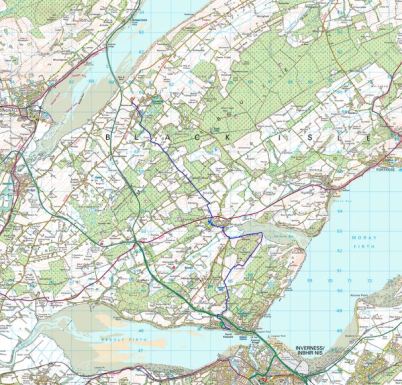
The beginning of how to avoid the A9.  Inverness to North Kessock.

As part of my ongoing Lands End to John O’Groats exploits another week was looming. We are having such hot weather down here i thought Scotland could give some relief. A few weeks ago JD and I filled the gap in the Scottish Lowlands leaving me only a section north from Inverness. I had heard horror stories of people walking on the A9 and was determined to avoid it if at all possible. A little eleventh hour research came up with the John O’Groats Trail, a coastal route from Inverness.  Before I knew it, most of my trips are last-minute decisions, I was stepping off the train in Inverness. I was not impressed by the city – too many tourists, too many drunks and beggars, too many cheap high street shops. I was therefore glad I had booked a B and B across the river for the first night, this gave me an easy 4 miles evening walk to help me on the way and escape the city. I didn’t even stop for a coffee.

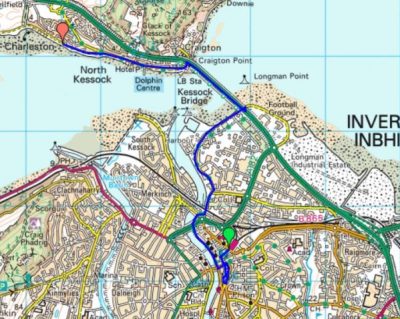
The official start of the trail is outside the castle where there is a fine statue of the Jacobite heroine Flora MacDonald, the one of Bonnie Prince Charlie fame. I did find a waymark for the JO’G Trail. Pleasant walking initially alongside the River Ness led into industrial estates where the only building of interest was Cromwell’s Tower – this is all that remains of a great fort here completed in 1682, It seemed incongruous in the industrial setting.

Once alongside the Beauly Firth the massive Kessock Bridge carrying the A9 made itself present. A scramble up the banking onto the pathway felt illegal. The way across was scary up close to thundering traffic which seemed to be ignoring the 50mph limit. It was a long way down to the water and my search for dolphins was futile.

Thankfully off onto quieter lanes at the far side life became tranquil once more. My B and B on this north side was a haven of peace overlooking the Beauly Firth. I slept well anticipating some interesting explorative walking.

*****

A WEE DONDER. 8 Glasgow to Milngavie.

Change of plan – Milngavie to Glasgow, the Kelvin Walkway.

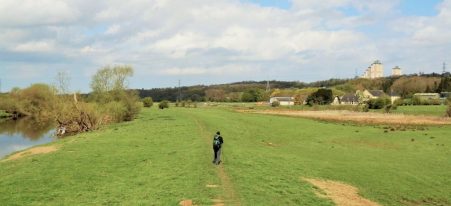
I’m still not absolutely sure, and it was my idea I think, why we changed our direction for today. An early morning train was taken from the Exhibition Centre to Milngavie.It was years since I’d been here and I was surprised at the amount of signage for the obviously popular West Highland Way. Several groups of backpackers were setting off on that journey. There was no mention of The Kelvin Walkway and we realised the River Kelvin didn’t even come through here. We set off on paths marked on the map and our first sign after a while was for the Allander Way which we’d never heard of. Still it seemed to be going in the right direction so we moved on, we had a train to catch later in the day and didn’t want too many problems. The Allander was more of a drainage ditch than a river but gave easy walking through a dull landscape.

We began to notice on the river banks a large yellow flowered plant which turned out to be the American Yellow Skunk Plant. A garden escapee which apparently has an unpleasant odour as it matures.

The river was narrow and meandering, at one point a very substantial girder bridge had been installed by the Royal Engineers, it should last forever. That is more than can be said for ‘Stan’s seat’  We didn’t really notice where the Kelvin joined forces. Our next landmark was the Balmuildy Pipeline Bridge which deposited us on a rather busy road. The map showed nearby evidence of the Antonine Wall and Roman Forts but our brief diversion revealed nothing. The Antonine Wall was built in AD 142 between the Forth and Clyde. It didn’t last long and the Roman Legions retreated to Hadrian’s wall.  As it was built mainly of wood and turf there is not much apart from its course to see on the ground.

Some pleasant riverside walking followed until we were suddenly diverted away onto roads near Maryhill. Left high and dry we followed our noses once more across Dawsholm Park and luckily [skillfully] rejoined the river. Now in a gorge and a more urban setting there seemed to be a plethora of abandoned railway bridges and at some stage we must have gone under the Forth-Clyde canal aqueduct of 1790. I wish we’d known as steps take you up to see Maryhill locks.

Signs for Glasgow appeared although I suppose we were already in it. The grounds of the Botanical Gardens were on the opposite bank and next an old flint mill site was passed.  Kelvin Bridge was an impressive structure with some ‘homeless’ camping under its arches, not the best of campsites. Also beneath the bridge in the water a Heron was waiting patiently.

Kelvin park was next. The Highland Light Infantry memorial remembered those men who died in the Boer war. We looked into here yesterday evening when the place was packed with sunbathers – pale skin and ginger hair don’t make for tanning.  All around are university buildings, churches and museums suggesting that Glasgow is definitely worth an extended cultural visit.

After all that the Kelvin runs into the Clyde almost unnoticed.

We had time for a celebration meal and drink in the Counting House, an interesting old bank-house a Wetherspoons acquisition, near Queen Street. The Modern Art Museum nearby was disappointing. Then on the train home to Preston.
So we had accomplished our venture, the Lanarkshire Link,  to join up the Pennine Way with the West Highland Way. The journey was more interesting than I had envisaged, thankfully as JD had come along. It would be good to see in the future an official Tweed – Clyde linkup,  it is 70% viable now.

*****


A WEE DONDER. 7 Uddingston to Glasgow.

The Clyde enters the big city.

The trains were back to normal this morning and we had a quick journey back to Uddingston. We dropped down to the Clyde and crossed a pedestrian bridge but immediately we were taken away from the river on undulating paths and roads through what looked like old mining or industrial areas which are slowly being developed with housing estates. Not particularly attractive. We eventually rejoined the Clyde near an abandoned railway bridge just upstream from an attractive weir, I think we were in Carmyle.  Somewhere along here was the stork’s nest on a lamppost. One benefit of the urbanity was a nearby supermarket whose well known value cafe we visited for morning tea and snacks. 

We crossed another old railway bridge onto the north bank of the river where we remained all day. On this side we came across new signs which detailed the route in minutes. The M74 was ducked under and then there were surprising stretches of pleasant countryside as well as modern housing. Somewhere we passed near by Parkhead and Celtic Park the home of Celtic FC.

Along here we were brought into conversation with [accosted by]  a well known Glaswegian on a bike with his dog. Tales of the slums of Glasgow,  a Barras stallholder, working with the London privileged in the 60’s [he showed us the scar on his hand from a bite from Christine Keeler’s dog!!] some sort of ongoing protest about a drugs/jewellery raid on his house many years ago and his subsequent life as an artist. James Donnelly, all is documented on the internet. For a flavour watch …

Anyhow onwards around a towering wall hiding old water treatment works. The cycle way we were sharing became busier with families out cycling and we spent a lot of time dodging bikes. Now into the parkland of Glasgow Green which houses the Peoples Palace Winter Garden glasshouse and Templeton’ s Carpet Factory brick facade. Through the park, today busy with families, is an obelisk built to honour Horatio Nelson.

Bridges come thick and fast now as we approach the centre. across the way was once the infamous Gorbals tenements. The route stays alongside the Clyde all the way but mostly with a busy road adjacent so there are no riverside developments or cafes to enjoy. Having just returned from the Thames Path through London I feel Glasgow has missed a trick. We could have easily diverted into the busy centre of Glasgow and all its historic buildings. The river also seems to lack any boat traffic.

The most interesting section on the river is the Exhibition Area in the west. Lots of modern designs are highlighted in this area as well as restored dock side relics. There is the Finnieston Crane and on either side of the river Rotunda which once housed lifting equipment for the passenger tunnel, closed in 1980.  The old tower and pump-house has been converted into a distillery. On the far bank is the BBC Studios, a science museum and an old paddle steamer.

This all culminates at the Riverside Museum with its Tall Ship alongside.

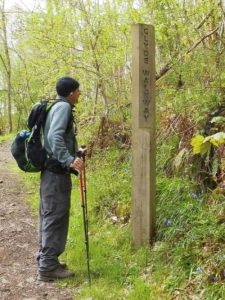
It is here where the Clyde Walkway finishes and the River Kelvin enters the Clyde. Tomorrow we will follow that river to Milngavie to complete our week.

*****

We could have been singing this as we walked the last few days. All together now –

*****

A WEE DONDER. 6 Dalserf to Uddingston.

On and off the Clyde.

There were two obstacles today: the large towns of Motherwell and Hamilton straddling the Clyde and a complicated motorway system where I had read that it may be necessary to catch a bus around major roadworks. We found more problems in the streets of Blantyre.

From our morning bus we recrossed Garrion Bridge and sped up the hectic road to seek The Clyde Walkway going off down a lane. it wasn’t signed, waymarks and posts have a mysterious habit of disappearing from roads. The traffic noise faded and soon we were in beautiful woodland and showing our, or at least my, lack of knowledge at tree identification.

We continued to see a garlic-like plant we had noticed for the last few days growing prolifically in the shade alongside the river, it looked introduced and invasive. Research showed it to be the Few-flowered Garlic, Allium paradoxum, which we had never seen before and is obviously a nuisance. I have in my garden the bluebell like Three-cornered Garlic Allium triquetrum a similarly invasive species which although attractive I am constantly battling with.

Most of our walk along the Clyde here was on a flood plain with lots of evidence of previous high waters, there were in fact signed alternatives for when the river was high. On the hill above us were high rise flats in the vicinity of Motherwell, are these the ones you see driving north on the motorway? But generally the towns had little impact on the walk. All seemed rural and peaceful especially looking back to our old friend Tinto Hill.

Around us was the old Hamilton Estate but to be honest we didn’t see any of the remaining ruins. If we had had more time it would have been interesting to explore some of the obviously popular paths around Dalzell House in the estate. There was a nature reserve, Barons Haugh, with observation hides over the marshes but without binoculars all we could see were the flats.

The  railway Ross Viaduct was a landmark high above us.

Heading for Strathclyde Loch and Country Park. we could hear it before we saw it. One minute this…

…the next this.

The boom boom of loudspeakers was an intrusive element of the day and totally unnecessary in a ‘country park’ but it was good to see people out enjoying themselves. We followed the masses alongside the artificial loch which was centrepiece for the 2014 Commonwealth Games water sports venue.

At the North end of the loch the River Clyde had disappeared somewhere and we ended up on roads to a restaurant at the Innkeepers Lodge where we enjoyed a coffee in the sun and discussed our options for onward travel. The bus transfer was still advertised but the new pedestrian bridges and walkways through the motorway complexes had literally just been opened days before so we followed our noses on a carousel of paths. I’m not sure what we crossed over or where we ended up but the Bothwell Bridge over the Clyde appeared  and at its far side a way-post down to the river path. Unfortunately this didn’t last long and soon we were back up on the roadside following our instincts. This we did through a good part of Blantyre urban area. A cyclist approached us looking for a cycle shop to buy inner tubes, he’d had a lot of punctures. We couldn’t help which was a shame as he also was on a LEJG journey. We eventually realised we must have missed something so before entering a huge shopping complex decided to strike off down a side street and under the railway to luckily join up with Clyde Walkway on a newly surfaced path which had come from we know not where.

Soon we were at The David Livingstone Centre. This includes the listed building of his birth, surrounding parkland, and a 3,000 piece David Livingstone collection. We managed unintentionally to miss it all, I presume it may have been closed.

An elegant iron cantilevered suspension bridge, built in 1952 but rebuilt more recently in 2000,  took us onto the north bank of the Clyde for our final stretch. And what a delightful stretch. woodland, bluebells, sparkling river, dippers and a kingfisher. Suddenly ahead up in the tree covered banks was a red sandstone castle looking impregnable. Boswell castle was started in the 13th century and played a major roll in the Scottish Wars of Independence.

We diverted off the route into a place named Uddingston to find the station only to find no trains running but there was a replacement bus which eventually arrived and took us into Glasgow for our two nights of accommodation.

*****

A WEE DONDER. 3 Broughton to Carmichael Visitor Centre.

The bit in the middle.

Our plan was to link up the Tweed with Clyde. The old railway line is a public footpath from Broughton to Biggar and after that we thought minor roads would suffice. So it was back to Broughton on a number 91 bus. A signed track went past Broughton Brewery the first microbrewery in Scotland, 1979. Unfortunately or perhaps fortunately they hadn’t opened when we passed by.

The walking along the old railway line through a flat landscape was not inspiring so we were soon back in Biggar. Having said that we met more groups of walkers on this section than we had seen all week.

A light lunch was taken in one of the cafes on Biggar High Street. The place still has a market town feel to it with independent shops and fine buildings in the wide main street, ‘biggar’ than most.

Spurning the opportunity to visit the Gasworks Museum, a Victorian Puppet Show or the more interesting Albion Motors display we passed an unusual installation of a stainless steel snowplough.   Having given the world the likes of television, pneumatic tyres, golf, mackintosh raincoats, tarmac and the telephone, the Scots have a fair reputation as inventors and pioneers. James Archibald Cuthbertson was the inventor of the high lift snowplough, celebrated here, as well as rubber vehicle tracks and unusual wheels for Land Rovers and amphibious vehicles. His engineering firm continues production in Biggar.  We wandered out of town by an old mill and ford. A ScotWays [Scottish Rights of Way and Access society] sign gave us the chance to keep to paths and avoid roads for a good section to Thankerton. This was undulating sheep country interspersed with small farms and those typical compact Scottish cottages. The bridge at Thankerton was over the Clyde but we weren’t to see it again until later tomorrow. 

The weather was not great with a cold wind and moisture in the air. To put a few more easy miles into the day we pushed on via a small lane to Carmichael House Visitor Centre under a misty Tinto. From here we were able to get yet another 91 bus, from a different operator, back to Biggar.

Mission accomplished. No more ‘Biggar’ jokes please.

*****


A WEE DONDER* a walk from the Southern Upland to the West Highland Way.

Innerleithen to Milngavie.

I finished the Pennine Way at Kirk Yetholm 50 years ago and started the West Highland Way in Milngavie 15years later. So as part of my humble protracted Lands End – John o’Groats I could fill that gap.  I’ve done K.Yetholm to Melrose on St. Cuthbert’s Way, and Melrose to Innerleithen on Southern Upland Way so I’m left with Innerleithen to Milngavie. Out with the maps and I realise by a combination of old railways and riverside paths I could have an easy week’s  walking. I’ve called it the Lanarkshire Link.

That highlighted a problem as rights of way are not shown on the OS maps of Scotland. There is no definitive map of rights of way as there is in England and Wales and no single place on the web where you can find out about them. Paths are marked with black dotted lines but that is no indication of whether they are passable. Finding out about footpaths through Scotways [Scottish Rights Of Way & Access Society] is cumbersome for a non local so we will just have to see how things work out on the ground. Interestingly ‘rights of way’ in Scotland can be lost if there is no evidence of their use over 20 years which seems heavily biased towards the landlords.

I happened to mention my plans to JD, of Canary Island GR131 fame, who jumped at the chance of a bit of exercise and within hours he’d booked a train heading north. Cost less than £15 for Preston to Galashiels via Edinburgh.  Finding accommodation in the various villages en-route wasn’t too big a problem although that will be more expensive.

So we found ourselves on an afternoon bus from Galashiels asking for a ticket to  Innerleithen, which we couldn’t pronounce. Even in the Borders the Scottish accent is going to be a problem.


*
DonderTo walk in a slow and carefree manner, not really concerned with how long it takes to arrive at one’s destination. Scottish slang.

That is a good maxim to follow.


A WEE DONDER. 5 Lanark to Dalserf.

The Clyde Walkway through the ‘orchards of Scotland’

We were on a roll now as there was a waymarked trail, The Clyde Walkway, it was signed from Lanark’s centre. We even had a useful app for the phone giving directions and points of interest. For a change it was warm and sunny. After a brief section by the river out of Lanark we had to cross over and follow the road through Kirkfieldbank before a lane led to a barrage at Stonebyres power station and a decent riverside path. The fourth of the Clyde Falls was downstream but we didn’t have a good view because of the tree foliage which is in its full flush of green.

Gentle strolling through open countryside along the banks of the river felt right for the warmer weather we were enjoying.

Are we in the wrong field?

Approaching Crossford there was extensive housing development near old properties of the Carfin Estate, looked like it would be a gated estate. This estate in the 19th century was extensive with orchards and gardens. Their old Iron Bridge across the Clyde was closed for repairs. We came out at the elegant stone road bridge just as an MG sports car rally drove across. The pub was closed and asking a local about a cafe suggested there was one close-by but after walking half a mile back towards Lanark we gave up and sat on a park bench with a banana and water – far healthier.

Where’s the cafe?
Oh and have you seen any MG’s?

The fields onwards were famous at one time for orchards and on the opposite bank were several garden centres doing a roaring trade. If we had been more observant we might have spotted an occasional apple tree. To give variety we had some ups and downs through woods on the Milton Lockhart estate.

More people were met as we neared the road, families out enjoying the sunshine. Two backpackers stopped to chat, they were from Manchester and doing a Dover to Cape Wrath journey! They quickly disappeared into the distance.

Off to Cape Wrath.

I meant to say that the Clyde Walkway markers had taken on Brobdingnagian proportions [word of the day]

Ahead was Mauldslie Bridge which with it’s elaborate gatehouse used to form the entrance to one of Lanarkshire’s oldest hunting estates.

Again across the river was sighted Dalserf church with its unusual clock tower. A ferry once operated across the Clyde at Dalserf, although this has long since been superseded by the nearby Garrion bridge.

We meandered with the Clyde and suddenly popped out onto a very busy road. This is where we diverted for our bus stop, walking thankfully down a pavement as the traffic hurtled by. The complicated two bridge roundabout at Garrion was traffic hell.

Stood in no-mans land at a solitary bus stop is a sobering experience: is the bus running today? did I read the time table correctly? how do I get a taxi?

Anyhow we made it back to Lanark and a good Italian meal.

*****


A WEE DONDER. 4 Carmichael to Lanark.

The Carmichael Estate, The Falls of Clyde and New Lanark – interest throughout the day.

The number 91 bus dropped us back at the entrance to the Carmichael Estate, the ancestral home of Clan Carmichael for 800 years. Luckily there is a series of marked trails through the extensive grounds which are farmed for beef and venison.  Carmichael House was built in 1754 on the site of an earlier castle. In 1952 the roof was removed to avoid property taxes and death duties, a short sighted action, and it is now a substantial ruin surrounded by woodland. We found our way up to it – what a place it must have been in its heyday. We were surprised the public are allowed to wander in and out of the decaying buildings in these days of health and safety. Our path leading west traversed the once substantial gardens and even went through a pets’ graveyard.

Once out of the estate we made our own way on quiet country lanes passing yet another abandoned railway and over The River Douglas. The small town of Douglas was only 5 miles away, Clan Douglas has associations there and JD’s ancestors were hereabouts. Tinto that pointed hill still loomed over us to the south.

Bridge over the River Douglas.

We were making good progress towards the Clyde and only had to worry about a lane leading to a possible river crossing. Gates across the lane looked ominous but we squeezed by onto the banks of the Clyde and yes there was a way across the bridge at a water extraction barrage. Thankfully we didn’t have to risk the older crossing.

We were now on a waymarked trail visiting the Falls of Clyde. The Falls of Clyde is the collective name of four linn (waterfalls) on the River Clyde. This afternoon we would pass Bonnington Linn, Corra Linn and Dundaff Linn, Corra Linn is the highest, with a fall of 84 feet.  [The lower falls of Stonebyres Linn would be seen tomorrow] I had previously never heard of this area so was delighted when we entered a wild sandstone gorge with waterfalls round every corner. Despite the river level being low, blame that water extraction plant, this was spectacular. We passed a peregrine lookout but apparently they haven’t nested here for a few years which is a bit strange, is there persecution occurring in the area?

At a viewing point overlooking the falls there was a series of interpretation boards – the most interesting related to William Wallace. Thats what happens if you lead a rebellion against England, take note Nicola Sturgeon.

To complete a great day we entered New Lanark, founded in 1786 by David Dale who built the mills with Richard Arkwright to take advantage of the water power of the waterfalls on the River Clyde.  Dale built the cotton mills and housing for the mill workers. With his son-in-law, Robert Owen, a social reformer, New Lanark became a successful business and an early example of a planned village environment. The New Lanark mills operated until 1968. Thankfully most of the buildings have been restored and the village has become a major tourist attraction and a UNESCO World Heritage Site. You come round a corner and there in front of you is the mill complex which was far bigger [not another Biggar joke]  than I had imagined. Large water power powered mills with workers cottages perched above. I was impressed. We wandered around but didn’t pay to go into the various sites but we did visit the cafe in one of the old mills. As well as reaching the Clyde we were now on the Clyde Walkway which should take us into Glasgow.

Resisting the road up into Lanark we followed the river for another half mile through delightful woods before a steep ascent up into Castlebank Park and to our wee b and b.

Lanark was an odd place with an even odder road system which seemed designed to kill pedestrians. We were here for two nights and would be using buses to help with logistics – surely not another number 91.

St. Nicholas Parish Church Lanark.

*****

A WEE DONDER. 2 Peebles to Broughton.

The 39 Steps…

John Buchan, the author and diplomat, spent time in Broughton where his grandparents lived. He became famous for his thriller novel The 39 Steps published in 1915. There is a museum to him in Peebles. The John Buchan Way is a 14mile walking route devised to link Peebles with Broughton.  We decided to follow the first half of the route this morning. It was waymarked with a book motif out of the town up alleys and out into to the open heading for Cademuir Hill. This hill has Iron Age hillforts but disappointingly the route doesn’t visit them. Some of the higher hills in the distance, I think the Pentlands, still had patches of lying snow. Our route descended to a minor road where we were glad to put on waterproofs not just for the rain in the air but to shield us from the biting wind. This is sheep country ‘par excellence’, acres and acres of grassy hills with the newborn lambs released onto.

Hill Forts to the right.

Looking back to Peebles with the Hydro prominent.

A minor col was climbed giving great views of the open Southern Uplands country. We dropped down to meet up with the Tweed again at Stobo.

I had read about the unusual church here so we made a short detour to visit…

Stobo Kirk is an ancient church of the Church of Scotland dedicated to St Mungo. retaining much of the original 12th-century building, including windows, the nave and chancel, unlike many other Roman Catholic churches which were destroyed after the coming of the reformed religion.The porch was added in the late 15th–16th century and is notable for the grooves in the left-hand doorjamb, created by pupils sharpening their slate pencils before class or possibly by the sharpening of arrow heads prior to the weekly after-church archery practice which became compulsory after the disaster of the Battle of Flodden 1513. The 12th-century Norman entrance into the nave has a door made from a single board of cedar wood from the nearby Dawyck estate.On the outer entrance hangs the old Jougs [yokes] used to punish recalcitrant members of the parish until some time in the 18th century.

The church looked a bit of a curiosity to be honest but we had a good look around at the features and then found a seat for lunch in the sun which had fortunately appeared to warm us. Many of the headstones in the graveyard were adorned with scary skull and crossbones, a Memento Mori, a reminder of our own mortality, an aide-mémoire, should it be needed, that you too will die one day. Time to move on.

Evil looking Jougs.

Scraper marks.

We didn’t follow the longer and hillier John Buchan Way continuation. i optimistically thought that the dismantled railway alongside the Tweed would give us an easy walk into Broughton. This was the Symington, Biggar and Broughton Caledonian Railway branch to Peebles, closed in 1966. On OS maps of Scotland paths are shown as black dotted lines but there is no indication as to their privacy or right of way.  The dotted line was promising as we followed the obvious trackbed. Then there was a house and garden blocking our way, this was bypassed by a scramble up to the road. At the next obstacle we bravely walked past their kitchen window, I kept a discrete distance behind JD in case of dog problems. Safely through we enjoyed a long stretch of embankment walking, with the occasional entanglement in vegetation and boggy ground.

All the while the stately Tweed was by our side with views down the valley to the pointed local summit of Tinto, 707m. which was to feature for the next few days, Eventually we parted company with the Tweed and followed Biggar Water, more of a drainage ditch than a river, to Broughton where there was no accommodation but a bus, the ubiquitous 91, took us to Biggar. The curiously named  Elphinstone Hotel, an old coaching inn, was our welcoming stop over. There was apparently a Lord Elphinstone at some point in history. Just call it The Elph.  They looked after us well, the beds were ‘biggar’ than most and the breakfast ‘biggar’ than we could eat.

With a little effort a viable walking route could be established that would link the Tweed to the Clyde utilising the old railway.

*****

A WEE DONDER. 1 Innerleithen to Peebles.

An easy half day on the Tweed Valley Railway track.

The bus from Galashiels deposited us in Innerleithen, book shops, printing workshop and historic woollen mills. More importantly, the high street Whistle Stop Cafe, [appropriate name considering today’s walk] favoured by cyclists, gave us a lunchtime soup. We wandered off to find the old railway track which has been utilised as a walking and cycling route to Peebles alongside the River Tweed.

Innerleithen.

We didn’t have time to visit Trachair House out of sight on the other side of the river,  a hunting lodge owned by the kings of Scotland. It later became the home of the Earls of Traquair and is still lived in by their descendants. It is known as the oldest inhabited  house in Scotland.

The walking was straight forward on the surfaced track. Originally part of The Peebles Railway Company who extended their Edinburgh to Peebles line as a single track to Galashiels, [or Gala as everyone calls it apparently] it closed in 1962. As we walked there were many reminders of the railway in the form of fences, bridges cuttings etc and even a small station which has survived and now runs as a café, Nashy’s. A pleasant surprise which we took advantage of for a coffee out of the cold wind.

The station was in the village of Cardrona which seemed to be set out as a model village all well ordered and clean. We later found out it had been built in 1999 – 2002 by a local farmer speculator, Tom Renwick. Further on was a fine looking golf course.

Cardrona.

We continued alongside the River Tweed, a lone fisherman was casting in the water. All around were the rounded hills characteristic of the Southern  Uplands.  Fields that were a giant flood plain led into Peebles where Wetherspoon’s Cross Keys Inn was more than adequate for the night.Peebles was a buy spot with a typical Borders high street of solid buildings, Initially a market town, it played a role in the woollen industry during the 19th and early-20th centuries. In the 19th century health tourism flourished with hydropathy centres, Peebles Hydro Hotel survives but was out of our price range.

It’s good to be back in Scotland.