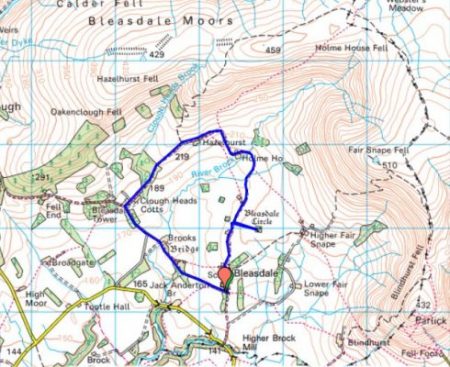
THE BLEASDALE CIRCLE AGAIN.

Bleasdale Circle with Fairsnape and Parlick looming above.

Another of my winter favourites. This circuit is mainly on lanes and good tracks but takes one right into the hills. I’ve written about it many times but today I have come across some interesting new facts.

For a start, Bleasdale School dating from 1850 where I park is now closed. It soldiered on since the Millenium with about a dozen pupils from the surrounding farms but when the number dropped to two or three its fate was inevitable.

Up the lane, the Parish Hall is heated using a wood pellet boiler with a wind turbine to generate electricity, forward-thinking for a small community. Further on is the uniquely named St. Eadmer Church.

The lane then heads into the hills past a few farms. A footpath diverts to visit Bronze Age Bleasdale Circle. Originally two circles of wooden posts with ditches and a central burial chamber. The wooden posts of the inner circle have been replaced by concrete posts but still are evocative of the site. There is the usual speculation as to the uses of these circles and their positioning. Burial urns from the site have been on view at the Harris Museum in Preston.  The whole site has been planted with a circle of trees which are visible from many parts of Bleasdale. The outer circle, obstructed by the trees, was possibly from an earlier Neolithic era. Ritual sites are often reused over the ages. I visited it today and got my feet very wet in the approach fields.

themodernantiquarian.com

Further into Bleasdale, there is a section of boggy ground before the next farm tracks which come in from the west, like crossing a watershed. All around are good views of the surrounding hills. As well as the Curlew and Lapwings a small flock of Pied Wagtails entertain me flitting along the wall tops. I’m now approaching the properties of the Bleasdale Estate. The estate is now run as partly agricultural and partly a shooting concern but I’ve just unearthed some of its history.

In the C19th a Mr Garnett lived in nearby Bleasdale Tower, he was an agricultural reformer and philanthropist and in 1857 founded The North Lancashire Reformatory School constructed on the estate. It catered for over a hundred boys who worked on the land and in trades such as tailoring and shoemaking as well as receiving an education

“In November 1857, a few weeks after its opening, three boys escaped from the institution due to the fence wall having not been completed. They were all apprehended in Preston the same evening and returned to the Reformatory.”

“Of the 51 discharges for 1865 thirty-three were doing well, twelve convicted, one dead and five missing”

As I walked down the lane today I crossed over Clough Head Brook on a substantial stone bridge which apparently was constructed by the boys. Stonemasons’ tools are depicted on the parapet.

The lane goes through the original school buildings which are now used as cottages and workhouses for the estate. The school enlarged over the years and eventually closed in 1905. A map from 1893 shows the school

In a wall on the corner is a King Geoge V post box [1910 -36]

Taking the shorter route on tarmac brought me past Brooks Farm where an arched ‘packhorse’ bridge is visible over the River Brock. Despite its appearance, it was never built for horses with steep steps at either end. It is not on a known packhorse trail and didn’t appear on maps till 1893. It has been suggested that the bridge was built to provide access from Bleasdale Tower to Bleasdale Church, I wonder if those reform boys built it.

In the wood nearby are some new, not particularly attractive, chalet type holiday lets, a sign of the estate diversifying.

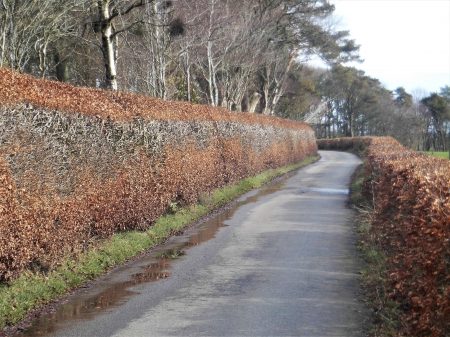
My way back to the school was enclosed by smart beech hedging for which the estate is renowned.
I took this photo of the Bleasdale hills on my way home, St. Eadmer’s church is right of centre.*****

*****

This walk was completed two days ago and since then advice about walking and climbing during the coronavirus emergency has been sensibly updated. As I’m in the vulnerable group I’m taking heed. We are all responsible for limiting the seriousness of the situation in the next few months.

BMC Advice.  18/03/2020

  • People need access to the countryside for their health – both mental and physical.
  • Follow the most current NHS advice regarding health and distancing. Currently Public Health England’s advice is: “you can go for a walk outdoors if you stay more than 2 metres from others.”
  • Consider your means of travel and distance – close to home is best and, despite the environmental impact, it’s better to be in personal cars than public transport at the moment.
  • Stick to familiar areas and low-risk activities.
  • Reduce your risk. Be very aware that medical and rescue services and facilities are going to be extremely stretched and overwhelmed. It would be socially irresponsible to be taking risks at this time that could place an additional burden on medical and emergency services.
  • Do not assume that Mountain Rescue will be available. There is a real possibility of reduced or even no cover for rescue in some areas as this develops.

 

CURLEW COUNTRY, STANLEY FELL.

I’ve set the bar high with trying to keep my feet dry in the wet weather we’ve had. But I’ve found another walk which takes me on lanes into the rough fell country between Chipping Vale and the Bowland Fells, namely Stanley Fell. There is nothing more evocative of this wild habitat at this time of year than the cries of the Curlew and the Lapwing. They were both present in voice and vision whilst in the gale-force winds unable to be photographed, but you all know what they look like.

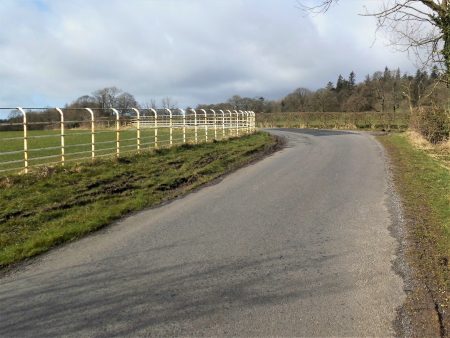
Walking up the road there was little traffic. More hens out on the loose than cars. White railings were used on corners of country lanes to improve visibility. I turned off into the Leagram Estate and passed the dell where snowdrops were in profusion last week. The next farm has a surfeit of sheep and lambs under roof all looking very healthy, they breed BlueFaced Leicesters here..

I love these tree roots.

Lanes continue to more remote farms many now upmarket residences. Ahead is proud Parlick. I’m getting into the hills.

I come out onto a road where Saddle End Farm is up the hill, I’m not going that way today but buy a half dozen free-range eggs at the end of their lane. I wonder if anyone is up on Fairsnape in this gale.

Saddle End Farm.

Turning right I follow the last of the tarmac which leads to the remotest farm, Burnslack. A culverted stream runs alongside. I recall coming here with my young children and exploring through the concrete pipes, admittedly not in flood conditions, to emerge higher up the stream – nine out of ten for child cruelty.

The way in…

A bridleway heads into the hills where the curlew are calling. On the way, a gate hangs on across the track, not even baler twine will save this one.

There is an old ford over a lively stream, I often feel an urge to follow these waters up to their hidden source, an endless task. This is remote country, not a coronavirus insight. As I come over the watershed there are the limestone knolls of Dinkling ahead and in the background Birkett Fell and Warrington Fell. Expansive uplifting scenery.

The track drops down to Lickhurst Farm, now a complex of stone residential conversions. Below is a little valley, a motorist parked up asks me where the Forest of Bowland is – I tell him he is in it and direct him through Little Bowland to the Inn at Whitewell. An old limekiln is passed…

… and a little further a low bridge over a stream, this used to be a ford and alongside is the original stone clapper bridge. This is unique in being a single stone over 15ft long. [Now guarded by wooden handrails.] All evidence of a way of living long past.

The road goes on by that often photographed and isolated red phonebox.

I have friends living in the Higher Greystoneley farm buildings so a cup of tea is very welcome. From there another stoney bridleway drops down to a ford, with wooden footbridge, and through limestone country to my car. I drive home in the gale knowing my feet remained dry and looking forward to poaching one of those farm eggs for lunch.

*****

.

A GLOOMY LONGRIDGE FELL.

With all this wet weather I’ve become obsessive about keeping my feet dry and out of the mud so today I walk up Longridge Fell on forest tracks and return on the road. I’m still restricted to a few hours in the day so It suits me to do another short walk whilst the weather is dry. I’m following a popular dog walking trail, I can tell that from all those black plastic bags by the track but I don’t want to spoil my walk by becoming angry so I ignore them. Every time you come up here there has been more tree felling changing the nature of the walks. They seem to plant new saplings amongst the debris of the felling without worrying about the remaining stumps.

There is evidence of the strength of the recent storms with trees casually uprooted. Onwards and upwards I go, I have no intention of getting my trainers dirty by going to the summit, I’m content getting some exercise on the tracks. I detour to a viewpoint towards the Bowland Fells which I always enjoy. These are size 12s if you need any.

Back on the main track, it starts to descend in sweeping curves, would be great on a mountain bike, towards Kemple End with Pendle In the distance. On reaching the road all I have to do is turn right and follow it back to my car less than two miles away. I normally avoid roads when there are alternative paths but this quiet highway turns out to be pleasantly undulating with views to the south. It certainly serves the purpose of keeping my shoes clean and dry. Halfway along is a small stream, Brownslow Brook,  coming off Longridge Fell which appears to be culverted into a water collecting plant, I’ve never noticed it when driving this road and I can find no clue to its function. I’m back home for lunch thinking it was probably me rather than the fell that was gloomy.

*****

RAPTOR PERSECUTON.

The Hen Harrier is an iconic bird of the Bowland  Fells, one I saw regularly in Croasdale but now, rare indeed. It even features as a logo on the roadsigns for the Forest of Bowland. [Some wit has suggested replacing it with a grouse.}

On the Radio Lancashire news yesterday there was an appeal to the public regarding the shooting of a Hen Harrier on the Bowland Fells between Slaidburn and Clapham. The unusual nature of this appeal from the police is that the shooting took place in October 2019. I wondered how seriously the police take these criminal acts if they are only now asking for information.

A little research comes up with the following post. As well as questioning the police response to this incident they publish a depressing list of about 30 Hen Harriers believed to have been illegally killed since 2018.

No further comment. Please read.

https://raptorpersecutionscotland.wordpress.com/2020/03/05/hen-harrier-shot-in-north-yorkshire-police-appeal-for-info-5-months-later/

THE EAST COLNE WAY.

A walk through the green lungs of Colne.

I picked up this leaflet at the cafe on Beacon Fell the other day, it looked interesting. Despite my friend Sir Hugh stating  ” The ones I am not enamoured by are where some local authority has connected a lot of inferior paths around the edges of crop fields with no particular objective other than perhaps encircling their borough or domain and claiming this as The Whatevershire Way”  to discover relatively new territory I was prepared to give The East Colne Way a chance.

I’ve driven along the A6068 Nelson to Keighley road many times on my way to walks in the Bronte Country and climbs on Earl Crag and familiar landmarks which I would visit today. This another of my short walks I’ve been doing recently to fit in with the weather and other commitments. I turn off the road to a lakeside carpark at Ball Grove Nature Reserve. This was the site of an C18th water-powered cotton mill which became in 1860 Sagar’s Tannery, the largest in Europe. Production ceased in 1970 and the buildings were demolished all but the present-day cafe.

I strolled alongside the lodges, now nature reserves, and Colne Water to a weir with a fish ladder.

An unofficial scramble brought me onto the road opposite the old cottage Hospital bequeathed by the Hartley family which has been converted into retirement accommodation.


Hartley Hospital.

Along the road are the Hartley Almshouses donated again by the Hartley family, yes those of jam fame. Talking to two residents one was very positive the other concerned about damp.

I cut up through some rough fields with ancient boundary walls and stiles, I’m surprised to find a waymarker for my walk, these continue to guide me around the circuit. 

I pass the workers cottages at Bents without a photo and press on up Skipton road to pass the Georgian  Heyroyd House, Apparently round the back are walled gardens.

More stone stiles led across fields to a lane alongside Colne Golf Course. A clapper bridge has had rails added to it – health and safety? It opened onto a lane that looked more like a stream.

The rocky ridge visible ahead is Noyna Hill, a real ‘green lung’ of Colne.

Farm lanes followed and I was soon crossing the causeway at Foulridge Upper Reservoir. The sun was quite warm and I lingered admiring the views over to Pendle Hill, Blacko Tower and round to Noyna and the Great Edge all Pendle walking areas par excellence.

The large gated property, Lower Clough owned by the Barnsfield Construction Co, had some impressive, well-guarded grounds. An open area The Rough is what remains of Lob Common, worryingly new housing seems to be creeping up the hill. Curlew are calling as I walk through. I come out onto a surprising lane lined on one side by handloom weavers’ cottages, several three-storied. Down at the roundabout is the old Turnpike House which I’ve driven past without realising its existence. Also on the lane is Lidgett Hall dated 1749. This delightful Conservation Area backs onto the open countryside where the housing development is occurring – so much for town planning.

Turnpike House.


Lidgett Hall.


Another open field heads towards a church with the hills above Wycoller in the background. I finish the day with a coffee in the lakeside cafe at Ball Grove Mill. This turned out to be a 5mile walk through beautiful northern countryside giving an insight into the past life of this area on the edge of industrial Colne. The only sour note is the lack of protection from developers to land unchanged from the C17th. 

*****


THE SINGING RINGING TREE.

There aren’t many trees on the bleak Pennine Moors above Burnley but in 2006 one was planted on Crown Point south of the town. Architects Tonkin and Liu designed a structure composed of metal pipes which, as well as being a stunning visual feature, creates a musical noise from the wind playing through the pipes. The Burnley Way [which I walked in 2017] predates it and thus avoids it which is a shame, some minor re-routing would easily include this notable landmark.

JD mentioned he had never visited the ‘Tree’,  not many of our friends have either. A walk was hatched to include this site, we procrastinated on several occasions during the stormy weather but today we set forth with a better forecast.  Several suggested walks start off from Townley Hall but parking is charged there so we, or rather I, decide to park up on a street in nearby Walk Mill.

We pick our way up various bridleways, parts of The Burnley Way and The Pennine Bridleway, onto Deerplay Moor. I’m not saying it was all easy going, the farmyards were a mudbath but we got through. Views to our left are down towards the Cliviger Gorge where road and railway head for the delights of Todmorden. We come across a memorial stone to Mary Townley who was instrumental in establishing long-distance routes in the Pennines for horse riders. In 1986 she road from Hexham to Ashbourne to draw attention to the poor state of England’s bridleways. Today these improved bridleways probably benefit mountain bikers rather than those on horseback.

The quotation The air of heaven is that which blows between a horse’s ears.” is, in fact, an Arabian Proverb.

We had a bit of a depressing section on a road where there was evidence of fly-tipping every few hundred metres. I just cannot understand this blatant antisocial behaviour.

The ‘tree’ had been out of sight most of the walk but at last on Crown Point, we left the road on the well-trodden path across to it. Unfortunately, a Union Jack has been stuck into it diminishing the visual impact of the fine installation. There was only a light breeze today so the tubes were only murmuring. We speculated on what sounds were produced in the recent gales, there will probably be something on youtube. 

Crown Point is a fine viewpoint in itself with Burnley below and a backdrop of Pendle Hill. There had been some patches of old snow as we walked up and there was a definite white rim to Pendle Hill. Easy walking took us off the hill directly back to Walk Mill and its historical past,

*****


A QUICK WALK AROUND BEACON FELL.

Longridge Fell is usually my quick fix hill for some fresh air and views but the tracks up onto it will be muddy, to say the least. I choose instead Beacon Fell with its well-made tracks,  it is no further to drive. Longridge Fell Is reputedly the most southerly named fell so Beacon Fell must be the second being only one mile further north. I can ascend both of them easily from my house for longer walks but this afternoon I only have an hour or so spare.

As I arrive in the quarry car park a pair of Roe Deer stand and look at me but quickly disappear when I open the car door. I thought I had a photo of the male but nothing shows up.

I walk briskly in a circle around the hill on familiar paths. I’ve never come to terms with the waymarking here.

There are a few dog walkers out, the cafe is strangely quiet. Everywhere seems green and moss-covered, a sign of a mild and very wet winter.

As I’ve mentioned on previous visits up here storms have taken their toll on some areas of the forest with a lot of tree felling taking place to tidy things up. Perhaps this is a blessing in disguise as the fell has a more open feel to it now and some of the new plantings are of native deciduous trees. Also, wood carvers have been busy creating new pieces.  I add a few more to my collection. There are ‘Green Men’ carved on some trees… … but today I find something a bit different – a ‘Green Woman’ or has someone taken a fancy to one of the lady volunteer rangers?

An obligatory visit to the trig point and I notice that the views to Fairsnape and Parlick are becoming obscured by growing firs – time for another storm?

I’m back at the car within the hour feeling much refreshed.

DRY FEET TO PILLING.

Knott End to Pilling.

On display next to a caravan site in Pilling is a restored Hudswell 0-6-0 steam engine similar to the ones used on the old Knott End To Garstang Railway, it has been painted in their livery and renamed the Pilling Pig. This abandoned railway was built to link the agricultural areas of Wyre with the mainline. It had a chequered history.

The whistle of these engines squealed like a pig – hence the name Pilling Pig.

The cafe where I park this afternoon is on the site of the old railway terminus at Knott End, next to the ferry over to Fleetwood. This was a favourite place of the painter LS Lowry and several of his paintings include the ferry slipway. To celebrate this association a statue, by local designer Tom Elliot, has recently been installed.

Jetty at Knott End. L S Lowry. 1957.

The above diversions link my walk this afternoon from Knott End to Pilling.

Storms are continuing and fields are flooded so I opt for the raised sea wall to keep my feet dry today, I’m confident enough to walk in trainers. Talking to a resident of the seafront he explains the sea is either way out of sight or breaking over the promenade. Recent sea defences have prevented flooding which is good news.

At the moment the tide is coming in. There are views across to a vague Black Combe and a clearer Morecambe Power Station.

The portion of the foreshore still visible is thronged with wading birds, I forgot my binoculars and the wind is too strong to take zoom shots with my little camera so their species will remain a mystery.

That is apart from this Little Egret which seem to becoming more and more common on our shores and estuaries.

The landside of the path is uninspiring with a few houses, caravan sites and flooded fields. At one point I pass a fenced off reedy area, a tractor is just leaving it and my query of the driver reveals that it is a Mallard breeding area with 40,000 birds who are elsewhere at present. I do not feel it is the moment to discuss my opinion of breeding birds for the shooting fraternity.

All afternoon the Bowland Hills filled the skyline to the east, what a contrast to the flat coastal area. Nearly all the other walkers on the wall have dogs.

The sea wall continues but seems to be fenced off [I’m tempted], the Lancashire Coastal path I’ve been following continues down Fluke Hall Lane into Pilling alongside a delightful period Junior School. Across the way, The Golden Ball inn looks ominously quiet. I’ve time on my hands but decide to explore the village rather than prop up the bar. Dam Lane takes me to a bridge over Pilling Water with a nearby desirable converted windmill. Another raised sea wall goes north to join the embankment I had previously considered following. Signs state that this should not be used from December to April but without a reason given.

I next look around the Parish Church, St. John the Baptist, yet another designed by the Lancaster firm Paley & Austin and built in 1887. There is fine stained glass in the east and west windows. I didn’t realise this church replaced an earlier C18th chapel which is just down the lane, Apparently, it still has the original wooden galleries. One to visit on another occasion.

The only other visitor attraction is Pilling Pottery which was closed. I sat in a cold and windy bus shelter hoping my bus back to Knott End would arrive on time before I froze.  It did –  and my feet were still dry!

I messed up my navigation driving home and ended up on one of the worst roads in Lancashire through Eagland Hill – very narrow, lined by flooded ditches, twisting with sudden right-angled bends,  undulating from subsidence on the marsh and the tarmac breaking up in many places. With Storm Jorge in full swing, I was relieved to reach Nateby and the A6.

*****

ROADS TO NOWHERE PART 2. HACKING FERRY.

I’ve found another one. This time on the West Pennine Moors 1:25000 Map 287 sheet over the hill in the Ribble Valley. I was pleased with my little expedition on a dead-end track to the Hodder the other day, so I started looking further afield and immediately came up with another obvious ‘road to nowhere’ It leaves the road at Mitton Hall and leads down a strange little peninsular to where the Ribble and the Calder join. I’d been on the opposite bank near Hacking Hall three years ago and even took a photo of this peninsular point. 

It was near here that Hacking ferry operated up until the 1950s, so perhaps this footpath linked with the ferry.

Time to put on the boots again.

I thought the best place to safely park was in the grounds of Mitton Hall Hotel, I find a place as far as possible from the hall, there are few cars about, and slink off along the road. An alley leads into fields, and I’m immediately confronted with a flooded stream I dare not jump across. I find a way round to Little Mitton Farm and wander through their yards without any problem and without seeing a soul. Stiles give access to fields which take me into Mitton Wood, an obvious pheasant breeding area, all I see are half a dozen roe deer the pheasants having been shot.

I’m walking along a ridge between the Ribble on my right and the Calder on my left, at its end I drop down to a stile into a riverside meadow. The field narrows as I proceed just above the flood line.  This is quite a dramatic situation with the two rivers roaring by. At its end, I can see Hacking Hall on the left bank of the Calder and the Hacking Boathouse on the right bank of the Ribble.

Near here in the past was the Hacking Ferry mentioned above. It is documented that the ferry ran on Sundays to enable people to attend church, but I wonder which – Old Langho or Great Mitton. There are historical photographs of the Hacking Ferry which was popular in the late C19th and early C20th.  One could probably request where you wanted to be dropped off. The last ferry boat is said to be preserved in Clitheroe Museum, I have yet to visit it.  (Fo more information  – The long lost ferry boat that evokes happy memories of rural Lancashire – Museum Crush)

The Ribble Way follows the north bank of the Ribble, and it was always planned to construct a bridge across at the confluence of the rivers. Stood at the end of the peninsular I wonder about where the bridge would have connected up these footpaths. I later find online the designs for an innovative bridge linking all three by Flint Neill civic engineers. This was back in 2003 before funding was withdrawn for such projects. An amazing looking three-way arch footbridge, with 43.5m legs and a high arch at the confluence of the Ribble and Calder rivers. What a shame it was never constructed, The rivers were running high with tree trunks whizzing along.  A few walkers were braving the winds on the Ribble Way. How many people come down to this spot I’m standing on? A kingfisher flashes past as I retrace my steps upstream.

I find my way back into the woods as the gale blows through the trees, creaking and groaning, hoping none will come crashing down – this is Tolkien’s Middle Earth after all.

.

At Mitton Hall Hotel the car park was completely full of wedding guests, I felt rather out of place in my full waterproofs.

ON THE ROAD TO NOWHERE.

I’m content to sit and peruse OS maps on a cold, wet and windy day.  In front of me is the 1:25000 Forest of Bowland and Ribblesdale [OL41]. I’m not too keen on double-sided maps, especially in a howling gale when you always need the reverse side. but the west side covers my local hills. Unfortunately, Longridge lies off the edge of this sheet and another, the Blackpool and Preston [Explorer 285].  It just makes the edge of Explorer 287, West Pennine Moors. All very difficult for a days walk.

Back to OL41 what takes my notice just now is a “dead-end”  public right of way path leaving the Chaigley Road opposite Walker Fold and heading to the River Hodder – ‘a road to nowhere’

Curiosity aroused I wondered about its origins, the fact that it ends at the river suggests there may have been a ford here in times past, but there is no path marked on the other bank. Does anybody ever walk this dead-end path? maybe fishermen and presumably the local farmers. Does it even exist on the ground? Lancashire C.C. still shows it as a right of way on their website. On an older map, I see that the trees at its end are named Limekiln Wood, could there have been a lime kiln at the end of the track?

The sun is coming out this afternoon, time to explore and see where I get to.

I was apprehensive as I left the road at Walker Fold. The footpath sign was hidden in the foliage, the lane looked private and there was a lot of water flowing everywhere. I have to admit to carrying wire cutters in my pocket. The first ‘obstacle’ would be the grounds of the properties on the lane but I needn’t have worried  – there was a stile with an arrow pointing me across their land via more stiles and a little bridge. Soon I was in open fields with well-constructed and maintained stiles showing the way, many of these appeared relatively new. In fact, this was country walking as it should be, the sign of a responsible landowner?  The only downside was the rain saturated fields courtesy of our recent storms.  A footbridge crossed a lively stream and the path weaved through plantations. Ahead on the horizon was the familiar outline of the Bowland Fells.

Once over a farm access road, my gravelled track started to descend towards the Hodder which could be heard before it was seen. Sheep looked at me as though they rarely saw anybody, mind you they always look like that. And then there I was stood next to the raging river with as I’d guessed a lime kiln built into the hillside. Along the banks were the limestone crags, the raison d’etre of the kiln and the original path. There was another clue as to the path’s continued existence – a small fishing hut and stiles giving access to the river. Lancashire Fly Fishing Association maintain this stretch.

What an idyllic spot on a summers day but at the moment the river is in flood mode and roaring down the valley. I was in a different world down here, the hidden Hodder, and for half an hour or so I watched in awe.

Downstream.


Upstream.

Mission completed I retraced my steps up the hill and used the road back to Walker Fold to avoid the worst of the soggy fields. A couple of things to note in this little hamlet of less than a dozen houses. It won the Lancashire’s best kept hamlet competition in 1994 and 2006 and boasts an old School/Chapel with links to The Latter-day Saints movement back in the mid C19th.

Now let’s have a closer look at those maps again…


SALE WHEEL – THE RIBBLE POST-FLOOD.

We’ve had two weekends of storms, Ciara and Dennis, with serious flooding in parts. The River Ribble hit the headlines with yet more flooding of Ribchester. I didn’t venture out last weekend when local roads were impassible but today things had settled a little and Storm Dennis was petering out. I always regret not going down to the river whilst it is in flood, the usual excuse is bad weather.

Not today. I parked up at Marles Wood; there were some dodgy looking cars and individuals around, so I photographed their plates for evidence later if my car had been trashed. Putting that aside I strolled off down the path to the Ribble where it cuts through a sandstone ridge and into an open stretch of water. This is the Sale Wheel. There seems to be a fault line in the rocks as the water flows through into an enormous whirlpool and then a right-angled bend to the river. Today the force of the flow took the turbulent waters off down the valley with little regard to the pool. Last week the flow would have taken the river onto the fields at the bend.

I was satisfied with what I saw and set off upriver. There was evidence of the height of the water last week when most of today’s path would have been impassable. Dog walkers, a common sight on this stretch, were keeping their pets on a close lead – any splashing about in the river would lead to tragedy.

As you approach the Dinkley footbridge there is normally a bit of a shingle beach and shallows in the river – not today, the mighty Ribble just flowed past.

Compare with a summer’s day…

The new bridge is substantial but, I wonder about the stability of the abutments on this side of the river; there already seems to have been some damage and undermining of them as the flow of the river curves into the bank..

Across the bridge, I picked up the Ribble Way markers for the stretch back to Ribchester Bridge. The way leaves the river through fields, today very boggy, and up to an elevated area where there are superb views back up the Ribble Valley to Pendle Hill and Dinkley.

I took an illicit detour into the woods to view the Sales Wheel from this side, and the river was equally exciting. Where the rocks dip, erosion shows the bands of gritstone alternating with mudstones. Both were laid down in a massive delta, the grits when the water was moving fast and deep and the mudstones when slow and shallow. Here, the strata have been faulted to almost vertical.

The way onwards through the woods, normally a pleasant path,  was difficult because of all the debris from the floods. The couple I met coming the other way were from Merseyside, having a couple of days in Hurst Green, The Shireburn Arms, exploring this part of the Ribble Valley – tomorrow, The Tolkien Trail.

The Ribble rolled on……to Ribchester Bridge.

I took the lane back on the south side of the river. The day had stayed fine, the wind only increasing towards the end of the afternoon, the last of Dennis.

Seeing the power of a river close up and imagining it a few metres higher, one has to have every sympathy with those whose houses have been inundated these last two storms. Unfortunately it appears that these floods will become the norm, whether from climate change or our mismanagement of our immediate environment. I look out at fields opposite me which are completely saturated; they are due for housing development, so where will the water go then? I think I know, better order some sandbags.

*****

LONGRIDGE RESERVOIRS.

I’ve had enough of splodging through waterlogged fields so today for my short walk I was happy to keep mainly to tracks and roads. Why not walk around the reservoirs in Longridge? There are basically seven, Dilworth Upper and Lower, Spade Mill 1 and 2, and Alston 1, 2, 3.

Preston originally had water from springs in the Alston area and a reservoir was built in Grimsargh in 1835. The first Upper Dilworth reservoir was built about the same time for water from Longridge Fell. As demand increased water was collected from the Bowland Fells and conducted to Longridge and its Alston [now no3] reservoir completed in 1842. Demand from Preston increased and the next to be constructed was Spade Mill [no 1], along with The Black Bull inn, see later as Corporation Arms. Some years of drought, remember them? lead to the purchase of Alston College on the edge of the village. Demolition of the college allowed a second Alston Reservoir [no 2] to be constructed in 1899. A second smaller Dilworth [lower] was opened in 1906. In the 1930s the aqueducts from Bowland were improved with the drilling of two tunnels, one out at Whitewell and the other through Longridge Fell from Jenkinson’s Farm in Thornley to Spade Mill Reservoir. A third large Alston [now no 1] was constructed about the same time.   The last of the Longridge Reservoirs to be built was Spade Mill [no 2] coming into use in the late 1950s.

That’s a lot of water.

Dilworth Upper.    1835.     24 million gallons.

Alston No 3.           1842.     86 million gallons.

Spade Mill No 1.   1862.    198 million gallons.

Alston No 2.           1899.    183 million gallons.

Dilworth Lower.     1906.        7 million gallons.

Alston No 1.            1931.    259 million gallons.

Spade Mill No 2.     1956.    212 million gallons.

The reservoirs have been under several different authorities, Preston Corporation, North West Water and now United Utilities.

Right, back to my walk, I parked up in upper Longridge and set off around the small Dilworth Reservoirs. immediately the strong Victorian stone architecture was visible …

Just above is the upper reservoir which is often a haven for waterbirds, Great Crested Grebes nested last year.  The lower reservoir has been decommissioned and I was under the impression that the upper was polluted from nitrate wash-off from the fell. Despite this, it is a popular angling spot.

Upper Dilworth with Beacon Fell in the background.

A footpath goes from here through an old quarry, Greenbank, now a housing estate. At the lower side of the quarry is a lake once a fishing spot for local youths. Above the houses is the well-known climbing venue Craig Y Longridge. From up here, there are views across the two Spade Mill Reservoirs and on to Alston. The lane I take goes past the WrittenStone which I’ve previously detailed here.

Walking along the main road I was outside the walls of the Spade Mill no 1 as I arrived at The Corporation Arms, the only inn uniquely owned by a waterboard.

Just past here I detoured up a bridleway to get a better view of Spade Mill No 2 the most modern of the reservoirs. Next, I was walking down to the Alston Reservoirs, both officially off track. The lane continues below the reservoirs and what was No 3 but now is managed as a nature reserve. There are hides to view the water and margins. With my naked eye today I saw very little, it was cold and windy.

Apart from the conversion of No 3 to a wildlife site, the reservoirs have a very sterile environment. There is some restricted fishing but one wonders why they couldn’t be opened up for some watersports. An interesting walk of about 6 miles on a breezy but dry afternoon.

Next up is storm Dennis – the menace.

NICKY NOOK. Calm before the storm.

As I arrived at the summit of Nicky Nook, a modest 215m, the wind was strong enough to make photography difficult. It was mid-afternoon, I hadn’t set off very early and Storm Ciara is on her way.  This hill, I don’t know the reason for its name, is just across the fields from my walk to Calder Vale the other day.

There were crowds coming up Nicky Nook from Scorton, or rather from cars parked everywhere on the lanes leading up to the fell, all to save half a mile of uphill. Traffic chaos prevailed. If this was the lakes these lanes would have double yellow lines to preserve peace and quiet for the local residents. I’d come a different way creeping round the back. A little lane off the main road gave sensible parking and I set off walking by St. Peter’s Church, the one with the pointy spire seen from the motorway heading north.

[Squire Peter Ormrod, who had made his money from the  Lancashire cotton mills, there was one in Scorton, built  Wyresdale Park in the mid-C19th. He died in 1875 and his brother James built the Church in his memory. All the family are buried here.  The architects were Paley and Austin of Lancaster, who designed many beautiful local churches. Interestingly the cut sandstone came from Longridge quarries.]

The road leading south from Scorton is narrow and busy and as a Millenium project a raised pathway was constructed to avoid the traffic. You feel rather hemmed in but I made good use of it today between the road and the River Wyre. Soon I was crossing fields with the prominent westerly stone tower of Nicky Nook visible above.

Footbridges crossed both the rail line and motorway giving close up views of the speeding trains, now in a new livery, and the traffic on the motorway with that well-known view of the spire of St. Peters.

A vague path crossed more damp fields to the complex of houses at Throstle Nest. Signage was poor and one had the feeling of being unwelcome close to the expensive properties. Even the stile leading to the road was low key and not signed from the highway. Normally most paths in the Wyre District are well marked. Feeling grumpy I was distracted and set off along the lane in the wrong direction!

After correcting my mistake I arrived at the entrance to Grizedale, a deep wooded valley coming out of the Bowland Fells. I made good progress up the well-used track, most people were coming the other way having already descended from Nicky Nook. A seat in the valley took my attention – one wonders about the stories behind these inscriptions.

Rest awhile and think of Vicki – drinking coke and looking pretty. 1990-2004.

The fell above was cloaked with rhododendrons which seemed at odds with the birch and oak forest I was walking through. A reservoir was reached, Grizedale Reservoir built in the mid – C19th along with others nearby to serve the Fylde with water from the Bowland Hills.

The steep climbing started up steps and a made-up path, it is a very popular hill. On the way up a tower was seen to the left and I went to investigate, probably for surveying when the reservoirs were constructed.

As I said the wind was already troublesome on the top and I didn’t linger long. Since I was last here Lancashire Red Roses have been stencilled on the trig point. Views to the Bowland Fells, towards the Lakes and Morecambe Bay were a little hazy. The most obvious visible features were man-made – Morecambe power Station, the motorway and several large caravan parks.

A wide track set off down towards Scorton but my attention was taken by another tower off to the west. It turned out to be a memorial to Queen Victoria’s Jubilee and gave a birds-eye view of Scorton. Its makeshift pole has gone askew.

Back on the main track, the hordes were returning to their parked cars. I slid off onto a delightful little path in the woods above Tithe Barn Brook taking me back to my parked car.

A pleasant two and a half hours’ exercise. Storm Ciara came and went but little did I realise the storm to come, Covid-19.

*****

CALDER VALE.

Calder Vale is a hidden village tucked away from the world to the east of the Bowland Fells. Quakers Jonathan & Richard Jackson founded Calder Vale realising the River Calder would provide water power and in 1835 the Lappet mill was built to spin cotton. At the same time, they provided for their workers and their families by building houses on site. A further mill was built downstream for weaving the fabrics. The waste from these mills was transported to Oakenclough further up the Calder where the same family had established a paper mill. Most of the mills have long since closed but the Lappet mill has survived by specialising in the production of Arab head shawls!  Those red or blue and white shemaghs for protection from the sun as well as windblown sand.   Time for a revisit.

I waited this morning for the mist to disperse, and I waited. By 12am I decided to set off hoping the sun would appear as promised. I am not far away as the crow flies but the lanes in this area are a maze. Eventually, I found a parking place by Sandholme Bridge on the Calder. I wanted to walk into Calder Vale from above to fully appreciate its position. The quiet lane rose up above the river heading towards the Bowland Hills [which were in the cloud]. I was directed off the lane towards Cobble Hay Farm, a working farm that also hosts a popular café and gardens. Guess what, it has been closed all winter but is reopening tomorrow, so no coffee today. The original farm is dated 1681.

Once through the farm, one is onto open pastureland which today was a quagmire, and I was concerned about becoming stuck as my boots sank further and further into the mud. Up above a couple of buzzards were wheeling around and crying. I approached the next farm cautiously, thinking there may be dogs at loose, but I was greeted by this friendly face.

I’m now on the edge of the Bleasdale Fells [Bowland], there used to be a pub up here, The Moorcock, now closed and a private house. I was aiming for the little St John’s Church,1863, the parish church high above the village.  It was closed today but apparently has some fine stained-glass. Next to it is the little village school serving a wider area than just Calder Vale, I wonder how many children walk up from the valley each morning.

Reversing their route through the woods I met up with the River Calder down below. A pleasant stretch alongside the lively water brought me to a weir where water was taken off to a large millpond which previously supplied the Lappet mill. The mill is no longer water-powered but it is interesting to follow the original leats.

Now deep in the valley, the first row of Calder Vale workers’ cottages are passed and how delightful they look today but car parking is obviously a modern-day problem. [heading photo]

The Lappet Mill is massive and the sounds of weaving can be heard outside. Let’s hope the demand for headscarves continues.

Just past the mill is an old farmhouse, a sheepdog rushes out to greet me. The farmer appeared, and we had a long chat on all things rural, meanwhile, the dog rounded up all the hens in the yard – ‘showing off’ said the farmer.

More cottages were reached over a footbridge. Alongside the river, there was very little sign of the lower mill, only a few stones and water channels here and there.

The track climbed out of the valley and crossed fields to a country lane. A man was practising with a parapente on an easy slope, he never got off the ground.

Once on the road, I walked quickly back to the car with the weak sun in the west and the rumble from the motorway becoming intrusive. I stopped to buy half a dozen farm eggs towards my tea.

*****

A SETTLE CIRCULAR. Second day.

“I may not have gone where I intended to go – but I think I’ve ended up where I needed to be”  Douglas Adams.

As I slogged up the steep lane out of Stainforth I was regretting the good and filling breakfast I’d just eaten in The Craven Heifer. I’d had a quick look around the churchyard, crossed the stepping stones over the beck and then followed the Pennine Bridleway signs. At the top of the lane was a gate giving access to some more spectacular waterfalls – Catrigg Foss. A placid beck wanders through upper pastures before disappearing into woods. Looking down from the top only revealed a very steep ravine with the water rushing way down below, it was time to explore the lower reaches by a steep path. The falls tumble down in two stages through vertical strata. A magic place to while away time.

Back on the Pennine Bridleway, I cross fields to reach a footpath going towards Attermire, passing a prominent erratic on the way. The day was not looking good with low cloud covering all the tops, down to about 400m. The bridleway I was intending to follow would be in the mist all the way to Ryeloaf Hill which couldn’t be seen – my resolve faltered. I was close to Jubilee Cave so I thought I would climb up to have a look not having been here for years. The two entrances were obvious and I went into the main one but didn’t explore further. This cave and several others in the area have been excavated finding animal bones from before the last ice age and evidence of early human since. There is a large platform area outside the cave, more evidence of human activity, where I sat and had a coffee and debated the day. Why not explore a few more caves at Attermire and then take a shortcut to Rye loaf if the cloud lifts.

So I took the footpath leading around the corner passing Wet Cave … … just spotted on the photo that good looking layback crack to the right of the cave.

Higher still was the larger Victoria Cave, discovered in 1837 and excavated extensively. Plenty of animal bones were found. The earliest, at 130,000 years old, [Upper Pleistocene interglacial]  when the climate was much warmer than today, included hippos, rhino, elephants and spotted hyenas. The glaciers returned and the cave filled with clay.  After the last Ice Age brown bear and reindeer bones were found as well as an 11,000-year-old antler harpoon, the first evidence for people in the Yorkshire Dales.  More recent Roman layers yielded bronze and bone artefacts including brooches and coins. The inner depths of the cave are now barred to preserve any further archaeological finds but I remember years ago exploring deeper connecting passages.

Returning down to the main path which goes south through the gap between Warrendale Knotts and Attermire Scars.

The back of Warrendale Knotts.

This area was one of my favourite climbing venues with a whole range of buttresses and tiers of limestone, all facing south and giving a huge variety of routes.  The scene as you approach the rocky crest from the south reminds me of those old cowboy films when hundreds of Indians suddenly appear along the horizon. Today one could hardly make out the features shrouded in mist. Anyhow, I walked on to find the trod leading up through the screes to the long escarpment where I remembered Attermire Cave should be.

It seemed much steeper and exposed than I recall but I think the mist added to the atmosphere. I reached an area of solid rock which I recognised from past climbs, Hares Wall etc, some of the best VS to E1 routes hereabouts. The vertical rock is immaculate limestone with cracks and pockets leading to overhangs higher up. I was pleased to identify so many climbs but I couldn’t find Attermire Cave itself. Exploring around the corner I came across the vertical cleft of Horse Shoe Cave, more of a landslip than a cave. Now pacing back and forth along the base of the cliffs I remembered that the cave I was looking for was on a higher shelf. [It’s there on one of the photos above!]  So  I scrambled up at a likely spot and traversed airily along a ledge to an exposed step into the mouth of Attermire Cave. The cave entrance is smoothed off from the previous flow of water, phreatic, and one can walk in, under an ominous wedged boulder, for several metres before a crawl takes you through to another chamber. I was not equipped for crawling today but the light on my mobile illuminated the outer large chamber well enough. Again this cave has yielded animal remains but also more recent human artefacts including of all things part of a chariot suggesting the cave had some spiritual significance.

Views were restricted so I retraced my steps carefully and descended the screes below. In the valley floor, previously a lake at one time, are metal targets apparently commissioned in the C19  when it was thought France may invade. They were used again before WW1.

There was no point going up the valley to climb Ryeloaf Hill as it was completely obscured by the low cloud. Another time. To save the day and incorporate a ‘loaf’ I climbed the easy low Sugar Loaf Hill on the way back to the car.

On reflection, my amended walk would be better called ‘Caves and Fosses,  AKA Loaves and Fishes’. I had made the best of today’s weather by keeping low and searching out those caves. I ended up climbing 20000ft in the space of 5miles.

*****


My Settle Circle below…

Caves and Fosses Walk.

A SETTLE CIRCULAR. First day.

You often hear the sound of crashing waterfalls before you reach them. A sign off the road directed me to Scaleber Foss in a wooded valley. Scrambling down to the base gave the best views as the water cuts through the horizontal strata. There are some lively smaller falls before  the beck disappears down a valley at a more sedate pace to be met later.

I had just started another walk plucked from the LDWA database. A circular 23-mile walk in Limestone country from Settle in North Yorkshire named  ‘Loaves and Fishes’. I enjoy a two day walk away from home, I’m not sure this brings it into the long-distance category but it is a good excuse to have a night in a pub halfway. Considering the winter days and my level of unfitness this walk would seem to fit the bill perfectly. At the last minute, whilst parked up at the start I changed the direction of my walk to fit in with the weather forecast, rain today and maybe drier tomorrow when I would be higher in the fells.

Back up onto the road, I was soon on an old lane following Brookil Gill, this is Langber Lane an ancient drove route linking Settle with Otterburn and on through to Skipton. Easy walking left me thinking on important topics: the state of the world politics, our future after so-called Brexit this Friday, Coronavirus, our own mortality and is that water getting into my right boot?

After a hop across the beck, a path continued into pasture land where the stream from Scaleber Foss joined at a wooden footbridge. An ideal wild camping spot.

A steep climb out of the valley and I joined a lane overlooking Long Preston, one minute I could see it and next clouds and hail showers obscured the view. As I came out onto a road there was a bench perfect for an early lunch. I’m not sure why this road heading onto the moors is surfaced, there are no properties up there. On old maps it is Queen’s Road [? Elizabeth I ] and was the direct route from Long Preston to Settle over Hunter Bank before the turnpike road was built in the valley in the 18C. An old milestone was thus inscribed.

Dog walkers told me of the fine views up and down Ribblesdale, not today. Once over the top, I took to a direct footpath and a blurry Settle appeared below me. Little lanes, some still cobbled, thread their way into town. I took a coffee and dried out in The Folly, a late C17th manor house built by a wealthy lawyer Richard Preston.

I didn’t have time for more coffee and cake in the Ye Olde Naked Man, formerly an undertakers with a ‘naked man’ on the outside wall, 1663 covering his privates. There were more delights to discover off the beaten track in Settle. Narrow streets, quaint cottages, a Quaker burial ground and an old Victorian Music Hall.

I was aiming for a footbridge over the Ribble and then I would follow the river upstream past Stackhouse and Langcliffe Weir to Stainforth. The imposing large quarries at Langcliffe were in the gloom. I must be on a Long Distance Walk according to the signage. The going was muddy and by the time I arrived at Stainforth Falls, the light was fading. Sat-Nav is responsible for wide vehicles becoming stranded and damaging the old packhorse bridge.

I stayed the night in The Craven Heifer,  a friendly and comfortable inn. There are a number of pubs named after the Craven Heifer, a massive cow bred on the Duke of Devonshire’s Bolton Abbey estate at the beginning of the C19th.

The restaurant was fully booked for a Chinese New Year banquet but the chef was able to cook a fish and chip supper for me in the bar before festivities commenced. There was talk in the bar of a new virulent virus spreading in China.

The fish was significant as it was the only one I saw all day – remember the title of the walk. The loaves come tomorrow but the fish are the salmon seen in October/November leaping the falls at Langcliffe and Stainforth, not my battered variety.

Gung hay fat choy!

*****


VIRTUAL CLIMBING.

Last week I was tracing virtual walks on OS maps, the guides arrived and are promising. Today, still with the knee strapped, I’m following routes up rock faces, again in my mind. A few jolts to my memory of friends and climbs shared.

Going back 30 – 40 years I was climbing as often as possible – maybe 4 or 5 times each week. You are bound to become good and in my own world, I did.  My regular climbing partners back then became my best friends, where are they now?

I’m not writing here of those who have faded into retirement, all great friends whom I still see.

But these three are missed the most, routes and companions come to mind in vivid detail.

Tony, the gentle giant from the Yorkshire coal mines, Off we went to California on an adventure of our lives only to find our English ropes too short for Tuolumne granite. Replenished we tackled some great climbs in Yosemite. RIP

Pete, the haunted personality, with a reach far further than mine. A Cornish holiday stands out and that ‘one more route’ on Gimmer Crag which had him in deep trouble back at home. RIP

Doreen, the elegant mover and faithful belayer and now deeply into suffering Alzheimer’s.  I’ ve just managed a 100 hundred piece jigsaw with her today and that was far harder than her last route, Jean Jeanie.

I must fish out some old slides of these climbers and scan them. So many memories and tales to be told.

For a start a grainy shot, from my study wall, of the Ist ascent of Pinocchio at Craig y Longridge, Sept 1989, Doreen belaying.

VIRTUAL WALKING.

Since the successful weekend away with Sir Hugh walking our straight line, coast to coast, on Northing 438  there have been some sunny days and the forecast is for several more soon. I would expect to be posting some interesting walks. But no I have developed one of those annoying twinges in my right knee. I’ve strapped it up and I’m hobbling about trying to keep off my legs as much as possible. There goes the phone again and by the time I’ve reached it, the line is dead, probably a nuisance call anyway.

This gives me time to think about future trips but first I have to sort out some National Grid conundrums. Sir Hugh and I set off from Blackpool last year on the Northing 438  line, I called it the SD 38 but hadn’t realised that it would take us into the SE and then the TA squares, There were more 38 crossings in Britain so I had to be more exact. A little revision on the National Grid site was used to resolve the nomenclature.  I needed to re-evaluate my title. SD38 to SE38 to TA 38 was too cumbersome and inaccurate so I dropped the letters and used numbers only arriving at the more precise 438 Northing.  Interestingly I have an app on my phone that gives me my precise grid reference at any one point with the touch of a button, but that uses the lettered 100K squares, ie SD. Using ordnance survey maps if I click on a point I’m given both the latter and additionally the all number reference. I’ve also the app ‘whatthreewords’ which pinpoints my position in a more literary way. I didn’t realise I had so much technology at my fingertips. I should never get lost, if only life was so simple.

Anyhow now I know where I am – where am I going? Well, nowhere at the moment but I’m always dreaming.

I don’t want to be away for long as I have certain commitments at home. The LDWA has a very good, nigh on encyclopedic, index to any walks you may aspire to. The search system allows you to choose any length of walk in any area of the country. My two latest searches for three or four days came up with St. Hilda’s Way in North Yorkshire [40miles and designed as a pilgrimage visiting sites associated with St. Hilda] and The Cuckoo Way along the Chesterfield Canal from Derbyshire to Nottinghamshire [46miles along the 240-year-old canal.] A quick click on Amazon and the guide books are coming to my postbox. I think the latter may be most suitable for walking at this time of year. If my knee settles I should find a window of opportunity for the canal walk whilst Sir Hugh is occupied and then we will be able to complete our coast to coast.

Time for another Brufen and then I can continue following the routes on my maps.

NORTHING 438. SKIPWITH COMMON TO FOGGATHORPE.

The correct carpark was found this morning, 50metres down the road. We were the first arrivals and waited for a torrential downpour to pass. The start couldn’t be delayed any longer and waterproofs were needed for the light rain. We headed due east on a good track into the woods, mainly birch at this end with Scots pines further on. All around was heathland, waterlogged at this time of year, giving a pleasant start to the day despite the dampness. The information board states that this is one of the last remaining lowland heaths in the north. Longhorn cattle, Hebridean sheep and Dartmoor ponies graze it to help maintain the habitat. It must be a joy in the summer when the heather is in bloom.

Good progress was made on the easy tracks and soon we were in North Duffield, a rather undistinguished village though it did have a village green and pond. Down a side street was a hut adverting woodcrafts, Stan was busy inside and offered to make us anything from a pillbox to a Welsh Dresser. It would have been good to purchase something from this craftsman who had previously worked in church restorations.

We had been dreading the 2K walk on the busy A163 road, there was no pavement but most drivers gave us a wide birth and by now the sun had come out. In the distance to the south was the massive Drax power station one of several in this area of Yorkshire presumably established when the coal industry was at its peak, what future now?

Over to our left was another nature reserve, the Lower Derwent Valley, and we wondered whether we could have found a way by the river. People were walking their dogs along the embankment and bird watchers scanning the flooded fields [header picture]. Our stint on the road came to an end at the elegant bridge over the Derwent.

Bubwith had some period brick houses and an old church started in Norman times.

Whilst looking around the churchyard we found a seat overlooking the River Derwent for lunch. Looking at the map I notice that this river comes all the way from the North York Moors near Scarborough on its way to join the Ouse. There was a good view back to the bridge with its flood arches.

Originally when plotting a route I thought we would be stuck on the A163 a lot further but Sir Hugh had spotted an old railway line now converted into a trail. We gladly went slightly beyond our ‘mile either side’ limit to access it.

This was the route of the Selby – Driffield railway which closed in 1965. Work has been done recently to unearth Bubwith station platforms. On the way, we met a chatty man walking his dog who worked part-time counselling rugby league players at Castleford Tigers, sounds an interesting job. We steamed into Foggathorpe station ahead of the time table.

That was the end of our three-day jaunt on the 438 line, good walking each day and not a hill climbed or a Harry and Meghan mentioned.

*****

NORTHING 438. CHURCH FENTON to SKIPWITH COMMON (ALMOST)

In this area are scattered some delightful small villages of which we knew very little, a combination of limestone and red bricks giving each one a friendly feel. We are getting to know them and today visit several.

Church Fenton is a long village street with a community shop and a couple of pubs, one doing better than the other. My thoughts today were to photo all the pubs we passed but I kept forgetting. More importantly, there is a railway station. East Coast mainline trains rush through but there is a stopping service to Leeds and York adding to our thoughts that these villages are commuter dormitories.

We opt for a quiet lane rather than muddy fields around an old RAF aerodrome, there is no sign of life this morning.

Rather out of the blue in this flat landscape, we climb stairs to cross that main rail line, a couple of trains thunder through shaking the bridge alarmingly.

A quieter stretch through ploughed fields but fortunately on good tracks and we enter Cawood on the Wolsey Way, more of him later. The village is built around an old medieval manor site, the Garth, which the village own as an open space. We wander into it over a ditch which despite its modest size was used to transport limestone out of the area for buildings in Southern cities. The outline of a moat is clearly seen on the ground. Hidden behind trees is the original gatehouse to the castle and adjacent banqueting hall, the only traces remaining.  An information board tells the history; how the Archbishops of York owned it, how Cardinal Wolsey was arrested here for high treason and the link to Humpty Dumpty, and how the Garth was saved from development by the crested newt. https://en.wikipedia.org/wiki/Cawood_Castle

Through the town with its brick houses and narrow streets, two pubs with different fates.

We cross the River Ouse on a fine metal swing bridge which won’t be used for shipping very often.

Once across we use a path on the raised flood embankment into Kelfield with its closed pub and seemingly inadequate flood defences. Lunch is taken in a very comfortable bus stop. Several of the older buildings in this locality have moats and there is one to see just along the lane.

We progress on continued good paths alongside the prosaically named Main Drain, the water flow is considerable given the lack of a discernable incline. One has to be on the alert to mischievous gates. The Watermill Bridge is a bit of an anticlimax. Riccall is another interesting village with a large church.

Once on King Rudding Lane all we have to do is walk back to the car but there is more about this place than is obvious. An information board tells us of its ecology, coal mines, and a wartime aerodrome. The country park car park where everyone is heading is not where we parked this morning so we have more to find tomorrow.

Our walk is finished just after 3pm, ideal to drive back to our comfortable hotel in Hambleton, The Owl.

*****