Author Archives: bowlandclimber

LANCASTER MARITIME MUSEUM BY DEFAULT.

20220817_160012

My bike has lain in the back of my estate car since early June when the day after a ride in Morecambe Covid eventually caught up with me, but that’s another story. Today was my first ride since then. I was pleased with my progress to Glasson Dock along the Lancaster Cycleway on the old railway track. A cheese and onion slice at the wonderful village shop went down a treat. Forget the touristy snack bar on the marina. I watched the children ( and their Dads) catching crabs from the dockside. All I had to do was cycle back the 10 miles to Halton.

20220817_134925

Lunch at the village shop.

20220817_140230

Quayside fishing,


20220817_140415

Crabs galore.


20220817_140840

The motor cyclists hang out.

20220817_141123

Down a side street – do you remember these?

The only excitement along the way was a lady cyclist who came past me remarkably quickly. Of course, she was on an electric bike and disappeared into the distance. That set me thinking. 

  1. Would it be worth buying one, how long does the battery last, how heavy are they? For me, one would only be useful for that extra push up the hills that I find increasingly difficult.
  2. How legal are they on cycleways shared by pedestrians? One would not be allowed a motorcycle on a cycle/pedestrian route. Apparently in cities they are becoming the transport of choice for muggers snatching valuables – silent assassins.

I pedalled sedately along into Lancaster. How many times have I been past the Maritime Museum and never visited it? I was in no rush so decided there and then to rectify that omission. They kindly allowed me to take my bike inside as I didn’t have a lock. £2 admission fee seemed very reasonable, if I had carried my Art Fund Card with me, it would have been cheaper.

One and a half hours later I emerged from the museum well satisfied. It is based in the original Lancaster Docks C18th Custom House and an enjoining warehouse overlooking the Lune on St. George’s Quay. (header photo)

Before Lancaster Port and Glasson Dock were established Sunderland Point was the main port on the Lune.

20220817_152134

The harbour front Sunderland Point.


20220817_152459

Unloading cargo at Sunderland Point, c1890

There were extensive and informative displays on the history of the port of Lancaster, focused on the transatlantic trade which made the city prosperous. This obviously involved the slave trade picking up Africans cheaply and transporting them inhumanly to the West Indies for profit and then the goods that then came back to Britain – sugar, rum, cotton, timber, tobacco. Ship building became a significant industry in the area and a furniture making firm Gillow’s established itself in the C18th. Felt hats were manufactured in Lancaster which I didn’t know. All these facets of life in Lancaster were thoroughly explained with a great selection of artefacts and photographs.

20220817_151222

The price of a slave.


20220817_154509

Cotton and rum in the warehouse.

There was detailed information on the history of the local fishing industries. Salmon from the Lune, Shrimps, cockles and mussels from Morecambe Bay.

20220817_150859

Cockling, Morecambe Bay.


20220817_150235

Salmon fishing in the Lune with haaf nets.

20220817_152224

20220817_150354

A fisherman’s cottage.


The perilous sands of Morecambe Bay were explored with mentions of the ancient crossing routes, still possible today with a local guide. The many deaths though were highlighted.

20220817_154309

From a gravestone in Ulverston.

Morecambe had its own history from a minor fishing port, to a passenger port for the Isle of Man and Ireland, a bustling early and mid C20th holiday resort (Bradford by the Sea) and the development of the port of Heysham not forgetting its nuclear power stations. All presented with excellent interpretation and original artefacts.20220817_151740

20220817_151851

The ‘super’ lido.

Aqua-Loonies

20220817_154927

Painting by Norman Wilkinson.

The coming of the canals and the railways was well documented. Included were the original plans for an Aqueduct over the Ribble at Preston to connect to the Leeds Liverpool Canal, this never was materialised, and instead the tram bridge was constructed. The latter is currently closed due to safety issues and one wonders whether there is the will or the finance to repair this historic structure. I was impressed with the ‘express’ passenger canal barge preserved in an upper room, these, with regularly changed horses, reduced the time of travel on the Lancaster Canal when coach travel on rutted roads was slow and uncomfortable.

20220817_154405

Inside an express canal barge.

A lot of the exhibits were to attract children with interactive features, but this didn’t distract from the amount of serious, learned and well presented history throughout.

In a room in the warehouse section I watched a video detailing the history of Lancaster since Roman times. Well worth the time. By then the café had closed, and they were ready to throw me out at 4pm closing time. Highly recommended, and you need a couple of hours in there to appreciate all the exhibits.20220817_153242

I was the last car at the Halton Station.

CLANDESTINE CLIMBING.

20220813_115102 (3)

                                                                         The secret crag.

There are few photographs and no maps in this post, I’m sworn to secrecy.

Any climber will admit to you that if he comes across a cliff face that apparently hasn’t been climbed on he keeps it very much to himself until he has climbed all the routes or at least the ones he is capable. Climbing lore is full of Crag X’s. I’ve known climbers spend hours on Google Earth trying to spot unknown crags. The protagonists will go to all lengths to ensure their apparent rivals don’t come across the location. Leaking the wrong grid reference or the wrong county if they think they could be robbed of the new route’s kudos. Talk of going to Wales this weekend when in fact they are sneaking into the Lake District. There are tales of car chases to try and follow the new routers to their new crag. Many a secret has however unfortunately slipped out over a few, too many, beers on a Friday night.

New routes on an already well climbed out crag are more difficult to hide before completion and there are many tales of rivals stepping in and ‘pinching’ the route from under the noses of the originator. A nonclimber will say isn’t the rock available to all, there are no property rights. But if a team have spent hours if not days cleaning, and in these times on certain crags placing expensive protection bolts, then they feel they have an unwritten right to first go. There was always a certain climber’s ethic and code protecting this ethos.

The first ascentionist’s list in climbing guide books is always of interest, if not heated debate in some circumstances. There is a wealth of tradition and history contained within. The top climbers satisfied with a select list of quality climbs to their name. Others have produced a plethora of named routes of dubious quality that rarely see anyone else climbing.

To be honest most of, if not all, the decent climbable rock on our small island has been identified. You just need to take a look at UK Climbing’s map to see that even the smallest and most esoteric pieces of rock have been climbed on. However, in recent years the popularity of bouldering, smaller rocks without ropes, has broadened the perception of what is possible away from the traditional areas.

I’ve modestly developed a few rather grotty quarries on Longridge Fell, non are popular but occasionally someone comments on a good route which is satisfying.

I remember a walk, 45 ago, up the Croasdale Valley one winter’s day looking at some craglets, Bull Stones, marked on the OS map. (Aren’t we lucky to have this fantastic mapping source, the envy of the world.) There was lots of rock but little of it high enough for roped climbing as was the norm then. I dismissed it. Step forward 20 years and the sport of bouldering has mushroomed. Every boulder, no matter how small, can be climbed by a variety of ways with just your rock boots and chalk bag, no rope required, Bouldering mats, a safety pad to soften your falls appeared later. That blurred vision of Bull Stones resurfaced, and I mentioned to my climbing partner Batesyman the possibilities up there.

The next weekend we were hiking up there, dodging the gamekeepers, and like kids in a sweetshop climbing everything we could. Bouldering mats were purchased and our boldness multiplied. Over several months we systematically climbed and charted over 300 problems on the extensive edges. M  (see below) himself joined in on some new routing. Thankfully the 2004 CRoW act gave access to many previously forbidden upland areas, particularly in the Bowland Hills, a bastion of grouse shooting. ( by the way they will be at it this week – the glorious 12th has passed) I produced a PDF guide to the edge, and it has been incorporated into Robin Mueller’s exhaustive Lancashire Bouldering Guide. If you are interested there is a delightful video http://vimeo.com/183222521

So when I receive an email from M.    How do you fancy helping me develop a crag that I have found? Between 10 and 20 m high?”

I’m hooked and despite my unfitness I was only too keen to join in the fun. I obviously had reservations of what could be new? A drive south on long forgotten roads. M and his wife have bought an isolated property in a secluded valley to start a new life. A lovely C17th farm house with flagged floors and low ceilings.

A walk on what is one of the hottest days of the year brings us to the crags where thankfully there is a pleasant breeze.  M shows me the first buttress – I’m blown away. Perfect rock, up to 20 metres high with cracks and breaks. I struggle to follow him up the first new route which he climbed on sight. There was a heart stopping traverse move at half height where you leave a crack and blindly grope for a rounded layaway flake.

His next offering, again previously unclimbed though cleaned this week, involved some very steep moves which I found impossible with my injured left knee, lots of undignified shuffling to get my right leg onto the nose and up to more interesting climbing on immaculate rock. A good lead from M, I couldn’t have done it.

Refreshed by sandwiches and fluid, and it was time for his ‘triple buttress’ route.  He had done this before but wanted my opinion of the grade – to be honest I found each of its three sections hard and thought-provoking, probably at least 4c/5a, harder than the other routes had been. But I’m not fit, so maybe I’m overestimating them. M is climbing well, and I’m impressed with the quality of the routes.

We were both exhausted from the climbing and the heat and agreed we had had enough. Back at M’s cottage we went down to the river where there is a secluded swimming pool. The cool water was so refreshing. Wouldn’t you all love this on your door step this weather? The day was topped off with tea and scones.

20220813_175541

The secret pool.

M will be busy prospecting new lines and I can’t wait to join him again.

BLEASDALE CIRCLE REVISITED.

P1090212 (2)My son had never been to see the Bleasdale Circle despite having walked around the Bleasdale estate since he was a young child. In fact when I think about it, we pushed him round in a ‘buggy’ when he was barely one. I had to remind him that was 50 years ago!
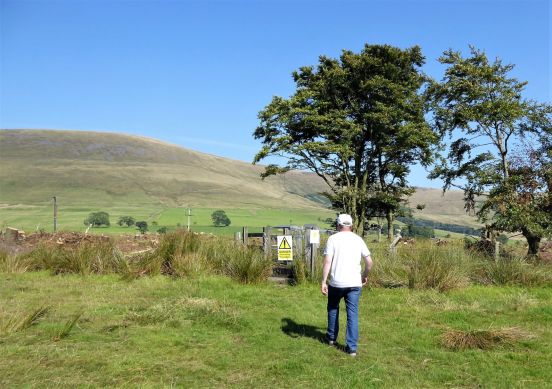
I must have a dozen or more posts regarding Bleasdale and have mentioned the Bleasdale Circle several times. Things didn’t look right today as we took the concessionary path towards the circle – the trees which enclosed it have virtually gone, I had to take a second look. As we came closer it was obvious that there had been severe storm damage since I was last here and the remaining trees harvested. To be honest the whole site looked a mess, all very disappointing, it’s going to need some loving care to make it presentable once more. The concrete inner ‘posts’ were still in place, but the interpretation board was undecipherable. The views from up high on the fells will no longer show the prominent circle of trees marking the site. See my previous photos here.

P1090213P1090214P1090215

I quote from previous posts –

The circles are Bronze Age and were originally oak posts, an outer and inner ring. Discovered in 1898 and subsequently excavated they yielded a central burial chamber with cremation urns and ashes. These are now on display in the Harris Museum in Preston. The inner ring of wooden posts have been replaced with concrete posts. The orientation of the posts within the circle of the Bleasdale Hills may suggest some deep reason for their siting here.  

Here is the official listing for it.

We walked on around the estate at a slow pace as the temperature soared. Our plan was to finish the walk just before six when the Cross Keys Inn at nearby Whitechapel would be opening. The plan worked, and we enjoyed a beer and a good meal.

Capturecross keys.

IN THE SHADE.

P1090206We are at the start of another heat wave, being out in the sun for long is energy sapping. But it is Tuesday when Rod and Dave go climbing, they have sensibly decided upon the shady Witches Quarry. I tag along.

My blog has been here before. I have been many times over the years, it is our nearest limestone climbing. The narrowest of lanes lead out of Downham for a few twisty miles with Pendle looming above. Today tractors going about their business slow me down – but there is no rush with the top down. Following an agreement with the farmer one is allowed to drive into the quarry, close the gate!

When I arrive a few other climbers are already doing routes. It’s a small world and I know most of them, so we chat whilst I wait for my mates to arrive. Then we sneak off to the lower and easier left-hand buttresses.

In times gone by we always wanted to lead a climb, ie roped up from the bottom, placing protection as you went. That felt like the only way to climb – testing one’s physical and mental capabilities. Of course there was always the risk that if you fell you may be injured or worse, with good judgement and luck I have survived 50 years of climbing. 

Times moves on, we are not as fit as before, we have lost that ‘edge’ to push ourselves, accidents at our age could have serious consequences. OK I’ll admit it we have lost our nerve and humbly resort to top roping routes. Having a rope above is so very reassuring.

We busy ourselves on some short crack climbs which seem more strenuous and tricky than their grades would suggest. All very enjoyable. We are in the shade, good company and the rural surroundings of the quarry are a joy. What better way to spend an afternoon.

Meanwhile, the other teams are leading much harder routes which I remember from the day. We are well and truly put in the shade.

P1090201

Rod and Dave safely top roping.


P1090200

Steve leading something much harder.

For the record – Hemlock, Coven Crack, Cauldron Crack, Sixth Finger and The Shrew.

CICERONE’S LANCASHIRE – back on the trail.

P1090151It’s two months since I was last able to do a walk out of Mark Sutcliffe’s guide book. Finding one locally I strode out today on his Jeffrey Hill chapter. The suggestion was to park at Little Town Dairy, a farm shop, nursery and café. I feel guilty using a businesses’ car park if I’m not giving them any business so I parked by the road higher up on the route, which was to prove tiresome later in the day.

I had reservations about the initial route through the upmarket barn  conversions at Dilworth Brow Farm, previously a run down property. There was no need to worry, the path through was obvious, and even the local dog was friendly. Every farm seems to be erecting holiday lodges, Is this a result of the recent ‘staycation’ mentality?

P1090114

An uncertain start.

P1090117

Dilworth Brow.

P1090122

Once into fields I could enjoy views over the Ribble Valley and distant Pendle as I dropped to an ancient bridleway. Being enclosed and sunken this was once a boggy mess, but drainage has been installed and an upgraded grit surface added. This was only a short section of the right of way, one wonders why certain paths are improved (a further one later) when others are neglected.

P1090126

Note the size of the left-hand gatepost.

I made the obligatory short diversion to view the Written Stone, I have written of this before,excuse the pun. A car passes down the farm lane, I thought I recognised friends from years ago and regretted not stopping them. As I walked through the tidy environs of Cottam House I asked a man about the history of the place, he turned out to be the son of the above couple. So we had a catch-up, I passed on my regards and walked on.

P1090129

The Written Stone.

P1090130

This was the start of a slow climb back up to the ridge of Longridge Fell. Rough ground skirting the golf club and then the road up to Jeffrey Hill at Cardwell House. A large walking group was coming past and didn’t seem over friendly, head down mentality. There was a straggler taking some interest in his surroundings. We ended up in a long conversation about all things, as he said “it’s not dark till late”. I felt he had lost connection with the route march he had been on. Nobody came looking for him.

P1090133

Up to Jeffrey Hill.

P1090137

The Ribble Valley and Pendle.

P1090140

No time for stragglers.

I took a picture of the iconic view which I mentioned in a recent post. A ‘glass wall’ has replaced the iron railings depicted in the painting I own from 40 years ago.

P1090145

That view from Jeffrey Hill.

Nearby was a bench for refreshments. Some stones had been intricately carved as part of an art sculpture from 2014, It was a shame they removed the star of the installation, the Sun Catcher.

P1090142

Remains of the sculpture installation.

Now steeply downhill, look at the contours, ending up on the road at Thornley Hall. The ford leading off the road was surprisingly full. The next bit of track starts as a track but quickly becomes an overgrown narrow path, the book advises a stick for hacking back the vegetation. I happily swashbuckled my way along and at the end came onto another strange short stretch of gritted path.

P1090150

Looking back up to Jeffrey Hill.

P1090154

The listed C18th Thornley Hall.

P1090157

The ford.

P1090158

A promising start to the bridleway…

P1090165

…soon becomes this…

P1090168

…and then unexpectedly this.

Familiar lanes took me past Wheatley Farm and a house that always has a splendid floral display. Onto the busy main road where care is needed on the bend. I was glad to be back in the peaceful fields of Chipping Vale under the Bowland Hills. Heading towards Little Town Dairy where I could have parked at the start, but no I was faced with another steep climb back onto the fell. I reckon I had climbed over 1000ft in the 7 miles which took me 4 hours including all those stops.P1090169

P1090172

Wheatley Farm, 1774.

P1090174P1090175

P1090177

One has to spend one’s money on something. 57 has gone shopping.

P1090178

Parlick and Fairsnape.

There was one more encounter at Sharples House. The farmer there had previously talked of having the largest cheese press in Lancashire, I believed him. In the past many farms in the area made their own cheese, tasty Lancashire. Today he seemed in a good mood, so I enquired further, and he took me to see the stone, it was indeed large and must have weighed a ton. He explained that the house was from the late 17th century. A former occupant, a Peter Walken (1684-1769) had been a nonconformist minister as well as a farmer. Uniquely he kept a series of diaries, most have been lost but two from 1733-34 have been found and published by a researcher from Preston museum. The present farmer was contacted and was able to see the journals but described them as boring, though they must have given an insight into farming life in the first half of the 18th century. He also told me of a mystery from the last century when two thieves broke into the house killing the farmer, but the daughter perhaps escaped hiding in an adjacent barn. One wonders how much local history has been lost.P1090183

There is another mystery just along the lane at Birks Farm – what is this structure in the wall built for? I should have asked the last farmer, next time.P1090184

Up the steep lane, over the last stile and I finish this splendid walk back at my car overlooking Longridge.P1090186P1090189P1090190

***

Capture

A BLOGGERS GIFT.

P1090093

                                                                                    Beacon Fell.

My friend and blogger Sir Hugh, conradwalks , often talks of ‘a bloggers gift’ Some unexpected happening or conversation that brings the story to life. He seems to collect these occurrences on a regular basis, many of them centred around a cup of tea with complete strangers. I’m secretly jealous.

Picture the scene – we are walking down a country lane when a man recognises me and enters into conversation. We are just passing his house, and he suggests showing us around his garden. We are not rushed for time, “Yes we would like that” was our innocent reply. The garden was large and unruly with many interesting plants. His main passion was apples and he had many varieties, most grafted onto stock by himself. We had finished the garden tour when his wife offered us tea, we couldn’t refuse. Next thing we were seated in the garden with tea and chocolate birthday cake. Talk was inevitably about the old times, we had many shared acquaintances.

As we came away after a good hour in their company I realised I should have had a photo of the occasion – a bloggers gift. Too late, what a missed opportunity.

Anyhow, here are a few photos from our stroll around the Whitechapel area beneath Beacon Fell. The emphasis was on beautiful Lancashire pastures with extensive views and on the multitude of very expensive properties, you don’t get much for less than a million. Mike was prospecting a possible route for a walk he is leading later in the month starting and finishing at the newly refurbished Cross Keys Inn.

P1090090

Whitechapel St James Church.

P1090092

Into the fields.

P1090095

Himalayan Balsam in profusion.

P1090096

Hydrangeas at Crombleholme.

P1090098

Modern day fencing.

P1090100

Wood Fold.

P1090105

P1090106

Barnsfold barn conversion.

P1090111

C17th Ashes Farm, moated.

P1090112

Cross Keys Inn, closed on a Monday lunchtime

***

Whitechapel

LITTER ON THE FELL.


P1090076

             Longridge Fell looking across the green Chipping Vale towards the Trough of Bowland.


At the risk of raising the blood pressure of my, environmentally sensitive, readers – read on.

Following on from my brush with Covid I  have not kept up with the walks featured in the Lancashire Cicerone Guide book. I hope to resume them shortly. Today I needed a gentle leg stretcher – Longridge Fell always has something to offer. I’ve not done a ‘litter pick’ up there for several weeks so that became the object of the morning’s stroll. 

Parking up I was immediately confronted with discarded pizza boxes and drink bottles , also strangely two plastic motor oil containers. There is a litter bin 10 metres away, though admittedly it is usually full to overflowing. Not a good start to the day. P1090074

I set off on my walk intending to clear this mess up when I return, it won’t all go in my bag. Longridge Fell was bone dry making for easy walking though the threats of moorland fires must be high. I noticed the bilberries were very small perhaps a reflection of our lack of rainfall this June and July. The other thing that struck me was that the heather was already blooming – I seem to have missed some seasons this year.

P1090075

A sad finding on the ridge was a recently dead Kestrel. I could see no signs of it being shot, but I did wonder afterwards about possible poisoning. Should I have picked it up and sent to the RSPB or police for toxicology tests?

P1090077

Up to the trig point and back in a circle I half filled my bag with the usual doggy poo bags, drinks cartons and food wrappers. The short stretch on the road at the end provided an equal amount of rubbish dumped out of passing cars. All I had to do was pick up the rest of that rubbish in the car park. 

This is a local beauty spot with a fine view of Chipping Vale and the Bowland Hills so there are always cars parked here. In lock-down it was a free for all with all the verges taken over, things are back to normal now. Today I noticed two artists busy painting the scene. I wandered over to have a chat and admire their work. One was using watercolours and the other acrylic, they both complained about the high temperature affecting their paints. What a talent to be able to capture that view with a few brushstrokes. I wish I had asked them to email me a copy of their finished paintings.  That reminds me, I have on my study wall a watercolour of the very same scene done for me by a Mr. A Long, an artist who lived in Longridge 40 odd years ago.  

P1090086

P1090085

P1090089

Mr Long’s painting.

What a contrast from two gents fully appreciating their environment to the louts who drive up here with their takeaways and don’t take them away.

A COUNTRY LANE.

P1090044 (2)

I used to be able to recognise and name most of the wayside flowers. As part of my A Level Botany course we had to present a collection of pressed and dried flowers to the external examiner for an intensive viva. I’m talking of 60 years ago, I suspect the modern day student will not of heard of external examiners and vivas. Being the sad git that I am, I still have my folder of dried flowers, about 200 species all classified and labelled precisely. I may fish them out and show you my diligence.

Time passes by and one’s interests widen, but I have always tried to put a name to plants as I pass by, but I admit to becoming a bit rusty on those once familiar names. At my age one starts to worry about dementia but all my friends struggle too. Annoyingly that elusive name will often surface at a later time. Anyhow, to brush up on my plant recognition skills I decided to upload an app onto my phone that would help me on those I had forgotten. I know I’m behind the times with this technology.

There were several to choose from, and eventually I chose one. I pointed it at an Ox Eye Daisy and it only told me that it was from the Asteraceae (daisy) family. That didn’t seem to be good enough, so I tried a few more. None were particularly accurate or quick to respond, maybe it’s my ageing Android phone. I searched ‘best plant apps’ and eventually settled on iNaturalist. Time to put it to the test.

A local walk I often do involves a pleasant almost traffic free lane. They call it Mile Lane despite the fact that it only measures half a mile. My mission today was to try and photograph and identify every flower seen on this short rural stretch of Lancashire. Last time I was out I was solely on the trail of the Bee Orchid – today I would be content with a Thistle or Dandelion.

That half mile took me far longer than usual as I searched the verges and hedges for as many plants as possible. Rather disappointedly I only counted 25 different species. (Grasses weren’t included, that would have been a step too far.) I recognised the majority of them but was stumped by one which my app told me was a Hedge Woundwort, Stachys sylvatica. I wasn’t aware of its pungent smell, next time I come across it I’ll check that out. Its common name suggests it was used for dressing wounds, no doubt having some antiseptic properties.

I was not impressed with the iNaturalist. It took a long time to register the plant and often gave a rather vague identification. I admit my phone is not the best for photography which may have a bearing on the results. If any of you have a suggestion for a favourite plant identification app I would be very grateful for your advice, I’ll try it out on a different lane.

P1090051

 Hedge Woundwort.

TO BEE OR NOT TO BEE.

Last year I bought a recommended book ‘Dancing with Bees’ by Brigit Howard, though fascinated by the subject I didn’t get past the first few chapters. It remained on my bedside table along with other must read volumes. I’ve caught up on about a dozen books whilst laid low with a vicious Covid visitation. Brigit’s book is as much about reconnecting with nature as it is about bees and I have been stimulated to learn more. I took advantage of a hot sunny day and went outside to watch the bees visiting a particularly scented clump of purple Astrantia. It was overload with so many bees buzzing around, several species were noted but as for identifying them that was a different matter. Taking photos was as frustrating as with butterflies. This isn’t going to be easy. Defeated I await the arrival of a bee identification book before I try again.

***

Meanwhile, I am aware of Bee Orchids growing in our local limestone quarries. I have never seen one. A chance comment from Shazza (all things nature and Clitheroe) mentioned she had spotted Bee Orchids at Crosshill Quarry, that’s all I needed. A flower Bee should be easier to observe than a flying one.

It wasn’t that easy. I parked up in Pimlico on the edge of the industrial sites of Clitheroe and headed into Crosshill Quarry nature reserve. A meadow off to the right was all a meadow was supposed to be, abundant grasses and flowers. I felt like Sherlock Holmes combing through the foliage for evidence. Purple orchids, trefoil, vetch, etc but no Bee Orchids.

I continued on to the small Quarry within the site where Shazza had reported  Bee Orchids. I searched diligently across the open quarry floor, ideal limestone habitat for a Bee Orchid, but to no avail, wishing I had asked her for a more precise location. There was a myriad of other species, marjoram, bedstraw, twayblade and other orchids.

The last time I was here on the Sculpture Trail I failed to spot the Footprints in the rock face by Tom Dagnall – I made sure I didn’t miss them today.  They were so effective, how did he carve them into the limestone? 

***

Round two. There is a geological trail nearby, Salthill Quarry, which I had never visited, All was unfriendly industrial units and articulated lorries. I eventually found somewhere safe to park the car and set off more in hope than expectation. The main purpose of the trail was to highlight the rock faces and bedding planes of an old limestone quarry. Crinoid fossils predominated. I was itching to climb the shorter walls but thought better of it. The path was too enclosed for Bee Orchid habitat, I needed open spaces. Following the trail round, it could do with better interpretation boards, I came into more open ground with Pendle Hill lording above us. A fossil bench has been constructed with images of ‘sea lilies’, animals on the sea bed, that became crinoid fossils all those years ago. Backwards and forwards I combed the hillside for the elusive bee. I was by now almost back to where I had started, and I took a diversion to look at an isolated rock face on the edge of the industrial complex. Some other purple orchids took my attention and there suddenly was a Bee Orchid. It couldn’t be mistaken and then there were a couple more. By now I was down on my knees trying to zoom in for the best shot. And to think I was only 40 metres from where my car was parked inside the quarry.

***


Ironically the bee mimicked by this orchid is not present in the UK, so the plant is self pollinating after all. Why is it here in the first place?

A Beginner’s Guide to Rights of Way and Access Law — Country Ways

I’m sharing this post as I feel it is important that the public are aware of their rights in the confusing world of access. Please have a read, no matter how experienced you are.

This courtesy of the Ramblers Association – worth printing out for reference. A beginner’s guide to rights of way and access law 25 May 2022 Can you tell a bridleway from a BOAT? Do you know what that pink patch on your map means? And is it really impossible to commit trespass in Scotland? Find […]

A Beginner’s Guide to Rights of Way and Access Law — Country Ways

BACK IN THE SADDLE – Morecambe bay and beyond.

June 24th. 2022.

Crawling out from under my rock I wonder where a week has gone. It went in a haze of Covid fever, headache, cough and abdominal pains which laid me lower than expected. I could hardly read others posts never mind complete my own. I’m not at my best.

June 14th. 2022.

Where was I?

Ah, yes. Parking up at Halton Station in preparation for a cycle ride around Morecambe Bay. Post coffee I’m off, so good to be out again feeling free as a bird. Into Lancaster, over the Millennium Bridge and out to Morecambe. I take a bit of detour past the football ground to arrive at the coast in the West End near the site of a former pier. The view out over the bay is clear, but everything seems at a great distance. I soon pass the Midland Hotel, one day I will call in for tea, and continue up the promenade without stopping at the various attractions.

West End Sculpture.

I’ve been this way so many times before, I even know the way from the end of the prom to reach the Lancaster Canal. Normally I turn south here but today to vary my route I head north alongside the canal. This is a delightful stretch with the canal elevated above the surrounding countryside. Below are Hest Bank and Bolton-le-Sands, and father out are the treacherous sands of the 2004 cockling disaster when 21 illegal Chinese immigrants lost their lives. We still don’t know how to manage the flow of immigrants into our country.

I have to be careful to leave the towpath at the correct spot, not signed, to pick up the 700 cycle route which could eventually take me, if I wished, all the way around Morecambe Bay to Ulverston and Walney Island, Barrow. Today I only went as far as the River Keer and its eponymous bridge. Whenever I’m here I can’t help thinking of The Bridge on the River Kwai and start whistling Colonel Bogey. Obviously the name of the bridge and its wooden structure set my mind into action. So much so that I paused my writing here a couple of hours ago to watch the 1957 film starring William Holden, Alec Guinness and Jack Hawkins on Vimeo. I had forgotten how good it was, building up the tension and reflecting on the British character and psychology in times of war. Directed by David Lean, arguably his best film was a few years later – Lawrence of Arabia. We will shortly come across his name once more. It is worth your time to watch again and revaluate    https://ok.ru/video/2090020047523

The Bridge on the River Keer.

***

Where was I?

Ah, yes. Coming alongside the diminutive River Keer into the railway town of Carnforth. The railway station is on the main west coast line with branches to the Cumbrian Coast and inland to Skipton, a busy junction. Most of the main line expresses cruise through at speeds unimaginable at the time of the fictional ‘Milford Junction’ just pre-WWII. It was here that David Lean directed much of the romance of Noel Coward’s Brief Encounter. Carnforth has capitalised on the ongoing success of the film and a Heritage Centre has been created on the platform – all things railway and cinema. Here I go again – diverted to watching a tormented Celia Johnson and a rather wooden Trevor Howard in Brief Encounter on the computer. I’m now an emotional mess, must have been  the Rachmaninoff. I’ll never finish this post.

***

Where was I?

Ah, yes. Enjoying a cup of tea at the famous waiting room. I had time to drift back in time as the pot of tea took an age to arrive. On my way again I now followed the 90 (Lancashire Cycleway) up to sleepy Nether Kellet now high in this range of unnamed low hills.  Views back to the Bay with the Lakeland Hills behind and ahead over Lancaster and the Bowland Hills. Whizzing down I missed my turn and ended up alongside a military training centre above the Lune. All barbed wire, locked gates and grey paint. Halton village had some old properties previously related to a now demolished Halton Hall, worth a more detailed visit. Back over the Lune I was the last car in the car park and drove home tired but contented not knowing what was ahead.

More variations and suggestions on cycling Morecambe Bay, very satisfying. Shame about the ensuing Covid.

***

***

Further to some comments below on this post, here are a couple of phone photos taken by my son on the canal in Stretford. Bee Orchids.

***

BACK IN THE SADDLE – Morecambe Bay and beyond?

June 14th. 2022.

A couple of weeks go by with more minor injuries preventing walking far – so time to get back on the bike. The problem was where should I go – my easy routes are becoming repetitive. After a few days bouldering up at Craig Y Longridge I feel rather stiff and lethargic this morning. Before you ask, although walking is painful I am able to do low level bouldering as long as I don’t jump off or more likely fall off. Anyhow, I have survived and need a longer day’s exercise, the wind has dropped so out comes the cycle, or rather in goes the cycle, into the cavernous boot of my estate car. No need to dismantle anything which could later cause me problems of a mechanical nature. Every cycle ride I do my heart is in my mouth expecting some failure which my limited mechanical abilities could not solve, leading to a long walk. I’m surprised there isn’t a breakdown service available to cyclists.

I’ve spotted, on the cycling map, a Route 90 that will give me a circular ride after I’ve progressed up Morecambe Bay to Carnforth. As I said, feeling lethargic I didn’t get going until lunchtime but once more I’m in the parking at old Halton station. I grab a coffee from the convenient snack van ready for the off along the familiar lines through Lancaster to Morecambe…

***

I’ve not felt well for a couple of days, head cold, sore throat, chesty cough, dizziness,bowel and bladder irritation and as I commence to write up yesterday’s completed excursion here this morning I feel distinctly worse. Time for a Covid test.

I’m going to bed so will catch up with you later.

CICERONE’S LANCASHIRE – To the points.

I’ve never been fully around Sunderland or Bazil Points so walk no 18 in Mark Sutcliffe’s Cicerone Guide to Walking in Lancashire was an attractive proposition especially as it was flat as a pancake which suited my crumbling body.

I have a fear of rising tides, so the logistics for this walk were important. Tide timetables were consulted and double-checked, last Saturday looked good with a low tide at 9am. Unusually for me, I was parked up at Overton at 9am. Would my car disappear under the waves whilst I was out, I said I was nervous about the tides around Morecambe Bay. Remember the disaster in 2004 when at least 21 Chinese illegal immigrant labourers were drowned by an incoming tide whilst picking cockles off the Lancashire coast.

There was little sign of water as I walked across the causeway, just mud and marsh grass in all directions. The Sea Thrift gave the area a pink glow. A few cars passed heading to town. Soon I was at the few houses that call themselves Sunderland, once the major port for Lancaster and beyond. I wrote of the history of this place when I visited in October last year.

That time I was on my cycle so didn’t go right round the point itself. Today I continued past the last house onto the rocky shoreline and found a place to sit at the very end looking out over the Lune to Cockerham and distant Knott End. There was Plover Lighthouse seemingly on land today. As the tide was well out there were virtually no waders on the shore, just the odd shelduck, but curlews were calling in the fields behind me and goldfinches flitting through the gorse bushes. A local lady walked by and talked of the unique life here. I enjoyed the peace and the view knowing that when I turned the corner Heysham power stations would dominate the landscape.

Glaucium flavum only found on the coast.

I passed by Sambos Grave and the Camera Obscura, I couldn’t resist going inside for the upside down view. Cows were grazing on the marshes. A wild rose had the most delicate perfume.

Up at Potts’ Corner more people started to appear on the sands, presumably from the nearby caravan parks. Here I joined the zigzagging lane for half a mile before cutting across fields to use the sea wall leading back to Overton. The village is a cluster of cottages on an elevated site above the Lune. Some of the properties dating back to the C17th when it was a farming and fishing community.

I walked on to the church, one of the oldest in Lancashire. It was locked, so I couldn’t view the interior box pews and balcony. I found a seat near the Norman doorway and ate my sandwich looking over to Glasson. Then along came a gent in a tweed jacket, shorts and trilby, he cycled in to get some photos of the estuary as the tide comes in. Turns out we had mutual interests and spent a pleasant half hour chatting about this and that.

There was an old lane leading down to the shore from where at one time a ferry crossed to Glasson which looked very close. I walked around Bazil Point on the edge of the rocks, which would be difficult if the tide was in. Each gate on the way has a smart red sign. The point was as atmospheric as the one I’d walked this morning and as the tide raced in the surface of the water displayed a silver shimmering which I found mesmerising.

Ferry Cottage – considerably modernised. What a situation.

Looking back to Bazil Point.

At one stage I left the beach to walk in the fields, though I later found I needn’t have. The path left the field by a most unusual high stile down to the beach. By now I was surrounded by a herd of cows with a sturdy bull coming my way. I was glad of the escape route.

The bull is prowling at the top.

And then I was back at my car, still above the waters. What a magic area this is and well represented by Mark’s walk.

GREBE UPDATE.

Following my post about a week ago I have kept visiting the Upper Dilworth Reservoir in Longridge to check on the progress of our Great Crested Grebes and their two chicks. I am glad to report that the chicks are doing well and swimming independently of their mother, no longer hiding on her back. I was slightly concerned that there was no sign of the male today.

June 3rd. Happy family.

June 6th. Where’s dad?

Where did mum go?

FLAG WAVING IN BLACKPOOL.


I was confused by the rash of Bank Holidays and Jubilee Festivities and found myself in the midst of Blackpool’s celebrational party, and they know how to party here. The crowds were too thick to cycle through safely, I was returning from Lytham to Fleetwood on the promenade. This was my first time out on the bike since my collision here which resulted in torn knee ligaments. I was being extra careful. 

I had accomplished my mission to visit the Mussel Tank which I’ve passed so many times without realising it was there, thanks to Shazza for highlighting it. There is some purpose to blogging after all. The tanks, built in 1934, were used for cleaning the mussels harvested from the muddy Ribble Estuary. By the mid 1950s the beds closed down, mainly  because of changes in the Ribble channel affecting restocking. There were three tanks. A cleansing tank now the RNLI, a chlorination tank now the Ribble Cruising Club and the storage tank now the Mussel Tank which has been given a face lift as an open space for public enjoyment. There are interpretation plaques about the mussel trade, an art wall displaying ceramic tiles portraying local features produced by students at Lytham Sixth Form College. There’s also a large-scale mussel sculpture by a Martyn Bednarczuk which I thought resembled a smiling dolphin rather than a mussel.


One of the original tanks. Lytham St Annes Civic Society

I was glad to see that they had restored the sails on the iconic windmill.

Nearby was an installation by Tom Dagnall reflecting on the diversity of the SSSI Ribble Estuary.

It was time for an excellent coffee break in St. Annes.

There seemed to be an awful lot of people on the prom in the vicinity of the tower. I just assumed Jubilee celebrations but as I cycled on there were more and more camera clutching folk by the tram line.

I stopped to enquire and was informed of a parade of trams from the past. Nothing seemed to be happening, so I cycled on keeping to the higher way alongside the tramline. Eventually the parade arrived. A motley collection of Blackpool trams and an exquisite turn of the century Bolton tram. There was a lot of flag waving from the passengers, they must have thought me a misery. The photos may mean something to someone.

I made it back in one piece, quite pleased with the 30 odd miles I’d cycled.

I BELONG TO GLASGOW – Part 4.

*****

Kelvingrove Art Gallery and Museum.

First stop on arriving in the immense baroque red sandstone Kelvingrove Art Gallery and Museum was their café where we relaxed and enjoyed a light lunch whilst the organ concert was taking place above.

This place is like the British Museum, Science Museum,  the V and A, Natural History Museum and the Tate all rolled into one. It’s immense, one needs a battle plan to find a way around the multiple galleries on two floors. The entrance hall is large enough for concerts with the organ at the north end.

We were most interested in the art galleries in the east wings. We were straight into another Mackintosh exhibition. Lots of examples of his work and that of his collaborators. There was a partial reconstruction of a Glasgow Tearoom which he designed for Miss Cranston who owned several tearooms in the city. There was metalwork and glass from the same era. I was struck by the design of the leaded window as it was almost identical to those in my parent’s inter-war semi-detached.

The next gallery was devoted to an extensive collection of The Glasgow Boys. Encountered earlier in the University this group of local artists rebelled against Victorian sentimentality and revolutionised Scottish painting at the end of the C19th. Outdoor naturalistic painting of local scenes and people with strong brush strokes and later French-inspired techniques bordering on the abstract. 

Time for coffee and cake, 

Now on the first floor.  Scottish landscapes, French art, Scottish Colourists and Dutch art. Quite a variety.

Lavish Scottish landscapes.

***

Large French display – mainly impressionists.

Renoir.

Monet.

Signac.

***

The Scottish Colourists, a colourful modern French style for Scotland at the start of the C20th.

J D Ferguson.

***

Classic Dutch paintings.

***

And in a room of its own ‘Christ of St John of the Cross’ by Salvador Dalí. This iconic painting was purchased by the gallery in 1952 for £8200 and now estimated to be worth £50million. Dali said he had dreamed the scene of Christ looking down on a shoreline from the cross, no nails or blood.

We had only seen a fraction of the displays in the Museum. In the west wings were a multitude of history, science and nature which we didn’t explore.  There were some outstanding paintings on the landings surrounding the first floor and from up here one had a view into the two courts.

A bus back into town, a pint in the Counting House (Witherspoon’s superb use of an old bank) and back home to Preston in a few hours.  Glasgow is certainly worth a visit whatever your interests.

I BELONG TO GLASGOW – Part 3

*****

Mainly Mackintosh.

A taxi was used after breakfast to take us quickly up to the Hunterian Art Gallery in the University. The taxi fare of about £13 was almost as expensive as our train tickets from Preston to Glasgow, £15 for the two. From the outside the gallery was a big block of concrete, brutalistic Mike said. But inside is a hidden gem – The Mackintosh House.

Charles Rennie Mackintosh (1868-1928) was a renowned architect, designer and artist creating modern Art Nouveau buildings with the interiors and furnishings complementing his minimalistic ideas. His wife Margaret was a talented artist/designer and collaborated on many of his works.

One of their projects was to transform the interior of the house they were living in from 1906 to 1914, 78 Southpark Avenue.  They had a vision for light clean lines, often taken from nature, and designed everything from the furniture to the curtains to create integrated spaces for living in. “the room as a work of art”  Subsequent owners kept the interior and eventually Glasgow University took it over in 1945. The furnitures were put in storage and when the house was demolished in the 1960s the interiors were preserved along with drawings and photographs of the house. By 1981 the interior of the house had been carefully replicated inside the university art gallery and the original furnishings installed. Carpets, curtains and soft furnishings were produced from drawings and photos.

So we found ourselves stepping into the Mackintosh’s entrance hall from over a century ago. The adjoining dining room was more of a sombre hue with distinctive Mackintosh chairs. On the next floor up elegant stairs was the L-shaped drawing room created from two rooms, As soon as you enter you are transfixed by the white decoration, flooded with light from windows which replicate the original house’s orientation. All was sublime. Delicate details from Margaret compliment the distinctive furniture of  Charles. Up a floor, and you were in the bedroom, again an L-shaped area. All white with furniture inspired by plant and bird forms.  Everything was exquisite.

For an in depth look this video is recommended.

The adjacent art gallery had more of Mackintosh’s work, complemented by his wife, and fellow artists and collaborators, the husband and wife James and Frances McNair. This included a reconstruction of one of Mackintosh’s last interior schemes from Derngate, Northampton, 1916, pictured in the heading photo.

Adjacent galleries highlighted the painter James A M Whistler. I don’t remember seeing any of his works before and was particularly impressed by his long portraits, delicate impressionism.  No sign of his mother.

The university gallery had several of the paintings of the Glasgow Boys and the Scottish Colourists.

The ‘Boys’ – an informal group of 20 Glasgow artists that came together in the early 1880s – they challenged Victorian Scottish painting, and developed a distinctive style of naturalist painting. Outdoor painting of local scenes and people with strong brush strokes and later French-inspired techniques bordering on the abstract. Whistler’s work was an influence.

Hornel, Henry and Gauld.

The ‘Colourists’ – four painters – Francis Cadell (1883–1937), John Fergusson (1874–1961), George Hunter (1879–1931) and Samuel  Peploe (1831–1935).  They used vibrant primary colours and simplified avant-garde forms. I first became aware of them at an exhibition in Woking in 2019.

Still Life . Cadell.

There will be more of these Scottish painters in the Kelvingrove Art Gallery and Museum this afternoon. Time for a break.

I BELONG TO GLASGOW – Part 2.

*****

The Burrell Collection.

A good buffet breakfast set us up for a full day. The bus took us south of the Clyde  alighting at the entrance to Pollock Park. A pleasant walk through the grounds and we were  outside the Burrell Collection building, reopened in March after a major refurbishment. It originally opened in 1983 to house the vast collection of the Burrell family, gifted to Glasgow in 1944. Sir William Burrell, (1861–1958) a wealthy shipping merchant, devoted more than 75 years of his life to amassing one of the world’s greatest personal art collections, renowned for its quality of Chinese art, exquisite stained-glass and intricate tapestries, as well as its breadth of fine art. The galleries are built with a warm sandstone and lots of glass, situated in the middle of all the greenery of Pollock Park.

We were in for a bumper day. 9000 objects from 5000 years.

Burrell collected just about everything from all over the world and the first we noticed were the many medieval doorways from monasteries and country houses, they have been carefully incorporated into the building giving access between the galleries. The interior is a pleasing blend of stone, wooden beams and glass giving a beautiful light for the visitors.

In the covered courtyard is the Warwick Vase. It was found in the C18th in fragments in the villa of the Roman Emperor Hadrian outside Rome. It was restored and given to the Earl of Warwick. The Vase stood in the courtyard of Warwick Castle for almost two centuries until it was purchased for The Burrell Collection in 1979. A large marble sculpture in the form of a two-handled drinking cup, with motifs to the Roman God of wine Bacchus. So one of the star exhibits was not actually collected by the Burrells.

Off we went around the ground floor outer galleries with exhibits scattered throughout the rooms. Burrell started collecting Chinese antiques around 1910, Jades, porcelain and furniture from all dynasties. 


Egyptian artefacts were well represented, and I was particularly pleased to see the lion head of the goddess Sekhmet, 1390BC. My cat Seth is named after this goddess, the name change when the vet pointed out his sex. 


Suits of armour were everywhere,  I was amazed at their intricate artistry and the fact that somehow they had survived intact from the C16th.


.

The museum is home to more than 700 ecclesiastical stained-glass panels from across Europe, and the outer galleries are ideal for displaying them with natural light.

You will all recognise this bronze Rodin statue.

Time for a coffee from the pop-up café in the entrance.

Now we delved into the inner galleries where pictures were protected from the outside light. I thought that the fantastic collection of master painters, Degas, Rembrandt, Manet etc needed more space to show them at their best.

There was an informative section on carpets, mainly Islamic designs.   The  C17th  Garden Carpet from Iran was displayed with its animated video representation bringing  it to life, showing how far museums have become more interactive and accessible

Upstairs were several galleries delving into the secrets of creating the masterpieces. Printing, lace making, woodcarving, metalwork, glassblowing, bronze casting etc etc. We should have left more time for these fascinating insights, but we were coming to the end of our visit and a restorative tea and cake in their café was called for.

I think we missed far more than we saw, and a return visit would be warranted. Once outside we decided to have a walk around Pollock Country Park and see the house where the National Trust for Scotland was started. We did not know what to expect but were surprised at the Georgian grandeur of the house. It had closed for the day, so we only admired it from the courtyard which was full of colourful azaleas. Walking through the stables we found a path following the river, White Cart Water, and skirting the gardens, with a view of the house frontage. The gardens were resplendent with blooming rhododendrons. We wandered back past the estate sawmills, closed for refurbishment, a cricket pitch and Highland cattle in the fields.


Back in town we enjoyed a pint in one of the oldest inns in Glasgow. The Scotia Bar established 1792. A friendly place with a good selection of ales – we had the session Belhaven. All around were pictures of old Glasgow and you could imagine the sailors of the past from the nearby docks sipping their pints in here. The subsequent Turkish restaurant was unfortunately a let-down.

A good night’s sleep is needed before tomorrow’s excursions.

I BELONG TO GLASGOW. Part 1.

*****

The city.

As we sip our pints in the unique Counting House, a Wetherspoons pub created from an old bank in the centre of Glasgow, the words in the title come to me. If we had stayed too long in the friendly, but toxic atmosphere of this drinking emporium Glasgow would have belonged to me. Sensibly we cut the session short and went off in search of some food. We found the busy Madras Café and enjoyed some good Southern Indian food before returning to our hotel for the night.

Mike and I had travelled up from Preston to Central Station on the train this morning at a ridiculous £7.50 single fare. Our plan was to explore some highlights of central Glasgow and over the next couple of days visit the outstanding art galleries. Having an architect along would give extra value for me.

The ‘Merchant City’ area of Glasgow was developed from Medieval periods but came to the fore in the C19th when merchants’ money from shipping  (tobacco, sugar, tea  and slaves) created impressive Neoclassical buildings. Everywhere we looked were historic properties. Mike had a list. First up was the City Chambers (opened in 1888 by Queen Victoria) headquarters of various city councils over the years. All was marble, mosaics and mahogany. Unfortunately only the entrance chamber was accessible (post Covid regulations) giving some idea of the opulence.

On the outside wall of the Chambers were the official Imperial Linear Measures. Not normally of great moment but since our crazy government is thinking of resurrecting them in place of the Euro metric I thought a photo would be of historical interest. They may have an armed guard on them by now.

We were in George Square surrounded by imposing buildings and full of statues of notable Scots. Sir Walter Scott was 80ft up on his pedestal, towering over Robert Burns, James Watt, Victoria and Albert and several more.

As you can see we had a damp start to the afternoon. Our next objective, on the other side of the square, was the Gallery of Modern Art (GoMA) housed in a Merchant’s building, whose history was as interesting as the art. Built in 1778 as the town house of William Cunningham a wealthy Glasgow tobacco merchant who made his fortune through the triangular slave trade. It had been enlarged considerably over the period,  namely the Corinthian pillars to the Queen Street facade, the cupola above and the large hall to the rear of the old house. Outside is the most photographed statue in Glasgow – The Duke of Wellington resplendent with traffic cones, four today! The council have given up on removing them. 

The entrance opened out into a stunning oval stairwell illuminated from a distant skylight.

The art on show included black artists who have been in the minority in Scottish culture, yet their post-colonial legacy is important today. Tam Joseph’s Timespan was intended to be a representative leap forwards in racial equality and human rights.

On the next floor were recognisable modern paintings.

The top floor, Domestic Bliss, was less recognisable with contemporary installations.

Ready for a coffee and a sit down we headed downstairs to the café in the extensive library.  I recognised this from a previous visit, but I couldn’t think when!  They had just reopened after all the Covid restrictions that Scotland had imposed for longer than England. Good coffee and cakes.

Mike wanted to visit The Lighthouse,  the former offices of the Glasgow Herald newspaper. Completed in 1895, it was designed by the architect Charles Rennie Mackintosh. The first of his designs we visited on our trip. Yet again delayed post Covid problems meant we couldn’t access the higher floors and the famous spiral staircase leading to the viewing tower. 

Mike thought that the Cathedral, the oldest building in the city, C12th, would be a good place to visit, so we set off in the rain to walk up there. My camera didn’t like the moisture and refused to work, so I switched to my phone for the rest of the day.

The Cathedral was a massive Gothic structure – inside and out. Noticeably was a central pulpitum, a richly carved stone screen between choir and nave added in the early 1400s. The cathedral had survived the reformation intact.  Somewhere in the crypt was a shrine to St. Mungo, we missed it. Some lovely stained-glass.

We re-emerged just as the rain stopped and were attracted to the Necropolis on a hill behind the Cathedral. Reached by a bridge this large Victorian cemetery has 50,000 graves, many of them with ornate mausoleums. Wandering around was like something out of a horror film, I was expecting bodies to creep out of some of the shrines. From up here the copper roof of the cathedral was very obvious, copper having replaced the over heavy lead. It was worth coming up here.

A restorative coffee in a fish bar, and we were on a train to the western dock’s area. The last time I stayed in Glasgow was here next to the Armadillo and the Finnieston Crane. We had a walk on both sides of the river, BBC on the south bank, as crowds queued for a Russel Brand concert.

Then it was back to the centre for that drink and meal, quite a busy afternoon. 

CICERONE’S LANCASHIRE – Lunesdale and Kirkby Lonsdale.

***

This is my latest route from Mark Sutcliffe’s guide to walks in the Red Rose county, although this one starts in Cumbria. Kirkby Lonsdale is a bustling market town in south Cumbria, My journey here had been slowed by several convoys of horse-drawn travellers probably heading to Appleby Horse Fair to be held next month. I park near the Devil’s Bridge where I know the parking is free, his suggestion of central parking is probably unwise.

The medieval Devil’s Bridge has three graceful, ribbed arches and is closed to traffic. I was in no hurry and in fact on arrival cross the bridge on foot to buy a coffee from the mobile stall, a favourite with motor cyclists, when at weekends up to a hundred may congregate here. It has also been the scene of youngsters ‘tombstoning’ into the river below, not to be advised. Chatting to a cyclist, of the bicycle genre, it transpires he has ridden from Preston in a time not that much more than double my car journey. The bridge has a legend relating to the devil, I liked this version…(ignore the plugs towards the end)

So it’s getting late when I start my walk downstream alongside the Lune. For two miles along this stretch all is peace and quiet, only a few dog walkers. The air is however full of rapidly flying Sand Martins, I’m almost mesmerised by their acrobatics. I suspect that this year’s juveniles are boosting the numbers. On the opposite side is a long low sandbank with obvious nesting holes visible. Ahead in the distance are the Bowland Hills, just visible in the rather cloudy sky. Behind are the Barbondale group of lower fells and there across to the east is the distinctive Ingleborough. Once he has attracted your attention you are hooked and spend the rest of the day taking more and more duplicate photographs. I make an effort today to avoid that trap, unsuccessful as you will see later.

Before long I’m heading away from the river on a flooded track up into the village of Whittington. Mark’s route takes a path parallel to the village road, but I am curious to see the old houses so take a slight diversion up the main street. I’m glad I did as there are some interesting properties many from the C17th, most of them listed.

Barn at Low Hall, late C18th…

…with pigeonholes and an owl opening.

Malt Kiln House.

The pub is closed.

The Old School. 1875.

Manor House.

The grand Whittingham Hall from 1831 is hidden down a private drive.

Eventually up the hill I reach the parish church of St. Michael with its early C16th tower. The rest having been largely rebuilt in 1875 by Paley and Austin, well known for their church architecture in Lancashire. Internally there is an elaborately carved chancel screen. The church is built on the motte of an earlier castle, where I sat in the sunshine enjoying a sandwich, The path I should have approached the church by was clear to see ahead of me. Whilst admiring the view I witnessed something I’d never seen before – an angry blackbird was chasing at low level a squirrel across the field. Presumably the squirrel had been attacking the bird’s nest.

Rest over I tackled the very steep lane heading north, it appeared to be a ‘green’ lane but was in fact a highway though I doubt few motorists would tackle it from the bottom. All was in fact very green and shady.

Once at the top I took diverted paths around Sellet Hall with views across to Barbondale and of course Ingleborough.

Sellet Hall. C17th much modified.

Down a meadow full of contented cows to Sellet Mill, a former water powered corn mill where the iron mill wheel has been preserved.

Sellet Mill. C19th much modified.

The continuing bridleway back up the hill was rather strange, behind the mill was the original millpond (now a leisure pond) and coming down into it a rocky stream. The bridle way took me straight up this stream, in parts the old cobbles were visible, but most will have been washed away. After heavy rain this way would be impossible.

At the top I came out into meadows above Kirkby Lonsdale with excellent views over the valleys and to, yes you’ve guessed it, Ingleborough. Again strangely the RofW went straight across the middle of a rugby pitch, what are your rights when there is game on?

Then it was through the middle of the Queen Elizabeth high school, I felt I was trespassing.

I found Kirkby over touristy. There are lots of interesting buildings and alleyways, but the town suffers from a traffic problem with cars everywhere, even though my photos seem to show an absence of them!. I was glad I’d parked out of town – be warned. The flags are out for the Queen’s Platinum Jubilee later this week, in case you are from another planet.

I made my way towards St. Mary’s Church. The oldest parts of the church are Norman, doors and pillars, but the structure has had numerous alterations over the centuries. Inside there are three Isles and the nave, so the church appears grand. Some of the Norman pillars have incised decoration similar to Durham Cathedral. I missed a ‘green man’ carved on one of the C12th columns. There is a C13th piscina in another.

The graveyard is extensive with some impressive memorials and at one corner is an unusual octagonal stone gazebo from the late 18th century which was formerly in the vicarage garden.

I’d come over here to visit Ruskin’s View, a celebrated view of the Lune as it curves gracefully in the wide valley with the hills beyond. Turner had painted this scene in 1822 and Ruskin, art critic, painter and poet had this to say about it – “I do not know in all my country, still less in France or Italy, a place more naturally divine.” Kirkby Lonsdale’s tourist jewel was set forever. Unfortunately there has been a land slip below the path which has therefore been closed for safety reasons. There was no way round it, so I give you this picture from the tourist board.

Disappointed I descended the steep Radical Steps to the river. The steps were built in 1820 for Dr Francis Pearson, a political radical, to divert the existing public footpath from his garden – a radical step. A level walk along the riverside, popular with locals and tourists, lead back to the Devil’s Bridge.

In its six miles an excellent walk, one of the best I have done from the book so far

*****