Category Archives: Art and architecture.
SCULPTURES DOWN THE EDEN.

Eden Benchmarks are a series of ten contemporary stone sculptures located at intervals along the length of the river Eden between its source above the Mallerstang valley and Rockliffe, north of Carlisle, where it runs into the Solway Firth.
“Each sculptor worked in residence for six weeks and this enabled them to formulate their ideas by familiarising themselves with the locations and talking with local people, including schools, who were encouraged to visit their workshops to see the sculptures taking shape. The artists’ brief allowed as much creative freedom as possible to produce site-specific sculpture, which harmonises with the landscape and captures the essence of each unique locality.
Collectively the sculptures give visual expression to our awareness of the river’s ecology and the need to look after it; individually they foster a profound sense of place, their capacity as seats accommodating an interactive focus for quiet reflection.”
These sculptures were funded and commissioned by the East Cumbria Countryside Project group in 1996. It disbanded in 2008 when funding dried up, but the sculptures are still there even if not officially cared for.
I have already discovered the first two in the last couple of days, ‘WATER CUT’ in Mallerstang and ‘PASSAGE’ in Stenkrith Park, Kirkby Stephen. Today I intended to visit as many of the remaining eight before I ran out of daylight. It would mean more driving than walking, I had plotted a route down the Eden between all the village sites. The satnav on my new phone proved invaluable.

I’d enjoyed my two nights at the Black Bull in Nateby and they sent me off with a hearty breakfast, I didn’t eat again until I was back home in the evening. I stopped briefly in Kirby Stephen to take that photo of Lady Anne Clifford’s statue which I used yesterday. I noticed this seat with its friendly notice, I didn’t have time for chatting but what a good idea. As the benchmarks have all been sculptured to provide a seat to sit and contemplate this was a good start to the day.
A mad dash up the scary A66 and I was taking the road into Appleby. A little side lane, Bongate, lead down to an old ford over the Eden by a derelict mill and a small carpark. At the edge of the carpark was a rough looking boulder – could this be the benchmark? It was only when I walked around the other side of it that I could see fully the carved flower. I brushed the leaves aside and sat in it for awhile watching the river flow by. Stunning.
‘THE PRIMROSE STONE’ by Joss Smith at Bongate near Appleby.
“Shaped from a nine ton block of St Bees Sandstone, the Primrose Stone magnifies the ‘inscape’ of the much loved first rose of spring. As you approach the sculpture from behind it looks like a rough erratic boulder and the carved petals of the flower at the front come as a surprise. It envelops the sitter in a bowl shape that is positively seductive and, like a primeval satellite dish, amplifies the sights, sounds and smells of the river”.
Joss Smith lives in London. His work is mainly studio based and traditionally figurative but has recently been making accessible sculptures for public places.


*
I needed more time to explore Appleby but I was soon on the way farther north. I found a bit of roadside parking by the cricket pitch on the outskirts of Temple Sowerby and strode across muddy fields towards the river. You can see the state of the ground after all the heavy rain. The sculpture came as a surprise with the spheres scattered over the surface ripples. There was a distinct feeling of motion as the spheres ran into the river. I loved the ripple effects she had created around each grain.
‘Red River’ by Victoria Brailsford at Temple Sowerby.
“The stepped slabs of Lazonby Sandstone in this sculpture represent the contours of the landscape and its light, shade, pattern, shape and form. The spheres, reminiscent of gigantic pebbles in a fast moving stream, are a powerful evocation of the river and its energy but also, like hugely enlarged grains of sand, recall the origins of sandstone in the shifting sand dunes of Triassic Cumbria”
Victoria Brailsford’s work relates to ecological issues and ranges from charcoal drawings to wood carving and large stone sculptures. 


*
Back across the boggy fields and reset the satnav for Edenhall, a tiny red sandstone hamlet across the river from Langwathby. I park in a small pull off and ask the couple on the adjoining garden if I’m OK there. They don’t see many strangers in the village and I explain my mission. They are proud of their nearby Benchmark and regale me with their favourites, they haven’t made it to the Water Cut in Mallerstang as yet. I leave them to their pond maintenance and walk down the lane towards the squat red sandstone C12th church. I turn off at the wheel headed cross, the base looks ancient but the shaft as is often the case much more modern, There used to be a manor house down here which explains the churches isolated position surrounded by parkland. It also explains the name of the river bank walk I was about to set of along – The Ladies Walk. Built for the manor house occupants, a level path above the river with old iron railings and stone seats at intervals, fit for a lady. Not sure how far along I would have to go, met a bloke walking the other way but he knew nothing of Benchmarks. Up some steps and there is the sculpture. Two curved pieces of red sandstone in juxtaposition. They have graceful curving lines and wonderfully detailed surface rippling. The low lying one is being gradually covered by green moss and for a moment I think of cleaning it to reveal the detail, but I stop myself in time. These sculptures were specifically envisaged to reflect the landscape and now I feel they are slowly becoming part of it. That is probably hidden praise for the sculptor’s skill in the first place. I was warned that the ongoing path was flooded so I turned tail and followed the ladies alongside the ever enlarging river.
‘South Rising’ by Vivien Mousdell on Ladies Walk at Edenhall.
“Made from Lazonby Sandstone, ‘South Rising’ pays tribute to a vigorous ecosystem, representing the river’s perpetual journey and the annually recurring movements of migrating fish and birds. The horizontal stone alludes to the river itself, flowing north, and the tall vertical stone, with perhaps a passing resemblance to Long Meg, inclines south toward the rivers distant source. Chiselled with a surface texture reminiscent of water reflected sunlight, both stones have been carved in sweeping curves like the surrounding landscape, creating a rhythmic energy passing from one to the other”
Vivien Mousdell trained in ceramics but switched to wood and stone carving and letter cutting. A skilled and versatile artist she has specialised in public commissions such as the stone boundary markers on the Cleveland Way and a variety of wood carvings on the Whitehaven to Ennerdale cycle path. She is also a puppet maker and performer and video artist. Some people are just so talented.


*
Straight up little lanes in picturesque scenery, through Great Salkeld, I need to visit Long Meg and her Daughters on the other side of the river some day. Down there by the river are Lacy’s caves, chambers carved into the soft sandstone, which I distinctly remember from my Eden Way walk all those years ago. There was also an excellent climbing crag which is unfortunately now banned. Public footpaths and access are at a premium along this stretch which is a disgrace. The Settle-Carlisle line comes through the middle of Lazonby, I duck under it and head for the riverside picnic area. The Eden is in full flow. In rather drab surroundings the next benchmark lies low in the grass, can you spot it? 

This one really is becoming organic. Moss is taking over and obscuring most of the stones’ cyphers. I see the sun or is it moon at one end and that’s about it. I do like the view up to the graceful bridge though.
‘Cypher Piece’ by Frances Pelly at Lazonby.
“The sculptor presents us with a series of puzzles to be decoded. The combined stones mimic the river landscape and contain various references to human history. A sun and moon have been carved at one end of the sculpture representing the winter solstice and a variety of images are portrayed elsewhere, including a fish, a Roman 1996, a Celtic horses head’ a rams horn and decorations taken from a Norse tomb”
Frances Pelly lives in Orkney. As well as carving stone she also works in bronze. 


*
Where next? A short drive along the valley to another delightful village, Armathwaite. This a spot I know well having climbed on the riverside crags many happy times. I parked at the bridge and walked through the grounds of the Fox and Pheasant and up into Coombe Woods on a carpet of leaves until quite high above the river and the crags. The path leveled out and there was the carved block in a ring of smaller stones. I could easily pick out the intricate carvings of discarded clothing from the bloke who has gone for a swim. What an imagination, the sculptor’s not mine. I found a lower way back closer to the roaring river. A magic stretch of water.
‘Vista’ by Graeme Mitcheson in Coombs Wood near Armathwaite.
“A solitary walker reaches a plateau in Coombs Wood where beneath him, between the trees, he can see the winding river Eden. Nine stones form an ellipse in clearing. It is a hot day and he removes his clothes and goes for a swim. This sculpture is about walking in the countryside and being at one with nature. The largest of the stones is carved with representations of various items of clothing and a map, which also functions as a sundial. A tiny face depicted on the cap is reference to a series of faces carved on the cliffs below in 1885 by William Mounsey who famously walked the length of the Eden”
Graeme Mitcheson lives in Derbyshire. His work is based in traditional stone masonry and he turns his hand to everything from commissions for bird baths and garden ornaments to architectural restoration and memorials.


*
An easy drive and I was parked on the village green at Wetheral near the church. It was just after one o’clock and for the first time I thought I might make the Solway today. A steep little lane took me down to the river and there was the next sculpture on a flat piece of land. This was a large affair, a bench with angels’ wings, cushions and arched panels reflecting the nearby bridge.
‘Flight of Fancy’ by Tim Shutter at Wetheral.
“The steep scale of the wooded bank across the river and the soaring viaduct combine to give the feeling of an outdoor cathedral. ‘Flight of Fancy’ plays with this ecclesiastical sense of lifting the spirit with angel’s wings, church style masonry and very convincingly carved prayer cushions”
Tim Shutter is a master stone mason in the classical tradition. He is based in London.


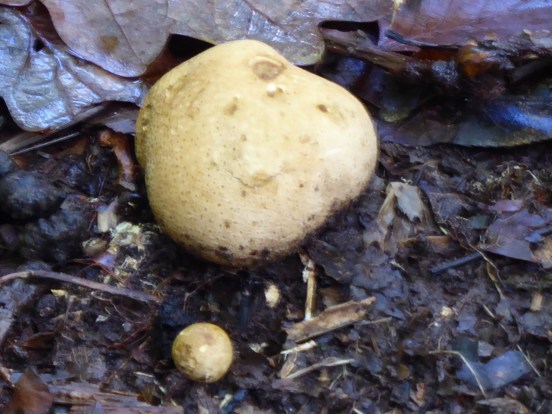
Back on the village green I became distracted by some tiny yellow fungi hidden in the grass -possibly Golden Waxcaps? There’s beauty in the minutiae too. 
*
I was apprehensive of my detour into the centre of Carlisle for my penultimate benchmark. I new there was some parking near the castle so I asked my phone to take me there. It was clever enough to warn me that “the castle may be close today” Despite the heavy traffic delays I eventually arrived in the car park but couldn’t understand how to operate the pay machine. Two ladies took pity on me and as they had just finished their shopping spree gave me there still in time ticket. I felt the day was slipping away with these delays. 
I walked towards the river only to find another car park without charges, the dog walkers used this one. Somehow rivers either bring a city to life or become subjugated into the background. The river Eden in Carlisle is of the latter character – lost between rail, roads and industrial sites or maybe it was the dullness of the afternoon that prejudiced me. The four stones were set in a line in the parkland alongside the river. Strange angular carvings which didn’t relate easily to me, erosion usually produces smoother features. OK they are smooth on one side but I find the other angles jarring.
‘Toward the Sea’ by Hideo Furuta in Bitts Park at Carlisle.
“The four components of this sculpture are manifestations of the sculptor’s intense and mathematical explorations of the stone itself and, almost incidentally, describe a sequence of water eroded stone running parallel with the flow of the river nearby”
Hideo Furuta sadly died in 2007 aged 57. He was an artist of international standing and was based at a granite quarry in Dumfries and Galloway. 


*
Maybe I was a bit harsh about Carlisle as I know from my trip on the Hadrian Wall path that the Eden is in magnificent form either side of the city. Anyhow I was pleased to find an easy way out of the city to my last destination, the village of Rockcliffe on the Eden before it slips into the Solway.
The clock had turned three and the light was fading and I couldn’t find anywhere to park. I eventually used the carpark of a nearby pub and walked on down past the church to a little red cliffed bay area next to the river. Flood debris showed that it is often underwater. At the end I could see my final benchmark and thankfully it was a thing of beauty reminding me bizarrely of the amoebae I used to study under the microscope. How does the sculptor achieve such smoothness and shapes out of a block of sandstone? My only thought is that it could have been positioned closer to the Solway estuary itself but there may have been practical reasons against that. Here I saw the river slipping around the corner into that unseen estuary. I found a place to sit inside it and watched the sun fading in the greyness over the flat marshlands.
‘Global Warming’ by Anthony Turner at Rockcliffe.
“The title of this sculpture is indicative of its global perspective. Situated where the river Eden flows out to sea there is an expanding awareness of the wider world. It could simply be a huge sea creature washed onto the shore but it conveys the sense of an even bigger scale. There is a mysterious pregnant silence about it and it resembles a planet earth held carefully in a hand. The term global warming is now ominously synonymous with the world overheating yet we would like it to mean a nurturing, life enhancing glow”
Anthony Turner was born in Kenya. A self taught painter and sculptor. Recalling his childhood in Africa his sculptures are organic, exotic and sensual.


*
What a journey. I didn’t expect to reach all the Benchmarks today but time just seemed to flow for me. You must admit these sculptures are so impressive and yet so diverse. At each one I felt a strong connection with the artist, the stone and the setting. It is too late for me to rewalk the Eden Way but wouldn’t that be a finer way to appreciate the river and take in these works of art.
I’m back home after an easy motorway journey from Carlisle and preparing to visit my cousin and her husband down in Derbyshire. In the past I have shared walks with him but now he has advanced dementia and is bed bound. Maybe I’ll show him some pictures of the River Eden.
EDEN VALLEY, MALLERSTANG.

Time to head into the hills. After a good breakfast I was ready to be away fairly early from the pub. Interestingly the garage opposite had more farmers’ quad bikes in for servicing than cars. 

Refueling.
It was a short drive up the valley into Mallerstang proper. On the way I passed the ruins of Pendragon Castle. The early morning light was so clear that I made a quick photographic stop in case things were murkier when I returned, it starts getting dark between three and four.
There is a lot of legend associated with the castle. it was supposedly built by Uther Pendragon, the father of King Arthur. It is said he tried to divert the river to form a moat.
A well known local couplet goes –
Let Uther Pendragon do what he can, Eden will run where Eden ran.
The castle was built during the reign of King Rufus in the 12th century by Ranulph de Meschines, After attacks by Scottish raiders in 1541 it became uninhabitable until the C17th when Lady Anne Clifford inherited it. She rebuilt it and added to it in 1660. It remained one of the favourites among her many castles until her death in 1676 at the age of 86. She spent her time between Skipton Castle and here in Westmorland becoming involved with local affairs and restoring several nearby churches. A long distance walk tracing her travels passes this way. There is a statue of her in Kirkby Stephen market place. 
Her successor, the Earl of Thanet, had no use for the castle and removed anything of value from it, By the 1770s much of the building had collapsed. It now stands as a romantic ruin with pointy Wild Boar Fell in the background. 


Whilst wandering around the ruins I was treated to a flypast by a Lockheed Hercules. 
I drove through Outhgill which I visited yesterday and parked up at The Thrang for a walk I had picked off the net. It would take me up to the first Eden Benchmark, Water Cut – before visiting Hell Gill and its waterfalls, and then wandering back past valley farms.
Quite a broad track headed away from the valley floor, an old bridleway to Hawes at the head of Wensleydale. All the rivulets coming down from Mallerstang Edge were in full flow and my feet were wet after the first ford crossing. 

That dot on the horizon turned out to be the benchmark in its very prominent position – how come I have never spotted it before? After some steady walking and a few more fords it was reached at about 420m. 


Water Cut by Mary Bourne. 1996.
“Water Cut is located a few miles from the source of the river Eden, high up on the eastern side of the Mallerstang valley. Like a huge milestone, it stands alongside the ancient green road known as Lady Anne Clifford’s Way. The space carved between the two vertical pillars creates the shape of a meandering river in the sky and provides a ‘window’ onto the real river in the valley below. It also symbolises the power of the river Eden cutting through the rock on its journey through East Cumbria and our own human journeys through the rural landscape and through life. Made from Salterwath Limestone, taken from a quarry near Shap, it also resembles the gate posts and stiles in drystone walls, which are so characteristic of the area, whilst it’s outer curve makes reference to the viaduct arches on the nearby Settle-Carlisle railway.”
Mary Bourne is an accomplished stone carver, living in the North East Scotland. Her work explores forms of the landscape and her relationship with the natural environment.
I played about with various camera angles. The more I looked they resembled two salmon leaping, are there salmon in the Eden?


From up here one has good views north along Mallerstang Edge and across the valley to Wild Boar Fell. The limestone lower layers contrasting with the overlying gritstone.
Not much farther I came to Hell Gill, I could hear it well before I reached the bridge over it. A deep rift in the limestone tearing down the hillside with thrashing waters in its depths. This was dramatic. I tried to get views down into the canyon but it was sensibly well fenced off. All was green mossy and ferny, I think there are fairies down there. 


The water tumbled on down the hillside and I followed. It came to a welcome rest at a ford. 


But what was that noise? A small steep detour and I could see the next and probably the best cataract. A video should have been taken. 


My boots were under water crossing the fast flowing ford. 
It must be all downhill from here but the next few miles tried my patience. I was basking in the beauty of Mallerstang and yet struggling to find the bridleway marked on the map on the ground. There was a lot more rough walking to come. It tended to keep above the top intake wall and hence involved tussocky grass and boggy areas. Few people use this way. 


There were a few more waterfalls to admire and the light on the other side of the valley was beautiful. No steam on the Settle to Carlisle today.


Eventually I made my way to the valley bottom and along by the Eden back to my car just as the sun was going down behind Wild Boar Fell.


I would highly recommend this walk, it packs a lot into those 6 miles without going onto the tops. I never saw another person.
Mallerstang-trail.pdf (edenriverstrust.org.uk)
***


THE POETRY PATH. KIRKBY STEPHEN.


A close up of the hedge laying motif showing how difficult they were to pick out.


Knapweed purples the banks.
For touch, taste, smell, sight, hearing I give thanks.”


GOLDSWORTHY PINFOLDS IN THE EDEN VALLEY.
|
|


Faraday Cottage.


ARTY THINGS IN THE EDEN VALLEY.

It must be 40 years since I walked ‘The Eden Way’, which as the name suggests follows the River Eden from its source in the fells above Mallerstang, through Kirkby Stephen and Appleby, past Carlisle to the Solway Firth. I remember I only took a bivy bag for lightness and ended up quite damp several mornings.
It’s an area a little out of comfortable reach from Lancashire and I have neglected it over the years. Some recent climbing nearby has brought it back to my attention and it so happens that one of the many books I have read in this month or so of poor weather was ‘The Stream Invites Us To Follow’ by Dick Capel. ( I seem to recollect John Bainbridge recommending it, that is one of the joys of Blogging, your readers, few though they may be, often come up with suggestions which you have overlooked. Thanks John )
Dick Capel came to Cumbria in 1982 working as a warden in the National Park as it was then. He changed areas in 1991 starting work for the East Cumbria Countryside Project, ECCP. This aimed to promote the conservation and enhancement of the natural environment of East Cumbria. During this time he became heavily involved with the Eden Valley and particularly in developing a series of sculpture trails reflecting the area. He writes evocatively of the area and his own trials and tribulations. In particular he highlights The Eden Benchmarks, The Poetry Path and a series of Goldsworthy Pinfolds that appeared under his watch.
*
The Eden Benchmarks.
The Benchmarks are a series of ten contemporary stone sculptures located at intervals along the length of the river Eden between its source above the Mallerstang valley and to the Solway Firth.
“Ten sculptor’s were chosen as part of the East Cumbrian Countryside Project, ECCP. The artists’ brief allowed creative freedom to produce site-specific sculpture, which harmonises with the landscape and captures the essence of each unique locality. The sculptors worked in residence for six weeks and this enabled them to formulate their ideas by familiarising themselves with the locations and talking with local people, including schools, who were encouraged to visit their workshops to see the sculptures taking shape”
“Collectively the sculptures give visual expression to our awareness of the river’s ecology and the need to look after it; individually they foster a profound sense of place, their capacity as seats accommodating an interactive focus for quiet reflection”.
*
The Poetry Path.
Encouraged by the success of Eden Benchmarks Capel’s next arts project was the Poetry Path by the Eden on the edge of Kirkby Stephen interpreting the hill farmer’s life and love for the Eden Valley.
“Twelve short poems, written by Meg Peacocke, have been carved by lettering artist Pip Hall on blocks of stone installed at intervals along a circuital route either side of the river Eden. Decorative motifs with each poem depict some of the activities associated with every month of the hill farmer’s year”
“The aim of the Poetry Path is to introduce a permanent and integrated interpretative experience into the landscape, which is assimilated as part of the heritage it promotes and conveys a powerful message about the farmer’s potential role in maintaining a sensitive but viable hill-farming regime in relation to the natural environment as a resource both for nature conservation as well as food production”.
I could not have written that.
*
Andy Goldsworthy’s Pinfold Cairns.
In the area there are six of these stone cones built into village pinfolds, which used to hold stray animals, Created by the sculptor Andy Goldsworthy (1996 – 2002) supposedly based on the prominent piles of stones called the Nine Standards above Kirkby Stephen. At one time Goldsworthy lived in the area.
*
The funding ran out in 2008 for the ECCP. But the art remains. Sculptures and poems reflecting the area’s heritage and beauty, and hopefully enhancing peoples enjoyment and understanding of the countryside and environment.
Dick’s book has acted as a catalyst for some exploration on my part. I find myself visiting friends up here so I have decided to stay on, I’ve booked into the Black Bull in Nateby for a few days. 
A related website provides all the information you need on all the installations. I have quoted above from that site.

*
“The stream invites us to follow…and certainly, there is no more fascinating pastime than to keep company with a river from its source to sea” W H Hudson, Afoot in England.
FUNGAL FUN AT BROCKHOLES.

I am a born again Mycologist. I’ve seen the light.
I’d signed up for an ‘Introduction to ‘Fungi Walk’ at Brockholes. In the depths of Brockholes’s Nature Reserve Jim, our ‘guide’, holds a small piece of twig with some even smaller black and white stems – Candlesnuff Fungus, for us to examine. This minute organism may even provide the compounds to fight cancer. He emphasises the importance of fungi in evolutionary terms and future research. Fungi, neither animal nor plant, have been on this earth 1.5 billion years. There are millions of varieties, but we only know of a small percentage. They have helped our environment to evolve. And what may they hold for the future?
What is the world’s largest living organism he asks? – not the Blue Whale or the Sequoia Tree – no there is a fungus that occupies some 2,384 acres in Oregon’s Blue Mountains. 1,665 football fields, or nearly four square miles. A truly humungous fungus. I like the style of our ‘funguy’ Jim. 
Jim, has only this week been on the telly, BBC Northwest Tonight with everybody’s favourite Roger Johnson in a feature on Brockholes Nature Reserve. Have a look Here if it is still available.
We are in the presence of an amateur expert though even he can only identify a fraction of the thousands of UK’s fungi. Perhaps a hundred or so noted at Brockholes. And the general advice is don’t eat any of them unless they are on the shelves at Tesco. (other supermarkets are available) The names of some of them give a warning. Death Cap, Destroying Angel, Funeral Bell.
***
It didn’t stop raining all night, and I was expecting a wet morning ahead so dressed for the occasion with full waterproofs as I parked outside the reserve in the Crematorium grounds, (saving the £5 parking fee). This gave me a brisk mile walk down through the woods to the Floating Visitor Centre meet up. There were maybe 20 of us, an eclectic bunch. The sun shone throughout the morning and hence I sweated undercover.


Jim led us out into the reserve, and we had only gone a few metres before he stopped on a grassy verge. A keen eye was needed to spot the tiny fungi, Blackening Waxcaps, They slowly revert to a black mess. I would have walked straight past them or even worse squashed them. The more studious followers were making notes.


Then onwards into the woods. Puff Balls, Brackets, Slime, Jelly Ears etc etc. Here are some of my hurried photos. 


Jim was a wise general naturalist as well as a fungus finder and imparted words of Lancashire wisdom as we proceeded. All very entertaining. Buzzards flew overhead and Long Horn Cattle grazed the meadows. All too soon the adventure was over, and we headed back to the floating visitor centre and more importantly the café. 
After a coffee I had a stroll around the rest of the reserve. There wasn’t a lot happening, so I headed to the River Ribble and followed its banks back to Red Scar Woods and the climb back up to the crematorium high above the river. I was peering around me and examining every bit of dead wood for specimens, I didn’t spot many but I am full of resolve to get out tomorrow with my new-found enthusiasm for fungi. I need to download one of those apps to my phone to help in identification. 


The Autumn colours are finally coming through and the cherry trees in the Crematorium were particularly dazzling. I had ended up walking about 6 miles in my wanderings.
A SUNDAY STROLL AROUND BLEASDALE.

This is one of my favourite walks for the wetter months. Virtually dry underfoot the whole way and yet in touch with the imposing Fells of Bowland. I’ve been walking these paths for 50 years since moving to the area. We used to push our two young sons around in a double buggy in the early seventies, remember those. 
I keep returning and have since introduced my grandchildren to the delights. But looking back at my recent traverses, there have been many on here, I always seem to have walked anti-clockwise from Bleasdale Church. Time for a change.
I am always looking for somewhere new to explore locally. Today, despite the clocks going back and giving me an extra hour in bed, I’m not really up and going till midday. I have missed my chance to cycle the Fylde Coast or even the Guild Wheel, it will be dark or gloomy before five. So I fall back on the tried and trusted – Bleasdale Estate. But let’s look at the map and why not go clockwise for a change or even for the first time for years, unlikely though that seems.
The mention of Bleasdale Estate may jog memories in some of you of the disastrous court case in 2018 of their gamekeeper, James Hartley, accused by the RSPB of raptor persecution. Technicalities ruled the damming video evidence of his crimes inadmissible. I still question the partiality of the judge. Is Mr Harley still employed on the estate? Have a read for yourself – Case against Bleasdale Estate gamekeeper collapses as RSPB video evidence ruled inadmissible – Raptor Persecution UK
Putting that all aside I park near the Lower Lodge, I’ve always wanted to live there, it’s so cute. The road is still marked Private, but pedestrians seem allowed, I’ve never been challenged, famous last words. Now that the estate have introduced a ‘Glamping’ site quirkily called ‘Lantern and Larks‘ on their property (more of that later) there is more traffic up and down the private lane. 
I must say that everything about this estate, maybe apart from their raptor persecution problems common with most shooting estates, is immaculate. They obviously take a pride in their appearance. The driveway past the lodge is newly mown either side to perfection. The Bleasdale Fells are in the background of every view on this walk. Since I was last here there has been a lot of clearance of the mixed plantation on the right which was becoming invaded with the dreaded rhododendrons. It will be interesting to see how they develop it further with plantings. 


Across the way, as I walk down the manicured lane, Bleasdale Tower, built in the early 19th century sits at the base of the fells. The sun is not quite making an appearance, but the temperature is high for almost November. There is not a drop of wind and all is silence as I stroll up towards the Tower. Well not quite because a delivery van keeps passing backwards and forwards looking for some address. It won’t be easy out here when the post code covers a vast area. A lady dog walker helps him out – hopefully as he speeds past me to the remotest of houses. 


I walk on past the buildings that at one time in the C19th served as a Reformatory School for Preston. North Lancashire Reformatory for Boys, Bleasdale, near Garstang, Lancashire (childrenshomes.org.uk) 
The lady with the dog catches me up as I’m taking photographs of stone walls. I’m reading a book by Angus Winchester all about Dry Stone Walls, recommended by Walking Away, and I’m keen to put it into practice. I would hazard a guess that these walls are mid C19th when the estate was being established. Her dog photo bombs my picture of an old ‘gate’. 


The lady lives in a property on the estate and tells me she was born at Vicarage Farm along the way. That brings back memories of my attending that house in the middle of the night, when GPs did home visits. I’m talking about the late 70s or early 80s. She recalls her mother telling her of an occasion requesting a visit to her ailing aunt in this remote farm and the doctor saying put on all your lights, and I’ll be able to find you. That was probably me. What a small world.
She talks of living out here and attending the local school and church. The school is now closed, but the church, St Eadmer, is open and has a service once a month. She disappears into a farm to meet a friend but tells me to look out for the original site of the school marked by some stones along the way.
On the old track, now grassed over, and in my own world I startle to hear a bike bell ringing behind me. A cyclist is taking a shortcut home to Chipping. He dismounts, it’s muddy anyway, and we walk together chatting about all things cycling. I forget to look for the old school foundations after the vicarage, next time. We also pass the diversion to Bleasdale Circle, though I doubt I would have taken it as the fields are so waterlogged. At the little school I take the estate road going west, and he pedals off down the main track. 


It is along this stretch of lane are the Glamping pods, Lantern and Larks. They don’t look the most attractive, a cross between a shed and an awning from this vantage point. Turns out they are part of a National Group with other locations. As you can imagine they are not on the cheap side of accommodation, but where is nowadays? In their blurb they talk about the wild life to find in the surrounding area and highlight the Hen Harrier. It is these grouse shooting estates that are responsible for most of the deaths of the Harrier, a mixed message there.


Just past here on the right over the infant Brock is an old packhorse bridge said to have been on the way from the estate properties to the church and school. I would like to know more. Cutting across some fields I’m soon back at the car from there. 

Well that has been a very satisfying round.
***

PENNINE POETRY – MIST.

Simon Armitage’s Stanza Stones – Mist.
We, Clare, JD and I, are well on schedule for our quest to visit the final Stanza Stone for today. After the Snow and Rain along comes the Mist.
The scenery changes on our onward Northern drive, deep wooded valleys crowded with solid stone terraced mill houses. Cragg Vale, Mytholmroyd (birthplace of Ted Hughes, Poet Laureate 1983 – 2008) Hebden Bridge, Pecket Well. We start dropping off the moor into Oxenhope when a steep narrow lane brings us back into the hills looking for somewhere to park under Nab Hill.

A muddy track leaves the lane, we check GPS that it is the correct one, a Stanza Stone waymark is soon noticed. Passing small quarries, no soaring climbing faces here, the rock is softer and splits into thin slabs possibly to be used as stone roof tiles common in Yorkshire at the time. We are on the lookout for a larger quarry on the right and then a stone cairn. Wind turbines look down on our wanderings. The problem is that there are several piles of stones on the edge of the moor, when is a pile of stones or a stone shelter a cairn? I dismiss the first stones and head farther towards an obvious larger cairn, ignoring smaller ones on the way. There is doubt in the team. The clue we have is to drop below the cairn to find slabs of rock. Nothing obvious here, how far down the slope should we go? We repeat the process under the other ‘cairns’. JD wanders off to pinpoint the OS map’s indication of the stone with his GPS, that doesn’t help. Clare scouts the lower ground, there are lots of slabby rocks about. I ponder that not being able to find the Mist Stone in the mist would be ironic, we are having difficulty on a perfect day. At last back at the first pile of stones we discover the correct slabs. 


The story goes that one slab was lifted in situ for Pip Hall to carve, it had a hairline crack down the centre and as the stone was moved it split, much to the consternation of the workmen. Undaunted Pip carved each one independently to later place them together, so that the lines hopefully read as one. (The picture of the split comes from their book) One has to give some thought to this lady out on the moor in all weathers carving away. These slabs are of a softer grit than the ones previously visited, Snow and Rain, and the lettering paler. Simon’s poem is equally evocative though, looking out over the valleys and moors where the Bronte Sisters once roamed for inspiration. Lichens are spreading out over the letterings giving them a more ancient look than their mere 12 years – come back in another 12 years. Someone’s ashes are scattered around and will slowly be blown across the moor or crushed underfoot.

The split slab back in 2011 before repositioning.


Mist.
Who does it mourn? What does it mean, such
nearness, gathering here on high ground
while your back was turned, drawing its
net curtains around?
Featureless silver screen, mist
is water in its ghost state, all inwardness,
holding its milky breath, veiling the pulsing machines
of great cities under your feet, walling you
into these moments, into this anti-garden
of gritstone and peat.
Given time the edge of
your being will seep into its fibreless fur;
You are lost, adrift in hung water
and blurred air, but you are here.
The three Stanza Stones we have visited so far have exceeded my expectations and I can’t wait to return with our team to the Ilkley Area, home of the Literature Festival where the idea was born, to discover the remaining three, Dew, Puddle and Beck. Wouldn’t it be great to find the fabled seventh, but I suspect that will only appear to an alert walker somewhere on the Stanza Stone Trail.
***
My navigation skills have improved for the drive home, – these are roads I know well up above Wycoller. We even have time to stop off to look at one of East Lancashire’s Panopticons, The Atom. Both a shelter and a viewing point over the valley and to Pendle Hill. I am sure from memory that when it was first installed there was a stainless steel atom in the centre of the ‘Molecule’ – no sign of it now.
(The other three are Colourfields in Blackburn, The Singing Ringing Tree above Burnley and The Halo above Rossendale.) 


The day couldn’t have gone better. Sunshine, excellent company and three poems found and enjoyed.
PENNINE POETRY – RAIN.

Simon Armitage’s Stanza Stones – Rain.
15 miles of scenic driving on open moorland roads and then through densely knit and gritty Pennine communities brought us to the White House Inn on the road out of Rochdale. We have just come from Marsden where up in Pule Hill quarry we found and admired our first Stanza Stone, Snow, a water themed poem by Simon Armitage skilfully inscribed by Pip Hall. This is one of six, or maybe even seven, scattered on the rugged Pennine Watershed between Marsden and Ilkley. There is a 45-mile walking trail between them all, but we have chosen to use the car and visit them individually. We have resisted the idea of visiting each stone according to the weather depicted. Let’s enjoy today’s sunshine.
The White House is an iconic moorland inn situated where the Pennine Way crosses from the peaty horrors of the Peak District peat to the pleasanter Yorkshire Dales. Many long distance walkers have been known to give in here. Most people today are either enjoying lunch in the pub or doing short walks from the road, as are we. 
The Pennine Way is followed alongside an aqueduct connecting several reservoirs. All level walking. I camped along here once with my young son on a Lancashire Borders Walk. Sensibly we had eaten well in the pub beforehand and only needed water for a brew. The brown peaty solution didn’t need a tea bag, today my tea was already brewed safely in my flask along with a picnic lunch.


A miniature arch took us over the water and into Cow’s Mouth Quarry. This is where I become boring once more as I try and trace routes climbed way in the past. They are mainly slabs, with often little protection available, needing a steady head. Nowadays with bouldering mats the picture has become blurred between a roped route and a high ball boulder problem. 

But I’m not here to climb today, I’m with Clare and JD looking for the second of Simon Armitage’s Stanza Poems – Rain. This one is easy to spot being at the base of a rock face right by the path. Pip had a lovely canvas to write on, but advice was first taken from climbers so that no footholds were destroyed, or new ones created. Pip’s carving seems more pronounced than on Snow back at Pule Hill, this rock, being more compact, maybe helping. The letters are imbued with gold. We read aloud the poem marvelling at Simon’s turn of phrase. 


Again here is the poem in case you can’t make it out in the pictures.
Rain.
Be glad of these freshwater tears,
Each pearled droplet some salty old sea-bullet
Air-lifted out of the waves, then laundered and sieved, recast as a soft bead and returned.
And no matter how much it strafes or sheets, it is no mean feat to catch one raindrop clean in the mouth,
To take one drop on the tongue, tasting cloud pollen, grain of the heavens, raw sky.
Let it teem, up here where the front of the mind distils the brunt of the world.
We find a sheltered spot for lunch. I forget to take a picture of the extensive views across the moors with distant reservoirs, wind farms and mill chimneys. I am on too much on a high from the poetry – tasting cloud pollen. We wander back with shared tales of moorland adventures.
Fellow us farther on our poetry quest.
PENNINE POETRY – SNOW.

Simon Armitage’s Stanza Stones – Snow.
Simon Armitage is steeped in Pennine Grit. Brought up in West Yorkshire and living in Marsden in particular, his works have been influenced by the rich heritage of the area. I have been reading a few of his books and poems recently and feel an affinity to his working class background. When you delve deeper you realise the profound and original intellect of the man and his ever widening focus. That’s why he is Poet Laureate.
My friend JD, who has featured many times in these posts, told me about some of Simon’s readings on the radio, such as his journey as a modern day troubadour down the Pennine Way, and more interestingly his series of poems carved and brought to life in the rocks of the high Pennines. The Stanza Poems, six poems on the theme of water in various forms: Snow, Rain, Dew, Puddle,Mist and Beck, a collaboration between himself, Pip Hall the stone carver, and local expert Tom Lonsdale, a landscape architect. Those looking hard enough might stumble across a seventh Stanza Stone, a secret stone left in an unnamed location within the Watershed area, waiting to be discovered and read. As far as I know nobody has.
I bought the book and was immediately fascinated. Stanza Stones a book by Simon Armitage, Pip Hall, and Tom Lonsdale. (bookshop.org)
What they have produced is truly magical and the insights of the protagonists brought to life in the book. I take my hat off to the literacy skill of Simon but equally so to the dedication and art of Pip the sculptress which will be borne out in our efforts to locate the stones.
A fairly tough trail, considering the moorland terrain, of 50 miles or so has been worked out between the carved stones from Marsden in the south to Ilkley farther north. Suffice to say JD and I never got around to walking it, mainly because I thought some of the 20-mile days across rough moorland with no bed at the end was too much for me to contemplate. I happily compromise and suggest a motorised raid to the individual stones. The idea catches fire and in a conversation with the ‘Slate Poem Lady of Longridge Fell’ (another story enacted in my lockdown posts) we have a willing and knowledgable accomplice. Welcome aboard Clare, one of her slate poems in her garden says it all.

Messenger. Mary Oliver.
Cometh the day cometh the hour. We are off to Marsden with a fair forecast. I’m afraid to say my navigational skills fell short of the sat nav lady whom I chose to ignore. We came at the first site in a round about way, but the moorland scenery and deserted roads were worth it. Mutterings from the driver and the other passenger who kept well clear of any navigational mistakes. 
An unpretentious lay-by below Pule Hill, west of Marsden, is our starting point. The steaming brick ventilation shafts of the Manchester to Huddersfield railway are obvious above us on the hillside. As well as the railway down there somewhere the narrow Huddersfield Canal goes through the Standedge Tunnel, the longest, highest and deepest canal tunnel in Great Britain. Their combined history is worth a read, it’s a lot more complicated than you think. Above all that are the ramparts of Pule Hill quarry and rocky edge on the skyline. Fortunately for us the original quarry incline is still intact giving an easy climb up into the workings. Memories of plodding up here with ropes and gear for a day’s climbing come flooding back, and I feel a quickening in my step. We are impressed with the amount of quality stone work just giving access to the quarries. What a substantial industry of men must have worked away on these slopes. 


I’m distracted by the quarry rock faces I have ascended in the past whilst the other two go off in search of the poems engraved in stone. 

Nature’s art.

At the far end of the quarry are two large blocks built into the wall and there is our first poem laid out in front of us, letters carved into the two stones bringing out the colours of the rock from those past quarrying days. We trace with our fingers across the rock surface. Already after 13 years the patina is changing, and green lichens are crossing the letters, what will another decade bring. There is already some slight damage caused by man. 


Here is the poem transcribed as it is difficult, but not impossible if enlarged, to read in the photos. The stanzas cross between the two stones.
Snow.
The sky has delivered its blank missive. The moor in coma.
Snow, like water asleep, a coded muteness to baffle all noise, to stall movement, still time.
What can it mean that colourless water can dream such depth of white?
We should make the most of the light.
Stars snag on its crystal points. The odd, unnatural pheasant struts and slides.
Snow, snow, snow is how the snow speaks, is how its clean page reads.
Then it wakes, and thaws, and weeps. S A.
Before we leave, we discover a beautifully constructed curving wall seat inscribed with ‘Ilkley 45 1/4 miles’ which is the distance to the last stone via the trail, thankfully we have the car to take us onwards.

We skip happily down that incline, pleased to find the first stone and captivated by the scenery and the poem it now holds. Let it snow.
***
A SOUTH LAKELAND RIDGE.

I smile to myself as I reply to the email from Sir Hugh. He has plotted a walk for us from Cartmel taking into consideration our combined physical failings. I did the same for him on our last walk and his immediate response was ‘we could perhaps extend it farther’ by using some other paths. All turned out well – LEVEL FROM LEVENS. My immediate response this time, without a good deal of thought, is that we could easily extend his proposed route from Cartmel. No more is said until the decision time comes later in the day. Somewhere along the line is a hidden understanding of the other person’s idea of a good walk, I don’t think we have ever crossed that line though we have had some exciting episodes close to it.
What is going on in Cartmel? There are cars parked alonside every road and a one way system in operation. We follow it blindly into the racecourse car park where we had meant to park in the first place. £2 for the day as we scramble to find some change. There is a Medieval Pageant in the village explains the man on the gate. (Subsidised parking with medieval prices, normally £4 for the day or a hefty £10 on race days)

Sir Hugh trying to look enthusiastic at the start of the walk.
It takes a bit to orientate ourselves in the massive car park which is filling fast. We are the only ones taking a bearing across the racetrack to enter the woods on the northwest side. Once in the woods the path is not as clear as we had expected but a bit of steep climbing, not Sir Hugh’s favourite at the moment, and we were out onto little lanes and on our way.

On your marks.

Steeper than it looks.

On our way.
The little lanes connect up with isolated properties on the hillside – Well Knowe, Hard Crag, Wall Nook, Over Ridge and finally Speel Bank. Each unique in its own way but all bearing the mark of Lakeland vernacular architecture from the C17th- C18th. They all look in good condition in stunning scenery and in the last decade or so most of the outbuildings have become out of the way holiday cottages. Though in a hard winter would be difficult to access.

Halfway up we come across an agricultural machinery graveyard. Old tractors, strange looking implements, old cars and strangely up here a speed boat, all rotting into the vegetation. We find it a bit spooky and once Sir Hugh mentions some American horror movies it is time to get going. Only just last night I had rewatched Psycho for the first time for years – remember the cars in the pit.

I then took to photographing the various stiles we squeezed through or climbed over.
A couple of girls pass us brandishing what looked like a well presented leaflet of walks in the area, though their map was somewhat basic for the almost identical walk that Sir Hugh has us on. I will look into finding this publication as we are well impressed with the area so far. We never see them again.

The ridge is up ahead.
The lane keeps going up past the last farmhouse, which shows no signs of gentrification for the Airbnb set. 
Soon we were onto what I’m calling Ellerside Ridge, volcanic rock outcrops everywhere, we even spot a few bouldering areas. Lakeland in miniature.

A last stile over a high wall and suddenly we are looking down on the Greenodd/Cartmel Estuary. There is Ulverston, there is the railway viaduct from Cark and there is Chapel Island off the coast from Conishead Priory. I seem to remember being told that one could walk out to the island at low tide, not something I will be doing. All places familiar to us from previous expeditions but never seen from up here before. We are thrilled with the way the walk is turning out even though rain clouds are massing over the sea. The undulating ridge gives us plenty of time to take in all the views. 


After about a mile we can see from the map a nearby trig point on How Barrow, a lowly 170m but one we could not walk past without visiting. Fortunately a gate gave us access to that side of the fell and the proud little craggy summit was soon reached, A perfect spot for lunch. Others also reached the summit for the first time, and all proclaimed its vantage point despite the incoming rain, we are a hardy lot.


From up here Cartmel village was a little hazy but the backdrop of Hampsfell reminds me of the last time I visited Cartmel on my trek around Lancashire’s monasteries. 
Back on the other side of the wall a couple with a smart Airedale seemed to be hanging around. “could you tell us where we are and how do we get back to Cartmell?” They have no map and had been wandering in completely the wrong direction. Sir Hugh demonstrates the usefulness of GPS and sends them confidently on their way – we never see them again.
The meat of our walk is over but decision time has arrived – walk back down the road into Cartmell or keep to tracks on a more circuitous route through the woods. Yes, you guessed it, into the woods we plunge. I have used these tracks before, but all looks different today until we realise that there has been extensive forest clearing on the estate following the storms of 2021. A curiosity passed on the way is a walled enclosure – we speculate on a pinfold, but there is no evidence of a gate. Perhaps some sort of water collecting reservoir? Anybody know?


The light rain accompanies us all the way back to Cartmel. 
We don’t venture into the village festivities but set off in the car on a long diversion to get us out of the racecourse, an hour later and there would be a queue of traffic trying to leave.
I complement Sir Hugh on his choice of route, a good 5 miles, or rather 6 miles after I had gently twisted his arm for that little extra, equally enjoyed by both of us. And in my mind it never really rained until the journey home.
I will give a link to Sir Hugh’s version when he has posted. Here it is, hot off the press – conradwalks: Five miles or six miles?
***

BITS OF LONGRIDGE HISTORY.

Anybody can make history. The one duty we owe to history is to rewrite it. Misquoting Oscar Wilde.
Storm Agnes is coming, batten down the hatches. But our little group complete the short morning walk around Longridge before the rain arrives. We are safely in The Alston eating lunch as the trees begin to sway – not a day to be out and about. 
When I say our group I’m including myself into their group who meet once a month for a sociable walk of historical interest. I was out the last two weekends researching possible future walks with one of the group’s regulars for when it is his turn to lead. I am invited along today as a ‘guest’ mainly because the walk is in Longridge itself and comes past my house.
It’s a year or so since I walked with them, so I had to reacquaint myself with names and faces in the car park of The Alston. I’m not a group walker at the best of times, but they are a friendly lot, and selfishly a short walk today suited my diminishing exercise needs. There is some debate amongst the flock as to the needs of waterproofs and boots, faffing is increased disproportionally with the number of people involved.
Our leader has us away relatively promptly – Storm Agnes is making an appearance at noon, we need to get a move on. He, our leader, has a job on keeping the attention of the 20 or so walkers. But he is an ex-teacher, including having taught my children, so he keeps us in order. He has lots to tell us of the history of the area and has done his research thoroughly. He starts by quoting Oscar Wilde so that any later errors may be excused.
Moving on past my house, proudly illustrated in the header photo, we come across a series of interesting sites scattered around the village. The attention of the group fades somewhat as we progress. Our passage creates mild panic on the roads, think Moses parting the seas, and obstructions on the pavements, most passers-by stand aside to our onslaught.
The Alston Arms; Old Rib Farmhouse; Green Nook; the railway to Grimsargh; Pinfold Lane; Reservoirs; St. Lawrence’s; war memorials; the Old Station; mills; various pubs and bustling Berry Lane all play a part.
I don’t risk my newly repaired camera to the elements today, so you will have to be content with these sepia postcards of Berry Lane and The Old Rib.


Nowadays with the spider’s web, it is easy to find their histories elsewhere if you are interested, either true or rewritten as Oscar would say. Anyhow, thanks for having me along.
***
It seems superfluous to include a map but keeping to my usual habit here is our route, a mere four miles but full of history.

WALKING UP THE AVENUE.

It’s a while since I’ve given you some music –
This song was in my mind, but I couldn’t remember where it came from – of course it is an Irving Berlin number, A Couple of Swells, from Easter Parade performed originally by Fred Astaire and Judy Garland way back in 1948.
So we’ll walk up the avenue
Yes we’ll walk up the avenue
And to walk up the avenue’s what we like
They were probably singing about 5th Avenue, New York, but I have the more humble Avenue in Hurst Green as my walk today.
The morning was one of those frustrating ones, all apparently too common in these days of modern technology. Attempted phone calls and online machinations. Car. insurance first, last year I paid £371 and this year they are quoting £832. Time for a change. Money Supermarket seemed easier to navigate than the popular Confused.com once you have all your information to hand. Prices came up from £450, I settled for £480 with the Bank of Scotland. Insurance is a minefield. I still need to ensure the original insurers don’t automatically charge my card – can’t get through on the phone.
On the subject of insurance my car is still away being repaired after my unfortunate run in with a wall. They said it would be ready last week, no word from them. After half an hour on the phone line I gave up.
Also, I’m still trying to ensure that repairs to my camera are carried out under the guarantee. My telephone calls to the shop are all answered by different personnel, and they never get back to me. My random poor pictures today are therefore from my ageing phone.
By now it is lunchtime and the sun is shining. Time for a short walk to keep my legs going. Bouldering is out of the question, my left arm is sore as hell from the Covid jab yesterday and my right arm equally so from the flu jab. Was it wise to have them both at the same time? The ‘Avenue’ walk appeared out of the depths of my mind. It would be on good surfaces and not too long or steep, I’m taking my physio’s advice and moderating my exercise.
The Avenue starts in Hurst Green and goes all the way to Stonyhurst College. 
Depressingly the Bailey Arms pub is still closed but “open for refurbishment if a new licensee can be found”, an all too familiar story. There used to be three pubs in the village in recent memory but only the Shireburn Arms is still trading in Tolkien territory. 
I walk up the Avenue, past little cottages, past the famous Almshouses, through Stonyhurst’s gates, past the spooky graveyard and the even spookier Madonna statue, Our Lady of the Avenue. I place a foot on Cromwell’s Stone and cast my eyes down the continuing Avenue all the way to the college itself. There is a lot of history around these parts, much of it covered in my many other posts on the area. 


Are you still singing that song, I am?
At one time you could walk the full length of the Avenue past the fish ponds up to the college facade. Now there are closed gates and notices to make you aware there is no right of way, fair enough, but after walking up the road past the golf course towards Longridge Fell you can take advantage of a Public Path into the grounds and then directly across that very facade. Not the grandest of entrances but us commoners will have to make do. 

They don’t like you taking photographs in the grounds, child protection explained the security guard the last time I was here. They can’t begrudge a photo of the exquisite St. Peter’s Church, not a child in sight. Seriously though they have probably some children boarding from very rich foreign countries, so security must be a nightmare. 
I could have taken the path down through the fields past the clay pigeon shooting range, you have to ring a bell before continuing and being shot, but I wanted to keep my feet dry and avoid the slippery slopes, we have had a lot of rain if it hasn’t escaped your notice. So on I go past the observatory and gardens using the farm track. Groundsman are mowing which must be an almost continuos ongoing task on the estate to keep it up to scratch.
Round the back well out of view are a couple of soccer pitches and then the wonderfully positioned cricket square with its iconic brick pavilion and views over the Ribble Valley and Pendle. 


I come out past more estate cottages to the busy Whalley Road. I could have carried on across and down to the river to join the Tolkien Trail back to Hurst Green but as I said I wanted to keep my boots clean. Having already established from Google Earth that there was a continuous footway beside the road back to the village that is what I follow.
The Shireburn Arms is open, now part of a group, James’ Places which seems to be the way these rural inns can survive. Opposite is the village green with three interesting crosses, but you will have to search for the oldest, have a look here.
A pleasant afternoon stroll on the Avenue.
And for a contrast if you like rocksteady –
THE WRONG ROUTE.

Following on from my last post which described a half aborted climbing session, today we now have a walk that didn’t quite work out. I’m on a losing streak. Again I’m with Mike reconnoitring for walks he could lead with his monthly walking group.
Remember the stipulations “should start at a place with toilets, not too much rough ascent, between three and four miles, the fewer stiles the better and finishing at a pub for lunch” He thought he had found one in a book of short walks in Lancashire, I didn’t catch the title. This time on the outskirts of Blackburn, Pleasington in fact, incorporating Wainwright’s Memorial on Billinge Hill and the popular Witton Country Park. Sounded promising when he invited me to join him.
Things didn’t go well when we struggled to park near the Railway Inn, yes there is a station here for commuting into Preston or Blackburn. We eventually settled on roadside parking up the lane which wouldn’t be ideal. Shame that the nearby Butler’s Arms is closed. We set off, walking up the lane past the impressive Pleasington Priory. Pleasington Priory – Wikipedia We don’t even think to have a look inside, if it is open. 
Up a smaller lane past expensive building conversions to the gates of the Old Hall. 
A track goes left here, and we soon come to our next problem, a loose eroded bank leading to an awkward stile. Probably no go for those of his group not into mountaineering. I didn’t think to take a photo of the obstacle.
A wandering route through rough fields brings us out onto a lane I recognise from previous Witton Weaver Walks which we now follow up to the Yellow Hills, named from the abundant gorse that blooms up here – but not in September it seems. There are always a few people up here because of Wainwright’s Memorial plaque, a toposcope with a rather poor impression of Alfred in the centre. We gaze in all directions, but distant views are hazy, nevertheless a wonderful lookout. This ascent would have been better in reverse with the vista in front of you. Niggly. 
I never feel at ease through the next open field which always has cows and occasionally a bull. Today they all seemed very docile, perhaps it’s just my fears.
Entering the woods of Billinge Hill we pay particular attention to the guide’s directions. There are paths everywhere up here, some I recognise, but mainly I am ‘lost’ blundering about in a hopeful direction. Using a bit of creative thinking we follow the steep and slippery paths down alonside a ravine. Mike is not happy, any of his group who may have made it this far would be now struggling. 


We in turn struggle down to enter Witton Park and civilisation. Ice cream vans, car parks, sports pitches, dog walkers. 
We are lucky to have this rural expanse open to all on the edge of a major town. Witton Country Park covers 480 acres of countryside with pretty picnic spots, walks, nature trails, play areas, sports pitches and a visitor centre. The estate was once owned by the Feildens, a wealthy textile family, who built and lived in Witton House from 1800 and created the park at the same time. From 1900 the house was empty for long periods and during both world wars the house and estate were used by the army. Dry-rot set in. Witton House was demolished in 1952, after being sold to Blackburn Corporation in 1946 along with the estate. 
We join the crowds and follow the sluggish River Darwen down the valley to Butler’s Bridge. Now on a surprisingly busy road ahead are the gates leading to Pleasington Cemetery. I’ve never ventured farther, but the notice board shows a vast complex of burial grounds. 
We divert to continue into the woods and up a sunken lane which eventually is captured by barbed wire into a most unfriendly narrow walkway back to the priory. 

We have had 4 miles of exercise through an interesting environment. It took us for some reason three hours and Mike has ruled it out from his future itineraries.
Last year I did a similar, but better balanced walk , from Cicerone’s Walks In Lancashire, an excellent selection, which also took in Hoghton Bottoms in a seven-mile circuit.
Back to the drawing board for Mike.
***

A SHORT LOCAL STROLL.

I’m idly looking at the OS map for something new on my home ground. I’m only looking for a few gentle miles and I think I have spotted a footpath I’ve not knowingly been on before, however unlikely that seems. The weather is on the change, and it has been raining this morning, I bide my time until after lunch.
Being lazy I drive my car to the top of the village to start the walk rather than tramp the streets. There is parking next to Craig Y bouldering venue, part of the defunct Green Bank Quarry complex, The BMC secured Craig Y whilst the rest of the site has been developed into a housing estate. Passing through it is a bridleway leading to an ancient sunken lane, Written Stone Lane, did some of the quarried stone exit this way? Today I wander down it coming out near the site of the Written Stone about which I’ve visited many times before and linked to The Written Stone of Dilworth for a detailed history. 


On across the road to go down a quiet lane to where my ‘new’ path should be found on the right. There is no sign, but I know I’m in the correct place. Ahead doesn’t look very inviting – farm buildings and all the usual associated junk. I wonder whether the way will be blocked, but no after having to open one gate styles start appearing in the field boundaries, although I doubt few come this way. In the fields there are several small ponds probably Marl Pits originally,they are teeming with Mallard families.


At one point a fishing lake has been created in Page Brook, here footpath signs are more evident taking you through and away from the private lake. All very civilised.


I recognise Stonelands Farm in the distance from a different walk done three years ago. I am still none the wiser as to the origins of the carved stones, although the rounded one is definitely Roman. 


Crossing carefully the road on the bad bend by The Corporation Arms, one of many local pubs that did not survive lockdown and the continuing financial restraints. 
Soon off the busy road the Tan Yard track is taken back up into the quarries, what must Longridge have been like when they were all working. The caravan site is enlarging, and I notice some of the permanent vans have extensive views across the Ribble Valley – not a bad place to live. Pendle always manages to pop its head up. Himalayan Balsam is doing its best to obliterate the final stretch of path.


The rain starts just as I arrive back at the car. That has been a pleasant afternoon’s outing, a new path found and plenty of interest along the way, all on the very edge of town. .

THE GUILDED WHEEL.

My camera went into ‘frozen mode’ after a short time on my latest cycle around Preston’s Guild Wheel. Gone for now are the pictures of the Ribble in flood mode, the harmful Giant Hog Weeds and the cautionary notice to dismount on the steep descent to Brockholes. I had no reason to ignore the latter, I’ve been going from one injury to another in the last month, so caution was uppermost. I had parked in the Crematorium grounds after all.
Ospreys have been regular visitors to the nature reserve recently, but obviously not today. They do have a problem with Himalayan Balsam though. It was surprisingly quiet considering the good weather and school holidays. They must be all at Blackpool, not the ospreys just the crowds.
The rural ride from the reserve along the Ribble Flood Plain into town is unfortunately virtually the last of the green fields on the wheel, housing has taken over elsewhere in the last few years.
My phone camera comes into action on the tree lined boulevard into Avenham Park. Miller Park is looking immaculate, although the former, now empty, Park Hotel overlooking the scene has run into planning and financial problems as have many civic schemes in these cash strapped days. 

Plenty of cash is being spent on flood defences along Broadgate. I manage to squeeze through wheeling my bike on the numerous diversions/obstructions which I should have or could have taken, I persist with the directissimo. It is all green paint for updated and complicated cycleways at the bottom of Fishergate Hill, I survive into Docklands. No steam trains today. And no more photos.

After the car showrooms the newly opened Western Distributor road linking the M55 with the western edge of Preston seems to be working fine, but at the end of the day is only there to link up with all the new housing developments. The traffic just keeps multiplying without any structured environmental planning. Planting a few trees alonside the new road fools nobody. I have never seen a boat on the Ribble Link – more money misplaced? At least it is more carbon friendly if that makes any difference.
One now enters Lea, Cottam, Fulwood and Broughton or wherever. It is all housing, housing with a regulation 5 m square front garden often enclosed in the most unfriendly hedgehog fencings. At least the Guild Wheel has been preserved as a corridor to the other end.
I stop for a snack and contemplation opposite the war memorial on Garstang Road and all I can hear are builders bulldozers in the land behind me. Nothing is sacred.
I’m flagging now through those green corridors, surprisingly lots of ups and downs. 21 miles is far enough, but I have guilded the wheel, even though it is becoming a little tarnished.
“both the water of life and the river of death”

The walking and even the gardening has been put aside, and I’m spending a lot of time reading whilst it rains outside. My cousin has just published a comprehensive history of the parish of Bolton by Bowland. (Spot the B connection). He has lived there for many years and has spent much of his time researching the history, geology, genealogy, ecology and everything else interesting relating to the village and surrounding area. I’m already well through my complimentary copy and have learnt so much more of our nearby neighbourhood and English history in general.
(Our Craven Parish. Bolton by Bowland. John Pallister. ISBN 978-1-911138-39-6. Amazon doesn’t stock it. When I see John next week I’ll find out where it is available.)
That brings me to that other subject – my aversion to Amazon. I don’t like to be controlled by some giant all invading corporation. I have no wish to subscribe to Amazon Prime when I try to order a paperback. Can one control the internet? I suspect not. Unfortunately all of us are hooked, even by innocently reading this post you are being tracked. I use the independent Blackwell’s or Abe books wherever possible. I now find out that Abe, even though they support smaller suppliers, is connected to Amazon! What is the future for independent bookshops? They need the internet to sell their hidden volumes and yet Amazon must be contributing to the physical bookshops closing every week. “both the water of life and the river of death” is a quote from Simon Armitage, our current Poet Laureate
I’m presently into Simon Armitage, with an ongoing project to visit the Stanza Stones, his poems carved into Pennine rocks by Pip Hall. http://www.stanzastones.co.uk/
Walking Home by Simon, his journey on the Pennine Way back to his home in Marsden. is a book I have just finished. A modern troubadour paying his way by poetry recitals in a variety of venues along the way. I found his writing engaging and romped through the volume. So it was back to Abe for the follow-up Walking Away. a similar trip bringing to life the SW Coastal Path. All Points North is a gritty and amusing predecessor. He certainly does have a passion for observation and words.
It’s still raining, so I will start on something different, the next book. A Celebration of Lakeland in Winter by a John Pepper. A recommendation from George at Lakeland Walking Tales ‹ Reader — WordPress.com That’s the value of blogging and linking into far more professional sites than mine.
My simple reading list is endless, and maybe I have added to yours.
THE CRAVEN LIME WORKS.

I’m enjoying a lunchtime pint of Tetley Bitter in the Craven Heifer in Stainforth. The last time I was here was at the end of February 2020 when I stayed a night mid-walk. “It was Chinese New Year, and they were fully booked in the restaurant for a Chinese Banquet, but the chef was able to cook a fish and chip supper for me before festivities commenced.” There was talk in the bar of a new virulent virus spreading in China. We all know what happened next. 
Hopefully the virus is now behind us, and it is good to be walking in Limestone Country. The barman says the pub closed during lockdown and only reopened under new managers last year. It is still owned by Thwaites, the present landlord has a five-year lease but grumbles that trade hasn’t really picked up. One problem is that the village is becoming dominated by holiday cottages, not many locals left, and the cottages are only occupied less than half the time. Who would want to run a pub in these cash strapped days? I finish my pint and bid them good day.
I’m halfway on a short walk mainly devised to explore the Craven Lime Works. It was only recently that I was made aware of this Industrial Heritage site on the delightful Walking Away site. I must have walked and driven past dozens of times without realising its existence.
There is further information from these two sites.
Visit Settle – Craven Lime Works & Hoffman Kiln “Without doubt the centrepiece is the huge Hoffmann Kiln. Built in 1873 it is a huge industrial scale lime kiln”
and more thoroughly Craven and Murgatroyd lime works 400m north east of Langcliffe Mill, Langcliffe – 1020888 | Historic England
Good, that’s saved me trying to interpret and explain everything.
There is no signage off the road north of Langcliffe, but Hoffman Kiln Road sounds promising, it leads to a large new purpose built office and light industrial complex in the grounds of the former lime works. A lot of money has been spent by Craven District Council, with help from European cash – we are going to miss that. I only hope this is a successful enterprise as at the moment the majority of the units are standing empty.
The almost hidden car park for the Industrial Heritage site is impressively large even with electric charging points. It is situated directly below the massive old quarry on the hillside that supplied all the limestone for the kilns. We used to climb up there in the distant past, I think that is discouraged now. Today I am the only car parked on the site. 

I wander into the ‘preserved’ site, the interpretation boards are very good. This has been a vast industrial complex – limestone from the quarries, converted in coal-fired kilns to lime which was transported off site by the integrated railway. As well as the kilns there are so many other associated ruins to see – inclines, winding houses. weigh bridges, water courses, tunnels, old rails, tram ways, spoil heaps. The operation lasted from the mid C19th to the 1940s.

1907 OS map.
First I look at the remains of the buttressed bases of a pair of massive vertical Spencer steel kilns. Difficult to visualise the scale of this operation that provided purer lime from the beginning of the C20th. 

Back round onto the quarry floor and a dilapidated weigh house. 
And then along to the Hoffman Kiln – wow it’s massive, think football pitch. In I go, you don’t need a torch as the frequent limestone inlet arches give enough light, in fact a magic image. I’m enthralled. There are the vent holes for the smoke up to the now demolished central chimney; there are the holes in the roof for the coal inlets; there are the ageing firebricks; there are the miniature stalactites from the slow seepage over the years. Are there bats or giant spiders in here? I walk around the massive kiln twice, and even think about a third, this is so atmospheric. 


At the far end is a tunnel which accommodated a line bringing stone from the quarry above. A waterway used for counterbalancing a crane lower down delivering fuel into the kiln from the roof. Ingenuity far beyond our present engineers involved in the HS2 going above budget from week to week. They can’t even sort out the Euston terminus after 10 years, money down the drain, revised plans costing another £5bn! How many cycle lanes could you build for that amount of money.


The only part of the complex that wasn’t viable was the separate Murgatroyd quarry and overhead triple kiln next to the railway at the northern end of the site. A smaller scale operation which collapsed in 1887. Today I couldn’t make out the tops of the three kilns for the abundant vegetation, I realise now I should have dropped down to see the lower outlet of the kilns. 

Industrial history satisfied I walk through the fields up to Stainforth and my pint. I come back, not on the familiar riverside path but on a higher way through Stainforth Scar. Gently climbing out of the meadows into the trees on the scar and emerging on the limestone plateau. The way ahead is etched into the fields, signs of an ancient passage way to Winskill Farm. 1675 says the date stone with the initials NBCB. What history could these walls tell. It is surrounded by what look like traditional meadows with a variety of flowers and butterflies.


From up here looking back over my right shoulder is the prominent Smearsett Scar and distant Ingleborough. Over my left shoulder Pen-y-ghent has suddenly appeared quite close by.

There are some tempting ways leading to Attermire Scar from here, but I’m only looking for a short day. My path is clear through stiles in the extensive network of fields and old lanes. The view is down the shallow valley with its patchwork of fields to Langcliffe. That’s where I was planning to head, part of Wainwright’s Pennine Journey, until I spot a vague path/sheep trod going between a wall and the Langcliffe Quarry, now alongside. Will it take me on a shortcut? I said I was looking for a short day especially after that pint. Worth a try and yes it brings me out into the Lime Works without any serious obstruction, but don’t necessarily follow me on any of these walks. Mine was still the only car in the car park.


I would highly recommend a visit to the Craven Lime Works with or without a walk.
***

A SHORT WALK FROM HURST GREEN.

***
I was deterred by these signs on what I thought was a right of way the other day. I didn’t have a map at hand, so I opted out and walked up the lane. There is a hidden side to Hurst Green, large expensive properties guarding their privacy, but public footpaths shouldn’t be lost or walkers intimidated. Officially all Public Footpaths should be signed where they leave a public highway but speaking to officers on the Local Authority these signs regularly disappear. 
The morning’s heavy rain has passed, and I’m back armed with the latest 1:25,000 map and approach from the other end near the old bobbin mill on Dean Brook. There are predictably no waymarkers, but the start of the path is clear above the Brook. I walk past properties that were probably mill workers’ cottages in the past and soon come out onto the lane, The Dean, which drops from the village crossing the brook and climbs back into the countryside. Curiosity satisfied I’m on my way. 


The quiet road heads upwards with views over the Ribble Valley opening up to the south. I know there is a path somewhere leaving it to climb Doe Hill , but I can’t find it initially in the heavy vegetation. Is that it, hidden away?

The Ribble Valley.

There is a stile in there somewhere.
Once into the field I can see the trig point, Doe Hill, one I’ve never knowingly visited before, a short distance away. More interesting is the nearby clump of beech trees, maybe 30 or 40, all growing as one. How long have they been here – a couple of hundred years or more? There is a vestige of a wall enclosing them, who planted them and why? A magic place, I half expect a troupe of fairies to be dancing around., it is the summer solstice after all. Whatever it is a good viewpoint – Longridge Fell, Pendle and the Ribble Valley. 


I pick my way across fields full of buttercups, finding stiles in the appropriate places and come back out onto the lane heading to Greengore, a C16th hunting lodge for the Shireburn family, which I’ve photographed many times before. There appears to be some building work going on at an adjacent barn, let’s hope it doesn’t distract from the Grade II listed Greengore property. 


I knew of the sturdy bench at the junction of lanes and was glad to sit for some refreshment, it was still a very muggy day. The lane dropping to Dean Brook, yes the same one, is bordered by hedges full of roses and honeysuckle, with foxgloves pushing through the bracken. 


Crossing the bridge I am reminded of bringing my children and then my grandchildren here for the simple pleasure of ‘pooh sticks’. Even today I can’t resist dropping a stick upstream and watching it emerge farther down. 
Hidden away just off the track is Sand Rock, all that remains of a large sandstone quarry used in the construction of Hurst Green Itself. I divert here to see if my lost favourite orange cap is anywhere to be found, I last had it on when I came looking in here at the rock face a few days ago. Some lower boulder problems are chalked up, evidence of recent interest. We climbed a route up the middle of the quarried face, Vanilla Slice E2 5c, in 2002, it looks impossible to me now. No sign of my cap. 

Onwards alonside the brook cascading down the soft sandstone rocks which have been smoothed into beautiful curves over the ages. Plainly visible today are the remnants of the dam footings and ongoing leat supplying the bobbin mill farther down valley (where I started my walk today). 

***
I’m back at my car after this short, 2.5 mile, but interesting exploratory walk. The black clouds have blown away, and the sun is beginning to come out. I have another site I want to look at, the Stonyhurst Roman Catholic cemetery just up the road. I’ve always been fascinated by the mausoleum type chapel visible through the railings from the roadside, but never visited. Going through the gates into the cemetery one is immediately drawn to a white statue of Christ with Pendle as a backdrop. The cemetery is laid out with mature coniferous trees forming stately corridors between the many vaulted graves. The Mortuary Chapel is dated from 1825, but I can’t find out if it is dedicated to any particular family. Does anybody know more details? 


Detail from a window.

Through a window, showing it to be a chapel rather than a mausoleum.
***