Category Archives: Art and architecture.

ISAAC’S TEA TRAIL. 3. NINEBANKS TO ALLENDALE.

   Wednesday, 9th June.    11 miles.

  From the terrace of the YHA the hills I would be traversing were all too obvious, it would be a day of ups and downs. The weather just got better and better as the day wore on.

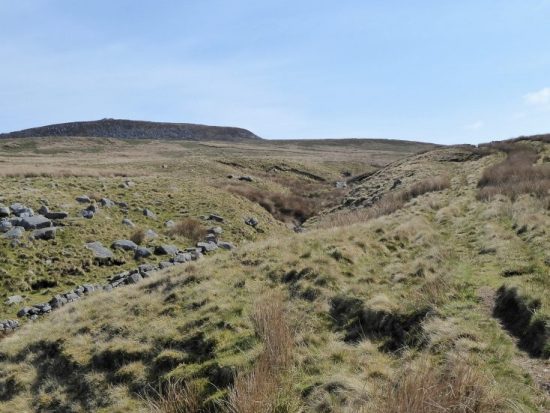
  A gentle walk up the lane brought me to Redheugh, a cluster of houses, Isaac Holden was born here in 1804 and baptised at Ninebanks church in 1806. The way followed a ridge across fields and through the remains of Keirsleywell lead mine, where he worked with his father and brother in the 1820s. At the road  I walked alongside the low Mohope Beck watching Sand Martins coming and going.

Redheugh.

Keirsleywell Spoil.


Malakoff Bridge.

Mohope Beck.

The bridge in Ninebanks crossed the larger West Allen River. Some steep steps came out on the higher road, where I diverted to visit some buildings of interest. First was the old Hearse House, built in 1856 after fundraising by Isaac. It wasn’t long after that Isaac died and was carried on the hearse to be buried in Allendale. The little museum was filled with an eclectic collection of objects relating to mining, funerals and tea. A great deal of information was displayed about the Holden family. Not to be missed if you are walking the trail.

  Along the lane is a terrace which was once Ninebanks school and Ninebanks church, St Marks, dating from 1764. A peaceful place for a short break.

  From then on I used ancient tracks through rough farmland, there were lambs everywhere. I crossed two old bridges below Dryburn which would have been used by lead carriers with their string of ponies going to the smelt mill in Allendale. Most of these old bridges have been washed away in floods.

  A road was crossed alongside High House Wesleyan chapel, now a private residence but the graveyard is still there. I had difficulty finding the path in the next group of fields, but received a friendly reception from a farmer’s wife and dogs when I wandered into their yard. She showed me a way and complained that the RofW hasn’t been maintained.

  After a few more difficult fields I was ready for a sit down and some lunch overlooking the valley.  There was a long stretch in Monk Woods high above Whitfield Hall and Church. The Whitfield  Estate belongs to the Blackett-Ord family, it was their moorland I tramped across yesterday and it is their woods I’m walking through today. Every hundred yards are pheasant feeders and the estate is very proud of its ‘sporting’ pheasant shooting, which I find abhorrent.

Baby pheasants, what a life.

I was glad to be away from the woods and on the final climb to take me to The East Allen valley. I passed limestone quarries and was in the heart of Curlew and Lapwing territory. Lovely open upland walking territory.

Heading down towards the river I passed Keenly Wesleyan Methodist Chapel established in 1750 after John Wesley had preached nearby.  It is said to be the oldest chapel in the world in continuous use.

  Without checking, I followed a very steep path down to a footbridge and steeply up the other side to find myself lost in field. I could see my mistake on the map and decided to follow the edge of fields until I could join up again without backtracking. This involved some risky crossing of barbed wire and then some very steep descending to reach the RofW by the river. The path alongside the  East Allen wasn’t straight forward with irritating diversions.

Going off track.

Definitely lost.

East Allen River.

A large Weir appeared by a road bridge and alongside was the site of Allendale Smelting Mill. There are some ruined buildings, but a lot is now a small business park. From the C17th, the Blackett family owned the mineral rights to the Allen Dales. Ore was extracted by levels driven into the mineral veins with horses pulling carts along the tunnels.  In addition to lead, the smelting mill produced silver, it closed in 1896.  The trail  crossed the bridge for the final mile. Of note was the opening to the Blackett Level which in 1855 was to run for miles in search of new veins of lead ore. It never fulfilled its promise.

Recommended.


The Blackett Level.

Leaving the East Allen River a steep hill brought me into Allendale, a small market town. The central square was busy with many taking advantage of the sunny weather to enjoy a drink outside one of several inns. I was staying at the King’s Head and my room had a bath which I much appreciated after a longish day.

After a rest and a brew, I wandered around the village, which had several Isaac Holden connections. First and foremost was St. Cuthbert’s Church where Isaac is buried with a fitting memorial.

On the edge of the marketplace is Isaac’s Well, 1849. He raised funds for its construction  to bring clean water to the town.

Across the road is the old savings bank, of which Isaac was a founder member. He also raised funds for two of the Methodist chapels in the town. On the edge of town is a row of cottages, Wentworth Place, where the Holden’s grocery store was. A busy man.

Old Savings Bank.

Primitive Methodist Chapel.

Trinity Methodist Chapel.


The PO. in Isaac’s time.

Wentworth Place.

*****


ISAAC’S TEA TRAIL. 2. ALSTON TO NINEBANKS.

  Tuesday, 8th June.     9 miles.

I wandered around the quaint cobbled streets and alleyways of Alston in the morning sunshine. There are a variety of small shops, some are aimed at the arts and crafts end of the market, but thankfully there are grocery and bakery outlets so I was able to buy a picnic lunch.

Town Hall.

St. Augustine’s Church where Isaac’s parents married in 1796.

  The Tea Trail follows the Pennine Way out of town but I decided on a different route, The South Tyne Trail which runs alongside the South Tynedale Railway. This narrow gauge track once linked Alston to Haltwhistle and the rest of the network. It has been partially restored for tourist trips. I therefore headed to the Station just out of town. The café was just opening and volunteers were busy with odd jobs, but alas no trains were running today. I had to be my own pretend train as I followed alongside the single track a couple of miles to Kirkhaugh Halt, where I picked up the official Tea Trail once again. It had been a pleasant diversion alongside the South Tyne.

  The path dropped to the South Tyne and a new footbridge replacing one washed away in 2018 floods. This one looks built to last, confirmed later by a local resident living next to Kirkhaugh Church who had watched the whole progress. The church was where I was heading next.

Note the church steeple.

  To give its full title – The Church of the Holy Paraclete. (Holy Spirit- I had to look it up.) The church has symbols of the dove inside, there are nine to seek out, I managed a measly three. Isaac married Ann Telfer here in 1834. The church was subsequently rebuilt in 1869 by the Rector Octavius James, inspired by Bavarian churches – hence the needle steeple. A bench outside was ideal for an early lunch.

  The stretch of minor road running back along the S Tyne was tree lined and the habitat of red squirrels but I didn’t see any. I left the road near Randalholme,  and climbed steeply through fields to reach the few houses named Ayle, a remote spot. Some flower filled meadows followed before a steep drop through hawthorns came to a footbridge over the gentle Ayle Burn, another bridge replacing one washed away in 2002.

Ayle.

A new waymark appears.

  It was a steep pull up to Clarghyll Hall, a good example of a bastle, a fortified farm. Rector Octavius James had a hand in its restoration.

  Various lanes and tracks took me through remains of mines and a colliery all reverting to nature. Bits of old machinery are evidence of recent attempts at mineral extraction. Curlews and Lapwings provided entertainment, but with little success with the camera. Then it was out onto the open heather moor.

Plantings on old colliery.

   A large notice proclaimed the virtues of the management of this moor which is of course for grouse rearing and shooting. I can’t agree with the propaganda and patronising information put out by the shooting fraternity. Anyhow, it was a good upland walk with skylarks singing above, no doubt any resident birds of prey have been done away with. Northumberland does not have a good history on raptor persecution.

As it descended to West Allendale the track became very rutted and stony, I spotted a field on the edge of the open access land which avoided all this and took me straight to the door of Ninebanks YHA. What a splendid hostel this turned out to be. Dating from the C18th during the lead mining bonanza, all around are visible reminders of that era, open shafts, spoil heaps and hushes down the hillsides. Sitting outside on the terrace, looking out over the Moors with the only sound that of birds – what a place to forget the Covid problems.

A good long varied day.

*****

ISAAC’S TEA TRAIL. 1. NENTHEAD TO ALSTON.

Monday, 7th June.           7 miles.

  I pull off the motorway at Tebay services, it’s chaotic. There is virtually no parking space, the whole area is like Blackpool front on a Bank Holiday. So they were correct when it was hinted that all the Benidorm crowds would be let loose in the British countryside.  Not that I have anything against Benidorm. I wasn’t going to queue to spend a penny, so I drove out and headed  for what I thought would be a quieter area of the country – the Northern Pennines as they are signed off the motorway at Penrith. Nenthead was my starting point for a few days walking Isaac’s Tea Trail

  Nenthead was a major centre for lead mining from 1750 to the end of the C19th. The London Lead Company was founded by Quakers, and they built decent houses  (considering the period) for the workers, complete with a free lending library and schooling for the children. There was a brief spell of reworking the mines for zinc, but that ceased in 1940. The village clings on as a quiet backwater with little to attract the tourist.

  It is however on one of the c2c cycle routes and there in the centre of the village is the bicycle repair man. He is tinkering with the gears on a lady’s bike. I stop to ask him where it might be safe to leave my car for three nights. He points across the way to the  mining museum, which looks closed, but there is a large car park with no overnight  restrictions, so that is where my car is I hope. I leave Nenthead as quickly as I arrived, I’ll look around when I return.

  From the village centre an Isaac’s Tea Trail finger post points along an ordinary looking street but at its end I’m surprised to see a model village of Nenthead with added features from around the world, obviously the lifetime’s work of a local. Along the riverside path, presumably the Nent, I meet a man walking his dogs, I notice one is attached to a harness and wheels. Apparently he has a form of a neurological disorder where they lose the use of their back legs before even worse symptoms develop. The owner is giving his dog some sort of life for now.

  The whole area has signs of past mining with the spoil heaps now reclaimed by nature. There are lime kilns and mine entrances scattered across the hillsides. The soft sand from reworked spoil heaps is riddled with rabbit holes. Apart from the grazing sheep, I come across a group of alpacas.

  The path is well signed as it crosses from field to field along the valley side on stone stiles. There are a few farms still working, but many have fallen into ruins. At one time up here was a thriving village, Nentsberry, with pub, chapel and school. An old man out walking looks as though he comes from that period, they are probably bred tough up here.

  Down some steps the road is reached at a bridge. The Hare and Hounds is ruined, but a once blacksmith’s shop is still standing. Across the bridge is Nent Hall built from the proceeds of the rich Hudgill mine and now a country house hotel.

  I meet a woman coming along the riverside path and she warns me of a closure farther along due to flood erosion repairs. So my brief spell by the water comes to an end at the Path Closed sign. I suspect that people are still using it, but I decide to be sensible and follow an alternative FP up past the neglected Lovelady Shield Hotel. I  climb steeply up the hillside to meet a quiet road and then a rough mining track contouring the valley. There are a few farms up here, but most of the surviving properties are holiday lets. All around are signs of past mining, I’m getting good views of the valley and stride out purposefully.

The track drops me into Blagill, another old settlement clinging on.

The last stretch into Alston is a delightful path alongside the River Nent as it slides over limestone slabs and tumbles down small waterfalls. Along here there has been flood damage from Storm Desmond and repair work has been carried out using European money. What’s the future for funding these projects now?

  Curlew are making a commotion as I pass through their fields. I forgot to mention that I spotted a red kite early on.

Alston is reputed to be the highest market town in England and I enter it on twisted cobbled alleys, arriving at the Market Cross. I’ll explore farther tomorrow as I’m ready for a brew and a rest. My Inn for the night is run rather incongruously by a Chinese lady who is most welcoming and full of laughs. I think I’m going to enjoy this walk.

*****

ISAAC’S TEA TRAIL.

The memorial stone to Isaac Holden in the churchyard at Allendale states –

IN MEMORY OF ISAAC HOLDEN

A NATIVE OF THIS PARISH

WHO DIED NOVEMBER 12TH 1857

AGED 51YERS

HE GAINED THE ESTEEM

BY HIS UNTIRING DILIGENCE

IN ORIGINATING WORKS OF CHARITY

AND PUBLIC USEFULNESS

UPWARDS OF 600 PERSONS

SUBSCRIBED TO ERECT

THIS MONUMENT

  Isaac was born to a poor family in the West Allen valley NE of Alston. He naturally started work in the lead mining industry from a young age  but at some stage in the 1830s  when work was hard to come by he and his wife opened a grocery shop in Allendale and he began selling tea in this local area of the Northern Pennines. Tea was becoming popular, its price had dropped meaning the less prosperous could afford it. Methodist Chapel tea bazaars were a means of raising money. Around the same time he became devoutly religious and started fundraising for local projects. It is for his charitable deeds that he is mainly remembered.

  This 37 mile long distance walk has been established to explore the scenic area of these Northern Pennines and introduce one to the rich mining and religious history still to be found in the villages. Isaac would walk these very paths, selling his tea to the local lead miners and farmers.

  The Wesleyan Chapel, Allendale, 1839,  Savings Bank, Allendale, 1840s,  Isaac’s Well, Allendale, 1849,  Hearse House, Ninebanks,1856 are some of his legacies visited en route.

It is a circular walk and thus can be started anywhere, there are sufficient accommodation opportunities in the villages to support the walker on what is described as a strenuous route. There is a website with all the information you need and downloadable directions and maps. https://isaacs-tea-trail.co.uk/  The route is marked on the OS maps. A guide book has been written by Roger Morris and is available from the Allenheads Trust Ltd.

The forecast remains fair for another week, so time to put on my boots again; follow in Isaac’s footsteps; explore this quiet region; soak up some history and maybe drink some tea.

*****

Day 1. Nenthead to Alston.

Day 2. Alston to Ninebanks.

Day 3. Ninebanks to Allendale.

Day 4. Allendale to Nenthead.

THREE MOORLAND TRIGPOINTS SOUTH OF OSSIE.


Friday, June 4th.       7miles.    Oswaldtwistle.

   What am I doing here?  In  the middle of a field halfway to a trig point on Duckworth Hill with a farmer cursing us for trampling his private land. We retreat to placate him, fortunately I know most of his family and acquaintances, so after some gentle banter he leaves us to the futile pursuit of visiting trig points. We visit point 217 m and complete the day of a triple of trig points on these West Pennine Moors. Incidentally, not all were  necessarily on the highest ground in the vicinity. It wasn’t my idea, but it actually provided an enjoyable walk, yes you’ve guessed it, I’m out with Sir Hugh again.

Sir Hugh on Duckworth Hill, 217 m, Pendle in the background.

Our meeting place at Immanuel Church turned out to be a large car park for our sole use. The first helpful bystander we met was cutting the cemetery grass, he suggested a route beyond our comprehension but visiting a splendid waterfall. After a brief walk in the wrong direction, we eventually reached open ground. Today most stiles and paths were adequately marked, any diversions were our mistakes. The wind turbines on Oswaldtwistle Moor watched our progress all day. At Jackhouse, an old farmhouse, we received more directions this time including a nature reserve.

Immanuel’s graveyard and our first ‘guide’

Danger ahead…

Jackhouse and our second ‘guide’

It being a sunny day we decided to visit the said reserve and walk around the lake. Unfortunately, we took our own path through the undergrowth, a waterfall was passed, and then further progress was impossible, an escape route was taken to find the correct path. This was pleasant with views over the lake, a former mill feeder. Onwards through a cluster of barn conversions, Cockerly Fold.

The ‘wrong’ waterfall.

Escaping from the jungle.

A better view of the nature reserve lake.

A barn being converted in situ.

We disturbed a lady sunbathing at Cocker Lumb Cottage, no picture this time. Cocker Lumb is the beck coming down this valley. Not many people come this way and she suggested heading for “the trees up there” – there was of course a profusion of arboreal growth. Rough meadows followed, in fact most of the land up here could be classified as rough meadow with little modern agricultural use, hence the profusion of horsey establishments. I’ve no idea how most residents arrive at their remote houses, there are many rough lanes which must communicate with the outside world.

Cocker Lumb.

Hidden houses.

Down by the beck  a concrete obelisk in a field took our notice, it seemed to have a plaque on one side. There was no way of entering the field so we had to be content with futile zoom shots and  futile internet research later.

Our unknown obelisk.

An unavoidable but short stretch along a busy road and we were at Mt. Pleasant Farm and our first trig point of the day, 308m.  There wasn’t anything aesthetically pleasing about its position.

308 m – we didn’t investigate the blue thing.

An easy stroll took us across Accrington Moor alongside a golf course, Green Haworth, with lots more stables and horse enclosures all around. A little lateral thinking had us into the field containing our next trig but to our amazement it was totally enclosed by a fence keeping the horses away from a large manure pile. It didn’t take Sir Hugh long to breach the defences and claim 257m. 

Accrington Moor.

Green Haworth course.

Accrington in the valley.

a pile of ….

Our intrepid trig raider.

Getting out of the field meant following the boundary until a gate appeared. The one we used brought us out onto the road exactly opposite our onward footpath. It was time for lunch. Lanes took us back into the outskirts of Ossie where a large litter pick up was in progress, one lady was in Whams Brook unearthing all kinds of treasure. A wander around the graveyard and we were back at our car park after about five hours fresh air, there is more to visiting trig points than you realise.

Stiles -ancient and modern.

A remaining mill.

Classic mill terrace.

Rubbish gathering.

Immanuel Church.

*****

On the way home I drove over Longridge Fell and was surprised to see a parapenter circling and landing in the field above the caravan park. He had glided over from Parlick, 5 miles away, and was trying to reach his home in Longridge. He was pleased with himself and packed up to walk home to ride his bike back to Chipping to collect his car. I’ve never seen anyone land here before, but he told me he made it to Scarborough on one occasion.

Coming in to land above Craig Y Longridge.

THE CUCKOO WAY. FIVE.

Tuesday, May 25th,       10 miles.     Killamarsh to Chesterfield.

Rain was forecast for the afternoon, so I boarded the first bus to Killamarsh, it took well over an hour to reach the destination having travelled around most of the Chesterfield district. I’ve become used to sitting for all this time with my face mask on. Calling at the hospital we picked up a drunk who had probably been released from casualty, as could be expected he caused some chaos on board before staggering off in the middle of nowhere.

I alighted at the Canal Bridge stop where I finished yesterday, but it was difficult to make out the bridge as the canal was filled in, encouragingly though was a sign for The Cuckoo Way to Chesterfield. The Greenway runs all the way to Renishaw and is a facility I hope the locals make use of, there were very few on it today.  So I disappeared into the undergrowth on the edge of a housing estate. The line of the canal was just a ditch to my left, at least it doesn’t seem to have been built over. The Cuckoo Way roundels, which I explained yesterday, were a help in navigating where the canal has all but disappeared.

Turning a corner the Trans Pennine Trail cycling route appears to the right following an old railway line. One could walk on the cycleway but I preferred to stay on the “towpath”. All of a sudden there was water in the canal, this section has been a fishery part of the Sitwell Estate. Coming towards me was a gentleman and his hound, he turned out to be the water bailiff for the estate. During the periods when we’ve not been allowed to travel far local fishing became a boom pastime and he was kept busy supervising the waters. He told me of the plans to restore more stretches of the canal, how to save and transfer the fish and how the line of the HS2 was coming through the region adding complications to the scheme. In this age of zoom conferences and working more from home will another railway be needed? The canal reverts to a ditch farther on.

The water bailiff goes on his way.

The line of the canal, the towpath and the Trans-Pennine Trail alongside.

The Greenway continued at times narrow and muddy, at others alongside the redundant canal. The cycle way has gone elsewhere. It passed the outskirts of Renishaw and then as a footpath following the filled in canal across open fields. Good progress was made as the way was clear ahead, although I had no idea of where I really was.

Approaching Staveley the canal originally was carried on a high embankment to cross the River Doe Lea, this is apparent on the ground except at the river itself, Staveley Puddlebank.

Staveley Puddlebank.

A lot of work is being undertaken at Staveley with a new lock and a basin constructed. This is some achievement as much of the labour is voluntary, Chesterfield Canal Trust. It was easy to get lost here with the new works and the many cycle routes.

Lunch was eaten on a bench next to the old Mill Green bridge. Men were fishing in the basin using very lifelike lures. As I sat two vessels came up the canal. The first powering a reed cutter and his mate using a rake to clear the water. In front of my eyes, the raker pulled a bath out of the canal – catch of the day. A little farther along he’d netted a bike and a supermarket trolley or were they art installations?.

Much friendlier than they look.

Catch of the day.

Entertainment over, I set off on the last few miles into Chesterfield. The towpath remained good and  a café was open at Hollingwood Lock.  On this section to Tapton new locks and bridges have already been built, and the canal is viable, although the only two boats I saw were from the Canal Trust used for pleasure trips raising money for the restoration cause. If you had a boat why would you put it on a section of canal only navigable for six miles.

And then there was a mile to go…

The end of the 6mile navigable section is short of the city and the rather dreary water comes to an end by building development sites which were basins in the years of the working canal. There are plans for a new showcase canal basin close to the city centre.

This lady’s not for turning.


First and last lock.

Even if the canal peters out before you get into Chesterfield, the sight of that twisted landmark is inspiring.

On reflection, I think it would be better to walk the way in the opposite direction with a far better finish at the Trent in West Stockwith.

46 miles of varied walking and I only became lost once in the housing estates of Killamarsh. I never heard a cuckoo, but I found a plausible reason for the Cuckoo tag, 

*****


THE CUCKOO WAY. FOUR.

Wednesday, 26th May.      10 miles.     Worksop to Killamarsh.

I found myself changing trains in Sheffield, but all went well and I was in Worksop by 9.30. Getting out of Worksop was more pleasant than getting in on the Eastern side had been – that old adage “West End Girls” comes to mind as I hum the almost Miles Davis like composition, hear that trumpet interlude!. The west ends of many towns and cities in England were usually cleaner and healthier to live in with the prevailing wind blowing the smog to the east ends.

Excuse my indulgence.

Back to the inauspicious start at an enclosed lock under the main street, but then all was lovely and green as this canal walk has been so far. I thought the sign was probably unnecessary.

I’m sure these were Tufted Ducks.

Today was going to be a day of locks, 30 were needed to raise the canal up to the Norwood Tunnel which went through the limestone ridge in the path of the canal between the Trent and Chesterfield, “The Giants Staircase”. Several of them were double or treble locks where there is no basin between the locks, these are quite rare in England. An amazing feat at the beginning of the Industrial Revolution. This stretch has been restored between 1995 and 2003, but the work is ongoing.

Eight locks up and I arrived at Shireoaks Marina, originally a C19th basin for a local colliery -the last coal left here in 1949. I had read about a recent building in the traditional way of a Cuckoo Boat, Dawn Rose, and that she was moored in the marina. I could find no way into the marina so if she was there I was denied a sight which is a shame.

Entrance to Shireoaks Marina.


The marina through the railings.

About this point I started to notice Cuckoo Way roundels. The birds didn’t look like cuckoos to me and I later read that they are choughs borrowed from Retford’s coat of arms and incorporated into the original Chesterfield Canal seal and now used in the Trusts emblem. The diamonds were from Chesterfield’s seal.

It was good to find some of those lovely Peak and Northern signs along the way. Above Shireoaks was the start of more climbing, the seven Turnerwood Locks and some old cottages picturesquely situated on the towpath. It was here I met a man cycling the towpath on a 1970s Claud Butler bike, one of the elite British bikes at the time. We chatted all things cycling and it was obvious he was very proud of his steed. Notice the Shimano gears with down tube shifters.

Around the corner a swan was sitting on her nest, it was only a few years ago that someone shot a pen in the same spot leaving the cob distraught. Why? Let’s hope this bird brings up a successful brood.

I was now at the bottom of the Thorpe series of locks with two triple locks and two double locks, 15 locks in half a mile all in sylvan scenery. I was suitably awestruck.

At the top the canal levels out. On the right is one of those old farms with accumulated junk from 50 years ago. I would have loved to explore deeper into the undergrowth but the whole place had a forbidding atmosphere.

Farther on was a DL – CC boundary stone which I’m still trying to decipher. The canal has the rail line running close by it and just before Kiveton Park station is the wharf where stone quarried nearby was loaded and taken off to London to rebuild the Houses of Parliament after they burnt down in 1834. At Dog Kennet Bridge the towpath changes sides for the short stretch to the blocked Norwood Tunnel. The last turnabout point is rather ornate. The tunnel ran for 2,880 yards before it was blocked by mining subsidence in 1907. I have to walk over the top.

The walk over was quite pleasant first past Kiveton Waters fishery, their café was closed, then through the old reclaimed colliery land where care was needed with the many paths going in all directions. Dropping downhill through fields there was an underpass for the M1 and then slowly water appeared on the left where the Norwood Locks had been. These were a series of 13 in a third of a mile, three treble and one quadruple. They are all filled in now. The way passes extravagant houses with traces of canal stonework in the water channel running alongside. It was whilst looking into the garden of one house that a kingfisher flew straight towards me, landed on a reed and then flew back again showing me all its colours.

Kiveton Fisheries.

Bits of the canal reappeared and then vanished under houses in Killamarsh where land was sold off. I became disorientated in the estates and reappeared at the bus stop 3minutes before the bus came down the hill. I have to get back here tomorrow morning hoping the line of the canal will be more obvious. It has been very short-sighted to build a housing estate here and it will be a major engineering undertaking to connect the two halves of the navigable canal.


Rather than end today on a sour note, here are a few photos of the detail that goes into lock construction.


*****

THE CUCKOO WAY. FIVE.

THE CUCKOO WAY. THREE.

Sunday,  May 23rd.        10.5 miles,     Retford to Worksop.

Today I’m left with vivid memories of abundant greenery along the canal for most of the way. I started off from the Town Lock in the middle of Retford but within minutes I seemed to be surrounded by trees. The canal crossed aqueducts, including one over the River Idle, and then with the King’s Park on the right and a massive manicured cemetery on the left I was in the countryside. A few old wharves were evident and then the West Retford Lock. Close to town was popular with dog walkers, one lady pushing a baby buggy had a little terrier close behind, as she passed me I realised another terrier was having a ride in the babyless buggy – arthritis was her excuse.

Doggy buggy.

I hadn’t gone far when I came across boats moored up and their owners engaged in canal side chat. Most times you pass moored vessels all you are aware of is some smoke from the chimney with the occupants tinkering deep inside out of view. Anyhow, these three were very sociable as we discussed the difficulties of restoring canals. I was able to chip in with the Lancaster – Kendal problem which they seemed to know all about. As with yesterday’s couple drinking wine I’ve  never been offered even a cup of tea  from a canal boat. I’m sure Sir Hugh will have partaken.

Lady Bridge, number 54, had good examples of the grooves cut into the stone by the horses tow-ropes. Nearly all the bridges and locks on the Chesterfield Canal have been given names with past associations, I suspect it was a very sociable trade being a boatman along here.

The next sequence of narrow locks were named after the Forest of Sherwood which extended this far in the C18th. The third one was named Charlie’s after the lockkeeper who live in the adjoining house. More open countryside bordered the canal with rich looking sandy soil. However, there were still a lot of trees bordering the canal, particularly some fine specimens of weeping willow.

Charlie’s Lock.

Today’s corny name.

A stretch of the canal ran alongside the A1 and the noise was only just tolerable, pity the people living  there. The inviting looking pub, The Chequers at Randby, was on the wrong side of the water which was probably a blessing as I had a way to go. The canal twists and turns through the Randby Bends seemingly getting nowhere, but it is only cleverly following the contours.

By the time I reached Osberton Lock I was ready for lunch and luckily found a bench which happened to be a memorial to a gentleman who had lived in the attached lockkeeper’s cottage for many years.

I was now entering the estate of Osberton Hall and I found the towpath changing over to the left-hand bank – the owner of the Hall in the late C18th  had an Act of Parliament keeping the towpath on the opposite side from his house. The landowning toffs have always been up to it, nothing changes. I managed a sneaky shot of the stately pile.

Now it was all semi urban scenery into Worksop. Interest was maintained by the defunct steam driven Bracebridge Pumping Station, for Worksop’s C19th sewerage. The canal then comes alongside a massive factory, apparently a flour mill. There were some pleasant canal side cottages still standing.

Then over the canal in front of me was a warehouse with direct access to canal boats moored below – the trap door is still there. The warehouse was at one time owned by Pickfords of removal fame but now functions as a coffee shop and gym, I had visions of a weight lifter coming crashing through.  It was time to finish for the day.

*****

THE CUCKOO WAY. FOUR.

THE CUCKOO WAY. TWO.

Saturday May 22nd.     6.5 miles.     Clayworth to Retford.

The bus drops me off opposite St. Peter’s Church, this originates from the C13th but was much altered in the C19th. Murals by the arts and crafts artist Phoebe Traquair cover all four walls of the chancel, but there was no entry today. Outside though the churchyard wall contains a large boulder, perhaps unearthed by navvies digging the canal or was it a meteorite landing in the village? The village cottages were bedecked in clematis and all was quiet on the little lane leading to the canal at Otters Bridge, now down to number 68..

This was the start of a delightful walking through open countryside, views across the flat drained fields, lively birdsong and the all-pervading Mayflower scent. A roe deer was seen scampering across an open field, mother mallards shepherding their broods and swans protecting their cygnets. There were long stretches of reed beds and I heard several warblers but only caught sight of the one Reed Warbler.

‘There are boats moored up alongside the headquarters of the Retford and Worksop Boat Club. Much tinkering is going on, but nobody is sailing. Today’s prize for the corniest boat name goes to Goldilocks.

Several canal side pubs were passed, but none looked inviting, plastic children’s play areas and hastily concocted Covid dining areas. One, The Hop Pole, reflected on the acres of hops grown locally in the C18th until the canal ruined their trade by bringing hops from Kent, which had a better taste. Another of interest on the outskirts of Retford, the Packet Inn, was once the terminus for the weekly packet boat from Clayworth bringing people and produce to market. This was a two-hour journey and the return was an alcohol fuelled party. 

Bridge 61 is named Bonemill bridge alongside the building where bones were crushed for use as fertiliser. All these bridges and the older warehouses are constructed with attractive local bricks which have aged well.

Alongside the canal a garden has been furnished with signs and the occupant was all to pleased to chat about them.

After miles without, the first lock of the day was named Whitsunday Pie Lock, this strange title having many dubious origins. It is the last wide lock on the canal.  People were fishing unsuccessfully for perch and a couple had pulled up in their boat having cruised out of Retford for the weekend. They had just opened a bottle of wine and were in no hurry to proceed. This resulted in a lengthy conversation about boating, Covid and the best pubs in Retford. They had named their newish boat Our Lass – they were well and truly Yorkshire born and bred. For some reason I omitted to take a photo.   The next couple walking their greyhound were just as chatty and seemed to have all the time in the day, maybe life is more relaxed around here. Eventually I came into Retford with more old warehouses making an appearance. As is often the case these have been either converted into attractive living accommodation or become cafés or restaurants. so it was pleasant enough as the rural scene turned to urban hustle and bustle. The Town Lock is much narrower than those before, a good place to finish for the day.


*****

THE CUCKOO WAY. THREE.

THE CUCKOO WAY. ONE.

Monday,  May 24th.      10 miles.     West Stockwith to Clayworth.

The bus to W Stockwith went around the houses more than once, at one time reversing the way through Misterton. I have a tight logistical transport plan to enable me to walk linearly and I was beginning to see it go wrong on the first day,  or is it the third? – it is too complicated to explain.

Suffice to say I started the walk at the canal basin next to the River Trent.  Is this the start or the end of the canal, well it depends, but in my case it is the start. 46 miles to go.

The River Trent is wide here and tidal, boats used to access it from or to the basin by the first lock. The canal as far as Retford had locks wide enough to accommodate  the larger River Barges. People are busy tinkering with their boats in the basin and the sign says the lockkeeper is on duty from his converted warehouse.

The River Trent with the old winch which pulled engine-less vessels into the basin.


The river lock and keepers cottage.


1798 warehouse, now the lock-keeper’s office.


A busy basin.

 A few boats were moored up on the first stretch of the canal. The towpath surface to Misterton has recently been improved and there are benches at regular intervals, that’s a good start.  The May Blossom was a delight, often lining both sides of the water, the theme of the day really. The sun was shining and the wayside flowers vying for attention. Life outside Lancashire was good.

The start of the canal.

Alongside Misterton, swans had made their nest on the towpath side, apparently if the male is on the path you had better turn around. Today he was too busy chasing ducks that came near the female on the nest.

The brick bridges are all numbered, counting down from 85, and modern mileposts are in place counting down from 45. I don’t know if any of the original mile markers have survived.

Bridge 82 0f 85.


One mile gone, 45 to go.

The rest of the morning is spent out in open countryside with hardly a habitation to be seen. I chat with a couple of lady dog walkers who tell me about the wild life I may or may not see. Kingfishers and otters are at the top of the ranks. One stretch of reeds is full of the song of Reed Warblers, but I only catch a glance of them. https://www.youtube.com/watch?v=jgFDzVeyg94

The surrounding countryside is flat agricultural land as far as the eye can see, there is nothing here for the fellsman. Having said that I do pass at a distance Gringley-on-the-hill, an ancient village with far-reaching views. I can just spot its church tower on zoom.

Lunch is taken sat on the steps of Shaw Lock. On the adjacent bridge are the initials of the builder and date.  In a field nearby is an old brick works, boats brought coal in to a wharf and took the bricks out.

More wild woods and lush verges followed until I came to the mouth of Drakeholes Tunnel. Here the path goes over the top as did the horses whilst the boatmen pushed the barges through.


At the other end of the tunnel was a small wharf and across the road an Inn due to reopen soon, but will they still serve beer?

The next bridge along is named Face Bridge but the face on the keystone is very weathered. The bridge is ornate as it was the on the driveway to Wiseton Hall. The canal bends around the estate because the owner stated that it should not be built within 200 yds of the hall. The power of the upper classes.

 There had not been much traffic on the canal but in the last mile along comes a boat and two men paddleboarding.

I need to pay attention to the bridge numbers as I leave the canal at no. 68, Otters Bridge, to climb up to Clayworth and the end of my first day. I arrive just as the rain does.

*****

THE CHESTERFIELD CANAL – WALKING THE CUCKOO WAY.

The Cuckoo Way follows the towpath of the Chesterfield Canal for 46 miles, arguably one of the most beautiful and varied waterways in England.

The canal was designed by James Brindley but much of the work was by his assistant John Varley. The line, known locally as ‘Cuckoo Dyke’, opened in 1777, five years after Brindley’s death. It was at the forefront of canal design in its day with a multiple staircase lock flight and the longest tunnel in the country at Norwood. Originally extending 46 miles from the River Trent through Worksop and Retford to Chesterfield. Along the way it negotiated two tunnels and a combination of narrow gauge and broad gauge locks. A decision was made for the canal to be narrow from Chesterfield to Retford, but on a larger scale between Retford and the River Trent to accommodate wider-beam river traffic along that section.

Throughout the 19th Century the canal was very successful, carrying coal, agricultural goods, bricks, iron, timber, pottery and ale. Its most famous cargo was 250,000 tons of stone from local quarries which were used in the construction of the Houses of Parliament. The original cuckoo boats, all horse-drawn, were unique to the canal. Most boat trips were short, this meant that there was no requirement for overnight accommodation and hence no, or only a small, cabin or shelter. The “traditional” canal art was also missing.

The advent of the railways brought a gradual decline that was compounded in 1907 by a collapse in Norwood Tunnel. Although some trade did continue on the canal, the last recorded commercial cargo was in the 1960s. A sizeable section between Stockwith and Worksop remained navigable. In 1976 the Chesterfield Canal Society, now known as the Chesterfield Canal Trust, was formed and restoration completed of the Worksop to Norwood and Staveley to Chesterfield sections. The path apparently follows close to the original line of the canal on the remaining unrestored section.

The Cuckoo Way has the making of an interesting and varied walk in a part of the country I hardly know. Maps and a guide are available from the Canal Trust. After all our problems with the Covid pandemic and the resultant restrictions it is perhaps time I ventured farther afield – so here I go on an easy ‘expedition’ to get me started.

*****

.

THE CUCKOO WAY. ONE.

SOUTH OF THE RIBBLE AGAIN – OSBALDESTON.

Friday, May 7th.   8.5 miles.    Osbaldeston.

I’m just about to eat my supper;  wild garlic encrusted fish,  a poached egg and new potatoes. The wild garlic was picked on today’s walk from one of the numerous wooded dells I traversed, my rucksack will smell of garlic for days.

 Two days ago I was in Balderstone and today I’m parked in Osbaldeston, a few houses in a row.  Obviously  ‘balderston’ is the common phrase. I’m off to explore another bit of countryside south of the Ribble bypassed by the busy A59.

The little lanes around here are fairly free of traffic mid-morning, but I suspect will be a different matter at school and work times. As I said Osbaldeston is hardly a village, a row of mixed cottages and affluent houses with large gates, you know the sort. I was soon in fields where one stile led to another making navigation simple. I’ve just realised that hedges and not walls mark the boundaries in this area. The elegant steeple of Balderstone church was always peeping over those hedges and up above Mellor Moor, but more of that later.

I spotted a deer running off up a field and when I passed this dell I heard crying – and there were two very young calves left in the grass. A quick photo and I left as soon as possible, what a start to the day.

The next group of houses, Studdlehurst, were hidden away at the end of a lane. Again large gates and horsey activities were evident. The man mowing the lawn of what was probably the original farmhouse was chatty, mainly about the weather, his massive garden and the state of the footpaths since lockdown.

The next house had distanced itself from the general population behind electric gates, but had provided excellent waymarks, gates and stiles on the public rights of way – what more can you ask?  Mercyfield Wood was full of bluebells, I apologise if I took too many ‘bluebell pictures’ today.

Crossing fields towards the river a new fence was going up but the original stile will be reinstated, the workers told me. At last, I was down by the River Ribble which was flowing quickly after overnight rain. I was on the lookout for Otters but to no avail. All the usual birds were present with Sand Martins making a return.  Across the way was Hothersall Hall and I had a different view of it than from my usual walks.

The RofW path cut across the land to Osbaldeston Hall however a concessionary path was signed by the river so I gratefully followed that. A large group of Swans were paddling about farther on below the Old Boathouse.  At Osbaldeston Hall I was pleasantly surprised to find the footpaths well-marked and the landowners going to a lot of effort to make life easy for the walker. I had only seen this hall from the Ribchester side before so it was good to come close up. A pleasant spot for a snack in the sunshine which had been in short supply until now. The old ‘Boathouse’ on the other side gives a clue as to a former ferry as well as a ford marked on an old map.

One cannot but sympathise with the farmer if his sheep are being worried, I fear that with the vast increase in dog ownership there will be a corresponding increase in irresponsible ownership.

The next mile or so was a switchback in and out of woods and ravines. Again plenty of scope for bluebell pictures and for picking some wild garlic for supper.

Once I approached C17th Oxendale Hall I was being watched by security cameras, the footpath became enclosed circling the property and I could have continued into the woods without seeing the Hall. An unmarked public footpath, not meant to be used, in fact crosses their frontage for a close up view. Of course, I was spotted and asked, or rather shouted at, if I was lost? I wasn’t lost, and I didn’t have the time of day for further conversation so continued on my way.

The next hall, Showley, another Grade II listed C17th but much altered, was something of a difference. The agricultural junk started well before the house and continued in most available directions. They deserve a listing for the amount of junk.  I wonder if they get on with their neighbours at Oxendale Hall.

I picked up a lane taking me back to the A59 and after some time was able to cross safely this busy road. Once on the other side I had a choice of low level field paths back to my start or climb up onto Mellor Moor, the weather had improved and I knew the view from up there was worthwhile. Hence, I started the slow trudge up the lane and onto the open moor. Stopping for breath gave me an excellent view of Pendle.

The top of the moor is marked by a trig point but more unusually by the site of a nuclear monitoring post. A plaque relates its history. The Lancashire Telegraph had this write-up.

Concrete blocks amid the swaying grass are the only outward signs of what used to be a large underground nuclear monitoring post for the Royal Observer Corps, which opened in 1959. It closed just nine years later and has since been sealed.

Three men would have entered the post during times of potential nuclear attack and reported on explosions read off special equipment installed to read blast pressure, power and flash. The bunker, therefore, had its own source of power, ventilation, communications, sanitation, food and water.

The monitoring post was just one of 1,500 across the country which would be able to track and report any nuclear fall out, keeping the local population informed of the level of danger. Thankfully they were only ever used for training and exercises.

In the Second World War, an above ground look-out post was built here, too, by the Royal Observer Corps, for spotting identifying and tracking hostile or friendly aircraft flying over this part of East Lancashire.

A direction indicator has also been installed for the far-reaching 360 degree views across the surrounding countryside, Wales, the Lakes and Yorkshire as well as all the nearby Lancashire hills.   Apparently this was also the site of a Roman signalling station, overlooking Ribchester from around AD 80. Earthworks are marked on the map but I’ve never identified them on the ground.

Pointing to Bowland.

I intended to follow footpaths back down the moor but came across this unfriendly gate. Not one to turn back on a public footpath I entered the grounds leaving the gate ajar in case of a hasty retreat. No hounds appeared so I was able to progress to the next obstructed stile. Why do people buy properties knowing there are rights of way through them only to do their best to keep the public out? Another one for reporting to the local authority.

 More friendly fields took me down and across the A59 again to bring me back into Osbaldeston. Today I was luckier and my friends in Mellor Brook were home so a pleasant glass of wine was enjoyed in their garden before coming home to cook my supper.

*****

THE OTHER SIDE OF THE RIBBLE – BALDERSTONE AND SAMLESBURY.

Wednesday, May 5th    11miles.    Samlesbury.

Where haven’t I been for a while? Well it’s several years since I explored the countryside visible southwards across the River Ribble. In the past I thought that the footpaths were difficult to follow and rights of way ignored on the ground. Time for a revisit. So I found myself parked up in Balderstone;  a school, a church and a couple of houses. I waved to a man delivering hay to one of the houses and then I was off along quiet country lanes. At Lane Ends I visited a trig point, for no obvious reason, at the lofty height of 74 m.

My first objective was to visit Balderstone Hall on the River Ribble and view from this side the former ford across to Alston. I’ve recently been looking at this scene from the Alston side.

https://bowlandclimber.com/2018/11/08/alston-looping-the-loop/

https://bowlandclimber.com/2021/01/08/river-ribble-at-alston/

A pleasant stroll down fields above the river brought me out into the confines of expensive and secluded properties. A right of way was shown on the map but it looked daunting. As it happened a couple of builders whom I knew were working on a wall of the Hall, they said nobody was about and showed me the way through past the rather intimidating signs. I didn’t like the look of the river crossing, maybe in high summer and low water I’d be tempted. The old map marks the ford.

 I retraced my steps and left the exclusive properties for a path past a more run down farm. Crossing fields on the flood plain I bypassed a large farm and climbed back up the escarpment to reach a road heading west to Bezza House. Years ago, when Bezza was a tree nursery, I used to come here with Dor and many of the trees in her and my garden originated from here. One in particular that she bought was the ‘handkerchief tree’ Davidia involucrata, an exotic specimen from China. It takes years to flower and so one spring whilst they were away for the day I went around with a ladder and white paper tissues which resembled the flowers from a distance. Suffice is to say that they were well and truly tricked but the tree had the last laugh by flowering the next year and every year since.                                                                                                               

There are great views from up here of the Thirlmere Aqueduct crossing the River Ribble.

Where the road used to continue bollards have appeared and now only a bridleway continues to Samlesbury. And what a pleasant bridleway it was;  lined with spring flowers, bordering fields full of lambs and having views across the Ribble to Alston, Longridge and beyond.

It was getting near lunchtime so I hurried to reach St. Leonard the Less Church where I expected there to be seats. I was not disappointed, in fact a couple of walkers were already occupying the prime bench. The church unfortunately was closed. It has some very old box pews, apparently. I had to be content with the exterior views of the oldest, C16th, sandstone part and the distinctive tower built at the end of the C19th. In the graveyard was an ancient sundial, 1742,  and a large font, 1769. The adjacent primary school is also of a certain vintage, I’m always cautious taking photos near schools.

A path climbed fields towards a house which turned out to be another religious establishment, the Roman Catholic Church of Saint John Southworth  and presbytery.

An old sunken track high above the busy A59 was a hidden delight to walk. Peace came to an abrupt end when a stile deposited me onto the pavement adjacent to the traffic lights at the busy junction next to the Five Barred Gate motel.  

Once across safely I was happy to follow  the quiet lane past the extensive sewage works. Up and down it went until I was able to take a footpath across to another lane, thus by-passing the Nabs Head  pub which has too many recent memories for me. I was soon on the pavement outside the C15th Samlesbury Hall. What a magnificent building this is and to think it was bought in 1920 for demolition, only to be saved by a local trust. I crept into the grounds for a closed look.

Crossing the busy road I made use of a quiet bridleway, Park Lane, taking me to Mellor Brook. I wished I’d had a bag to collect some wild garlic. From up here I could look across the extensive BAE site and the Ribble Valley to Longridge and the Bowland Hills. 

I took a footpath behind houses where friends live hoping for a cuppa, but they were not at home. This humble little stream, Mellor Brook, once fed a mill pond that supplied water to a cotton mill.

The village deserves a better look with little alleyways and old houses. An unknown lane went under the A59 and out into the countryside. Fields headed back to Balderstone with the church spire always prominent. On the way I passed the grand looking Grange, you could rent its nine bedrooms on Airbnb for £2000 per night. 

Arriving back at the school I was greeted by the man who’d seen me set off this morning. Turned out he was the school caretaker and seemed impressed by my modest mileage. I had time for a look around the outside of St. Leonards Church. It dates from the C16th but was rebuilt in the 1850s, the tower and prominent steeple were added in 1905 by those old favourites of Lancashire church architecture Austin and Paley.

I have had perfect weather for today’s enjoyable amble in this delightful backwater just off the A59. It was worth crossing the Ribble.  Looking at the map I will return and complete another circuit to the east based on Osbaldeston.

GOLDSWORTHY ON HIGH.

Monday, April 26th.     8miles.      Quernmore.

I have been up here before to seek out the Andy Goldsworthy ‘Three Chairs’, most recently in 2014.  https://bowlandclimber.com/2014/05/28/out-on-the-loose-again-clougha-pike-and-grit-fell/  when we did virtually the same walk.

There were quite a few cars in the car park this morning when we arrived – early birds or dog walkers. Sir Hugh was just recovering from his head dive last week and I noticed a slight reluctance to turn his neck, however today was only going to be about six miles, well it turned out nearly eight, but there was no problem.

We climbed up onto Clougha Pike using the Rowton Brook path which passes evidence of past cottage industries most notably the C17 cotton mill. The present owner was happy to chat about its history and life in general.


There was no let up in the ascent but the ground was mercifully dry. The trig point, 413 m, was adorned with the most un-Goldsworthy stones. The views over the bay were murky but Morecambe Power station was ever present. In the other direction that other old favourite, Ingleborough, was in the background. 

The easy way.

Clougha Pike summit. 415m.

The obvious continuation track went to Grit Fell, we followed it as the rest is trackless heather. The peat was bone dry and a joy to stride out on with skylarks somewhere overhead. A few grouse were calling gobackgoback. Not recalling that Goldsworthy’s installation was named ‘The Three Chairs’ we spent some time trying to identify three large gritstones fitting that description and marked approximately on the  map.

Grit Fell 467 m.       Can you spot Ingleborough in the gloom?

I did recall this isolated Xmas Tree farther along the ridge.

Once on the shooters’ highway we made good progress back in the direction we had just come from. I was beginning to doubt my ability as a guide when the moors stretched out ahead of us with no sign of quarries or chairs. Sir Hugh thought the day was a failure when suddenly we were there and the installations appeared much larger than I remembered. [marked G on the map] He was impressed – with the statues not my navigation. Do you call them statues, sculptures, installations or piles of stones? That’s where art has its personal interpretations. Piles of stones they certainly are not, these are carefully crafted structures with intricate stone work. Apparently Goldsworthy constructed one each year from 1999 to celebrate the millennium. We speculated whether he constructs them himself or employs a stonemason to help. After the obligatory photos we continued on our way off the fell.

An estate worker’s massive 4X4 passed us – or was it the Duke.

Three cairns appeared on the left which we declined to visit but on the next photo look quite interesting.

I was chatting to Sir Hugh about the Thirlmere Aqueduct which comes this way and an old quarry [marked Q on the map] near Ottergear viaduct ‘discovered’ and climbed in by my friend Pete. We reached the impressive viaduct and almost missed the quarry which I’d expressed a desire to revisit. A chance glance behind and we noticed a couple of blokes in the quarry. They were doing a bit of climbing there as it has been highlighted in a recent supplement to the boulders in this area. That led to a sociable chat about old times climbing.

A sandy path through the heather brought us back to the car park. A perfect little fell day.

*****

SOME RIBCHESTER LANES.

                                   Icy weather.

Wednesday 6th January.     6.75 miles.      Ribchester.

As I write this the news is as depressing as I’ve known for a long time. Over a thousand deaths in UK from Covid-19 in the last 24 hours and in Washington, USA, Trump attempting to be a dictator by inciting protestors at the Capitol Building.

That’s a shame as it has been a lovely sunny day, and we enjoyed a wander around the quiet roads on the south side of Longridge Fell – one of my local ‘lanes’ walks.

Mike and I met in the empty icy car park of Ribchester Arms which of course is closed. At the start we diverted to have a look at the Stydd Almshouses and the medieval chapel. I have written about these in detail before. Basically we then  walked up Stoneygate Lane onto the fell, along a bit and then back down again on Gallows Lane.  On the way we passed residences old and new reflecting the wealth that must be present in the Ribble Valley.

The Newdrop Inn, for sale.

Huntington Hall. Early C17th.

Dutton Hall.   Early C17th.

Early C20th.


More modest late C17th Lower Dutton Cottages.

An unknown old chapel.

On the way we came across this witch who had crash-landed.

‘Don’t drink and fly’

Another spectacular sunset ended the afternoon.

*****

SOME GOOSNARGH LANES.

Tuesday  29th December.       4 miles.       Goosnargh.

On the news today people from London, Tier 4, are  being turned away from the Brecon Beacons which happens to be in Wales. It beggars belief and I would hope that they are fined, but it is unlikely. We are in the most serious phase of the Covid-19 crisis and people are not heeding the advice never mind the rules. January is going to be bleak.

*****

My drive today was a safe three miles for a walk on lanes out of Goosnargh for some more exercise  and vitamin D.

I could have sworn from past visits that the lane down past Middleton Hall was well surfaced but no I was mistaken, it was muddier than my trainers could cope with. I carried on regardless. The views to the Bowland Hills and Longridge Fell were from a different angle to recent ones.

Middleton Hall.

Beacon Fell and Bleasdale.

Longridge Fell.

Westfield Brook was running swiftly below the little footbridge but there were signs in the fields of recent flood levels. On the far side was a dedication bench with the quotation –  Time is precious. Waste it wisely.” Attributed to a K Bromberg.   I wish I’d thought of that, but I’ve not even read any of her sexy novels. The lane did improve as I approached Goosnargh Lodge. In a field alongside is a magnificent Cedar Of Lebanon, it deserves a better setting.

The roadside lodge to the lodge has been renovated.  I was then back onto roads all the way to Goosnargh coming  into the village alongside Bushell House. Bushell House has been running as a Charitable Trust to care for the elderly since 1743. My mother enjoyed her last few years there.

Next door was the parish church, C16th St. Mary’s. I popped my head inside and ended up in a long conversation with a long-lost friend who is a church warden. Outside is a sandstone sun dial dated 1746 and the medieval base of a cross, sadly overgrown.

Two old inns completed the scene, Bushells Arms is now a private house and The Grapes is to let.

The Bushells Arms.

The Grapes.                                                                                                                                

I’ll finish with the pubs and a shot of the late December sky.*****

DOWNHAM DIVERSIONS.

Tuesday 22nd December,      7 miles.      Downham.

Today was one of those days; not a drop of wind, easy walking and hardly anybody about. I seemed in a trance as I wandered around a familiar easy circuit. Hands in pockets walking. I was alert to birdsong and the tinkling of the becks coming off Pendle Hill.  No planes disturbed the sky. This is excellent Lancashire limestone country, and I was in no rush to pass through it, in fact I was happy to wander at will in search of new discoveries. Time stood still in this bygone landscape while the sun shone but slowly the day turned to grey.

This moody Eagle track was in my head all day, as my grandchildren would say ‘I was in the zone’

 I had parked in Worston, which is much quieter than Downham, wandered up to the splendidly isolated Little Mearley Hall and then along the northern base of a generally misty Pendle linking a series of farms. The approach to Downham via the little beck was a delight, and I looked around the village even having enough time to go up to the top road to find the C18 milestone and further on the boundary stone hidden in the wall. [but I missed ‘The Great Stone of Downham’ also in this wall] A new path has been provided here to avoid the traffic. My way back was past Worsaw End farm made famous in Whistle Down The Wind starring Hayley Mills and Alan Bates. Prominent above is Worsaw Hill, one of the many Reef Knolls in the area. On a whim I decided to climb to its summit, never having done so before. I was rewarded with good views of the Ribble Valley towards Kemple End and a birds eye view of Downham. All was quiet back in Worston. I wonder how long it will be before we are in full lockdown?

Little Mearley Hall.

Hookcliffe.

Clay House Farm.

Approaching Downham. 

A slow wander around Downham…

Village Stocks.

‘To Colne 9 Miles To Gisburn 4 Miles To Clitheroe 3 Miles’


Boundary stone.

Downham Hall home of the Asshetons.

Lower Hall and Church.

Heading back to Worston…

Reef knoll country.

‘Whistling down the wind’

The ‘summit’ with Pendle in the background.

Downham.

A hazy Ribble Valley.  

Worsaw Hill. 221 m

*****

*****

May I take this opportunity to wish any readers out there the best seasonal greetings.

                                          A Lancashire Reindeer.


HOGHTON’S BOTTOM AND TOWER..


Hoghton Tower – from their website.

Tuesday 15th December.    5.5 miles.   Hoghton.

The de Hoghton family have owned the land around here for centuries. I’ve never visited Hoghton Tower even though it is open to the public in normal times but today I walk around the area. The present house was built on its hill in the 16th century and has been added to over the years. You can read about Sir Loin elsewhere. The situation is pleasantly wooded and drops to the valley of the River Darwen on the east side, Hoghton Bottoms.  Down that side is a largely hidden quarry which provides some classic climbs but unfortunately is in the pheasant breeding and shooting grounds of the Tower, the dark side of the Tower, so access is strictly limited to a short period of the year. It was always an exciting place to visit.

I started my walk alongside the Hoghton Wesleyan chapel which  is looking rather worse from wear. I went alongside period cottages which were linked to the estate quarry and down to the railway we used to cross when going climbing, often leaving a coin to pick up on the return, suitably squashed. Today I followed the track down past the pair of old buildings, Quarry Cottages, that are becoming more and more ruinous.

Down at the bottoms the old Higher Cotton Mill has been converted into expensive housing. Ahead is the imposing viaduct carrying that Blackburn to Preston railway. Once under it the roar of the River Darwen takes over – the river is flowing fast through the gorge and the path alongside follows the former leat to the mills. I reached the weir but the low sun precluded photos head on. From there on the Darwen takes a gentler course through its glaciated valley and the mud on the path increased as I progressed. A dodgy crossing of a wooden structure, couldn’t call it a bridge, concentrated the mind. Eventually I left the river and climbed out to join the busy main road in Feniscowles. I took a path through an industrial wasteland where I remember a former paper mill, now demolished. There were in fact two paper mills – the Sun and the Star. Once through the fenced off areas I suddenly arrived at the Leeds – Liverpool canal which gave pleasant walking for a mile or so. I chose a footpath to take me back towards Hoghton, this proved to be particularly muddy. The only highlight was a large bird of prey that took off and flew past me, it wasn’t a buzzard and looked more like a red kite, but I couldn’t be sure.

Ahead was a distant view of Hoghton Tower on its hill. On my way along the road I passed the 19th century Anglican Holy Trinity Church, I looked around the graveyard for de Hoghton family tombs but found none, apparently there are memorials within the church although the family were predominantly nonconformists.  Across the road was a fine looking house, the Old Schoolhouse,  and on the roadside a shelter dated  1877 with GdeH initials. Further on was a war memorial with a fine wayside cross of limestone. The land was given by Sir James de Hoghton, whose third son was killed in 1915 and is named on the memorial. I did wonder if there had been a pinfold by the road here but could find no reference to one.

I walked up the main drive of Hoghton Tower as far as possible on the public right of way before being diverted around the estate with the rest of the commoners back to my car.

From up here there was an extensive panorama of the Bowland Hills beyond Preston. A good day to be out.

*****

BEST OF A BAD JOB – MOOR PARK.

Saturday 5th December.  1.5 miles.  Preston.

How can I put this, am I anxious or annoyed?

To start with I was anxious, Chris my son had arranged [24hours previously] to come up to Longridge at 12noon for a socially distanced walk up on the Fell. He never arrived. Phoning his house brought no reply, I know when he is on ‘nights’  he switches the phone to silent in the day. More phoning was to no avail and his mobile was switched off. At one o’clock I felt I had to investigate and drove down to Preston. His car was in the street and all his curtains drawn. No answer to my knocking on his door.

How quickly can someone die from Covid-19?  Images of police breaking down that door. I already had experienced a similar traumatic episode involving the emergency services at a friend’s house in Liverpool last year. Passers-by start looking at me suspiciously especially when I start throwing objects at his bedroom window. It took several objects clattering against the glass before a weary face appeared.

Anxiety over, I suppressed annoyance; he had slept in and was very apologetic. I thought of mentioning alarm clocks but didn’t. I marched off round the corner to get some spare keys cut whilst he surfaced and drank tea.

Sorry we are not cutting keys due to the pandemic

On my return to save the day, or was it just his face, he helpfully suggested a walk around the local park – ‘whilst I was here‘  So that is how I came to walk around Moor Park and thoroughly enjoyed it.

The last time I walked through Moor Park was when I connected most of the open spaces In Preston into one continuous trail – A Preston Ten Parks Walk  [At the time I was hoping to spark the curiosity of local walkers to follow in my footsteps, although lots have viewed the post no one has admitted to completing what I thought was an excellent outing.]

Back to this afternoon we arrived into the park at its Southern gate and walked clockwise, along with many of Preston’s residents enjoying the open space and welcome sunshine. Moor Park is Preston’s largest and oldest park, originally common land it became, in 1833, the first municipal park in the emerging Northern Industrial towns. In the mid-1860s the park enclosed some 100 acres of the moorland, landscaped by Edward Milner.  It was part of a scheme to provide work for those unemployed because of the Lancashire cotton famine. A series of walks and ‘drives’ for horses and carriages were created, including an avenue of lime trees which was known for many years as ‘the Ladies Walk’. This formed the southern boundary of the park where we came in.

On the south road are large houses now used for rooms for solicitors and doctors. Also, here is the old Park School, Preston’s grammar school for girls, opened in 1906 closed in 1969. I think it is part of the campus for Preston College now.

Passing the children’s playground there was a little café open and doing a good trade in takeaway coffees.

At the edge of the park was a granite stone [?erratic] commemorating Tom Benson’s world record In 1997  of walking the perimeter of the park, covering a total of 314 miles!

The path we took ran through sunken gardens with an ornamental grotto and rocky tunnel.

The Jeremiah Horrocks Observatory was built in time for the 1927 total eclipse of the sun. [Horrocks was a 17th century astronomer from Hoole]. The university now own it but light pollution and vibration from the busy Blackpool Road prevent it being used for serious scientific research.

In the C18/19th the park was host to horse races  and there is a starting stone still present recalling those days.

The Serpentine lake is now looking rather unloved,  The supports and gates of a demolished  bridge were constructed from Longridge stone.

On this far side there used to be open air baths, they were filled in during the early seventies. There is no sign of them now.

During WW1 a hospital for the wounded was built.  After the hospital was closed in 1919 the buildings were used as an open-air school and then a prisoner of war camp in the second world war. When it closed some of the wooden buildings were moved to the docks for the Sea Cadets Headquarters. Only the interpretation board gives a clue to its position.

On the East side of the park  is the Preston North End football ground; they were a founder member of the English Football League in 1888. Today there was a league game being played, but due to Covid-19 rules no supporters are allowed so you wouldn’t know it.

That was an hour well spent with my lovely son.

*****

 Preston Council’s amateur map is reproduced below, by all means click on it to enlarge


THE FYLDE AROUND GREAT ECCLESTON.

Wednesday 2nd December.  6.5 miles.  Great Eccleston.

Great Eccleston is a village in the Fylde, that often gloomy and flat area of Lancashire not known for its walking. It was mentioned in the Domesday Book so has ancestry. It is known locally for its traditional shops, good pubs, a weekly market and its annual agricultural show which incorporates tractor pulling competitions, a niche motor sport. I parked up at noon on a sunny day, one needs the bright sun on these featureless landscapes. There was a bit of a market in the main street. I noticed one of the pubs has closed. There is an old pinfold down the street.

I left by Leckonby House, named after a wealthy local who bankrupted himself and ended up In Lancaster Prison. There was a C18th dovecote strangely isolated in the next field.

The St. Annes church at Copp was a prominent landmark up the road. It was established here in 1723 halfway between Gt. Eccleston and Elswick as a chapel of ease for St. Michaels. Nearby is a local primary school and opposite the old schoolhouse. It seems odd that the school is so isolated but I suppose it followed the church originally.

Elswick down the road is another small village on the road to Blackpool famous for its ice cream parlour. Also tucked next to the United Reformed church is an old chapel with a date stone of 1671 when this area was a centre for Nonconformity. The chapel is rather plain and has a house built onto it, it is now used as a hall for the adjacent church.

It was time to take to the boggy fields just as a hail storm blew through giving rainbows over the distant Bowland Fells.

Another stretch of lanes led towards drainage and flood defences. Here I got tangled up in barbed wire fences obstructing the right of way, later contacting the local authority they already knew of the problem. Surely the fencing contractors should be made aware of the need for stiles in the appropriate places. At last, I was on the embankment and following the Wyre downstream, a popular route for dog walkers. Walking around the loop was fast and easy which was needed as the sun was beginning to set. I had time to look at the Cartford toll bridge and the adjacent pub which has been modernised since I used to drink here 40 years ago. More rainbows appeared with the passing showers.

Being back here reminded me of a rather disastrous day walking the start of the Wyre Way.

The lights were on when I arrived back in Great Eccleston’s marketplace.

*****