Category Archives: Art and architecture.

A HISTORY LESSON IN WYRESDALE.

National Library of Scotland.

Monday,   November 16th.    9miles.       Scorton/Dolphinholme.

The river Wyre takes a sinuous route between Scorton and Dolphinholme and you can see from the map many fishing lakes along the way. Years ago it would have been a different scene with leats, millraces, serving the numerous mills in the valley. My ‘guides’ for today live in the area and know an awful lot of relevant history. The last walk with Peter and Denise was a couple of winters ago when we followed and traced the Lancaster Canal from Preston to Kendal.

After driving 14 miles, within my 15mile limit, I meet up as the one other socially distanced person. We are all following the rules now, even Boris has to. Off we go along lanes close to the motorway passing the farm of a close friend, sadly departed 5 years ago, where my family of cats originated from. It is eerily deserted today.

My cats’ homeland.

We pick up the Wyre Way which seems to have changed since I walked it a few years ago. The footbridge over the motorway has been dismantled, apparently the path goes under now. The caravan site we walk through has expanded dramatically but of course nobody is allowed to stay at present. The big attraction is  the fishing lakes established from old gravel pits, stocked with carp, pike, bream, tench, roach and perch. They don’t have a sympathetic feel for a path. A better stretch alongside the Wyre brought us to a bridge that used to lead to Wyreside Hall. Further along is the old Coreless water mill with its restored wheel.

We come out into Lower Dolphinholme. Peter points out the old mill warehouse, now apartments. The road down to the bridge used to come to a ford and when it was built up the doors to the cottages became smaller and smaller. The mill manager’s and mill owner’s houses are prominent and there is a redundant gaslight on the corner. The large mill here was originally for worsted manufacture and was one of the first mills to have its own gas works to light the mill and village.  Apparently behind the private walls is evidence of the gas containers. Peter knew all about this but for you a good history is really worth consulting – https://historicengland.org.uk/listing/the-list/list-entry/1466557


Diminishing doors.

Mill owner’s House.


As we leave the village I’m taken on a slight detour to visit the flue and chimney up the hill. It was built as a dual structure one for the gas and one for the steam from the updated mill.

We were going up  Waggoners Lane an obvious reference to the mill’s transport and then into Tinkers Lane, another reference to the past. This led past Belvidere House with its unusual hexagonal attached tower. Up here we were on the edge of the Bowland Hills and sheep were the only animals in the fields, subsistence farming. We came to a crossroads at Street where the Roman Road from Ribchester to Galgate was supposed to have run.

Now back onto paths alongside becks and fishing lakes. We saw a roe deer pirouette across a stream and vanish into the woods. It was muddy going. We skirted the grounds of Wyreside Hall, a large C18 pile which seems to be undergoing renovations/extensions – maybe a hotel or wedding venue? The local couple we met leading a thoroughbred racing horse didn’t know what was afoot.

The grounds of a farm and barn complex felt unwelcoming – high walls and vicious barking dogs. Coming out onto a road we parted company with Denise who took the direct route home to hopefully put the kettle on., I wanted to go through the grounds of Wyresdale Park which I had noted on my recent visit to Nicky Nook and Peter was all too ready to give me some more history. The hall was the work of  Lancaster architect Paley in the mid C19, better known for his churches, in a Gothic Revival design and over the years has been adapted to its present state as a recreational facility. Cafés, craft centres, camping pods, weddings, playgrounds and fishing are all on offer or at least they normally would be. I couldn’t see the hall but know where to drive through in future for a peep.

Wyresdale Park’s photo.

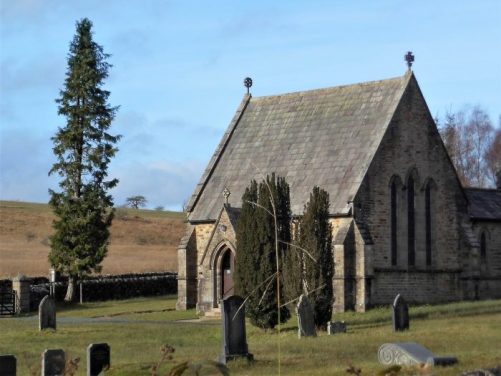
We strolled through Scorton with its iconic motorway spire. There once was a large cotton mill here, and we could see the line of the millrace now in a modern development. It was easier to walk along the road for a while rather than the soggy fields. I was then shown the lodges for the mill at Cleveley Bridge. We then followed the line of another mill race coming from the Wyre some distance away. Apparently in the early years of the C20 there used to be a series of commercial fisheries along here with water siphoned off the mill race. I had no idea where I was but soon we were climbing up to Shireshead, past the little chapel, now a recording studio, and along the lane for that cup of tea.


*****

ANOTHER SIDE TO STOCKS.

Thursday 12th November.  6.5 miles.  Slaidburn.

My vitamin D is topped up as I’ve been in sunshine most of the day, a bonus for November and I made sure I got away a little earlier so that I would finish before dark. During the current lockdown I have imposed upon myself a maximum distance of 15 miles [30 minutes] car travel for the purpose of subsequent exercise, I hope that is reasonable particularly into the sparsely populated countryside north and east of me. Today I travelled a shade over 13 miles to Slaidburn. I had been expecting to park outside the village because it has been so popular recently but on arrival the car park was virtually empty. I’d joined some of those red dashed lines on the map to give a circuit to the east of Stocks Reservoir I hadn’t walked before.

Yesterday was Armistice Day and the memorial was appropriately decorated.

From the old bridge over Croasdale Brook I headed out towards Hammerton Hall.

An incident happened here many years ago but is still fresh in my memory. Alan and I were returning from a circuit of Stocks Reservoir and chatting away, arrived at the ford leading straight to a farm in the village. Without consulting the map we just waded through maybe a foot of water knowing we had dry gear in the car. The farmer was leaning on his gate watching us but said nothing until we were well through. A voice then boomed out “you can’t come this way, it’s not the path. It’s on the other side”  Sure enough we should have stayed on the far bank down to the bridge. He showed no compassion so back we trudged through the river certain we could hear faint chuckling.

Over an even older and graceful Holmehead Bridge, past the falls on Barn Gill.

And there was Hammerton Hall on a prominent position above the River Hodder.  It is a large three-gabled Elizabeth house [1600] standing on the site of a 12th century house and incorporating parts of it. Its south facade gives a fine display of mullioned windows. Once the home of the  Hamerton family, a wealthy medieval family who are reputed to have been able to ride from Slaidburn to York (approx. 50 miles) on their own land!
Unfortunately, they lost most of their wealth and power when Sir Stephen de Hamerton joined Abbot Paslew of Whalley in the Pilgrimage of Grace of 1536. This was a protest against Henry VIII’s proposed dissolution of the monasteries. Sir Stephen was executed for treason in 1537.

My arrival at the next farm, Black House, coincided with a window cleaner, for some reason I found it incongruous that he would be out in such a remote spot. We exchanged pleasantries, he was from Colne and had a large rural area to cover. Farmers down country lanes are vulnerable to theft, and he has taken years to build up their confidence. He went on to talk about churches that he works on, for free, again I never really considered the cleaning of all that stained-glass. I walked on whistling George Formby’s favourite – ‘When I’m cleaning windows’

Along the elevated farm lane I had good views of Stocks Reservoir and Bowland Knotts behind although this wasn’t the purpose of the day.

At the end of the farm lane I came out onto tarmac opposite the small Dalehead Chapel. When the reservoir was constructed back in the 30s Stocks-in-Bowland village was engulfed, On the lake bed are remains of cottages, shops, an inn and a school but the church of St. James was dismantled and rebuilt here above the waters on the edge of Gisburn Forest. I sat on the church steps enjoying the sun.

It was easy to walk past my turn off into the forest, so I had to double back along the road to find it. I plunged into the woods for a short distance but then followed a farm track past a barn down to another isolated farm Brook House Green. The usual collection of huts and rubbish surrounded an interesting house with a date stone of 1761.


I always meant to put the engine back in…

I’ll gloss over the next half mile of pathless, reedy and boggy ground to arrive at Higher Stony Bank, another 17th century house. Along the road a man was exercising his large Irish Wolfhound on his own rough plantation. He, not the dog, was eager to chat about how he had bought the land and was planting it up with wild flowers and trees. “Best view in Bowland“…

Asking where I was from and where I was going he also said he had bought Pikefield Plantation, my next destination. This is a  group of trees on a prominent hill in the heart of this countryside. His parents ashes were up there and as his mother had been an archaeologist he had constructed a tumulus. What will future historians make of that? I often do wonder about people who leave litter in the countryside but this had me baffled…

The way back to Slaidburn was complicated through small fields with awkward stiles and poor waymarking. I battled on. Slaidburn remained hidden in the folds of the hills until the last moments.

How much can you get from a 6-mile walk?

*****

RADHOLME and BROWSHOLME.

Tuesday,  10th November.   6.5 miles.  Browsholme.

My road to Whitewell was closed, so I hurriedly chose another route. I was on the way to complete another interesting looking walk from my bumper book of Bowland Walks by Jack Keighley. I found a different parking spot on the circuit which also meant I avoided some unnecessary climbing in and out of Whitewell. There was no reason to include Whitewell as I’m already well acquainted with it. It was nearly 12noon when I set off across the fields where there are some limestone craglets  and an old limekiln. When my children were small we used to come here for a scramble about. The views of the Bowland hills are not so good today.

The first farm was Radholme Laund. I got chatting to the farmer in the yard, and he told me that at one time Matthew Brown breweries leased it and spread their brewing wastes on the land. Matthew Brown started in Preston in 1830 and moved to Blackburn in 1927. In 1984, they acquired Theakston but were eventually bought out in 1991 by Scottish and Newcastle. I well remember their Lyon Ales and many local pubs were tied to them. Radholme goes back to the Domesday Book and was originally a hunting lodge, Laund usually denotes a deer park.  A large area of Bowland was set aside for deer hunting until farming took over in the C16-17th. The present house was built in the C19th and has an impressive southern facade.

Boggy fields took me down past woods which had lost most of their leaves. Longridge Fell was always in the background. The cattle are now all in their winter quarters [the best place for them did I hear you say?] at Higher Lees Farm.  Then I was in and out of a stream before coming out onto the familiar road at Middle Lees. I crossed the course of the Roman Road and followed the farm lane to the cluster of houses at Lees House. I already knew the awkward path going steeply down to a hidden footbridge over Mill Brook and then steeply up the rough ground on the other side where I disturbed pheasants galore. Sheep pastures were climbed to the barking dogs of Micklehurst. I met the farmer who talked of  Covid-19 and the fate of local pubs. Most of these hill farmers must live an isolated life and yet are happy, nay keen to engage in topical conversations  I missed the path further on and ended up with more road walking than necessary. Until now the day had been bright but I seemed to enter low mist and drizzle and yet behind me Longridge Fell and the Ribble valley were in brightness.

I entered the drive of Browsholme Hall by its elaborate gatehouse but saw nothing of the Jacobean house still occupied by the Parker family who were the ancestral owners since 1507. Most of the land I’ve been walking on today at one time was part of their estate.  I’ve added a photo of the hall courtesy of visitlancashire.com As I made my way went up the fields Pendle came into view, I was heading towards the prominent Browsholme Spire. It is said that its castellated folly was built as a landmark for shooters on the nearby rough fells. It has been adorned with satellite communication dishes in recent years no doubt earning rent from telephone companies. A case of selling one’s soul. On a good day up here the Yorkshire fells are seen but today it was just the rather murky local Bowland Hills. At the bottom of the hill in the trees a sulphur spa is marked on the map, so I searched it out but was disappointed  to find only a boggy spring with the water only faintly tasting of sulphur.

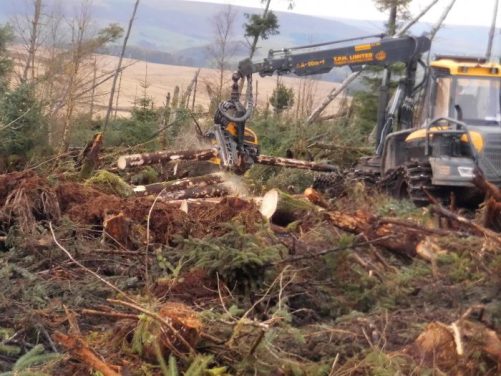
Crossing over that Roman Road once more I took the lane to Crimpton with its seven hand loom upper windows. After the reformation a wooden image of Our Lady Of White Well was brought to the isolated Crimpton for safety. Hence, the farm was well known to Roman Catholics as ‘Our Lady Of The Fells’. I found a seat for a snack looking out over Birkett Fell with Mellor Knoll and the Bowland Hills behind. I knew the next stretch through the forest was muddy and awkward but I couldn’t believe my eyes, most of the trees had been cut down and a machine was clearing up. The operator was able to grab a tree trunk in the machine’s claws, whizz it through stripping the branches and then cut it to length and place in a pile. Unbelievable – lift, strip, chop all in one go.

The day was getting on with all these distractions and I wanted to search out some caves in the limestone on the way back to my car. First was Hell Hole in a fenced off copse. There seemed to be two dangerous open deep shafts and a low cave entrance all connected to the same stream system.

Further on over more barbed wire was Whitewell Cave at the base of a rocky outcrop, a small stream disappeared underground leaving a dry cave entrance that would worth a crawl with a torch. There is another pothole down the road but that will have to wait for some other time.

By now it was almost dark, there was no sunset just a little light out to the coast, but I had only a short distance to go up the road.

Another shortish walk with plenty of new interest for me. I’ve just realised I never saw another walker – a perfect lockdown walk.


*****

WEATHER WINDOW ON A LONGRIDGE MISCELLANEA.

Sunday November 1st.  6.5miles.   Longridge.

Hurricane Zeta is chasing Storm Aiden across the British Isles this weekend. I get out this morning for a couple of hour’s exercise between the two.

My last post predicted or prayed for another lockdown, well Boris appeared on TV last night and announced one. I’m not getting into a debate about the why’s, when’s and how’s of our country’s attempt to deal with the virus. There will be plenty of time for that.

No, my walk today is probably going to be a regular one as we are told to stay home – but get exercise, no mention of distance travelled from home for said exercise, another fuzzy rule. So I walk from my doorstep. The diggers are having a Sunday rest on the latest building site coming to Longridge. Down past more new housing, then the cricket pitch and I’m in the countryside. Unusually ‘Mile Lane’ is empty of pedestrians, last lockdown it was busy most of the days with the good folk of Longridge taking their daily perambulation.

A delightful little lane along the track of the old quarry railway leads through bushes to the park. I have a painting of it on a sunny day by a local artist hanging upstairs.

The park is a magnet for dog walkers. There seems to have been an increase in canine ownership during the pandemic, unless I’m imagining it.

From Higher Road a track goes around the back of the old Quarryman’s Arms……and then through the quarries and down past the reservoirs, more new housing to the right, onto Lower Lane. Along here I spend time chatting, at a distance, to friends I haven’t seen for a while. I walk past one of my former homes, can’t believe it was so large. For the record…

Down by the church, a rather flooded Happy Alley, and round more reservoirs I come to Pinfold Lane. A pinfold was an enclosure for cattle or sheep that had strayed. The animals would be restrained in the pinfold until the owner redeemed them – normally by paying a small fine. Pinfolds were found in towns and villages from, at least, the Middle Ages onwards. I don’t know the site of this pinfold but it may have been at the end of the lane, here there is a benchmark and a substantial ancient cross base.

I stopped to put on my waterproofs as the first drops of rain were felt, but I was home before it became heavy. There was no temptation to save thousands buying a new house.

So in the coming lockdown weeks this little excursion, or variations on it, will probably be my go-to walk. Is ‘go-to’ an American expression? I don’t really like it and should have changed it to ‘regular’. I will no doubt come across other interesting Longridge titbits as time goes on.

*****

AN AFTERNOON AROUND BARNACRE.

Monday 26th Oct.  5.5miles.  Barnacre.

I was kicking myself by lunchtime today. The forecast was for rain but there was hardly any and now the sun was shining. Could easily have had a meet up with friends for a day’s walk. My new boots haven’t arrived yet, tomorrow?, so walking in trainers I need to stay on dry ground which is difficult around here at the moment. A cursory look at the map and I had inspiration for a quick afternoon’s outing on lanes around Barnacre, a rural area to the south and east of Garstang.

In less than half an hour’s drive I’m parked by another deserted looking pub, the Kenlis Arms.  originally  an 1856 hunting lodge,

The walk itself is on quiet lanes on the edge of the Bowland Hills passing a few farms and lots of sheep.

White sheep of the family.

My first real  objective is the Church of All Saints, yet another designed by Austin and Paley of Lancaster, 1905. Set in a peaceful woodland area its red roof stands out across the fields and its tower is castle-like. A lane takes me down to cross the motorway and main railway line.

Forge Lane passes the old forge where the family are splitting logs with a hired machine, looks great fun.

The lane continues down to a ford on the swollen Wyre but fortunately there is a nearby footbridge. This whole low-lying area is part of the local flood defences when water can be diverted into the fields to reduce the flow downstream. I walk through the Millennium Green past the hydraulic weirs for controlling the flow of the Wyre. It must be quite a sight to see the floodplain filling up. I’ve been this way before on The Wyre Way.

Millennium Green with a misty Nicky Nook in the background.

A diversion into Garstang’s High Street highlights several interesting buildings.

The old grammar school, C18th.

The old Town Hall. 1760.

I walk over the twin arched bridge on the Wyre and a little later drop down to the Lancaster Canal for about a mile of quiet towpath back to my car.

Garstang Castle.

A walk snatched from nothing and dry feet at the end of it.

*****


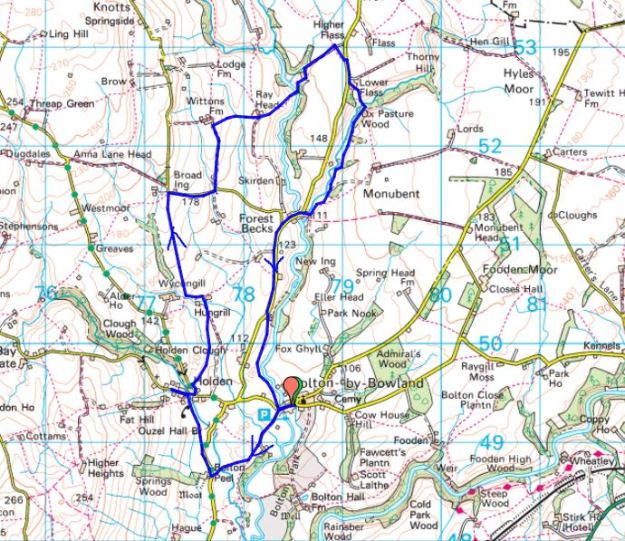
A BIT OF COUNTRYSIDE NORTH OF BOLTON BY BOWLAND.

I had to check the map this morning to ensure I wasn’t straying out of Lancashire on today’s walk, we are in Covid-19 Tier 3 after all. An extra mile and I would have been in Yorkshire but I don’t think anyone would have known.

Another route out of Jack Keighley’s Bowland walking guide taking me into the farmlands north of Bowland-by-Bowland. I have walked from B-by-B many times but this route promised some good riverside tracks unknown to me and probably unknown to any as I discovered.

After my recent rather long-winded posts I hope this will be more concise, it all depends on what I find.

There is a little car park in the village next to the bridge and surprisingly I was the first in this morning. I went south for a short while towards Sawley passing a sandstone cross base isolated in a field, I’m not far from Sawley Abbey. The last time I approached Bolton Peel from a different direction I had to ford the beck, so I was a little apprehensive of what I would face today after heavy rain. To my delight there was a footbridge alongside the ford, and I was soon up to the road at Bolton Peel. This is a sturdy C17th farmhouse with a preaching cross in front of it. From the original Peel family came Sir Robert Peel, he of police fame. There was nobody about this morning, so I had a sneaky peek into the adjacent barn with its cruck roof beams.

Now heading north I used a path by a lively beck into the little hamlet of Holden. There were some impressive waterfalls deep in the gorge. I have been visiting Holden Clough Nursery for years but now in younger hands it has become a thriving garden centre. Plants are still at the heart of the business, but they run a café and shop which I hoped would be open.  On with my mask and through the gift shop, I got their first brew of the day. The first time I’ve been in a café for 7 months – maybe the last.

Across the road is the exquisite Broxup House.

I knew the next stretch from a previous walk. It starts through the narrowest of gaps.  I was soon passing the C17th Hungril Farm and its posh barn conversion neighbour.

The next farm along was equally expensively renovated and yet round the back was the ubiquitous rubbish ‘waiting for Godot’

Muddy fields took me higher to the road at Broad Ing. Up here was expansive rolling farming lands with views to Pendle [in cloud] and Weets Hill. My heading photo depicts the scene and if you click to enlarge and look closely flocks of Lapwings or Redwings, perhaps both, can be made out above the trees. They were a common sight today.

Climbing higher I arrived in the farmyard of Wittons where a few waymarks wouldn’t have gone amiss. I blundered on into the next valley where some delicate barbed wire climbing was needed on the steep pull up to an old barn. Round the corner was an arrow pointing down a better route, one at the bottom pointing up would have been useful.

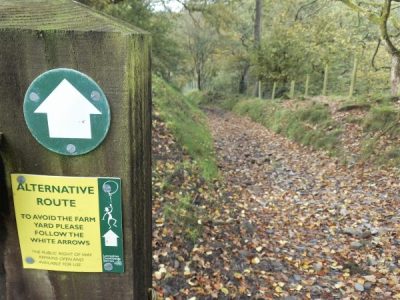
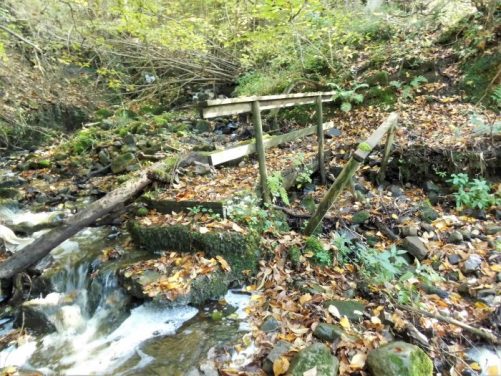
From Lower Flass my guide [admittedly 25years old] describes a permissive path alongside Monubent Beck, just follow the ‘white arrows’. A Right of Way took me down to a footbridge and it then climbed the hillside away from the beck. The permissive path was nowhere to be seen, so I just set off close to the water imagining I was on a track. A stile appeared and the odd footbridge but in between was jungle. It was obvious that nobody comes this way any more, there were certainly no white arrows. I was more concerned I might get shot if there was a pheasant shoot on. A bonus was that I glimpsed several roe deer running off through the trees. Every time I came to a stile I was emboldened to go further.

Eventually after this interesting trespassing section I came out the far end onto a road which I recognised from our cut through way to Settle and the limestone crags. By the bridge the Monubent Beck joined into Skirden Beck. This group of houses around the bridge is called Forest Becks and on foot I was able to see them better than when driving through. A lot of them have had recent facelifts.

A little further on the road I also Had a closer look at Stoop Lane house, 1703.

A familiar path above Skirden Beck led me straight back to my car at the bridge. I didn’t explore the village of B-by-B as I have covered it in a previous post.

*****

AMBLING AROUND ABBEYSTEAD.

*****

http://www.map-of-uk.co.uk/maps/map-of-lancashire.gif

The green area on the above map is the County of Lancashire which as you may well know has, as of this last weekend, gone into the highest Covid-19 restrictions – Tier 3.  So my wanderings in the foreseeable future will be solely in the Red Rose County. There are far worse places to be. As it happens I was already planning to visit Abbeystead today for a walk plucked out of Jack Keighley’s  Cicerone ‘Walks in the Forest of Bowland’  guide which seemed to have several points of interest. I’ve been following quite a few from this guide in the last weeks and have been impressed by their quality. The forecast is for cloud so a low level walk suits.

*****

I arrived at the carpark at 12noon to find it full, I’d half expected that. Fortunately a couple of early birds were just finishing their walk so I grabbed their spot. The River Wyre has two initial tributaries, The Marshaw and The Tarnbrook. I started my walk alongside the latter and soon came to the former. My curiosity had me bashing through the undergrowth to find the confluence of the two – a Dr. Livingstone experience. The two small streams meet and soon the River Wyre takes on a more majestic flow. Satisfied I go back to where I had started, it’s going to one of those days.

Marshaw Wyre bridge.

Meeting of the Waters

The Wyre flows on.

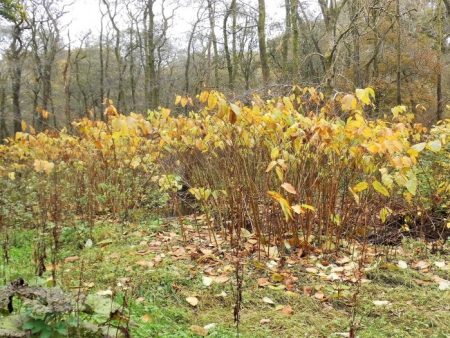
I took some photos of these large plants growing profusely along the banks – I don’t know their name? I thought the leaves were too large for Japanese Knot weed but I’m not so sure now.

My path left the Wyre Way and shot up some steep stone steps which kept on going. Eventually fields followed to come out onto the road at Hawthornthwaite with the fell road heading across to the Trough of Bowland just above me. All around were the Bowland Fells looking a bit dismal today.

The mole catcher has been working overtime.

A farm track took me past Marl House and then into open fields with no obvious track. For this walk the guide states “A somewhat complex route requiring careful reference to map and directions”  Well I was soon searching for the next stile and essential footbridge across a formidable little gorge, Cam Brook. Walking up and down my GPS didn’t seem to be helping. I persisted with my search and finally found a new looking bridge across but not where shown on my map. Anyhow, I was across and climbing fairly new steps but at the top where I should have gone right to an old mill a new pheasant fencing blocked my way and shepherding me upwards. I tried an open space in a hollow but at its end a high gate. I could see no path continuing, so I decided to head for a barn shown on the map and follow the track from there.   As I walked on I spotted three walkers coming the other way towards where I should have been. After pleasantries with them, I set forth or was that back, determined to find the mill ruins. After a couple of stiles I came across them in the woods, sad reminders of a bygone time. It had been a water driven cotton spinning mill until destroyed by fire in 1848. Associated workers’ cottages were disappearing nearby. That hollow I had been walking in half an hour ago was in fact the old empty mill pond.

Satisfied I returned to pass again the cheerful three sat on a log having lunch.

Last of the summer wine.

Now I knew where I was going – Little Catshaw 1763 and Catshaw Hall 1678. I passed through here before with Sir Hugh on our straight line walk from Longridge to Arnside in November 2018.

Little Catshaw.

Catshaw Hall.

The steep track led down over a sparkling side stream and to the Wyre in its heavily wooded valley. A sturdy bridge was crossed before stone steps went straight up the opposite hill to Lentworth Hall. These tracks must be centuries old linking farms and maybe going to the church where I was heading.

More stone steps.

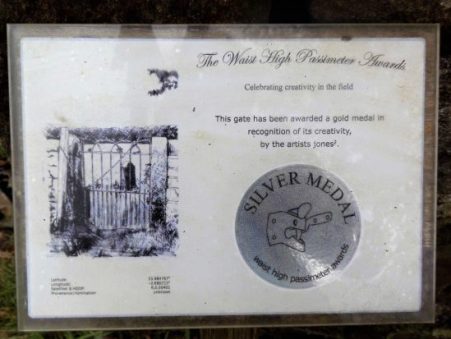
A gate at the top of a field, suitably full of sheep, admitted me into the churchyard of Christ Church, The Shepherds’ Church.  [The gate has its own story which I thought was a joke at first] The church dates back to the C14th but was rebuilt in 1733 and a spire added to its tower later.  Its stained-glass windows depict Biblical shepherd scenes, these would have been better appreciated from the interior but it was locked. In the porch are rows of hooks supposedly for visiting shepherds to hang their crooks. Above the door is an old inscription –  ‘O ye shepherds hear the word of the Lord

I found a bench to sit on for lunch, it was 2.30 after all.  Next to me was a war memorial with a thought-provoking inscription perhaps aimed at the agricultural soldier.

My next objective was a Friends Meeting House and Quaker burial ground up the hill at Brook House. As well as the meeting house there had been a school and schoolmasters house in this little complex of buildings, now residential conversions. The graveyard with its simple uniform headstones was accessible and was a very calming place. Apparently the Friends Meeting House In Lancaster has use of it but there didn’t appear to be many recent burials.

I was now quite high on the northern flanks of the Wyre Valley but views were limited by the weather. More fields took me past Chapel House Farm with its barking dogs and over a rickety stile to the road at Summers House.

Then a walk across rough country in worsening light to Grizedale Bridge over the Tarnbrook Wyre. A cart track was followed back to Stoops Bridge.

Grizedale Bridge.

Stoops Bridge.

Before I got my car I had a wander into Abbeystead  itself. All the C19th buildings are now part of the Duke of Westminster’s vast estate and built in an Elizabethan style. The big house is hidden from view. The hamlet is named after an Abbey founded here in the C12th by Cistercian monks from Furness. It didn’t last long and was soon abandoned.

All I needed was a bit of sunshine to bring out the Autumn colours.

For a walk visiting the reservoir and dam itself have a look here..

*****

THE CROOK OF LUNE.

Crook of Lune, looking towards Hornby Castle

Crook of Lune, looking towards Hornby Castle.     JMWTurner.  1816-18.        Courtauld Inst.

*****

The Crook of Lune – no this is not a historical crime story.

It is a bend in the river,  a visual station of the C19th artistic elite,  a rather whimsical painting by the celebrated J M W Turner and a popular visitor destination with a nearby carpark and picnic places.

It is a special place I’ve never really been to. I’ve walked past on several longer routes using the abandoned railway but without realising the significance and beauty of the place. Today I intended to do it justice.

Continuing this morning’s walk instead of returning to the car I pick up a path going down through the woods to follow the north bank of the Lune towards Halton. There is a large weir and on this bank is a small turbine house delivering community hydroelectric power. A digital screen gives a potted history of the area and the development of this new way of harnessing the Lune’s power. At times that can be overpowering and not long after it was operative the whole site was severely flooded, fortunately with no serious damage to the turbines. Incorporated into the building is a fish ladder with an automatic counting sensor. There are no signs today of the salmon for which the Lune is famous but this would be a good place to watch them swimming up water in the next few weeks. There is a long history of mills and forges on this site and there are still signs of early weirs and wharfs.http://www.ministry-of-information.co.uk/blog1/0602/images/180206-05.jpg

http://haltonlunehydro.org/wp-content/uploads/2013/08/halton-1936.jpg

The mills developed further in the C19th, stretching down the Lune to Halton, but were eventually demolished in the 60s. Only one remained and has been developed as a community space.  https://haltonmill.org.uk/about-the-mill/industrial-history/https://haltonmill.org.uk/wp-content/uploads/2013/03/mill-building-exterior.jpg

Alongside on the site is a section of interesting looking community housing.  https://cohousing.org.uk/case-study/lancaster-cohousing/ – worth a read.

A stretch of modern housing units is walked through before I reach the old bridge taking me back across the Lune. This bridge has an unusual history…

This brings me out on the line of the track of the Lancaster – Wennington railway, closed in 1966,  at the renovated Halton Station platform. I join the cyclists and walkers heading back up the Lune. It was from the undergrowth near here that Sir Hugh and I emerged one day on our straight line route having traversed the private Quernmore Estate. Today it would have been easy today to miss the footpath leaving the railway to follow the bank of the Lune. Across the way I could see where I had been not long ago. Then my riverside path took me onto new ground as I started looping the Lune. I passed under the first railway viaduct and a  great stretch of river followed before I started going around the Crook itself. Simply stunning. Apparently the view Turner painted was from further up the hill behind me.

I sat for a while in the memorial park watching the river flow by. And then I walked around the loop to the road bridge. This bridge, with its decorative balustrades, was designed by Paley, 1883, who normally did churches. I didn’t cross it but continued to the easterly railway bridge, identical to the westerly,  where I picked up the cycleway to cross back to the carpark.

From the bridge I get a last view back up the Lune satisfied with today’s walk completing the loop around the ‘Crook’

*****


THE LUNE AT AUGHTON.

This was the first half of a walk from the Crook Of Lune Car park. There was so much of interest that I’m posting in two halves.

Feeling generous, I paid a pound to park all day at ‘The Crook of Lune Car Park and Picnic Site’.

I’ve a walk planned up the Lune to Aughton and then back on higher ground. I have to give Sir Hugh credit for suggesting this route and I’m doing it while he is ‘hors de combat’.

The Autumnal mist is just lifting from the valley as I set off through green fields. A couple of dog walkers have beaten me to it. The river flows gently beside me,

I pass a weir and in some places there is a rushing of water round eddy pools.

Ahead is the bridge carrying the Thirlmere Aqueduct in giant pipes on its way to Manchester, unusually for waterboard bridges it also provides a foot crossing. Next I’m in an ancient forest; oaks, beeches, birches and ash. It once provided charcoal for iron smelting but is now a nature reserve managed by the Lancashire Wildlife Trust. The path does a roller coaster through the trees before depositing me on a green beach. There is a gulch ahead which I don’t fancy jumping. Sir Hugh had already said the large loop of the Lune here was boring, so I decide to go straight across the neck of the isthmus. That works OK although I don’t see much more of the river. Ingleborough is just coming out of the mist. Across the Lune is smoke from the Claughton brick factory  which I wrote about a few  weeks ago. As I’m keeping fairly local my walks all seem to be linking up with each other. I’m soon at the large agricultural barn marked on the map. More interesting is the cottage being upgraded a little further on before the steep hill up into Aughton. It  is  steep and brings me out at a miniature village green with a few cottages. The next steep stretch brings me to the higher part of the village where I go in search of the church marked on the map with the old school house next door. A bench in the sun is perfect for lunch. Walking up the minor lanes is a joy with Ingleborough behind, distant Lakes across the bay and closer at hand across the Lune are Caton Moor wind turbines with the Bowland Hills behind. I seem to be on a cycle route judging from the number of cyclists passing by, all with a cheery wave. A local dog walker passes the time of day and explains the different pronunciations of Aughton – orton. ayton, eighton. Take your choice.

The lane steepens heading back down towards the Lune. A herd of sheep are being brought up the road by sheep dogs, as soon as their job is done they can’t wait to jump on the back of the quad bike. The large house at Halton Park was a surprise. From here I can see the C18th cotton mill at Caton, originally powered by the Lune and later steam driven, now converted for residential use. The bridges on the Lune where my car is parked show up well, the surrounding trees taking on Autumn colours. Part two to follow.

*****

NEWTON AND SLAIDBURN.

                                                     The Hodder between Newton and Slaidburn.

A short walk was all I needed today.

I’m always driving through these two villages, so I thought it was time to visit in more detail. During this Covid-19 pandemic everyone seems to be out and about. All the car-parks are overflowing and the honey spots overwhelmed, I’ve usually kept well clear but today I had to park up in Newton. Mea culpa.  I found a safe spot outside the village but noticed some thoughtless blocking of farmers’ gates etc.

I first wandered around the olde worlde hamlet of Newton – in – Bowland.

Georgian Newton Hall.

Salisbury Hall.

John Brabbins Old School. 1757.

Old school 1842.

Old reading room. Late C18th.

United Reformed Church. 1887.


Then I was ready to start the riverside walk to Slaidburn. The River Hodder.

Ahead was the limestone bluff above Dunhow Hall.

There are cliff faces up there in the trees and I had time to climb up and explore. On closer acquaintance the rock was overhanging and compact, not much scope for my style of climbing, i.e.  too hard. Whilst I was up here I explored further and came out into meadows on top of the hill with good views towards Slaidburn. I wandered down to re-join the path near the gatehouse and then walked into Slaidburn on a short stretch of busy road. The 15th century St. Andrew’s Church turned out to be open, I had never visited it but read of rich internal features. Most of the interior was taped off, so I only had a glimpse of the elaborate screen, Norman font, box pews and pulpit. Outside there was a sundial from 1796 and a shaft of a Medieval Cross.

Next door was the Old Grammar School founded in 1717 and still in use as a village school.

Rows of 16/17 C cottages lead into the village and there in front of you is The Hark to Bounty pub.

The inn’s name is from the sound of the C19th Squire’s dog, Bounty.

At the top of the steps was the old courtroom of the district. On the outside of the iron rail the lower steps  were used for horse mounting.

The war memorial is on an island and an old Wesleyan Chapel has been restored.

Chapel Street.

The café on the village green was doing a roaring trade from passing travellers. Some impressive motorbikes were on display.

Leaving the hubbub I climbed away from the bridge and crossed into fields heading over into the Easington valley I’d been in a few days ago. The weather conditions today were much pleasanter with clear views of Easington Fell.

At Broadhead Farm I chatted to the farmer as he selected lambs to go to auction.

Following Easington Brook…… I came to the impressive Easington Manor House once again. Easington hamlet was as quiet as normal. Onwards through fields by Easington Brook to join the Hodder and a path back to the elegant Newton Bridge. And that was just a short walk.

*****

EASINGTON AND HARROP.

                                                                             Misty Easington Fell.

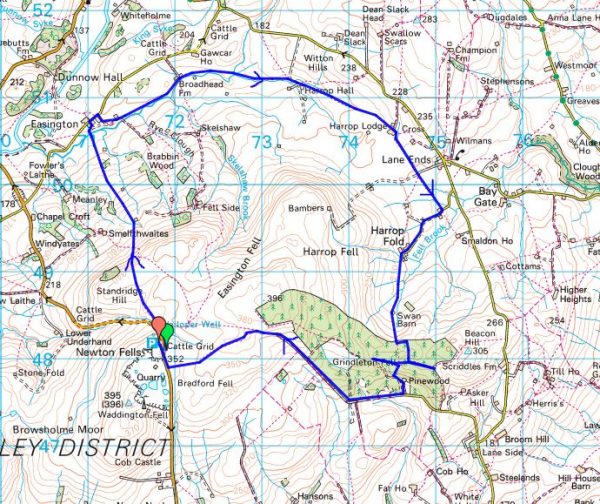
Two places hidden away in Bowland. I’ve driven through Easington but don’t remember end of the road Harrop Fold.

I planned to include Easington Fell into the round so I parked up at the top of the Waddington Fell road. I was the only car there on a misty morning and I hoped visibility would improve – it didn’t.

By the road side up here is Walloper Well.    Jessica Lofthouse (1976) described the place.

In the days of horse and pedestrian traffic none passed Walloper Well without stopping  to ‘quaff the clear crystal.’  Long ago, hill men, hunters, forest wardens and farmers off to Clitheroe markets and fairs, pedlars, lead miners from the nearby workings, all met here.  The name is thought-provoking. Why Walloper? From a word meaning a ‘fresh bubbling spring’, which this is, fresh from the moorside into stone troughs.  Age, wartime army practice and vandalism of 1974 made renewal of the trough necessary, but the flow has been constant.  One must drink, just as one throws pennies into the Roman fountain, to ensure one comes back again.”

So nothing to do with the frequently told story [very nonPC]  about the old man and his wife

Today there is no flowing water, I don’t know if this is the permanent situation.

After that disappointment I set off across the fell and immediately lost the path, if there ever was one. The ground was rough, what I call reedy walking, and you never knew if your feet would hit land or water.

Haircap Moss.

Persistence paid off and I spotted a cairn from where vague trods aimed to the barn shown on the map. From the hillside I could just make out Newton-in-Bowland, Easington and Dunnow Hall.

I was now on pleasant grasslands though this meant a herd of cows with accompanying bull. I was rather circumspect as was he. A teacher has just been killed near Richmond by cows.

Anyhow I arrived in to Easington unscathed and had time to look at the four dwellings making up the hamlet. The most interesting appeared to be the Manor House.

The Manor House.

I now followed the diminutive Easington Brook for a mile or so passing Broadhead Farm to Harrop Hall. On my approach to the latter the farmer shooed his herd of cows plus a large bull across the field for me to pass, a service I don’t normally receive. I realised at the remote Hall that I had visited before with a friend from Grindleton maybe 40 years ago to collect two kittens, Bonnie and Barnie I subsequently christened them. They were an adventurous pair climbing in through upper windows of my house and even venturing to the pub on the corner where customers fed them and returned them at closing time.

Harrop Hall.

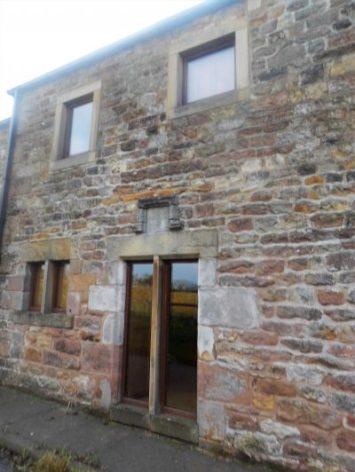
Harrop Lodge was next, another building with interesting features including a Venetian window in the gable end and other bits of architecture.

Barn window.

Wall niche.

This stone footbridge took me into the wrong field from which it was difficult to extricate myself.At Harrop Gate I came out onto a little road through an isolated metal kissing gate.

200 yards up this road was Harrop Chapel with benches outside for my lunch stop. The chapel was built in the early 1820’s and has been in continual use since. It ceased to be Methodist in 1969 and now holds Evangelical services.

Refreshed I strolled up the road to the hamlet of Harrop Fold, only half a dozen neat dwellings. Of particular note is a large white house , an original C17th Lancashire Longhouse which provided accommodation for the family at one end and the livestock at the other. On the other side is the Manor House of a similar age.

So far the walking had been very rural but now I headed back up the fell past a barn and into Grindleton Fell Forest where my troubles started. The paths didn’t go where I thought they should and didn’t correspond to my map.  The trees limited visibility and the mist descended. I walked in many directions without finding my intended onward route. I was glad to hit upon a track heading out of the forest to join a lane prominent on the map. It was now easy to follow across the fell until I came out onto open moor once more. Up here the views back down to the Ribble Valley must be stunning on a clear day. Ahead of me was the vague outline of Waddington Fell with its mast acting as a beacon to aim for. By now it was cold and damp and I was glad to reach my car. I’d clocked up 10 miles.

Not many of you will have explored Harrop – ‘the valley of the hare’

*****

CLAUGHTON BRICKS, CATON FELL, THE PLAGUE AND THE LUNE.

I have lost my camera with this day’s photos on. When I say lost I mean I can’t find it but I’m certain it’s in the car or the house. After much searching it still hasn’t turned up. My mind’s not focused as it is the funeral of my best friend.

Yes, it has turned up under the carseat!

The day itself, a week ago, was brilliant.

As you drive through Claughton on the Kirkby Lonsdale road an aerial ropeway crosses above you carrying clay in buckets down from high on Caton Fell to the brickworks by the road. I’ve always been curious as to what’s at the top of the ropeway. The other end of the rainbow. Today I intended to find out and dragged Sir Hugh along for company.

We parked at The Fenwick Arms, sadly closed as a result of lockdown and other financial pressures. One of the many casualties.

A steady 1000 ft. ascent on a previously cobbled track with not much to see, Claughton Hall was hidden behind trees and Claughton Beck could be heard but not seen. Near the top we walked under the upper part of the ropeway. The buckets were trundling up and down by gravity feed. Constructed in 1924, this is the last gravity feed aerial ropeway operating in Britain. We crept into the upper quarry to see where the buckets were coming from – the answer was a shed where presumably the shale and  clay was loaded. There was a large quarry behind. We need not have trespassed as there are plenty of YouTube videos.

We came out onto the open moor near the wind farm and past the restored Moorcock Hall – certainly one of the remotest houses in Lancashire with a splendid view over Morecambe Bay.

A diversion was suggested to the trig point, 361m, of Caton Moor. We had walked past here on The Witches Way in 2016 without visiting the top. It was fairly barren up here but there were good views over the northern Bowland fells with the shapely ‘peak’ of Mallowdale Pike catching our eye, one for another day?  Ingleborough of cause made an appearance.

On the way back Sir Hugh spotted a couple of workers on one of the wind-turbine blades, I think I would have walked past without noticing. They must have abseiled down for some repair work which looked perilous from below.

I tried an arty shot with the juxtaposition of wind power against nuclear, Morecambe Power Station in the blurry background.

After the excitement we found a picnic bench for a civilised lunch stop. Two ladies on an adjoining bench were having a conversation where they both spoke at the same time.

The tarmacked lane down to Brookhouse went on for ages in the ever increasing heat of the sun.

Brookhouse is a charming olde worlde village which modern times and the main road have passed by. We were glad of a sit-down in the church yard where fresh cool water was found. St. Paul’s church dates from the !6thC. Built into the West wall is a Norman Arched doorway. Set into it are stones from former buildings, various Medieval marked stones. Rather a shambles really.

Whilst in the pretty village we had time to find the Plague Stone. Set into the parapet of the bridge next to the pub is a large stone with a hollowed-out top. In Medieval times plague epidemics killed thousands of people up to the late C17th. Victims socially distanced themselves outside towns but collected food from the stone. It is thought that the depression in the stone was filled with vinegar to act as a sanitiser for the coins left in payment. Does this all sound familiar in the twenty-first century?

A field path took us to the busy A683 which we crossed to get onto the disused railway line [Lancaster to KIrkby Lonsdale] this provides a cycle way out of Lancaster city centre but sadly comes to an end near here as far as public access is concerned. The River Lune curves elegantly through the fields and despite its attractiveness there is little in the way of a marked path. A lady was swimming in one of the pools; it looked very inviting in the hot sunshine. Ahead was Ingleborough with Hornby Castle prominent upstream. Fields separated us from the brickworks with the windmills visible on the moor above.

Heading back into Claughton we crossed the site of the old railway line at Gatekeepers Cottage. There was no sign of life at The Fenwick Arms.

On the drive home I stopped to take a photo of the aerial ropeway and its yellow buckets crossing the road, I now know where they come from.


*****

LONGRIDGE SLATE POETRY – Dark clouds gathering?

On many of my local walks up on Longridge Fell since the pandemic started I highlighted the uplifting poems written on slate and scattered about the region. I still do not know the originator of these pieces of art. Each one has been chosen for its content – nature and the environment; humanity, compassion and hope.

Today I have a stroll around the village itself to discover even more poems.

When I wrote about Longridge in March it was virtually a ghost town, but time has moved on, we have relaxed and ventured out shopping again. The coffee shops have a new lease of life. Today in the blue sky and sunshine the streets were busy, but with many people wearing their masks between shops. A new normal as the infection rate rises?  The virus’s hand is on our shoulder warning us of a bleak Winter to come. In that context the poems take on a life of their own – interpret them as you wish, but we should embrace  their optimism.

The latest slates in no particular order…

There may be more painted slates lying unnoticed in the village, I’ll keep looking. I think we may need their solace in the months to come.

On my walk I had a song constantly nagging at my mind …

ANOUSHKA SHANKAR.

Following on from a post by Sir Hugh [ http://conradwalks.blogspot.com/2020/08/the-first-night-of-proms.html ]  this is why I pay my TV license. 

I’ve just watched/listened to a brilliant display of sitar playing by Anoushka Shankar, daughter of the legendary Ravi Shankar on BBC Four, part of their Proms season. There was no audience this year because of  Covid 19.

The first session was with an electronic mixer Gold Panda twiddling the nobs. Mind blowing, you just have to listen to it.

The second session was with a strings orchestra and Manu Delago playing the Hang drum, which looks like a wok. Inspirational.

I hope it will be still visible on catch up TV  – if you have paid your license.

https://www.bbc.co.uk/events/erfz3d

https://www.bbc.co.uk/iplayer/episode/m000m7gz/bbc-proms-2020-anoushka-shankar-and-gold-panda


THE OTHER END OF THE FELL.

                               Longridge Fell from the south, Kemple End is the steep bit at the right.

The fell in question is Longridge Fell, may I remind you it is the most southerly named ‘fell’. It rises to all of 350m and is a 6 miles long escarpment with a steep northern side and a gentler southern slope. The town of Longridge sits at its western end. My recent, infrequent, walks have been at the western end so today I explore the eastern end above Hurst Green where it drops steeply to the River Hodder. I have a particular path I want to explore.

I start in Hurst Green near the Shireburn Almshouses, they were first built in a commanding position on Longridge Fell itself in 1906 but were moved and rebuilt in Hurst Green in 1946 for Stonyhurst College workers.

Hurst Green Almshouses.

I set off on one of my favourite paths that goes alongside Dean Brook which has found its way down from the fell and here is in a little gorge where it was harnessed to provide bobbin mills with power. Today, after last night’s rain it was flowing energetically through its twists and turns. Alongside is Sand Rock an old quarry which I diverted to see. I have climbed here in the past but it tends to be damp and green. There is a good view of the bridge from up here.

The lane leads on past Greengore … … an old hunting lodge, and heads gently up towards Longridge Fell which on this slope is covered extensively with forestation. At the road I go left to pick up the forest track going higher onto the fell. It was near here that a fire broke out recently due to those dangerous disposable barbeques and their idiotic owners.

A sidetrack leads up onto the ridge where you pass through a wall stile to sudden extensive views; Chipping Vale to the Bowland Fells, Beacon Fell and the Fylde coast leading to Morecambe Bay and distant Black Coombe. A short boggy walk by the wall brings you to the summit Trig point, Spire Hill. There are usually a few people wandering around up here. Now out northeast are the three Yorkshire Peaks.

Heading eastwards I soon enter the dark forests where paths remain wet throughout the year. Further, on Hare Hill, is an area of older Scots pines I call the enchanted forest, where paths seem to disappear amongst the shapely trees draped in moss. I’ve bivied up in this spot several times, magic evenings with owls hooting and deer wandering by.

I emerge onto a forest track which leads to an open area with views this time into the heart of the Trough of Bowland whilst way down below are scattered farmsteads. There are some logs to rest awhile.

In the sunshine butterflies, mainly Red Admirals, flit about the purple heather which is just coming to its prime.

Onwards is a much smaller path in the trees on the edge of the steep northern scarp, the land just drops away from you. When I first explored these forests 50 years ago there were no paths at all, but over time this one has become established and now appears as a dotted line on the 1:25,000. In recent years with the advent of mountain bikes, a lot of tracks have become badly eroded – my feet are certainly wet by now.

As this narrow track, now hemmed in by young spruce trees, starts to drop down the fell end I’m on the lookout for that public footpath I want to explore. It drops down back NWesterly on an old rake. At one time this was through mature trees but these were felled a few years ago, I’ve not used it since. There is little sign of it amongst the new growth and I have to take a GPS reading to determine where it starts, there are vague traces of it so I build a stone cairn to mark the spot.

SD687408

As I go downhill the now reedy rake becomes more discernable but difficult to walk on. It needs more traffic but most don’t know of its existence so I’ll report it in the hope of some maintenance by the forestry people, they should have reinstated it soon after their felling operations.

Coming down to the forest edge a stile allows me to walk along an old sunken, and boggy, track. There is a bench here remembering a Liverpool hiker. I stop for a snack looking out over the peaceful Chaigley countryside with old friends Waddington Fell and Pendle in the haze. I imagine how the man must have enjoyed his trips to this part of the country escaping the urbanity of his home city.

Sir Hugh will be pleased to read that my next destination after Turner Fold was Kemple End. Here I wander past the cottages to reach a path going down the fell. This path follows the line of an old sledge way used for taking stone down from the quarries here to Hurst Green for the construction of the Shireburn family’s great hall which became Stonyhurst College. On a whim I decide to take an unknown, to me, footpath leading more directly down the fields. I come out by a delightful farmhouse, Throstle Nest, tucked away from society. The owner is strimming his verges, I stop for a chat and to compliment him on his residence. I’m the first person he’s seen on the path for months. He laughs that last weekend he travelled to the Dales to climb Great Whernside but the car parks were packed and the Covid hordes all over the hills. He won’t be leaving his Lancashire haven again during the viral pandemic. Of course, we then get to pontificating on when and how it will end so I forget to take a picture of his house but his view is good.

The public footpath goes through an unusual squeeze wall and straight across the front of the Stonyhurst College giving up-close views of the architecture and a vista of the ponds and straight drive in the reverse direction.

By the church which is unfortunately closed, I have my next ‘virus’ conversation with a mother and daughter. The daughter is reading philosophy and French at Oxford and is due to start her year abroad in Nantes. The uncertainty of the pandemic is giving her a few extra worries.As there was nobody around I took the opportunity to have a look at the old mill restoration. It dates back to 1840 when it was powered by water from the ponds for flour milling. Later in the C19th a steam engine was installed. Last time I passed it was falling into disrepair but has since been fully restored to function as a retreat centre. Apparently there are remains of a fives court which I missed.

The field paths back to Hurst Green are busy as I’m now on part of the Tolkien Trail. It is conveniently thought that J R R Tolkien, whilst staying at the college where his son was a pupil, may have used the local countryside as inspiration for his popular Lord of the Rings. You enter into the village past some pretty cottages,

I have enjoyed this splendid outing showing some of the best scenery in this part of Lancashire and have gone into more detail than usual in the hope that some of you will be tempted to visit but maybe keeping to the well worn tracks.

Another version of this walk in reverse and including a bit of the Hodder is here.

*****


THE RIBBLE BETWEEN MITTON AND CLITHEROE.

The clock on the tower of Mitton Church says 4.30. I’m glad I’ve delayed my departure until the sun has come out leaving a beautiful evening for my walk.

I’ve walked the East bank of the Ribble up to Clitheroe several times, it is on the Ribble Way.  I’ve often contemplated walking back down the other side. The problem was there didn’t appear to be a public footpath going south from Edisford Bridge which would mean walking some distance on a busy road.  A closer look at the 1:25,000, however, showed a black dotted field path on that section so maybe there was a way. Time to find out.

Mitton is a rather amorphous district of scattered farms and houses, Great and Little Mitton are separated by the Ribble just north of where the Hodder joins.  Mythe in Old English means the joining of two rivers. The Shireburn family of Stonyhurst were the principal lords.

 All Hallows Church where I parked is in Great Mitton and has C13th origins with a C15th tower. Today it was closed [Covid precautions] so I was unable to visit the interior famous for its Shireburn tombs and wooden artefacts from nearby monasteries. So instead I wandered around the graveyard coming across the sundial dated 1683 and an unusual cross with an ancient C14th rounded head featuring crucifixion carvings. From the graveyard is a lovely view down to the Ribble with proud Pendle Hill in the background.


Neighbouring the church is C16th Great Mitton Hall now smartly renovated with classy gardens visible over the wall. This is not to be confused with Mitton Hall, now a wedding venue, down the road in Little Mitton. The Three Fishes pub opposite the church has been closed for some time now.

I crossed over the Ribble on Mitton Bridge, another classic view of river and hill in heading photo, to reach the temporarily closed Aspinall Arms. This was once a coaching inn known as the Mitton Boat. A ferry boat operated across the River Ribble before the present road bridge was built in the C19th. This was the border between Lancashire and Yorkshire before the reorganisation.

A signed path goes down the side of the inn into fields alongside the River Ribble. There is quite a high banking along here and sand martins were in evidence swooping low over the water ‘chattering’ as they fly past. After a short way, a rather elegant aqueduct crosses the river, the pipes carrying water from Haweswater in the Lakes to Manchester.

A farm road is reached and followed almost to Clitheroe. Taking this photo I managed to get an electric shock from the unseen live wire I was bending over! A calf was brand new in a field and there were new countryside signs on display.

A riverside path continues to Edisford Bridge. It was along here the last time I passed that I had a wonderful view of a Kingfisher. No such luck today as the river is running very fast from all the rain we have endured. The campsite hidden in the trees was packed with people taking advantage of the easing of coronavirus lockdown.

I sat by Edisford Bridge for a drink taking in the scenery. This is a place where there was a ford before the present bridge was constructed, although it goes back to Medieval times. I crossed the bridge and found there was the start of a path going downstream although it wasn’t signed. A muddy section led to a gate into woods, this was now designated a concessionary path so I was confident of a way back.

A long bend of the river was closely followed at the edge of a large meadow. This side of the river was much quieter. A couple of girls were frying some sausages up for a picnic supper in the warm evening sunshine. I met another couple walk in the other way and they assured me of a route back to Mitton. The sand martins were again plentiful. At one point I disturbed a family of mallards which took to the fast-flowing water, I was concerned for the ducklings that seemed to be swept away but they ended up in a calm stretch by the other bank.

Steps led away from the river and a field was crossed signed by large yellow dots. A strange seat carved from a trunk with a couple of Bears was not that comfortable. This brought me onto the Public Footpath having avoided any road walking. Now that was what I would call a sensible concessionary path serving a good purpose and well used.

Stiles led through the lush fields. Looking back there were fine views of Waddington and Newton Fells, all familiar ground. Eventually, a narrow enclosed path brought me out onto the road less than 100 yards from the church.

A very satisfying walk of about 4.5 miles, one I will repeat. Beautiful English countryside and curiosity satisfied.

The clock now read 6.30.

*****

THE BLEASDALE CIRCLE AGAIN.

Bleasdale Circle with Fairsnape and Parlick looming above.

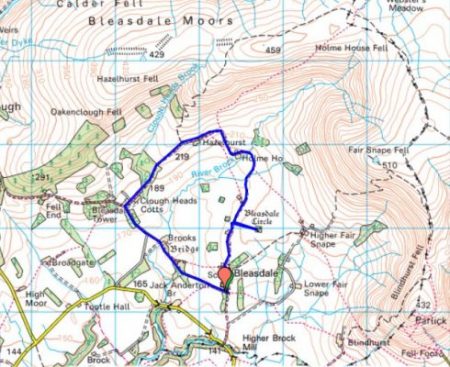
Another of my winter favourites. This circuit is mainly on lanes and good tracks but takes one right into the hills. I’ve written about it many times but today I have come across some interesting new facts.

For a start, Bleasdale School dating from 1850 where I park is now closed. It soldiered on since the Millenium with about a dozen pupils from the surrounding farms but when the number dropped to two or three its fate was inevitable.

Up the lane, the Parish Hall is heated using a wood pellet boiler with a wind turbine to generate electricity, forward-thinking for a small community. Further on is the uniquely named St. Eadmer Church.

The lane then heads into the hills past a few farms. A footpath diverts to visit Bronze Age Bleasdale Circle. Originally two circles of wooden posts with ditches and a central burial chamber. The wooden posts of the inner circle have been replaced by concrete posts but still are evocative of the site. There is the usual speculation as to the uses of these circles and their positioning. Burial urns from the site have been on view at the Harris Museum in Preston.  The whole site has been planted with a circle of trees which are visible from many parts of Bleasdale. The outer circle, obstructed by the trees, was possibly from an earlier Neolithic era. Ritual sites are often reused over the ages. I visited it today and got my feet very wet in the approach fields.

themodernantiquarian.com

Further into Bleasdale, there is a section of boggy ground before the next farm tracks which come in from the west, like crossing a watershed. All around are good views of the surrounding hills. As well as the Curlew and Lapwings a small flock of Pied Wagtails entertain me flitting along the wall tops. I’m now approaching the properties of the Bleasdale Estate. The estate is now run as partly agricultural and partly a shooting concern but I’ve just unearthed some of its history.

In the C19th a Mr Garnett lived in nearby Bleasdale Tower, he was an agricultural reformer and philanthropist and in 1857 founded The North Lancashire Reformatory School constructed on the estate. It catered for over a hundred boys who worked on the land and in trades such as tailoring and shoemaking as well as receiving an education

“In November 1857, a few weeks after its opening, three boys escaped from the institution due to the fence wall having not been completed. They were all apprehended in Preston the same evening and returned to the Reformatory.”

“Of the 51 discharges for 1865 thirty-three were doing well, twelve convicted, one dead and five missing”

As I walked down the lane today I crossed over Clough Head Brook on a substantial stone bridge which apparently was constructed by the boys. Stonemasons’ tools are depicted on the parapet.

The lane goes through the original school buildings which are now used as cottages and workhouses for the estate. The school enlarged over the years and eventually closed in 1905. A map from 1893 shows the school

In a wall on the corner is a King Geoge V post box [1910 -36]

Taking the shorter route on tarmac brought me past Brooks Farm where an arched ‘packhorse’ bridge is visible over the River Brock. Despite its appearance, it was never built for horses with steep steps at either end. It is not on a known packhorse trail and didn’t appear on maps till 1893. It has been suggested that the bridge was built to provide access from Bleasdale Tower to Bleasdale Church, I wonder if those reform boys built it.

In the wood nearby are some new, not particularly attractive, chalet type holiday lets, a sign of the estate diversifying.

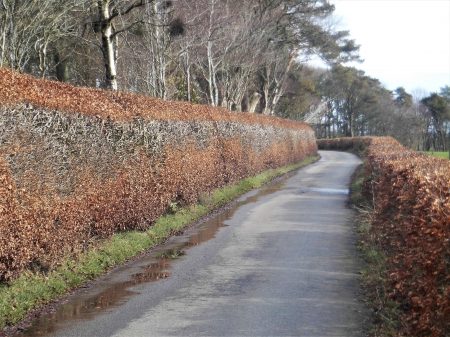
My way back to the school was enclosed by smart beech hedging for which the estate is renowned.

I took this photo of the Bleasdale hills on my way home, St. Eadmer’s church is right of centre.*****

*****

This walk was completed two days ago and since then advice about walking and climbing during the coronavirus emergency has been sensibly updated. As I’m in the vulnerable group I’m taking heed. We are all responsible for limiting the seriousness of the situation in the next few months.

BMC Advice.  18/03/2020

  • People need access to the countryside for their health – both mental and physical.
  • Follow the most current NHS advice regarding health and distancing. Currently Public Health England’s advice is: “you can go for a walk outdoors if you stay more than 2 metres from others.”
  • Consider your means of travel and distance – close to home is best and, despite the environmental impact, it’s better to be in personal cars than public transport at the moment.
  • Stick to familiar areas and low-risk activities.
  • Reduce your risk. Be very aware that medical and rescue services and facilities are going to be extremely stretched and overwhelmed. It would be socially irresponsible to be taking risks at this time that could place an additional burden on medical and emergency services.
  • Do not assume that Mountain Rescue will be available. There is a real possibility of reduced or even no cover for rescue in some areas as this develops.


THE EAST COLNE WAY.

A walk through the green lungs of Colne.

I picked up this leaflet at the cafe on Beacon Fell the other day, it looked interesting. Despite my friend Sir Hugh stating  ” The ones I am not enamoured by are where some local authority has connected a lot of inferior paths around the edges of crop fields with no particular objective other than perhaps encircling their borough or domain and claiming this as The Whatevershire Way”  to discover relatively new territory I was prepared to give The East Colne Way a chance.

I’ve driven along the A6068 Nelson to Keighley road many times on my way to walks in the Bronte Country and climbs on Earl Crag and familiar landmarks which I would visit today. This another of my short walks I’ve been doing recently to fit in with the weather and other commitments. I turn off the road to a lakeside carpark at Ball Grove Nature Reserve. This was the site of an C18th water-powered cotton mill which became in 1860 Sagar’s Tannery, the largest in Europe. Production ceased in 1970 and the buildings were demolished all but the present-day cafe.

I strolled alongside the lodges, now nature reserves, and Colne Water to a weir with a fish ladder.

An unofficial scramble brought me onto the road opposite the old cottage Hospital bequeathed by the Hartley family which has been converted into retirement accommodation.


Hartley Hospital.

Along the road are the Hartley Almshouses donated again by the Hartley family, yes those of jam fame. Talking to two residents one was very positive the other concerned about damp.

I cut up through some rough fields with ancient boundary walls and stiles, I’m surprised to find a waymarker for my walk, these continue to guide me around the circuit. 

I pass the workers cottages at Bents without a photo and press on up Skipton road to pass the Georgian  Heyroyd House, Apparently round the back are walled gardens.

More stone stiles led across fields to a lane alongside Colne Golf Course. A clapper bridge has had rails added to it – health and safety? It opened onto a lane that looked more like a stream.

The rocky ridge visible ahead is Noyna Hill, a real ‘green lung’ of Colne.

Farm lanes followed and I was soon crossing the causeway at Foulridge Upper Reservoir. The sun was quite warm and I lingered admiring the views over to Pendle Hill, Blacko Tower and round to Noyna and the Great Edge all Pendle walking areas par excellence.

The large gated property, Lower Clough owned by the Barnsfield Construction Co, had some impressive, well-guarded grounds. An open area The Rough is what remains of Lob Common, worryingly new housing seems to be creeping up the hill. Curlew are calling as I walk through. I come out onto a surprising lane lined on one side by handloom weavers’ cottages, several three-storied. Down at the roundabout is the old Turnpike House which I’ve driven past without realising its existence. Also on the lane is Lidgett Hall dated 1749. This delightful Conservation Area backs onto the open countryside where the housing development is occurring – so much for town planning.

Turnpike House.


Lidgett Hall.


Another open field heads towards a church with the hills above Wycoller in the background. I finish the day with a coffee in the lakeside cafe at Ball Grove Mill. This turned out to be a 5mile walk through beautiful northern countryside giving an insight into the past life of this area on the edge of industrial Colne. The only sour note is the lack of protection from developers to land unchanged from the C17th. 

*****