The Mythic Coast.
Blackpool has switched on its illuminations, boosting tourism for a few more months. But I’m not here for the lights; I’m here for a bracing walk beside the sea. In the past, I often cycled the Fylde Coast and have written about it here many times. I can’t believe it is two and a half years since my last visit. Today I’m motivated by yet another chapter in that 52 Ways to Walk book, Walk Beside the Sea. Not that I need much motivation to return to one of my favourite stretches on the Fylde.
The book promises: “the sound of surf and breaking waves are deeply restorative, while reflections pique and engage our brain, and the fractal patterns of shells and waves soothe our frazzled minds” Sounds good.
I check the tide timetables as I hope to walk out onto the beach, unencumbered by my cycle, to examine some of the artworks described in that last post from here. High 10:38; Low 17:13. Cleveleys. So the afternoon should work out well. Now to check the bus times from Cleveleys back to Fleetwood. The number 5 runs every half hour.
*
I park up at about two o’clock, on the front in Fleetwood near the Knott End ferry terminus and RNLI station. It’s obvious, judging from the views across Morecambe Bay, that the day is going to be crystal clear. 
Even though I’ve previously highlighted several memorials and statues to lives lost at sea at this end of the promenade, I find myself revisiting them, as they are so poignant even to a hardened soul like myself. The shoal of fish lead me to the ‘Welcome Home’ statue. 

I walk along the soft sands for a while; the sea looks so far away across the sandbanks exposed at low tide, but these are dangerous places when the tide comes in; many people have been cut off and rescued by the RNLI volunteers. They have had some unexpected and adverse critical reactions recently related to asylum seekers, but where would we be without them? The RNLI is the charity that saves lives at sea above all others. 


Back on the promenade, I make good progress but keep stopping to photograph Black Combe and the Lake District across the bay. A cargo ship is heading out from Heysham. 
The stretch to Rossall School seems to go on forever. The concrete panelling, part of the sea defences, is relieved by panels depicting episodes from The Sea Swallow, a beautiful illustrated book by Gareth Thomson based on a folklore story of the Wyre Mythic Coast, of which more later. 


The promenade sweeps onwards. My attention is divided between the panorama out to sea and the graceful seawall with its occasional artworks. 


Tall installations represent local flora and the animals that depend on them.


The wavy wall continues; can you spot Blackpool Tower? It ends with another piece from The Sea Swallow. 


Rossall School always looks Dickensian to me. 
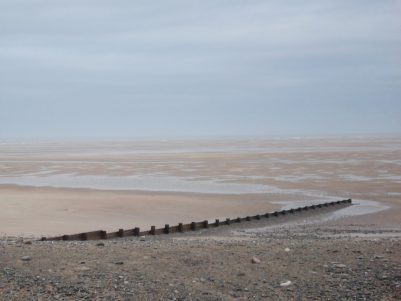
I’ve chosen to come in the afternoon to explore the sand at low tide. I’m starting to worry that I have missed the Shell and the Ogre installations, which I have only seen semi-submerged before. I walk on, taking in the curves of Cleveleys’s sea defences. Dog walkers far out on the sand give my seascapes some scale. 

 I drop down onto the beach for a change and alternate between sandy and stony stretches.


I can’t resist a bit of beachcombing.


And then I spot Mary’s Shell over the next groyne. 
How exciting to come up close from all angles and even get inside. The whole massive structure is encrusted by the sea’s twice-daily immersion. Lines from the poem are inscribed on the inside coils, though they’re hard to make out, and I spot a couple of other original decorations. 


Another groyne away, I thought I could see the Ogre sculpture, but it was surrounded by more boulders (for sea defences) than I remember before; perhaps some have been added over the years. I walk across the beach, and yes, he is there crouched and looking grumpy, a veritable ogre. He is heavily encrusted, as he becomes completely submerged at most tides.


 I scramble back onto the promenade with its futuristic lighting; I must come one night to repeat this walk.
I knew the ‘Ogre’s Paddle’ was along here somewhere; incongruously next to a cinema and gym, most people walk past it without realising its significance. I did for years, not even noticing it! 


One has to seek out the relevant poem’s lines on the paddles back side. 
On the promenade opposite the main street of Cleveleys is the 10m-high Sea Swallow statue. Opening like a book, the two swallows fly high. 
 The base features engravings from the poem.
All in all, it’s an elegant structure.


It’s only a short walk to my final art installation, The Fylde Shipwreck Memorial. A memorial to all known ships lost along the Fylde coast, from Fleetwood to Lytham St Annes. It is positioned on the promenade adjacent to the site of the most recently lost ship – The Riverdance. A rusting wall of names of over 200 boats. 


 Time to catch my bus back to Fleetwood.
*
With the tide well out, it’s not been a day of crashing waves, but more of soft sands, silvery seas, and big open skies. My mission to visit the Shell and the Ogre at low tide is accomplished. For a comprehensive history of the Mythic Coast art, you should look here before you go. The ‘children’s’ book The Sea Swallow by Gareth Thompson, which tells the story, is one of my treasured possessions.

*


 I now realise there was another Mary ‘panel’ at the start of the wall farther back – it gives me an excuse to have another leisurely exploration. https://bowlandclimber.com/2026/09/10/i-do-like-to-be-beside-the-seaside/


 Down on the River Wyre in St. Michael’s a tragic drama is transpiring, a 45-year-old local lady, Nicola Bulley, has gone missing whilst walking her dog by the river. You will have seen it on the national news, the trauma her family are going through as the days pass, without resolution, doesn’t bear thinking about.