


Cinque Terre. Corniglia – Manarola – Riomaggiore.
On our final day the plan was to complete the Cinque Terre walk but Tren Italia workers had other ideas and called a strike., fortunately a rather soft one – from 9am to 5pm. So with an extra early start we were in Corniglia just after 8am at the base of those 382 zigzag steps we had descended a few days ago. There is a sign at the bottom advertising a pharmacy at the top – ?oxygen. Once at the top we were ready for some breakfast in one of the cafes in the little square of this rather strange promontory village. 
 The coastal path has been destroyed so we take the higher route over the headlands via Volastra, this involves some fairly stiff climbing up stone steps. There are some great views back down to Corniglia to take our minds off the task. Most of this area is devoted to vines with stone walls supporting terraces down the steep hillsides. Any grapes grown here involved arduous work over the centuries. In recent years a type of rack rail has been installed for transport on the slopes, it all looks very precarious. No wonder the wine tastes good.


 The day is perfect with hot sunshine and blue skies and this section of the walk is relatively quiet. Soon we are descending steeply into Manarola with its busy streets above the harbour. The bar I chose for a light lunch of bruschetta and tomato has the only miserable waitress seen all week.

 From here to Riomaggiore the famous Via Dell’Amore clinging to the cliffs has also been destroyed by landslides so once again we haul ourselves [literally in parts] up steep steps. The place has suddenly become very popular with all sorts of humanity struggling along the trail. The drop into Riomaggiore is just as steep and we are hot and sweaty by the time we reach it. A swim in the stony bay round the corner is first priority and a lazy lie on the beach to dry off in the sun. There is time to explore the higher narrow streets of the village before going through the tunnel to catch a train back, now the strike is over.


In the evening we enjoy a rather over elaborate and expensive meal in a hilltop restaurant, La Ruota, the free Grappa at the end reminding me with a headache for the journey back to England the next day. It has been great to be back in Italy and this area is certainly spectacular if over touristy. I would like to return, alone or with a couple of friends, and explore some of the quieter coastal paths and the routes going into the hills inland.
 Santa Margherita Ligure to Portofino.
Years ago there was a good Italian restaurant in Preston named Portofino, candle lit dinners serenaded by a guitarist who happened to be Spanish, but never mind. The name stuck with me and I had a hankering to visit this place. So this morning we get off the train in rather elegant Santa Margherita and walk across the promenade past a statue of Christopher Columbus. He was born in Genoa up the coast so I’m not sure of the significance of his statue here.

Santa Margherita.
 It was raining as we set off into the hills –
 – steep tracks through pine and chestnut trees eventually brought us out at a cafe next to an old mill. Here a welcome coffee and a drying out helped us on our way. The whole area was very green and luxuriant but there was a lot of damage from recent storms. Soon we were looking down on the natural harbour of Portofino.
 Portofino has become the Italian playground of the rich and famous and was full of tourists. I didn’t venture into the jewellery and fashion boutiques, in fact I ate a sandwich on the castle promontory, there are some fabulous views of the harbour from up here. I then braved a coffee in the over priced Bar Pasticerria up the side street. They had photos of the visiting rich and famous from the past.


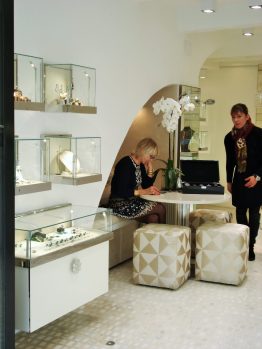


We had a route march back along the coast to catch the train in Santa Margherita. Portofino – been there, seen it, couldn’t afford the T shirt.
Boat trip Monterosso to Portovenere.
There were no walks scheduled for today, people were doing their own thing. I considered a walk northwards from Moneglia but fancied a change and the weather forecast was for morning rain. So after a leisurely start, I meant to say the breakfasts at the hotel have been excellent, I was on the train to Monterosso again. From here I was joining the tourists on the boat trip down the Cinque Terre coast and on to Portovenere. Actually there weren’t many people on the little boat as it was miserably damp. All the five towns were viewed from the sea which gave a different perspective to the walking days. We called in at Vernazza, Moneglia and Riomaggiore, Corniglia doesn’t have a harbour.

MONTEROSSO.

VERNAZZA.

CORNIGLIA.

MANAROLA.

RIOMAGGIORE.
I stayed on for the longer leg to Portovenere. By now the weather was stormy and most people had retreated off the upper deck. This a much larger town, again a UNESCO World Heritage Site, at the far end of the peninsula before La Spezia Bay. Its harbour is lined with brightly coloured houses. All these towns seem to have perfect pastel painted houses, I wonder if there is a plan or colour coordinating police?

 Narrow medieval streets lead up the hill to a castle and a church on the promontory, once the site of a temple to Venus (Venere in Italian) from which Portovenere gets its name. The main street, lined with shops, is entered through an ancient city gate. Here a small family cafe, Bar Zurigo, rather than one of the expensive restaurants was chosen for a lunch of Anchovies with a view over the harbour. By now the sun had come out and I strolled up the hill to the church and views up the rocky coastline and across La Spezia bay to Palmaria Island.


A tortuous bus ride to La Spezia and then the train back to Moneglia. I’m becoming very familiar with the stations on route but the line generally is disappointing due to all the tunnels, it serves a purpose.
Cinque Terre. Monterosso – Vernazza – Corniglia.

The coast back to Monterosso.
This week is different for me and I’m not sure about walking with ten other people no matter how charming they may be. I feel I’m missing things on the way – flowers, birds, houses, shrines etc. OK you see them in passing but if I was on my own or with another much more time would be spent observing and absorbing. More time is spent chatting rather than experiencing the route. If you drop off the back to contemplate the rest are waiting for you to catch up – I don’t need that! Anyhow worse is to come today as we hit the crowded Cinque Terre paths.
Our morning train takes us to Monterosso the most westerly town of the Cinque Terre – Five Lands. The old part of town with narrow streets full of cafes also had two unusual churches. All humanity was here – Americans, Japanese and the rest of the world’s tourists. Some are content to eat ice creams in the expensive port but many are clambering in various attires along the famous cliff hugging path. Traffic lights would not seem out of place to regulate the flow of people. An entry ticket is needed by the way. Anyhow the path high above the sea is dramatic. We walk through pine and oak forests and terraced vineyards. There are good views back to Monterosso and eventually down to our next destination – colourful Vernazza, with its natural harbour dominated by the Doria Castle.

Monterosso station.

Monterosso beach.


Lunch, local Focaccia bread with Pesto, is taken in a little cafe away from the port itself but everywhere is crowded.


 Then more steps climbed out of the village and we traversed high again towards Corniglia which is perched on a promontory rather than at sea level. It was an interesting place to explore with little passageways leading nowhere and good views of the coast. There was time for an ice cream before heading down flights of steps [382 I didn’t count them] to the station platform for the return train.

Looking back down on Vernazza.

Corniglia.

Onwards to Manarola – for another day.
 My antisocial self survived, actually enjoyed, the day: I’m getting into tourist mode. Back in Moneglia a swim refreshed me ready for a meal at a small restaurant [U Limottu] up an unfrequented side street. Ate the best fish so far in this town and the best wine from Colli di Luni a complex red Niccolo V.
Rapallo, Montallegro and Chiavari.
Back on that train again, this time to Rapallo. But for some strange reason the train only goes as far as Sestri Levante where we have a 40 minute wait for an ongoing train, time for a walk round the town of impressive buildings and a coffee. Once at Rapallo we cross the small town to make our way up to the Funicular station for a squashed 500m ride to the upper station. A short walk up steps leads to The Sanctuary of Our Lady of Montaleggro. Here in 1557 a vision of Madonna was seen and a sanctuary built for pilgrims, the present day impressive marble facade dates from 1896. 

 From here we had a well paved level track [with stations of the cross] along a ridge of oak and chestnut trees, unfortunately the mist interrupted coastal views.

Looking across the Tigullio Gulf towards the Portofino peninsula.
For most of the day the pilgrim/mule trail was cobbled, often between old stone walls running across terracing on the hillside. Inland low hills, with scattered farmsteads, led up to the distant Apennines whilst down to our right were glimpses of the coast. There was a steep scramble up a rise in the woods and we were nearly mown down by mountainbikers on the descent. The ornate church of La Madonetta suddenly appeared in the trees further on.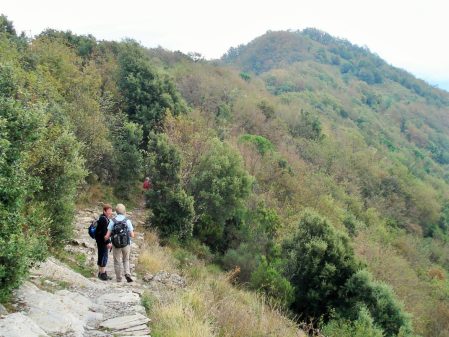

 From here paved ways led down to the town of Chiavari which had some grand buildings in its centre and lots of alleyways leading nowhere. The railway station was tucked away in a tunnel.

 This was a relatively short walk as we had a wine tasting to attend in the early evening. This took place in an old house used in the past for the preparation of Anchovies which were an important food through the winter months. Our host runs a restaurant here and gave an entertaining and informative presentation helped by his young daughter. [blurry picture below] One of the grapes used in this region is the Vermentino producing a light fruity dry white wine. We tried four from slightly different areas and methods. After that we staggered out into the street and into a nearby restaurant [Gian Maria] for a tasty prawn spaghetti and of course more wine.
Framura, Delva Marino and back to Moneglia.
Breakfast was promising. Our group of ten also.
The railway along this coast connects all the towns directly whereas the roads are a convoluted and slow affair. Both commuters and tourists use the train. In the cool morning we await the train heading south to Framura, two stops away, only 10mins late today. Once at Framura the walking starts, typically we are to find, with steep steps out of town. Now is not the time to chat with one’s new companions. Soon we are high above the coast with spectacular views east. A sunny square materialised with an old defensive tower and then we were heading down again on a track through pines, giant heathers and strawberry trees.
 A few streets led us onto the beach at Deiva Marina and I couldn’t resist a swim in the invigorating Mediterranean, I was soon dry in the hot sunshine. A nearby cafe provided caffe macchiato. There was a chestnut festival in the village which was just getting going with music and roasted chestnuts.

 Jollities over a steep ascent through oak forests brought us out at a wooden cross high on Monte Telegrafo, 443m, but views were restricted by the trees.
 Downhill once again to the prominent village of Lemeglio with it’s black and white church –
 – and then on old paved tracks back to Moneglia.

Moneglia
For a first day’s walking this had been quite tough with steep gradients and nearly 3000ft of ascent. This area is outside the Cinque Terre region and few other walkers were seen. A session in the hotel’s Jacuzzi helped aching muscles before an excellent meal of mainly fish and ten new names to recall.
“Cinque Terre is a string of centuries-old seaside villages on the rugged Italian Riviera coastline. In each of the 5 towns, colourful houses and vineyards cling to steep terraces, harbours are filled with fishing boats and restaurants turn out seafood specialties along with the Liguria region’s famous sauce, pesto. The Sentiero Azzurro hiking trail links the villages and offers sweeping sea vistas.”
That sold it for me.

I’ve only really been to the Ligurian coast once – climbing based on Finale west of Genoa. We also came close finishing the three week GEA in the Apennines to the north of La Spezia a few years ago but hadn’t time to visit the coast.
This time I’m heading straight to Moneglia a coastal village between Portofino and the Cinque Terre. My fellow passengers on the flight were from Durham and I slipped back into my early accent as chat passed the time quickly. Its interesting how a common background leads to familiarity. An early arrival at Pisa airport, thanks Easy Jet, had me on a bus to town. The ticket queues at the rail station were a testament to Italian inefficiency but after half an hour or so I was on a train to La Spezia. A dash saw me on the coastal train onwards. Glimpses of the Med. and the iconic villages flashed past but a lot of the time we were in tunnels.
Moneglia looked a bit run down but improved as I approached my hotel, Piccolo, near the sea front. Disappointingly there seem to be buildings blocking off the sea front itself. I realise later that this little town is much quieter and less touristy than the other resorts.
I’m here in roundabout way on an Exodus walking holiday, the rest of the group are coming later on a flight from London. So I make myself at home, have a swim in the sea, refresh and go out to find supper. My choice, Restaurant Vela, is a great little family run place and they look after me well.

Moneglia -our street.

One can’t always be in exotic areas, Lancashire is enough. Mel was up for a few days, my planning had been delayed by other arrangements, so on the hoof we enjoyed the following days.
Thursday. 11.30 Pick up at Preston station . 12.00 lunch at the five star RK Sweet Centre – masala dhosa £2.50.
14.00 a walk around the reservoirs in Longridge visiting the shops to purchase delicacies and drink for tonight’s home cooked Italian meal.

A Longridge reservoir.
Friday. A late start saw us in a compulsory Chinese buffet in Southport.
After the Egyptian Room in the Atkinson Gallery we spent time looking at the eclectic historical exhibits relating to the Sefton coast – lifeboats, Bootle Docks, shrimping, Dan Dare, Meccano.
On the spur of the moment we drove down the coast to Crosby to view Antony Gormley’s ‘Time and Space’. It was mid tide so the figures ranged from full bodies to heads barely visible in the sea.

Crosby beach.
Saturday. Another late start, shan’t tell you why, and we were following the Ribble Link canal towards the Ribble. We didn’t go all the way but cut across a golf course to the Lancaster Canal which we followed back towards Preston, stopping off at a cafe in the UCLAN sports ground. We skirted Haslam Park and continued along the surprisingly green route into the centre of Preston where goods from the canal were transferred to trams to cross the river and join up with the Leeds/Liverpool canal. The modern Ribble Link strives to do the same but I wonder how many boats use this facility. A glorious sunny day.

Lancaster Canal in Preston.

End of the canal in Preston.
The excellent Egyptian cafe in Preston provided food as good as Cairo in the evening.
Sunday. The weather remained good. Another ‘watery’ walk, taking in Cockersand Abbey, coastal walking, Glasson Dock, another canal and Thurnham Hall, was enjoyed in the sunshine.

Cockersand Abbey.

Glasson estuary with the damaged Plover Scar light.

Glasson Dock.

Link canal with Bowland Fells in the distance.
Back home it was time for an ‘Indian’.
Monday. Take Mel back to the station until we meet again next Spring on the Thames Way for some more ‘watery’ walking.
http://www.gourmethouserestaurant.co.uk/
Friesenberg Haus – Breitlahner and home.
This hut had closed early this year but we wanted to do more of the high level walking on our last day so we walked up to it and along the ZRR before coming down to the valley. It was a misty morning but promised better, the Russians disappeared early up towards the Furtshaglhaus and higher things. We trudged up through the woods into a vast hanging valley meeting some of the staff from the Friesenberg coming out for the last time. An excellent stone track zigzagged out of the valley up to the hut on a higher bluff. At almost 2500m this is the highest hut in the Zillertal. It has an interesting history – built originally in the 20’s as a private Jewish establishment. As the war approached the area was used to train elite German troupes which put the hut warden in a difficult situation. But tolerance prevailed between mountaineers and there is a bronze plaque outside the hut celebrating against “intolerance and hate”. Today we sat on the steps for a short break as the shutters were closing for winter. We continued along the route in and out of clouds, it was arduous and we realised we couldn’t get as far as we had hoped. Fortunately there was a signed track leading down to Breitlahner – this we followed but it didn’t seem to be used much. Marmots were screaming at us in one area, we realised that we hadn’t seen much wild life on this trip – birds were particularly absent. Down and down we went into boggy ground and then welcome dwarf pines. The day became hotter and on reaching the valley floor we were ready for a rest. Paths led alongside the gorge, the road had disappeared into tunnels, until we emerged at the Breitlahner which turned out to be an old traditional alpine hotel. A bus whizzed us through Ginzling into Mayrhofen, the scenery was spectacular all the way.


Spot the marmot.


Good to be back at the friendly Zillertal Gasthof, we enjoyed a celebratory meal featuring wild mushrooms at the excellent Tiroler Stuben – the rockman had a headache the next morning! The journey back to Janbech and Munich was easy. We found ourselves by chance in the wonderfully atmospheric Augustiner Restaurant, the Oktoberfest is just getting underway.


The SBahn train to the airport was halted because of people on the line. We didn’t really know what was happening but decided on a panicky train back to Munichost and then an expensive taxi ride had us at the airport with minutes to spare. An exciting end to our trip.
Quote of the day – “that was close” at the airport.
A trip up to Italy – PfitscherjochHaus.
The weather reverted to rain and low cloud so an easy walk up to Italy was the obvious choice for today. We passed some fine waterfalls up the valley and before we knew it we were at the old border post. A little further the Italian hut appeared out of the mist. There was a warm welcome in the modern hut. We settled in for lunch – pasta and good coffee. A large group of cyclists arrived from somewhere to stay the night. The hut has a chequered history, it was blown up by the Italian army in 1966 due to border disputes, rebuilt in 1980 and has continued to provide mountain accommodation.

Compare with yesterday’s view from the balcony.


Pfitsherjoch Haus 2277m

More food – Italian this time.
We stole away and retraced our steps down the valley in the mist.
Back at Dominikushûtte supper was interesting – can’t remember the food. A man in soaking camouflage kit burst in from the dark carrying a baby kangaroo style, his wife followed. They turned out to be Russian and doing a similar trip to us! The baby must be hard as nails. An unfortunate retarded chap [sorry for any unpolitical phrasing] was having supper with his carer and making grunting noises. I went to the loo downstairs and whilst there had the scary movie moment as a stumbling grunting ogre came towards me. Enough said.
Today’s quote – “mustn’t grumble” determined to enjoy the rainy day.
Neumarkte Ronde to the Olperer Hūtte.
The day dawned unexpectedly bright and sunny. We made a quick decision to do this high level circular walk after booking in at the Dominikus for a couple more nights. The breakfast was rather disappointing considering the accessibility, no fruit or eggs, so we were away early. Back along the road to pick up the signed way, 535, a gradually ascending good path up the side valley, the unpronounceable Unterschrammachbach. Lots of people were descending from an overnight Saturday at the hut, suggesting a cramped and noisy night. Fast flowing streams were crossed on new bridges until we met up with the Berliner Höhenweg in a large mountain bowl under the Olperer 3220m. Four lads were heading up to an unseen pass leading to the Geraes Hütte. Signposts put us on our more modest way switchbacking across the contours coinciding with The Peter Habeler Way [the famous alpine and Himalayan mountaineer haling from Mayrhofen] This route, established in 2006, was well paved with slabs of rock – how do they move them? Views down to the Schlegeis lake and up to the Hochfeiler became more impressive as we moved round. Eventually the Olperer Hütte came into sight on its perch looking most unimpressive from an architectural point of view, ‘hen-house’ was the phrase we used. It was rebuilt in 2006 and was certainly impressive inside. We sat on the balcony with our teawasser [stingy Brits] enjoying the view down the valley. A group of pygmy goats entertained us below. The way down was heavily used and unpleasant until it entered the pine forest before reaching the road. People seemed to be ascending late in the day. We were back fairly early in the Dominikus enjoying a Radler [citrus shandy beer] and chatting to the family [see quote of the day]. the hut seemed to get busier as the evening went on. Dumplings and sauerkraut were on the menu!

Morning view from the balcony.

Unterschrammachbache.

The upper bowl.

Looking back down hanging valley.


Well paved Peter Habeler Way


Olperer Hutte coming up.

Sandwich with a view.


Dumpling – you have to be there.
Quote of the day – “the sun shines on the right shoes” our hosts’ misinterpretation of righteous!
Furtschaglhaus – Schlegeis, Dominikushütte.
Woke to sleet and snow with nil visibility. So a leisurely breakfast and sitting around for a late start as fortunately we were heading down the valley and decided to take a half day. We phoned the Dominikushütte and booked a room, they sounded pleased to have us as the bad weather would put a dampener on the weekend. There was a trail through the snow going down steeply to the valley below, the rocks were slippy and we took our time. Very few people were coming up and our route of yesterday would be out of the question. We arrived in the valley next to the provisions lift from where a track ran to the lake/reservoir. By now it had stopped snowing but the clouds were down revealing only occasional glimpses of the surrounding mountains. We dawdled along the lakeside track, walked through a mainly deserted carpark and arrived at the dam. This 70m wall was built in the 1960s and provides hydroelectric power as well as flood control for the Mayrhofen Valley. The original alpine hut was destroyed in the process and our present accommodation, Dominikushütte, was constructed higher above the water. We received a warm welcome from the family and dog, bowls of Knödel soup went down well as we dried out. Our room was airy and spacious, a change from the mountain huts. We are still at a height of 1800m and the afternoon was gloomy with no one else about, time for festering [an unusual verb describing our activity] They had given the chef the night off as nobody else was expected but slowly more people started arriving and by evening it was quite busy. By special request we had Tyrolean Grosti with a great celeriac remoulade for supper. A wicked schnapps finished off the meal.


 We had three days left and wanted to visit the last three high huts but the forecast was poor, We deliberated over various options but went to bed undecided, lets see what the morning is like.
Quote of the day – “this is better than sleet” as the morning snow piled up.
Berliner Hütte – Furtschaglhaus.

The Schonbichlerhorn, today’s objective.
Today takes us over one of the highest ‘walking’ passes in Austria. The forecast is for rain later so we plan an early getaway. The breakfast in the Berliner is poor and expensive, they could do so much better – some fruit juice and maybe boiled eggs. The hardy young crowd who eat their own breakfast on the terrace are away early, we are happy with 7.15am. It was uphill all the way, at first through shrubs on zigzags and then at a rock wall we took a shelf up to the right into a rocky area. Here a ridge soared upwards towards a vertical rock face, surely we don’t go up there but yes a few hundred metres of scrambling led on. Poles were packed away for the hands on experience, there were cables but they weren’t needed as the rock was solid and full of jugs. From the col the summit cross of Schonbichler Horn, 3133m, was 5mins away. The rockman proudly bore the summit stamp on his forehead and we signed the book “post Brexit”. Fantastic views as you can imagine, a whole new world opened up to the NW, The Tuxertal Alps with the Olperer 3426m prominent. To our left were glacial systems coming off the Grosser Moeler, 3480m, and the Hochfeiler, 3510m, the highest peak in the Zillertal. We sat and ate more of that stale bread and cheese whilst looking around. Cables led us down loose ground but there was no hard packed snow that had been so difficult last year, our micro spikes were never used. After an 8 hour day the Furtschaglhaus was a perfect traditional hut with super friendly guardians. An early supper and we were in bed way before the beer-swilling weekenders at the hut. We never meet any British walkers.

Looking back to the Berliner and yesterday’s pass.

Easy cables on the lower ramp.

It goes up there somewhere…

Pausing for breath.

Easy scrambling to the top.

The Grosser Moseler in the distance.

Sliding down the otherside.

Hochfeiler at 3509m the highest in the Zillertal.

The Furtschaglhaus.

Serious eating and drinking. Quote of the day – “this must be where the cables start” – as we looked up at the precipitous face.

Greizer Hütte to Berliner Hütte.
From the balcony of the hut today’s route looked impressive – straight up the couloir on the opposite wall to a pass at 2872m, Moerchen Scharte. Breakfast was fairly miserable – a tray with two pieces of dry bread, cheese and coffee, we had to buy more of the same for lunch. Within less than a kilometre we lost about 350m dropping down to the valley to cross awkward rocks in the river bed before clambering up the otherside, these rivers must be dramatic in flood. A 6m metal ladder, straight from B & Q, was loosely attached to the buttress in front of us making a novel start to our climb. For a while wires protected us crossing steep rocky ground on the edge of the couloir but they were hardly needed. The path then came out onto a large grassy spur up which it zigzagged interminably. The morning was enlightened by two fit girls passing us at a trot, one carrying a dog, kangaroo like, in a front pouch. They soon disappeared from sight.

Uphill all morning, spot the ladder.

When I’m cleaning windows.

Who needs the cables?

Its a dog’s life…

The pass is on the right – a long way to go.
The grass ended at a minor col and here was a large boulder field stretching upwards, two people were struggling through it but whilst having lunch [that dry bread and cheese] we spotted a higher traversing path on the right avoiding the difficulties. Towards the top more chains were used on a rather loose buttress depositing us at the pass. A lone lady was sat there unconcerned, she followed us down later but then disappeared. The clouds were coming and going from the tops but we had a good open view of the glacial systems on the Schwarzenstein range.

It’s so dry.

Well above the boulder field.

Not as serious as it looks!

Back to yesterday’s pass.

The Berliner Hutte is down there somewhere.

Distant glaciers.
The track wound endlessly down through fascinating rock formations. The granite contained tourmaline, quartz and agate crystals which I probably would have missed without the rockman. The agate was collected in this area in the last century.

Rock chaos below the pass.

Tourmaline crystals in the granite?
The Berliner Hütte seemed miles away and we lost a lot of height getting to it. There was a well paved way, previously for mining or hunting? Our arrival coincided with the start of the rain. This hut is built on a grand style, all wooden paneling, creaking floors and chandeliers. It was started in 1879 and extended in 1911 to its present size. Photos early last century show the glacier almost at the back door, the ice has now retreated hundreds of metres up the mountain. We had a great two bedded wooden room, the dinner was good but the whole place felt a little impersonal which is a shame for such an historic place.

Paved way down to the Berliner Hütte.


Meant to say I somehow forgot my camera on this trip and all photos are from my phone. One disadvantage of the phone touch screen is I have to take off my gloves to operate it.
Today’s quote – “I just have to be in the mountains” the rockman expressing his joy of the day.
Kasseler Hütte – Greizer Hütte.
We knew we were in the big mountains when only after 3 hours did we start climbing the 800m to today’s pass, [2701m] Lapen Scharte The day had started bright and clear, perfect for the long traverse below the glacier of Grosser Loeffler. We hopped across glacial streams with the odd bridge of help. Soon after leaving the hut we passed through the incongruous door, an ‘art’ installation on the hillside which hopefully will eventually disintegrate. The Kasseler remained in view all morning across the valley. Towards the end of the traverse cables helped us across a cliff face. On a magnificent viewpoint down the Stilluptal valley we snacked and girded our loins for the difficult climb through the boulder field up to the pass. Great care was needed not to loose the trail and not to break a leg amongst the haphazard rocks. The final steep pull up was rewarded by views to the steep gully leading to Moerchen Scharte, tomorrow’s unlikely objective. An Ibex sat and watched us from a perch above the path. I managed to gash my leg badly on a granite boulder at the pass reminding me to be more careful, I’m not as agile as I used to be. The Matterhorn like Greizer Spitze loomed above. Thankfully the way down the otherside was much easier and we soon sipping Berghütte trinken on the sunny balcony of the Greizer Hütte. Supper with some Dutch lads was enjoyable but we were soon ready for bed, 9pm. We were assigned a busy dormitory but thankfully nobody snored.

The long traverse towards the pass in early morning light.

Glacial streams.

The infamous door.

Slow progress.

Looking across to the Kasseler Hutte.

Up to the pass.

Onwards and upwards.

Spot the Ibex.

The commanding Greizer Spitze.

Down to the Greizer Hütte.

Greizer Hutte.

Tomorrow’s gully looks daunting.
Today’s quote – “it’s not nice gneiss” as we crossed the difficult boulder field.
Up to The Kasseler Hūtte.
The usual bus/train/plane/train had us into Mayrhofen by tea time, sorry coffee time. Our booked Gasthof Zillertal on the outskirts of town looked a little austere but turned out to be friendly, clean and economical. Basic rooms perfect for one night and a good breakfast thrown in. Mayrhofen is touristy with plenty of funny hats and cuckoo clocks for sale. We retreated into the traditional Berghof Hotel for a civilised dinner of Goulash Soup and Lake Pike fried in butter. Slept like a log.


In the morning we walked up to the TI office where we were to catch a private mini bus, sitting outside the time for departure arrived but no bus. A glance down the road spotted a likely looking vehicle which we just managed to board before it departed. Up the Stilluptal valley we passed a famous waterfall and continued on a private track in increasingly dramatic scenery to Grüne Wand Hütte. Here we felt we deserved some refreshment before setting off – it was the best apple strudel I’ve ever had! 


The steep zigzagging trail through woods and then rocks brought us in 800m to the Kasseller. A traditional hut sitting on a promontory with excellent views of tomorrow’s walk. I am with the ‘rockman’ and by chance on the terrace in the sun he met a fellow geologist from Israel, much discussion ensued. There was a lovely display of local wild flowers all labelled which interested me more.


The two geologists.
We were humorously quizzed about Brexit by the guardian – if you voted in you had a room, if out all you got was a mattress. The usual evening meal was followed by a talk from the guardian about the various route options and the weather [set fair] – a nice touch if we could have understood it all. You may have noticed we’ve hopped into the route on day 2 to avoid the 9hr day from the Edelhûtte. It’s called the Berliner Höhenweg because most of the huts are run by the Berlin section of the German Alpine Club, DAV.

Today’s quote – “every third night is enough” on discussing shower arrangements.

Puy L’Eveque.
Following on from my last post I’m in France not Austria, no I didn’t board the wrong plane, this is one of the weeks I spend at my friends’ house in The Lot valley. I’m wandering about in those new boots to ensure they are comfortable and intent on some secret training. It really is too hot most days to walk far but I’m up and away for a few miles every morning. I enjoyed the local ‘communication tower’ walk more than usual as the tracks had a more rustic feel to them now that the quad bikes have been banned. The herds of deer and ibex were still present in their artificial enclosure and there were lots of illicit plums and hazelnuts to pick.


Walked the long way via Tousac and the old railway to the Marie Restaurant in Duravel for their 6 course lunch, 13 euros. needed a lift back. Another morning a long sweaty march through the vineyards to Puy L’Eveque and then up through the chestnut trees to a friend’s house in Martignac. He donated an abundance of tomatoes and courgettes from his small potager which featured in our menus for the week. Traditional markets were visited, several restaurants’ multi course lunches endured and much time was spent in the pool. We prepared lots of salads in the hot weather to try and eat healthier.
Up the road in Loupiac by coincidence my neighbours from home were spending a week and we visited their luxurious accommodation. Reciprocating they spent a lazy afternoon by our pool. The area is famous for its tannin rich dark red Malbec wines and they had been donated three bottles of the best Domaine des Sangliers ‘Santon Black’, but as they don’t like red wine they generously passed on to us, lovely – all part of the training.
The nearby family Filhol Chateau Hauterive provides us with lovely fresh rose and rich red wines. They were also in the middle of plum harvesting and drying to produce the best tasty prunes. The vines were all well pruned and ready for picking in a few weeks time – they just need a little rain before then.


Ten days of blue skies and thirty degrees sun – all things come to an end and Austria beckons.
Oh and bye the way always….
Last September we were preparing for a trip to the Stubai in Austria, the HiTec ‘Eurotrek’ boots mentioned then have given me a good year’s walking but there is now little tread left on the heels, a lace eyelet has pulled and the thin leather on the toes is disintegrating. They are still remarkably waterproof but are resigned as from now to garden duties. Not bad for 40 quid.

Looking in the shops many of the boots on offer seemed narrow so I went for HiTec again as they seem to fit. This time I’ve chosen their Altitude version with a rubberized toe cap and a hopefully better Vibram sole – all at twice the price.
 The inexpensive Peter Storm waterproof has been OK in light rain and is proving wear resistant but feels a little thin for the mountains in September. I have upgraded to a North Face version costing four times the price and twice the weight.
 The jury is out, I’ll report back in a year.
We are heading to Austria again, this time to Mayrhofen and into the Zillertal Alps for another week’s high level trek – Zillertal Rucksack Route (Berliner Hohenweg)
8 Mar 2013 – Zillertal Rucksack Route (Berliner Hohenweg
8 Mar 2013 – Zillertal Rucksack Route (Berliner Hohenweg
8 Mar 2013 – Zillertal Rucksack Route (Berliner Hohenweg
Bouldering in Crowshaw Quarry.

Since I last did a new problem up here https://bowlandclimber.com/2015/09/01/what-have-you-done-today/ I’ve been trying a traverse line on the far left-hand wall, hands on a sloping top ledge and intermittent footholds below. I always seem to be on this problem just before I go off on a walking holiday, and I’m worried about my ankles if I fall off. So today I seek moral and physical [moving the pad] help from one of my oldest, and arguably favourite, climbing partners, Dor, who now unfortunately doesn’t partake. I start on the easy bit, climbing up a flake to reach the traverse. A couple of damp hand holds lead left to a large foot ledge before the committing moves up to the highest point. From here I can use a couple of decent footholds as I hand traverse on slopers. There is a section where you have to smear to make progress and I repeatedly chicken out, and I skittle back, all good warming up. Frustrated with my progress and aware of my spotter’s commitment, I try again maybe four times with the same retreating result. So forget about moving the pad – place it further left and go for it. Good left hand whilst my right foot is on a hold, left foot on a smear, slap across and down with the right hand, smear both feet and then stretch to a left foothold and follow with the hands, and it is done.
End of the line.

“Even if you’re old and grey
you still got something to say” Traveling Wilburys.
Thanks, Dor.