Tag Archives: Walking.

A LANCASHIRE MONASTIC WAY. 10. Lancaster to Carnforth.

                                                                 Morecambe Bay.

Another day snatched from Winter.

In his guide, John Covey follows the Lancaster Canal from Lancaster to Carnforth. That is a route I’ve walked often in the past so I decide after exploring Lancaster to follow the Lancashire Coastal Way instead.

Covey details a Lancaster Friary,  a Dominican community of preachers. [1260 until dissolution] There is no trace of any building now.

He also mentions St. Leonards Hospital established in the C12 as a leper hospital later having a church and chaplain for the poor. It closed in 1470 and all trace has gone.

Gardiner’s Hospital was established as an almshouse in St. Mary’s Gate near the castle around 1485. These almshouses were rebuilt in 1792, eventually to be sold in 1938 and the site built upon. To replace them, four almshouses were built in Queen Street. At last, I had something to seek out and find. On the way, I came across the Friends Meeting House, a Quaker building dating back to the Friends Meeting House, a Quaker building from 1708. That set me musing in this election week. would the Quakers be the ‘Greens’ of religion? what of the rest?  RC’s – Tories, CofE – Labour, Methodists – Lib Dem. We will know our fate tomorrow.

Also in central Lancaster, I already knew of the Penny Almshouses. William Penny, several times mayor, gave funds in 1715 to build 12 small houses and a chapel for ‘poor indigent ancient men and women’. They received a house, an allowance, a suit of clothes and the services of a chaplain. The plaque over the entrance records Penny’s generosity and warns in Latin, ‘profanos hinc abesse’ – those of ill-repute should keep away.  Next door,  the Assembly Rooms were built in 1759; income from events helped support the almshouses.

On my way up past the castle, I noticed another property – ‘served as a dispensary providing health care for the poor, 1785 -1833’  Lancaster has been very charitable in the past.

My object of climbing up here was to visit Lancaster Priory Church. A Benedictine priory was founded around 1094 on the elevated site, about the same time as the castle was being established on an old Roman Fort. The remains of the priory are under the Church, which was built in the C15. Becoming a parish church it avoided destruction in the Dissolution. Inside are the celebrated carved choir stalls with their misericords from 1340, two sets of impressive organ pipes, along with some beautiful stained glass.  From up on the hill, the site of the Roman Fort, a path led down and passed close to the Roman Baths.

All I had to do now was walk a dozen miles to Carnforth.

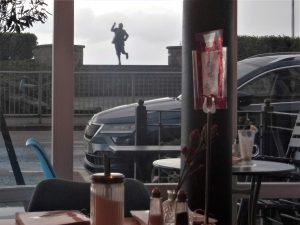
The Millennium Bridge was right in front of me, and I crossed the Lune to pick up a cycle path all the way to Morecambe. The views across to St George’s Quay had the Priory high above and a crooked house squashed in below. There was not much to see on this straight route, so I made good progress and was suddenly in front of the Midland Hotel. No, I didn’t go in for coffee. I saved that till a little later at the Lighthouse Cafe, a community cafe with a comprehensive menu. Whilst I ate toasted teacake [homage to my good friend Tony] I gazed out at Eric Morecambe bringing me some sunshine on the prom. Unfortunately, when I emerged from the cafe, the rain came down and had me scurrying for my waterproofs, which once donned, of course, the rain stopped for the day.

The promenade went on for what seemed like forever, with a few installations to distract one. Suddenly, I was free of roads and walking on the shoreline. Stoney and muddy in equal proportions. The tide was out, but following all the recent rainfall, the marshes were very boggy.  Views across Morecambe Bay were obviously extensive b,ut the background hills came and went. Ahead was the prominent but diminutive Arnside Knott.

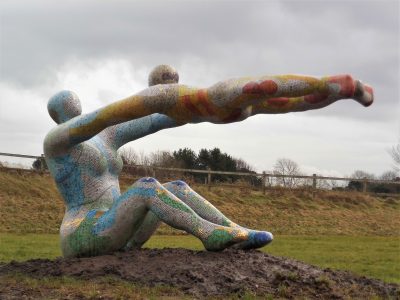
At Red Bank Farm, busy with visitors to the cafe, I came across The Praying Shell statue carved in limestone above the sands where 23 Chinese cockle pickers died in 2004.   Artist Anthony Padgett has said a link may be made to that tragedy, but the idea was conceived before.          “Its symbolism is intended to parallel humanity’s openness to a larger dimension and the way cockle shells open as the tide comes in.” Another couple of miles of marshland with lots of channel hopping where there was no distinct path, probably underwater at high tide. I climbed to higher ground in one or two places. I must admit to being uneasy in tidal areas. The Keer Channel was a muddy mess. I finally hit solid ground on the little road running alongside the Keer and realised I’d been here before with Sir Hugh on our Way Of The Crow Walk between Longridge and Arnside. That was a very wet day 2 years ago.

I had a brief encounter with Carnforth Station before catching my train.

*****

A LANCASHIRE MONASTIC WAY. 9. Cockerham to Lancaster.

                                                         Lancashire Coastal Way.

It is strange weather – one day of wind and rain, the next bright sunshine and then more rain. I take my chances on a sunny day. I’ve moved on to the northern part of Lancashire’s Monastic Way by John Convey, I may think about a link-up from Sawley at a later date. It is a clear morning with a chilly wind coming off the sea as I walk down the lane to  St. Michael’s Church, an Anglican Parish Church in Cockerham. Of course, it is closed when I arrive. The oldest part is the C16 tower. The body of the church was rebuilt by the Lancaster architects Austin and Paley.  who were responsible for much church architecture from the mid 19th century. Cockerham Priory from the C13 was situated hereabouts, but there are no remains from when it was dissolved in 1477.

Soon, I was on The Lancashire Coastal Way following flood defences, surrounded by low-tide marshes around the coast to visit Cockersand Abbey. The obvious remains are the C13 Octagonal Chapter House with a few other bits of walls from the Abbey Church. There had been a hospital on the site, which was dissolved in 1539. The land was subsequently acquired by the Daltons from Thurnham Hall, and the Chapter House used as a mausoleum, hence its preservation today. It is a bleak spot for an Abbey.

Out in the Lune estuary is the Plover Scar Lighthouse, also known as the Abbey Lighthouse, an active 19th-century lighthouse now fully automated. The last time I was along here, the lighthouse was being repaired following a collision with a commercial vessel. Nearby on the coast is the original lighthouse keeper’s cottage. The lighthouse can be reached at low tide, and in the past, the keeper would have had to attend to the paraffin lamps.

After Crook Farm, I followed what had been Marsh Lane, which disappeared under flood water at one point. Wet socks resulted.

But soon I was seated outside the friendly Glasson Cafe enjoying a coffee and pasty.

The marina was quiet at this time of year; I joined the Glasson Branch canal, which, when it was completed in 1825,  joined the Lancaster Canal near Galgate. Then, in 1883, came the railway to link to Lancaster, it was on this disused line I would continue the walk. But first, I had a look at Christ Church alongside the canal. This Anglican Parish Church was designed by Edmund Sharpe, who became involved with the Lancaster firm of Austin and Paley mentioned above. Originally built in 1840, but added to in the 20th century. I walked in to find that the west gallery has been converted into an accessible coffee/reading room. The stained glass in the east window was impressive, designed by Joseph Fisher [1979] of the Lancaster firm  Shrigley and Hunt

Returning to the Railway track, I crossed the River Condor and headed north, easy walking with views across the Lune estuary. To my right were the grounds of Ashton Hall, now a golf course. I could not see the hall, which was established in the C14, a tower apparently is from that date. The hall has had many owners, but in 1884 was sold to the wealthy linoleum manufacturer, James Williamson, who, when he was knighted, took the title Lord Ashton. With reference to today, he arranged to have a halt built on the railway line I’m walking on. After his second wife’s death, he had the Ashton Memorial built in Williamson Park, an elevated site seen from afar and later today.

River Condor.

Ashton Hall Golf Course.

Along the line, the hedges were loaded with red berries, no wonder lots of birds were about, Redwings and Fieldfares. A solar farm has been built near Stodday, they must have more sunshine here than the rest of Lancashire. The climb away from the line up to Aldcliffe was steeper than expected. I was now heading directly into Lancaster along the Lancaster Canal, a route I’ve used before.

Today, I had time to leave the canal and take a look at the nearby Lancaster Cathedral. In 1791, when the Roman Catholic Relief Act was passed,  local Catholics built a mission in Dalton Square. When a larger church was needed, local architect Paley designed this church for the present site, which was consecrated in 1859 and became a cathedral in 1924. The tower and spire are 240ft high, making it visible throughout the city. The interior was impressive, but with too many fussy side chapels. Some of the stained glass was by Shrigley and Hunt, mentioned at Glasson. Unfortunately, I found a lot of the information preachy; I can appreciate the stunning architecture without being religious.Time to catch my bus.

                    Lancaster with the Ashton Memorial, Cathedral and Town Hall.

*****

ANOTHER VISIT TO ROEBURNDALE.

I ‘discovered’ Roeburndale whilst walking Wainwright’s Way between Dunsop Bridge and Hornby a couple of months ago. The route I was following dropped into the valley and climbed out just as quickly. I thought there must be a better way to explore this valley of natural woodlands. Research on the web showed some permissive paths but even those didn’t link up completely. When Sir Hugh was wanting to complete his WW trail in the area I was only too keen to revisit and investigate paths in the valley. The plan was to leave one car at Hornby, drive to the foot of Salter Fell and walk back down the hidden valley. Simple. Come the day and we struggle to negotiate the ice on the narrow steep road, expert driving by Sir Hugh. Shaken after skidding up that steep hill we consider what to do. I became nervous about returning up the hill in my car later in the day and having two cars stuck. We decided unanimously to get the hell out of here as soon as possible, so Sir Hugh in first gear retreats. The skid marks on the road were still there later in the day – good decision. The road is much steeper than the picture suggests.

Now parked up in Wray our option is to walk up Roeburndale and somehow [all a bit vague] find a circular route back. Wray is a quiet village of stone cottages which hit the headlines in August 1967 when the Rivers Roeburn and Hindburn flooded causing loss of properties, bridges and livestock but thankfully no villagers. The way out of the village is by Kitten Bridge over the River Roeburn, this was the way for workers going to Wray Mill [wool and silk] now converted into accommodation. Looking back over the village Ingleborough was prominent.

We picked up a track leaving the road at a small building and followed it into the woods quite high above the river. The path was intermittent and hidden beneath all the Autumn leaves.  In about a third of a mile, it started descending steeply and remains of wooden steps in places suggesting we were on track. Once down level with the river, there was some boulder hopping to be done and lots of fallen trees to get around. A truly hidden valley.

A meadow was then traversed to the bridge I had crossed before in the middle of those apple orchards. This time we followed the permissive footpath signs along the valley. The vague path climbed away from the river ending at a belvedere overlooking the river. Onwards we went, picking up the odd waymark and guessing, intelligently, where the path would go. We spotted a diversion to the wire bridge across the river and went to explore the other side. The bridge was exciting – slippery, creaking and swaying.   A camping barn was marked on the map and we found it after one false alarm. We gained access from the outer stairs which led into the bunk room, all very cosy. Down a ladder, we were in the kitchen with all you would need for a night’s stay. I wonder who owns/runs this place. Once back over the bridge……we pick up the permissive path once more as it contours high in the valley just in the edge of the woods. The day was passing, there was no sign of a thaw and we didn’t have a plan. My thought of returning along the fells to the east was slipping away with the daylight.  We decided to follow blindly the permissive path and cross the river by the bridge Sir Hugh had found the other day. Lots of undulations in the trees before we came out into open fields and started dropping down to the river. A muddy track led us to ‘Sir Hugh’s bridge’  which was sturdier than the last one. The path seemed to go away from the river so we made the decision to climb up to the road which would be our quickest way back to Wray. [It would have only been another quarter of a mile to Barkin Bridge and thus completing a stretch of Wainwright’s Way wholly in this delightful wooded valley.]                                                                                                                                             In parts the road was an ice rink and as I said our tyre marks were still visible from this morning. This otherwise pleasant stroll down the lanes was enhanced by views to Ingleborough, Whernside, the Howgills and the Lakeland tops.

They were just starting carol singing when we arrived in Wray.

*****

A LANCASHIRE MONASTIC WAY. 8. Whalley to Sawley.

                                                                         Sawley Abbey.

Time we visited an Abbey or two.

But first, a visit to Taste Buds Cafe for a second breakfast and coffee, what a great takeaway. Good coffee and tasty bakery.

Fortified, I wander through the graveyard of St Mary & All Saints, built on the site of an 8th-century church and a later Norman (circa 1100) church. The present church building dates from around 1200, with the tower being added in 1440. Inside are apparently ancient pews, some of which are from the Abbey. Despite several visits, I’ve been unable to see inside. The Saxon Crosses in the graveyard I’ve pictured before.

I go through the Eastern gate of Whalley Abbey to look at the remains of one of the largest monastic sites in the north. A Cistercian order started here in 1296 and was still expanding in the 15th century. There was a church, monastic lodgings and an infirmary. After the dissolution, it passed into private hands and most was demolished, so only low walls remain. The larger walls were part of the monks quarters. A manor house was built on the site and today is used as a religious centre. An image from their website gives an idea of the layout. The last Abbot, John Paslew was executed for his part in the Pilgrimage of Grace, an uprising against Henry VIII actions. The emblem of the Abbey – Three Fishes – crops up a lot in the locality.

I leave the village via the vast west gate and out under the railway into the countryside along the Calder River.

Dog walkers were out in force using footpaths that were new to me. I walked around the site of Calderstones Hospital, an institution for people with learning disabilities. Most of the site has been demolished and redeveloped for housing. Out the other side of the complex, I’m into semi-frozen muddy fields on the line of a Roman Road to Skipton, and somewhere there is a base to a medieval cross. I spent some time looking for it, backwards and forwards. Frustrated, I carry on only to stumble into the large, unmissable stone nowhere near its OS mapped site.

From this open ground I have good views of Pendle to the east… … and to the north, Longridge Fell. In this shot can be seen the domes of Stonyhurst College and, closer at hand in Mitton, the old hall and the C13 All Hallows Church. It is a shame this church isn’t visited on this walk as it is full of interest, including medieval woodwork from Sawley Abbey and memorials to the local Shireburn family, dating from the late 16th century.

Now back on the Ribble Way, I start meeting lots of dog walkers from Clitheroe. I come round a corner to see a lady with binoculars studying a tree, and she points out the kingfisher to me. Wonderful. Off it flies only for me to come across again shortly in some reeds upriver. It’s times like these that I wish I had a better camera.

The walk by the river around Clitheroe was very familiar to me, and I made good progress as the sun gradually lowered in the sky. The works at West Bradford are all too familiar. Near Grindleton, the path climbs up onto the road from where there are good views of misty Pendle.

Ahead is the bridge over the Ribble at Sawley.

I reach the  Sawley Abbey grounds with half an hour’s daylight remaining.

Another Cistercian monastery, founded in 1146, it bordered onto the lands of Whalley Monastery, and there are records of quarrels over fishing rights on the River Ribble. After dissolution, the abbot William Trafford tried to resurrect the abbey under the Pilgrimage of Grace. This failed and Trafford was hanged at Lancaster in March 1537, and the abbey immediately plundered of its valuables. Over the years, stone from the monastery was used in local buildings. On the ground, there is little left of the church, but remnants of the refectory and a grand fireplace are visible. Outside the site, earthworks connected to the monastery can be seen in the surrounding fields. I’ve now finished the first half of A Lancashire Monastic Way, from Upholland to Sawley and thoroughly enjoyed the new paths and history I’ve encountered. The next half is from Cockerham Abbey to Furness Abbey;  I’m wondering whether to devise my own walking link between the two?

*****

A LANCASHIRE MONASTIC WAY. 7. Ribchester to Whalley.

                                                                         Whalley Arches.

I’m away early on a clear frosty morning as I continue my way linking Lancashire’s religious sites.

Walking out of Ribchester, I divert up a little lane leading to some interesting treasures. Firstly, on the left is St. Peter and St. Paul, a barn church, dating back to around 1789. At that time, it was still illegal for Catholics to have public places of worship. Therefore, it was built to appear like a barn. The church was considerably enlarged in 1877. The inside is very plain, but there are some outstanding new stained glass windows designed by Deborah Lowe and executed by Pendle Stained Glass in memory of the Walmsley family.  One celebrates the life of St. Margaret Clitherow, the York martyr whose remains are reputed to have been possibly buried in the nearby Stydd church of St. Saviour. [See below]  Margaret was crushed to death in York at Easter, and the window references Stydd, York’s shambles and minster as well as the spring season and her reputed last words: “Jesus have mercy on me.” Another window celebrates the region’s history and landscape, depicting a scene from the River Ribble. Fishes, a kingfisher, sheep and a horse are included in the scene, which shows wildflowers and a dandelion clock, suggesting the passage of time.

In the graveyard, I came across a type of ‘triptych’ gravestone of the Pratchett family. Who were they?

Across the way is a delightful small building, the Stydd Almshouses.  Built by the Shireburn family in 1728 to house the poor people of the parish. Quite unique. Even the well is listed.

Further up the lane in a field is St. Saviour’s Chapel, established in C12 – 13. Associated with it was a ‘monastic hospital’ of the Knights Hospitaliers providing accommodation and aid to pilgrims and the needy. There is no sign of the hospice, but the chapel remains, having undergone several modifications.

Fortunately, it was open this morning, so I was able to view its simple interior. The original studded south door gains entry. The most obvious initial feature above the altar is a graceful C13 window reflected in the design of the oak chairs. The Norman north doorway is blocked, but the original wooden door remains in place against it. There is a stone coffin of unknown origin and several tomb slabs on the floor of the Sanctuary. A lavishly engraved C14 one, Sir Adam and Lady de Clitheroe; a straight cross, Father Walter Vavasour 1740;  a simple cross, possibly St. Margaret Clitherow, the martyr mentioned above. High on the west wall is an old entrance from another building and possibly a gallery similar to the one in St. Michael’s Church in Much Hoole I visited a few days ago. Outside, the northern door has Norman dog-toothed carving. To complete the picture, there is also a medieval cross base in the grounds.

Back on the road, it was a short walk to Ribchester bridge over the Ribble. Here, the Ribble Way continues as a track past farms to come alongside the river. At one of the houses, I was accosted by a weather-beaten gardener and given a lesson in how to save the world through nature. The path alongside the river was very familiar to me. A couple of herons took flight, and there were cormorants this far inland. Ahead, Pendle Hill looked resplendent above the valley, and the new Dinkley Bridge shone white.

Once over the bridge, I followed lanes, on the line of a Roman Road.  Over to the left was Longridge Fell, and the green domes of Stonyhurst College could just be made out. Its origins began abroad as a Jesuit School when Catholic education was banned in England. The local Shireburn family owned the C13 hall, and their descendants donated it to the Jesuits in 1794. It has flourished as an international Catholic School to this day.

This was the reverse of a day on Wainwright’s Way a couple of months ago, so I knew my way across the fields and up past those modern static caravans to reach the Church of St. Leonard at Old Langho.

I popped into the Black Bull Inn next door for the keys to the church. Like St. Saviours at Stydd, this is a simple building. Interestingly, it was built around 1557 using stones from the dissolved Abbey at Whalley. a number of carved stones are in the exterior walls. Inside the pews have carved ends from the late C17 with initials of their benefactors. Fragments of medieval stained glass have been incorporated into the north chancel windows. The tiles in the sanctuary are Victorian.

The graveyard was extended in the early 20th century to serve the nearby Brockhall Hospital. There is a single mass grave commemorating 600 patients, but that is another story.

More lanes brought me into Whalley, where I crossed the River Calder on Old Sol’s bridge alongside the brick arches of the railway viaduct. The light was starting to fade as I came through the massive, vaulted west gate of the Abbey. It was too late to visit the Abbey, that can wait until tomorrow morning. The nearby Parish Church always seems to be locked when I pass by; it apparently has stalls removed from the Abbey. I was able to see the Saxon crosses in the graveyard before catching my bus home.

*****

A LANCASHIRE MONASTIC WAY. 6. Red Scar to Ribchester.

                                                                      Roman Ribchester.

The bus drops me off at the Preston Crematorium, and I stroll down the remembrance avenue. The land to the right is industrial units on the site of the former Courtaulds Mill, which produced Rayon. This was a large operation on the edge of Preston with its own power plant and railway, a branch of the Preston-Longridge line. Over 2000 jobs were lost when it closed in 1979. Its prominent chimneys and cooling towers dominated the landscape until demolition in 1983, when lots of the population of Longridge went to view the explosive event.

Lancashire Evening Post.

I was now on the top of Red Scar, a steep escarpment dropping to a horseshoe bend of the Ribble. I’ve joined the Ribble Way, which goes eastwards high above the river,  glimpsed through the trees. Worryingly, I start to notice ‘Footpath Closed’ signs, but continue to see what the problem is and not wanting an unnecessary detour. I climb over barriers. The path drops to cross Tun Brook, and there have been landslides damaging the footbridge and its abutments. I can’t drop into the stream bed as the mud is too steep and unstable, but can I cross the bridge?  The stepped way to it is impossible, but with a little sidetracking, I reach the edge of the bridge, which has been further damaged by a falling tree. Tentatively, I make my way onto the creaking structure, thinking that if it fails, nobody will find me here. I’m relieved once across the other side. Satisfying but foolish.

Moving on after I’d climbed out of the ravine, I was on country lanes and in wet fields well above the Ribble. Distant views were rather dull. Coming the other way, you wouldn’t have been too pleased by this sign…

Hereabouts was a Roman road marked on the map, but not much evidence on the ground. I passed close to Alston Hall and the Observatory previously attached to it. There was plenty of evidence of horses ruining the fields.

A succession of ups and downs finally brought me out onto Hothersall Lane, which drops dramatically down to the River Ribble near the outdoor centre.

A curiosity I am aware of is the ‘Hothersall Boggart’. A buried stone head was found on the land and placed in the fork of the tree, leading to tales of fairies and boggarts. Heads are found in this area and were often placed on buildings to ward off evil spirits. [see more in the Roman Museum to follow]

Along the lane is Hothersall Hall rebuilt in 1856 in the Gothic style and looking resplendent today. I sat on a nearby stone to eat a sandwich which set off a dog barking in the garden; a few crusts seemed to please him.

Across the river was Osbaldeston Hall, another place with a long ancestry.

.

I was alongside the river now, which today was meandering slowly, but this area is prone to flooding, and Ribchester often makes the headlines on those occasions.

Ribchester is famous for Bremetennacum, the Roman fort strategically situated on the banks of the river at a crossroads of several important routes. Not only was there a cavalry fort, but also a vicus, a village community surrounding it. It was time to visit the Roman Museum…

The phrase ‘good things come in small packages’ applies to this excellent little museum. The Roman history of the area is comprehensively explained, and artefacts displayed and interpreted well. One of the first findings [1796] of Roman occupation was by a schoolboy in a ditch – The Townley Hoard – now displayed in the British Museum. As part of this hoard is a well-preserved helmet, and there is a replica on display here.  Of great interest are the more mundane items on display – combs, leather shoes, brooches, glassware, slingshot balls, etc. Oh, and there are some more stone heads.

Replica Roman Helmet.

Tombstone of Asturian Cavalryman.

Well worth a visit.

Behind the museum are the excavations of a Roman granary and nearer the river, a Roman Bath House [heading photo]. How much more must be lying beneath the present-day Ribchester?

Granary.

Built on a site close to the Roman Fort is the C13 St. Wilfrid’s church, stones from the fort most likely being used in its construction.

Inside, the Dutton Chapel contains a small C14 wall painting of St. Christopher and some medieval coloured glass pieces in one of the windows. There is a recorded mass burial from the Black Death in the C14 when the chapel was added.  Black Death wiped out a large percentage of the population, and following it, there were not enough peasants to work the land, the feudal system fell apart, and it became more economical in Lancashire to graze the fields with sheep. Hence, the wool trade gave way to the cotton trade, where spinning and weaving skills existed, leading in turn to mills and urban industrialisation.

In the porch is a beautifully carved tombstone of obvious antiquity from a grave of a Knight of St. John of Jerusalem, an order once based at St. Saviour, Stydd – but that’s for tomorrow’s walk.

One of the gravestones in the churchyard has the following inscription…

Here lieth the body of
Thos. Greenwod who
died May 24 1776
In ye 52 year of his age
Honest, industrious
seeming still content
Nor did repine(?) at what
he underwent
His transient life was 
with hard labour fill’d
And working in a
makle(?)pit was kill’d.

The nature of Thomas’ death seems clear – he died in an accident, probably a marl pit, of which there are many in the area. They were dug to obtain lime-rich mud, which was used to improve the land; most are now small ponds.

Nearby is a C17 sandstone sundial…

Church Street is lined with weavers’ cottages, many of them listed but spoiled with all the parked cars. The White Bull, an iconic inn with its porch supported by columns possibly from a temple to Minerva,  a place of worship in Roman times.  The attached sandstone mounting block is cut into three steps.

Further on is the Black Bull inn and nearby my bus stop where I was preparing for a half an hour wait when up pulled one of my neighbours with the offer of a lift home, a good end to a satisfying day.

*****

A LANCASHIRE MONASTIC WAY. 5. Preston to Ladyewell.

Guild Wheel and Ribble Way.

I was back in Preston bus station, and a short walk, including Winkley Square, had me in Avenham Park. It wasn’t supposed to rain, but I was donning waterproofs under the old railway bridge before setting off along what was mainly the Preston Guild Wheel shared with The Ribble Way. The weather remained dull and damp all day.

The 21-mile Guild Wheel cycle and walking path  [National Cycle Route 622] was opened in 2012 as one of the projects of that year’s Preston Guild. Established by royal charter in 1179, the Preston Guild of Traders was initially held every few years on an irregular basis but has taken place every 20 years since 1542, except 1942 when it was cancelled due to World War II, resuming in 1952. It circles the city of Preston, mainly on off-road trails, and is very popular with cyclists.

In the park, a group of Cromwell’s soldiers were preparing to re-enact the Battle of Preston.

I normally cycle this route, so it was a different experience on foot, but I was able to make fast progress. I was soon on the banks of the river opposite Cuerdale Hall, the site of the Cuerdale Hoard discovery in 1840. The hoard was a vast collection of Viking silver coins and jewellery now displayed in the British Museum.

Cuerdale Hall

The trail became busier once it entered the Brockholes Nature Reserve, a large wetland area. I didn’t have binoculars with me, so there was no lingering. The steep track up into Red Scar Woods was easier without having to push a bike. Leaving the Ribble Way, the Guild Wheel goes through the grounds of Preston Crematorium.  The diversion to Ladyewell Shrine involved roads and tracks very close to the motorway, so the traffic noise was ever-present. The lane leading up to the shrine is thought to have been a pilgrim route for centuries and continues to be so. The present Ladyewell House incorporates a chapel from 1685, which was used until St. Mary’s Church was built up the road in 1793. [I have photos of my children in a nativity play in the present-day church when they attended the neighbouring Fernyhalgh infant school, now closed.] Our Lady’s Well remains the object of pilgrimages to this day, pressing a button serves you with water from the well. There is also an ancient cross base here amongst the modern Catholic shrines and religious tat. I’m not sure why the Ladyewell Shrine has become so popular as a pilgrimage destination.

*****

A LANCASHIRE MONASTIC WAY. 2. Burscough to Rufford.

                                                                            Glorious Lancashire.

My day starts rattling along on the NothernRail train to Burscough. The morning mist is lifting off the fields, and blue skies promise a good day. I’m starting a loop around this unfamiliar area, hoping to spot more religious sites than on my first outing on this Lancashire Monastic Way. One of the first streets I turn down in suburban Burscough is Chapel Lane  – a good start. And yes, there at the end is the C19 church. Next to it is the rebuilt Burscough Hall Farmhouse, which dates from the early C16/17 and where services took place before the church was built.

The hoar frost defines the path across marshy ground whilst giant diggers joist on a nearby landfill site, all very romantic.

I’m aiming for the remains of Burscough Priory, in a private garden, but visible in the winter months – just.

The priory was established in the late C12. and followed the Augustine order, named after St. Augustine of Hippo, an early Roman African theologian. Apart from being a religious institution, the priory looked after the needy and the traveller until its dissolution. All that remains are two massive Gothic pillars from the central church tower.

Next door is a large residential caravan site where this unusual car was seen ? self-built cross between a Nissan and a 2CV.  From the sublime to the ridiculous.

On the corner of the lane is Cross House, and there is the base of an ancient cross suggesting a pilgrim route.

Along the lanes that I followed through the Lathom estate were these two cottages – the cruck-framed farmhouse…

…and a Keeper’s Cottage, 1868 in the Jacobean Style…

More of the Lathom Estate followed across the road at a gateway to the estate, where there are two octagonal gatehouses, one occupied and the other up for sale.

The gates themselves have very ornate stonework…

My main objective was the Lathom Park Chapel, established in 1500 by Lord Stanley, 2nd Earl of Derby, from benefits received after the Battle of Bosworth. It escaped suppression at the Dissolution of the monasteries. Attached are some delightful almshouses.

Nearby, in fields below the remaining west wing of Lathom Hall, was a nostalgic remembrance statue. Let us not forget…

This has a particular significance as the Lathom Estate played a key role in the British war effort during the First World War as a Remount Depot. Lathom offered his land so that horses and mules could be prepared for their duties at the front line. Horses came to West Lancashire from all over the world. After unloading, they  ‘drove on the hoof’ through the country lanes to Lathom. The park was divided into ‘squadrons’ of 500 horses, each with its own superintendents, foremen and 150 grooms. The War Office statistics indicate that between September 1914 and November 1917, 215,000 horses and mules passed through Lathom Park. A recent stone memorial was dedicated to these forces.

I found a way out of the estate on an unmarked path…

… to yet another war memorial to Lathom residents…

I was not looking forward to the walk alongside the busy B5240, but it soon passed, and I came across a few interesting properties of unknown origin.

I was then back on the Leeds Liverpool Canal with a long-distance view of Ainsworth Mill, a mid-C19 steam-powered corn mill conveniently located next to the canal.

I was soon at the junction with the Rufford branch, my way ahead, which leads to the River Ribble and the Ribble Link to the Lancaster Canal.

After the top lock, I came face to face with a blocked towpath; they were replacing the railway bridge over the canal ahead. A massive crane was being used to lift sections of the bridge, and there was obviously no way I could sneak through. However, a little lateral thinking and a few fences climbed had me back on my way.

The flat fields hereabouts are perfect for growing turf, and I watched a clever machine ‘harvesting’.

Fast walking followed along the towpath towards Rufford. I was surprised to see in the far distance the Bowland Fells, Longridge Fell and Pendle. Winter Hill was a little closer.

I crept past these sleeping swans and went through the stone bridge circle.

As you arrive in Rufford, there are busy marinas on either side of the canal.

I had time before my train to look at the Church of St. Mary the Virgin, built in 1869 on the site of a 1736 Chapel. The church was closed, and I wandered around the graveyard looking for a C11 preaching cross. Luckily, a churchwarden appeared from nowhere and pointed out the said cross base [with an incongruous addition] along with a mass grave from when the church was extended. He pointed out one more gravestone with the words  Richard Ally  Bassoon
The inscription was a reminder of the time when the choir, stationed in the west gallery, sang Psalms to the accompaniment of Instruments of Music, which included a bassoon,  played by Richard Alty. Apparently, the said bassoon is preserved in a case in the church – I wish I’d had time to see it. Inside the church are also several monuments to the Hesketh family, closely associated with the nearby Old Rufford Hall.

Bassoon player.

‘Mass grave’

‘Preaching cross’

I caught my train and was back in Preston before dark.

*****

A LANCASHIRE MONASTIC WAY 1. Upholland to Burscough.

Stunning Dean Brook.

A train to Wigan, a bus ride, and I’m in West Lancashire armed with my latest walking guide, A Lancashire Monastic Way. Not the best of starts – my first monastery, the remains of Upholland Priory, is a wall in the car park of the local Conservative Club.

I was exploring the grounds of St. Thomas the Martyr Church in Upholland. The church grounds were extensive, and I’m always amazed by the number of graves in some of these old churches. In fact, there were so many graves that the stones have been used to pave the area around the building. The Benedictine monks established a priory here in 1319. Monasteries served as hospitals, schools, and places of refuge for the needy and homeless, but by the Dissolution, the priory here was only helping two elderly individuals and two schoolchildren. The chancel of the priory became the nave of today’s Parish Church, and the rest of the monastery dispersed, apart from that wall. Due to my early start, I was unable to see the interior of the church, which apparently has a window made from medieval glass found in the ruins.

As this is a ‘Monastic Way’, I’d better educate myself on the Dissolution of the Monasteries.

The Dissolution of the Monasteries was a process instituted by Henry VIII  between 1536 and 1541, when monasteries, priories, friaries and convents were appropriated by the Crown.  Henry wished to divorce his first wife, Catherine of Aragon, for failing to give him a male heir. The Pope refused to grant the divorce, so Henry established the Church of England, breaking from Rome along with the Reformation throughout Europe. Apart from religious changes, the idea was to increase the income of the Crown. Much monastic property was subsequently sold off to fund Henry’s military campaigns in France and Scotland. The gentry and merchants, Henry’s sympathisers, who bought the land, prospered.  At the time, there were nearly 900 religious houses in England, housing thousands of monks, nuns, and friars. The majority of these were given money or pensions.   Some abbots refused to comply and were executed, their monasteries destroyed. The fabric of English society was changed almost overnight.

Back to the walk  – a lot of cottages in the surrounding streets appeared quite ancient, one in particular. Derby House, with mullioned windows and the Stanley ‘eagle and child’ crest, 1633.

The usual suburban, hemmed-in paths led to a deserted golf course and out into fields with a misty view across the flat landscape to Winter Hill. A ravine appeared alongside the track, and I dropped down to the water below, Dean Brook. All was autumn colours and splashing waters, a joy for the next mile or so. At one point, I climbed out of the valley only to drop back down to a muddier path crisscrossing the Brook. A hidden, unexpected gem that makes these walks memorable. The Brook discharges into the River Douglas, where I have a little detour under the motorway and railway at Gathurst to join the Leeds-Liverpool Canal. The Douglas rises on Winter Hill and goes into the Ribble estuary near Tarleton. Back in 1794, it was made navigable between Wigan and its mouth for small boats mainly carrying coal. It was soon superseded by the Canal opened in 1783, although apparently the remains of several locks can be found on the way to Parbold. The Navigation Inn here has suffered the ignominious name change to The Baby Elephant.

River Douglas.

I’m on the towpath for the rest of the day, and once under the motorway and railway into open countryside. I had to think which direction I was going in. Several swing bridges in varying states of repair were passed, the minor ones still giving access to farmers ‘ fields. I was welcomed into West Lancashire, although I thought I was already there.

Once past Appley Bridge, there were double locks built to speed transit when the traffic was heavy, now only the one is in use. On the map nearby is Prior’s Wood Hall, a C17 listed building with possible associations with  Upholland Priory; I am kicking myself for not diverting to see it.

At the next stone bridge, a cobbled lane goes between cottages to reveal a stone cross marking the site of Douglas Chapel. There was a chapel on this site from the C13, rebuilt in 1420, possibly by the Knights Hospitallers as a Catholic place of worship. It continued in service until 1875 when its replacement, Christ Church, higher in Parbold, was consecrated. Around that time, it was demolished and its pulpit and font moved to the new church. I  found some old pictures before demolition, notice the wooden pews. Further along the canal, Parbold was bustling with a cafe and pub alongside an old windmill, built at the time of the canal, now an interesting art gallery. Shortly afterwards, the River Douglas, which has been running parallel, goes off under the canal towards the Ribble. I caught up with these two…The countryside here is flat and fertile, and there was an almost surreal view across fields with the remains of the recent pumpkin crop. Nearby was the “Lathom Fish” by the talented Thompson Dagnall which provided a good seat for a brew.

Leaving the canal at the Ring O’Bells, I had a minute to spare before a bus arrived taking me to Burscough Junction, where my mad rush down the forecourt was watched by the guard of the waiting train; he kindly held things up until I’d collapsed aboard. Who says we can have trains without guards?

*****

A LANCASHIRE MONASTIC WAY.

I have stumbled across a guidebook written by John Convey for this walk through Lancashire. A two-section walk linking medieval monastic sites of Lancashire and South Cumbria, beginning in southwest Lancashire at Upholland, and making its way up to Furness Abbey in what is now Cumbria. The first section finishes at Sawley Abbey. The second starts at Cockerham Priory and continues to Furness Abbey. The author has researched the area thoroughly and writes a lively account of the history of the various localities. A third of his guide consists of references and sources to his research, lending authenticity to the places visited.  Time will tell if his walking route is worthwhile.

The guide gives good public transport information, and I intend to eschew my car for the duration. Out with the bus pass and Senior Railcard. I will hopefully complete the way on an ad hoc daily basis, with regard to the winter weather and other commitments. It should be ideal for the short daylight at the end of the year.

Convey has an obvious liking for the variety of landscapes in the ‘old’ Lancashire. As well as the monastic houses from Medieval times, he includes many other religious places of note along the way. As he says –

“Every time I see a church

  I pay a little visit

So when at last I’m carried in      

 The Lord won’t say ‘Who is it’?

*****

WAINWRIGHT’S WAY. 14. HONISTER TO BUTTERMERE.

  Haystacks.

Haystacks didn’t make it into A Wainwright’s top ten fells but he loved the place so much that he had his ashes scattered by Innominate Tarn on its flanks. And so our journey through his life and works comes to an end. Looking back on Nick Burton’s Wainwright’s Way, from Blackburn to Buttermere, I can say every day has been enjoyable and would highly recommend it to anyone regardless of the AW associations. A journey through northern hills as varied as any.

The car park at Honister is packed, people having left early to reach the summit of Great Gable for the Fell and Rock Climbing Club remembrance service. We have the track up into the abandoned mines virtually to ourselves. At 11am we hear the atmospheric bugle call from Gable.

Across the way are more abandoned levels and inclines next to the rather spooky climbing venue of Buckstone How, in centre of the picture. Looking back snow-topped Helvellyn shone out.

Our way came past an MBA bothy in an old mine building, Dubs Hut. We wondered if it had been occupied the night before. We did meet one chap who had spent the night camped atop Fleetwith Pike, seen going down the track. As we followed the old mine tramway we got our first glimpse of Haystacks with Pillar and High Crag behind.

There was a drop in height to cross Warnscale Beck and then begin the winding path up the flanks of Haystacks. Top of Haystacks arrowed.

From time to time to distract us, there were stunning views down to the Buttermere valley.

A Wainwright. 1973.

The way was rough and undulating until suddenly we were on the shores of Innominate Tarn, AW’s last resting place, his ashes having been carried up by his widow, Betty, with Percy Duff and his two sons. March 22nd 1991. A beautiful place with Gable and Pillar as a background. His famous quote from Fellwanderer reflecting his often hidden humour – “And if you, dear reader, should get a bit of grit in your boot as you are crossing Haystacks in the years to come, please treat it with respect. It might be me.”

A Wainwright. 1973.

Cleaning our boots we scrambled up onto the summit ridge of Haystacks to be joined by many more enjoying the splendid clear November day. There were paths everywhere through the rocks and there was, surprisingly, a tarn almost at the summit. An unexpected view down Ennerdale from the top. Most people had come up from the Buttermere Valley via Scarth Gap and several scrambles to the top. We were now faced with this steep dropoff which Sir Hugh’s two mechanical knees objected to. As stoical as ever he made the descent slowly but surely, onlookers were impressed.  Once down the worst, we stopped in Scarth Gap for a bit of lunch.

Crowds going up.

Sir Hugh coming down.


The long descent from Scarth Gap, across the side of High Crag, went on forever but our route around the west side of Buttermere Lake was a joy. Eyes kept looking back to the rocky Haystacks and its neighbour Fleetwith Pike.

Our final destination was to be the little church of St. James to view the Wainwright Memorial window but we were thwarted by a remembrance service taking place.

VisitCumbria image.

VisitCumbria image.

We were content to stand outside listening to that evocative bugle call –

*****

WAINWRIGHT WAY. 13. ROSTHWAITE TO HONISTER.

A wintery interlude.

This was a short walk, not necessarily in sequence, bridging a gap in our WW progress through the Lakes. It had been a wild night with snow falling on the tops and we were in full waterproofs when we left the tiny village of Rosthwaite following AW’s Coast to Coast Walk. 

Field paths soon had us alongside the River Derwent at Longthwaite. All these ‘thwaites’ in the area derive from the Norse meaning of clearing or meadow. In the meadow here were some camping pods alongside the YHA as well as a collection of boots.

There was a short stretch of rocky scrambling by the river protected by chains, not quite a Via Ferrata. You have to go up to Honister for a full Via Ferrata experience.


Autumn colours accompanied us to Seatoller. We passed above the Glaramara Hotel where we had spent a very comfortable night. In the background were Glaramara Fell itself and Seathwaite Fell leading to Esk Hause in the clouds.

Seatoller was sleepy and the 17th Century Yew Tree Inn seems to have become holiday accommodation. Cottages here were occupied by German miners back then digging for graphite seams.

A Wainwright. 1973.

We were to join the old toll road leading to the Honister Green Slate mines. A steep stepped path gained height quickly and we were then above the modern road making good progress against the wind and rain.

The old road was intact for most of the way and lead us straight into the quarries at the pass.

Honister Mine still produces green slate but has diversified into an ‘adventure experience’ with mine trips and Via Ferrata. That steep track ahead is our way up to the final day on Haystacks.

*****

WAINWRIGHT’S WAY. 12. LANGDALE TO ROSTHWAITE.

Zigzagging to Borrowdale.

I walked the Cumbria Way with one of my sons in 1988. It follows a mainly low-level route for 70 miles through the Lake District from Ulverston to Carlisle. We had enjoyed a traditional, comfortable night in the Old Dungeon Ghyll Hotel and then the next day walked over the Stake Pass down into Borrowdale and on to Keswick. The route passes from what was Westmorland into Cumberland and that is what we had in store for today, albeit only as far as Rosthwaite. The clocks have gone back and day light is getting short. Add to that we have created for ourselves an awkward drive for two cars – one at either end of Borrowdale and Langdale. Sir Hugh loves to be up and away before light but I’m a night owl and like my mornings to start slowly, preferably after a cup of coffee at 9am. So it was a shock for my system to be getting out of bed at 5am and on the road 30minutes later.

Once again beautiful early light shone on the Langdale Pikes as we started the route up the valley.

The last time we were both here was the sad occasion of scattering our friend Tony’s ashes. A little ‘ceremony’ involving flasks of tea and muesli bars with family and friends in the valley bottom below Gimmer Crag had some of his ashes duly scattered. This was followed by myself and Sir Hugh taking Tony’s son, Robert, with the remaining ashes in his rucksack, up a climb on Gimmer, Tony’s favourite Lakeland crag. I chose what I thought was an easy route for the occasion, a three-star VD, Oliverson’s Variation and Lyon’s Crawl. A long rising traverse in a superb position. We placed Robert in the middle and set off on what turned out to be an exciting exposed and in parts tricky climb right across the West Face. To help progress Sir Hugh says he had to pretend he wasn’t frightened as we coaxed an ashen-faced Robert across and up. Nevertheless, we accomplished our mission, and Tony is up on the top of Gimmer looking down upon us today.

Pike O’Stickle with Gimmer Crag further right.

Our route continues along the valley floor for about two miles and then starts a zigzagging ascent alongside the beck on a well-reconstructed stone path, Stake Pass.

Great Langdale with Bowfell up left, Rossett Gill centre and our route Stake Pass in mist right.

Heading to Stake Pass.

Looking back down Langdale was a geology lesson – U-shaped glacial valley with moraine debris.

A Wainwright. 1974.

We reached what we thought was the top just as clouds piled in from the west. There followed a strange endless hummocky plateau before we finally crested the pass and looked down into Langstrath. Down we went on a series of superb zigzags taking us right into the valley bottom. I have no recollection from the Cumbria Way of this unique path.

Alongside the path, as we descended was the lively Stake Beck cascading down rock slabs.

Sitting on rocks, enjoying lunch, we tried to make out features across the valley, there were crags everywhere but we only identified Cam Crag Ridge correctly. The track down the valley was rough and we made slow progress, enjoying the scenery and reminiscing. I had forgotten how much of a slog up the hillside on the right it was to reach Seargent Crag Slabs and lower in the valley BleakHow Buttress seemed to be disappearing under vegetation.

Bleak How.

.

A Wainwright. 1973

Another enjoyable day on our Wainwright Way, not so many AW connections today but he would have appreciated those zigzags.


*****

WAINWRIGHT’S WAY. 11. MILL BRIDGE, GRASMERE TO ODG, LANGDALE

Into the heart of Lakeland.

Today was like a walk down memory lane as the Great Langdale Valley is one of my favourites. From early days camping at the head of the valley, long hot summer days circling the fell tops, hours on the crags and leisurely pints in the Old Dungeon Ghyll pub – it all came flooding back. I’m sure that Sir Hugh and my reminisces would have been utterly boring to most of you.

What has changed over the years is the amount of traffic and people. Every car park and grass verge was full of vehicles and the villages packed with tourists. AW was complaining about the crowds back in his day and advised going out of season, the season now apparently extends throughout the year.

We started the sparkling day with a gentle stroll down lanes alongside the River Rothay passing whitewashed Lakeland cottages.

In Grasmere, we joined the throngs of people on a Wordsworth pilgrimage. Sir Hugh headed straight to Sarah Nelson’s Gingerbread shop which has been trading since 1854, the shop was previously a small school where incidentally the Wordsworths had taught in the early 19th century

.

Alongside is the parish church and in the graveyard are buried William Wordsworth and his family under the shade of a yew tree, one of eight planted by William,

.

A Wainwright. 1974.

A lane out of the village leads to Allan Bank. This was the home of Wordsworth from 1808 to 1811 and later Canon Rawnsley, cofounder of the NT in 1895.

A Wainwright. 1974.

Our thoughts were now on the fells and the steep climb above us to reach the summit of Silver How. AW devotes a chapter to ‘a delightful’ fell in his Central Fells, Book Three of the Pictorial Guides. [my 1969 copy cost 15/-]

A Wainwright. 1958.

Silver How from Elterwater earlier in the day.

The path is well-trodden and goes through bracken and then a band of twisted juniper trees.

There are ample opportunities to rest and admire the views down into Grasmere, with Helm Crag and the Grisedale fells of yesterday in the background. A scramble into and out of a miniature rocky gill leads to the summit cone, there are more walkers approaching from several directions.

The blue sky from this morning has dulled and the sun disappeared but the views south over Grasmere, Rydal Water and Windermere and then round to the Lakeland Fells are outstanding.

It’s too cold to linger on the summit so we set off, rather too hastily, on our descent. This whole upland area is a confusion of humps and bumps with paths in all directions, we were not taking the long high-level route but the valley alternative suggested in the Wainwright Way guide. Nick Burton’s instructions, normally very clear and accurate, are a little vague and in the mist would be useless. Before long we had lost the path supposed to be besides Megs Gill and were on a compass bearing down a steep rocky hillside to pick up the path going into Langdale. The views up the valley with the Langdale Pikes were appreciated more once we were back on the way.

“All humps and bumps”

Our steep way down in red.

Great Langdale Valley.


What followed was a lovely stroll up the centre of the Great Langdale Valley away from the busy road with time to take in all the views and what’s more, the sun had reappeared.

As I said our attention was taken by the climbing venues above, tales of past climbs from years ago were related and no doubt repeated. Raven Crag Walthwaite, Scout Crags, White Ghyll, Pavey Arc, East Raven Crags, Raven Crag, Middle Fell Buttress, Gimmer and Bowlell all were revisited.

A Wainwright. 1974.

Scout Crags, there are climbers on the upper crag.

Dramatic White Ghyll.

East Raven Crags with Harrison Stickle behind.

Raven Crag.

To cap it off we popped into the Climbers Bar at The Old Dungeon Ghyll for a drink. Not much has changed in this room with its warming open range and wood-panelled walls. We were envious of two climbers just setting off for a couple of routes on Raven Crag directly above the pub.

The drive home through Ambleside and Windermere will be glossed over – there is no ‘out of season’ anymore.

*****


WAINWRIGHT’S WAY. 10. PATTERDALE TO MILL BRIDGE, GRASMERE.

A taste of A Coast to Coast Walk.

My copy of AW’s Coast to Coast Walk is dated  1973, I backpacked it with two of my cousins in April 1979. We started on the East coast finishing through the Lake District and having lots of fun along the way:  lost tents, freezing nights. dodgy pork pies etc. I noted that our three nights camping on farm sites cost 95p in total, the rest were wild. Today’s walk follows a section of that C to C and there were plenty of people out on the footpaths enjoying the sparkling weather. It is difficult to know how many of them are walking the C to C as many now use a luggage transfer system so the sight of heavily laden backpackers is rarer. AW was keen to point out that the route was an example of what can be achieved linking public rights of way and open country to create a route of your own choice. Most people opt for ‘official’ long-distance routes but Sir Hugh and I concur with his premise, both of us having completed many miles of our own device.

There was a ground frost, snow on the tops and not a cloud in the sky as we left Patterdale before most people were about. The Post Office has the following plaques …

Round the corner was the imposing Patterdale Hotel where Sir Hugh had spent his honeymoon, he couldn’t remember which room but says he has the receipt still. Perhaps he will show it on his blog of today. Next was the church with its unusual clock tower and its new banner.

A Wainwright. 1974.

The little lane leading into Grisedale where we used to park whilst climbing or walking in the area is now a no parking zone. Pay up in the pay and display carparks. We walked on past Elmhow Barn deeper into the valley. On the left is St. Sunday Crag where I once climbed Pinnacle Ridge pursued by mountain rescue dogs thinking I was lost or dead. On the right is Eagle Crag, which I’ve climbed on several times, with some good solid middle-grade multi-pitch routes. On one occasion I left a bunch of large ‘hexes’ [pre friends] on a belay ledge and had to go back a week later to reclaim them.

Dollywagon Pike and Eagle Crag below Nethermost Pike.

Eagle Crag.

We started ascending more steeply to the old climbing hut of Ruthwaite Lodge, once I think it belonging to Sheffield University Mountaineering Club, but now restored after a fire [1993] in memory of two climbers from Outward Bound Ullswater, who lost their lives climbing Mount Cook, NZ. Up above on the slopes of Dollywagon Pike was a cliff [?Falcon crag] with a dramatic looking chimney.

Falcon Crag.

Pausing for a break we had a perfect view down Grisedale with Place Fell in the distance.

A Wainwright. 1973.

By now more people were appearing all heading to Grisedale Tarn.

There was more climbing to reach the high point of the hause, now in a bitter wind. Dropping down the other side we found a sheltered spot in the warm sun for lunch. An assortment of walkers kept passing us on the way to the top.

The route onwards was rocky and awkward but with great views to the west. Morecambe Bay and the lower end of Windermere glistened in the sun. Looking back was equally scenic with the waterfalls we had passed a feature.

We slowly reached the road as the sun dipped early with the clocks having changed this weekend. Grasmere was glimpsed our next port of call.

*****

WAINWRIGHT’S WAY. 9. TROUTBECK TO PATTERDALE.

A splendid Lakeland day.

We now embark on a climb from AW’s Book Two of the Pictorial Guide to the Lakeland Fells – The Far Eastern. This book was published in 1957 and my copy is well used from my days tramping these fells in the early 1970s, ‘Doing the Wainwrights’ was high on my list of activities.  He dedicates his Book Two to “The men who built the stone walls” and we saw plenty in evidence today, walls that’s to say.  AW followed this route with friends on the second day of his first holiday in the Lakes, 1930.

A Wainwright. 1957.

Our objective, High Street, was way up in the clouds as we left Limefit Park on the bridleway in Troutbeck Valley.

We had walked two and a half miles, passing The Tongue, before we were faced with any significant ascent and then the climbing began up the fellside to reach a grooved track, Scot Rake. We were now in the cloud and is was heads down for a mile of climbing with little to detract from our exertions but the skidding tyre marks of some kamikaze cyclist.

Scot Rake, much steeper than it looks.

For the first time, people were met on the ridge from Froswick to Thornthwaite Crag. Omitting the latter we wandered a bit aimlessly towards High Street with hounds sprinting surreally out of the mist. Once a wall was reached it was a simple matter to follow it to the trig point, not a place to linger with a cold wind blowing and complete cloud cover.

Only when we were further down the north ridge in the Straits of Riggindale did views start to appear and the rest of today’s walk was spread out in front of us and what a scene. Lakeland at its best. At one time I knew every fell in the Lakes but today we struggled to identify many of them.

Coming out of the clouds towards the Straits of Riggindale.

Down to Haweswater.

Hayeswater.

AW would not have approved of this ‘improved’ path.

Seclusive Martindale.

It was late when we found a semi-sheltered spot for lunch around the back of The Knott, Sir Hugh still struggling with his ill-fitting gloves. The onward track was awkwardly rocky and the strong gusts of wind made things worse so I think we made slow progress to Angle Tarn.

Angle Tarn, one of AW’s favourites.

By now most of the clouds had lifted and we could see back up to High Street and our descent route.

There were flashes of sunshine onto Brothers Water and Harsop but we kept to the higher path which weaved around rocky outcrops and along a delightful balcony path to Boardale Hause, a meeting of paths. A popular well-reconstructed path took us down into Patterdale where our car was parked opposite the White Lion.

Boardale Hause and Place Fell.

A truly enjoyable eleven miles in the footsteps of AW.

Patterdale with Grisedale, our next valley, heading into the fells.

A Wainwright. 1974.

*****


WAINWRIGHT’S WAY. 8. MITCHELLAND TO TROUTBECK.

Into Lakeland.

Autumn has come overnight with the bracken dead and leaves falling as we followed the rough moorland track towards Crag House. The infant River Gilpin is crossed on its way down to the Lyth Valley, famous for its Damson blossoms, to join the Kent into Morecombe Bay.  I’ve been here before on the final day of the Dales Way,1981, but I don’t remember or like the gaudy signs.

Next, we were heading for a group of little hills above Windermere which we last visited as part of mopping up Wainwright’s Outliers. Today we only summited School Knott. Passing on the way Schoolknott Tarn.

A Wainwright. 1974.

A rainbow heralded our arrival.

Up here one is directly above Windermere, town and lake, for a bird’s eye view but the Lakeland hills have a cloud covering.

All paths lead down towards the town which we skirt near the railway station and Windermere Hotel for a brief brush with the traffic.

WW’s next objective is Orrest Head which gave AW his first glimpse of the Lake District on the 7th June 1930 on a visit from Blackburn. “the first time I had looked upon beauty, or imagined it, even”  So this was the inspiration for his Pictorial Guides to the Lakeland Fells.

There were plenty of people climbing this hill today to look upon that beauty, unfortunately, the clouds marred the view. There was a glimmer of brightness way down in Morecambe Bay, most of Windermere was visible but the tops of the Coniston Hills, Langdale Pikes and the Kentmere ridge were obscured. Still, it was a good spot for lunch with its AW viewfinder. 

A Wainwright. 1974.

Grass slopes, cropped by the sheep, lead down onto a backroad near Crosses Farm. Looking at the map we realised there was no need to drop to Troutbeck Bridge as here was a  footpath signed Troutbeck. This gave easy walking via Far Orrest, where in a barn, a lad was tuning up his hillclimbing motor.

More fields passed and we were back on route at Longmire Lane heading into the hills. The tops of Coniston and Langdale were almost visible as was the western branch of the Kentmere Horseshoe. Parallel to us were the scattered white houses of Troutbeck across the valley, many sketched by AW in Westmorland Heritage. Once above Limefit Park, [seen in the above photo], we came down to the car we had parked earlier this morning. This is a luxury chalet park with all facilities, it was a farm caravan park in AW’s days. My last picture shows our way next time into the fells proper, passing the small rounded Troutbeck Tongue on its right to gain the HIgh Street ridge.

A Wainwright. 1974.

*****


WAINWRIGHT’S WAY – A KENDAL INTERLUDE.

A Kendal snapshot.

Nick Burton’s book Wainright’s Way is far more than a walking guide as he incorporates so much well researched biographical detail of AW. Already I’ve have covered his early life in Blackburn which included a look at the town where he lived from 1907 – 1941.

Now having reached Kendal, where AW lived from 1941 until his death in 1991, Nick takes a short tour of the town pointing out places AW was associated with and I found much of interest on my stroll around. Kendal Civic Society has placed green information plaques everywhere marking historic buildings, far too many for me to mention here, all I can say is that Kendal is worth a days visit.  It was not a town I was particularly well acquainted with, in the past queuing through the main street on the way to and from the Lakes, now it is thankfully by-passed.  Visits to the climbing wall in an old milk processing mill on the outskirts gave no time for exploring the town and anyhow the traffic is awful and parking difficult.

Today I start above Kendal Green, a lovely open space, at the end of a culdesac where AW had a house built in 1949. He lived here with his first wife, Ruth, and then with his second, Betty until his death. Being elevated he had good views to the Kentmere Fells. What a contrast to Audley Range in Blackburn.

AW would walk down past Kendal Green on his way to work, this is a large open space with mature trees. Halfway down is a plaque commemorating an oak planted in 1864 to celebrate Shakespeare’s 300th birthday. I wasn’t sure that oak was still standing but there is a further plaque for one planted in 1964, 400 years since his death. The link is explained in the first plaque.

At the lower end, you arrive at Windermere Road where AW caught buses to the Lakes on a Sunday. Here also is the corner shop where he stocked up on pipe tobacco.

The long straight road into the town is  Stricklandgate leading to the distinctive Town Hall where AW worked from 1941 to 1967, becoming Borough Treasurer in 1948.

To get here I passed the  Library, Stricklandgate House, and ‘Wainwright’s Yard’ The latter a newly developed shopping arcade made more memorable by the present-day premises of Westmorland Gazette who published most of AW’s books.

The ‘yard’ is one of the dozens off the main street that at one time hosted small industries and shops, most have been altered over the years but all are numbered and can be located with a leaflet from the tourist information. One nearby is named Webster Yard after the architect who designed much of 19th-century Kendals’ prominent housing. Another is C17th Sandes Hospital built with wool money, it now encloses rebuilt almshouses designed by Webster’s firm. Apparently many of the properties AW would have known were demolished in the 1970s.


Sandes Hospital

I wandered into the back yard/garden of The Brewery, formerly a Vaux brewery and now an arts centre and Yough Hostel, and was delighted to see the Leyland clock which I’ve discussed in a previous post about the A6 over Shap.


Further on are some ornate gates that lead to Holy Trinity Church. Built when Kendal was prosperous from the wool trade it is one of the widest churches in the country with five aisles. What an amazing church.

There is the Old Grammar School and Abbot Hall and I’m on the banks of the Kent for a riverside walk. A small park had a plaque referring to K Shoes, once one of Kendal’s largest industries. Howard Somervell of Everest fame, 1920, belonged to the family running K Shoes and naturally wore Kendal-made boots on the mountain. Nearby is a record of historic flood levels.

MIller Bridge, Webster designed, was built in 1818 as part of a complex of warehouses serving the terminal basin of the Lancaster Canal. Aynam Mills were originally for the wool trade but in AW’s time were the premises of a well-known tobacco and snuff manufacturer, Illingworth’s. I became a little lost in the maze of lanes amongst all these warehouses, many being put to good use.

My route took me along an elegant Georgian terrace the home of the all-encompassing Kendal architect George Webster. A little further was another terraced area with an open space where the residents dry their clothes to this day.

I passed another church and then Castle Dairy one of the oldest occupied houses in Kendal. Apparently, the Elizabethan interior is worth viewing as part of a meal in the restaurant now in the building.


Round the corner is the town’s Museum where AW was heavily involved for the time he was in Kendal. It was closed today so I was not able to view a collection of Wainwright memorabilia.

Over the busy Victoria Bridge with associated sympathetic warehouse accommodations alongside the Kent. Ahead back on Stricklandgate was the third of Kendal’s parish churches. On the next corner are the premises of Titus Wilson, printers since 1860, AW’s first publisher.

It was now a short walk back up the side of Kendal Green.

Kendal is certainly worthy of further exploration.  I can appreciate it would be a good place to live and did I mention Kendal Mintcake?


WAINWRIGHT’S WAY. 7. HAWES BRIDGE TO MITCHELLAND, B5284.

Westmorland Country.

Sir Hugh and I are progressing on our Wainwright Way journey, over halfway now. We’ve been able to do at least one trip a week between other commitments and weather windows. Today we pass through Kendal, AW’s hometown from 1941 to his death in 1991, featured prominently in his Westmorland Heritage book, 1974. Then we climb Scout Scar one of AW’s The Outlying Fells, 1974, “ a pictorial guide to lesser fells .. of Lakeland written primarily for old age pensioners…”  We were hoping for good views from this fell into Lakeland and in particular the Kentmere fells leading to High Street our objective in a couple of day’s time.

The day starts well with a gentle stroll along the River Kent into Kendal, we chose a riverside option over the suggested canal route which we have both very familiar with. Perfect, sunny and clear, boding well for the day ahead. The filled-in Lancaster Canal was joined on the edge of town as it headed for defunct wharves and warehouses at the heart of a previously industrial Kendal, the coming of the canal improved the supply of coal from Lancashire to those industries. However today we were diverted up past an enormous cemetery to visit what remains of Kendal Castle on its elevated hill. AW, when he first moved here lived in a council house just to the north-west of here.

Castle Grove AW’s first house in Kendal.

Many of Kendal’s dog walkers were up here this morning enjoying the weather and views, Scout Scar was prominent to the west whilst looking north to the Lakes there were some ominous clouds on the summits. The castle has guarded over Kendal since the C12th and has apparently strong links with Katherine Parr, the 6th wife of Henry VIII.

A Wainwright. 1975.

Heading down we walked through neat Victorian terraces, crossed the River Kent on a footbridge and joined the crowds on Kendals high street. The town hall where AW was Borough Treasurer stands proud at the top of the street.  When I explored Kendal recently I was unable to find Collin Croft one of the sites sketched by  AW in his Westmorland Heritage, I tried a little harder today and we found our way into a hidden maze of alleys typical of the town.

We then walked up leafy streets heading out of town. A sign above a gateway alluded to links with a previous Presbyterian Chapel. An obelisk appeared without any information. Over the Kendal bypass, interesting milepost,  we entered fields that are marked as an old racecourse and also the start of the Lake District National Park. The sky was clouding over despite the optimistic forecast. Scout Scar, or more correctly Underbarrow Scar, is a limestone escarpment popular with the people of Kendal and today walkers and joggers appeared from all directions.  We arrived onto the ridge near a large cairn with the trig point to the north. It was then that the heavy rain hit us, views disappeared and we walked on grimly towards the ‘mushroom’  shelter. Any semi-shelter was already taken and it was too cold to hang about so we just carried on to the end of the fell, a slight anticlimax to what should have been a memorable situation. The shelter was erected in 1912 in recognition of George V’s coronation. It has a 360-degree indicator which I had been interested in viewing but all that was lost in our haste to get off the fell.

A Wainwright. 1975.

Calmer sunnier conditions returned as we walked off nearby Cunswick Scar on Gamblesmire Lane, a bridleway we followed down into a different landscape. Undulating green fields, stone walls, sheep, whitewashed squat farms all make up the Cumbrian landscape, of course in AW’s time it was Westmorland. Gamblesmire Lane, almost Quagmire Lane in parts continued through this landscape. In sections it was a unique, hedge defined rollercoaster.

We eventually found somewhere to sit and eat and then it was field after field heading towards an isolated tower. A farmer was sorting out his sheep for market and seemed keen to chat, he must lead an isolated life up here. Eventually, we reached the restored bell tower of the C17th St. Catherine’s Church, the rest of the church was demolished and a new one built a short distance away, seen in the picture below.

A Wainwright. 1975.


More idyllic fields were traversed and we were soon back at the car and a drive home in lovely low sun.

*****

WAINWRGHTS WAY. 6. HOLME TO HAWES BRIDGE [NATLAND]


A bit of limestone.

This walk gets better and better. We are lucky today with the weather, sun and heavy showers. We only had a few of the latter, whenever Sir Hugh put his waterproofs on the sun came out. The walk out of Holme was easy along a couple of quiet lanes which brought us to Holme Mills the linen mill I mentioned in my last post. A delightful spot with its mill pond but we had taken the wrong way and were well off course. Rewind back into Holme and we started again, this time picking up the path alongside Holme Beck with a series of squeeze stiles. These iconic stones become a feature of the day linking fields together.

We then had a few flooded fields to negotiate to reach the A6.

Safely across the floods with Farleton in the background.                                         

Now little lanes, between occasional characterful cottages, ran parallel to the A6 but in a different time zone. This is limestone country.


We passed the fortified farmstead of Beetham Hall, built to defend the locals from marauding Scots.

A Wainwright. 1975.

Next, we were in Beetham, a little hamlet with a long history from the Doomsday Book. I didn’t know about the village stocks until today but I’ve spent many hours in the village pub, the C17th Wheatsheaf Inn. What made Beetham prosperous was the corn mill dating from the C12th and we passed it on the River Bela.

What followed was a promenade through the parkland of Dallam Tower with its Fallow Deer wandering freely. We exited by a bridge over the River Bela before it slides into the Kent Estuary.

Milnthorpe was bypassed on an enclosed path climbing a little ridge with superb views of the Kent Estuary and the Lakeland fells ahead. Across the way was St. Anthony’s Tower a ‘folly’ erected in 1832 as a memorial to the passing of the Great Reform Act, they did things like that in those days. A folly to remember ‘Brexit’  would be very appropriate – but where would you erect it?

A Wainwright. 1975.

We popped out onto the A6 and walked down the pavement until a lane going right. Paths were followed into Heversham, crossing at one point the disused Furness rail line linking Arnside to the main west coast line at Hindcaster. We passed Dallam school, a well-respected establishment. Lunch was taken on a seat in the churchyard of St. Peter’s. There was an ancient cross [?C8th] in the porch but the inside of the church was uninspiring Victorian, having been ‘restored’ by the Lancaster firm of architects Sharpe, Paley and Austin. They were responsible for a large amount of work on churches and country houses in the north-west.

Avoiding the A6 surprisingly steep paths over little hills gave good views down the Kent Estuary, ahead to Scout Scar above Kendal and distant Kentmere with the HIgh Street range we have to tackle. Eventually, we dropped down to Levens Hall, its topiary hedges hidden behind high walls. I was looking forward to the walk alongside the River Kent in Levens Park as I have passed it so many times without venturing away from the car. It didn’t disappoint. It was a delight. Competing with Dallam Park the path climbed above the winding river through mature trees, Bagot Goats walked past us and Black Fallow Deer sprinted by.

Don’t get in my way.


Leaving the park we had a short stretch on the line of the Lancaster Canal with its incongruous field bridges. We left the canal at the aqueduct and skew bridge in Sedgwick visited on another occasion.

Today we walked down past Sedgwick Hall, the previous home of the Wakefield family, of gunpowder fame, to rejoin the River Kent.

A Wainwright. 1975.

A lane brought us onto its banks at a suspension bridge. The original bridge here was built in 1858 to take workers across the river to the gunpowder works on the west bank [now a caravan site] it was washed away and replaced by the current bridge,1875.

The river could be heard roaring ahead and soon we were above a gorge with great views down to the rushing waters.  The river then had a short peaceful passage before rushing once again under Hawes Bridge, all very exciting and a fitting end to today’s walk.


A Wainwright. 1975          

For videos of the river in spate have a look at Sir Hugh’s http://conradwalks.blogspot.com/2019/10/wainwrights-way-holme-to-crowpark-bridge.html

*****