HOW MANY LIVES DOES A CAT HAVE?

  Seth doesn’t appear Wednesday night, no sign of him. Thursday morning. I go round my neighbours checking garages and sheds. No sign of him along the road. The road that at the moment because of closures has become the main through route in Longridge. The traffic is non-stop, a cat doesn’t stand a chance of crossing the road — I should have kept him in.

  Seth is named after the Egyptian goddess Sekhmet. So why a female goddess? Well, when I took ‘her’ as a kitten thirteen years ago to be spayed, the vet announced she was a he. Oh! So I quickly changed her/his name to the masculine Seth and then he was neutered.

  Historians say the Egyptians revered the number nine because they associated it with their sun god, Atum-Ra. According to one version, Ra gave birth to eight other gods, (including Sekhmet). Since Ra often took the form of a cat, people began associating the nine lives (Ra plus eight) with feline longevity. In truth, they only have one like the rest of us but their agility often gets them out of serious situations.

  I went to bed Thursday night fearing the worst. Friday morning there he was curled up at the bottom of the stairs. But he was not happy, a quiet moan and a tired look in his eyes showed he had a problem. I  picked him up and realised the right back leg was hanging at an unusual angle, he showed distress if I moved the limb. How had he managed to drag himself home? Nine lives. A phone call to my local vet arranged an appointment that afternoon. They thought his hip was dislocated and would have to sedate him to try to relocate it. I was asked to come back at 7pm. 

  7pm. The receptionist explained they were still trying to manipulate it. Her concern was obvious. I sat in the waiting room, it felt like being in casualty at a hospital. I read all the notices on the walls. (I never knew lily stamens were deadly to cats and dogs)

  7.30pm. Nigel, the vet, appeared with sweat on his brow  “we are struggling to get the joint back into place”. It felt even more like casualty.

  8.00pm. Nigel came back looking much happier, he had been successful. All I could do was thank him for his skill and persistence.

  8.30pm. Seth had come round from his anaesthetic and was back in his basket. There had been no other injuries. I was given instructions for the next 24hours or so, and  took him home. We both slept well.

  Over the weekend he was placed in a roomy cage in the kitchen to give him space but avoid over movement. He slowly showed his indomitable spirit and demanded food. I gave him some chicken pieces as a treat. When he stood up, both rear legs seemed supportive. He complied with his restriction with a knowing look.

  Back at the vets for a check-up on Monday morning. All the staff seemed pleased, and no doubt relieved to see him well. The star took it all in his stride (no pun intended) Keep him in the cage for a month to ensure there is no strain on the joint was the advice. He will need lots more treats! Thankfully, I have no plans to be away, or at least I can postpone them, so I can give him all the attention he deserves.

  He can’t tell me what had happened — just another of his nine lives.

A RURAL RIDE FROM LONGRIDGE.

  Not a footpath in sight, not a stile climbed, not a fell summited, and you will be pleased to hear not a church visited. Oh! Well, maybe just one. My heel is playing up just when the weather is bucking up. Not to be defeated, I drag my bike out of the garage and do a few short rides around Longridge. So today I was ready for a longer ride. Out to Bashall Eaves, Cow Ark, Chipping, Whitechapel and back, about 29 miles (47 km) or so.

  Cycling brings a different aspect to one’s locality. No flowers to identify, no birds to watch, no passing conversations. Just the tarmac ahead and that steep ascent looming. Today I concentrate on the inns that I pass, past and present. In the Ribble Valley and Bowland we have been lucky to have had an excellent selection of quality establishments. Rural inns have a long pedigree, their names tell us much of the local history. Unfortunately the country inn has suffered from economic pressures and several hostelries have bitten the dust.  Covid has had a serious effect on the hospitality business.

    On my corner is the Alston Arms, now The Alston which has had several reincarnations since its establishment in 1841. It has survived the COVID lockdowns and  seems as busy as ever with locals, a large outside seating area has helped. Strange that I have not visited since over two years ago, when it was the favourite venue of my friend developing Alzheimer’s disease. She always ordered the same — fish, chips and mushy peas. And they were good!

  The second one encountered on the road is the Derby Arms, recently reopened after a period under a fish franchise, The Seafood Pub Company,  It looked open today for lunch, so all is well, hopefully. The area around here was part of the Derby Estate. The Stanley Family, Earls of Derby, established lands in Thornley here, hence the pub’s name.

  Along the way through Chaigley I pass the former Craven Heifer Hotel. The Craven Heifer became a popular pub name, particularly in the Craven area, so I don’t know how one popped up in Bowland. This hotel was a regular eating place at the end of the last century, it closed Christmas Eve 2008. Since then, it has been a private residence.

  On the way down to the Hodder I passed these gates which are normally locked. Today they were open, and I had a quick peep into their lands, with a lake and a large house in view. No idea who lives here. Chadswell Hall.

  I stopped off at the Higher Hodder Bridge, the river was as low as I’ve seen for a while. Just up the road is the former Higher Hodder Hotel. This was another hotel with a long period of serving good food and ales. It became well known to the fishermen casting in the Hodder below. I noticed on an old photograph a petrol pump in its forecourt, those days are long gone. Its demise came in 2001 with a severe fire from the kitchen. Bought by a local businessman and converted into apartments. It still has problems with erosion from below where the Hodder flows, undermining the banks. One day it may all fall into the river.

  At the next crossroads I knew of an ancient milestone but had never stopped to investigate, Today I had a good look at it. There was lettering on two sides with mileages.  On the West face  To Preston 10M. To Gisburn M8. On the North face
To Lancaster 16M. To Whalley M3.  1766. It turns out that this is Grade II listed.

  The next pub is the Red Pump in Bashall Eaves. This had been closed for some time when it was resurrected by the present owners in 2014, who turned it into a ‘gastropub’ with accommodation including recently added Glamping Yurts and Shepherd Huts.  I notice that it has restricted opening hours, so calling in for a pint is not always possible. The pub has a connection to a murder mystery  that was never solved.

  Some serious pedalling has to be done climbing the road towards Browsholme Hall who have got in on the café scene. No time to visit today. On through the strangely named hamlet of Cow Ark and soon I’m freewheeling down the road which follows the line of the Roman Road from Ribchester to Carlisle and back over the Hodder at Doeford Bridge.
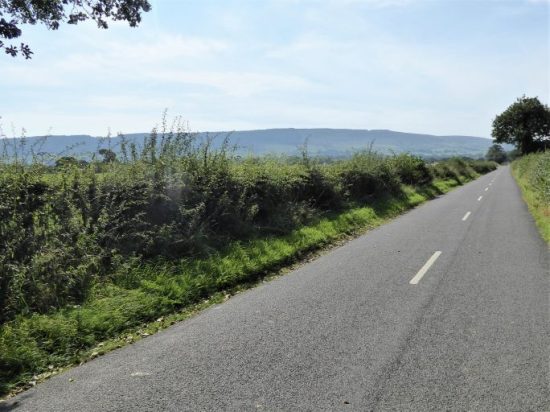
  The Gibbon Bridge Hotel is a little farther on and has a history only going back to 1982 when the family diversified from farming to catering. Over the years the hotel has grown and particularly in recent times with the focus on weddings. They still do a good lunch in the dining room, with magnificent views over the gardens and Chipping Vale.

  Chipping at one time had three pubs in the village. The Talbot has been closed  for years and is looking in a sorry state. Opposite, the Tillotson’s is now open again but has annoyingly random hours, they were missing trade today as lots of tourists were wandering around the quaint village.

  The Sun has had a renaissance and is now thriving both as a locals’ drinking pub and a reliable eatery. It is reputedly the most haunted pub in Lancashire.  https://www.youtube.com/watch?v=aA1MZp3WYdI  I couldn’t resist a wander around the churchyard looking for Lizzie Dean’s gravestone.

  The Cobbled Corner Café has not reopened — it was a favourite with cyclists.

   The Dog and Partridge just outside the village dates from the 16th century but closed in 2018 and is up for sale for residential development. Sign of the times.

  I now head out to Whitechapel on narrow lanes under the shadow of Beacon Fell, When I first came to this area in the early seventies a curiosity was the Cross Keys Inn run by a farming family. It had irregular hours depending on work on the farm, a quirky bar, a good pool table. Late night sessions were common. At times, if the landlord was busy elsewhere, there was an honesty box for the drinks you had consumed. The inn was known, tongue in cheek, as The Dorchester! It closed over a decade ago but was bought by a local builder who has restored it along with accommodation units and has recently reopened it. Again, as the case with many of these rural pubs they are not open every day, particularly at the beginning of the week, but it is good to see it trading and I’ve promised myself a pint there soon.

   Down the road is yet another Lancashire village, Inglewhite, centred on a village green and a cross. The pub here is called The Green Man and has a date stone of 1809. Green Men go back to pagan times and are a fairly common inn name — the sign here depicts a typical Green Man. This pub has been closed off and on for several years, reflecting the difficulties of successfully running a rural inn. Let’s hope it stays open for the foreseeable future. It was not open today!

Homeward-bound now with tiring legs, I pass the last rural pub — Ye Horns Inn. An 18th century listed building that closed four years ago. It had been run as a family business for decades, famous for its Goosnargh Roast Duck reared down the road, and its unique wooden panelled snug located behind the bar. New owners have developed the site with residential properties, but hope to reopen the pub soon. I await with bated breath. Another unique feature here is the men’s urinal across the road from the pub. Not sure how many drunken patrons were run down on this precarious crossing.

  It is strange that my trip around all these rural inns didn’t involve any alcohol intake but as you saw several are closed for good, others concentrate on dining and others have limited opening. With a bit of organisation and forward planning, a right good pub cycle could be achieved around the eight trading pubs— but whether it would be legal or safe to ride a bike at the end of it would be debatable.

LAST DAY ON THE TWO SAINTS WAY.

Cannock to Lichfield.      7 miles.

  My B&B host gives me a lift back to the Ring Circle Fort, and I’m on my way, downhill to Lichfield.  One was supposed to be able to see the cathedral from up here, but low cloud prevented that. There was good walking up on Gentleshaw Common and then old tracks through woods to come out onto quiet lanes to sleepy Chorley.

Back into the fields I came to Farewell Hall and the Church of St. Bartholomew built on the site of a priory.

For the next two miles I walked along the ancient Cross In Hand Lane, so named from the wooden cross pilgrims would hold as they approached St Chad’s Well. This lane was a joy to walk, in places hewn out between sandstone banks and in others with mature hedges. A scattering of farms were passed along the way, and at the bottom of the last hill a cave reputedly used by Medieval candle sellers to pilgrims.

Medieval cave?

Lichfield was entered alongside the old Pinfold, which has been recently restored.

The house belonging to Erasmus Darwin, the Physician and naturalist and Charle’s grandfather, is now a museum in the shadow of the cathedral. The man himself was looking out of a window. There are many fine houses in Lichfield which is worth a longer visit.

At last the three unique towers of Lichfield Cathedral were seen as I approached the magnificent entrance. A Saxon church was built here to house the bones of St Chad, to be replaced by a Norman Cathedral, the present Gothic structure dates from the 13th and 14th centuries.  One walks down the beautifully vaulted nave, through the chancel and there in front of you is the shrine of St. Chad.

Behind in the Lady Chapel are the famous Herkenrode stained-glass windows rescued from Belgium. St. Chads Head Chapel was closed to the public.

Two relics related to St Chad were on display —  The Lichfield Angel,  a beautiful limestone carving from the chest that contained his bones. The 8th century St. Chad Gospels, from which St Chads cross emblem was derived.

Leaving the Cathedral I notice the statue of St Chad by local sculptor Peter Walker  recently installed in the grounds. He looks a kindly man. The south door is every bit as good as the main one,

I then wander alongside the lake, Stowe Pool originally a 12th century millpond and fishery, to reach St Chad’s Church and Well and my final interpretation board!  When St. Chad arrived in Lichfield, 669, he baptised converts at a local spring and founded a monastery. He was buried here in 672 but his bones moved the Cathedral when it was built in 700. The present day church is mainly from the 14th century with many more recent modifications. Nearby is the Well which has been popular as a pilgrimage place, at one time surrounded by arched walls but now by a simple wooden structure. I’m not sure that the water is very pure.

My journey had come to an end, I have learnt a lot and experienced a good mixture of rural and urban scenery. The route was well thought out in that respect. The churches have been inspiring and whatever your religious views they are beautiful buildings and how well we preserve the past in Britain. The problem of churches being closed occurs anywhere nowadays. The guide book is well written and informative, the instructions are clear. There was no shortage of accommodation (putting my Crewe faux pas aside) or dining possibilities, although Covid precautions are still affecting the latter. As usual, I met relatively few people walking any distance, and only four on The Two Saints Way. I covered 90 miles from Chester to Lichfield, but I have to say I was relieved to know I could now rest my heel for a few days. There has been constant background pain all week, which at times distracted me from my surroundings — I was beginning to feel like a real pilgrim towards the end and possibly should have dipped my foot in St. Chads Well.

*****

DAY SEVEN ON THE TWO SAINTS WAY.

  Milford (Stafford) to Cannock.        10 miles.

  You have done well to follow me this far. I have done well to get this far. There are no churches to bore you with today!

  I have a dilemma — an extra and not particularly inspiring 4 miles from Stafford to reach Cannock Chase which I’ve done before on other occasions. A bus goes to Milford every hour. Dilemma solved, I take the pilgrim’s bus.

  This section over Cannock Chase brings back memories of when I completed it in reverse with my mate Mel 20 years ago. I’ve just returned from his delayed wake, he died in the middle of lockdown, April 2020. We were finishing The Heart of England Way back then, having walked from Lichfield to Stafford. As was our custom before travelling to our respective homes, we would have a few beers and a meal. We were in some dingy curry house in Stafford, Mel ordered a Chicken Jalfrezi, a fairly hot dish. When it arrived there must have been 30 whole chillis in it, I don’t know if there was any chicken. Mel managed a good three quarters of his meal. He was sweating profusely when the waiter came for the dishes, seeing the remains of his meal the waiter turned to Mel and said “so you don’t like chillies?”  This was met by much guffawing from Mel, he was still laughing about it years later. Great times.

   There are tracks all over the common at Milford, it must have been a nightmare during busy times in lockdown. Today it was mainly dog walkers parking up. Once in the trees the tracks can become confusing, I took the first compass bearing of the trip to get me into the Sherbrook Valley. There are numerous named LDWs coming through here.  As the clouds were down on the tops  I thought the valley route would be more attractive and so it turned out. Hands in pockets type walking, whistling a tune.

Having dallied with The Staffordshire Way, I joined The Heart of England Way, which led me to a visitor centre where I enjoyed a coffee and cheese slice. This was timed well, as it had started to rain. The car parks were full to overflowing, and yet the area is so vast that people soon thin out.

  The area around the visitor centre was RAF Hednesford in WW2 and has an interesting history worth reading. There are remains of huts scattered around and a Burma Star Memorial.  

   This area is popular with mountain bikers and there are several demanding loops heading into the trees and hills. The railway is crossed by an elaborate footbridge, which I don’t think was here the last time. More mountain  bikers were parked up just off the main road.

The main track I was using undulates through the forest and gradually climbs up to pass by an Iron Age Castle Ring Fort. This is the highest point on Cannock Chase at 801ft. The bracken growth at this time of year tends to hide the features, and the views weren’t good today.

There is a pub just down the road, but as was the case of many, it was closed and looking unkempt. I set off to walk the lanes but came across a pub that was open, The Rag. A pint and crisps were welcome and there happened to be a bus stop almost outside which would get me to my B and B on the edge of Cannock.  The bus driver was surprised to get a passenger from this out of the way place.  It was soup and sandwiches in my room tonight.


*****

DAY SIX ON THE TWO SAINTS WAY.

Stone to Stafford.      11 miles.

*****

  I enjoy a leisurely breakfast, this should be a short day. Another gel pad is added to my right heel, I’m beginning to walk on high heels.

It didn’t take me long to get back onto the way at St. Saviour’s churchyard in Aston. In the porch of the church I noticed a cockerel mounted above the door. Its interesting history was noted..

Behind hedges and walls across the lane is Aston Hall, now a home for retired priests. It was here in 1839 that the bones of St. Chad were found, having been hidden at the time of  the Reformation. They are now strangely in Birmingham Cathedral rather than the more obvious Lichfield. A lady dog walking told me how she discovered many of the local paths around here during lockdown and had noticed the TSW markers. I enjoyed a long stretch through fields with open atmospheric skies, just what you need to put a spring in your step in the morning.

I  then entered a watery nature reserve. A man birdwatching was eager to tell me of a large bull blocking the path at the next stile. He had taken evasive action and clambered along the banks of the stream, he was in no hurry to return. Forewarned, I proceeded carefully and sure enough the bull was lying there with his herd of cows. I never know which breeds are allowed in fields with public footpaths, and I probably wouldst recognise them anyhow. A bull is a bull whichever breed and this was a large one. I couldn’t see any obvious escape route, so I stood and watched for a while before tiptoeing cautiously past against my better judgment. I’m alive to tell the tale.

Burston village was across the canal, a few cottages surrounding a millpond, delightful. Behind and strangely adjoined to the last cottage was a little chapel, St. Rufin’s. (he of the legend)  It is thought there has been a church in this vicinity visited by pilgrims since the Middle Ages.

A peaceful stretch of canal was now followed  with boat owners relaxing or busying themselves with jobs on board.  I watched as boats negotiated the locks, by now I think I would be able to navigate these canals.

The guide book said leave the canal at the ornate bridge…   This took me into the village of Salt, I had promised myself a pint and sandwich in The Hollybush Inn, one of the oldest pubs in the country. Alas, it was closed. An appointed caretaker has been here since last July 2020 keeping an eye on the place. He was sat outside and pleased to chat, but there was no offer of a brew, even when I expressed my disappointment.     There followed a bit of hilly walking and wandering through large fields to come out in a crop being harvested on the edge of an MOD property. The incongruous memorial behind bars told the story of the Battle of Hopton Heath, fought here in 1643 between Royalists and Parliamentarians.    The entry into Hopton  through sandstone cuttings was promising, but the village was mainly modern bungalows.

  My way onwards to Beacon Hill was obvious and the hill promised views to The Wrekin and Cannock Chase. All I got was the approaching dark rain clouds over Stafford..  I’d had no rain all week, but ended up donning waterproofs for the last mile or so through the streets of Stafford. By the time I reached the centre, it was dry. St. Mary’s church was much better cared for compared to Stoke Minster, but unfortunately was closed. The foundations of an earlier Pre-Norman church can be seen  in front of the church.

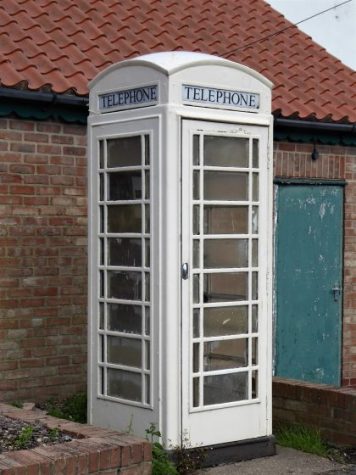
  The narrow lane leading to the high street passed the largest wooden framed town house in England. Shame they can’t spell ‘phone’    Next door was my comfortable hotel, The Swan an old coaching inn, and opposite was the oldest building in Stafford, St. Chad’s Church,1150. In its grounds was the base of a Medieval stone cross.

*****

DAY FIVE ON THE TWO SAINTS WAY.

Stoke-on-Trent to Stone.     13.5 miles.

  A long day.

Having slept in I crept out of my Airbnb at 9am, nobody else was up. My first priority was to find breakfast. By the station, all the cafés and bars were busy with football supporters topping up their alcohol levels before travelling to Birmingham for a derby match. I found a popular little café near the Cathedral where I had another oatcake, this time with an egg filling.

The Cathedral was large and imposing, but with rather run down grounds, it was not open. The present church is from the 19th century. In the graveyard is a Saxon cross from the earliest 8th century church. The cross has fine carvings, which may be the origin of  The Staffordshire Knot emblem. Another church was built in Norman times and its arches survive in the graveyard. Apparently inside the Cathedral is a memorial to Josiah Wedgwood and also to Stanley Matthews the footballer. I found the graves of Spode and Wedgwood. Time to move on.

The canal was regained for a few miles to get me out of Stoke. A typical stretch of urban towpath but well-used by joggers and cyclists. Somehow, I walked past the Britannia Football Stadium without noticing it, its new name is the awful Bet365 Stadium. I did however spot the sign on the marina — line dancing?

I cut through the backstreets of Trentham and arrived at the entrance to Trentham Gardens, a very popular family destination, I did not have time to visit the Gardens, but I called at their café for my mid-morning brew. Shopping seemed to be the main attraction.

After crossing the River Trent, I passed by an old courtyard, the original entrance to the estate. It seemed a shame it was going to ruin. Across the road was a modern courtyard development  modelled on it giving no doubt very expensive accommodation.

A little church, St Mary’s, was tucked away on the edge of the gardens. In the graveyard was a Saxon cross with  a well-worn Kneeling stone at its base. Pilgrims would have prayed here for centuries.

A steep track led up the hillside into King Woods on a ridge, all part of medieval hunting grounds. Down below, traffic crawled along the M6 on the stretch I broke down on last week, that’s another story. I couldn’t miss the football ground from up here. Despite all the cars and crowds below at Trentham, I was the only person walking along the airy ridge. I was surprised then when I came across a Colditz type wire fenced enclosure. Apparently this is The Monkey Forest, one of the Trentham attractions which must have cost millions to construct. There was no sign of the Barbary Apes that live in there, but I hadn’t paid my entrance fee.

Farther on, I could hear excited voices in the woods and again I was surprised to come across an aerial assault course, the Trentham people certainly know how to extract money from visitors.

I made my own assault of the hill in front of me to come out into the open at the 1st Duke of Sutherland’s statue. His statue was erected here in 1836 as an indication of his service to the local populace. This popularity didn’t extend to his time in the highlands, where he was responsible for much of the Highland Clearances and was hated by the Scots for evermore. His statue on Ben Bhraggie has been threatened with  demolition on many occasions. There were good views down over Trentham Gardens with its lake and the Stoke area in general, and quite a few people had come up here for that reason. (heading photo)

At the bottom of the hill was the little village of Tittensor with the church of St. Luke’s in the middle of a housing estate. It had an attractive timbered tower, a Duchess of Sutherland foundation stone, a bench for refreshments and the now familiar TSW interpretation board.

There was a very pleasant stretch over Tittensor Chase’s sandy heathland. Just visible in the high bracken were a Saxon burial mound and a much larger hill fort, Bury Bank,  which at one time was the capital of Mercia and probably the birthplace of St. Werburgh, a then princess, to  King Wulfhere. This family has gone into folklore from the ‘fact’ that Wulfhere killed two of his sons, Wulfad and Rufin. Read the full story involving St. Chad  here.

Tittensor Chase.

Saxon mound.

Bury Bank, ancient fort ahead.

Then I was back on the Trent and Mersey canal towpath for a mile into Stone. The town makes much of the legend mentioned above. The main street looks similar to many other pedestrianised town centres with its Costa Coffee, Wethespoons, Mountain Warehouse etc.

The St. Michael’s Church was built in 1758 in the grounds of a previous Augustinian Priory, where there was a shrine to St. Wulfad, who was supposed to be buried here under a pile of stones. Today the church was closed so I couldn’t view the stained-glass window dedicated to Wulfad and Rufin. In the grounds was a family Mausoleum of Earl Vincent,  an admiral in the time of Lord  Nelson and a Crompton grave.

Vincent Mausoleum.

Crompton family C17th tomb.

My hotel for the night was out of town. On the way I stopped at a garage to buy some milk and in conversation with the attendant found he had some involvement with the church back in Tittensor. He is doing the Two Saints Way in day sections, we compared experiences, a strange meeting. My hotel, Stone House, was the best of the trip yet.- a sumptuous bath and an excellent Indian restaurant.

*****

DAY FOUR ON THE TWO SAINTS WAY.

Barthomley to Stoke-on-Trent.     12 miles.

  I think I was still in shock this morning, I emptied the coffee sachet into the bin rather than my cup and then I used my asthma spray on my armpits. What more could go wrong?

The advantage of the taxi back to Barthomley was I didn’t have to face that busy road again. The driver was Turkish and on the way I got his life history. He lives in Alderley Edge because that has more say with the girls on dating sites than Crewe would have.      He made out he was also a football agent and told me to look out for an up and coming star at Liverpool – Harvey Elliott.

I’ve inserted an extra heel pad into my right boot.

Well signed and stiled field paths took me south from Barthomley, heading for a valley which the guide book author rated as one of the most scenic stretches on the way. Mill Dale. I wasn’t  that impressed. Once I had found the path down into the valley, I felt hemmed in by fencing. I would have liked to wander by the water. Yes, there were good stretches of water in the distance, but I seemed separated from the reality. This was reinforced at the end near houses where the way ahead was obscured, deliberately? I made my way up into fields above the valley.

I crossed what must have been the M6 and then started climbing a small hill with views back to the Cheshire Plain, Mow Cop to the northeast and then down to villages with a monument to Wedgwood prominent on Bignall Hill behind. I assumed it to be for Josiah Wedgwood of ceramics and pottery fame, but I find out later it is a John Wedgwood, 1760-1839, a local coal mine owner and employer. Within a few hundred yards, the scenery has changed – gentle Cheshire to grittier Staffordshire.

Audley is the first village I come to with a welcome little bakery where I can sit outside in the sun and enjoy a coffee and cheese slice. Naughty but nice.  The route winds its way between villages using green areas which in the past have been a hive of industrial activity. The area was rich in coal, ores and clay. First Leddy’s Field reserve and then the much larger Apedale Country Park. I meet three walkers who lived around here as children and can remember the pits and railways. They are having a nostalgic meet up.

Leaving Leddy’s field.

‘Last of the summer wine’

Apedale.

Walking along the old railway, I make good progress. A park warden tells me of the problems they have had during lockdown with bad parking and litter. They were reduced to a skeleton staff who spent most of the time dealing with the nuisances and now are way behind with their general work. He is a keen walker, having completed many long distance paths, and is proud that the Two Saints Way comes through his patch. In another part of the park there is a heritage centre, museum and narrow gauge railway. Tours of some old mines are possible.

The pit railway.

Nice job!

A steep road, there are a lot of hills today, brings me into Chesterton, an old colliery village, and the outskirts of Stoke. It is urban walking for the rest of the day. The pubs here have closed down, the church has an unkempt appearance and the streets untidy with litter  The café I find specialises in Staffordshire Oatcakes  These are a local delicacy like an oaty pancake, very popular in the Stoke area, I buy one filled with cheese and sit on the steps of the nearby Salvation Army hall to eat it with my coffee. I must look like a tramp.

  An unsavoury park takes me up a hill into the next area of housing where I rely on my phone satnav to navigate me down to the Trent and Mersey Canal.

  The walk along the canal was varied from industrial wastelands to upmarket waterside living. There were reminders of the pottery trade all along the way. I stuck to the canal towpath, whereas the Two Saints Way wandered into the old garden festival site and on to visit the Potteries Museum. I had hoped to see the Staffordshire Saxon Hoard there, but the museum is closed until later in the year, which is a shame.

Best floral display.

Wasteland.

The Round House. Formerly part of the Wedgwood Etruria Pottery works, and built 1769.

I dallied at the junction of the Trent and Mersey with the Caldon Canal. The Etruria Industrial Museum there was closed!

  My Airbnb room in Stoke was not far from the canal in the student area, my hostess is a holistic practitioner and a musician, the house was an oasis of calm. Down the road was an Afghanistan restaurant which served fabulous food, the staff were obviously concerned about their relatives and happenings out there at the moment now under the Taliban. Most won’t be eating as well as I am – Qabuli Pulau.

*****

DAY THREE ON THE TWO SAINTS WAY.

Nantwich to Barthomley.      12 miles.

  I reflect on the temporary healing powers of beer and Brufen as I hobble into Nantwich on a lovely sunny morning. The Church of St. Mary doesn’t open its doors until 10am, so I poke about in the narrow streets with some surprising finds.

Chimney from a wheelwright’s forge and smithy,

The Market Hall.

Good to see it thriving.

Parked up for the day’s shopping.

Immaculate Higgins classic.  I saw the proud owner cycling on quiet lanes later in the day.

  St Mary is an amazing church – cathedral like. You are enthralled as soon as you enter the Nave. Most of the church is C14th, and it is recognised as one of the finest Medieval churches in England.   The splendid, intricately carved Monks stalls with triple canopies and their Misericords grab your attention.     A fine tomb to a Thomas Smith and his wife from the C17th…     …and an effigy of C14th Sir David Cradoc, patron of the church, in alabaster.   A majestic modern stained window depicted life in rural Cheshire, linked into the creation story with Halley’s Comet in the right trefoil, dating it to 1985.    I forgot to look for the several ‘Green Men’ in the church. On the outside there were some fine gargoyles, in the red sandstone.
  At last, I was away and walking through pleasant parks alongside the River Weaver. Dog walkers were in ascendancy – I wonder how long this passion with dogs will last? Nantwich seemed to be a good place to live.

    And then I was in the countryside with well-marked paths leading me on.   I was on my way to Wybunbury, Winbury to you, and I was pleased to find the post office open with coffee and sandwiches available to enjoy on the seat outside. I take every chance I can for a sit down and some caffeine.

  At the end of the village was St. Chad’s tower once a C15th church but now truncated since the demolition of the main part of the church in 1972 due to subsidence. The tower was stabilised in 1832 using methods of under-excavation, later employed to stabilise that leaning tower in Pisa. Apparently it still leans to the north. It is thought that one of the figures at the entrance depicts  St. Chad. A modern St. Chad’s church was passed in the village earlier.

As it was early C20th.

  The path out of the churchyard took me through a wetland reserve and up into horse paddocks with a multitude of stiles, when a simple footpath diversion would have been more sensible.   On the outskirts of Hough I met up with a man and his Springer Spaniel, both as keen as each other on exploring the boggy land in the woods which we traversed. Then it was into fields of tall maize, where you just had to follow a narrow corridor. Somewhere along there I crossed the West Coast mainline, the real one this time. I was glad of a sit down and coffee at the White Lion in Weston. Across the road was the small brick built All Saints’ Church with its unusual semicircular chancel.

  Time was passing on as I walked the narrow lanes to Englesea Brook a small hamlet with a museum devoted to Primitive Methodism. Originated in America, the movement began in England around 1807. It was mainly a working class movement and had a part to play in the establishment of the trade unions.  A prominent tomb in the graveyard is that of Hugh Bourne, one of the pioneers of Primitive Methodism.   Onwards past some fine houses with a few hills to climb at the end of the day.   At last the steeple of St. Bertoline’s Church at Barthomley came into view, standing on Barrow Hill an ancient burial ground. This is where on a visit a few months ago I discovered the Two Saints Trail, it felt good to return here. Each section of the way has an interpretation board erected by http://www.twosaintsway.org.uk

St. Bertoline’s is a handsome church in red sandstone, most of it dating from the 15th century, though there is a Norman doorway built into the north wall. Inside are tombs of past notables in the Crewe Chapel. The chancel was rebuilt in 1925–26 by Austin and Paley, well known church architects from Lancaster. Above the west door are three carved heads, the left one was replaced in 2015 with the homely face of Bishop Peter Forster of Chester. I met the vicar as he came to lock up and of course discussed at length ‘my pilgrimage’.  He had recently come to this church from a Blackpool parish – what a contrast.

  Adjacent to the church is the friendly White Lion Inn where I enjoyed a pint of beer in memory of Dor whose relatives are buried here and who loved this pub.   This has been a long day, five churches, but it was not finished. I had struggled to find accommodation in Barthomley and all I could manage was the Travel Lodge a mile or so away just off the motorway on a busy dual carriage way. I risked life and limb getting there only to find I wasn’t booked in. Not knowing there were two, I had by mistake booked the Travel Lodge in Crewe, a few miles away. They could accommodate me here, but at the cost of £100, the ‘walk in rate’. I laughed at that, as they had never had anybody actually walk in before, cars and lorries only. Helpfully, the receptionist suggested getting me a taxi to the other place and before I knew it I was putting my feet up in my booked room. That was the least expensive way out of the dilemma, and I would book a taxi to take me back to Barthomley in the morning. But I did feel stupid.

*****

The arrow on the map shows my eventual destination.

DAY TWO ON THE TWO SAINTS WAY.

 Tarporley to Nantwich.   12 miles.

  As soon as I arrived in Nantwich I searched out a chemist before they closed. I was in need of more Brufen and some gel heel pads as I had been in increasing pain during the day. I was still considering catching the train home, the station was close by. But let’s see what difference a night’s rest makes. The Railway Inn where I was staying weren’t doing meals, shortage of chefs at the moment with Brexit and Covid. I was content with a pint and a sandwich and that early night.

  This morning I had rejoined the Two Saints Way on the Shropshire Union Canal at the Shady Oak pub for a short stretch to Wharton’s Lock. I’d been here before on the Sandstone Trail which was followed up to Beeston Tor, arriving before the castle opened – another time.

  Then I ended up walking along quiet Cheshire lanes, as apparently the right of way across fields has been disputed, time the Council sorted that problem, it sniffs of rich landowners to me. At least from up here there were good views back of Beeston Castle.

  Bunbury was a spread out village where I stopped off at The Nags Head for a coffee, surprising how many people were drinking in the bar at this early hour.

  St. Boniface church, C15th, was on the highest point and as I arrived a funeral service was just finishing with people milling around outside. Out of respect, I was going to move on, but a chance conversation with the funeral director assured me they would be gone shortly. In fact, this had been a memorial service for a local resident who’d died during last year’s lockdown. A Scottish piper headed the ash scattering procession into the churchyard. Then I eventually looked around the beautiful sandstone church, featuring some outstanding stained-glass and historic tombs. The friendly vicar, who was very proud of his church, was interested in my route and pointed out not to be missed churches further along the way. The day was getting on, so I didn’t visit the Dysart Arms opposite.


I walked on to rejoin the canal at Bunbury locks, where there was the old stabling for express horses of days gone by.  

  Continuing along the canal I passed the equivalent of a motorway service station busy with barges and boating people. It appeared as though some regulars along this stretch were vying for floral boat of the year. I came across an unexpected café at a cheese factory. I don’t often pass a coffee stop, so I was soon ensconced with a brew. Lots of friendly people to chat to and a chance to put my foot up.

  The canal continued alongside a busy road and industrial estates. I was distracted enough to photo all the different flowers on the towpath. Up to 30 different species in a short stretch, I won’t bore you with all the pictures.

  Slowly the walk became more rural as I passed the Middlewich branch of the canal. The waters became much busier with traffic, everybody seemed to be having fun. 

   I decided not to take the Llangollen canal as my heel was playing up, I just continued along the Shropshire Union into Nantwich, a busy section of the canal.

Soon I was in Nantwich, with its many attractive and historic buildings.

  The church could wait until tomorrow, I was in need of a rest.

*****

CaptureTSW 2

DAY ONE ON THE TWO SAINTS WAY.

Chester to Tarporley.  11 miles.

  I started my Two Saints Way  “pilgrimage” in Chester. An early morning train had me there by 9am and the Cathedral is not far from the station.  The Romans built a settlement here with straight intersecting roads in AD 79. It was later inhabited by a Romano/British population, and it remained an important location for the domination of Wales. At the site of the present Cathedral, Christian worship began in late Roman times. A church and abbey were dedicated to St. Werburgh when her remains were moved here, protected by the Roman walls.  At the dissolution,1538,  the abbey was destroyed but the Cathedral subsequently survived. As was normal, additions and alterations took place up to the Victorian era. It has to become one of the best representatives of the Gothic and Perpendicular styles. I went to see the shrine of St. Werburgh. I was greeted by a model railway exhibition!

  Pete Waterman OBE, the record producer and railway enthusiast, has designed a layout to commemorate the work of Chester’s Civil Engineer Thomas Brassey, 1805 – 1870,  who in his lifetime was responsible for many of the railways in Britain and the rest of the world. There is a commemoration bust to him in the cathedral. Lots of excited children and adults were gazing at the little trains whizzing around Pete’s West Coast mainline. Is that the man himself?

  To get back to my purpose down the far end of the magnificent nave of the Cathedral was the shrine to St. Werburgh who looked a little small in her niche.

Elsewhere, there were stained-glass images of both my saints.


  There was much more to explore in the Cathedral, but I haven’t space here for more pictures. My journey had begun.

  The streets of Chester were busy with tourists and shoppers but around the corner was an old cross unnoticed by many, it stands at the  central Roman crossroads.  Then it was shops galore down Bridge Street…

… leading to Newgate, the Roman amphitheatre and St. John’s Church with its attendant Medieval ruined chapel, the first Saxon Chester Cathedral.    I reached the canal and set off Eastwards at last. This area had been the industrial heartland of Chester in the C19th, when it was an important port. There has been a sympathetic preservation of the old alongside modern living. This was the Chester Canal, the first part of the Shropshire Union network. The towpath has been ‘improved’ with tarmac giving fast going, but I found hard going on my heel. More locks followed and at Tarvin Road lock there was a traditional lockkeepers cottage and an unusual round lengthman’s hut.

My first diversion was into the village of Christleton, a wealthy backwater, to visit St. James, a C15th church built on the site of a much older wooden church. Inside were several interesting relics, including a marble font, Millennium stained-glass windows and a wooden carving of a pelican tearing its breast to feed its young.

  Alongside the church on the green was the village well and Victorian pump house.

  I found my way back to the canal, now passing elegant houses and gardens. Fishermen were after perch and roach. One chap I chatted to said he had had 20 catches that day but whilst I was there not a single bite!

  There were no locks on this stretch through the flat Cheshire countryside. Passing a marina, I watched a couple trying to steer their newly hired boat out of the basin.

  Along here I saw my first Way of St. Chad’s roundel marker.

  Onwards the towpath was rather overgrown, not many people walking this stretch. Over to the right was Beeston Tor with its prominent castle, on tomorrow’s walk.

My destination today was Wharton’s Lock, where I intended to have a drink in the Shady Oak pub whilst waiting for a taxi to Tarporley. Alas, the pub was closed, the first of many. I was preparing to walk up the roads to Tarporley when another disappointed couple who had travelled here for a drink offered me a lift. Before I knew it, I was sat in the beer garden of the Forrester’s Arms. That was fortuitous because by then I was limping on my bad heel and ominous thoughts of having to catch the train home tomorrow were in my mind. A good evening meal and a night’s sleep hopefully would put me in a different frame of mind, if not body, tomorrow.


*****

TSW 1


THE TWO SAINTS WAY.

   Whilst visiting Barthomley in Cheshire a few weeks ago I noticed a footpath marker for the Two Saints Way, a route I was unaware of. A bit of research on the LDWA site followed, and the guidebook was ordered.    (Incidentally I use Blackwell’s now for ordering online books. They are competitive with Amazon for price and delivery, are still independent and pay their taxes in the UK.)   The route has been devised as a 92mile (148K) Pilgrimage between the Cathedral cities of Chester and Lichfield. David Pott’s guide-book is well-produced and gives all the background information you need on the Saints and Churches. The directions seem precise and are separate from the descriptive information.

The Two Saints are St. Chad, whose shrine is in Lichfield, and St. Werburgh, enshrined in Chester. They were both alive in the kingdom of Mercia in the 7th century and were prominent in introducing Christianity to the region. In Medieval times, pilgrimages were made between the two cities and onwards. I have completed St. Cuthbert’s Way, The North Downs Way and St. Hilda’s Way in the past, not to mention the Camino de Santiago de Compostela, so this route sits alongside them nicely. I am not overtly religious, but the history and sense of purpose behind these ancient and modern pilgrimages appeal to me and give a theme and focal point to a long-distance walk. In any case, many ancient tracks now followed by our trails were originally used by monks linking their monasteries,  and these became trade routes. Wayside crosses are a common sight on our walking trails.

   St. Werburgh was the daughter of the Mercian King Wulphere, she learnt the Roman Christian faith from her mother and entered a convent at Ely. Over her life, she came to oversee all the convents in Mercia and was respected as a model of Christian virtue. She was buried at Hanbury, Staffordshire, but during a Danish invasion in the C9th her bones were moved to the safety of St. Peter and St. Paul in the walled city of Chester. Her shrine there became a pilgrimage site, and the abbey church became Chester Cathedral. A story links St. Werburgh and a miracle with a flock of geese, and a goose became a symbol of her.

   St. Chad was born around 634 to a Northumbrian family and had his early religious training under St. Aidan at Lindisfarne and then in Ireland. In his life, known for humility and Godliness, he took on many monastic positions and came to Lichfield in Mercia where he would baptise the converted in a holy well. Nearby, he founded St. Mary’s church. He was buried there in 672, but when a new church was built nearby in 700 his remains were transferred there, this was superseded by the present day Cathedral started in 1085. At the Reformation some of his bones were removed and hidden by Catholic families in Staffs, they were found at Aston Hall, on the route, and moved to Birmingham RC Cathedral. St. Chad’s well became a site of pilgrimage. The Gospels of St. Chad, documents from his time, are preserved in the Cathedral and the symbol of St Chad’s Cross was taken from them.

Enough of the history, I am looking forward to walking through traditional English countryside and interesting towns and cities. Hopefully a varied walk. For no good reason I’m starting in Chester and heading to Lichfield.   Uniquely, the Two Saints Way route is referred to as The Way of St Chad in the Chester to Lichfield direction and waymarked with the symbolic cross of St Chad. The route from Lichfield to Chester is referred to as The Way of St Werburgh and waymarked with a goose, her symbol.  So, I’ll be following the Way of St. Chad, but paying homage to St. Werburgh whenever I look back.


*****

Since I wrote this I ‘bruised’ my heel bouldering and have delayed the start of my walk. Wish me luck.

THE INGLORIOUS 12th.

Hen harrier.

   I’ve put myself out of action by landing badly on my heel whilst bouldering without a crash pad, just when I was preparing for a long distance walk. So with the grouse shooting season soon to be upon us, I’ll share a post from Rapture Prosecution of a press release from Rewilding Britain   which highlights the fact that OUR National Parks host substantial areas of Grouse Driven Moors. Certainly worth a read.

https://raptorpersecutionscotland.wordpress.com/2021/08/05/new-research-reveals-extent-of-nature-impoverished-intensively-managed-grouse-moors-in-britains-national-parks/

The evidence of damage to protected habitats, increased flooding, greenhouse gas emissions from moor burn, and of course, the illegal persecution of protected wildlife, especially birds of prey and small mammals caused by the grouse shooting community is pretty damning. But our politicians do little about it.

The more the public are aware of the problems, the more chance of some legislative reform. There are lots of people (Chris Packham, Ruth Tingay etc) out there trying to raise the profile of the damage, if not criminality, caused by the shooting community. So sharing this post may open more eyes and ears to the situation. There are plenty of petitions to add your names to, every little helps.

And if that’s not enough, with a reference to my Bowland area, why not take a look at the events on Hen Harrier Day tomorrow https://henharrierday.uk/hhdo-2021

Now back to the Olympics.

YELLOW DUCKLINGS UPDATE.


     I was back up there tonight. As I walked in, I could see the six ducklings swimming about below. Their activity seemed frenetic – darting hither and thither. But no sign of Mother Duck. My anxiety rose, suspecting her fate. How would the ducklings survive?

   I sat around in the light rain watching their activities.

   Thankfully after perhaps an hour in flew Mother Duck who immediately took control of the situation and heralded her offspring into the dense bracken with much chirping and squeaking. They will be safe tonight.


   Whilst poking about on one of the quarry walls I became aware of a constant buzzing noise. Wasps were flying about, and there in front of me was the biggest wasps’ nest I’ve ever seen, over a foot high. Time to retreat.

OUT OF THE ORDINARY.

I could hear rustling in the ferns behind me all evening and when I looked some movement in the vegetation and the occasional squeak, but no clue as to what was in there. I was bouldering on the north facing wall of Sweden Quarry, which gave shade from the hot sun, even so I was sweating profusely, we are just not accustomed to temperatures in the high 20s. The quarry hosts quite a bit of bird life – blackbird, wren, robin, chiffchaff, blackcap, mallard and no doubt many more. Barn owls nested earlier in the season. It is a great place to sit and take in the ambience such as it is with old tyres, fencing and rotting trees cut down in the plantation a few years ago. The pool at the bottom has shrunk greatly in this recent drought.

I was about to leave when I spotted something yellow out of the corner of my eye, in fact, there were two yellow blobs in the grass. The squeaking became louder as Mother Duck led her brood out of hiding down to the drying up pool at the base of the quarry. The other four chicks were brown and well camouflaged, it was the two yellow ones that gave the game away. I grabbed my phone for a quick shot, but then realised they were out to play for a while, so I was able to retrieve my camera and sit down to enjoy their display. Mother floated quietly whilst the chicks darted about exploring, exercising their legs and no doubt eating the odd green morsel. After some time, Mother decided they had had enough and marched them back into the undergrowth to hide away for the night. I hope the ducklings survive but fear for the yellow ones who are all too obvious to any predator. I will report back on further sightings over the next week. (Still six there two days later) So how unusual are yellow ducklings? Mallards, Muscovy and domestic ducks have occasional yellow ducklings, many of these develop into white ducks – so we will see.

The joys of living in the Ribble Valley on an evening like this.

COFFEE ON THE FELL.

P1030909

Thursday, July 15th. 7.5 miles. Knowle Green/Longridge Fell.

10am. As usual, I’m festering in bed with a second coffee and the day is drifting away. The high temperatures ensure I’m not rushing off anywhere. The phone rings and I prepare myself for fending off Amazon Prime or Netflix scams. But no, it is JD enquiring if I’m wasting the day or would I like a walk, 5 or 6 miles up the fell? I say yes to the latter and hurriedly sort myself out to meet him at the top of town. Things have gone quiet since my trips away, I’ve been bouldering up in Sweden Quarry the last few days, where there is shade from the hot sun, but my arms need a rest, so a walk is perfect.

We take the path through Green Banks Quarry housing estate, given planning permission on the understanding that it would be for tourist lets and bring prosperity to Longridge, what a joke. A bridleway goes down to the Written Stone, all familiar territory. We catch up, he’s been away in the Lakes, and I’ve been straight lining it to the North Sea. Our vague plan was to walk field paths above Knowle Green and then maybe climb up onto Longridge Fell.

P1030892

Coincidentally, one of the last times I was here was with Sir Hugh on that straight line walk I mentioned earlier, back in winter 2019. https://bowlandclimber.com/2019/02/04/sd-38-longridge-to-barrow-whalley/ So I had a ready-made continuation walk on paths not known to JD or to many others, judging from their wildness. The same farmer who appeared from his run down house back in 2019 was eager to chat again today. He was all talk of shearing his sheep tomorrow and how if he penned them in on his cobbled area they would clean the yard of vegetation. There is no money in sheep wool these days. He warned us that the footpath ahead was difficult to follow, but I thought I knew better until we ended up in the wrong field. I did at least find the hidden way across Cowley Brook.

P1030896   Working our way up pathless fields to Hougher Hall was hot work, the dreaded Horse Flies were a menace. The slate poem by the gate is a lovely reference to swallows, unfortunately there aren’t many about this year.P1030902

   It was with some relief that we arrived at the open fell by the little reservoir. This where JD pulled out an ace and set his stove up to prepare a decent coffee with biscuits. Luxury. Friends of mine wild swim in this water, but I see that a ‘No Swimming’ notice has been erected since last I was here. Presumably, United Utilities Health and Safety.

P1030904

Barista extraordinaire.

   Refreshed we continued up onto the fell, looking back the reservoir appeared hazily below. P1030905    We had no need to visit the trig point, and it was now all downhill on the spine of aptly named Longridge Fell. There was some friendly discussion as to the length of our walk, JD’s 5 or 6 probably transformed to my 7 or 8 miles.

   Guess what, we finished the afternoon having  another coffee with his wife on their sunny patio with their wonderful Bowland Panorama.P1030910

   Simple pleasures but maybe too much caffeine.

*****

CaptureKnowle green

NORTHING 438. OLD ELLERBY TO THE NORTH SEA.

P1030833

Saturday 10th July. 9 miles.

    The morning of our final day starts misty and damp. We struggle to find anywhere to park near the coast – it is all PRIVATE and NO PARKING signs and feels unfriendly. We ask at Low farm and they point us to a secure place in their yard. From Old Ellerby we are a happy to follow little lanes for most of the morning. We see nothing of the hall at Burton Constable. At last, a footpath alongside a drain gives some relief from the tarmac. We meet locals walking the lanes, one couple exercising their two energetic Spaniels. There is talk of drilling in nearby fields – fracking or natural gas? An industrial plant looms out of the mist on a path we do not follow. Our path into Aldbrough shows enough fractures to be worried about.

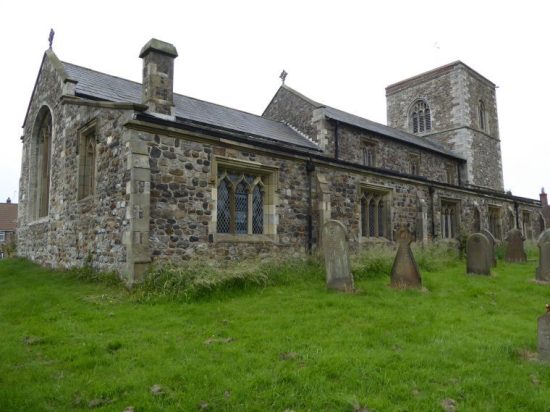
At Aldbrough, we head for the church and find a seat for some lunch. The Church, St. Bartholomew’s, is from the C12th and built predominantly with course cobbles.P1030818P1030825P1030821P1030822P1030816P1030824

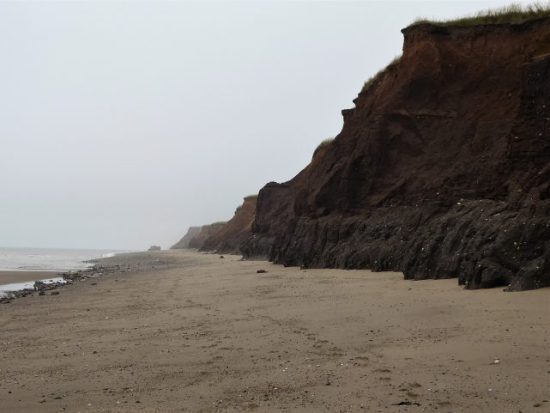
The narrow lane takes us past our parked car and onto the top of the crumbling cliffs – the end of our walk  – or is it. We had seen fishermen on the cliff top and now they were down on the beach, so there must be a way down. All around are private and no entry signs, but I can rely on Sir Hugh to persevere, before we know it we are on the sands. A chat to the fishermen, whom are casting for Skate, and then using GPS we are exactly on the 438 latitude line which we draw in the sand. A satisfying end to our straight line coast to coast from Blackpool started in January 2019. It is unlikely that anyone else has done or will do this walk, making it quite unique.P1030828P1030832P1030854P1030846P1030843P1030841

We return to Low Farm along the crumbling cliff path and buy some fresh eggs from the 5year old who is in charge of the chickens. They are preparing for a family birthday party tonight, it should have been in Ibiza. Friendly people living in a distinctive landscape.P1030855P1030858


*****

CaptureSD38oe to sea._LI (2)

*****

A straight line, 121.78 miles.  We have taken 16 days and I estimate walked 157 miles.

Check out http://conradwalks.blogspot.com/ for an alternative story.

Capture 438line

NORTHING 438. BEVERLEY TO OLD ELLERBY.

P1030765Friday 9th July.      11.5 miles.

We are back at the golf course – dare we park in the President’s space – better not. The road into town leads through the common, the cows have moved to a cooler place. A dog walker tells us that sometimes the cows turn up in the town streets. P1030739

P1030742

P1030740

Our one point of reference is the Minster, and we are amazed at its size and presence. On a more mundane note, we spot the cream boxes of Hull Telephone Department, a separate entity to BT. We do not do Beverley justice as we slink along side-streets, aiming for the all important bridge across the River Hull. P1030747P1030748P1030750P1030751

Time seems to be dragging in the oppressive heat, so we are pleased to come across a café alongside the river. Two no-nonsense mugs of tea revive our flagging spirits.P1030755P1030754

This necessary crossing of the Hull and a major dyke took us just over one mile from our straight line, probably the most we have deviated on the whole walk. Once the bridge is crossed, a new land opens up – flat drained fields as far as the eye can see. Sir Hugh likened it to the ’empty quarter’. Fields of barley, wheat, rape and linseed. We are soon through Weel where complicated footpaths could have taken us south, but we had an eye to a black hashed line on the map following the Holderness drain. This proves to be an accessible and newly cut embankment, and we are soon at Meaux Bridge where a locked gate has to be negotiated. Something tells me that we weren’t supposed to be in there. It pains me to show the picture of Sir Hugh’s struggle.P1030759P1030760

P1030763

The empty quarter.

P1030770P1030777

P1030776

Cornflower and mustard.

P1030787

P1030786

Linseed.

P1030779

Little roads wander through the Benningholme Estate. The highlight along here was whilst we are sitting on a log, a man appears from the nearby house with offers of iced orange. These are very welcome and we spend time in conversation with him and his neighbour. Once the world has been put to rights we resume our journey to Skirlaugh, taking a field path for the last stretch.P1030783

The early C15th Church here takes us by surprise – according to Pevsner, a “gem of the early-perpendicular” style.

P1030791P1030792P1030793

A couple more miles on narrow lanes, crossing the Trans Pennine Trail/Cycleway which ends in Hornsea, and we are back at our car at The Blue Bell  pub in Old Ellerby.P1030794P1030795

It’s been a hot and sweaty day, relieved thankfully by our two unexpected drink stops.

*****

Capture SD38 b to oe_LI

NORTHING 438. NORTH CLIFFE TO BEVERLEY.

P1030735 (2)Thursday 8th July.    10.5 miles.

   You may wonder how we then found ourselves atop of a windmill.

   In hot sunshine we had been walking uphill on a minor road for about 5 miles when we decamped into a field for some lunch. I suggested to Sir Hugh that today’s post would be fairly short as little had happened, he wondered if anything exciting would occur towards the end.  We eventually left the road and found a footpath going in our direction, don’t forget we are following a straight line as close as possible to latitude Northing 438. This we gratefully followed onto the golf course and whilst getting our bearings got into conversation with a friendly chap walking across the course. We asked for the best way to cross towards a windmill we had seen marked on the map. Having explained what we were doing, he wanted to discuss the long distance paths he had walked and also suggested to us the best pub in Beverley – the gas lit Nellie’s.(the White Horse) His wife and friend had by now walked away,  we parted and approached the windmill which was surrounded by a large herd of cattle, so we didn’t get up close. Beverley Minster could be seen down below through the trees. We now made a b-line to the clubhouse, where our car was parked, and whilst photographing the windmill there our man approached again and asked if we would like to go up it. Turns out Brendon is President of the club! He tells us of the history of the course, founded in 1889 and the unusual nature of it being on common land with the cows wandering freely. There are local rules for if your ball lands in a hoof mark or even worse cow dung, apparently the greens are fenced around to keep them free of animals. Next thing we were all climbing the rickety stairs up the inside of the mill, We paused on the second floor to admire the clock mechanism gently ticking away. Once on the top parapet, we had views of the surrounding countryside in all directions. 

P1030719

On the golf course.                                                                                                                                                                                                                                                     

P1030723

P1030727

P1030731

El Presidente.                                                                                                                                                                                                                                                                                                                                                                                  

P1030732


P1030734

P1030736

P1030729

Zoom to Beverley Minster.

A strange but interesting meeting. 

***

   The day had started back at North Cliffe where we parked next to the church, we are using two cars to facilitate this linear walk. The church and hall caretaker appears, so we get some history of the estate and the church. He has been doing this work for 50 odd years and lives in an estate house opposite, we saw the Lodge yesterday – all of a similar architecture. Most interesting is that the founder of the estate was a Samuel Fox, who invented a steel ribbed umbrella superior to his competitors. He went on to establish a large steel producing complex. https://en.wikipedia.org/wiki/Samuel_Fox_(industrialist)  Mr Fox funded the building of this little church, dedicated to St John,  and was buried in its graveyard shortly after its completion in 1887.

The path out of North Cliffe doesn’t exactly go up a cliff, but does climb quite steeply up an escarpment which is the beginnings of the Yorkshire Wolds and into the pretty village of North Newbald. Old cottages surround a village green, complete with church and pub., quintessential English. We investigate a house on the green which had been the village school, the owners appear to give us some history and suggest cups of tea, we politely decline – if we had known what was coming on the road walk we would have accepted their offer.

Climbing the ‘cliffe’


Anybody with a dog or an MX5 gets a picture.

The old school.

It was then we began our hot  and sweaty ascent on minor roads farther into the Wolds. I walked the Wolds Way with Mel way back in 1999, no wonder I don’t recognise it. All up and down between extensive fields.


We eventually escape onto the golf course…

*****

CaptureSD38 nc to b_LI


NORTHING 438. FOGGATHORPE TO NORTH CLIFFE.

Wednesday 7th July. 9.5 miles.

   It was January 2020 when Sir Hugh and I were last over in East Yorkshire, walking our straight line coast to coast. (My comment on that post may explain the naming of our line) No progress has been made since then, for obvious reasons. But today we are back, with four days walking to reach the sea.

   Foggathorpe feels familiar as we pick up the old Market Weighton to Bubwith rail line which is now a pedestrian and cycle route conveniently coinciding with our 438 latitude line. As a railway line goes, this is quite pleasant, with verdant vegetation and a succession of locals with a variety of dogs. We even meet a horse rider trotting along.

 Back on the Bubwith – Market Weighton Line.


Australian Shepherd Dog and Patterdale Terrier.


Cocker Spaniel.


Patterdale x Jack Russell.

   We leave the line at the Old Holme station, where the last lady we met lives on the old station house.

Holme Upon Spalding Moor Station.


Station House.

A minor road is used to bypass the main road through the village, this brings us out  exactly opposite the lane we need to take to reach All Saints Church. It is set on the top of the only hill, 45 m, in the area. We approach through a wonderful flower meadow. It is an ideal spot to find a bench, enjoy the view and have some lunch. The church is Medieval, with some parts dating from the C13th. The limestone stonework is elaborate on the C15th tower, and in parts the softer sandstones show a lot of wear. It is closed, so we wander around the very extensive graveyard. There are several war graves of English and Australian airmen, nearby there used to be an RAF airbase used in the second world war.

War Graves.

  Close by the church on the hill in a field of wheat is the remains of a Royal Observer Corps post from the second world war, this is of interest to Sir Hugh as his father was a member of the Corps. There is not much left to see. There is also evidence of a locked underground bunker which was used during the Cold War years as a nuclear monitoring post.

   A good public footpath ran straight through the crops and linked up at the bottom of the hill with a farm track, which we planned to use to avoid busy road walking. We were aware of possible trespass, and when the first farm vehicle approached we were asked if we had “lost the footpath”. Explaining our route, we were given the go ahead but “to keep our heads down when passing the big house”, this we did. We were walking through an enormous pig farm with muddy pigs everywhere and little tin huts for them to sleep in.

   Our plan works, and soon we are on a quiet road heading east to North Cliff where our car was parked. I suspect we will have to follow many of these lanes to stay close to our line. It looks like we are walking through an estate whose properties have similar architectural features. Our car is parked by the North Cliffe Village Hall next to an old church. 


North Cliff Lodge.


North Cliff Church and Village Hall.

Black clouds appear and thunder reverberates all around us, but we survive without a soaking, although the muggy conditions are unpleasant.

Time to go and find our hotel north of Hull, we may struggle to find much of interest to write about on this walk.

*****


ST. HILDA’S WAY. DAY 4.

Friday, 2nd July. 8 miles. Sleights to Whitby.

I catch the bus back to Sleights and head down to the station to rejoin my route. As well as being on the Esk Valley line, the Whitby – Pickering Heritage uses this section. I had seen steam from trains yesterday and when I heard a hoot this morning I grabbed my camera for a shot of the steam train powering through…

…it turned out to be a diesel hauling the carriages today!

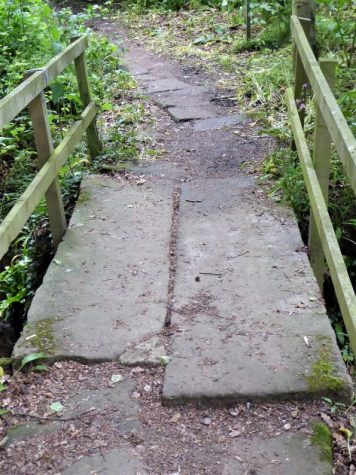
   I soon left the Esk Valley Way and used footpaths gradually gaining height through pleasant farmland. A bit of a hiccough had me vaulting barbed wire to get back on course to Sneaton, a small village in the hills, you have no inkling that the coast is just a couple of miles away. St. Hilda’s Church, Sneaton is set back from the road and yet again it was locked. I’ve chosen a bad time to visit these churches. The graveyard looks like a haven for wildlife. This church is renowned for its stained-glass window depicting Caedmon. Caedmon was a lay brother and herdsman at St. Hilda’s monastery. He had a dream that he could sing and, relating this to Hilda, she encouraged him to compose and sing religious verses, the original hymns? From up here I had my first view of Whitby Abbey, and my continuation was named the Monk’s Walk heading that way. Excellently preserved flagstones for almost a mile, well-worn from the passage of time, and a stone clapper bridge for good measure..

On the outskirts of town, I decided to try and stay high and approach the Abbey from the SE. This worked well, and I was soon on the headland with the Abbey ruins in front of me. That’s when I joined the crowds swarming out of the car park. I hadn’t quite expected the place to be so busy when for the last three days I was mostly alone. I suppose the Abbey is a major attraction and when you throw in Dracula, Scampi and Captain Cook, Whitby is a magnet for tourists.

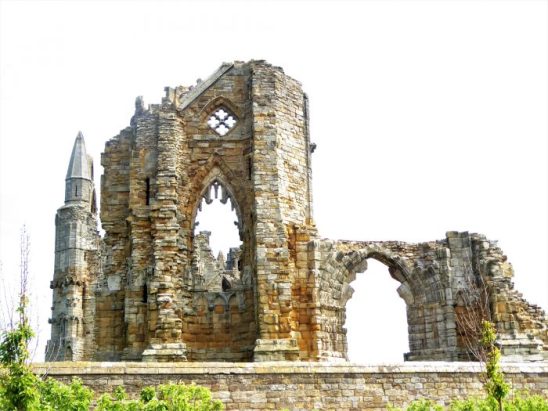
St. Hilda’s Abbey  was destroyed by Danish invaders in 867. A new Abbey was started in 1078 as a Benedictine monastery. Gradually this became one of Yorkshire’s great houses with 40 monks and a large estate.  It was rebuilt several times in the C14th and C15th, and these are the ruins we see today. Henry V111 put paid to the monastery. Shelling by German warships in 1914 ensured the building deteriorated further.                                                                                                                                                                    (Don’t know what happened to my camera settings there.)

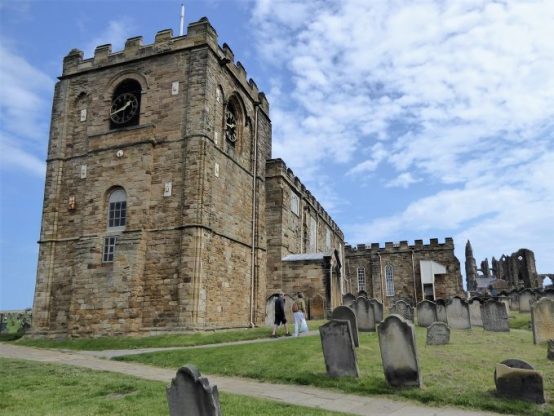
On the headland close to the Abbey is  St. Mary’s Anglican Church, of Norman foundation but much changed over the years, it probably is on the site of St. Hilda’s original monastery.

This was the first church that I had found open, and it had an interesting  interior, most of the floor space being occupied by box pews – some labelled for their occupants .               

Nearby is the Caedmon Cross, erected in 1898, which celebrates the spread of Christianity from St. Hilda’s Whitby and Caedmon and his Hymns  in particular. Hilda is depicted standing on the headless snakes – ammonites, and surrounded by five bishops she taught. In the background can be seen the square tower of St. Hilda’s Anglican Church, my next objective.

   The graveyard is extensive, but apparently starting to fall down the cliffs into the sea. There have been reports of bones on the beach!

I go down those famous 199 steps, join the crowds jostling in the narrow streets and find a café with a free table, I enjoy the traditional Whitby ‘fish and chips’ – not really different to fish and chips elsewhere.

I thread my way through the narrow alleys and steps past the famous Whalebones and Captain Cook.   …to arrive in front of St. Hilda’s Anglican Church. This impressive structure was built in 1888 when it was thought it may become a cathedral, hence its size and apparent rich contents again denied me by Covid restrictions.

   Across town was the more pleasing to my eye St. Hilda’s RC Church. Again apparently it is richly embellished with many references to Hilda.  It is a shame that I have not been able to view the interiors of all these St. Hilda’s churches, particularly for the stained-glass windows depicted her life. 

All I had to do now was walk up to St. Hilda’s Priory at Sneaton Castle. (a different Sneaton to this morning). I was a little dismayed to find it is now a wedding venue.

The Sisters of the Holy Paraclete owned Sneaton Castle, a Georgian property originally built by a Caribbean sugar plantation owner, James Wilson, when he retired to Whitby. The nuns moved into adjacent St Hilda’s Priory in 1915, and the castle was run as a girls’ boarding school and then a retreat, but the increasingly elderly community of nuns, whose numbers have dwindled to around 25, decided to sell up in 2018, realising the castle was making a loss. They have moved to a new priory on another part of the estate. I found it all a little confusing and didn’t take the opportunity to ask if I could view the Norman priory or even the new one.

Castle and Priory.

P1030610

St. Hilda.

*****

*****

That was my 40-mile circuit of this wonderful corner of the North Yorkshire Moors and the Esk Valley completed. Eight St. Hilda’s Churches were passed, as well as other important places of worship. My regret is not being able to view the interior of those churches, however they gave a focus to the walk. The stone trods were a delight, as were the villages, making this a worthwhile and interesting tramp which for the most part you have to yourself.

I think that is enough of going round in circles looking for churches for a while, Sir Hugh is trying to get me back on the straight and narrow.