Category Archives: Bouldering

BACK TO BOWLAND.

Croasdale nostalgia.

A chance conversation with a stranger in the woods the other day reminded me that I have been neglecting my home ground, Bowland, in my posts of late—too much Southern stuff. We had a mini walk from Dunsop Bridge in the summer, but it is high time to get back up there. This morning at 7 am, my new watch tells me I have only had three hours of sleep despite being in bed for eight hours. So I turn over for a lie-in, only for the watch to suddenly tell me it’s “time to get moving”.  I had been mulling over in my mind last night on where to walk today, maybe that’s why I didn’t sleep.  

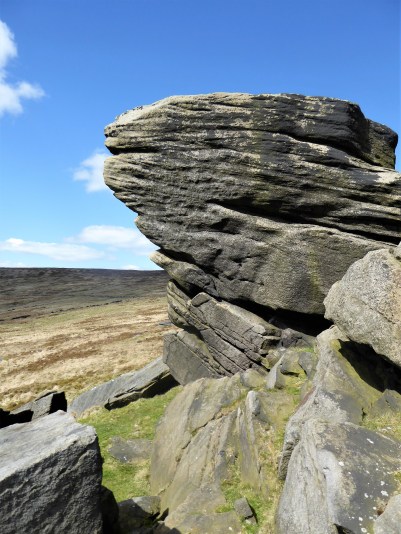
The weather plays a part in where I decide to go, and this morning, late, it has to be said, the mist has lifted with the promise of sunshine. I’ve not been up the Salter Fell track in Croasdale for a while, so why not have a leisurely afternoon exploring The Bull Stones up there? This was a regular haunt of mine when AB and I were developing the bouldering potential on these remote rocks. What a great time we had back at the start of the century. 

The journey there is almost as good as the walking. A lot of the time, following the Roman Road from Ribchester.  Coming down Marl Hill, Ingleboough is in the haze if you know where to look. Bowland is laid out to the north west. The famous Trough can be made out, but I’m heading for that other pass through to Lancaster, Salter Fell, on through Newton and Slaidburn, classic Bowland villages. Sadly, it appears that The Hark to Bounty pub has closed. There’s a lot of history attached to that inn.

I drive up the little lane leading out of Slaidburn, past many barn and farm conversions.  As you turn into Wood House Lane, the surface begins to deteriorate. Past the agricultural machinery graveyard, it becomes worse. The road to nowhere. 

I press on, knowing I can park up in a space at the top of the lane. But when I get there, the space has gone, a new gate has been installed, and any verge parking has been obliterated. Turning around is not easy, but I come back down the lane a little to where there is some hard standing. One wouldn’t want to get a wheel stuck in this remote spot.

It is 12 noon when I set off walking back up the lane.  Through the fell gate is a memorial to the aircrashes and loss of life in this area of Bowland.

At last, I am on the Salter Fell Road, which goes over to Hornby. The Romans came this way from Ribchester to Carlisle, suggesting there would have been an even older way through the hills. The Medieval Monks came this way with pack ponies, wool from their estates in Yorkshire and returned with salt from the coast, hence the name. The Lancashire Witches were brought over here to Lancaster to be tried and hanged. Alfred Wainwright thought it “the finest moorland walk in Britain”,  and I won’t disagree. And I must have walked or cycled it many dozens of times. 

I always get a thrill when you come around the corner and see the full length of Croasdale ahead, with the track winding its way to the watershed. A herd of tough  Belted Galloway cattle roam the hillside. Belties. They have a double coat that allows them to thrive in harsh climates. They are raised primarily for their high-quality, lean beef. Today, they mill around the track but are very docile, the type of cows I like.

There is an old quarry up there, and when it was in operation, attempts were made to upgrade the road. You can still see traces of tarmac here and there. But the way is rough now, which I can attest to from my past cycle rides along it. Only United Utilities and the shooting fraternity have the right to use motor vehicles on it. A few years ago, a section of the track just past the bridge was eroding, threatening to close the route. Drastic action was taken, no doubt costing tens of thousands, to stabilise the hillside. It seems to be working so far. Whilst they were at it, they improved the road surface going up the hill. There is a shooting hut up there after all.

A  Witches Way tercet is reached on the shoulder of the hill. Sir Hugh and I followed that route from Barrowford to Lancaster Castle back in 2016. It commemorates the 400th Anniversary of the 1612 trial and hanging of the Lancashire Witches. Ten, white, cast-iron installations on or near the path were embossed with tercets of the walk’s poem, written by Carol Ann Duffy. Appointed Poet Laureate in 2009, she was the first female and the first Scottish Poet Laureate in the role’s 400-year history.

Standing alone up here, a harsh reminder of brutal times, but giving Elizabeth Device a fine view back down Croasdale.

There is still some way to go; this is a wide, expansive Bowland. But where’s the sun?

I reach the gate across the track at the watershed and gaze at the horizon on the other side. Can you see the sea? I certainly can see Wolfhole Crag,  one of the more remote Bowland hills. I had an epic walk there in May 2023.

But today I am going no further on the Salter Fell Road.  I know a little track going at right angles up towards the Bullstones Circuit. It’s always boggy up this stretch until the first easy boulder is reached, where you can traverse across the fell on firmer ground until beneath the Taurus Boulders.

From up here, one looks at the ‘back’ of the Chipping Fells across acres of peat and heather.

I am always ready for a rest and a bite to eat on reaching here. Today was no different.

This is where AB and I first started our exploration. He couldn’t wait for the gamekeepers to pass by before he launched up the tower of Bully Off.  I did warn you there is some serious nostalgia ahead. 

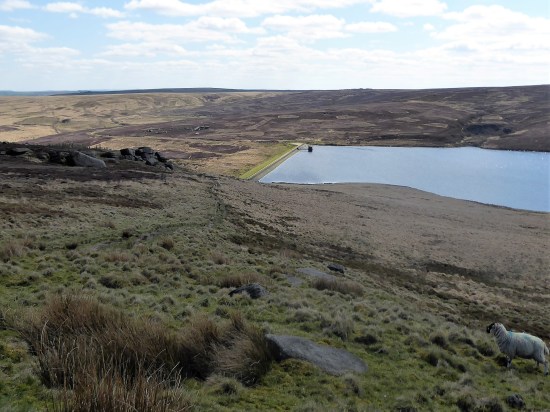
Just forget my hankering for the rock and immerse yourself in the wild moorland scenery, even if the light is rather flat. One can always see further than the camera can reach on days like this.

I stroll along below the boulders, taking in the scent of decaying bracken as I look down the valley. I am the only person for miles.

As I come around the corner, the sun finally appears, lighting up the higher boulders.

I don’t bother climbing up there; I’m happy enough to scan the horizon with my binoculars. And I want to see if I can find that massive ancient stone trough. Can you imagine sitting up here, in all weathers, with your hammer and chisel, crafting this out of a gritstone boulder?

I take a sheep trod I know under Reeves Edge. Thankfully, the bracken has died back, so as long as I concentrate, I can’t go wrong, especially with sheep leading the way.

It’s a long way back across the hillside, but eventually a stalking track is reached, which takes me down to the little reservoir and the ford through Croasdale Brook.

I have struggled to cross this water in winter in the past, but today I just walk through rather than risk slippery stones. Yes, my feet are wet, but I’ll soon be back at the start.

Pendle is coming out of the mist as I follow the track back to the car.  But this post is not about Pendle. It is about the wild and beautiful Bowland. I haven’t seen a soul all day. Oh, and did I mention I watched a Hen Harrier gliding low over the fells?  Magic.

Thanks to that random conversation in the woods, I have again tagged Bowland to a post. At least I should have one reader.  Maybe they will comment. 

For any climbers interested in a detailed bouldering guide, feel free to download it  here.

PILGRIM’S PROGRESS. MORE HEIGHTS.

Day 14. Wirksworth to Duffield. 

It’s Market Day in Wirksworth and very busy, so I just set off without my usual morning coffee. I have to climb up to Alport Height somehow. There are numerous small lanes and field paths to choose from. The scattered houses of Gorsey Bank are my first objective.

I pass a small Catholic church on the way, and then Providence Mill. Wirksworth mills were renowned in the 19th and early 20th century for specialised tape manufacture. John Bowmer began tape making in 1883 at Providence Mill, later known as Gorsey Bank Mill. They produced narrow red tape to bind legal documents. (That’s where the term ‘red tape’ comes from.) The firm was later to take pride in the fact that it had manufactured the fuse-binding tape for every Mills Bomb used in the First World War. The mill is now an exclusive-looking private residence.

At the end of the metalled road, a wide byway, Prathall Lane, continues to climb. There is a wayside water trough, so this must have been a route regularly used by horses.

There are views back to the limestone quarry overshadowing Wirksworth and more rural scenes to the west. The summit of Alport Height with its antennae appears, so I just follow the little lanes in the right direction.

A path leads to the parking area next to the antennae. There is a toposcope, but to be honest, although the views are far-reaching, they lack interest, and the masts obscure half of it. The trig point is at 314 m (1,030 ft).

If this ‘port’ was on a long-lost trackway, could this be a marker stone? How do you date stones anyhow?

I don’t hang around on what is a bleak spot in the wind. My attempt at a shortcut back to the road is thwarted by a motocross track with noisy bikes churning up the sand. But what is this? Not noticed on the way up, but a rocky pinnacle in a small abandoned quarry. The Alport Stone. Chipped holds on one side tempt you onwards, but how do you get back down?

I have found some old photos of early ascents.

I make good progress by sticking to the quiet lanes, the type with grass down the middle.

The Midshires Way is encountered again, where it climbs onto a small ridge. Longwalls Lane must be an ancient track with signs of cobbles and worn down to the bedrock in places.

At its end, as I drop down to Blackbrook  (who, according to all the signs, doesn’t want any more houses, like similar villages being swamped with developments), there ahead of me is The Chevin, a gritstone ridge above Belper leading me straight to Duffield. How much more appealing than Alport Height? In Blackbrook, I cross a ford and climb through trees to a cluster of houses at Farnah Green, where by the roadside is a 19th-century milestone. Derby 7  Wirksworth 6. And then I’m onto the ancient track across the Chevin, possibly the Portway, and maybe used by the Romans to reach their Lutadarum, a grand way to finish my walk today. Cobbled most of the way with views down into the Derwent Valley and Belper. I walk along with a local couple, and he explains the history of the area to me. I would have been puzzled by this isolated wall structure, seen by the wayside without his knowledge.

From the listed buildings site – Former firing range. Circa 1800. The range is comprised of a tall, tapering target wall, aligned north-east to south-west, approximately 25 metres long and 5 metres high. The wall is built of coursed squared gritstone, with a heavy flat gritstone coping. To the southeast of the wall are a group of five regularly- spaced rectangular coursed stone firing butts or platforms, the first being approx 150 metres from the wall, and spaced every 25 metres thereafter.

The firing range was built for the local militia, the Belper Volunteer Battalion, raised by the Strutt family who established the textile factory communities at Belper and Milford. Lt. Cl. Joseph Strutt was the battalion commander. The range was used during the Napoleonic Wars, and again in 1860, during the Boer War and the First World War. The firing range is important evidence of the part played by local militias in the national defence strategy of the early C19, and is a rare survival of the period. 

Quite unique.

I left the couple and made my way down through the extensive and hilly golf course past the clubhouse onto the main road in Duffield.

I had not gone far when I noticed this sign by some steps.

Duffield Castle is a remnant of the estate of the de Ferrers family, who originally owned the village; however, they lost their local possessions to the king in 1266, and their castle, if it ever was finished, was demolished. All that is visible is the mound with traces of foundations and a well. As the sign says, use your imagination.

The train takes me back to Matlock.


***

PILGRIM’S PROGRESS. PART OF THE PORTWAY?

Day 12. Bakewell to Winster.

For the next stretch of my ‘pilgrimage’, I’m booked into a B&B in Matlock. I won’t bore you with my travel logistics. These days, it is becoming more difficult to find accommodation in the smaller towns and villages. 

Where did merchants, drovers, and pilgrims, making lengthy journeys, stay overnight before the arrival of inns?  Before starting this walk, I had never heard of The Portway.

“There are several ‘portways’ in England, such as the route over the Long Mynd in Shropshire, but the Derbyshire Portway seems to be the longest and the best-researched. The route in Derbyshire was first suggested by Cockerton, a historian from Bakewell, in the 1930s, who based his idea of a long-distance route on a string of ‘port’ place names such as Alport and Alport Height, which can be linked together by existing tracks and paths. These place names are reinforced by references to a ‘Portwaye’ in some medieval documents and two Portway lead mines.  It seems clear that the word is Anglo-Saxon, and was applied by them to pre-existing, non-Roman routes.. A ‘port’ suggests a place of safety and shelter, so I think a portway was a long-distance route which had ‘ports’ for travellers at intervals of roughly ten miles. Sites where wayfarers could sleep, cook and graze their animals overnight. In Derbyshire, these are likely to have been on high ground for defence”

Stephen Bailey.  Old Roads of Derbyshire. 2019. 

An introduction from the book I’ve just been reading. Well, that adds another dimension to my walk. Again, like pilgrim routes, the portway is not defined precisely on any map, so my wanderings between significant Saxon religious sites can be combined with linking possible ‘ports’ together. They are likely to have had very similar routes.

I’m back in Bakewell for another four days ‘pilgrimaging’. As usual, I start the day with a coffee,  this time in the Graze café.

The church clock is striking 10 as I leave the hustle and bustle and start to climb steeply up Butts Road. They provide a handrail for the elderly,  and I make good use of it. At the top, there is a fresh breeze, so I’m hoping for cooler temperatures than of late. Alongside the cemetery, a gent is walking his dog. We stop to discuss the weather, and the conversation drifts to long-distance walking and eventually to climbing. He, in fact, moved here originally to be near the rocks. A pleasant interlude after the steep climb.

Suddenly, I’m out into rolling limestone country on a walled lane, and I feel I’m on an ancient route. A portway? Losing and gaining height as I go.

A short stretch on a road, and I spot the stile I’m looking out for. Pleased to be off the road, I enter a swaying sea of oats and, hopefully, by my passing, help to define the right of way. Skylarks are everywhere; it’s a glorious morning.

I reach the lane at Conksbury Bridge in Lathkill Dale. Across the way is the site of an abandoned Medieval village, but from here I can’t make out any features.

 Going down Lathkill Dale for a distance, I’m unable to access the stream. A man is picking raspberries from a particularly fertile patch, and I join him for a while. Last year, there was hardly any, but this summer is giving a bumper crop. Ice cream and fruit for him this evening.

Continuing downstream to Alport is an option, but I want to visit Youlgreave, it must be nearly 40 years since my two sons and I did a Limestone Loop around the Peak District, staying in YHAs. I remember the one in Youlgreave being at the top of a steep hill away from a river. My sons were convinced every youth hostel was at the top of a hill at the end of each day.

Youlgreave was mentioned in the Domesday Book. It increased in size in the late 18th century when lead mining prospered. It is now a magnet for visitors, thanks to narrow streets, interesting limestone properties, and charming cottages. The village street is hectic, far too narrow for the number of cars using it. 

All Saints Church dates back to the late 12th century, and I feel it would be best to dedicate a separate entry to my in-depth look around; otherwise, this post would become overly long. All I’ll mention here is a carving of a Norman traveller carrying his bag and shaft. Just like me.

The YHA is still here, looking as I remember it, but I don’t recall the cafe on the ground floor. Anyhow, I go in hoping for a pot of tea, but nobody is in a rush to serve me.

Wandering on, I reach the village fountain, which has an interesting history. A farmer’s daughter, a local spinster in her 70s. Hannah Bowman formed the Women’s Friendly Society of Youlgrave and had plans to bring water to the village. Previously, the villagers had to walk down to the valley for water. A 1,500-gallon capacity conduit was built in Youlgrave’s marketplace on the site of its ancient Saxon cross. At its opening in July 1829, the Derbyshire Courier voiced its approval: ‘The inhabitants of Youlgrave are rejoicing from at last having their anxious wishes realised by a salubrious spring of soft water being conducted to the village cross, where it now forms a beautiful radiated fountain discharging upwards of 10,000 gallons in 24 hours. The spring is as pellucid as crystal, almost equal in purity to distilled water. The cistern fills up overnight, and residents pay an annual charge of sixpence to use the splendid new facility”

It is still functional, owned and run by the villagers.

From the fountain, I take the lane down to the valley, where a clapper bridge spans the River Bradford. Lower down the river is proving popular with locals who, in this heatwave,  are enjoying paddling and swimming in the deeper pools created by the weirs.

By the lower clapper bridge I sit on a bench for a spot of early lunch before the climb out of the dale.

I’m not sure which way to navigate around Castle Ring at Harthill, marked by a red arrow above. The Bronze Age hill fort is on private land. This entire area, including nearby Stanton Moor, is characterised by numerous prehistoric circles and standing stones.

My choice is influenced by the fact that I’m now on the waymarked Limestone Way, last crossed in Miller’s Dale. So to the left we go, proving very pleasant in the shade provided by the stately beech trees.

I recognise the parking place on the road, which I’ve used many times for climbing at Cratcliffe. Despite being on the ‘Limestone Way’, this is gritstone country. Britain’s geology frequently baffles me. One of those stone circles can be seen by a tree in the fields below. Ahead are the twin rock pinnacles of Robin Hood’s Stride; the trees have grown since I was last here.

Let the Limestone Way wander on; I’m off to take a look at those climbs of old, and there is a Hermit’s cave to be found somewhere. There are voices in the trees. I’m hoping for some climbing action.  I get to enjoy some high-standard bouldering with friendly youngsters.

Everywhere seems overgrown as I try to find my way to the Hermit’s cave, but eventually, there it is. You can just make out the figure of Christ on the cross. 

https://derbyshireheritage.co.uk/curiosities/cratcliffe-hermitage/ gives a link to the Portway.

I peek around the corner at the imposing main crag. Did we really climb up there?

Below the rocks – everybody had a Hilary in their lives.

I find my way back to the Limestone Trail and begin the slow, now weary climb up Dudwood Lane, which is initially metalled, but soon becomes rough. 

Portaway Mine, presumably a lead mine, is marked on the map. 

One of those lovely stone squeeze stiles lead me into Winster through parkland..

There is a meeting of villagers in the church, St John the Baptist’s, so I won’t disturb them. The tower dates from 1721, and restorations to the body of the church were completed in 1885.

Today, the village is bedecked with bunting for its Wakes Week celebrations. I only have five minutes to spare before my bus.

Lead mining, for which Winster was renowned, may have originated here in Roman times. The boom in mining from the late 17th century turned the village into a prosperous town, one of the largest in Derbyshire.

Historically, Winster was also a main crossing point for many roads and trackways, one of the most important being The Portway, an ancient trading route that passes close to the village. Salt routes from Cheshire came through the village, as did the main turnpike from Nottingham to Newhaven in later years.

With more than 70 listed buildings, Winster has one of the most impressive street scenes in Derbyshire, and the main street is an array of impressive buildings which merge with a jumble of cottages up the bank on the southern side. The Old Market Hall, which dates from the 17th century and is now owned by the National Trust, together with The Old Hall and Dower House, are particular highlights”

 I’m lucky to catch that bus as the roads have been closed for resurfacing until today.

BIRTHDAY FAMILY FUN.

A self-indulgent post.

Birthdays come around every year. This year, we decided to celebrate as a family. A quiet getaway for us to meet up without too much fuss; no surprises, balloons or embarrassing kissagrams.

For some time since it reopened, I have enjoyed eating at the Cross Keys Inn at Whitechapel.  I refer to its reincarnation in recent years. There has been a Cross Keys here for over a century; it was known affectionately to locals, tongue in cheek, as the Dorchester. 

The original building was a farm called Lower Oakenhead, dating back to the mid-1700s. Sometime in the first half of the 19th century, the owners expanded into the licensed trade, and the property became a coaching inn, The Cross Keys, that operated alongside the farm. When I used to visit it in the 70s/80s, three Hesketh brothers ran the farm and inn. Often, you couldn’t get a drink until they had finished milking. I remember the pool table, open fireplace and dominoes. The brothers needed to retire to bed early for the morning’s milking but would leave the bar open with an honesty box. As well as beer, they strangely sold Uncle Joe’s Mint Balls.


ttps://chorleyinnsandtaverns.blogspot.com/p/goosnargh-whitechapel-cross-keys-inn.html

It closed eventually in 2004 and was bought in 2009 by a local builder, John Holden. He slowly renovated the inn and commenced on converting the stables, cowsaheds and storerooms into holiday lets. Reopening in 2021: The postal address of the holiday properties has been renamed Dorchester Drive in deference to its history. 

It seemed the perfect place for a family gathering, so I reserved two lodges for the weekend, with the original intention that the dogs could accompany us. Booking the meal arrangements was slightly marred by my inability to drive; I like to do things face-to-face, and telephone conversations were vague regarding seating. Eventually, a friend gave me a lift up there, and I made final arrangements but without the dogs for various reasons. At least once we were there, cars wouldn’t be needed for the weekend.

Our small family, eight of us, met up there on the Friday evening; to my relief, the lodges were spacious and luxurious. Across at the inn, we were soon seated at a table adjacent to the bar, which was extremely busy and noisy with Friday night drinkers. I’m glad I’d arranged for us to be in the separate room where we could hear ourselves talk. The evening went well, with everybody enjoying the meal and atmosphere. We retired to one of the lodges for family games.

Breakfast was served for us the next morning, and it was excellent. 

The plan for the day was to walk five or six miles from the Inn without having to drive, but on returning to our lodge, the key no longer worked in my hand or all the other family members who thought they had the knack. Back to the bar. Dan, the man, came to investigate but couldn’t do any better. He phoned the property owner’s representative, but she was at the hairdresser’s. Don’t worry; it will all be sorted by the time you return from your walk. But no, all the stuff we need is in the lodge—another call to the building firm that owns the complex. John was around in no time. His key didn’t work either. A call to his friend, the locksmith, was thwarted by his attendance at a football match. He then called brother Chris to help out. By now, there was a crowd outside watching the proceedings and giving advice.

 An increasing arsenal of heavy-duty tools was employed to break through the door’s bottom panel. Burglars look away. J and C managed to remove it, with J flying through the hole created, much to the amusement and applause of the crowd.

We retrieved the gear we needed for the day’s walk and left the scene of devastation.

The planned walk across fields directly from the inn went well.

Soon, we were down to the bridge over the River Brock. There was very little water in the river.

The valley was busy with families and dog walkers. We looked a mottley lot.An earth slide proved popular with children and my not-so-young grandsons.

Leaving the river, we went through fields to come out at the base of Beacon Fell. The fun included grass whistling, a forgotten art… … and impromptu rounders.

Tree hugging is de rigueur with my family. And there were some grand trees to hug.

The trig point had to be visited.
More fun was had on the gymnastic apparatus.

Some of us walked down the snake.

and of course, the cafe for coffee and ice creams. We were lucky to have a sunny day.

The route back down the fell passed through the interesting houses of Crombleholme.

I knew the path direct to the Cross Keys was usually boggy, and so it proved today, but everyone enjoyed the challenge. A few added to the challenge by jumping the streams.

Some of us went to look around the nearby churchyard to seek out a C18th sundial. The church itself was locked.

Back at the lodges, most of us had a snooze before reconvening for pre-dinner drinks.

Another successful meal followed in the much quieter dining room. The food and staff were excellent. Back to the apartment for more fun and games, although we were all tired, so retired at a sensible hour.

Sunday dawned drizzly, we packed up and returned to my house for breakfast/lunch. Cards and presents were opened. By now, it was dry, and so the whole family descended upon Craig Y Longridge, the local bouldering venue. The three grandchildren were performing feats way beyond my ability. But I did manage to cling on with my bad hand long enough for a group photo.

What a successful weekend, thanks to my family. You’re not twenty-one every year.

What’s the secret to growing old gracefully?

Time
Health
A quiet mind
Slow mornings
Ability to travel
Rest without guilt
A good night’s sleep
Calm and boring days
Meaningful conversations
Home cooked meals
People you love
People who love you back

Ah, well, I’ll be back at the hospital tomorrow.

*

For the record, here is our recommended walking circuit of about six miles directly from the inn. 

DON’T FORGET TO FEED THE BIRDS.

An overnight dump of snow has transformed the surroundings. My car, which I shall not be moving today, is under four inches of the white stuff.

The back garden looks neat and tidy for the first time in months. I put out the usual ground feed and the select seeds on the bird table. Within minutes the blackbirds are fighting over the oats, and the coal tits are raiding the seeds.

The morning slips away.

I eventually decide on a walk. I am lucky I can reach the countryside directly from my doorstep without using the car. I have no real plan. I walk past the cricket pitch. The road, where cars have passed, is easier to use than the rutted pavement. Up ‘Mile Lane’ is my usual route. I hear the joyful cries of children long before I see them sledging down the field.

Even in the semi-urban landscape, there are sheep struggling for survival.

Someone has been out early in the park and built an igloo. I used to do that and sleep out for the night in the garden.


Everyone is in a chatty mood, so progress is slow. Hence I decide on a short loop around the reservoir rather than the longer fell road, which I did yesterday. From up here, there are views across the valley to Beacon Fell and the Bowland Fells (in cloud).

I peek into Craig Y and share a picture of it on its Facebook page.

As I wander back through the streets, more snow is in the air. It won’t be good if it freezes tonight. Around the corner, a friend, JD, is building a snowman for his grandchildren. All jolly good fun.

Bleasdale with BC

Tuesday 12th November 2024 Kemple End has been a fantasy location for a number of years with its quirky name tickling my imagination. Bowland Climber has mentioned it many times during our years of walking together but it has remained a kind of mystery for me, even to my questioning its actual existence, and somehow we…

Click to view

Bleasdale with BC

I didn’t have time to write this one,  so I’m grateful for Sir Hugh’s version.

I have one photo to add. Sir Hugh on the slippery slope. It is more straightforward to climb back up than descend.

NEW ROUTES GALORE.

I’m catching up on some news while recovering from my second cataract operation. I am full of admiration for the surgeon’s skill. Please excuse any typos; I still haven’t regained full stereoscopic vision.

In the last few years, I have mentioned climbing with my mate Mark on a ‘secret’ crag high in Mallerstang in the upper Eden Valley. I showed the odd photo but never gave away the location.

I played only a small supporting role in developing this lovely crag, but I enjoyed the exploratory nature of the climbing very much. The epic walk up to the crag. The peace and isolation of the fell. The views down into Mallerstang and, in the distance, to many Pennine and Howgill Peaks. The occasional train trundling down the valley, even a low-flying Dakota or microlight passing by. We had a hidden cave where we could store gear and ropes to lessen the load on our walk-up.  Hammering in those belay stakes and then abseiling to clean those soaring cracks. On one occasion, when a large block came careening towards me, I dodged at the last moment—freezing and baking in the same month—the best company with Mark, Jude, and other friends.

The Neb, Wild Boar Fell.

Our stash.

Main Wall area.

Narrow Buttress. E1 5b

Upper Malerstang.

Well, he has now published his exploits on UKC under the title ‘Wild Boar Fell’. There is also a new Fell and Rock mini-guide to the Eden Valley, due to be published, which will include the routes on Wild Boar Fell. In the meantime, here is Mark’s interim guide https://bowlandclimber.com/wp-content/uploads/2024/10/Wild-Boar-Fell-Both-sections-8.pdf

Just look at the opening photo. You would enjoy a day’s climbing up there.

*

On a different scale, up on Longridge Fell above Craig Y is a secluded quarry, Crowshaw, which is much more accessible.

We have been climbing in there for a few years now. Robin Mueller started the ball rolling with exciting boulder problems on the curiously shaped right wall.

There is a video of his exploits. https://www.youtube.com/watch?v=f2M1Oc3G-JQ&    https://youtu.be/f2M1Oc3G-JQ

I returned and cleaned up the slab right of his passages, then the lower walls to the left, which offered some easier boulder problems.

I had my eye on a 15-foot rock tower, but there was a nasty, pointed boulder below it. This was duly displaced with crowbars. Yes, I know we are mad. I played around bouldering out the start, but committing to more complex moves was getting me too far off the ground. I enlisted the help of Mark, of Wild Boar fame above, and he came over to belay me in September 2015. I was glad of the rope and protection on what turned out to be a decent climb – Tweeter And the Monkey Man, about VS 5a. We noticed the imposing blank wall to its right.  My musical post describes the evening.

Tweeter, with that steep wall to its right.

My attention drifted back to the left walls again. That night, both Mark and I had attempted a high-level right-to-left traverse along the lip without success. Where the footholds ran out, it became technical and strenuous. I seem to remember I was going to France the next day, so I didn’t want to end up with a broken ankle.

I couldn’t let it rest, so I was back in August 2016 with Dor as my spotter and protagonist. I needed that to progress and eventually complete the End of the Line. V2.    https://bowlandclimber.com/2016/08/27/its-the-end-of-the-line/

That steep wall still attracted me, but after putting a rope down it, I realised it was way too hard. I did give the ‘Friend’ slots a clean, thinking somebody may lead it. That’s how it stayed for years; not many knew of the quarry or visited it. Local climber Paul of  https://crusherholds.co.uk/ has done everything at CraigY, so I thought I would show him my wall. He was impressed, but we never got around to trying it until this year, when, with a new bouldering guide coming out, he bit the bullet.

Days of rain came and went; there was a short window in the weather for one afternoon. We met up, and I rigged a top rope for him to look at the problem. Tenous moves off layback creases and minuscule footholds had him off the ground. The following moves past slopers were obviously the crux; he struggled with the sequence. Eventually, opting for a slap through past the worst hold. It all looked very insecure, and his success rate was only average. Once at the slot, he said it was OK to the top. I suggested a roped lead with some gear at half height, but as he explained, that was past the difficulties, and he was confident of the upper section.

We moved the ropes, and I got set to spot him on the first difficult section.  That is when we realise that if he fell, we would both probably disappear down the steep, bramble slope below us. So I tied into the ropes and hung above the drop. The pads covered the base adequately. On came the tight edging shoes to cope with the ripples masquerading as footholds. The finger laybacks somehow kept him on until poised below the crux slaps. This time, his right hand didn’t connect well, and I could see his tendons straining to keep contact before the next slap. Only just made it. But then it was a triumphant romp to the top.    Probing the Proud Line 7a+

It rained for the rest of the month.

There remains a sneaky little line to the left, if anybody fancies it before Probes has another look. 

A FAMILY FUN DAY.

P1070391

My son and my youngest grandson have come up from Manchester for a spot of Bouldering at Craig Y Longridge, here in the village.

I am lucky living in Longridge on the edge of Bowland and The Ribble Valley. Many of my posts have been about this local area which I am passionate about. From a climbing point of view I have on my doorstep one of England’s premier bouldering venues. This unique gritstone crag overhangs for almost all of its 150m length creating an outdoor bouldering wall with many desperate, certainly for me, problems. Over the years I have used it as a training crag to keep me fit for the traditional climbs in the mountains and dales of Britain. I never became really good but I was always strong.

Climbing has changed as a sport over the years, big boot days in the Lakeland mountains have been replaced by gymnastic bouldering in indoor gyms, you may have seen this modern take in the last Olympics. Youngsters are taking to it for the pure physical challenges without the danger. All you need is a pair of rock shoes and a chalk bag to have lots of fun and build up an all round physical fitness at the same time. Friendly rivalry and a good social scene go hand in hand. No wonder climbing gyms have been springing up like mushrooms in all our towns and cities. 

All three of my grandchildren have taken to bouldering and regularly attend climbing gyms in Manchester. Even my son, just turned 50, has gone back to the sport which I introduced him to as a child. I always preferred climbing outdoors and only resorted to the climbing walls when the weather defeated us or in the coldest winter months. We tended to visit the walls with higher roped climbing as that is what we did. For years this helped me keep up my fitness but various issues in the last few years have curtailed my activities. I still manage a few ‘proper’ routes each year but they are diminishing along with my climbing partners as aging creeps upon us. But I do have Craig Y on my doorstep as I said, so whenever possible I go up there and do some easy traversing to keep my muscle memory intact. It is far better, and cheaper, than going to a gym and I still get the social interaction from the youngsters and old hands who regularly turn up.

 The weather is promising, there have been far too many bad days this year, so Sunday is arranged. His dad will bring him and he has invited one of his bouldering buddies to join us. Time to introduce Alex to the delights on hand and see how he performs away from the plastic. In the gym the holds are colour coded so you can see what you are going for, outside you have to ‘read’ the rock to pick your way. 

The afternoon starts badly with the discovery of a burnt out pile of papers on the car park, The rain overnight has created a soggy mess, I may have to come back another time to clear it. What is in the minds of some people? I’m beginning to sound like Victor Meldew. P1070377

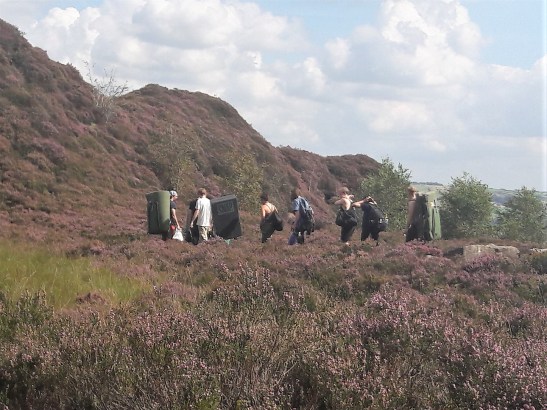
In we go through the gate, tortoise like with the bouldering mats on our backs. Convenience climbing 20m from the car. P1070378P1070380

You may notice and wonder about the proximity of houses. This was once all the abandoned Greenbank Quarry, one of many in Longridge. Most closed down after World War II but I am led to believe stone was used from this one for the completion of the first motorway in the UK, AKA Preston Bypass, in the fifties. The quarry, partially infilled, laid dormant and became grassed over. We climbed in here from the early 80’s. I remember cows grazing in the field, with the pond lower down a favourite fishing spot for local children, almost a rural idyll.  All changed when it was bought by a developer who wanted to turn it into a holiday chalet park. Planning permission was granted from the tourism affect it would have on the village. That was always a  debatable point. 20 chalets became 30. and yes you guessed it about fifty houses were built. There was no attempt at the ‘tourism’ market – but we knew there wouldn’t be. Once again the planners duped or was it more sinister than that? 

Anyhow the developer kicked us out of the field when building commenced, well some of us. A fund was started by local climbers contributing money towards purchasing the strip of land directly adjacent the crag, the BMC (British Mountaineering Club) matched the donations and the crag was bought from the developer. He should have really have given it us as he was absolved of all responsibility of a potential danger directly  below a public road. 

In August 2008 the ground below the crag was levelled, a great improvement. Fencing put in place and our own gate complete with official BMC signage installed. The ‘housing’ development has matured, there have been no serious conflicts between the residents and climbers – although this is always an issue when in close proximity to the general public but, and dare I say it, some of the younger generation don’t respect privacy and property. (Victor Meldew again) Lets hope we retain this facility for future generations.  

The early days of BMC ownership.fencing 003 fencing 005

I’ve gone off subject a little, but good to fill you in with the background to this unique place. 

There are already a few other climbers here but it never gets seriously busy. People come and go, enjoying their own activity without impinging on others. I direct our little team to some easy traversing to warm up. It becomes evident that the youngsters lack stamina for too much length of horizontal moves, being used to a limited number of vertical moves before jumping off at the gym. They do however soon dispatch the ‘up’ problems I show them next.P1070382

Below is Bomb Squad 6B being dispatched.

They both are then eager to try some of the harder problems along the crag, that’s when my son and I take off our rock shoes and continue in only in an advisory and encouraging capacity.

Alex and his friend had enjoyed the day. They found the grades tougher than in their gym which is understandable in the transition to real rock. Their confidence for going higher improved as the day went on. Enthusiasm fired I hope. 

Meanwhile my son and I had a good catchup 

Sit start to Porridge Gun 6B+ almost to the top. 


FATHER’S DAY.

P1060958

A gentle aside.

I don’t ever remember celebrating my Father on any special day way back when I was a child, though I did make lots of fuss of him as he crept into old age before it was too late. He died in 2005 and I paid homage to him more recently here, where you will hear some good music.

The idea of a special day to honor fathers was probably introduced from the United States where it has been celebrated for a century or so.

Mothering Sunday on the other hand was an existing Christian celebration dating from  medieval traditions. Commercialisation has taken over and both days are now largely a shopping excuse.

Putting that aside I am pleased when my two sons plan to visit me, along with some of their progeny and partners. They do offer to bring food but I am happy to prepare a feast and get in the drinks to celebrate the day. They normally eat me out of house and home but today grandson J is mountain biking in the Peak and A is bouldering out in Fontainebleau. So we are down to six and two dogs, Gizmo always wants to be centre of attraction, as can be seen from my header photo. 

My cat Seth senses the arrival of their two dogs and disappears upstairs for the day. After tea and cakes we take the opportunity to get up the fell whilst the sun is shining and develop an appetite for the curries to follow. The dogs love the freedom of the planation and charge off through the bracken after some unknown scents. We walk sedately around. Gizmo the larger dog can’t wait to get into the water of the little becks which have been swelled by all the recent rain, the more refined Phoebe is not so sure. The gap over one side stream seems to have widened and the party use different techniques crossing it with only the odd wet foot or paw.P1060953

P1060952P1060954P1060955

On the way home we call in at Craig Y bouldering venue so S can show L the hidden pleasures. What a good photo opportunity of us all on the rock. 

IMG-20240616-WA0000

Three generation ‘bowlandclimbers’

The meal is a success and they all depart in time for me to watch the first England game of the European Cup whilst I wash up.P1060957

Thanks lads. 

BOULDERING AND BIRDS.

P1050296

An afternoon up on the fell. 

First stop Craig Y Longridge where I do some easy low level traversing. There is only one other climber here, a friendly bearded wonder from Southport, he is trying far harder things than I. As part of my training programme, those were the days, I rest every few feet. To justify this I  do a little bird song identification with the help of Merlin. At the far end of the crag where I hide out there are trees and bushes, I often see wrens, blackbirds and goldfinches. Leaving my phone recording for five minutes brings up Robin, Goldfinch, Chiffchaff, Blackbird, Wren, Wood Pigeon and Blue Tit. Not a bad sample from an urban site. My friend from Southport is perplexed. Oh, and the Grebes are back on the little reservoir across the road. P1050512

Moving on I drive to the far end of the fell and mosey about in the hidden quarry there. First I spot a couple of Roe Deer disappearing on my approach. I do a little low level traversing again, finding the lowest traverse too hard, before I sit and listen.   All trees and in the countryside – so what will I hear?  Wren, Blue Tit, Great Tit, Siskin, Willow Warbler, Chiffchaff, Pheasant, Blackbird, Wood Pigeon, Robin, Goldcrest. P1050506

Moving on I visit another hidden quarry and dream about climbing one of its steeper walls. Whilst I’m there – Blackbird, Wren, Willow Warbler. Coal Tit, Pheasant, Siskin, Jay. This quarry is common land yet the neighbouring property is trying to fence it in. P1050508

On the way home I can’t resist a brief walk around my favourite plantation. Proper ‘twitchers’ are hoping to see the Barn Owls quartering the fell. I disappear into the trees, but I can hear the Cuckoo across the way. I’ve never seen him of her, but they always return to the same spot. A spell binding call.  In the higher quarry pond Mother Mallard has eight ducklings, only one in the photo, I wish them all the best. P1050467

So back to the bouldering – Its not all about the grade, its all about the song.

PENNINE POETRY – RAIN.

P1000172

Simon Armitage’s Stanza Stones – Rain.

15 miles of scenic driving on open moorland roads and then through densely knit and gritty Pennine communities brought us to the White House Inn on the road out of Rochdale. We have just come from Marsden where up in Pule Hill quarry we found and admired our first Stanza Stone, Snow, a water themed poem by Simon Armitage skilfully inscribed by Pip Hall. This is one of six, or maybe even seven, scattered on the rugged Pennine Watershed between Marsden and Ilkley. There is a 45-mile walking trail between them all, but we have chosen to use the car and visit them individually. We have resisted the idea of visiting each stone according to the weather depicted. Let’s enjoy today’s sunshine.

The White House is an iconic moorland inn situated where the Pennine Way crosses from the peaty horrors of the Peak District peat to the pleasanter Yorkshire Dales. Many long distance walkers have been known to give in here. Most people today are either enjoying lunch in the pub or doing short walks from the road, as are we. CaptureStanza 2

The Pennine Way is followed alongside an aqueduct connecting several reservoirs. All level walking. I camped along here once with my young son on a Lancashire Borders Walk. Sensibly we had eaten well in the pub beforehand and only needed water for a brew. The brown peaty solution didn’t need a tea bag, today my tea was already brewed safely in my flask along with a picnic lunch.1qhsxyqg

P1000177P1000179P1000180

A miniature arch took us over the water and into Cow’s Mouth Quarry. This is where I become boring once more as I try and trace routes climbed way in the past. They are mainly slabs, with often little protection available, needing a steady head. Nowadays with bouldering mats the picture has become blurred between a roped route and a high ball boulder problem. P1000189

P1000195

But I’m not here to climb today, I’m with Clare and JD looking for the second of Simon Armitage’s Stanza Poems – Rain. This one is easy to spot being at the base of a rock face right by the path. Pip had a lovely canvas to write on, but advice was first taken from climbers so that no footholds were destroyed, or new ones created. Pip’s carving seems more pronounced than on Snow back at Pule Hill, this rock, being more compact, maybe helping. The letters are imbued with gold.  We read aloud the poem marvelling at Simon’s turn of phrase. P1000181

P1000186

P1000185P1000188

Again here is the poem in case you can’t make it out in the pictures.

Rain.

Be glad of these freshwater tears,
Each pearled droplet some salty old sea-bullet
Air-lifted out of the waves, then laundered and sieved, recast as a soft bead and returned.
And no matter how much it strafes or sheets, it is no mean feat to catch one raindrop clean in the mouth,
To take one drop on the tongue, tasting cloud pollen, grain of the heavens, raw sky.
Let it teem, up here where the front of the mind distils the brunt of the world.

We find a sheltered spot for lunch. I forget to take a picture of the extensive views across the moors with distant reservoirs, wind farms and mill chimneys. I am on too much on a high from the poetry – tasting cloud pollen. We wander back with shared tales of moorland adventures.

Fellow us farther on our poetry quest.

PENNINE POETRY – SNOW.

P1000172

Simon Armitage’s Stanza Stones – Snow.

Simon Armitage is steeped in Pennine Grit. Brought up in West Yorkshire and living in Marsden in particular, his works have been influenced by the rich heritage of the area. I have been reading a few of his books and poems recently and feel an affinity to his working class background. When you delve deeper you realise the profound and original intellect of the man and his ever widening focus. That’s why he is Poet Laureate.

My friend JD, who has featured many times in these posts, told me about some of Simon’s readings on the radio, such as his journey as a modern day troubadour down the Pennine Way, and more interestingly his series of poems carved and brought to life in the rocks of the high Pennines. The Stanza Poems, six poems on the theme of water in various forms: Snow, Rain, Dew, Puddle,Mist and Beck,  a collaboration between himself, Pip Hall the stone carver, and local expert Tom Lonsdale, a landscape architect. Those looking hard enough might stumble across a seventh Stanza Stone, a secret stone left in an unnamed location within the Watershed area, waiting to be discovered and read. As far as I know nobody has.

I bought the book and was immediately fascinated. Stanza Stones a book by Simon Armitage, Pip Hall, and Tom Lonsdale. (bookshop.org)

What they have produced is truly magical and the insights of the protagonists brought to life in the book. I take my hat off to the literacy skill of Simon but equally so to the dedication and art of Pip the sculptress which will be borne out in our efforts to locate the stones.

A fairly tough trail, considering the moorland terrain, of 50 miles or so has been worked out between the carved stones from Marsden in the south to Ilkley farther north. Suffice to  say JD and I never got around to walking it, mainly because I thought some of the 20-mile days across rough moorland with no bed at the end was too much for me to contemplate. I happily compromise and suggest a motorised raid to the individual stones. The idea catches fire and in a conversation with the ‘Slate Poem Lady of Longridge Fell’ (another story enacted in my lockdown posts) we have a willing and knowledgable accomplice. Welcome aboard Clare, one of her slate poems in her garden says it all.

P1000145

Messenger. Mary Oliver.

Cometh the day cometh the hour. We are off to Marsden with a fair forecast. I’m afraid to say my navigational skills fell short of the sat nav lady whom I chose to ignore. We came at the first site in a round about way, but the moorland scenery and deserted roads were worth it. Mutterings from the driver and the other passenger who kept well clear of any navigational mistakes. CaptureStanza 1

An unpretentious lay-by below Pule Hill, west of Marsden, is our starting point. The steaming brick ventilation shafts of the Manchester to Huddersfield railway are obvious above us on the hillside. As well as the railway down there somewhere the narrow Huddersfield Canal goes through the Standedge Tunnel, the longest, highest and deepest canal tunnel in Great Britain. Their combined  history is worth a read, it’s a lot more complicated than you think. Above all that are the ramparts of Pule Hill quarry and rocky edge on the skyline. Fortunately for us the original quarry incline is still intact giving an easy climb up into the workings. Memories of plodding up here with ropes and gear for a day’s climbing come flooding back, and I feel a quickening in my step. We are impressed with the amount of quality stone work just giving access to the quarries. What a substantial industry of men must have worked away on these slopes. P1000147

P1000149P1000150

I’m distracted by the quarry rock faces I have ascended in the past whilst the other two go off in search of the poems engraved in stone. P1000168

P1000151

Nature’s art.

P1000155

At the far end of the quarry are two large blocks built into the wall and there is our first poem laid out in front of us, letters carved into the two stones bringing out the colours of the rock from those past quarrying days. We trace with our fingers across the rock surface. Already after 13 years the patina is changing, and green lichens are crossing the letters, what will another decade bring. There is already some slight damage caused by man. P1000167P1000160

P1000163P1000164

Here is the poem transcribed as it is difficult, but not impossible if enlarged, to read in the photos. The stanzas cross between the two stones.

Snow.

The sky has delivered its blank missive. The moor in coma.                                   

Snow, like water asleep, a coded muteness to baffle all noise, to stall movement, still time.

What can it mean that colourless water can dream such depth of white?             

We should make the most of the light.                                                                           

Stars snag on its crystal points. The odd, unnatural pheasant struts and slides.

Snow, snow, snow is how the snow speaks, is how its clean page reads.

Then it wakes, and thaws, and weeps.     S A.

Before we leave, we discover a beautifully constructed curving wall seat inscribed with ‘Ilkley 45 1/4 miles’ which is the distance to the last stone via the trail, thankfully we have the car to take us onwards.P1000170P1000169

We skip happily down that incline, pleased to find the first stone and captivated by the scenery and the poem it now holds. Let it snow.P1000176

***

THE WRONG BOOTS.

DSC00472

        EVERY PICTURE TELLS A STORY.

I had arranged to meet Rod for a few climbs up at Kemple End, the quarry at the far end of Longridge Fell. Originally I had suggested it to him as a good option for afternoon shade in our mini heatwave last week. That didn’t seem to work out, so we found ourselves up there this morning instead – a good option for morning sun.

Autumn was in the air and the grass had a heavy dew, but the bracken was dying back which made access along the quarry rim somewhat easier. We backed up the top belays on the way in and scrambled down to the base. The rock was in perfect condition despite recent rain. 

P1010459

I have been asked to rewrite the section on Kemple for the up-and-coming, maybe in a couple of years, latest Lancashire climbing  guide book. (On my bookshelves I have about five or six previous editions going back decades, all a little dog-eared) Hence, I was wanting Rod to re-climb a few routes to get an overall grade consensus, particularly where there has been some recent rock re-arrangements. Another climber’assessment can clarify your own jaundiced view.

I thought Rod’s sack looked rather small, I’d brought the rope and gear, and sure enough when he delved into it no rock shoes or harness came out. Probably on the kitchen table back home, it’s easily done. No problem I contrived a makeshift harness, and he thought he could manage in his stiff hiking boots. After all we had started our climbing days in ordinary boots, dedicated rock shoes had only just started to appear on the market, from France originally. My climbing shoes would most likely not have fit anyhow.

The first climb, Ribbled, went well, even I managed it with my dodgy ligaments confirming its easyish HVD grade. Birdy Brow has lost its flake and is no longer feasible, so we put a rope down Bird on the Wing, its replacement. This has a few reachy starting moves made worse by Rod’s boots, but he persevered and got up thinking it about VS 4c.

We sit and have a break in the sun, an owl is hooting somewhere in the hidden quarry bowl. There is the hum of bees around the brambles and heather. All very peaceful. All part of the climbing day.

Then over to Great Expectations, one of my favourites here. Another steep start brings you to a shallow sloping ledge in the middle of the wall, use this to somehow make farther progress. It wasn’t to be today. Rod’s boots skidding on the blank wall where rock boots would have just smeared. A potentially good day’s climbing marred by the wrong boots.

DSC00473

                             Not so ‘Great Expectations’ in big boots.

WILTON FEST 2023.

Capture

A nostalgic, even indulgent, look back at all those routes of old.

I used to climb in the gritstone Wilton Quarries, there are four of them above Bolton, regularly in the 80s and 90s, my climbing mates living in that area. We would drive down after work to tackle some of the classics. Our standard was for repeating the routes done back in the 60s and 70s, generally up to E1, but the quarries were buzzing with local experts climbing, often soloing, the more modern test pieces. After a midgy exit we would retire to one of the local pubs, Black Dog or Bob’s Smithy, for a pint or two to chew over the evening’s activities and plan for the next week. Wonderful care free days with like-minded individuals.

Well the Wilton devotees along with the BMC have for the last ten years hosted an annual festival of Lancashire quarry climbing to invigorate and perpetuate our unique climbing culture. The Wilton Fest.

I was always out in France for September at my friends’ house in the Lot Valley, a lovely place and a lovely time of year, so I had never attended the Wilton Fest. Unfortunately the house has now been sold, and I’m left in the UK at this time of year.  The upturn of this is that today I was free to drive down to Bolton and join in the fun. 

I have never seen as many cars parked up in the quarries and on the busy road alongside them, hope nobody gets a ticket. The good weather is a blessing to the hard-working organisers.

I drop down first into Wilton One, the largest of the quarries. Only the early risers are climbing. The prow is a unique feature of this quarry, left standing for whatever reason by the labourers. Inside is sunny and dry whilst the outer face looks forbidding as always. A couple of blokes, of my vintage, climb Rambling  Route a pleasant VD, whilst a younger couple tackle the impressive Christeena up the edge of the prow. I am beginning to wish I had brought my camera rather than relying on the phone which can’t cope with the contrasting light and has let me down today.20230902_11424520230902_120220

There is nobody climbing on the outside of the prow which I was hoping for Cameo, Flingle Blunt, Fingernail etc. Don’t ask me where some of these names come from. Nor was there anybody on the big lines farther left – Loopy, Wombat, Central Route. There were later in the day, apparently. I did however watch a pair on Leucocyte Right Hand. I remember the moves up at the start were bold towards a high prominent quarryman’s ironwork, but today’s climbers are able to place a camming device into one of the shotholes lower down, if only that had been my option 40 years ago.  20230902_112107

I move on past climbers on regular routes of old – Virgin’s Dilemma, don’t ask, and 999.  20230902_120910

I start climbing out of the quarry only to meet a friend from 30 years ago. He and his son are heading down into One to witness the 60th anniversary repeat of another classic, Black Out. There is promise of a good crowd and drone footage. The crowd is of a certain vintage and I recognise many old faces. Eventually Ian Lonsdale introduces the original protagonists,  Ray Evans and John Nuttall. (the truth is that they were led up the route in 1963 by a Dave Brodigan, so a lady from that era sat next to us expounds) Let’s just ignore some of the detailed history, and nobody blacked out on the climb. Ray climbs elegantly up the groove with little protection, the pegs are long gone, before the delicate moves left along ledges to the original belay of pitch one. John joins him and leads through the groove above. A masterful display from these pensioners.  20230902_13470920230902_13550220230902_14034320230902_140843

I eventually find myself up in Wilton Two where all the trade stands and facilities are. Only to be greeted by “geriatrics are not allowed here” from another old Longridge colleague. I obviously ignore him, and we proceed to where there is free flowing coffee.

After lots of chats and meetings up I make my way over to Wilton Three. (What you see in there are the ranges and huts of a gun club which shares access with the climbers.) This was possibly our favourite evening venue in the past. Lots of accessible routes of quality in our grade range. I’m eager to see someone climbing Shivers Arête, and just as I arrive there is a climber on the crux moves near the top. When we did it there was a rusty peg in a crack for illusionary protection. That has gone and now there is a bolt in its place – controversial in many climbers’ ethics.  20230902_15100520230902_151815

Times have changed and now there are as many boulderers as roped climbers. They seek out the hardest technical problems without hardly leaving the ground, or at least not a few feet above. I admire their sport. They are the recognisable turtles with bouldering mats on their backs. 20230902_132045

Back to Wilton Two and another coffee. Crusher Holds is there, along with his young family, on his trade stand. His children have their own little shop, so I purchase some wooden toys to enrich their day. (The cars are only allowed in for this special day)  .20230902_155948

My dodgy hip, that is preventing me climbing, has had enough of scrambling between venues. Time to go home. It has been good to catch up with friends, and I was impressed by the number of climbers all enjoying themselves. It has been estimated that 500 attended. I should have stayed for the talk to be given by Johnny Dawes, the original ‘Stone Monkey’. 

A LITTLE LONGRIDGE LITTER.

20230605_144203

The gardening can wait. It’s hot and stuffy and my hay fever is irritating. Time to escape to higher ground not to far away. A quick lunch and I’m parked on Jeffrey Hill. It’s not rained for days and the ground is looking parched. What is usually a boggy path is now bone dry and trainers are all I need. There is a welcome breeze, and I’m soon ‘walking on sunshine’ with the familiar panoramic Bowland Fells stretching out above the vale of Chipping. Newly cut meadows adding to the patchwork. Yorkshire’s three peaks are in the far haze.

20230605_140336

All very idyllic you will think, but I also choose to do a litter pick at the same time. I thought there was less rubbish than usual on the path to start with, but by the time I’d completed my 3-mile circuit my sac was full. Dog poo bags, tissues, empty water bottles, cans and strangely a pair of underpants. I declare the fell litter free – but for how long?

20230605_144952

As an afterthought on the way home I called into our local bouldering Craig Y Longridge to check out any litter there. I’m pleased to say there were only a couple of bottles to remove and these had probably been thrown from the road above. Well done climbers for looking after their own environment. By now the crag was in the shade and I enjoyed a bit of exercise on some of the easier problems.

Back to the garden and those weeds. 20230605_173554

***

CaptureLongridge Fell

CICERONE’S LANCASHIRE – MORE OF THOSE LONG LONELY BOWLAND MILES.

P1010746

                                                                      Catlow Fell and Bowland Knotts.


Mark Sutcliffe’s Chapter 4.  Bowland Knotts and Cross of Greet.

Driving the lanes to Slaidburn once more and this time taking the continuation towards the Tatham Fells to park at the Cross of Greet Bridge, deep in Bowland. The last time I started a walk from here along the River Hodder, November 2020, the whole area was waterlogged and virtually impassable.  I am hoping for better conditions today after a few dry days. It’s a Bank Holiday weekend, yet I’m the only car parked up by the river.P1010901

I skip across the marshy area and have no problem fording the stream this time. The walk-up to the isolated barn goes well. A barn owl is disturbed as I peep inside, it flies off, and the chicks go quiet. I don’t hang about. Outside was a rusting lime spreader manufactured locally in Clitheroe ? Vintage 1960.

P1010751

The infant Hodder.


P1010759

Kearsden Brook ford.


P1010760

The Hodder gathering pace.


P1010764

The barn.


P1010770

Abode of owls.


P1010772

Atkinson Spreader, Clitheroe.

The way onto Pike Side is rather vague, and I end up following sheep tracks and even sheep. I realise that somewhere I have gone wrong arriving at an old lime kiln next to the wall, SD 725591. There are shake holes marked on the map, so there must be underlying limestone near about. With a bit of rough ground I regain the route by the gate, SD 723593. There are the ruins of an old barn here, and I follow the straight access track all the way to the road at Bowland Knotts, although at times it disappears underwater.

P1010777

Sheep track.


P1010788

Limekiln  SD 725591. 


P1010792

Gateway. SD 723593.


P1010808

To the road at Bowland Knotts.

There are craggy outcrops either side of the road and some are suitable for bouldering.  I find a seat not far off the road for lunch with Ingleborough in full view.

P1010816

Roadside bouldering in Yorkshire.


P1010817

Roadside bouldering in Lancashire.


P1010818

Peggy and John Phillips seat.

Tracks follow the wall westwards towards a trig point, 430 m,the highest point of the Bowland Knotts also recorded as Crutchenber Fell, a ladder stile crosses to it. This is a rough tramp, but there are good, if hazy, vistas into Yorkshire, Stocks Reservoir, Pendle and the Bowland Hills.

P1010821

Crossing to Crutchenber Fell.


P1010824

Trig 430 m.


P1010823

Bowland Knotts.

I stay on the south side of the wall for the undulating mile to the next feature, Cold Stone Crag. There is a path of sorts. There is climbing on this remote crag, but I doubt if many come this far, you might as well boulder back at the road. On one occasion I made the boggy walk in to photograph the crag for a new guidebook, only to arrive after the sun had moved round. The process was repeated the next day at an earlier hour. From up here the whole of the Pendleside panorama is visible.

P1010829

P1010831

P1010834

P1010837

Forever onwards alongside the wall and a gentle climb up to a height of  486 m, no cairn denotes the ‘summit’. The miles are long up here. An undecipherable boundary stone is encountered. The maps vary on the name of the hill – Great Harlow, Hailshowers Fell, Raven Castle or perhaps Catlow Fell.

P1010838

Catlow or Hailshowers Fell.


P1010845

Boundary Stone – Lancs/Yorks.


P1010847

Ravens Castle stones?

A little farther and a fence line leads me down to the road at the Cross of Greet. By the cattle grid is a large stone with a shallow square hole in the top. It stands at the Lune/Ribble watershed. formally the Lancs/Yorks border and may have had in the past a stone cross inserted into it.  Or was it a plague stone? nobody knows. I think it’s more likely to have been a cross at an important passage through these remote hills. 

P1010854

I chat to some cyclists riding the classic round from Slaidburn. Up to the Cross of Greet, over Tatham Fell past the Great Stone, maybe a brew at Bentham or Clapham and then back over Bowland Knotts, through Gisburn Forest to Slaidburn. I did it once with my mate Tone, never to be forgotten. P1010858

Down the road for 800 m then follow one of the faint paths down to the stream”  Well I’m not sure about the 800 m, and I don’t find any obvious paths. It will be even worse once the all encompassing bracken has grown. But I do find myself down at the Hodder, not the magnificent river it will later become, and hop over to the other side. P1010863P1010864

A slight climb and I am on the brink of an abandoned quarry. Stone from here was transported by rail to build the dam of Stocks Reservoir as the valley was slowly flooded in the 1930s for the Fylde Waterboard. Only the church was saved, stone by stone and rebuilt on higher ground. There is lots of archive material online.  The quarry is atmospheric particularly with the surviving, but rusting dinosaur of a steam crane. P1010868

P1010871

P1010877

P1010875

P1010884

At the edge of the quarry is the base of the Far Costy Clough, a worthwhile scramble up onto White Fell I’m lead to believe. Yet another one to add to my list. Another day.P1010880

I’m content to just to follow the old rails  out of the quarry back to the  Cross of Greet Bridge. Another longish day out in Bowland.P1010885

P1010891


P1010897

P1010900


***

CaptureCross of Great (3)

CICERONE’S LANCASHIRE – REMOTE BOWLAND.

P1010516 (2)

I’m running out of titles for my series of walks in Bowland as set out by Mark Sutcliffe in his Walking In Lancashire book. He has certainly covered the area well. Highest, Best of, Heart of,  and today Remote or even the Remotest…  How many of you have been to Wolfhole Crag  or Whitendale Hanging Crags? This is a long post I’m afraid – it was a long day.

I enjoy the familiar drive into the hills with the roof down. Along the Hodder Valley; farmers busy silage cutting in the fields; over the Roman road with views to Ingleborough; down to picturesque Newton; along to stately Slaidburn and up Woodhouse Lane to my parking place just before the fell gate. I say my parking place as it was a regular spot when we were developing the bouldering potential of Croasdale’s Bullstones all those years ago. Not many drive up this far, but Mark mentions the single space, there is a little more back down the lane.

P1010468

Newton on the Hodder.

The hike up the rough Hornby Road, a Roman Road again, (aka Salter Fell Track) has been done dozens of times and I pass familiar landmarks. The war memorial to airmen lost on these fells; the ancient sheep folds and bothy down in Croasdale where I have stayed with my grandson; the culvert where one can still see the Roman workmanship; the large quarry where the peregrines nest; the bridge where the road has been saved from sliding into the valley; the Tercet stone demarking the Lancashire Witches fateful route to the assizes in Lancaster;  over to the right the bouldering playground of Bullstones and later the vague track dropping into upper wild Whitendale. P1010473

P1010484

P1010485

P1010492

P1010489

P1010494

P1010507

P1010527

Along here somewhere I meet two RSPB workers checking on nesting Hen Harriers. It is good the birds have returned and let’s hope more survive the persecution by the shooting fraternity this year. No photos and as they say on the news “their anonymity and location have been protected”  The road goes on over the watershed.P1010503

After four miles I leave the road for another four miles of mostly trackless and waterlogged ground. Mark says “the next stretch is very boggy and needs careful negotiation” Go no farther if you are unsure or if the weather is bad. This is remote country with no easy escape routes. My walking poles disappear into the mire quickly followed by my boots. Jack be nimble. It is not so bad – I survived. There is beauty there if you look closely.P1010534P1010536P1010541P1010540

P1010539P1010535If I close my eyes I could be at the seaside, the sound of gulls is everywhere. I think they are Black Backed, Great or Lesser?, a large colony exists up here. I try for a video, more for the sounds than the fleeting fly overs. They are becoming more aggressive, dive-bombing me. I look down and there below my feet is a scrape of a nest with three eggs. Better move on taking extra care where I place my feet. 

P1010599

P1010555P1010590

It doesn’t take much to persuade me to take the ‘optional’ diversion to Wolfhole Crag half a mile away. One wouldn’t come this far in good weather and not go to the highest point. There is a trig point, 527 m, and also an interesting collection of gritstone boulders. I can’t resist a few simple boulder problems, keep them simple as you don’t want to break an ankle up here. The longer routes look fearsome. Somewhere there is a shallow cave in the rocks – the original wolf hole. P1010552P1010559

P1010567P1010569P1010577

A good place to eat my sandwich, wish that had been two as the day panned out. All around – The Lakes, Yorkshire Three Peaks and most of East Lancashire. Pendle is always visible. All a little hazy in today’s heat. P1010578

Walking back down the fence line, no navigation needed, is not easy because of more bogs. Maybe it is better on the other side, No it isn’t I tried. White Crag is nothing but a few boulders. Whitendale Hanging Stones are not much bigger. But according to the gravitational method to establish Britain’s centre of gravity  OS calculated that the geographical centre of the British Isles, including Islands, lies at SD 6419 5654 virtually where I’m stood. I’m too weary to take it in. In fact as I drop down very steeply I’m just too pleased to see the small tarn on the col between Brennand and Whitendale. The walls and fences aren’t too easy to negotiate. I lose even more height as I descend to the Duchy farm at Whitendale where my route ahead climbs back up zigzags for 800ft onto Dunsop Fell. P1010614P1010609

P1010611

White Stones.


P1010619

Whitendale Hanging Stones, centre of Britain.


P1010632 (2)

My way down.

P1010643P1010646

Small mammal traps remind me I’m on shooting lands, the hunting class have some barbaric practices. P1010637P1010636

I collapse onto a wall at the farm, nobody is about, I’m even wondering if I should phone my son for a cop-out evacuation, but a drink and a banana fortify me for the final stage. Thankfully once back on a stony trail my steps become stronger, and I push on up.  The trail disappears into peat, but there are some posts and cairns to guide me to Dunsop Head, a vague col with a wall, gate and another of those crafted signs. Looking at the map and the terrain I realise I’ve never been on Baston Fell to the north, today is not the time to visit. Let’s just get down.  

P1010642 (2)

My way back up.

P1010648

P1010649

Looking back down to Whitendale with Hanging Stones above somewhere.

P1010654P1010655

P1010659

Go east across more bog. By the time Stocks Reservoir comes into view you are almost home and dry, although your feet are probably wet by now. Eventually the bridleway becomes more visible as a sunken way and the airmen’s memorial appears. There is my car down the lane with Pendle still watching over us. Seven hours of remote walking, one to talk about in the pub later.  

P1010664

P1010667

P1010668

***

CaptureWolfhole. (2)

HUTTON ROOF.

P1010173 (2)

As I write this today, with the rain coming down, yesterday’s welcome sunshine seems a distant memory. After several Lancashire walks taken directly from a guide book it was time to visit a different area and plan a route for myself in hopefully contrasting scenery. It worked out better than expected.

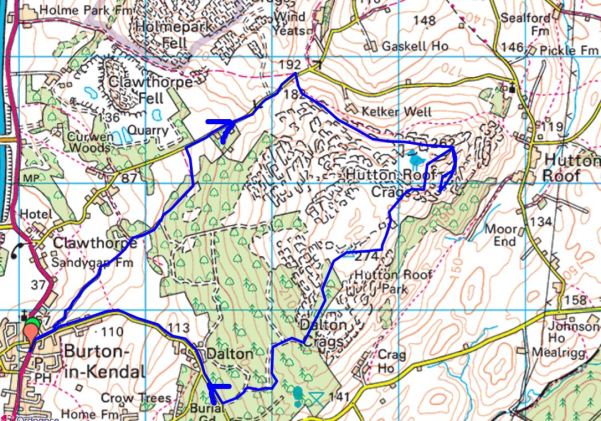
We were up the motorway out of Lancashire and into Cumbria, but only just. Not the Lakes but a quiet corner hidden away in the extreme south of the county. In the past I travelled here often to climb and boulder on Hutton Roof crags, beautiful sculptured limestone in the exquisite landscape above Dalton. It was time for a revisit and going over the map the night before I came up with a circuit including the summit trig point which I had not knowingly visited before, my focus then being primarily on the climbing area. It’s complicated up here with several ‘rakes’ of rock running across the fell, presumably fault lines in the limestone, creating miniature walls of rock. Paths are everywhere, but don’t always go anywhere and once the bracken is up it’s like finding your way through a maze.

I phoned Mike at a respectful time in the morning to see if he fancied a walk, but he was due to visit family on this Coronation weekend. Maybe I should therefore go for a longer walk in Bowland? Before long however he phoned back to say he thought, taking advantage of the good weather, he would postpone family to another day. I outlined my planned walk with only vague ideas of how we would navigate across the limestone plateau. Sandwiches hurriedly made we set off.

It was almost noon when we parked up in Burton-in-Kendal, but this worked to our advantage as the misty morning had given way to bright sunshine and blue skies. The first pleasant surprise was the old bridleway, Slape Lane, leading out of the village. A Panoramic Viewpoint has been erected  to honour Queen Elizabeth’s Golden Jubilee in 2002, the distant Lakeland Hills depicted were unfortunately hazy in reality. At least closer at hand Farleton Fell appeared prominent. P1010122

P1010191

Between hedges and walls the bridleway snaked slowly up the open fell side, first through farmland and then into forestry. Our attention was taken with the spring flowers and the unidentified bird song in the trees.

P1010124

Cumbria Wildlife Trust seem to have a hand in managing the woodlands and provide helpful information boards and permissive paths going who knows where. We stuck to the bridleway which came out onto a short stretch of road leading to a col where the Limestone Link footpath crosses Farleton Fell on its way from Kirkby Lonsdale to Arnside or vice versa. Nearby Newbiggin Crags look worthy of exploring.P1010132P1010133P1010136

Turning right we followed the footpath through coppiced woodlands and then onto more open limestone fell. Purple Orchids sporadically appeared giving a splash of colour. What a place for our lunch, looking out over fertile farmland and farther into Cumbria and the distant Howgill Fells. P1010154

I knew, or thought I did, my way to the climbing area, marked as The Rakes on the map. Soon we spotted climbers along the edge. Most were doing roped routes, and we stopped to watch for a while – what a perfect afternoon for them. Can you spot South America? P1010161

P1010167

P1010160

Now for the difficult bit. There was a path leading away from The Rakes which I thought might take us to the trig point, but it kept going down. Trying to make a straight line back up the hill was impossible across the shrub covered limestone blocks. Not wanting to break a leg we surrendered and back tracked on the path we had come in on. This brought us back to our lunch spot! I glossed over this by praising the weather and suggesting to Mike it was good training for him, he’s off to the Amalfi Coast in a couple of weeks. We struck off on a higher path heading in the right direction only to find it twisting and turning through the rocks. Forward visibility was obscured by the vegetation, one just had to keep going the most obvious way. Junctions caused some serious discussion, but we might as well just have tossed a coin. A runner appeared coming in our direction, on asking him if he had come from the trig point he looked baffled obviously not recognising the term. Onwards. A well-used path came up from  the valley, so we joined it. A couple of dogs came past us followed by their owner who gave the impression of knowing the way but in fact this was her first time too. We followed the dogs and suddenly came out on to the more open top with the summit trig clearly visible.P1010177

P1010171P1010176P1010179P1010178

A true 360 degree viewpoint, now with Ingleborough coming out of the cloud.  The Bowland Hills were clearer than the Lakes. Morecambe Bay was a silver shimmer and one could see Blackpool Tower through binoculars if you wished. I don’t seem to have taken may picture at the top. It would be worth getting up here early one morning in the crisp air to make the most of the visibility. And what sunsets you could witness.  P1010183P1010184

If we didn’t get a move on we might have been seeing one of those sunsets. But once into Dalton Hall’s woods the forest tracks lead us unerringly down to a lane through the few houses of Dalton and down eventually to Burton. P1010189

It was 6 o’clock back at the car – oh well I could forget about cutting the lawn.

What an exceptional walk this turned out to be. On reflection, I see on the map public footpaths from Dalton that would have taken us to Burton without the road walking, maybe next time as I’m sure there will be a next time.

***

Capturehuttonroof

CICERONE’S LANCASHIRE (and a bit of Yorkshire) – On the hoof.

P1000795

                                                                               Black Hambledon.

Another skylark day.

I hadn’t decided where to walk this morning but after a bit of faffing I hurriedly opted for a ready-made route, no 39, in Cicerones’s 40 Lancashire walks book by Mark Sutcliffe. It is described as the Reservoirs of Worsthorne Moor, but it is far more; traversing post-industrial landscapes, wild gritstone boulders, trackless moor, endless views and the summit of Black Hambledon, Hoof Stones Height, 479 m. I haven’t knowingly been up Black Hambleton before and today’s route virtually circled it before committing to the top.

It was almost lunchtime when I parked up on The Long Causeway, an ancient route from Pendle through to the Calder Valley, now dominated by wind turbines.  A fell runner was just returning from his morning circuit, there was still a chill in the air. (we’d had a ground frost)

Some of the early tracks I remembered from The Burnley Way done back in 2017. Leaving the wind turbines the way drops down Shedden Clough into an old limestone mining area where they used ‘hushes’, dammed watercourses to uncover the limestone. There was evidence of industrial activity wherever you looked. P1000808

P1000817P1000816

A man from Salford was exercising his two dogs down by the bridge. He escapes up here for fresh air and tranquillity. The young dogs were having a great time, I think they were pleased to be out of Salford too. A couple of mountain bikers came through and after that I met no one until almost finished. P1000811P1000814

I was on the Pennine Bridleway heading towards Cant Clough Reservoir set deep in the hills. Normally one can go across the dam, but there was maintenance work in progress which meant a  tiresome diversion down the valley and back up again. They were ‘repuddling’ the clay lining, probably the first time since the construction at the end of the C19th. You may remember the 2019 panic when the reservoir dam above Whaley Bridge was put under strain and threatened the area with flooding. P1000829

P1000827

In another extensive quarried area I soon left the PBW, for a while anyway, and headed on a smaller path bordering the wild Rams Clough up into the hills towards an unnamed 468 m summit. All was quiet except for the joyous skylarks. I was soon looking back at Cant Clough Reservoir. The path became steeper and rougher – a sign of things to come?

P1000839

P1000840

P1000847

I reached a bridge in the middle of nowhere carrying the BBW where I managed a photo of a Wheatear which flew from post to post, I remember several of them in this very same place on my Burnley Way outing. P1000848

P1000800

Passing into Yorkshire, Gorple Upper Reservoir now came into sight below and there above me the Gorple Stones, which looked as though there would be bouldering possibilities. But how often do you get a day like this up there? P1000855P1000856

Ahead now was the prominent Gorple Buttress. I recall the excitement in the climbing magazines back in 1995 – “John Dunne has climbed an E7 on the jutting prow of Gorple” Walking below it today it looked as impossible as ever, overhanging and slopy, I wondered if anybody has repeated it. Dunne went on to produce an even harder more direct line at E9 three years later. A good spot for lunch gazing down at the remote reservoir and across to Black Hambleton. P1000860

P1000859

P1000869

P1000956

John Dunne on Eternal E7, cooler day.         David Simmonite.

Stirring myself I was soon down to the dam. Mark’s route goes a little down the valley, towards the lower reservoir, before climbing again, but I spotted a level path getting to the same point by crossing, possibly illegally, the dam  and using the estate’s shooters’ track. Not advised in the killing season. There were some very attractive little gritstone buttresses above that valley, I may need to return. P1000873

P1000893P1000887P1000909

P1000898

 Gorple Lower Reservoir.

Across the way were the hauntingly fascinating ruins of  C16-17th Raistrick Greave, presumably abandoned when the reservoirs were constructed, around 1930. It had been a large farm and buildings, one suggestion is that it may have been also a stop-over on the local packhorse trails. Reaps Cross is nearby and of course The Packhorse Inn over at Widdop. P1000907P1000915

To be honest I never really picked up the path again. The ground is very rough and tussocky, when I thought I was back on track I usually ended up on a sheep trod going nowhere. I just battled up the hillside keeping to a southerly direction avoiding Clegg Clough for more than one reason. All around was that dry straw-coloured moorland grass so attractive from afar in the winter months. P1000922

Boggy paths started to appear on Hoar Side Moor and I followed one until I hit the fence which I could follow westwards up Black Hambleton at last.  All very bleak and isolated. P1000930P1000933P1000929

The trig point eventually appeared. I found a rock to sit on straddling the Lancashire /Yorkshire boundary. All around were the familiar Pennine Hills. Bowland, Pendle, Ingleborough, Boulsworth, StoodleyPike and many unnamed ones to the south.Way down below I could see a Barn Owl quartering the rough pastures.P1000934

P1000936

Pendle in the distance.

P1000940

Bench marked rocky seat.

I wish the walk could have ended up here as I never found the proper path off to the southwest, the rough ground making it hard going, and the mile alonside the busy road was scattered with litter.  But ignoring that last hour this had been a stunning walk of variety and remoteness, sorry I was distracted by all those boulders. I was tired by the end.  P1000954

***

  CaptureBlack Hambledon.

CICERONE’S LANCASHIRE – BOWLAND’S HIGHEST.

P1000644

It was alarming that my car radio suddenly switched from Radio Lancashire to BBC Cymru as I turned off the A6 towards Dolphinhome in deepest Lancashire. Had I taken the wrong turning somewhere down the road? it turns out their frequencies are very similar, still a bit strange.  I was on route to the heart of Bowland not Bangor. Tarnbrook’s few houses lie at the end of the road alongside the northern branch of the River Wyre. They are part of the Duke of Westmorland’s vast Abbeystead estate. I’ve covered this area many times before, most recently here in my Cicerone series. Parking along this narrow lane has always been an issue and the estate are discouraging us going past a suitable lay-by at the entry to the valley. I go along with this even though I know of a large grassy verge higher up the lane. These parkings are both  mentioned in Mark Sutcliffe’s walk number 10 onto Ward’s Stone in the Cicerone Lancashire Walks guide book, my objective for today. It looked far off on the horizon.P1000794

What a day, clear blue skies and sunshine. Rare enough in these northern hills. But there is a cool easterly wind blowing even down here as I start my walk along the lane to Tarnbrook. I add a few extra warm garments to my rucksack. The quiet lane runs alongside the Tarnbrook Branch of the River Wyre and its joyful passage keeps my attention on the mile or so morning walk up the valley, and of course the lambs. I pass Ouzel Bridge leading to  a farm. The Ring Ouzel, or mountain Blackbird, is found in the tree lined cloughs in the Forest of Bowland. Will I see any today, I have previously? P1000646P1000647P1000791P1000650

Once into the hamlet I take the concessionary path straight up the fell into open access land, roughly following Tarnsyke Clough. Unfortunately not a Ring Ouzel in sight but there are plenty of lapwings and curlews flying around. This is essentially a Land Rover track to take shooters up to the butts on the fell. In the past, before the CRoW act, it was jealously guarded by the keeper living in the hamlet. Us climbers wanting to go up to the forbidden Thorn Crag, seen up on the right, often resorted to devious tactics, walking up a longer, but permitted, way to the plateau and then dropping down to the crag. We came unstuck one day when my climbing partner uncoiled his new rope, a fluorescent yellow. We could be seen from Blackpool never mind from the keeper’s cottage in Tarnbrook. Session over we would walk boldly down the estate track knowing we would be rudely accosted but also knowing they would have to let us out at the hamlet, stalemate. Things changed with the implication of the access agreement, the same gamekeeper who had sworn at us the last year now wished us a good day. The worm turns. There are no confrontations today and I just plod on upwards at my steady pace. I can’t believe I used to carry a bouldering pad up here. P1000653

P1000667

Thorn Crag and boulders.

P1000664

Looking back down to Tarnbrook with Hawthornthwaite Fell behind.

I reach the ‘Luncheon Hut’, park your Range Rover here sir. P1000665

Onwards, I ignore the track off to the right and continue on to a division of tracks not specifically stated in the guide. It mentions contouring to the left, I somehow ignore this and  follow the tempting main track upwards to its terminus, SD593578, and then pick up a fainter path linking a series of shooting butts rising up the fell. All very pleasant although the modern butts resemble WW1 fortifications. I am obviously wrong but take a compass bearing on the trig point and climb onwards. With relief the conspicuous weather station up here comes into view, I was then only a few  hundred metres from the summit. It would all be far more difficult in mist. Probably would have been better to stick more closely to Mark’s directions.

P1000677

End of the road.

P1000678

Old pony track.

P1000680

Grouse bunker.

P1000687

The Fylde plain and Morecambe Bay lie down below, all a little hazy, as I reach the trig point, 560 m. The Lakes and northern Pennines were imaginary. By now the wind was almost gale force making any movement awkward. Fortunately there is a gritstone boulder, the Ward’s Stone itself, nearby behind which I cowered and added more layers of clothing. I used my spare balaclava to keep my cap from blowing away. Even with two pairs of gloves my hands were frozen. I was the only person out on the fell which was probably good considering my appearance.

P1000690

560 m trig with nearby Ward’s Stone.

P1000688

Grit Fell to the west and Morecambe Bay.

P1000691

Over to Caton wind farm with the Lakes hiding behind.

P1000696

Ready for battle at Ward’s Stone.

Half a mile across the sea of peat was another trig point one metre higher, so at 561 m the highest in Bowland. Why there are two so close together I can find no reason. All is Bowland emptiness to the east, except for Ingleborough’s distinctive summit across the  Craven Fault. The book says head for Ingleborough, but I found a vague path going to its right and meeting up with a fence line that comes from nowhere. It’s all too easy in clear weather like today.

P1000699

Heading just right of Ingleborough.

P1000705P1000704

P1000709

P1000711

Queen’s Chair.

The going was good to firm on what after rain can be a quagmire of peat. The fence gave way to a wall, which gave me a bit of shelter from the wind. Another fence lead me down the fell. The Three Peaks remained unclear but ahead the remote Wolfstones and White Hill were obvious. These latter two are rarely visited trig points in deepest Bowland. Having said that not a lot of people come this way, the path along Ward’s Stone ridge is not heavily used.

P1000716

The wall with Distant Pendle. I was having difficulty holding the camera steady.

P1000735

White Hill.

This part of the fell was being used as a seagull roost, and I  was dive bombed a couple of times. Judging from the number of gulls this won’t bide well for vulnerable eggs and chicks of Lapwings or Curlews. P1000736

Suddenly I was onto one of his lordship’s roads coming over the hill from the north. This took me all the way down alongside the upper Tarnbrook Wyre in Gables Clough to the valley bottom. Farmers were busy with their sheep and lambs. P1000759

P1000752P1000764P1000770

P1000776

In the hamlet the estate houses were being done up for a new lease of life. I remember a few years ago talking to a lovely old gentleman outside his house. He had lived there all his life and was the last resident still there. it will be interesting to see how gentrified the place becomes with new residents moving in. P1000783

SAM_4998

July 2014.

It seemed a long trudge back along the lane to my car. The extra road walking brings the mileage up to 10, more than the 7 1/4  stated in the guide. With hindsight, given the strength of the wind, it would have been an easier day in reverse.

***

This is what you may find on shooting estates. A snare cage trap on a log which is meant to kill predators such as the stoat or weasel. The problem is that other small mammals can easily enter and if the dimensions of the entrance are not correct so can larger animals. All very nasty to my mind. You wouldn’t want to put your hand in one! They make a resounding loud snap if touched with a ski pole.

P1000785

***

CaptureBowland

                                                                   BOWLAND.

Capture Wards Stone.