SCULPTURES DOWN THE EDEN.

P10108732

 Eden Benchmarks are a series of ten contemporary stone sculptures located at intervals along the length of the river Eden between its source above the Mallerstang valley and Rockliffe, north of Carlisle, where it runs into the Solway Firth.
 “Each sculptor worked in residence for six weeks and this enabled them to formulate their ideas by familiarising themselves with the locations and talking with local people, including schools, who were encouraged to visit their workshops to see the sculptures taking shape. The artists’ brief allowed as much creative freedom as possible to produce site-specific sculpture, which harmonises with the landscape and captures the essence of each unique locality.
 Collectively the sculptures give visual expression to our awareness of the river’s ecology and the need to look after it; individually they foster a profound sense of place, their capacity as seats accommodating an interactive focus for quiet reflection.”

These sculptures were funded and commissioned by the East Cumbria Countryside Project group in 1996. It disbanded in 2008 when funding dried up, but the sculptures are still there even if not officially cared for.

I have already discovered the first two in the last couple of days, ‘WATER CUT’ in Mallerstang and ‘PASSAGE’ in Stenkrith Park, Kirkby Stephen. Today I intended to visit as many of the remaining eight before I ran out of daylight. It would mean more driving than walking, I had plotted a route down the Eden between all the village sites. The satnav on my new phone proved invaluable.

Capturebenchmarks

I’d enjoyed my two nights at the Black Bull in Nateby and they sent me off with a hearty breakfast, I didn’t eat again until I was back home in the evening. I stopped briefly in Kirby Stephen to take that photo of Lady Anne Clifford’s statue which I used yesterday. I noticed this seat with its friendly notice, I didn’t have time for chatting but what a good idea. As the benchmarks have all been sculptured to provide a seat to sit and contemplate this was a good start to the day.P1010658

A mad dash up the scary A66 and I was taking the road into Appleby. A little side lane, Bongate, lead down to an old ford over the Eden by a derelict mill and a small carpark. At the edge of the carpark was a rough looking boulder – could this be the benchmark? It was only when I walked around the other side of it that I could see fully the carved flower. I brushed the leaves aside and sat in it for awhile watching the river flow by. Stunning.

‘THE PRIMROSE STONE’ by Joss Smith at Bongate near Appleby.

Shaped from a nine ton block of St Bees Sandstone, the Primrose Stone magnifies the ‘inscape’ of the much loved first rose of spring. As you approach the sculpture from behind it looks like a rough erratic boulder and the carved petals of the flower at the front come as a surprise. It envelops the sitter in a bowl shape that is positively seductive and, like a primeval satellite dish, amplifies the sights, sounds and smells of the river”.

 Joss Smith lives in London. His work is mainly studio based and traditionally figurative but has recently been making accessible sculptures for public places.

P1010070P1010073P1010077P1010080P1010082P1010083P1010088

*

 I needed more time to explore Appleby but I was soon on the way farther north. I found a bit of roadside parking by the cricket pitch on the outskirts of Temple Sowerby and strode across muddy fields towards the river. You can see the state of the ground after all the heavy rain. The sculpture came as a surprise with the spheres scattered over the surface ripples. There was a distinct feeling of motion as the spheres ran into the river. I loved the ripple effects she had created around each grain.

‘Red River’ by Victoria Brailsford at Temple Sowerby.

“The stepped slabs of Lazonby Sandstone in this sculpture represent the contours of the landscape and its light, shade, pattern, shape and form. The spheres, reminiscent of gigantic pebbles in a fast moving stream, are a powerful evocation of the river and its energy but also, like hugely enlarged grains of sand, recall the origins of sandstone in the shifting sand dunes of Triassic Cumbria”

 Victoria Brailsford’s  work relates to ecological issues and ranges from charcoal drawings to wood carving and large stone sculptures. P1010107P1010110P1010117P1010116P1010140P1010120

*

 Back across the boggy fields and reset the satnav for Edenhall, a tiny red sandstone hamlet across the river from Langwathby. I park in a small pull off and ask the couple on the adjoining garden if I’m OK there. They don’t see many strangers in the village and I explain my mission. They are proud of their nearby Benchmark and regale me with their favourites, they haven’t made it to the Water Cut in Mallerstang as yet. I leave them to their pond maintenance and walk down the lane towards the squat red sandstone C12th church. I turn off at the wheel headed cross, the base looks ancient but the shaft as is often the case much more modern, There used to be a manor house down here which explains the churches isolated position surrounded by parkland. It also explains the name of the river bank walk I was about to set of along – The Ladies Walk. Built for the manor house occupants, a level path above the river with old iron railings and stone seats at intervals, fit for a lady. Not sure how far along I would have to go, met a bloke walking the other way but he knew nothing of Benchmarks. Up some steps and there is the sculpture. Two curved pieces of red sandstone in juxtaposition. They have graceful curving lines and wonderfully detailed surface rippling. The low lying one is being gradually covered by green moss and for a moment I think of cleaning it to reveal the detail, but I stop myself in time. These sculptures were specifically envisaged to reflect the landscape and now I feel they are slowly becoming part of it. That is probably hidden praise for the sculptor’s skill in the first place. I was warned that the ongoing path was flooded so I turned tail  and followed the  ladies alongside the ever enlarging river.

‘South Rising’ by Vivien Mousdell on Ladies Walk at Edenhall.

“Made from Lazonby Sandstone, ‘South Rising’ pays tribute to a vigorous ecosystem, representing the river’s perpetual journey and the annually recurring movements of migrating fish and birds. The horizontal stone alludes to the river itself, flowing north, and the tall vertical stone, with perhaps a passing resemblance to Long Meg, inclines south toward the rivers distant source. Chiselled with a surface texture reminiscent of water reflected sunlight, both stones have been carved in sweeping curves like the surrounding landscape, creating a rhythmic energy passing from one to the other”

 Vivien Mousdell trained in ceramics but switched to wood and stone carving and letter cutting. A skilled and versatile artist she has specialised in public commissions such as the stone boundary markers on the Cleveland Way and a variety of wood carvings on the Whitehaven to Ennerdale cycle path. She is also a puppet maker and performer and video artist. Some people are just so talented.

P1010717  P1010674

P1010677P1010713P1010679P1010682

P1010691P1010687P1010689P1010685

P1010711

 *

 Straight up little lanes in picturesque scenery, through Great Salkeld, I need to visit Long Meg and her Daughters on the other side of the river some day. Down there by the river are Lacy’s caves, chambers carved into the soft sandstone, which I distinctly remember from my Eden Way walk all those years ago. There was also an excellent climbing crag which is unfortunately now banned. Public footpaths and access are at a premium along this stretch which is a disgrace. The Settle-Carlisle line comes through the middle of Lazonby, I duck under it and head for the riverside picnic area. The Eden is in full flow. In rather drab surroundings the next benchmark lies low in the grass, can you spot it? P1010747P1010724

This one really is becoming organic. Moss is taking over and obscuring most of the stones’  cyphers. I see the sun or is it moon at one end and that’s about it. I do like the view up to the graceful bridge though.

‘Cypher Piece’ by Frances Pelly at Lazonby.

“The sculptor presents us with a series of puzzles to be decoded. The combined stones mimic the river landscape and contain various references to human history. A sun and moon have been carved at one end of the sculpture representing the winter solstice and a variety of images are portrayed elsewhere, including a fish, a Roman 1996, a Celtic horses head’ a rams horn and decorations taken from a Norse tomb”

 Frances Pelly lives in Orkney. As well as carving stone she also works in bronze.  P1010738P1010732P1010733P1010740

 *

 Where next? A short drive along the valley to another delightful village, Armathwaite. This a spot I know well having climbed on the riverside crags many happy times. I parked at the bridge and walked through the grounds of the Fox and Pheasant and up into Coombe Woods on a carpet of leaves until quite high above the river and the crags. The path leveled out and there was the carved block in a ring of smaller stones. I could easily pick out the intricate carvings of discarded clothing from the bloke who has gone for a swim. What an imagination, the sculptor’s not mine. I found a lower way back closer to the roaring river. A magic stretch of water.

‘Vista’ by Graeme Mitcheson in Coombs Wood near Armathwaite.

“A solitary walker reaches a plateau in Coombs Wood where beneath him, between the trees, he can see the winding river Eden. Nine stones form an ellipse in clearing. It is a hot day and he removes his clothes and goes for a swim. This sculpture is about walking in the countryside and being at one with nature. The largest of the stones is carved with representations of various items of clothing and a map, which also functions as a sundial. A tiny face depicted on the cap is reference to a series of faces carved on the cliffs below in 1885 by William Mounsey who famously walked the length of the Eden”

 Graeme Mitcheson  lives in Derbyshire. His work is based in traditional stone masonry and he turns his hand to everything from commissions for bird baths and garden ornaments to architectural restoration and memorials.

P1010757P1010762P1010766

P1010774P1010785

P1010788

P1010797P1010810

 An easy drive and I was parked on the village green at Wetheral near the church. It was just after one o’clock and for the first time I thought I might make the Solway today. A steep little lane took me down to the river and there was the next sculpture on a flat piece of land. This was a large affair, a bench with angels’ wings, cushions and arched panels reflecting the nearby bridge.

‘Flight of Fancy’ by Tim Shutter at Wetheral.

“The steep scale of the wooded bank across the river and the soaring viaduct combine to give the feeling of an outdoor cathedral. ‘Flight of Fancy’ plays with this ecclesiastical sense of lifting the spirit with angel’s wings, church style masonry and very convincingly carved prayer cushions”

 Tim Shutter is a master stone mason in the classical tradition. He is based in London.

P1010819P1010838P1010823

P1010825P1010826

P1010831

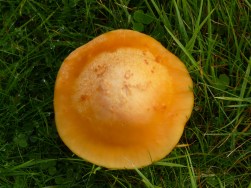
Back on the village green I became distracted by some tiny yellow fungi hidden in the grass -possibly Golden Waxcaps? There’s beauty in the minutiae too. P1010844

 *

 I was apprehensive of my detour into the centre of Carlisle for my penultimate benchmark. I new there was some parking near the castle so I asked my phone to take me there. It was clever enough to warn me that “the castle may be close today” Despite the heavy traffic delays I eventually arrived in the car park but couldn’t understand how to operate the pay machine. Two ladies took pity on me and as they had just finished their shopping spree gave me there still in time ticket. I felt the day was slipping away with these delays. P1010850

I walked towards the river only to find another car park without charges, the dog walkers used this one. Somehow rivers either bring a city to life or become subjugated into the background. The river Eden in Carlisle is of the latter character – lost between rail, roads and industrial sites or maybe it was the dullness of the afternoon that prejudiced me. The four stones were set in a line in the parkland alongside the river. Strange angular carvings which didn’t relate easily to me, erosion usually produces smoother features. OK they are smooth on one side but I find the other angles jarring.

‘Toward the Sea’ by Hideo Furuta in Bitts Park at Carlisle.

“The four components of this sculpture are manifestations of the sculptor’s intense and mathematical explorations of the stone itself and, almost incidentally, describe a sequence of water eroded stone running parallel with the flow of the river nearby”

 Hideo Furuta sadly died in 2007 aged 57. He was an artist of international standing and was based at a granite quarry  in Dumfries and Galloway. P1010853P1010861P1010862

 *

 Maybe I was a bit harsh about Carlisle as I know from my trip on the Hadrian Wall path that the Eden is in magnificent form either side of the city. Anyhow I was pleased to find an easy way out of the city to my last destination, the village of Rockcliffe on the Eden before it slips into the Solway.

The clock had turned three and the light was fading and I couldn’t find anywhere to park. I eventually used the carpark of a nearby pub and walked on down past the church to a little red cliffed bay area next to the river. Flood debris showed that it is often underwater. At the end I could see my final benchmark and thankfully it was a thing of beauty reminding me bizarrely of the amoebae I used to study under the microscope. How does the sculptor achieve such smoothness and shapes out of a block of sandstone? My only thought is that it could have been positioned closer to the Solway estuary itself but there may have been practical reasons against that. Here I saw the river slipping around the corner into that unseen estuary. I found a place to sit inside it and watched the sun fading in the greyness over the flat marshlands.

‘Global Warming’ by Anthony Turner at Rockcliffe.

“The title of this sculpture is indicative of its global perspective. Situated where the river Eden flows out to sea there is an expanding awareness of the wider world. It could simply be a huge sea creature washed onto the shore but it conveys the sense of an even bigger scale. There is a mysterious pregnant silence about it and it resembles a planet earth held carefully in a hand. The term global warming is now ominously synonymous with the world overheating yet we would like it to mean a nurturing, life enhancing glow”

 Anthony Turner was born in Kenya. A self taught painter and sculptor.  Recalling his childhood in Africa his sculptures are organic, exotic and sensual.

P1010878P1010879P1010883P1010881P1010886P1010892

*

 What a journey. I didn’t expect to reach all the Benchmarks today but time just seemed to flow for me. You must admit these sculptures are so impressive and yet so diverse. At each one I felt a strong connection with the artist, the stone and the setting. It is too late for me to rewalk the Eden Way but wouldn’t that be a finer way to appreciate the river and take in these works of art.

I’m back home after an easy motorway journey from Carlisle and preparing to visit my cousin and her husband down in Derbyshire. In the past I have shared walks with him but now he has advanced dementia and is bed bound.  Maybe I’ll show him some pictures of the River Eden.

EDEN VALLEY, MALLERSTANG.

P1010297

Time to head into the hills. After a good breakfast I  was ready to be away fairly early from the pub. Interestingly the garage opposite had more farmers’ quad bikes in for servicing than cars. P1010656

P1010175

Refueling.

It was a short drive up the valley into Mallerstang proper. On the way I passed the ruins of Pendragon Castle. The early morning light was so clear that I made a quick photographic stop in case things were murkier when I returned, it starts getting dark between three and four.

There is a lot of legend associated with the castle. it was supposedly built by Uther Pendragon, the father of King Arthur. It is said he tried to divert the river to form a moat.

A well known local couplet goes –

    Let Uther Pendragon do what he can,                                                                                                     Eden will run where Eden ran.

 The castle was built during the reign of King Rufus in the 12th century by Ranulph de Meschines,  After attacks by Scottish raiders in 1541 it became uninhabitable until the C17th when Lady Anne Clifford inherited it. She rebuilt it and added to it in 1660. It remained one of the favourites among her many castles until her death in 1676 at the age of 86. She spent her time between Skipton Castle and here in Westmorland  becoming involved with local affairs and restoring several nearby churches. A long distance walk tracing her travels passes this way. There is a statue of her in Kirkby Stephen market place. P1010666

 Her successor, the Earl of Thanet, had no use for the castle and removed anything of value from it, By the 1770s much of the building had collapsed. It now stands as a romantic ruin with pointy Wild Boar Fell in the background. P1010185P1010188P1010189

Whilst wandering around the ruins I was treated to a flypast by a Lockheed Hercules. P1010205

I drove through Outhgill which I visited yesterday and parked up at The Thrang for a walk I had picked off the net. It would take me up to the first Eden Benchmark, Water Cut – before visiting Hell Gill and its waterfalls, and then wandering back past valley farms.P1010209

Quite a broad track headed away from the valley floor, an old bridleway to Hawes at the head of Wensleydale. All the rivulets coming down from Mallerstang Edge were in full flow and my feet were wet after the first ford crossing. P1010224P1010221

That dot on the horizon turned out to be the benchmark in its very prominent position – how come I have never spotted it before? After some steady walking and a few more fords it was reached at about 420m. P1010225

P1010236

P1010234P1010241

Water Cut by Mary Bourne. 1996. 

Water Cut is located a few miles from the source of the river Eden, high up on the eastern side of the Mallerstang valley. Like a huge milestone, it stands alongside the ancient green road known as Lady Anne Clifford’s Way. The space carved between the two vertical pillars creates the shape of a meandering river in the sky and provides a ‘window’ onto the real river in the valley below. It also symbolises the power of the river Eden cutting through the rock on its journey through East Cumbria and our own human journeys through the rural landscape and through life. Made from Salterwath Limestone, taken from a quarry near Shap, it also resembles the gate posts and stiles in drystone walls, which are so characteristic of the area, whilst it’s outer curve makes reference to the viaduct arches on the nearby Settle-Carlisle railway.”

Mary Bourne is an accomplished stone carver,  living in the North East Scotland. Her work explores forms of the landscape and her relationship with the natural environment.

I played about with various camera angles. The more I looked they resembled two salmon leaping, are there salmon in the Eden?

P1010253
P1010252P1010245

P1010247

P1010289

From up here one has good views north along Mallerstang Edge and across the valley to Wild Boar Fell. The limestone lower layers contrasting with the overlying gritstone.

Not much farther I came to Hell Gill, I could hear it well before I reached the bridge over it. A deep rift in the limestone tearing down the hillside with thrashing waters in its depths. This was dramatic. I tried to get views down into the canyon but it was sensibly well fenced off. All was green mossy and ferny, I think there are fairies down there. P1010346P1010352P1010366P1010372P1010377P1010388P1010398P1010401

The water tumbled on down the hillside and I followed. It came to a welcome rest at a ford. P1010409P1010418P1010422P1010424P1010433

But what was that noise? A small steep detour and I could see the next and probably the best cataract. A video should have been taken. P1010440P1010451

P1010459

My boots were under water crossing the fast flowing ford.  P1010462

It must be all downhill from here but the next few miles tried my patience. I was basking in the beauty of Mallerstang and yet struggling to find the bridleway marked on the map on the ground. There was a lot more rough walking to come. It tended to keep above the top intake wall and hence involved tussocky grass and boggy areas. Few people use this way. P1010464P1010480P1010513P1010533

There were a few more waterfalls to admire and the light on the other side of the valley was beautiful. No steam on the Settle to Carlisle today.P1010550P1010472P1010477P1010466

Eventually I made my way to the valley bottom and along by the Eden back to my car just as the sun was going down behind Wild Boar Fell.P1010539P1010565P1010572P1010579

P1010582P1010600P1010635P1010625

I would highly recommend this walk, it packs a lot into those 6 miles without going onto the tops. I never saw another person.

Mallerstang-trail.pdf (edenriverstrust.org.uk)

***

Capture

CaptureMallerstang

THE POETRY PATH. KIRKBY STEPHEN.

P1000936
 
 Twelve short poems, interpreting the hill farmer’s life throughout the year, written by Meg Peacocke, have been carved by lettering artist Pip Hall (0f Stanza Poems fame) on blocks of stone on a circular walk either side of the river Eden just outside Kirkby Stephen. Each stone also has an engraving depicting the month’s theme.  There was a handy car park at Stenkrith Bridge as this is also the start of another walk on the old rail track over three viaducts.  I was amazed at the flow of water through the little gorge below the bridge, a hidden thundering cataract. A little metal bridge took me over the water into the park.P1000777P1010052P1000791P1000785
 Alongside the path in the trees the first of the poems, well actually it was the ninth, October (Sheep Sales) as I had come into the trail half way round. Two stones, one of sandstone and the other Limestone. It was just possible to make out the poem.
 
 Sandstone. A desert wind, grain by grain, laid down these rocks. How did we trace a path through ancient dunes?
 Limestone. A million blanched and compacted shells. How did we swim through the drift and not perish?
P1000797 P1000800P1000802
 The next poem, November (Tupping Time) was on a pair of upright stone slabs, again at the edge of the woods next to some spectacular rapids in the Eden.
 
 Through hazels and alders, softly or in spate, Eden moves in the valley it has hallowed  from Mallerstang to the shifting Solway sands.
P1000813P1000818P1000823
P1000836
P1000828P1000832
 I diverted from the poetry Path to try and find my first Eden Benchmark which was described after two of the poems. I could find no sign of it alongside the river and wondered whether it could have been washed away in the frequent floods. I was not entirely sure what I was looking for so I gave up and headed across the fields to the next poem, a Haiku.  December (Tree Planting)  I found them lying flat in the field.
 
  There sails the heron  drawing behind him  a long wake of solitude.P1000838P1000841
P1000846P1000844P1000843
 
 
 Next to Swingy Bridge was an upright stone commencing the year in January (Hedge Laying)
 
 The sky’s harsh crystal, wind a blade, trees stripped, grass dull with cold. Life is a kernel hidden in the stone of winter.
 P1000848
 

P1000853

P1000857

P1000854

A close up of the hedge laying motif showing how difficult they were to pick out.

 Having crossed the Eden I now followed an old sunken path through the woods on the other bank.
February’s (Cattle brought in for winter) poem was a stark tower of four blocks.
 
 Snowlight peers at the byre door. Neither day nor night, Four months ago we fetched the cattle in, safe from reiving wind and rain, months of standing shifting, burdened with patience. When will winter end?
Thin strakes of run on the byre door. Fork a load of silage out, straighten your back to watch them shove their muzzles in, and wonder if they crave the hazy nights when they can roam among tall summer grasses, sleek and sound and warm.  P1000862P1000877
P1000871
 
 The path crossed a small but lively stream and the March (Walling) poem’s block was in the water itself. Apparently when they were deciding where to place this stone it slipped from its cradle but landed perfectly in the water.
 
 From field and fell run cols run small. I am the rain tear in the eye blood in the vein I am the sea.  
P1000884
P1000889P1000896
 
 
 April (Lambing) was built into the stone wall on the right. If the stone was already in the wall, which I assume it was, it is a sign of the walls antiquity.
 
 Coltsfoot, celandine, earliest daisies. Twin lambs race to the mother, baby cries, Mam! Mam! Jolt out of them and now they jostle the ragged ewe, boosting each split hoof high off the bitten turf. Pinching jaws and hard curled coats are braced against these April suns and sleets.  P1000904P1000908
 
 Farther on just before a bridge over the old railway line and again built into a wall was the larger May (Paling) poem. Another piece of ancient wall. Look at those lovely lichens growing on the rock.
 
 Penned in a huddle, the great tups are clints of panting stone. The shepherd lifts a sideways glance from the labour of dagging tails. His hands are seamed with muck and sweat runs into his eyes. Above us, a plane has needled the clear blue.  P1000914P1000915P1000917
 
 After the bridge June (Gathering and marking sheep) was found in the undergrowth on the right. The two blocks look as though they have come out of a mill floor.
 
 Light drops like honey from branch to branch. Elders balance their dishes of cream, while fledglings try small quivery leaps, testing buoyancy of the air.  P1000926P1000929P1000927
 
 I followed the path down to join the track of the old railway, part of the longer viaducts walk. July (Haymaking and silage) was soon encountered, a large rough block of limestone there on the left.
 
 Silage. Tractor incises the first green furrow. Skilful geometrician, the driver judges an arc of weather. P1000938P1000940P1000941P1000946
P1000943
 
Farther along August’s (Showing sheep at shows) poem is semi hidden in the trees to the right. A large weathering sandstone block with a white patina of lichens encroaching on the lettering.
 
 Crabapples tart on the tongue, Hazelnuts milky, Rosehips cool in the hand, Thistledown silky.  Squirrel is speaking his mind.
Knapweed purples the banks.
For touch, taste, smell, sight, hearing I give thanks.”
P1000950P1000953P1000978
 
 The last poem on my circuit was September (Farmer’s markets) a block of shaped red sandstone maybe reflecting the railway’s past. The bold lettering adding to the effect.
 
 Revetted banks, a concrete post. Rabbits tunnel the cinder waste. Angle iron, link of broken chain. Listen, and catch the hiss of steam again. P1000982P1000989
P1000991P1000995
 
I have transcribed the poems above as photographs don’t show them clear enough. As well as the poems, motifs reflecting the subjects were inscribed on the stones, I found it virtually impossible to make these out which is a shame but sculptures on natural rock exposed to the elements will suffer from corrosion. I really enjoyed this little walk, a great idea to highlight the area. The stones were well chosen and positioned. Meg’s poetic lines are to the point and very evocative – make sure you read them.
 
 I was back where I started, but smarting from not finding that benchmark, I rechecked  on my phone, ‘pocket computer’, It seemed to suggest it was after the first two poetry stones and gave a grid reference. But people often quote misread grid refences. Lets look again. I delved deeper into the undergrowth by the river after the second poetry stone and found nothing, the grid refence I was getting was different from the publicised one. I then followed my phone to the given grid reference and there stumbled upon the installation It was close to the river hidden by undergrowth, nearby the first poem which being composed of two stones could have caused the confusion.
 
 This, the second Benchmark down stream on the Eden was called ‘Passage’ by Laura White
Evocative of the river’s passage through the gorge under Stenkrith Bridge, this sculpture is subtle and unobtrusive but exudes an inner strength that somehow gathers the special ambience of its location. The shapes carved into the stone are clearly derived from the shapes in the river bed rocks but have been refined to activate and compliment the space and provide a focal point for contemplation”  
 
 Laura White’s early work with stone explored organic themes but more recently she has used mixed media and video images. She lives in London and teaches at Goldsmiths College in London and Manchester Metropolitan University.
 
 Ah well, at least I found it. The stones were rather lost in the vegetation and are slowly naturally mossing over, not many people visit them or perhaps can’t find them. Whatever, it was a good excuse to spend some more time alongside the lively Eden and on the breccia bedrock. 


P1010030P1010036P1010035P1010032
P1010007P1010011P1010014
 
Tomorrow I will head to the hills for the first of the Eden Benchmarks. 

GOLDSWORTHY PINFOLDS IN THE EDEN VALLEY.


P1000678
 
“People also leave presence in a place even when they are no longer there” 
 Andy Goldsworthy.
 
 I had two objectives today – The Poetry Path in Kirkby Stephen and Andy Goldsworthy’s six Pinfold Cones, from early this century, scattered around the area. As the day progresses an Eden Benchmark crept into my itinerary. It became a bit of a whirlwind day. Just warning you, in fact I have just decided to remove the poetry to another post.
It is difficult to write a post when virtually all of your six subjects, in this case the Pinfold Cones. are almost identical.
  A fairly early start and I found myself driving narrow lanes in the mist. This is limestone country. Through the village of Orton and onwards to Crosby Ravensworth to try and find my first pinfold. This was easy as it was next to the main street at the south end of the scattered village. A small square pinfold with one of Andy Goldsworthy’s stone cones in the centre. The cone shape is said to have been influenced by the Nine Standards Rigg above Kirkby Stephen. He has used it in installations in many places. He talks of the cone shape being warm and enveloping, a source of hope and also protection. They focus our attention on the environment and the history of man’s influences upon it.
 This cone is made from local limestone, looking quite black in this damp morning. The Pinfolds will have been around for a long time, a pen used for stray animals before they could be reunited with their owners. We have a good example on the outskirts of Longridge. I have found some reference for Goldsworthy’s pinfolds being rebuilt on the  original sites, there doesn’t seem to be any documentation for each one. I must assume at least that it will now guarantee their survival.P1000674
P1000676P1000677
P1000681
 Back in Orton I stopped for a coffee in Kennedy’s Fine Chocolate shop. Maybe I should have stocked up on luxury Christmas presents, but I didn’t. Across the street is The George Hotel, we ended up there one afternoon after climbing at nearby Jackdaw Scar, Kings Meaburn, a crag where you start on a sandstone lower wall which morphs into limestone as you progress. The geology of this whole area is fascinating and one learns a lot from climbing on its cliffs. The bar staff had had a busy Sunday lunchtime and were wanting to rest before the evening’s trade. Being officially open, they happily accommodated us though, by locking us into one of the bars at the back with orders not to let anybody else in. We sipped our supplies of beer and played pool for an hour or so. P1000687P1000689
 I drove through the village of Raisbeck without realising and ended up on a single track road going nowhere. I had to backtrack and found the next Pinfold, a larger square with a gated entrance hidden away in the trees, the clue being Pinfold Bridge shown on the map. Another limestone construction. Judging by the vegetation few people bother to search it out. P1000696P1000698P1000703
 Not wanting to face that narrow lane again I retraced my way back through the few houses that make up Raisbeck. Something caught my eye as I passed a small building. Stopping for a closer look it turned out to be an old school house. The Dame School was built in 1780 by farmers of Raisbeck and repaired in 1857, probably closed by 1900. Dame schools were for young children of poor families providing only a basic education.  By the 1970s the old school building was in a bad condition. A poet named Michael Ffinch and local supporters fought to have it designated and restored. 
 The notice on the door said “COME IN”. There was a room downstairs with a fireplace and wooden floored room upstairs. There wouldn’t have been space for many children. How good that it has free access without any obvious funding. Ffinch wrote a poem about it and I wished I had photographed it in the room because I can’t find it now.
Outside was an unusual stone picnic table and 2 stone ‘flower beds’ one celebrating Queen Elizabeth’s reign, the other Charles coronation. They are quick off the mark up here.P1000717P1000732P1000739P1000758
  There was still mist about on the hills as I drove down to Kirkby Stephen. P1000767P1000770
*
 My next stop just outside Kirkby Stephen – The Poetry Path. But I am leaving that for a separate post.
*
 
 The day was still young or so I thought and therefore I decided to drive to find more Goldsworthy Pinfolds which were easily accessible by road in the area north of Kirkby Stephen. 
 I drove the short distance to Church Brough and parked under the shadow of the castle at the primary school. There was the circular Pinfold with its Cone – but slap bang in the middle of the school’s play field. I hesitated taking any photo of  this one due to its proximity to the school. P1010667
P1010054P1010057
 Up the fast and furious A66 to Warcop. All around are military training grounds with lots of warning signs. In fact as I got out of the car distant artillery bursts were audible. The little square pinfold was a haven of peace. We are now in sandstone country.
P1010060P1010068
 Farther up the A66 past Appleby I took to those narrow country lanes again to the small village of Bolton. The pinfold was easy to find right next to the road. New housing is going up all around and it is good that the Pinfold survived even though it is somewhat hemmed in. Not as sympathetic to the environment as Goldsworthy would have liked..P1010101P1010098
 
 
 Driving back to Kirkby Stephen there is still light enough to carry on to Outhgill, higher up the Eden at the start of Mallerstang, where the last of my pinfolds was situated. I have driven through this hamlet many times but never stopped to explore.  At one time Outhgill had an inn, a post office, a smithy, parish church and a Methodist chapel. Of these, only the church still functions. In the churchyard are the unmarked graves of 25 of the builders of the Mallerstang section of the Settle-Carlisle Railway who died or were killed during the construction. At the time the line was constructed (1869 to 1875) between Dent and Kirkby Stephen, six thousand navvies and there families were employed and housed in shanty towns in the valley. Can you imagine the squalor?

P1010622P1010621

 I noticed one property named Faraday Cottage, where the father of the scientist Michael Faraday was the blacksmith in the late 18th century. He in fact moved to London before Michael was born so the link is tenuous.  P1010616P1010615
P1010618

Faraday Cottage.

    The Outhgill pinfold was up a little lane and was the smallest I had come across.  P1010614P1010611P1010608
 
 Quite a busy day. The Black Bull in Nateby proved a very friendly place with good food and beer. I slept much better than I do at home.  P1010648P1010651P1010650
 
***
 
download (1)

ARTY THINGS IN THE EDEN VALLEY.

P1090554

It must be 40 years since I walked  ‘The Eden Way’, which as the name suggests follows the River Eden from its source in the fells above Mallerstang, through Kirkby Stephen and Appleby, past Carlisle to the Solway Firth. I remember I only took a bivy bag for lightness and ended up quite damp several mornings.

It’s an area a little out of comfortable reach from Lancashire and I have neglected it over the years. Some recent climbing nearby has brought it back to my attention and it so happens that one of the many books I have read in this month or so of poor weather was ‘The Stream Invites Us To Follow’ by Dick Capel. ( I seem to recollect John Bainbridge recommending it, that is one of the joys of Blogging, your readers, few though they may be, often come up with suggestions which you have overlooked. Thanks John )

Dick Capel came to Cumbria in 1982 working as a warden in the National Park as it was then. He changed areas in 1991 starting work for the East Cumbria Countryside Project, ECCP. This aimed to promote the conservation and enhancement of the natural environment of East Cumbria.  During this time he became heavily involved with the Eden Valley and particularly in developing a series of sculpture trails reflecting the area. He  writes evocatively of the area and his own trials and tribulations. In particular he highlights The Eden Benchmarks, The Poetry Path and a series of Goldsworthy Pinfolds that appeared under his watch.

*

The Eden Benchmarks.

The  Benchmarks are a series of ten contemporary stone sculptures located at intervals along the length of the river Eden between its source above the Mallerstang valley and to the Solway Firth.

“Ten sculptor’s were chosen as part of the East Cumbrian Countryside Project, ECCP. The artists’ brief allowed creative freedom to produce site-specific sculpture, which harmonises with the landscape and captures the essence of each unique locality. The sculptors worked in residence for six weeks and this enabled them to formulate their ideas by familiarising themselves with the locations and talking with local people, including schools, who were encouraged to visit their workshops to see the sculptures taking shape”

“Collectively the sculptures give visual expression to our awareness of the river’s ecology and the need to look after it; individually they foster a profound sense of place, their capacity as seats accommodating an interactive focus for quiet reflection”.

*

The Poetry Path.

Encouraged by the success of Eden Benchmarks Capel’s next arts project was the Poetry Path by the Eden on the edge of Kirkby Stephen interpreting the hill farmer’s life and love for the Eden Valley.

“Twelve short poems, written by Meg Peacocke, have been carved by lettering artist Pip Hall on blocks of stone installed at intervals along a circuital route either side of the river Eden. Decorative motifs with each poem depict some of the activities associated with every month of the hill farmer’s year”  

“The aim of the Poetry Path is to introduce a permanent and integrated interpretative experience into the landscape, which is assimilated as part of the heritage it promotes and conveys a powerful message about the farmer’s potential role in maintaining a sensitive but viable hill-farming regime in relation to the natural environment as a resource both for nature conservation as well as food production”.

  I could not have written that.

*

Andy Goldsworthy’s Pinfold Cairns.

In the area there are six of these stone cones built into village pinfolds, which used to hold stray animals,  Created by the sculptor Andy Goldsworthy (1996 – 2002) supposedly based on the prominent piles of stones called the Nine Standards above Kirkby Stephen. At one time Goldsworthy lived in the area.

*

The funding ran out in 2008 for the ECCP.  But the art remains. Sculptures and poems reflecting the area’s heritage and beauty, and hopefully enhancing peoples enjoyment and understanding of the countryside and environment.

Dick’s book has acted as a catalyst for some exploration on my part. I find myself visiting friends up here so I have decided to stay on, I’ve booked into the Black Bull in Nateby for a few days. P1010169

A related website  provides all the information you need on all the installations. I have quoted above from that site.

P1010171

*

“The stream invites us to follow…and certainly, there is no more fascinating pastime than to keep company with a river from its source to sea”  W H Hudson, Afoot in England.

BETWEEN BROCK AND BEACON.

P1000527

The blue skies continued for another day and I managed a local walk along the River Brock and up onto Beacon Fell. A rather haphazard sort of ramble as you will see from my map. All very familiar but resplendent in the Autumn colours. There was a lot of flood water on the country roads getting there and in then in the River Brock, even the side streams were raging.P1000505

P1000512

In my new found fungal mode I kept veering off the path into the mixed deciduous trees looking for specimens. Rotten tree stumps were a fertile hunting ground. Isn’t it great when your photographic objects don’t fly away. Most I could not identify until I was home and using an on line search site. I’m still not that confident on labelling most of my photos but I’m beginning to narrow them down.

I spent a bit of time exploring the old mill site at Brock Bottoms which is slowly disappearing into the vegetation. The mill was once a thriving water-driven cotton spinning mill with up to twenty cottages in the valley for the workers.  The mill was probably built in the 1790s. After a chequered history and two reincarnations as a roller making factory, and then a file making factory the mill finally closed in the 1930s. For some time the ground floor of the mill operated as a café, whilst the top floor was used for dancing on Saturday nights!P1000508P1000514

After the short trip south along the Brock and back again I took the footpath following the river upstream. Before I had gone far, there right alongside the path was a large funnel mushroom, 6 inches across, and while I was clinging to a tree I spotted these tiny capped fungi, barely an inch high.P1000643P1000642

The surrounding trees were putting on a good display. P1000645

I followed the river often on board walks which are deteriorating and becoming very slippy. In parts they have been washed away as the bank becomes eroded. A new raised section has been installed – an expensive path to maintain.P1000654

I went as far as the old ford and than climbed up the rough lane into mixed birch and beech woods. A good spot for bracket fungi.

P1000659P1000662

On reaching the road there seemed to be traffic chaos. There had been a Scouting navigation event on at the nearby Waddecar camp and literally hundreds of cars were coming to pick up the youths. The lanes here are so narrow and had soon become gridlocked. Something the organisers need to sort out before next years event. P1000667

I climbed steeply up into the heights of Beacon Fell, the header photograph showing the light on the way. I was then in the more sterile coniferous trees, but to my delight there were many different fungi hidden away in the depths. One only has to look. I bypassed all the usual paths as I scavenged deep into the trees. I did however eventually reach the obligatory trig point. P1000554

P1000553

Coming down a different way I took a path I had never used before. It passed hidden Lower Lickhurst, a surprisingly large mansion. I was wary of my right of way through their grounds but good signage and stiles led me out and across fields. I still find these modern gates a little incongruous in the countryside no matter their practicality – probably designed by committee or even AI. An old sunken way dropped me back to the Brock car park to complete an interest filled 6 miles.P1000669P1000671P1000673

I took care to avoid those narrow gridlocked lanes on the way home.

***

CaptureBrock

BLUE SKIES OVER THE FELL.

P1000623

By now you will know that if I just say ‘the fell’ I’m referring to Longridge Fell. However there is a new restaurant in town simply called Fell – not been yet, rather pricy. Saving it for a special occasion. 

I was going to get my hair cut when a phone call came from the ‘slate poem lady’, Clare, wondering if I fancied a walk up the fell as the day was perfect. Of course I did.

We were accompanied by Zola, an Australian Kelpie. This breed, possibly descended from our Collies  are working dogs and need a lot of exercise. Whilst we walked three or four miles I think she did ten. There was a moment of panic when a Roe Deer bounded out of the trees and shot across the heather, Zola picked up the scent and was off. Fortunately cheese snacks dragged her back.

We had already taken a slightly different route up the fell because the paragliders* in the sky were spooking the dog. Normally they are launching themselves off Parlick across the valley, but occasionally if the winds change they congregate up here, using  the steep scarp for launching. P1000620

It all looked very exciting and the views from up there must be great but I was happy to keep my feet on the ground. Some of that ground was very boggy today but we made it to the trig point, yes we could see Ingleborough and Pen-Y-Ghent and the Hodder Valley spread below us, the sky was so clear, before we disappeared into the woods. I love this passage down the tunnel of light. P1000631

A bit of boggy walking, more boggy than I had expected, sorry, on past the tree that I christened ‘It’s Grim Up North’ years ago.P1060060 (2)

Back at the road I took a hidden track into Cowley Brook Plantation for some further circular exploration. We found some unidentified fungi and peered into the deep hole in the ground, Sweden Quarry. After some awkward bracken bashing we were again on the road not far from our parked cars, the paragliders were still enjoying the updraft.. The sun shining bright, these are the autumn days to be enjoyed and praised.

P1000618

* I hesitated to put up a picture of a paraglider. Three Palestinian PEACE protesters have been arrested in London for displaying such an image – apparently now associated with the dreadful Hamas invasion of Israel. Three women deny showing pictures in support of Hamas – BBC News


What strange times we live in.

Next time I will get a photo of Zola.

WHERE WATERS MEET.

P1000585

On our doorstep are two of the North’s great rivers, the Hodder and the Ribble. I don’t need an excuse to walk along either of them, and today I combine the two where they merge at Winkley on past Hurst Green. I park at the prominent bus stop just before the road drops down to the Lower Hodder Bridge. My previous posts on this area contain far more history and information than I’m about to give you on today’s short walk.

Hop across the road into fields and I’m on the popular Tolkien Trail and the not so popular Ribble Way. The well trodden ground shows just how popular anything to do with Tolkien has become, I estimate that 50% of people visiting Hurst Green walk the trail. Today I’m only sampling it. Soon I’m into the grounds of Winkley Hall and then become distracted by some fine bracket fungi. P1000566P1000592

P1000564

Past the farm with its ancient moat, now boasting a new ‘duck house’, and there is the Winkley Oak. Today I measured the circumference of the bole, 13m which is over 40 feet. somewhere I have read that it is almost 500 years old. This tree is an old friend of mine and I am pleased to see it in fine form. P1000576P1000578P1000583

By the fishermen’s hut the River Hodder slides into the River Ribble which continues it’s stately way to the sea. It is helped on its way a little farther by the smaller Calder coming from Burnley via Whalley. This latter junction is where the Hacking Ferry boat plied its trade until the 50s. The boat house is a little farther round the bend. I have always been intrigued by the tumulus marked on the map nearby and I try a long distance shot of it. The river is in gentle mood today but flood debris in the trees shows how turbulent it can become after heavy rain. P1000584P1000593P1000597P1000588P1000594P1000601

Soon after Jumbles I’m off the regular trail and heading up the hill to Cross Gills Farm. On the way I meet the lady farmer driving her buggy and checking on her sheep which she can recognise individually. We chat about all things farming, she is uncertain as to the future now that perhaps food can be created in the laboratory. A frightening thought. I’m offered a lift in her buggy up the steep hill to her farm, but that would be cheating wouldn’t it? and I may have missed these fungi and the view over the Ribble. P1000602P1000606P1000607

Straight across the main road into Stonyhurst College land. I circle the cricket pitch with it’s lovely period pavilion. P1000613

Out past Gardener’s Cottage  onto the road  leading back to my car. Halfway along I’m accosted by a lady, doesn’t happen often, who knows me from my past. Once I recollect who she is we spend more time lamenting the demise of all things important to the fabric of our society.  That’s two conversations today reflecting on our past and our future, and I was only out for a bit of exercise. That’s how it goes around here with such lovely folk. I reach the car just as it starts raining – serendipity. And there is Pendle as ever keeping a watch over the Ribble Valley.

P1000563

***

CaptureWinlkey.

FUNGAL FUN AT BROCKHOLES.

P1000406

I am a born again Mycologist. I’ve seen the light.

I’d signed up for an ‘Introduction to ‘Fungi Walk’ at Brockholes. In the depths of Brockholes’s Nature Reserve Jim, our ‘guide’, holds a small piece of twig with some even smaller black and white stems – Candlesnuff Fungus, for us to examine.  This minute organism may even provide the compounds to fight cancer. He emphasises the importance of fungi in evolutionary terms and future research. Fungi, neither animal nor plant, have been on this earth 1.5 billion years. There are millions of varieties, but we only know of a small percentage. They have helped our environment to evolve. And what may they hold for the future?

What is the world’s largest living organism he asks? – not the Blue Whale or the Sequoia Tree – no there is a fungus that occupies some 2,384 acres in Oregon’s Blue Mountains. 1,665 football fields, or nearly four square miles. A truly humungous fungus. I like the style of our ‘funguy’ Jim. P1000382

Jim, has only this week been on the telly, BBC Northwest Tonight  with everybody’s favourite Roger Johnson in a feature on Brockholes Nature Reserve. Have a look Here if it is still available.

We are in the presence of an amateur expert though even he can only identify a fraction of the thousands of UK’s fungi. Perhaps a hundred or so noted at Brockholes. And the general advice is don’t eat any of them unless they are on the shelves at Tesco. (other supermarkets are available) The names of some of them give a warning. Death Cap, Destroying Angel, Funeral Bell.

***

It didn’t stop raining all night, and I was expecting a wet morning ahead so dressed for the occasion with full waterproofs as I parked outside the reserve in the Crematorium grounds, (saving the £5 parking fee). This gave me a brisk mile walk down through the woods to the Floating Visitor Centre meet up. There were maybe 20 of us, an eclectic bunch. The sun shone throughout the morning and hence I sweated undercover.P1000347P1000348P1000353

P1000357Jim led us out into the reserve, and we had only gone a few metres before he stopped on a grassy verge. A keen eye was needed to spot the tiny fungi, Blackening Waxcaps, They slowly revert to a black mess. I would have walked straight past them or even worse squashed them. The more studious followers were making notes.

P1000363P1000362

Then onwards into the woods. Puff Balls, Brackets, Slime, Jelly Ears etc etc. Here are some of my hurried photos. P1000366P1000365P1000369P1000368P1000375P1000379

Jim was a wise general naturalist as well as a fungus finder and imparted words of Lancashire wisdom as we proceeded. All very entertaining. Buzzards flew overhead and Long Horn Cattle grazed the meadows. All too soon the adventure was over, and we headed back to the floating visitor centre and more importantly the café. P1000386

After a coffee I had a stroll around the rest of the reserve. There wasn’t a lot happening, so I headed to the River Ribble and followed its banks back to Red Scar Woods and the climb back up to the crematorium high above the river. I was peering around me and examining every bit of dead wood for specimens, I didn’t spot many but I am full of resolve to get out tomorrow with my new-found enthusiasm for fungi. I need to download one of those apps to my phone to help in identification. P1000383P1000350P1000389P1000391P1000394P1000396P1000398P1000399P1000403

The Autumn colours are finally coming through and the cherry trees in the Crematorium were particularly dazzling. I had ended up walking about 6 miles in my wanderings.

A SUNDAY STROLL AROUND BLEASDALE.

P1000336

This is one of my favourite walks for the wetter months. Virtually dry underfoot the whole way and yet in touch with the imposing Fells of Bowland. I’ve been walking these paths for 50 years since moving to the area. We used to push our two young sons around in a double buggy in the early seventies, remember those. CaptureBuggy

I keep returning and have since introduced my grandchildren to the delights.  But looking back at my recent traverses, there have been many on here, I always seem to have walked anti-clockwise from Bleasdale Church. Time for a change.

I am always looking for somewhere new to explore locally. Today, despite the clocks going back and giving me an extra hour in bed, I’m not really up and going till midday. I have missed my chance to cycle the Fylde Coast or even the Guild Wheel, it will be dark or gloomy before five. So I fall back on the tried and trusted – Bleasdale Estate. But let’s look at the map and why not go clockwise for a change or even for the first time for years, unlikely though that seems.

The mention of Bleasdale Estate may jog memories in some of you of the disastrous court case in 2018 of their gamekeeper, James Hartley, accused by the RSPB of raptor persecution. Technicalities ruled the damming video evidence of his crimes inadmissible. I still question the partiality of the judge. Is Mr Harley still employed on the estate? Have a read for yourself – Case against Bleasdale Estate gamekeeper collapses as RSPB video evidence ruled inadmissible – Raptor Persecution UK

Putting that all aside I park near the Lower Lodge, I’ve always wanted to live there, it’s so cute. The road is still marked Private, but pedestrians seem allowed, I’ve never been challenged, famous last words.  Now that the estate have introduced a ‘Glamping’ site quirkily called ‘Lantern and Larks‘  on their property (more of that later) there is more traffic up and down the private lane. P1000304

I must say that everything about this estate, maybe apart from their raptor persecution problems common with most shooting estates, is immaculate. They obviously take a pride in their appearance. The driveway past the lodge is newly mown either side to perfection. The Bleasdale Fells are in the background of every view on this walk. Since I was last here there has been a lot of clearance of the mixed plantation on the right which was becoming invaded with the dreaded rhododendrons. It will be interesting to see how they develop it further with plantings. P1000306P1000305P1000311P1000310

Across the way, as I walk down the manicured lane, Bleasdale Tower, built in the early 19th century sits at the base of the fells. The sun is not quite making an appearance, but the temperature is high for almost November. There is not a drop of wind and all is silence as I stroll up towards the Tower. Well not quite because a delivery van keeps passing backwards and forwards looking for some address.  It won’t be easy out here when the post code covers a vast area. A lady dog walker helps him out – hopefully as he speeds past me to the remotest of houses. P1000308

P1000312P1000313

I walk on past the buildings that at one time in the C19th served as a Reformatory School for Preston.   North Lancashire Reformatory for Boys, Bleasdale, near Garstang, Lancashire (childrenshomes.org.uk)  P1000314

The lady with the dog catches me up as I’m taking photographs of stone walls. I’m reading a book by Angus Winchester all about Dry Stone Walls, recommended by Walking Away,  and I’m keen to put it into practice. I would hazard a guess that these walls are mid C19th when the estate was being established. Her dog photo bombs my picture of an old ‘gate’. P1000315P1000316P1000321P1000323P1000325

The lady lives in a property on the estate and tells me she was born at Vicarage Farm along the way. That brings back memories of my attending that house in the middle of the night, when GPs did home visits. I’m talking about the late 70s or early 80s. She recalls her mother telling her of an occasion requesting a visit to her ailing aunt in this remote farm and the doctor saying put on all your lights, and I’ll be able to find you. That was probably me. What a small world.

She talks of living out here and attending the local school and church. The school is now closed, but the church, St Eadmer, is open and has a service once a month. She disappears into a farm to meet a friend but tells me to look out for the original site of the school marked by some stones along the way.

On the old track, now grassed over, and in my own world I startle to hear a bike bell ringing behind me. A cyclist is taking a shortcut home to Chipping. He dismounts, it’s muddy anyway, and we walk together chatting about all things cycling. I forget to look for the old school foundations after the vicarage, next time. We also pass the diversion to Bleasdale Circle, though I doubt I would have taken it as the fields are so waterlogged. At the little school I take the estate road going west, and he pedals off down the main track. P1000328P1000329P1000330

P1000332P1000333P1000334

P1000331

It is along this stretch of lane are the Glamping pods, Lantern and Larks. They don’t look the most attractive, a cross between a shed and an awning from this vantage point. Turns out they are part of a National Group with other locations. As you can imagine they are not on the cheap side of accommodation, but where is nowadays? In their blurb they talk about the wild life to find in the surrounding area and highlight the Hen Harrier. It is these grouse shooting estates that are responsible for most of the deaths of the Harrier, a mixed message there.P1000335P1000340P1000338

Just past here on the right over the infant Brock is an old packhorse bridge said to have been on the way from the estate properties to the church and school. I would like to know more. Cutting across some fields I’m soon back at the car from there.  P1000341P1000342

Well that has been a very satisfying round.

***

CaptureBleasdale.

FISH AND CHIPS.

20231025_114510More of a TripAdvisor review than a walk blog.

You may remember a walk I did a few weeks ago with Mike as a recce for of his group’s outing. Well Wednesday was the appointed day for the real thing, the monthly walk. The car park at the Hare and Hounds, Abbey Village, soon filled up, greetings made and boots were donned. The planned route followed paths through woods around the Roddlesworth Reservoirs. I came along as an extra, although I do know several of the other walkers – there were 24 altogether, oh and two dogs. That sounds an unruly number for the leader, Mike, to keep an eye on.

On the way over he was concerned that the group, who are prone to dawdle whilst they chat, wouldn’t complete the walk in time for the booked lunch; that areas of the way were excessively muddy; was it too steep in parts; would the small pub be up to providing a good meal for group. Getting lost was not an option. At least the weather was a perfect still blue sky day. 

All went well on the walk. Everybody kept up more or less, the dogs were well-behaved. Most people avoided the muddy, but best scenic, section alongside the upper reservoir, I took a few that way and met up with rest a little farther on. Most of the spectacular backdrop to these woods and the significance of the reservoirs was lost on the throng – who needs insights when you are busy chatting? (My original post gives you all that and photos to boot, I didn’t bring my camera today)

Back at the pub the bar was inundated with drink orders from the  couple of dozen arrivals. Credit to the barmaid for efficient and friendly service. Everyone seated, and the food arrived in fairly quick succession, a feat I admire from the chef. All seemed happy with their choices, there was a German slant to the menu as ‘mine host’ hails from there. Two hours passed, and then the crowd dispersed having thanked Mike for his excellent walk. I wonder if any will return to sample and appreciate the beauty of this area in a quieter slower mood. 

My fish and chips were perfect. 

DSC00424

ALL QUIET ON THE MORECAMBE FRONT.

P1000292

It’s taken two months for my car to be repaired after my stupid reversing accident on August Bank Holiday, https://bowlandclimber.com/2023/08/30/not-my-finest-hour The main problem was not being able to import the parts from the EU, I wonder why. (As an aside, today in the supermarkets there are no tomatoes as we switch from home produced to imported.) My unfortunate accident occurred after I had been cycling along the excellent cycleways out of Lancaster, and not having my estate car the last couple of months has prevented me getting to these ‘off-road’ venues. Cycling around the lanes of Bowland is scary with fast moving traffic and agricultural juggernauts. I nearly got ploughed into by an overtaking driver on the lane where I live a few weeks ago. Hence, I decided to wait until I could get back using my car to take me to safer and flatter cycleways.

20230830_100129 (2)

P1000299


Today was the day. I loaded my bike into the estate and set off to Lancaster, more particularly Halton old station by the Lune. First time out in the repaired car, it was like driving a brand-new car out of the showroom, you know that anxious feeling.  I’m not having much luck with traffic these days. On Saturday my trip out to the Trough of Bowland was blocked by an accident just  before Dunsop Bridge, fortunately I knew the roads from Whitewell to Cow Arc that then had me over the lovely scenic route to Newton that didn’t take me much longer. Today the A6 going North was a nightmare with traffic avoiding the congested M6. But no matter I was parked up at Halton before the  afternoon turned to dusk. How quickly it does so now, it gets worse when the clocks change at the end of the month – that’s the light not the roads (hopefully).

I took it easy, not having been on the bike for a while. The old railway line (Morecambe to Wennington) took me into Lancaster and over the Millennium Bridge to pedal into Morecambe. All very familiar. 

As one arrives at the sea front you have to stop and gaze across Morecambe Bay to the disant Lakeland hills. The stone pier was high and dry today at low tide. Photo stop. And then alongside the Midland Hotel, Art Decor or Streamline Moderne, where people were gathering for lunch in the panoramic dining room. I keep meaning to go in for a no doubt expensive coffee – but I’m usually dressed like a canary when I’m passing on my bike. A dedicated visit is the only way.

The promenade was quieter than usual despite half-term. I don’t understand ice creams on a cold day, fish and chips a far better option taken by many. The site for the Eden Project is fenced off but no sign of any progress, let’s hope they get the finances to go ahead. It looks rather small to me. There was nothing to stop my trip along the coast, I’ve done it so many times. I was soon on the canal towpath and enjoying my sandwich on my favourite bench, the one decorated with a canal motif. The seat was dedicated to someone who had died aged 70, that seems young to me these days.

The ride along the towpath is easy, and I was soon back at the magnificent aqueduct over the Lune. P1000278P1000280

P1000284P1000285P1000286P1000288

P1000289P1000291

P1020725

P1000293

P1000296

I had an option to visit friends but in view of my last episode and not wanting to push my luck I just headed to the motorway and drove home. The car is safely parked in my drive, not a scratch on it. A quiet day all told.

COME WITH ME.

P1000251

To misquote Laura Kuenssberg. Morning, come with me. I’m not going to go easy on you, but I’ll be fair. Shall we get on with it? Here we go.

If I have an hour to spare for exercise or some time between rain showers I inevitably end up doing a circuit in a nearby woodland. I’ve been up there  three times this week, no matter the weather, it’s different every time. Far better than walking around the roads or wet fields. It might be worth your while bringing boots or wellies as at this time of year there are some wet areas, nothing serious. Parking is easy, about 10 minutes out of town, some of you may know it.

Through the gate and a track heads straight on into the new plantation. A way through has been created by dog walkers and perhaps myself. It winds between the newly planted deciduous trees and the regrowth of conifers since part of the wood was felled several years ago. It is good to watch the growth year by year of these trees. I do wonder though, without thinning, the conifers may outstrip the planted oaks, beech, birch, mountain ash and hollies. It is the strong oily odours of the conifers that endure as you push your way through.

P1000274P1000238P1000237

The bracken is dying off and the heathers a dull brown too. Autumn colour is just starting in the trees. Flowers are replaced by different varieties of fungi, I wish I could identify more of them. There is always bird song up here but the bees and butterflies have gone for the year.P1000234

P1000242

Onwards the path reaches two isolated, tall, dead trunks from the original forestry. They stand like two sentinels spearing the sky, a good marker for a faint path going right and climbing the hillside, again winding its way between trees. Higher the track is easier to follow now the bracken is dying back and eventually comes out on the rim of a deep quarry, a large hole in the ground, filling up with water at this time of year. Time for a break, look back down over the plantation and the Ribble Valley, check out the quarry for bird life. There are deer up here too.P1000239

P1000241

Heading back down look out for a right branching path traversing through the new plantation below the sombre remaining Spruce. More twist and turns and one comes to a tumble down wall, evidence of fields before the forest was planted by the water board of the time. A wide track/forest break leads straight on into an ever darkening environment. Death pervades the atmosphere. Yes, these forests were a bleak monoculture aimed solely at timber production. P1000246P1000245

You may find a stone cairn which is the junction for heading back down through the trees, many of which appear dead, to the forest track and greenery. There is a sawn off stump here, and I often place a pebble on it only to find next time it’s gone. ‘Anti cairn’ walkers or some animal in the night. P1000249P1000250

Take a right and follow the wide track, sharing it with a stream which tends to drain along it halfway. At the end there is light as one emerges into the felled plantation. P1000253P1000254P1000256

A swerve  right and then a dink left down the hillside. There are some wet patches along here, but eventually you hop across a ditch and reach the lower path by the brook. This week it has been lively and could be heard long before it was reached. P1000259P1000261

Walk up the slope alongside the brook, again easier now the bracken is dying back. Another wall is met and a bit of a scramble down to a side stream waterfall where a miniature causeway has appeared in recent years. I always add a stone to it when I pass. The flow of water will probably wash them all away this winter. P1000263

P1000264

P1000266

For a brief moment you come out onto the open hillside where barn owls quarter at dusk. Higher up alongside the water there has been extensive tree planting. But we don’t go that way, instead we hop across a wall back into the original forest. There are different fungi on this stretch, yellowish ones that are quickly eaten, by slugs? The way onwards is clear but to either side is primeval swamp. The gales of the last couple of years have caused devastation, but it will all rot away given time, wonderful for diversification of the environment. Don’t stray from the path. P1000268P1000270

P1000273

P1000271P1000272

And then you are back at the road. P1000276

Two kilometres of discovery, reflection and peace.

Take your time and enjoy all it has to offer, it’s good for the soul.

Hope you spot something new and maybe go around the other way next time – it’s different.

ANOTHER SURPRISE.

20231018_131306

Following on from the unexpected meeting with Bruno the other day I had a surprise of a different sort today.

The approaching storm Babet seems to be passing us by. Yes it is windy, but the rain forecast has gone elsewhere leaving a sunny morning. A good opportunity to get up to Dunsop Bridge and have a better look at The Trough of Bowland Quarry which I’m supposed to be assessing for an upcoming new guide book to Lancashire climbing. I had a brief look in back at the end of July, but there were Peregrines about and the high bracken made exploration impossible.

The roads are quiet, and I enjoy the ride out through the Hodder valley and into the jaws of the Trough road. P1020492 The quarry is hidden away just before the road starts its winding ascent.  It’s late morning when I park up under the old Sykes Lead mine and the roadside Lime Kiln. The quarry faces west so should be sheltered from the easterly wind. A regular procession of motorcyclists pass me as I walk up the road to the gate.

A faint path leads into the quarry, all is peaceful and yes I’m out of the wind below the 70-foot wall of limestone. I have brought my extra long rope, so I should be able to abseil to the ground on it doubled. The bracken is dying back, and I can make my way up the right-hand side. It is steep, and I’m out of puff by the time I’m at the top. I’m concerned about where I can abseil from, the ground slopes steeply down to the top rim of the rock. I seem to remember from years ago trees above the main part but some of these have gone, and I’m limited to the far right side of the quarry. Being extra careful on the steep slope a solid birch tree is selected well away from the edge and using a sling around it I am able to anchor my rope. Gingerly I lower myself to the edge and peer over, my double rope makes the ground when I toss it down, that’s a relief. I should have had a photo looking down for those of you with a tender disposition.

I start to lower carefully as the top rocks are loose in . Before I toss any loose stuff down I bring my ropes back up out of the way, not wanting them damaged by falling rocks. One of the climbs here is called Guillotine, on the first ascent a dislodged rock cut through the climbers rope – not what you want to happen. I am starting to enjoy myself and the rock is generally sound. There is some good climbing here. I clear away a few saplings from some of the ledges as I come down, but this is just a preliminary inspection before deciding whether it would be worth the effort of a proper clean – yes we climbers are a bit obsessed. After some lunch I will go back up and have a closer look. On the photo, if you enlarge it, you can see my rope coming down just right of centre. 20231018_124750

As I am reaching the bottom I hear vehicles ascending a track on the fell on the opposite side of the road from the quarry. Strange. I thought I had heard voices up above me a little while earlier. Was I going to get challenged as to my right to be in there in the first place? By now there is a quite a crowd gathering across the way, and worryingly they all are carrying guns. The penny drops, and I realise I’m in the middle of a shoot. The beaters are coming across the fell above me and the guns are waiting to fire at whatever prey they are after, hopefully not me in the middle.

Time to get out of the firing line, I don’t know whether they can see me. Pull the rope down quickly, but no it keeps jamming. No shooting yet. Eventually I can just shove the rope into my sac and set off to walk out. They can see me now. I can vaguely hear them discussing me and expect a reprimand when I reach the road. But no they all seem friendly and wonder what I was doing in there, I apologise for getting in the way, but they don’t seem concerned as they are now banging away at birds flying over them. It gets very noisy. I try to take a video of the commotion, but it is difficult to anticipate when the birds will appear and the firings start.

Back at the car, now surrounded by 4X4s.  I talk to a man involved with the shoot – he is actually the caterer for their slap-up meal later. He tells me they are partridges and this is a sporting shoot as they fly so fast. Maybe only one in ten bite the dust, as opposed to grouse shooting when every two or three are shot. The shoot releases over three thousand partridges on this fell alone every year for the ‘sport’ – can you believe it. I bite my lip, I’m not as strong protestor as Greta Thunberg and I feel intimidated by all the guns. I do try to get a gentle dig in about whether they are still using lead shot, he is evasive with his answer and explains that most aren’t for consumption as there is little meat on them!

So it’s all for fun, as if I didn’t know it.

I’ll stick to enjoying the countryside in my own way and will be back in the quarry another day, but perhaps not on a Wednesday.

C’EST LA VIE – C’EST LE BRUNO.

20231016_140253

In these dark days as Israel sets out to destroy Gaza and its poor unfortunate Palestinian people some light relief is needed. ( I hope I won’t get arrested for that particularly accurate piece of free speech)  Along comes Bruno, a loveable French eccentric cycling around Europe, indeed the world given a chance.

I don’t know Bruno but am about to come face to face with his formidable Gallic presence.

A mysterious morning phonecall from Mike says he has a roving cyclist in his drive whom I might be interested in meeting, come around. Could be one of my passing acquaintances I think and off I go. There in the drive is this man and his touring bike with attached trailer, quite a common site on the lanes of Britain. I have met many an interesting European on the roads and have been amazed at their tenacity, endurance and sociability. I suppose I did it once.

The story so far – he is cycling along Lancashire’s quiet country lanes when, probably from the hawthorn hedge cutters, one of the wheels on his trailer deflates. It is surprising how quickly that slows you down. He pulls into my friend’s drive and asks for a bucket of water to diagnose the source of his puncture. Their combined efforts haven’t sorted out the problem, repair plasters haven’t stopped the leakage. 20231016_121606

There is still a leak from the side of the repair. Despite this Bruno is happy to talk at length about his exploits and the many previous and future destinations on his travels. He is keen to show us extracts from radio and TV appearances in Europe and other countries. His broken English and our wrecked French leads to some amusing conversation. When I took out my phone for a photo of the ever increasingly comic situation he demanded a video of his proposed next visit to the USA for YouTube. From what we can gather he had crossed America coast to coast on a couple of occasions. He has been on the road for 14 years – sleeping in barns if possible – hard to believe. He had a map in one of the many pockets on the bike to show us his travels. By now most of his worldly belongings are spread out on the drive but no progress  is made on the puncture. 20231016_121907

Mike goes off to phone Halford’s to see if they have this small size 22 inch tube in stock. He is met with directions to their website for what’s in stock – no luck there. I would have happily driven Bruno and his tube down there for a replacement.

Having reinstated the tube into the tyre with difficulty it still deflates, as expected. I tried. Meanwhile, Bruno, to reinforce his experience as a global adventurer, shows us all the food he carries as well as his Stetson hat ready for his USA visit. Gregarious to a fault.20231016_122652

Plan B. Another friend and his wife live around the corner, they are keen cyclists and work from home so should be in. I feel I can ask their help – that’s what friends are for. “This is Bruno”  holding his inner tube, I explain  “he is going around the world but has a puncture.”  Jonathon blinks but rises to the challenge and takes us into his garage, aka  bike shed. Michelle appears and after a chorus or two of ‘Michelle my Belle’ we get down to business. Jonathon dares rip the old patch from the inner tube. A feat I had resisted In case I accidentally inflicted Bruno onto Mike’s hospitality for the night. Michelle appears with a coffee, “pas de lait, mais six sucre s’il vous plaît“. As a perfect hostess there are three shortbreads and two mini chocolate Swiss rolls on the tray. As Jonathon and I discuss the best way to repair the puncture the shortbreads are dunked and quickly eaten. I didn’t have the French for ‘dunked’ but I think he understood as the Swiss rolls disappeared into one of his many pockets.

Back to Mike’s, who has wisely had a sandwich in our absence. In the drive is the shipwrecked bike trailer. Renewed energy and determination with some brute force saw the inner tube back into the tyre and back onto the trailer. J’espere c’est bon. 20231016_140752

It takes some time before Bruno packs up all his possessions in what to me appear flimsy polythene bags. 20231016_142146

Much later we see him off on the quieter way and perhaps with some relief onwards to Scotland, but I fear for his health as the temperatures drop. Bon courage. 20231016_142317 20231016_142406

Let me know if you come across him. You can find him on YouTube.

We have been into poetry recently and Eunice, a fellow blogger, has come up with this lovely effort. Thanks.

BC got a phone call from Mike
Who said “There’s this guy with a bike
In my drive, with a puncture
And just at this juncture
He’s in quite a bit of a stew”

So BC drove himself round to Mike’s
To offer some help with the bike
But the patched up repair
Was still leaking air
And the language was turning quite blue.

A phone call to Halford’s ensued
But they couldn’t supply the right tube
So BC rang a friend
In the hope he could mend
The puncture, which they couldn’t do.

With coffee and cakes from Michelle
And a bit of a sing-song as well
A solution was made
On the best way to aid
Poor Bruno, without more ado.

The tube was put back on the bike
With some brute force from BC and Mike,
Then back on the road
Went Bruno with load
And they waved him off into the blue. 

Eunice.

***

And in honour of Michelle, my friends, Bruno, France and the day in general.

PENNINE POETRY – MIST.

P1000172

Simon Armitage’s Stanza Stones – Mist.

We, Clare, JD and I, are well on schedule for our quest to visit the final Stanza Stone for today. After the Snow and Rain along comes the Mist.

The scenery changes on our onward Northern drive, deep wooded valleys crowded with solid stone terraced mill houses.  Cragg Vale, Mytholmroyd (birthplace of Ted Hughes, Poet Laureate 1983 – 2008) Hebden Bridge, Pecket Well. We start dropping off the moor into Oxenhope when a steep narrow lane brings us back into the hills looking for somewhere to park under Nab Hill.

CaptureMist.

A muddy track leaves the lane, we check GPS that it is the correct one, a Stanza Stone waymark is soon noticed. Passing small quarries, no soaring climbing faces here, the rock is softer and splits into thin slabs possibly to be used as stone roof tiles common in Yorkshire at the time. We are on the lookout for a larger quarry on the right and then a stone cairn. Wind turbines look down on our wanderings. The problem is that there are several piles of stones on the edge of the moor, when is a pile of stones or a stone shelter a cairn? I dismiss the first stones and head farther towards an obvious larger cairn, ignoring smaller ones on the way. There is doubt in the team. The clue we have is to drop below the cairn to find slabs of rock. Nothing obvious here, how far down the slope should we go? We repeat the process under the other ‘cairns’. JD wanders off to pinpoint the OS map’s indication of the stone with his GPS, that doesn’t help. Clare scouts the lower ground, there are lots of slabby rocks about. I ponder that not being able to find the Mist Stone in the mist would be ironic, we are having difficulty on a perfect day. At last back at the first pile of stones we discover the correct slabs. P1000198P1000218

P1000220

P1000201P1000202P1000204P1000208

The story goes that one slab was lifted in situ for Pip Hall to carve, it had a hairline crack down the centre and as the stone was moved it split, much to the consternation of the workmen. Undaunted Pip carved each one independently to later place them together, so that the lines hopefully read as one. (The picture of the split comes from their book) One has to give some thought to this lady out on the moor in all weathers carving away. These slabs are of a softer grit than the ones previously visited, Snow and Rain, and the lettering paler. Simon’s poem is equally evocative though, looking out over the valleys and moors where the Bronte Sisters once roamed for inspiration. Lichens are spreading out over the letterings giving them a more ancient look than their mere 12 years – come back in another 12 years. Someone’s ashes are scattered around and will slowly be blown across the moor or crushed underfoot.

P1000233

The split slab back in 2011 before repositioning.  

P1000212P1000206P1000213P1000215P1000210

Mist.

Who does it mourn? What does it mean, such
nearness, gathering here on high ground
while your back was turned, drawing its
net curtains around?

Featureless silver screen, mist
is water in its ghost state, all inwardness,
holding its milky breath, veiling the pulsing machines
of great cities under your feet, walling you
into these moments, into this anti-garden
of gritstone and peat.

Given time the edge of
your being will seep into its fibreless fur;
You are lost, adrift in hung water
and blurred air, but you are here.

The three Stanza Stones we have visited so far have exceeded my expectations and I can’t wait to return with our team to the Ilkley Area, home of the Literature Festival where the idea was born, to discover the remaining three, Dew, Puddle and Beck. Wouldn’t it be great to find the fabled seventh, but I suspect that will only appear to an alert walker somewhere on the Stanza Stone Trail.

***

My navigation skills have improved for the drive home, – these are roads I know well up above Wycoller. We even have time to stop off to look at one of East Lancashire’s  Panopticons, The Atom. Both a shelter and a viewing point over the valley and to Pendle Hill. I am sure from memory that when it was first installed there was a stainless steel atom in the centre of the ‘Molecule’ – no sign of it now.

(The other three are Colourfields in Blackburn, The Singing Ringing Tree above Burnley and The Halo above Rossendale.) P1000231

P1000232P1000230

The day couldn’t have gone better. Sunshine, excellent company and three poems found and enjoyed.

PENNINE POETRY – RAIN.

P1000172

Simon Armitage’s Stanza Stones – Rain.

15 miles of scenic driving on open moorland roads and then through densely knit and gritty Pennine communities brought us to the White House Inn on the road out of Rochdale. We have just come from Marsden where up in Pule Hill quarry we found and admired our first Stanza Stone, Snow, a water themed poem by Simon Armitage skilfully inscribed by Pip Hall. This is one of six, or maybe even seven, scattered on the rugged Pennine Watershed between Marsden and Ilkley. There is a 45-mile walking trail between them all, but we have chosen to use the car and visit them individually. We have resisted the idea of visiting each stone according to the weather depicted. Let’s enjoy today’s sunshine.

The White House is an iconic moorland inn situated where the Pennine Way crosses from the peaty horrors of the Peak District peat to the pleasanter Yorkshire Dales. Many long distance walkers have been known to give in here. Most people today are either enjoying lunch in the pub or doing short walks from the road, as are we. CaptureStanza 2

The Pennine Way is followed alongside an aqueduct connecting several reservoirs. All level walking. I camped along here once with my young son on a Lancashire Borders Walk. Sensibly we had eaten well in the pub beforehand and only needed water for a brew. The brown peaty solution didn’t need a tea bag, today my tea was already brewed safely in my flask along with a picnic lunch.1qhsxyqg

P1000177P1000179P1000180

A miniature arch took us over the water and into Cow’s Mouth Quarry. This is where I become boring once more as I try and trace routes climbed way in the past. They are mainly slabs, with often little protection available, needing a steady head. Nowadays with bouldering mats the picture has become blurred between a roped route and a high ball boulder problem. P1000189

P1000195

But I’m not here to climb today, I’m with Clare and JD looking for the second of Simon Armitage’s Stanza Poems – Rain. This one is easy to spot being at the base of a rock face right by the path. Pip had a lovely canvas to write on, but advice was first taken from climbers so that no footholds were destroyed, or new ones created. Pip’s carving seems more pronounced than on Snow back at Pule Hill, this rock, being more compact, maybe helping. The letters are imbued with gold.  We read aloud the poem marvelling at Simon’s turn of phrase. P1000181

P1000186

P1000185P1000188

Again here is the poem in case you can’t make it out in the pictures.

Rain.

Be glad of these freshwater tears,
Each pearled droplet some salty old sea-bullet
Air-lifted out of the waves, then laundered and sieved, recast as a soft bead and returned.
And no matter how much it strafes or sheets, it is no mean feat to catch one raindrop clean in the mouth,
To take one drop on the tongue, tasting cloud pollen, grain of the heavens, raw sky.
Let it teem, up here where the front of the mind distils the brunt of the world.

We find a sheltered spot for lunch. I forget to take a picture of the extensive views across the moors with distant reservoirs, wind farms and mill chimneys. I am on too much on a high from the poetry – tasting cloud pollen. We wander back with shared tales of moorland adventures.

Fellow us farther on our poetry quest.

PENNINE POETRY – SNOW.

P1000172

Simon Armitage’s Stanza Stones – Snow.

Simon Armitage is steeped in Pennine Grit. Brought up in West Yorkshire and living in Marsden in particular, his works have been influenced by the rich heritage of the area. I have been reading a few of his books and poems recently and feel an affinity to his working class background. When you delve deeper you realise the profound and original intellect of the man and his ever widening focus. That’s why he is Poet Laureate.

My friend JD, who has featured many times in these posts, told me about some of Simon’s readings on the radio, such as his journey as a modern day troubadour down the Pennine Way, and more interestingly his series of poems carved and brought to life in the rocks of the high Pennines. The Stanza Poems, six poems on the theme of water in various forms: Snow, Rain, Dew, Puddle,Mist and Beck,  a collaboration between himself, Pip Hall the stone carver, and local expert Tom Lonsdale, a landscape architect. Those looking hard enough might stumble across a seventh Stanza Stone, a secret stone left in an unnamed location within the Watershed area, waiting to be discovered and read. As far as I know nobody has.

I bought the book and was immediately fascinated. Stanza Stones a book by Simon Armitage, Pip Hall, and Tom Lonsdale. (bookshop.org)

What they have produced is truly magical and the insights of the protagonists brought to life in the book. I take my hat off to the literacy skill of Simon but equally so to the dedication and art of Pip the sculptress which will be borne out in our efforts to locate the stones.

A fairly tough trail, considering the moorland terrain, of 50 miles or so has been worked out between the carved stones from Marsden in the south to Ilkley farther north. Suffice to  say JD and I never got around to walking it, mainly because I thought some of the 20-mile days across rough moorland with no bed at the end was too much for me to contemplate. I happily compromise and suggest a motorised raid to the individual stones. The idea catches fire and in a conversation with the ‘Slate Poem Lady of Longridge Fell’ (another story enacted in my lockdown posts) we have a willing and knowledgable accomplice. Welcome aboard Clare, one of her slate poems in her garden says it all.

P1000145

Messenger. Mary Oliver.

Cometh the day cometh the hour. We are off to Marsden with a fair forecast. I’m afraid to say my navigational skills fell short of the sat nav lady whom I chose to ignore. We came at the first site in a round about way, but the moorland scenery and deserted roads were worth it. Mutterings from the driver and the other passenger who kept well clear of any navigational mistakes. CaptureStanza 1

An unpretentious lay-by below Pule Hill, west of Marsden, is our starting point. The steaming brick ventilation shafts of the Manchester to Huddersfield railway are obvious above us on the hillside. As well as the railway down there somewhere the narrow Huddersfield Canal goes through the Standedge Tunnel, the longest, highest and deepest canal tunnel in Great Britain. Their combined  history is worth a read, it’s a lot more complicated than you think. Above all that are the ramparts of Pule Hill quarry and rocky edge on the skyline. Fortunately for us the original quarry incline is still intact giving an easy climb up into the workings. Memories of plodding up here with ropes and gear for a day’s climbing come flooding back, and I feel a quickening in my step. We are impressed with the amount of quality stone work just giving access to the quarries. What a substantial industry of men must have worked away on these slopes. P1000147

P1000149P1000150

I’m distracted by the quarry rock faces I have ascended in the past whilst the other two go off in search of the poems engraved in stone. P1000168

P1000151

Nature’s art.

P1000155

At the far end of the quarry are two large blocks built into the wall and there is our first poem laid out in front of us, letters carved into the two stones bringing out the colours of the rock from those past quarrying days. We trace with our fingers across the rock surface. Already after 13 years the patina is changing, and green lichens are crossing the letters, what will another decade bring. There is already some slight damage caused by man. P1000167P1000160

P1000163P1000164

Here is the poem transcribed as it is difficult, but not impossible if enlarged, to read in the photos. The stanzas cross between the two stones.

Snow.

The sky has delivered its blank missive. The moor in coma.                                   

Snow, like water asleep, a coded muteness to baffle all noise, to stall movement, still time.

What can it mean that colourless water can dream such depth of white?             

We should make the most of the light.                                                                           

Stars snag on its crystal points. The odd, unnatural pheasant struts and slides.

Snow, snow, snow is how the snow speaks, is how its clean page reads.

Then it wakes, and thaws, and weeps.     S A.

Before we leave, we discover a beautifully constructed curving wall seat inscribed with ‘Ilkley 45 1/4 miles’ which is the distance to the last stone via the trail, thankfully we have the car to take us onwards.P1000170P1000169

We skip happily down that incline, pleased to find the first stone and captivated by the scenery and the poem it now holds. Let it snow.P1000176

***

ANYONE FOR SCOUT HILL, LUPTON?

P1000124

There aren’t many takers.  At 285m Scout Hill is the 1795th tallest in England. http://www.themountainguide.co.uk.  Not exactly inspiring. But I know a hill when I see one and this one was a prominent feature on the northern horizon when we were last up on Hutton Roof. It can be seen towering, or more accurately peeping, over Farleton Fell in the photo below taken on that day. I did have to look it up later to identify it as Scout Hill The seed was sown.P1010191

Encouraged by last week’s walk with Sir Hugh I plotted an easy route in the Lupton area to include Scout Hill. He thinks he has been up it before, and although I fully believe him details are very vague. He is keen to test his improving health by another easy ascent, surely it can’t make my hip any worse.

Parking is complicated by road works, water pipe installations. It takes me some time to orientate myself amongst the little lanes and the busy A65 flying past with lay-bys full of cars. By then we are through lush green fields and above the lively Lupton Beck. Farleton Fell is there above us, and it remains that way all day. Sir Hugh recognises the lovely footbridge over the waters, and we come out by the Plough pub. What I thought would be an easy ramble by the beck took us much longer than envisaged. We haven’t come far, and perhaps we should have retired to the pub for lunch. P1000083P1000081P1000087P1000088P1000100P1000104

Now up the lane to Crabtree Farm, quite steep in parts. They have diversified into clay pigeon shooting and are busy constructing a holiday park with those ubiquitous Gypsy Caravans, more like road menders huts quips Sir Hugh when he gets his breath back from the ascent. On we go, quite steep in parts. My hip is hurting, but I don’t say anything, there is no turning back. It is a delightful lane.

P1000107

Crabtree Lane – Scout Hill is ahead with a tree near the hidden summit.

P1000108P1000110

Once in the open we are on the slopes of Scout Hill, but there is no sight of its summit Trig. It won’t take us long after leaving the wallside right of way, climbing through the gorse to reach the summit. Should I just nip up and down quickly leaving Sir Hugh down here? No he is having none of that. Should I just let him nip up and down whilst I study the abundant fungi? We plod on. It is a strange fell with bits of ancient walls and little rivulets appearing from nowhere. There is still no sign of the summit, there are supposed to be communication masts up there. It is getting serious when compass bearings are taken and followed.P1000112P1000115

P1000119

Not there yet.

P1000114P1000116

P1000127P1000117

P1000120

P1000121 P1000122

But what’s this? Another wall and descent between us and our rapidly receding trig point. I’m secretly hoping we can’t get across, and we can call the whole thing off. P1000124

P1000125

But no, we can squeeze through a gated gap and the summit is ours. It turns out to be a good viewpoint particularly to the hills to the east – Gragareth et al.  If only it was a bit brighter. The Lakes are in clag, and we have some debate as to which is Arnside Knott, Sir Hugh’s local fell. The communication towers are largely ignored. P1000128P1000131

P1000132

We squeeze back through the gate and head towards a prominent stone. Standing or not? A good lunch spot nonetheless.

P1000136

Back on the right of way we waste no time abandoning it for an attractive path which at the far end proclaims ‘Private No Right of Way’. We are now on metalled lanes wandering across the hillsides, some barely drivable and going we know not where. It’s all downhill from here. Coming across the first person we have seen all day he promptly turns around and walks past us with a brief nod. It’s a strange area. Farelton Fell looms ahead of us.  I am glad when the roadworks come into sight and the little car is there. P1000140

P1000143

Felt I had bitten off more than I could happily chew today, just don’t always believe the map, the summit may have moved.

Today was tagged under The Lake District and nearby Lancashire, need a new tag for Cumbria whose borders wander around in this area.

Sir Hugh’s  post will appear in due course.

***  

CaptureScout Hill

PHEASANTS or PEASANTS.

There probably isn’t much difference in the eyes of the ultra shooters. The next massacre season is upon us.

Is this really happening in Britain today? I’m not eloquent enough to highlight the outrage felt by many, an increasing minority/majority. But that doesn’t stop my emotional reaction.  So please read this article and question your next conservative candidate if they dare step up to your doorstep. Any other candidate for that matter to restore the balance.

Your humble peasant.

Britain’s pheasant shooting season has begun. And a year-round massacre makes it possible | George Monbiot | The Guardian