There probably isn’t much difference in the eyes of the ultra shooters. The next massacre season is upon us.
Is this really happening in Britain today? I’m not eloquent enough to highlight the outrage felt by many, an increasing minority/majority. But that doesn’t stop my emotional reaction. So please read this article and question your next conservative candidate if they dare step up to your doorstep. Any other candidate for that matter to restore the balance.
I smile to myself as I reply to the email from Sir Hugh. He has plotted a walk for us from Cartmel taking into consideration our combined physical failings. I did the same for him on our last walk and his immediate response was ‘we could perhaps extend it farther’ by using some other paths. All turned out well – LEVEL FROM LEVENS. My immediate response this time, without a good deal of thought, is that we could easily extend his proposed route from Cartmel. No more is said until the decision time comes later in the day. Somewhere along the line is a hidden understanding of the other person’s idea of a good walk, I don’t think we have ever crossed that line though we have had some exciting episodes close to it.
What is going on in Cartmel? There are cars parked alonside every road and a one way system in operation. We follow it blindly into the racecourse car park where we had meant to park in the first place. £2 for the day as we scramble to find some change. There is a Medieval Pageant in the village explains the man on the gate. (Subsidised parking with medieval prices, normally £4 for the day or a hefty £10 on race days)
Sir Hugh trying to look enthusiastic at the start of the walk.
It takes a bit to orientate ourselves in the massive car park which is filling fast. We are the only ones taking a bearing across the racetrack to enter the woods on the northwest side. Once in the woods the path is not as clear as we had expected but a bit of steep climbing, not Sir Hugh’s favourite at the moment, and we were out onto little lanes and on our way.
On your marks.
Steeper than it looks.
On our way.
The little lanes connect up with isolated properties on the hillside – Well Knowe, Hard Crag, Wall Nook, Over Ridge and finally Speel Bank. Each unique in its own way but all bearing the mark of Lakeland vernacular architecture from the C17th- C18th. They all look in good condition in stunning scenery and in the last decade or so most of the outbuildings have become out of the way holiday cottages. Though in a hard winter would be difficult to access.
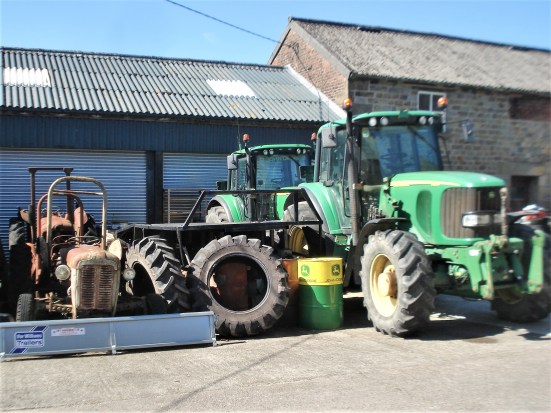
Halfway up we come across an agricultural machinery graveyard. Old tractors, strange looking implements, old cars and strangely up here a speed boat, all rotting into the vegetation. We find it a bit spooky and once Sir Hugh mentions some American horror movies it is time to get going. Only just last night I had rewatched Psycho for the first time for years – remember the cars in the pit.
I then took to photographing the various stiles we squeezed through or climbed over.
A couple of girls pass us brandishing what looked like a well presented leaflet of walks in the area, though their map was somewhat basic for the almost identical walk that Sir Hugh has us on. I will look into finding this publication as we are well impressed with the area so far. We never see them again.
The ridge is up ahead.
The lane keeps going up past the last farmhouse, which shows no signs of gentrification for the Airbnb set.
Soon we were onto what I’m calling Ellerside Ridge, volcanic rock outcrops everywhere, we even spot a few bouldering areas. Lakeland in miniature.
A last stile over a high wall and suddenly we are looking down on the Greenodd/Cartmel Estuary. There is Ulverston, there is the railway viaduct from Cark and there is Chapel Island off the coast from Conishead Priory. I seem to remember being told that one could walk out to the island at low tide, not something I will be doing. All places familiar to us from previous expeditions but never seen from up here before. We are thrilled with the way the walk is turning out even though rain clouds are massing over the sea. The undulating ridge gives us plenty of time to take in all the views.
After about a mile we can see from the map a nearby trig point on How Barrow, a lowly 170m but one we could not walk past without visiting. Fortunately a gate gave us access to that side of the fell and the proud little craggy summit was soon reached, A perfect spot for lunch. Others also reached the summit for the first time, and all proclaimed its vantage point despite the incoming rain, we are a hardy lot.
From up here Cartmel village was a little hazy but the backdrop of Hampsfell reminds me of the last time I visited Cartmel on my trek around Lancashire’s monasteries.
Back on the other side of the wall a couple with a smart Airedale seemed to be hanging around. “could you tell us where we are and how do we get back to Cartmell?” They have no map and had been wandering in completely the wrong direction. Sir Hugh demonstrates the usefulness of GPS and sends them confidently on their way – we never see them again.
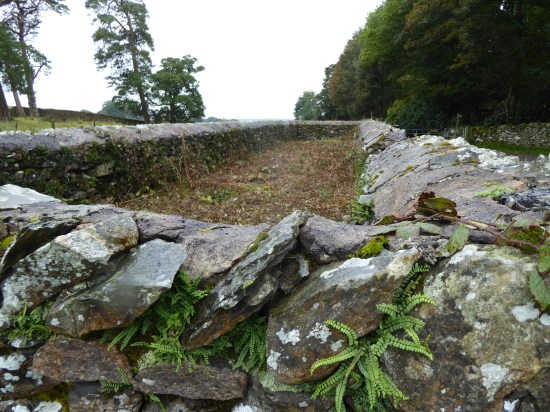
The meat of our walk is over but decision time has arrived – walk back down the road into Cartmell or keep to tracks on a more circuitous route through the woods. Yes, you guessed it, into the woods we plunge. I have used these tracks before, but all looks different today until we realise that there has been extensive forest clearing on the estate following the storms of 2021. A curiosity passed on the way is a walled enclosure – we speculate on a pinfold, but there is no evidence of a gate. Perhaps some sort of water collecting reservoir? Anybody know?
The light rain accompanies us all the way back to Cartmel.
We don’t venture into the village festivities but set off in the car on a long diversion to get us out of the racecourse, an hour later and there would be a queue of traffic trying to leave.
I complement Sir Hugh on his choice of route, a good 5 miles, or rather 6 miles after I had gently twisted his arm for that little extra, equally enjoyed by both of us. And in my mind it never really rained until the journey home.
Anybody can make history. The one duty we owe to history is to rewrite it. Misquoting Oscar Wilde.
Storm Agnes is coming, batten down the hatches. But our little group complete the short morning walk around Longridge before the rain arrives. We are safely in The Alston eating lunch as the trees begin to sway – not a day to be out and about.
When I say our group I’m including myself into their group who meet once a month for a sociable walk of historical interest. I was out the last two weekends researching possible future walks with one of the group’s regulars for when it is his turn to lead. I am invited along today as a ‘guest’ mainly because the walk is in Longridge itself and comes past my house.
It’s a year or so since I walked with them, so I had to reacquaint myself with names and faces in the car park of The Alston. I’m not a group walker at the best of times, but they are a friendly lot, and selfishly a short walk today suited my diminishing exercise needs. There is some debate amongst the flock as to the needs of waterproofs and boots, faffing is increased disproportionally with the number of people involved.
Our leader has us away relatively promptly – Storm Agnes is making an appearance at noon, we need to get a move on. He, our leader, has a job on keeping the attention of the 20 or so walkers. But he is an ex-teacher, including having taught my children, so he keeps us in order. He has lots to tell us of the history of the area and has done his research thoroughly. He starts by quoting Oscar Wilde so that any later errors may be excused.
Moving on past my house, proudly illustrated in the header photo, we come across a series of interesting sites scattered around the village. The attention of the group fades somewhat as we progress. Our passage creates mild panic on the roads, think Moses parting the seas, and obstructions on the pavements, most passers-by stand aside to our onslaught.
The Alston Arms; Old Rib Farmhouse; Green Nook; the railway to Grimsargh; Pinfold Lane; Reservoirs; St. Lawrence’s; war memorials; the Old Station; mills; various pubs and bustling Berry Lane all play a part.
I don’t risk my newly repaired camera to the elements today, so you will have to be content with these sepia postcards of Berry Lane and The Old Rib.
Nowadays with the spider’s web, it is easy to find their histories elsewhere if you are interested, either true or rewritten as Oscar would say. Anyhow, thanks for having me along.
***
It seems superfluous to include a map but keeping to my usual habit here is our route, a mere four miles but full of history.
This song was in my mind, but I couldn’t remember where it came from – of course it is an Irving Berlin number, A Couple of Swells, from Easter Parade performed originally by Fred Astaire and Judy Garland way back in 1948.
So we’ll walk up the avenue Yes we’ll walk up the avenue And to walk up the avenue’s what we like
They were probably singing about 5th Avenue, New York, but I have the more humble Avenue in Hurst Green as my walk today.
The morning was one of those frustrating ones, all apparently too common in these days of modern technology. Attempted phone calls and online machinations. Car. insurance first, last year I paid £371 and this year they are quoting £832. Time for a change. Money Supermarket seemed easier to navigate than the popular Confused.com once you have all your information to hand. Prices came up from £450, I settled for £480 with the Bank of Scotland. Insurance is a minefield. I still need to ensure the original insurers don’t automatically charge my card – can’t get through on the phone.
On the subject of insurance my car is still away being repaired after my unfortunate run in with a wall. They said it would be ready last week, no word from them. After half an hour on the phone line I gave up.
Also, I’m still trying to ensure that repairs to my camera are carried out under the guarantee. My telephone calls to the shop are all answered by different personnel, and they never get back to me. My random poor pictures today are therefore from my ageing phone.
By now it is lunchtime and the sun is shining. Time for a short walk to keep my legs going. Bouldering is out of the question, my left arm is sore as hell from the Covid jab yesterday and my right arm equally so from the flu jab. Was it wise to have them both at the same time? The ‘Avenue’ walk appeared out of the depths of my mind. It would be on good surfaces and not too long or steep, I’m taking my physio’s advice and moderating my exercise.
The Avenue starts in Hurst Green and goes all the way to Stonyhurst College.
Depressingly the Bailey Arms pub is still closed but “open for refurbishment if a new licensee can be found”, an all too familiar story. There used to be three pubs in the village in recent memory but only the Shireburn Arms is still trading in Tolkien territory.
I walk up the Avenue, past little cottages, past the famous Almshouses, through Stonyhurst’s gates, past the spooky graveyard and the even spookier Madonna statue, Our Lady of the Avenue. I place a foot on Cromwell’s Stone and cast my eyes down the continuing Avenue all the way to the college itself. There is a lot of history around these parts, much of it covered in my many other posts on the area.
Are you still singing that song, I am?
At one time you could walk the full length of the Avenue past the fish ponds up to the college facade. Now there are closed gates and notices to make you aware there is no right of way, fair enough, but after walking up the road past the golf course towards Longridge Fell you can take advantage of a Public Path into the grounds and then directly across that very facade. Not the grandest of entrances but us commoners will have to make do.
They don’t like you taking photographs in the grounds, child protection explained the security guard the last time I was here. They can’t begrudge a photo of the exquisite St. Peter’s Church, not a child in sight. Seriously though they have probably some children boarding from very rich foreign countries, so security must be a nightmare.
I could have taken the path down through the fields past the clay pigeon shooting range, you have to ring a bell before continuing and being shot, but I wanted to keep my feet dry and avoid the slippery slopes, we have had a lot of rain if it hasn’t escaped your notice. So on I go past the observatory and gardens using the farm track. Groundsman are mowing which must be an almost continuos ongoing task on the estate to keep it up to scratch.
Round the back well out of view are a couple of soccer pitches and then the wonderfully positioned cricket square with its iconic brick pavilion and views over the Ribble Valley and Pendle.
I come out past more estate cottages to the busy Whalley Road. I could have carried on across and down to the river to join the Tolkien Trail back to Hurst Green but as I said I wanted to keep my boots clean. Having already established from Google Earth that there was a continuous footway beside the road back to the village that is what I follow.
The Shireburn Arms is open, now part of a group, James’ Places which seems to be the way these rural inns can survive. Opposite is the village green with three interesting crosses, but you will have to search for the oldest, have a look here.
You will have noticed we are moving from Summer to Autumn, although the seasons are not what they were. Heavy rain forecast for today and yes it arrived this morning. Soup and bread for lunch which will become the norm from now on, ditching the salads. I make lots of nutritious soups from cheap, out of date vegetables, from the supermarket and my freezer is full of them.
Come early afternoon it looks brighter. From my house I can view the westerlies coming in over the Fylde plain. Should be OK for an hour or so. I walk down past the cricket ground watching the clouds scudding across Fairsnape. It feels quite warm in the sunshine.
Up Mile Lane (it is nowhere near a mile) meeting a few dog walkers on the way. We are all trying to dodge the showers. The spire of our village’s St. Wilfred’s Church always prominent on the horizon.
My mood is improving with every few more moments of sunshine. Exercise and sunshine are great healers, especially as we enter the darker months. By the time I pass through the park into the village I’m positively humming. Time to pop into our local Sainsbury’s for some more spinach destined for the freezer as soup. That’s nearly three miles under my belt before the next band of rain. Let’s hope tomorrow will give some breaks in the weather.
Following on from my last post which described a half aborted climbing session, today we now have a walk that didn’t quite work out. I’m on a losing streak. Again I’m with Mike reconnoitring for walks he could lead with his monthly walking group.
Remember the stipulations “should start at a place with toilets, not too much rough ascent, between three and four miles, the fewer stiles the better and finishing at a pub for lunch” He thought he had found one in a book of short walks in Lancashire, I didn’t catch the title. This time on the outskirts of Blackburn, Pleasington in fact, incorporating Wainwright’s Memorial on Billinge Hill and the popular Witton Country Park. Sounded promising when he invited me to join him.
Things didn’t go well when we struggled to park near the Railway Inn, yes there is a station here for commuting into Preston or Blackburn. We eventually settled on roadside parking up the lane which wouldn’t be ideal. Shame that the nearby Butler’s Arms is closed. We set off, walking up the lane past the impressive Pleasington Priory. Pleasington Priory – Wikipedia We don’t even think to have a look inside, if it is open.
Up a smaller lane past expensive building conversions to the gates of the Old Hall.
A track goes left here, and we soon come to our next problem, a loose eroded bank leading to an awkward stile. Probably no go for those of his group not into mountaineering. I didn’t think to take a photo of the obstacle.
A wandering route through rough fields brings us out onto a lane I recognise from previous Witton Weaver Walks which we now follow up to the Yellow Hills, named from the abundant gorse that blooms up here – but not in September it seems. There are always a few people up here because of Wainwright’s Memorial plaque, a toposcope with a rather poor impression of Alfred in the centre. We gaze in all directions, but distant views are hazy, nevertheless a wonderful lookout. This ascent would have been better in reverse with the vista in front of you. Niggly.
I never feel at ease through the next open field which always has cows and occasionally a bull. Today they all seemed very docile, perhaps it’s just my fears.
Entering the woods of Billinge Hill we pay particular attention to the guide’s directions. There are paths everywhere up here, some I recognise, but mainly I am ‘lost’ blundering about in a hopeful direction. Using a bit of creative thinking we follow the steep and slippery paths down alonside a ravine. Mike is not happy, any of his group who may have made it this far would be now struggling.
We in turn struggle down to enter Witton Park and civilisation. Ice cream vans, car parks, sports pitches, dog walkers.
We are lucky to have this rural expanse open to all on the edge of a major town. Witton Country Park covers 480 acres of countryside with pretty picnic spots, walks, nature trails, play areas, sports pitches and a visitor centre. The estate was once owned by the Feildens, a wealthy textile family, who built and lived in Witton House from 1800 and created the park at the same time. From 1900 the house was empty for long periods and during both world wars the house and estate were used by the army. Dry-rot set in. Witton House was demolished in 1952, after being sold to Blackburn Corporation in 1946 along with the estate.
We join the crowds and follow the sluggish River Darwen down the valley to Butler’s Bridge. Now on a surprisingly busy road ahead are the gates leading to Pleasington Cemetery. I’ve never ventured farther, but the notice board shows a vast complex of burial grounds.
We divert to continue into the woods and up a sunken lane which eventually is captured by barbed wire into a most unfriendly narrow walkway back to the priory.
We have had 4 miles of exercise through an interesting environment. It took us for some reason three hours and Mike has ruled it out from his future itineraries.
Last year I did a similar, but better balanced walk , from Cicerone’s Walks In Lancashire, an excellent selection, which also took in Hoghton Bottoms in a seven-mile circuit.
I had arranged to meet Rod for a few climbs up at Kemple End, the quarry at the far end of Longridge Fell. Originally I had suggested it to him as a good option for afternoon shade in our mini heatwave last week. That didn’t seem to work out, so we found ourselves up there this morning instead – a good option for morning sun.
Autumn was in the air and the grass had a heavy dew, but the bracken was dying back which made access along the quarry rim somewhat easier. We backed up the top belays on the way in and scrambled down to the base. The rock was in perfect condition despite recent rain.
I have been asked to rewrite the section on Kemple for the up-and-coming, maybe in a couple of years, latest Lancashire climbing guide book. (On my bookshelves I have about five or six previous editions going back decades, all a little dog-eared) Hence, I was wanting Rod to re-climb a few routes to get an overall grade consensus, particularly where there has been some recent rock re-arrangements. Another climber’assessment can clarify your own jaundiced view.
I thought Rod’s sack looked rather small, I’d brought the rope and gear, and sure enough when he delved into it no rock shoes or harness came out. Probably on the kitchen table back home, it’s easily done. No problem I contrived a makeshift harness, and he thought he could manage in his stiff hiking boots. After all we had started our climbing days in ordinary boots, dedicated rock shoes had only just started to appear on the market, from France originally. My climbing shoes would most likely not have fit anyhow.
The first climb, Ribbled, went well, even I managed it with my dodgy ligaments confirming its easyish HVD grade. Birdy Brow has lost its flake and is no longer feasible, so we put a rope down Bird on the Wing, its replacement. This has a few reachy starting moves made worse by Rod’s boots, but he persevered and got up thinking it about VS 4c.
We sit and have a break in the sun, an owl is hooting somewhere in the hidden quarry bowl. There is the hum of bees around the brambles and heather. All very peaceful. All part of the climbing day.
Then over to Great Expectations, one of my favourites here. Another steep start brings you to a shallow sloping ledge in the middle of the wall, use this to somehow make farther progress. It wasn’t to be today. Rod’s boots skidding on the blank wall where rock boots would have just smeared. A potentially good day’s climbing marred by the wrong boots.
I’m idly looking at the OS map for something new on my home ground. I’m only looking for a few gentle miles and I think I have spotted a footpath I’ve not knowingly been on before, however unlikely that seems. The weather is on the change, and it has been raining this morning, I bide my time until after lunch.
Being lazy I drive my car to the top of the village to start the walk rather than tramp the streets. There is parking next to Craig Y bouldering venue, part of the defunct Green Bank Quarry complex, The BMC secured Craig Y whilst the rest of the site has been developed into a housing estate. Passing through it is a bridleway leading to an ancient sunken lane, Written Stone Lane, did some of the quarried stone exit this way? Today I wander down it coming out near the site of the Written Stone about which I’ve visited many times before and linked to The Written Stone of Dilworth for a detailed history.
On across the road to go down a quiet lane to where my ‘new’ path should be found on the right. There is no sign, but I know I’m in the correct place. Ahead doesn’t look very inviting – farm buildings and all the usual associated junk. I wonder whether the way will be blocked, but no after having to open one gate styles start appearing in the field boundaries, although I doubt few come this way. In the fields there are several small ponds probably Marl Pits originally,they are teeming with Mallard families.
At one point a fishing lake has been created in Page Brook, here footpath signs are more evident taking you through and away from the private lake. All very civilised.
I recognise Stonelands Farm in the distance from a different walk done three years ago. I am still none the wiser as to the origins of the carved stones, although the rounded one is definitely Roman.
Crossing carefully the road on the bad bend by The Corporation Arms, one of many local pubs that did not survive lockdown and the continuing financial restraints.
Soon off the busy road the Tan Yard track is taken back up into the quarries, what must Longridge have been like when they were all working. The caravan site is enlarging, and I notice some of the permanent vans have extensive views across the Ribble Valley – not a bad place to live. Pendle always manages to pop its head up. Himalayan Balsam is doing its best to obliterate the final stretch of path.
The rain starts just as I arrive back at the car. That has been a pleasant afternoon’s outing, a new path found and plenty of interest along the way, all on the very edge of town. .
Mike is looking for a walk for a group he leads from time to time. There are a few stipulations. It should start at a place with toilets, not too much rough ascent, between three and four miles, the fewer stiles the better and finishing at a pub for lunch. You can guess at the age of the audience he is catering for. After a bit of internet searching and my previous knowledge I come up with this outline suggestion. I know the area reasonably well as it is often a meeting up place with my friends from the Bolton area. The hottest day of the year forecast, maybe, a good day to be in the shade, so these woods could be ideal.
***
First some facts I learnt about the reservoirs…
Rake Brook Reservoir is fed by two streams, one being the eponymous Rake Brook coming from Withnell Moor. It was constructed in the 1850s by a Thomas Hawksley for Liverpool Corporation Waterworks. The earth dam 85 ft tall and 1,490 ft long, with a capacity of 70 million gallons. A 3.75-mile channel called The Goit fed water through White Coppice into Anglezarke reservoir and hence into Rivington, from where a 17 mile pipe connected to Liverpool.
Lower Roddlesworth Reservoir was constructed at the same time as the above, again by Hawksley. Completed in 1857, 82ft high, 590ft wide holding 90 million gallons. It was fed by the River Roddlesworth coming down from Great Hill. This river subsequently ran into the…
Upper Roddlesworth Reservoir was completed if 1865. The earth dam 85 ft tall and 1,490 ft long, with a capacity of 70 million gallons.
***
***
We park opposite the Hare And Hounds pub in Dole Lane .which is already busy with cars, the area is very popular with dog walkers and fishermen. A walk that starts and finishes at a friendly pub.
Immediately the presence of the Victorian era is evident by the stately gates leading into the water board land, now United Utilities. They built things to last and to impress as will be seen in the engineering feats evidenced by the reservoirs. The proliferation of Himalayan Balsam is obvious from the start, it is getting worse by the year. Darwen Tower is seen in the hazy distance as we walk down the lane alongside the start of the Goit channel. Dropping down by an old waterboard cottage we cross the impressive outflow channel of the Lower Roddlesworth. I have never seen it so dry, it is usually a rushing curtain of water feeding the ongoing Roddlesworth Beck as it goes off to join the River Darwen. We are now looking across the lower reservoir’s dam, the surrounding area a forest of mixed woodland. Dogs are ‘unofficially’ paddling in the cooling waters.
That may be one of the problems with these tracks – too many dogs, not too many ‘doggy poo bags’, but lots of dogs rushing to say hello to you. I have grown more mellow to well-behaved dogs in recent years (I am a Cat person, but I know cats can be equally threatening to others, but you are unlikely to be savaged) At least today the ground is dry so any over friendly dog doesn’t cover you in mud. To be honest most are on a lead and the others are docile and under control. The few cyclists we meet are also considerate.
We cross the dam and for most of the morning we just follow well-marked forest trails, most with a decent surface, but mud can be a problem. The plantations are a delight of old beech and oaks, interspersed in parts by mature pines probably planted when the reservoirs were being constructed. Coppicing of ash and hazel give some variety. I am saying to Mike that if his walk is done in Autumn the group will be rewarded with the rich colours as the trees head towards winter. Or there again come in Spring when all is a carpet of Bluebells.
We climb steadily away from the reservoir on the main track, not too steep for his group’s needs and wide enough for the chatter that accompanies them. Down again to the Upper Reservoir dam where curious metal pencils act as a sieve to the overflow for any trees washed down in times of heavy rain. A small path shadows the edge of the water with some delightful picnic spots or just for stopping and perhaps meditating on the glory of it all. I’m sure the Victorians would have done that.
A bit more leg work takes one away from the water and into a long stretch in the trees. We have time to acknowledge the various dog varieties encountered, and occasionally to come into conversation with their owners. The turnaround point comes at a bridge crossing the River Roddlesworth. Time for a pause and rehydration, I did say it was the hottest day. As we rest dogs come and go, the most impressive being four generations of black and white collies.(only three caught on camera)
If we had continued farther up we would have come to the ruins of Hollinshead Hall. It was demolished as the water board took over. I have visited it before and many of the old walls and gates are scattered around in the woods. But that is for another day.
Our path now leads through a rusty gate and follows the River Roddlesworth back down the valley. Not sure if I have walked this section before, but I’m impressed. A deep rocky gorge with alternate waterfalls and quiet pools. Delightful even when the water level is low. The path we follow is obvious on the ground, even if not shown on the OS map, up and down on steps and boardwalks bringing us back to the upper reservoir. Turn left, and soon we are passing fishing stations out into the waters. The angling club car park is entered, but I’ve no idea how the road reached there.
We are looking for a gap in the fence which should have us on an ongoing path, I think we find the right spot and continue on a manufactured but well maintained route , courtesy of United Utilities. Duck boards and bridges see us through and there on the right is the gracefully arched wooden bridge bringing us back to the Lower Reservoir dam. We know our way back from here.
We are soon sat in The Horse and Hounds enjoying a pint of ale, all in the purpose of research for Mike’s walk.
Yes, when I look back to 50 years ago I remember well the walks we took along the Lancaster canal with our two young sons. The youngest on my back and the other in a buggy pushed by my wife. Happy days. Somewhere I may even have photographic evidence.
I wait in this morning for the recovery company to arrive and take away my estate car to a garage, I know not where or even care, for remedial restoration.
Later looking for somewhere flat and easy to walk in this heat I recall those far off days and decide to revisit the canal in the Barton area, west of the A6 and combine it with a little farther exploration. Parking on the narrow roads, now much busier with traffic, doesn’t come easy.
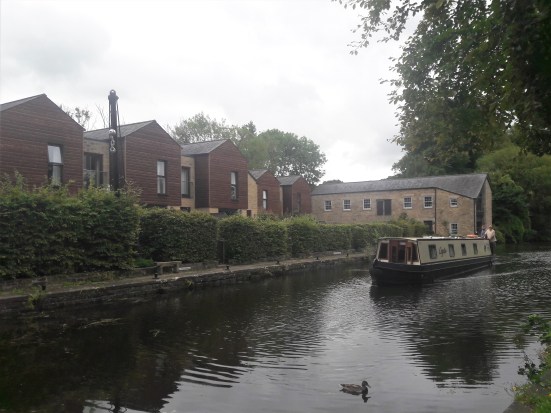
I eventually find a safe place near Moons Bridge Marina. I’m soon on the towpath which I remember as being very boggy a few winters’ ago. Today was all plain sailing, though that’s the last thing that some of the dilapidated barges moored alongside will be doing.
Leaving the canal at bridge 35 I take the lane leading to Bell Fold, an organic farm advertising free-range eggs, local honey and damsons. There didn’t seem to be an obvious shop, perhaps they were away for the day. As is common around farmyards there is an interesting collection of ancient and modern. Their collection of old tyres could grace The Tate. The ongoing lane must be one of the worst, I realise the muck I’m disappearing into is of animal origin rather than mud. I would imagine in winter it would be unpassable – very organic. Much, much worse than my photo portrays.
I’m looking for footpaths alongside Barton Beck. The bright yellow markers made it easy to follow even though the ground showed little footfall. As everywhere Himalayan Balsam is taking over, but I do like the aroma, especially on a hot day like today. The water is a little sluggish, but I spot shoals of ?minnows.
I leave the field via an ornate gate onto a lane alongside the extensive grounds of Hollowforth Hall, I always admired this property without knowing anything of its history. (It is in fact grade II listed, mainly mid C19th but based on a much older farm building) There were always noisy peacocks strutting around. Over the intervening 50 years since my early visits most of the surrounding barns have been upgraded into country residences.
I didn’t know whether I could use the ongoing unclassified lane leading to Park Head, but there aren’t any ‘No Access’ signs, so I walk on to reach the canal bridge where I drop down onto the towpath for the peaceful return leg.
The canal has a healthy growth of a small yellow flowering water lily. Dragon flies were flitting around, but I never seem to catch them stationary for a picture, have a look at this blog for how to capture wildlife.
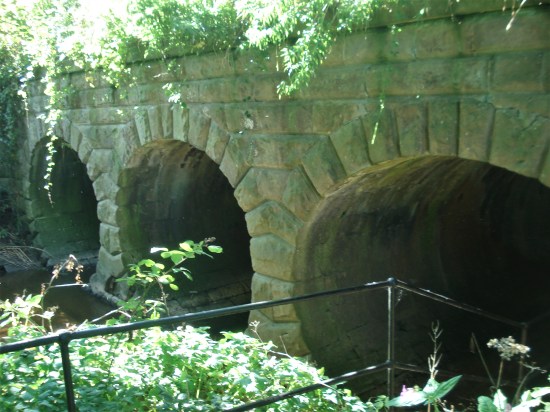
Along this stretch of canal one has a three arched aqueduct over Barton Brook as it winds through this rural Lancashire. I go down to explore and judging from the flood debris not a place to be after heavy rain. Farther on is an old swing bridge connecting farm tracks across the canal and then the extensive Moons Bridge Marina where I started.
All pure nostalgia and a pleasant way to spend a lazy summer afternoon – reassuringly not much has changed in this rural environment.
A nostalgic, even indulgent, look back at all those routes of old.
I used to climb in the gritstone Wilton Quarries, there are four of them above Bolton, regularly in the 80s and 90s, my climbing mates living in that area. We would drive down after work to tackle some of the classics. Our standard was for repeating the routes done back in the 60s and 70s, generally up to E1, but the quarries were buzzing with local experts climbing, often soloing, the more modern test pieces. After a midgy exit we would retire to one of the local pubs, Black Dog or Bob’s Smithy, for a pint or two to chew over the evening’s activities and plan for the next week. Wonderful care free days with like-minded individuals.
Well the Wilton devotees along with the BMC have for the last ten years hosted an annual festival of Lancashire quarry climbing to invigorate and perpetuate our unique climbing culture. The Wilton Fest.
I was always out in France for September at my friends’ house in the Lot Valley, a lovely place and a lovely time of year, so I had never attended the Wilton Fest. Unfortunately the house has now been sold, and I’m left in the UK at this time of year. The upturn of this is that today I was free to drive down to Bolton and join in the fun.
I have never seen as many cars parked up in the quarries and on the busy road alongside them, hope nobody gets a ticket. The good weather is a blessing to the hard-working organisers.
I drop down first into Wilton One, the largest of the quarries. Only the early risers are climbing. The prow is a unique feature of this quarry, left standing for whatever reason by the labourers. Inside is sunny and dry whilst the outer face looks forbidding as always. A couple of blokes, of my vintage, climb Rambling Route a pleasant VD, whilst a younger couple tackle the impressive Christeena up the edge of the prow. I am beginning to wish I had brought my camera rather than relying on the phone which can’t cope with the contrasting light and has let me down today.
There is nobody climbing on the outside of the prow which I was hoping for –Cameo, Flingle Blunt, Fingernail etc. Don’t ask me where some of these names come from. Nor was there anybody on the big lines farther left – Loopy, Wombat, Central Route. There were later in the day, apparently. I did however watch a pair on Leucocyte Right Hand. I remember the moves up at the start were bold towards a high prominent quarryman’s ironwork, but today’s climbers are able to place a camming device into one of the shotholes lower down, if only that had been my option 40 years ago.
I move on past climbers on regular routes of old – Virgin’s Dilemma, don’t ask, and 999.
I start climbing out of the quarry only to meet a friend from 30 years ago. He and his son are heading down into One to witness the 60th anniversary repeat of another classic, Black Out. There is promise of a good crowd and drone footage. The crowd is of a certain vintage and I recognise many old faces. Eventually Ian Lonsdale introduces the original protagonists, Ray Evans and John Nuttall. (the truth is that they were led up the route in 1963 by a Dave Brodigan, so a lady from that era sat next to us expounds) Let’s just ignore some of the detailed history, and nobody blacked out on the climb. Ray climbs elegantly up the groove with little protection, the pegs are long gone, before the delicate moves left along ledges to the original belay of pitch one. John joins him and leads through the groove above. A masterful display from these pensioners.
I eventually find myself up in Wilton Two where all the trade stands and facilities are. Only to be greeted by “geriatrics are not allowed here” from another old Longridge colleague. I obviously ignore him, and we proceed to where there is free flowing coffee.
After lots of chats and meetings up I make my way over to Wilton Three. (What you see in there are the ranges and huts of a gun club which shares access with the climbers.) This was possibly our favourite evening venue in the past. Lots of accessible routes of quality in our grade range. I’m eager to see someone climbing Shivers Arête, and just as I arrive there is a climber on the crux moves near the top. When we did it there was a rusty peg in a crack for illusionary protection. That has gone and now there is a bolt in its place – controversial in many climbers’ ethics.
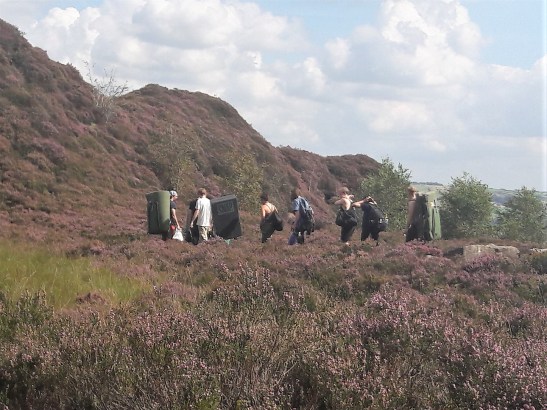
Times have changed and now there are as many boulderers as roped climbers. They seek out the hardest technical problems without hardly leaving the ground, or at least not a few feet above. I admire their sport. They are the recognisable turtles with bouldering mats on their backs.
Back to Wilton Two and another coffee. Crusher Holds is there, along with his young family, on his trade stand. His children have their own little shop, so I purchase some wooden toys to enrich their day. (The cars are only allowed in for this special day) .
My dodgy hip, that is preventing me climbing, has had enough of scrambling between venues. Time to go home. It has been good to catch up with friends, and I was impressed by the number of climbers all enjoying themselves. It has been estimated that 500 attended. I should have stayed for the talk to be given by Johnny Dawes, the original ‘Stone Monkey’.
For a change I park at the Crook of Lune, famous for its Turner painting. looking up to Hornby Castle and Ingleborough. That view is still there today. I rely on my phone’s camera rather than any artistic ability.
And then I’m off cycling the old railway line to Halton. On the spur of the moment I decide to climb up to the Lancaster Canal to see me through the city. Once out the other side into suburbs I leave the canal before its towpath deteriorates and follow new-found narrow lanes to Aldcliffe and then descend back down to the rail track taking me into Glasson.
It’s August Bank Holiday, but I’ve hardly seen a soul. Until now, the place is humming with motorcyclists and tourists around the harbour café. I make my way over to the other side of the dock to my favourite shop – coffee and cake, sat in the sunshine chatting to two ladies who have arrived on horseback. The sea lock gates still seem to be out of operation leaving the harbour unusually empty at low tide. The Port of Lancashire Smoke House still haven’t moved into their new premises. Things go at a slow pace in out of the way Glasson.
On the way in I had noticed a summer fête at the little canal side Christ Church. I remember getting some delicious homemade marmalade here a year or so ago. I make it my business to call in on the way back. Wheeling my bike between the stalls I find the jam table. I come away with two jars of thick Seville marmalade, made by Beryl as before the vicar tells me.
The railways and cycle way take me all the way back to the Crook of Lune. They are packing up at Halton, it has been a busy day on the Lune and the cycleways.
Time to visit my friends in nearby Over Kellet. John, an old climbing mate, has recently been in hospital with a bad heart. I go bearing marmalade. Tea and chat and it is getting late. Prewarned I drive down to the motorway bridge and see that the road is jammed solid going south. Time to find a quieter way home through the hills. Unfortunately my quick three point turnaround had me carelessly backing into a wall. A loud crash as the rear windscreen fell into the boot. Oh dear! I had badly dented the tailgate. I drive home in a more sombre mode and this morning spend an hour on the phone to my insurance company answering tedious questions and facing an expensive repair.
Mid-August already. I’m losing this year somehow. I head up the fell for a short afternoon amble but find a grouse shoot taking place on Gannow Fell. Not the big ‘driven’ affair with lots of beaters, butts and toffs, but the ‘walked-up’ variety. A few guns walk up the fell hoping to flush out the grouse. To be honest I rarely see a grouse on this patch of fell and talking to one of the helpers they haven’t had a good session. No sympathy there from me.
I fall back on the haven that is Cowley Brook Plantation. I’ve mentioned it before as a pleasant place to walk around. An old plantation owned by United Utilities who cut some of the timber a few years ago and planted more mixed woodland species. At the same time they have opened up access to the public and paths have developed within it. I like the idea of spontaneous path generation, not all of them going anywhere in particular,that is part of the charm of the place. It’s good to watch the development of the different trees as the years come by. Normally the place is alive with birdsong, but today all is quiet, perhaps the guns from across the way have frightened them. At least the brook is gurgling away.
Mountain Ash.
This fungus seems to be…
…eaten as soon as it emerges
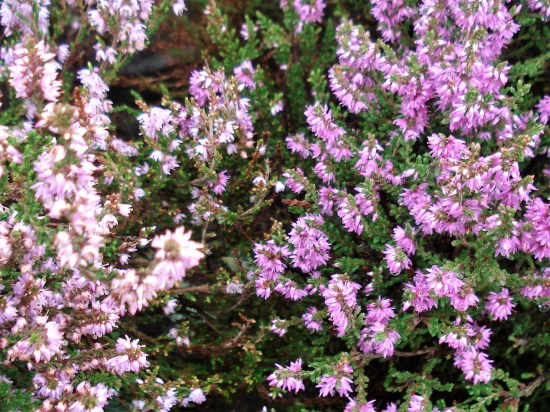
Oh, I forget, I titled this post ‘heather’ because of the sudden blooming of the fells up here. Most of the heather flowering at this time of the year, in various shades of purple, is Calluna vulgaris. One can smell the semi sweet musty aroma from the roadside. In another week or so there will be a haze of pollen blowing across the land. Get out and enjoy it while you can – providing they are not grouse shooting.
It may have passed your notice that Alison Rose, the NW Bank CEO, resigned recently as a result of ‘a serious error’ relating to leaking Nigel Farage’s account. Yet today I read that she will still be paid a £2.3 million compensation package. Maybe it is time to change banks – any suggestions?
This seems to be a recurring theme. Business managers, multi nationals and politicians profiting from their negligence at the cost to Joe Public. You and me.
My short walk has failed to put me in a good mood. Every thing should be beautiful.
My camera went into ‘frozen mode’ after a short time on my latest cycle around Preston’s Guild Wheel. Gone for now are the pictures of the Ribble in flood mode, the harmful Giant Hog Weeds and the cautionary notice to dismount on the steep descent to Brockholes. I had no reason to ignore the latter, I’ve been going from one injury to another in the last month, so caution was uppermost. I had parked in the Crematorium grounds after all.
Ospreys have been regular visitors to the nature reserve recently, but obviously not today. They do have a problem with Himalayan Balsam though. It was surprisingly quiet considering the good weather and school holidays. They must be all at Blackpool, not the ospreys just the crowds.
The rural ride from the reserve along the Ribble Flood Plain into town is unfortunately virtually the last of the green fields on the wheel, housing has taken over elsewhere in the last few years.
My phone camera comes into action on the tree lined boulevard into Avenham Park. Miller Park is looking immaculate, although the former, now empty, Park Hotel overlooking the scene has run into planning and financial problems as have many civic schemes in these cash strapped days.
Plenty of cash is being spent on flood defences along Broadgate. I manage to squeeze through wheeling my bike on the numerous diversions/obstructions which I should have or could have taken, I persist with the directissimo. It is all green paint for updated and complicated cycleways at the bottom of Fishergate Hill, I survive into Docklands. No steam trains today. And no more photos.
After the car showrooms the newly opened Western Distributor road linking the M55 with the western edge of Preston seems to be working fine, but at the end of the day is only there to link up with all the new housing developments. The traffic just keeps multiplying without any structured environmental planning. Planting a few trees alonside the new road fools nobody. I have never seen a boat on the Ribble Link – more money misplaced? At least it is more carbon friendly if that makes any difference.
One now enters Lea, Cottam, Fulwood and Broughton or wherever. It is all housing, housing with a regulation 5 m square front garden often enclosed in the most unfriendly hedgehog fencings. At least the Guild Wheel has been preserved as a corridor to the other end.
I stop for a snack and contemplation opposite the war memorial on Garstang Road and all I can hear are builders bulldozers in the land behind me. Nothing is sacred.
I’m flagging now through those green corridors, surprisingly lots of ups and downs. 21 miles is far enough, but I have guilded the wheel, even though it is becoming a little tarnished.
Following on from my recent cycle outing I feel empowered and keen to get out again. Empowered with a small p but powered nonetheless. I find myself back at the Halton Station parking by the Lune. But this time there is the bonus of the tea van lady, I have missed her sweet smile and eastern European accent. It transpires she only comes at weekends now – I celebrate with a coffee. Her prices have increase by 50% but who cares, this is better than any Costa outlet. (only £1.50 for good coffee here)
The chap next to me is ordering a bacon bap with his coffee having completed a morning cycle ride from Penrith, that must be 50 miles or so. He is of similar vintage to me, and we get into conversation of the cycling variety. His steed is a £7,000 German electric bike, no wonder he is here in quick time. Mine is a no frills, strong as an ox, been everywhere Dawes ‘Wild Cat’ from the 1980s. I don’t think he was impressed.
The talk somehow drifts to past climbing in the Lakes. He knows Paul Ross, a celebrated Lakes climber, again of a certain vintage, who has recently, since his return from living in the States taken up environmental matters in our National Park. Only this morning I was reading on his Facebook page of the considerable objections to Zip Wires proposed across the old road alongside Thirlmere, which had even been shamefacedly supported by the head of the Lake District National Park Authority! That whiffs of corruption. Thankfully the planners threw it out. But we need the likes of Paul Ross to keep abreast of Disneyfication of the Lakes.
By now it was raining, so time for another coffee and time to let the Marathon athletes pass on the track. I became caught up in a similar race last year and found cycling through the racing runners trying. I have time to let them go by today.
Bidding farewell to my cycling friend I find I’m faster than his batteries, I’m crossing the Millennium Bridge as he heads for the station and home. Being a little wary of a dodgy stretch into Morecambe since I was almost assaulted earlier in the year (a Cassius Clay/Muhammad Ali duck and dive saved me that day) I’m happy today to see there are lots of people out and about, so I feel somehow safer.
Millennium Bridge.
St. George’s Quay.
I make it on to the seafront, the tide is well out. For maybe half a mile I have to navigate around dogs on long leads and teenagers, head down, plugged into their phones. Modern times. Once past Eric’s statue the holiday crowds thin out, and I can relax and admire that famed Morecambe Bay panorama. I realise I have not been into Happy Mount Park or The Winter Gardens on my visits through here. The latter is only open on Saturdays and Sundays, so I missed an opportunity today.
Children’s play on the site of the up-and-coming Eden Project.
The yacht club lookout.
My way back along the familiar canal towpath seems effortless, and I’m soon back onto the Lune Aqueduct where I finished the other day from the opposite direction.
That’s two of my ‘tried and tested’ cycle routes covered, look out for the next two – Blackpool Promenade and Preston Guild Wheel.
Later, in Arnside, tea and cakes were waiting for me at Chez Hugh’s.
With difficulties sailing up the Lune into Lancaster, Glasson became an important port in the late C18th and was originally connected by canal to the Lancaster Canal, opened 1825. This has survived to this day, though only as a leisure facility. A railway line from Lancaster to Glasson Dock opened in 1883, closed to passengers in 1930 and to goods in 1964. Time moves on and a cycleway has been created from Lancaster to Glasson on the bed of the old railway.
The above photo shows that abandoned line heading to Glasson. And that is where I’m heading. I’ve not been out on my bike since May, two months ago when I visited, you guessed it, Glasson. Yes, I know I’ve done this cycle ride and written about it many times, but it is good to have a ready-made, tried and tested itinerary to fall back on. Force of habit indeed.
I do however wander off the tried and tested, as is my wont. After my coffee and snack at the shop in Glasson, cycling back along the line I notice a sign to Stodday off to the right. I’ve not been there before, a quick look at the map and I can see little lanes leading back to the Lancaster Canal on the outskirts of the city. Perfect. That’s how it turns out with narrow paths and quiet lanes lined by hedges full of flowers. I’m not sure if I found Stodday, but I do cycle past the few houses that constitute Aldcliffe.
Then it is all downhill to join the canal. There is a good towpath all the way through the heart of the city, well-used by local residents and the student population. What a fantastic facility and the canal side pubs busy with tourists.
Farther on it was good to see the family of swans who nest every year in the same spot. The six youngsters, almost as large as their parents, spent a lot of time upside down feeding on the plant life.
I drop off the canal just before the aqueduct across the Lune, and I’m soon loading my bike into the car. Job done and a new variation added.
The lady in the tea van has not reappeared at the Halton car park this summer, sadly missed.
The walking and even the gardening has been put aside, and I’m spending a lot of time reading whilst it rains outside. My cousin has just published a comprehensive history of the parish of Bolton by Bowland. (Spot the B connection). He has lived there for many years and has spent much of his time researching the history, geology, genealogy, ecology and everything else interesting relating to the village and surrounding area. I’m already well through my complimentary copy and have learnt so much more of our nearby neighbourhood and English history in general.
(Our Craven Parish. Bolton by Bowland. John Pallister. ISBN 978-1-911138-39-6. Amazon doesn’t stock it. When I see John next week I’ll find out where it is available.)
That brings me to that other subject – my aversion to Amazon. I don’t like to be controlled by some giant all invading corporation. I have no wish to subscribe to Amazon Prime when I try to order a paperback. Can one control the internet? I suspect not. Unfortunately all of us are hooked, even by innocently reading this post you are being tracked. I use the independent Blackwell’s or Abe books wherever possible. I now find out that Abe, even though they support smaller suppliers, is connected to Amazon! What is the future for independent bookshops? They need the internet to sell their hidden volumes and yet Amazon must be contributing to the physical bookshops closing every week. “both the water of life and the river of death” is a quote from Simon Armitage, our current Poet Laureate
I’m presently into Simon Armitage, with an ongoing project to visit the Stanza Stones, his poems carved into Pennine rocks by Pip Hall. http://www.stanzastones.co.uk/
Walking Home by Simon, his journey on the Pennine Way back to his home in Marsden. is a book I have just finished. A modern troubadour paying his way by poetry recitals in a variety of venues along the way. I found his writing engaging and romped through the volume. So it was back to Abe for the follow-up Walking Away. a similar trip bringing to life the SW Coastal Path. All Points North is a gritty and amusing predecessor. He certainly does have a passion for observation and words.
It’s still raining, so I will start on something different, the next book. A Celebration of Lakeland in Winter by a John Pepper. A recommendation from George at Lakeland Walking Tales ‹ Reader — WordPress.com That’s the value of blogging and linking into far more professional sites than mine.
My simple reading list is endless, and maybe I have added to yours.
Those aren’t my walking boots, they are on hold for the moment, but my gardening shoes. I have a habit of leaning them upside down, to keep them dry, outside the backdoor after what is usually a short session of weeding or mowing. There they remained for a few days whilst we had an onslaught of continuous rain. You may recall the sad end to the Ashes Test at Old Trafford last week.
This morning I thought I would do a spot of rose deadheading, a relaxing activity unlikely to put a strain on any of my ongoing injuries. I shoe horn my right foot into the shoe, tying the laces. The left foot comes up against something soft and mysterious. Had I left a sock in there? Putting my fingers in I can’t dislodge the obstruction, but tapping the shoe on the floor brings out a toad to my surprise and amusement. He, they always look like a ‘he’, sits there unconcerned. I check the shoe for his mate but only find a slug presumably his lunch. Gardening is delayed whilst I retreat for another coffee.
Toad in the hole – the story relates that on an unspecified golf course a player’s ball was pushed out of the 18th hole after which the offending toad poked his head out to the amazement of the players. The chef at the golf club devised a dish immortalizing this episode; a sausage, the mole, poking its head out of the batter. This is how legends are born.
I’m enjoying a lunchtime pint of Tetley Bitter in the Craven Heifer in Stainforth. The last time I was here was at the end of February 2020 when I stayed a night mid-walk. “It was Chinese New Year, and they were fully booked in the restaurant for a Chinese Banquet, but the chef was able to cook a fish and chip supper for me before festivities commenced.” There was talk in the bar of a new virulent virus spreading in China. We all know what happened next.
Hopefully the virus is now behind us, and it is good to be walking in Limestone Country. The barman says the pub closed during lockdown and only reopened under new managers last year. It is still owned by Thwaites, the present landlord has a five-year lease but grumbles that trade hasn’t really picked up. One problem is that the village is becoming dominated by holiday cottages, not many locals left, and the cottages are only occupied less than half the time. Who would want to run a pub in these cash strapped days? I finish my pint and bid them good day.
I’m halfway on a short walk mainly devised to explore the Craven Lime Works. It was only recently that I was made aware of this Industrial Heritage site on the delightful Walking Away site. I must have walked and driven past dozens of times without realising its existence.
There is further information from these two sites.
Good, that’s saved me trying to interpret and explain everything.
There is no signage off the road north of Langcliffe, but Hoffman Kiln Road sounds promising, it leads to a large new purpose built office and light industrial complex in the grounds of the former lime works. A lot of money has been spent by Craven District Council, with help from European cash – we are going to miss that. I only hope this is a successful enterprise as at the moment the majority of the units are standing empty.
The almost hidden car park for the Industrial Heritage site is impressively large even with electric charging points. It is situated directly below the massive old quarry on the hillside that supplied all the limestone for the kilns. We used to climb up there in the distant past, I think that is discouraged now. Today I am the only car parked on the site.
I wander into the ‘preserved’ site, the interpretation boards are very good. This has been a vast industrial complex – limestone from the quarries, converted in coal-fired kilns to lime which was transported off site by the integrated railway. As well as the kilns there are so many other associated ruins to see – inclines, winding houses. weigh bridges, water courses, tunnels, old rails, tram ways, spoil heaps. The operation lasted from the mid C19th to the 1940s.
1907 OS map.
First I look at the remains of the buttressed bases of a pair of massive vertical Spencer steel kilns. Difficult to visualise the scale of this operation that provided purer lime from the beginning of the C20th.
Back round onto the quarry floor and a dilapidated weigh house.
And then along to the Hoffman Kiln – wow it’s massive, think football pitch. In I go, you don’t need a torch as the frequent limestone inlet arches give enough light, in fact a magic image. I’m enthralled. There are the vent holes for the smoke up to the now demolished central chimney; there are the holes in the roof for the coal inlets; there are the ageing firebricks; there are the miniature stalactites from the slow seepage over the years. Are there bats or giant spiders in here? I walk around the massive kiln twice, and even think about a third, this is so atmospheric.
At the far end is a tunnel which accommodated a line bringing stone from the quarry above. A waterway used for counterbalancing a crane lower down delivering fuel into the kiln from the roof. Ingenuity far beyond our present engineers involved in the HS2 going above budget from week to week. They can’t even sort out the Euston terminus after 10 years, money down the drain, revised plans costing another £5bn! How many cycle lanes could you build for that amount of money.
The only part of the complex that wasn’t viable was the separate Murgatroyd quarry and overhead triple kiln next to the railway at the northern end of the site. A smaller scale operation which collapsed in 1887. Today I couldn’t make out the tops of the three kilns for the abundant vegetation, I realise now I should have dropped down to see the lower outlet of the kilns.
Industrial history satisfied I walk through the fields up to Stainforth and my pint. I come back, not on the familiar riverside path but on a higher way through Stainforth Scar. Gently climbing out of the meadows into the trees on the scar and emerging on the limestone plateau. The way ahead is etched into the fields, signs of an ancient passage way to Winskill Farm. 1675 says the date stone with the initials NBCB. What history could these walls tell. It is surrounded by what look like traditional meadows with a variety of flowers and butterflies.
From up here looking back over my right shoulder is the prominent Smearsett Scar and distant Ingleborough. Over my left shoulder Pen-y-ghent has suddenly appeared quite close by.
There are some tempting ways leading to Attermire Scar from here, but I’m only looking for a short day. My path is clear through stiles in the extensive network of fields and old lanes. The view is down the shallow valley with its patchwork of fields to Langcliffe. That’s where I was planning to head, part of Wainwright’s Pennine Journey, until I spot a vague path/sheep trod going between a wall and the Langcliffe Quarry, now alongside. Will it take me on a shortcut? I said I was looking for a short day especially after that pint. Worth a try and yes it brings me out into the Lime Works without any serious obstruction, but don’t necessarily follow me on any of these walks. Mine was still the only car in the car park.
I would highly recommend a visit to the Craven Lime Works with or without a walk.
I opted out of climbing with M during that hot spell. But today was perfect, sunny and warm with a breeze keeping things pleasant and the midges away.
Spent most of the time sitting relaxed in the grass holding his ropes as he attempted some more new lines at Crag X (or is it Y?) – they are getting progressively harder as we explore further. I’m not actually doing any climbing, bad elbow being the latest excuse, but my advice from below is becoming more vocal if not of any great practical value.
How is this for a crack line? We couldn’t do it, notice the use of the royal we.
This was easier Bilberry Jam. VS 4c.
The temperature rose as the afternoon wore on, but we were done by then. Time for a retreat and fish and chips. A cracking perfect day.



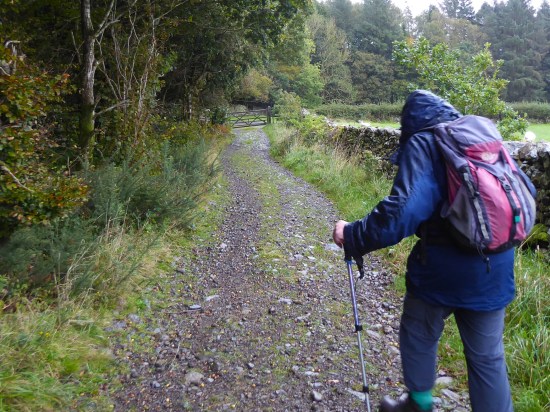


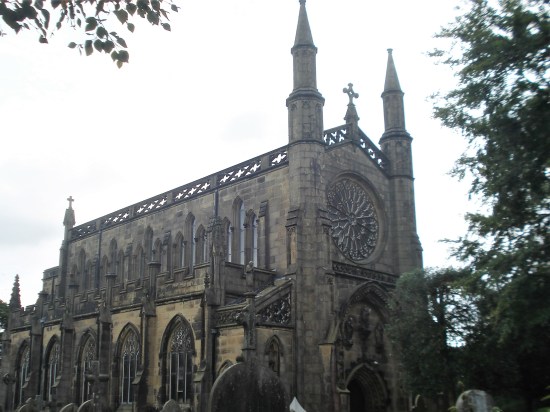


 Entering the woods of Billinge Hill we pay particular attention to the guide’s directions. There are paths everywhere up here, some I recognise, but mainly I am ‘lost’ blundering about in a hopeful direction. Using a bit of creative thinking we follow the steep and slippery paths down alonside a ravine. Mike is not happy, any of his group who may have made it this far would be now struggling.


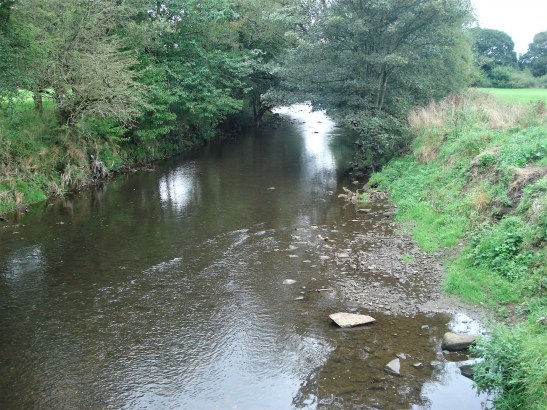


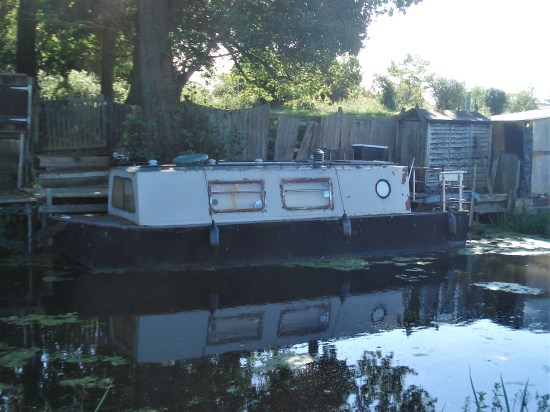






 All pure nostalgia and a pleasant way to spend a lazy summer afternoon – reassuringly not much has changed in this rural environment.