Tag Archives: Bowland

A CIRCUIT OF PENDLE HILL VISITING A WELL HIDDEN WELL.

                                                                              Evening light on Pendle.

As I lazed away this morning reading I came across a comment about Fox’s well on Pendle Hill.

George Fox was born in 1624 and was in his 20s at the time of the civil wars between the Royalists and the Parliamentarians. This was also a time of questioning the established religious ideas. Fox was travelling the country preaching an alternative simpler Christian message. By the 1650s he was in Northern England and in 1652 according to his journal…

“As we travelled we came near a very great hill, called Pendle Hill, and I was moved of the Lord to go up to the top of it; which I did with difficulty, it was so very steep and high”                                    “When I was come to the top, I saw the sea bordering upon Lancashire. From the top of this hill the Lord let me see in what places he had a great people to be gathered”                                                   “As I went down, I found a spring of water in the side of the hill, with which I refreshed myself, having eaten or drunk but little for several days before”

Hence, the name, Fox’s Well, in memory of his visit. He went on to found The Religious Society of Friends, the Quakers. Many parts of the North became Quaker strongholds and because of his vision Pendle Hill became a special place for Quakers.

*****

Well no time to lose.                                                                                                                                 The sun was shining but it was already 11am, I’m slow to get going these days.                          The well is not marked on the OS maps but I had a grid reference SD 80494200, I must have walked past it on my last visit here.                                                                                                          As I drove across I was planning a route in  my head, park in Barley and walk the hill on its steep side, the Big End. Coming down the road that cuts across the east side of Pendle I was astonished to see a line of parked cars stretching for half a mile, negotiating past them wasn’t easy.  Things were even worse in the village with the car park full to overflowing and lots of desperate drivers cruising about. So this is a Covid-19 day out for half of Lancashire. I curse myself – I shouldn’t have come to a honeypot on a Sunday.

Just as I’m thinking of going elsewhere I remember a safe and legal pull in on the road perfect for my little car. So Just after mid-day I’m walking back up the hill past all those badly parked cars. I then join the crowds along to Pendle House and then up the steep stepped path. Not really my idea of a day’s fell walking but I have an objective so it’s a matter of head down and grin and bear it.

As if by magic as soon as I cross the stile at the far end the masses disappear, they are on the way to the crowded Trig point which I can happily miss today. I pick up the track heading down the north side and before long I can hear running water. It becomes a gushing sound and there on the hillside is flowing water from a spring. Just above is the metal cover of the well and lo and behold when I lift it  there is the goblet to fill with the clearest of water to quench my thirst. The best water in Lancashire it is said, I wouldn’t disagree.

Feeling pleased with myself I ponder my onward journey. I have no intention of joining the masses on the summit, so I pick up a traversing path going west. This takes me to a stone shelter on the edge of the northern escarpment where I’d planned a lunch stop. Perfect. As I’m finishing a youthful foursome from Liverpool arrive. I share the seating with them and enjoy their banter. Onwards to the Scouting Cairn and then I decide to go over Spence Moor, Pendle’s little brother. I forgot to mention that the views are outstanding today in all directions. I have a birds eye view of Clitheroe in the Ribble Valley. Over towards Longridge Fell and Bowland parapenters are circling. The Three Peaks, Skipton and East Lanc’s hills, Winter Hill and the distant Welsh mountains complete the panorama.

I’m surprised to find a recently improved track heading my direction, probably coming from The Nick of Pendle. Reluctantly I soon have to leave it to maintain height to Spence Moor. There is nobody about and on the rough pathless ground I put up grouse, snipes and skylarks.

On the way across boggy ground I come across a sheep on its back – riggwelted.           Riggwelter takes its name from Yorkshire dialect with Nordic roots; “rygg” meaning back, and “velte” meaning to overturn. A sheep is said to be rigged or ‘riggwelted’ when it has rolled onto its back and is unable to get back up without assistance. You can experience the same by drinking a few pints of Black Sheep Brewery’s Riggwelter beer. Anyhow, I came to the rescue of this girl although she didn’t seem very appreciative.

There are no markers to announce my arrival at the rounded summit of Spence Moor. A little further and I pick up a soggy path going east. Down to my right are the East Lancs towns of Nelson and Colne. While over to the left is a different view of Pendle, my steep ascent path is clearly seen on the right.

I decided, perhaps wrongly, to drop steeply down to the two Ogden reservoirs, it would have been better in retrospect to have carried on high towards Newchurch.

A tarmacked lane descended to Barley Green where there has been a tasteful conversion of old Nelson Waterboard 1930 buildings to living accommodation. And then I was back into Blackpool, err no,  sorry – Barley. There were no-parking signs everywhere and I can only imagine the hassle that the locals have had during this strange pandemic when the world and his dog have to go walking. Normally this is a pleasant village to wander through.

I’ll come on a weekday in the future.

*****

THE OTHER HALF OF BLEASDALE.

I parked up rather late in the day, to be honest I had missed the sunshine but roused myself for some much-needed exercise. It was 4pm and there was rain in the air. I choose one of my local  ‘wet weather walks’ knowing all the fields were supersaturated. Once more this week I have a hard surface to walk on. I was up here a few days ago with Mike doing the ‘other half’ of the ‘Bleasdale Circuit’.

I walk up the estate road from the delightful South Lodge. Ahead of me are the bleak Bleasdale Fells with Bleasdale Tower, the big house, sheltered below. I pass cottages originally associated with the C19th reformatory school established here for juvenile miscreants. There is still an old post box in the wall.

The lane skirts the big house and heads off across the fell side. There is an upper lodge on the lane.

Now there are more open views across the fields to the surrounding fells, a rainstorm is approaching Beacon Fell.

I come out onto the high road heading over to Oakenclough and Dolphinholme. The Fylde coastline at Blackpool is prominent in the incandescent light, Blackpool Tower is always something to focus on if you can spot it.

A long downhill stretch of road and I’m almost back at the car. There is a prospering trekking centre and Tootle Hall, an old farm which used to be a café in my heyday.

The last time I walked this particular variation of Bleasdale was at the beginning of Lockdown in March when I was trying to avoid the crowds, not a lot has changed!  https://bowlandclimber.com/2020/03/22/social-distancing-walk-mark-iii/

I’m getting itchy feet and need a change of scenery. Think I’ll risk all and get away for a few days before we are locked in again. Tally-ho!

*****

BLEASDALE BIMBLE.

Bleasdale.

Today I do a short walk on the Bleasdale Estate lanes with Mike who has all too recently lost his wife to dementia.

I’m not the best of companions as I become as upset as him.

We have done this walk many times in the past before returning home to his wife’s excellent lunches.

Today I provide the soup and support, I hope.

The butterfly below brightened the day.

A Red Admiral making the most of the October sunshine.

*****

THE HODDER FROM DUNSOP BRIDGE – NEW PATHWAYS.

JD and I make the best of this lovely late September weather on another section of Lancashire’s loveliest river. We find paths under the Bowland Hills that neither of us have traversed.

We leave a quiet Dunsop Bridge at 10am and walk the familiar track lined with giant redwoods  to Thorneyholme Hall and then head upstream through fields next to the Hodder. The grass is wet hinting that the cold nights of Autumn have arrived. A fisherman appears and instantly recognises JD from their mutual BAE Systems workplace. Pleasantries are passed, and we wish him success at catching a trout.

Across the river we spy the Sugar Loaf hill, a limestone knoll which has been quarried for the kiln below. It is said that at one time a gibbet stood on its summit. I keep meaning to go and have a closer look.

Further up the river we cross a wire suspension bridge which bounces alarmingly. When and why was it built?

The road is reached at Boarsden Farm, and we walk along it for 1/4 mile leaving the river, there is no traffic. A footpath cuts up the fields past the largely unseen Heaning Farm. Some soggy fields later we pop out onto a tarmacked road only to acutely turn back into fields leading to Gamble Hole Farm. Just above it is a large hole formed when a cave system collapsed. We are in limestone country and there are several sinkholes in the next large field. There is also a bull with his cattle, so we keep the other side of barbed wire and exit eventually into the aptly named Bull Lane. Lunch is taken in the warm sunshine and I decide to alter our route. Over the wall I’ve spotted a series of paths along the base of Burn Fell, so we backtrack a little to walk up a minor road before heading to Burn House Farm and its barking dogs. This farm is at the back of beyond with amazing views to Pen y Ghent, the Easington/Waddington fells and all the familiar Bowland fells surrounding the Trough road.

Farms under Burn Fell.

Wide views.

Our track contours the base of Burn Fell and there is a memorial to several WW2 aircraft crashes in the vicinity. I visited one on Burn Fell last year.

A delightful interlude takes us into trees and a hidden clough. Eventually we arrive at Beatrix Farm which was on my original route. This has been a stock rearing centre since the C13th and was once a busy hamlet with its own market. There are traces of grassed-over foundations of long vanished dwellings but I’m not sure we recognise any. Ahead Totridge Fell and Mellor Knoll increasingly dominate  the scene.  Bowland at its best. Chatting away we soon reach Wood End Farm with its diversified herds and then Dunsop Bridge. There is not enough social distancing available in the café for tea and cake.

An excellent round on paths new to us alongside the Hodder and some remoter farms of Bowland.

*****

NEWTON AND SLAIDBURN.

                                                     The Hodder between Newton and Slaidburn.

A short walk was all I needed today.

I’m always driving through these two villages, so I thought it was time to visit in more detail. During this Covid-19 pandemic everyone seems to be out and about. All the car-parks are overflowing and the honey spots overwhelmed, I’ve usually kept well clear but today I had to park up in Newton. Mea culpa.  I found a safe spot outside the village but noticed some thoughtless blocking of farmers’ gates etc.

I first wandered around the olde worlde hamlet of Newton – in – Bowland.

Georgian Newton Hall.

Salisbury Hall.

John Brabbins Old School. 1757.

Old school 1842.

Old reading room. Late C18th.

United Reformed Church. 1887.


Then I was ready to start the riverside walk to Slaidburn. The River Hodder.

Ahead was the limestone bluff above Dunhow Hall.

There are cliff faces up there in the trees and I had time to climb up and explore. On closer acquaintance the rock was overhanging and compact, not much scope for my style of climbing, i.e.  too hard. Whilst I was up here I explored further and came out into meadows on top of the hill with good views towards Slaidburn. I wandered down to re-join the path near the gatehouse and then walked into Slaidburn on a short stretch of busy road. The 15th century St. Andrew’s Church turned out to be open, I had never visited it but read of rich internal features. Most of the interior was taped off, so I only had a glimpse of the elaborate screen, Norman font, box pews and pulpit. Outside there was a sundial from 1796 and a shaft of a Medieval Cross.

Next door was the Old Grammar School founded in 1717 and still in use as a village school.

Rows of 16/17 C cottages lead into the village and there in front of you is The Hark to Bounty pub.

The inn’s name is from the sound of the C19th Squire’s dog, Bounty.

At the top of the steps was the old courtroom of the district. On the outside of the iron rail the lower steps  were used for horse mounting.

The war memorial is on an island and an old Wesleyan Chapel has been restored.

Chapel Street.

The café on the village green was doing a roaring trade from passing travellers. Some impressive motorbikes were on display.

Leaving the hubbub I climbed away from the bridge and crossed into fields heading over into the Easington valley I’d been in a few days ago. The weather conditions today were much pleasanter with clear views of Easington Fell.

At Broadhead Farm I chatted to the farmer as he selected lambs to go to auction.

Following Easington Brook…… I came to the impressive Easington Manor House once again. Easington hamlet was as quiet as normal. Onwards through fields by Easington Brook to join the Hodder and a path back to the elegant Newton Bridge. And that was just a short walk.

*****

THE ‘SAFE SIX’ CLIMB NICKY NOOK.

My last trip to Nicky Nook was in February just before Storm Ciara and, without realising it, before the more devasting storm Covid.

I grew up with Enid Blyton – The Famous Five and the even better Secret Seven. Maybe my sense of adventure was instilled into my developing psyche from these innocent tales.  I’ll not spoil this post with any historical racial or sexual criticism of her works.

Anyhow today there were six of us  – the  safe six of these Covid times.

From http://www.gov.uk     When meeting friends and family you do not live with (or have formed a support bubble with) you must not meet in a group of more than 6, indoors or outdoors. This is against the law and the police will have the powers to enforce these legal limits, including to issue fines (fixed penalty notices) of £200, doubling for further breaches up to a maximum of £6,400.

We met up at a secluded carpark down single track lanes.  The other five had travelled from South Manchester and Cheshire and had invited me along for no particular reason, the only link being blog posts we mutually follow.

Introductions completed we set off suitably distanced.

Everyone took photos of this unusual School Bus Stop. I don’t know which school or which bus but there can’t be many pupils.I didn’t pay much attention as to which way we went but we passed through several typical Lancashire farms and I have to admit the waymarking was on the whole excellent. With our intrepid leader, follow the orange cap – phreerunner in another guise, striding out confidently we were soon onto the fell road skirting the wild Bowland Fells. We then dropped back into farming country and a lane where we came across a Wyresdale shooting party, ‘ducks and partridges’ season apparently. I met up with an acquaintance from Longridge who takes his dogs along for retreaving. they were heading off for lunch at the hall. No invites for us but there was a bench for a coffee break. My new friends excelled at this point by bringing out some homemade delicacies, Paul’s Fridge Cake was my favourite but Martin’s Chocolate Thingy was a close second. [My regular walking partners please take note – I expect better in future.]

Shooting party.

Coffee bench. In memory of a beekeeper.

A steady climb past a false summit and we were at the trig point, repainted since I was last here but sadly graffitied by the ‘was here’ brigade. Despite the biting wind we enjoyed views in all directions. Someone spotted the Isle of Man, someone else Blackpool tower and even North Wales. My pictures fail to show them well.

Leaving the crowds and doubling back on ourselves we took the steepish, but not the steepest, path through invasive rhododendrons into the delightful Grize Dale valley. Everyone was impressed by the path alongside first the reservoir and then the bubbling stream.

Another rememberance bench on cue signalled the lunch stop. I had to pass on the offered goodies.Fields took us into Scorton passing by the parish church whose spire is a well known M6 landmark.  Before long we were back at the carpark. An enjoyable stroll in Lancashire’s finest. I didn’t take as many photos as usual as I was too busy chatting but you can see more in Martin’s post and also read the true story.

*****

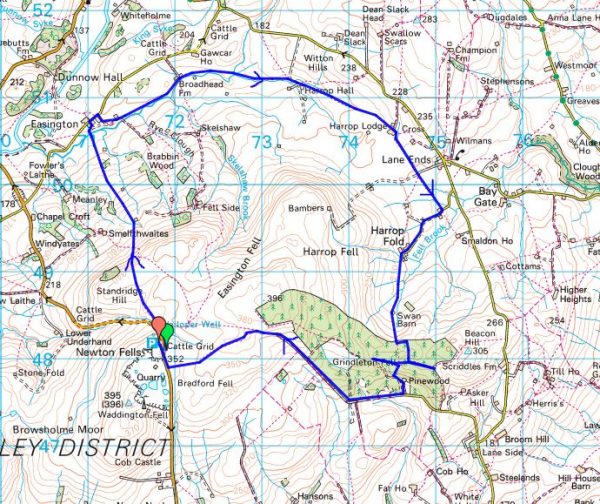
EASINGTON AND HARROP.

                                                                             Misty Easington Fell.

Two places hidden away in Bowland. I’ve driven through Easington but don’t remember end of the road Harrop Fold.

I planned to include Easington Fell into the round so I parked up at the top of the Waddington Fell road. I was the only car there on a misty morning and I hoped visibility would improve – it didn’t.

By the road side up here is Walloper Well.    Jessica Lofthouse (1976) described the place.

In the days of horse and pedestrian traffic none passed Walloper Well without stopping  to ‘quaff the clear crystal.’  Long ago, hill men, hunters, forest wardens and farmers off to Clitheroe markets and fairs, pedlars, lead miners from the nearby workings, all met here.  The name is thought-provoking. Why Walloper? From a word meaning a ‘fresh bubbling spring’, which this is, fresh from the moorside into stone troughs.  Age, wartime army practice and vandalism of 1974 made renewal of the trough necessary, but the flow has been constant.  One must drink, just as one throws pennies into the Roman fountain, to ensure one comes back again.”

So nothing to do with the frequently told story [very nonPC]  about the old man and his wife

Today there is no flowing water, I don’t know if this is the permanent situation.

After that disappointment I set off across the fell and immediately lost the path, if there ever was one. The ground was rough, what I call reedy walking, and you never knew if your feet would hit land or water.

Haircap Moss.

Persistence paid off and I spotted a cairn from where vague trods aimed to the barn shown on the map. From the hillside I could just make out Newton-in-Bowland, Easington and Dunnow Hall.

I was now on pleasant grasslands though this meant a herd of cows with accompanying bull. I was rather circumspect as was he. A teacher has just been killed near Richmond by cows.

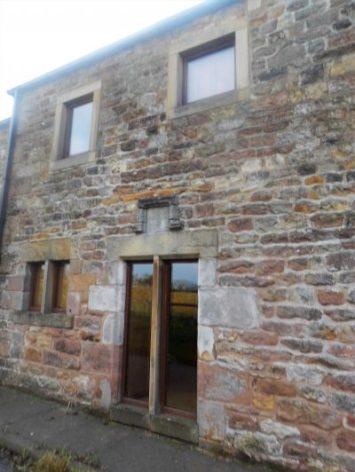
Anyhow I arrived in to Easington unscathed and had time to look at the four dwellings making up the hamlet. The most interesting appeared to be the Manor House.

The Manor House.

I now followed the diminutive Easington Brook for a mile or so passing Broadhead Farm to Harrop Hall. On my approach to the latter the farmer shooed his herd of cows plus a large bull across the field for me to pass, a service I don’t normally receive. I realised at the remote Hall that I had visited before with a friend from Grindleton maybe 40 years ago to collect two kittens, Bonnie and Barnie I subsequently christened them. They were an adventurous pair climbing in through upper windows of my house and even venturing to the pub on the corner where customers fed them and returned them at closing time.

Harrop Hall.

Harrop Lodge was next, another building with interesting features including a Venetian window in the gable end and other bits of architecture.

Barn window.

Wall niche.

This stone footbridge took me into the wrong field from which it was difficult to extricate myself.At Harrop Gate I came out onto a little road through an isolated metal kissing gate.

200 yards up this road was Harrop Chapel with benches outside for my lunch stop. The chapel was built in the early 1820’s and has been in continual use since. It ceased to be Methodist in 1969 and now holds Evangelical services.

Refreshed I strolled up the road to the hamlet of Harrop Fold, only half a dozen neat dwellings. Of particular note is a large white house , an original C17th Lancashire Longhouse which provided accommodation for the family at one end and the livestock at the other. On the other side is the Manor House of a similar age.

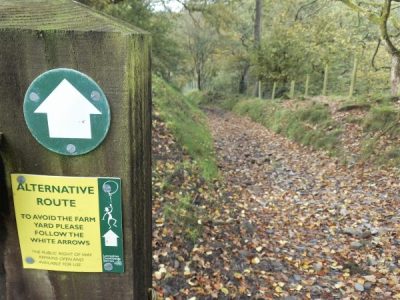
So far the walking had been very rural but now I headed back up the fell past a barn and into Grindleton Fell Forest where my troubles started. The paths didn’t go where I thought they should and didn’t correspond to my map.  The trees limited visibility and the mist descended. I walked in many directions without finding my intended onward route. I was glad to hit upon a track heading out of the forest to join a lane prominent on the map. It was now easy to follow across the fell until I came out onto open moor once more. Up here the views back down to the Ribble Valley must be stunning on a clear day. Ahead of me was the vague outline of Waddington Fell with its mast acting as a beacon to aim for. By now it was cold and damp and I was glad to reach my car. I’d clocked up 10 miles.

Not many of you will have explored Harrop – ‘the valley of the hare’

*****
LITTLE BOWLAND VARIATIONS.

Little Bowland is the area west of the Hodder River below the Totridge fells. Limestone predominates giving springy turf to walk on. There is one minor road through the centre.

I often walk in this area but today, a hot sunny Sunday, I find some new paths and ascend a little hill previously missed. What follows is a rather dull description of this beautiful area.

I park near the entrance to Leagram Hall and walk up the lane through the park. As usual there are hundreds of sheep at Laund Farm, supposedly Blue Faced Leicesters. I take a track off to the right going over a hill to cross Leagram Brook at ParkGate farm where there has been a minor path diversion. Over more hills and down to Park Style which was being renovated last time I passed, there has been some progress but it looks unloved and deserted. So onwards to pass the buildings of Lickhurst and over a limestone knoll to Dinkling Green, another cluster of houses. Don’t they have some nice names around here. I usually continue further into limestone country from here but today walk down their farm lane until a sunken track takes me over a little col and down to that minor road I mentioned. I become distracted here by some crags just off the road. On closer inspection they are low and broken but there are some fine Maidenhair spleenwort ferns growing out of cracks.

Down the lane is a quarried reef knoll where there is some hard bouldering.

On reaching it I decide to climb the hill behind as there are no intervening walls as far as I can see. New Laund Hill a modest 229m. though what a fantastic view point it turns out to be. North up the Hodder towards the Trough Of Bowland and its surrounding fells, distant Pen-Y-Ghent, Waddington Fell and then down the Hodder to Longridge Fell and Chipping Vale.

By coming up this way I miss New Laund Farm and Fairy Hole caves. Through the interesting buildings of  Fair Oak, a barn has a date stone 1729, and on to Higher Greystoneley, my friends are out so I miss out on a brew.

I hardly recognised the next bridleway as most of the trees seem to have been cut down since the last time I was here.

There is another limestone quarry behind the prominent limekiln. I have a poke about and find some interesting faces which could be worth exploration.

I always have difficulty over the last stretch, there is a crucial bridge over Leagram Brook and I struggle to find it. I admire the mature trees in the park… … and contemplate the symmetry of Pendle and Longridge Fells.

I have only seen two people all day.

*****

CLAUGHTON BRICKS, CATON FELL, THE PLAGUE AND THE LUNE.

I have lost my camera with this day’s photos on. When I say lost I mean I can’t find it but I’m certain it’s in the car or the house. After much searching it still hasn’t turned up. My mind’s not focused as it is the funeral of my best friend.

Yes, it has turned up under the carseat!

The day itself, a week ago, was brilliant.

As you drive through Claughton on the Kirkby Lonsdale road an aerial ropeway crosses above you carrying clay in buckets down from high on Caton Fell to the brickworks by the road. I’ve always been curious as to what’s at the top of the ropeway. The other end of the rainbow. Today I intended to find out and dragged Sir Hugh along for company.

We parked at The Fenwick Arms, sadly closed as a result of lockdown and other financial pressures. One of the many casualties.

A steady 1000 ft. ascent on a previously cobbled track with not much to see, Claughton Hall was hidden behind trees and Claughton Beck could be heard but not seen. Near the top we walked under the upper part of the ropeway. The buckets were trundling up and down by gravity feed. Constructed in 1924, this is the last gravity feed aerial ropeway operating in Britain. We crept into the upper quarry to see where the buckets were coming from – the answer was a shed where presumably the shale and  clay was loaded. There was a large quarry behind. We need not have trespassed as there are plenty of YouTube videos.

We came out onto the open moor near the wind farm and past the restored Moorcock Hall – certainly one of the remotest houses in Lancashire with a splendid view over Morecambe Bay.

A diversion was suggested to the trig point, 361m, of Caton Moor. We had walked past here on The Witches Way in 2016 without visiting the top. It was fairly barren up here but there were good views over the northern Bowland fells with the shapely ‘peak’ of Mallowdale Pike catching our eye, one for another day?  Ingleborough of cause made an appearance.

On the way back Sir Hugh spotted a couple of workers on one of the wind-turbine blades, I think I would have walked past without noticing. They must have abseiled down for some repair work which looked perilous from below.

I tried an arty shot with the juxtaposition of wind power against nuclear, Morecambe Power Station in the blurry background.

After the excitement we found a picnic bench for a civilised lunch stop. Two ladies on an adjoining bench were having a conversation where they both spoke at the same time.

The tarmacked lane down to Brookhouse went on for ages in the ever increasing heat of the sun.

Brookhouse is a charming olde worlde village which modern times and the main road have passed by. We were glad of a sit-down in the church yard where fresh cool water was found. St. Paul’s church dates from the !6thC. Built into the West wall is a Norman Arched doorway. Set into it are stones from former buildings, various Medieval marked stones. Rather a shambles really.

Whilst in the pretty village we had time to find the Plague Stone. Set into the parapet of the bridge next to the pub is a large stone with a hollowed-out top. In Medieval times plague epidemics killed thousands of people up to the late C17th. Victims socially distanced themselves outside towns but collected food from the stone. It is thought that the depression in the stone was filled with vinegar to act as a sanitiser for the coins left in payment. Does this all sound familiar in the twenty-first century?

A field path took us to the busy A683 which we crossed to get onto the disused railway line [Lancaster to KIrkby Lonsdale] this provides a cycle way out of Lancaster city centre but sadly comes to an end near here as far as public access is concerned. The River Lune curves elegantly through the fields and despite its attractiveness there is little in the way of a marked path. A lady was swimming in one of the pools; it looked very inviting in the hot sunshine. Ahead was Ingleborough with Hornby Castle prominent upstream. Fields separated us from the brickworks with the windmills visible on the moor above.

Heading back into Claughton we crossed the site of the old railway line at Gatekeepers Cottage. There was no sign of life at The Fenwick Arms.

On the drive home I stopped to take a photo of the aerial ropeway and its yellow buckets crossing the road, I now know where they come from.


*****

FAIR DAY ON FAIRSNAPE.

                                                         Looking back along the Fairsnape ridge.

JD and I set off from St Eadmer’s Church for a round of the Bleasdale fells. It was warm and sunny from the start. As is usual in these Covid 19 days we caught up with each other’s news and discussed the state of the nation as we walked up the estate road. Before long we were faced with the long rake across the side of the fell up to Fiendsdale Head, it seemed steeper than before. Drinks were taken half way up as we suffered from the heat.

The way onwards to the summit is always boggy but with a judicious choice of cloughs and some changing of sides over the fence we made it with dry feet. There are not enough flags.

We were kept entertained by a helicopter making repeated trips with some payloads to the distant White Moss. An even stranger sight greeted us we reached the 520m true summit of Fairsnape, a substantial digger perched on the peat hags.The operator was sat in the cab so we could ascertain his mission. United Utilities [North West Water to you and me] are trying to stop peat erosion and water run off. He evens out the cloughs, the helicopter drops stones to form a barrier before heather is replanted. Easy.

Stones emptied into the cloughs.

Well on a good day like today its good work but in a storm it would be a different matter. He spoke of trying to avoid the monster getting sucked into the peat. We left him to it but wondered at the effectiveness of man in such a huge scale of wild moorland.

The trig point, 510m, and cairn of Paddy’s Pole [no idea of its origin] on the western edge of Fairsnape are easy to locate in today’s clear weather but this area can be a nightmare in bad conditions and poor visibility. We both had tales of aimless wanderings.

In these conditions an easy stroll across to the trig and Paddy’s pole..

The shelter gave us a place to sit and eat lunch. I was on the lookout for flat soft areas for a future bivi night.

Along the ridge towards Parlick we were keen not to miss Nick’s Chair a lofty rocky prominence.

Nick’s chair – easy to spot in this direction.

Here is a 2014 picture of my grandson on the chair featured in one of my ‘lockdown’ quizzes.

We didn’t bother with climbing to Parlick’s summit but took a traversing path around it before descending the Zigzags down the rough fell side to Blindhurst.

Blindhurst with Beacon Fell in the distance.

Blindhurat Farmhouse.

It was then an easy walk across fields back to the church. A well devised route from JD. I believe I had a touch of sunburn.

The last time we did a similar route was almost 2 years ago to the day in Hurricane Ali, what a contrast.

*****
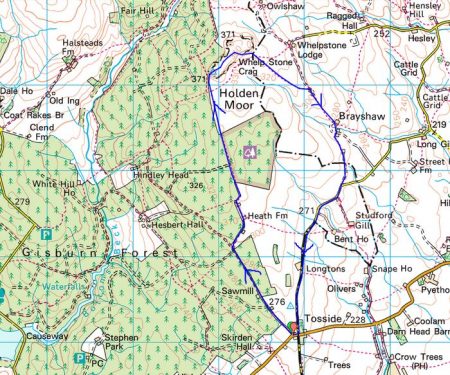
WHELP STONE CRAG – Gisburn Forest.

                            Distant view of Whelp Stone Crag peeping out of vast acres of Gisburn Forest.

I parked in Tosside; a church, a village hall, a war memorial in the middle of the road and an inn that is closed.

St. Bartholomew.

War memorial and ‘pub’


On the map the track leading to Whelp Stone Crag looked straightforward, a lane to a farm and then a footath alongside Gisburn Forest. As far as the farm the lane was good but the path onwards diabolical, difficult to follow on the ground, encroaching trees and waterlogged for most of its length. Why do I always seem to find these horrors?  I could hear the mountain bikers on the Gisburn Forest trails whooping with delight, I hope they could not hear my cursing. I would not recommend this approach, there are probably better traks within the forest.

The crag in sight over more rough ground.


Anyhow I arrived at the trig point, 371m, on top of a fragmented gritstone edge. Ravens were cavorting about in the updrafts. There must be some good bouldering on these rocks. From here I could look down on the bikers speeding along the trails. There were 360 degree views over Pendle, Bowland and into Yorkshire although the higher peaks were cloud covered. I was the only person up here.

After a snack as I was preparing to leave a couple arrived on the summit. ” That was the worst path we have ever been on” was their opening conversation. I had no idea what they meant.

The ongoing ridge was a delight before trackless slopes took me down to squelshy fields where farmers were rounding up their sheep. Across the valley, A65, were the limestone hills of the Settle area.

The unmarked footpath just about navigated me through or around, I was never sure which, several farms called Brayshaw. They all had a well worn look to them and were undoubtably of vintage.

Passing a smarter residence I reached some tarmac on a minor road. I threw in the towel and followed it back to Tosside. I think I was in Lancashire most of the afternoon but the oulook was Yorkshire Dales country.

*****

RIVER WENNING AND ‘THE BIG STONE’.

The River Wenning comes out from the Craven limestone dales and heads towards the Lune.  Today we were constantly reminded of the Dales by the presence of the Three Peaks on the horizon. The river takes its name from the old English ‘wan’ meaning the ‘dark one’ and within yards of the carpark we were crossing its rushing brown waters. These waters in the past powered mills in the Bentham area, originally for flax but later turning to cotton and silk. Here at Low Bentham modern accomodation has been developed in some of the old buildings.

It was a pleasure to walk upsteam chatting to Sir Hugh especially after the last few stressful weeks. Before we knew it we were in a massive caravan park, part residential and part tourism. We were impressed as to the quality of the park but what would you do here all the time.

After exracating ourselves from the park we climbed little used paths linking farms up the side of the fell. Some tidier than others.

Fourstones Farm

Once on the open fell the object of our walk appeared on the horizon across boggy terrain. The Great Stone of Fourstones stands on the Lancs/Yorks boundary. Known locally as ‘the big stone’, it is a glacial erratic gritstone. Originally as the name suggests there were three others which were broken up by farmers, but I can find no reference as to any dates or why one stone survived. A feature of the stone is a set of worn steps carved into the side, easier to climb than descend. I remember playing here with my children and finding more adventurous ways to the top. Today we were entertained with an ascent by a passing motorcyclist in his unsuitable footwear. The stone is covered in carved graffiti.

Leaving here we weaved a way across the fell to descend past interesting farms with the dramatic view of the Yorkshire hills ahead of us.

Gragareth, Whernside, Ingleborough and Penyghent.

Grusckham.

A late lunch was taken sat on a couple of stones only to pass a perfect wooden seat within a hundred yards. This is a frequent occurence on walks which remains an unexplained quandary.

Dawson.

From time to time we were strafed by Chinook type helicopters which had the conversation ranging to ‘Mash’ – Hawkeye, Hot lips and Radar. We are of a certain generation.

Back on the River Wenning we bypassed Higher Bentham village using a lane by riverside mill cottages. Once through another large caravan park we took paths on the north side of the river to Lower Bentham.

Sleepy Lower Bentham.

Yet another interesting walk in unfamiliar territory. Are there more in this area?

*****


LITTLEDALE. A bittersweet day.

                                                                   Bowland at its best.

I walked here a week ago, August Bank Holiday Monday. We had planned it to avoid the crowds. Sir Hugh’s write-up is already published.

On my drive home I had a phone call to say my friend with dementia and motor-neurone disease had suffered a turn for the worse. Was I glad I had not taken the motorway, it was jam packed. My little car sped through the by lanes and I arrived along with the paramedics. There was little they could do except offer sincere empathy, likewise the on call doctor who came shortly afterwards. Thankfully she could be nursed, unconscious, at home. Two days later she passed away peacefully. I’ve lost two of my best friends this year.

A week later I have loaded my photos but am unable to give a  commentary.

Baines Crag carpark.

Artle Beck.

Crossgill Farm, 1681, typical of the area.

The former St. Anne;s Chapel. 1752.

Littledale Free Church, 1849, now a store.

Littledale Hall and buildings, C19 gothic style. Now a ‘therapy centre’.

Sir Hugh entering upper Littledale.

Leafy Littledale.

Over to Roeburndale – another day.

Littledale – there and back.

I want one of these when the time comes.

Littledale Hall again.

Caton Moor wind turbines.

Slopes of Clougha with the infant River Condor.

Looking back towards distant Ward’s Stone Fell.

Baines Crag.

A steep end to the day.

*****

HAVE YOU BEEN TO LOWGILL? THE FAR SIDE OF BOWLAND.

This all happened a few days ago. I’d driven up the minor road from Slaidburn which heads over the hills to Bentham. As I crossed the watershed at the Cross of Greet I became aware of the vast landscape ahead of me. The Yorkshire peaks of Ingleborough and Whernside, the Barbon Fells and the distant Lakes overlooked a barren landscape of upland moor. There is nothing but sheep up here and they tend to sit on the road creating an additional hazard. I’m on my way to meet up with Sir Hugh whom I’ve not seen for 6 months due to Covid problems.

From the Taham Fell road, there is a turning to Botton Head, a culdesac, more of that later and then a sign to the mysterious Lowgill. I drove down the steep narrow lane hoping nothing would come the other way. We have arranged to meet in the village near the school where parking is just possible.

We had an idea of a route up and down the valley of the Hindburn River using paths and lanes.

The paths turned out to be little used and finding the bridges to cross the numerous streams became a challenge. The first path took us up to the little Church of the Good Shepherd, erected in 1888 by the Lancaster church architects Austin and Paley. Well named as these Tatham Fells are home mainly to sheep.The road leading up to it was 1in4 with an acute bend which must make attending Sunday service in an icy winter exciting.

The Hindburn was running high and the water was the colour of a well-brewed Pekoe tea. The way we chose ran alongside for a while. The name, as in neighbouring Roeburndale, is from the deer that roamed these parts in large numbers. I imagine there will still be a few about when you are not looking, as are red squirrels apparently.

We were in pathless sheep pastures with the occasional old barn helping navigation, distant Ingleborough kept popping up on the horizon.

For a while we walked alongside the River Hindburn.

Lower Thrushgill was the first inhabited house we came across, tastefully restored from its 1798 origins. At one point the path going by it seemed to head straight into their conservatory. Out on the lane we met up with a friendly deaf and mute man clutching a poorly photocopied map of the area, we helped him on his way by pointing out hopefully the correct route. He was the first person we’d seen all-day but shortly afterwards we met a lady and boy with their dog. The boy had been bathing in the river – simple pleasures reminiscent of my own childhood.

Approaching Botton Head.

We crossed the river and walked up to Botton Head Farm at the head of the valley. This old farm dating from the C17th is at the end of that culdesac road I’d notided on my drive over. The farmer, had he seen us coming? emerged for a chat which pleasantly gave us some history of farming in the area and more. He had lived here all his life and seen most of the surrounding farms abandoned and bought for restoration as country residencies. The land becomes rough, suitable only for sheep and the scattered barns no longer needed. A dying breed. At least he put us on the right track for a lost bridleway which had us searching for stiles and bridges. A magic spot by a side stream served lunch in the sunshine.

The lost ways were ‘followed’ to a farm building strangely named Swans and then a track to the road at Ivah. Here we met up with the lady and her dog, now much friendlier [ the dog that was] and coming down the lane a jubilant walker doing sign language. He had completed his circuit, thankfully our earlier directions had proved correct and helpful. Despite his limitations, we made out that he was ‘buggered’ from the day’s exertions. We weren’t that tired as we strolled down the lane to the few houses that make up Lowgill.

An impressive marble monument was in a prominent position by the road remembering four souls lost in WW1.

Until 1960 there used to be a public house here, The Rose and Crown, this may have been it…A lot of the houses had collections of presumably local stones from the fields. They looked like tortoise shells and felt heavy. I need to correspond with ‘the Rockman’ for their origins – he came up with name  ‘septarian nodules’. Concretions of sedimentary rock and minerals from the Cretaceous seas 50 – 70 million years ago.

So our six-mile exploration of this hidden Bowland valley had been a complete social distancing success. We parted with ideas of another equidistant meetup and walk in the near future.

My quandary was whether to take the easy option of going north to link up with the motorway home or go back over those lonely hills. The latter won so it was topdown for a road trip as good as anywhere in England.

Barbon Fells, Whernside and Ingleborough.

Cross of Greet road


Distant Pendle.

Source of the Hodder.

Roman road from Newton.

“STOP GROUSE SHOOTING’S WAR ON WILDLIFE”

I hope this will be my last post for now on the ills of the grouse moor. I’ve recently tried to highlight raptor persecution and today want to bring to your attention the vast losses of other wild life occuring on grouse moors. The more the public become aware of these killings the more the pressure on politicians. So read the article, spread the news and sign the petition.

Hundreds of thousands of innocent animals – foxes, stoats, weasels, and hedgehogs, as well as birds are killed in traps and snares on Scottish grouse moors every year. This is having a massive environmental impact as these moors cover a fifth of the land in Scotland. The same is happening in the rest of the UK.

The League Against Cruel Sports have just published an article  with a link to the full report.

There is a petition to sign here.

A recent article in The Yorkshire Times by David Goff is worth reading. https://yorkshiretimes.co.uk/nature

It’s time I got out to do some some walking…

43 HEN HARRIERS MISSING SINCE 2018.

There is a petition for you to sign at the end of this post.

I wrote a few days ago about Hen Harrier Day and I hope some of you may have had a chance to watch part of the virtual presentation on YouTube. There were some excellent videos of Hen Harriers in flight and their courting display. Amongst the many features of the programme, several respected environmentalists added to a balanced debate on Raptor Persecution over grouse moors. I would imagine there will be footage available on YouTube if you missed it.

Moving on, I received a post today from Raptor Persecution UK, a rather polarised group, from which I have extracted the following factual information which I present without comment. It is a list of Hen Harriers, mainly tagged, that have disappeared or been confirmed killed since the beginning of 2018.  Other Raptor deaths have not been included.  

It makes a depressing read.

***

February 2018: Hen harrier Saorsa ‘disappeared’ in the Angus Glens in Scotland. The Scottish Gamekeepers Association later published information claiming the bird had been re-sighted. The RSPB dismissed this as “completely false”.

5 February 2018: Hen harrier Marc ‘disappeared’ on a grouse moor in Durham.

9 February 2018: Hen harrier Aalin ‘disappeared’ on a grouse moor in Wales.

March 2018: Hen harrier Blue ‘disappeared’ in the Lake District National Park.

March 2018: Hen harrier Finn ‘disappeared’ near Moffat in Scotland.

18 April 2018: Hen harrier Lia ‘disappeared’ in Wales and her corpse was retrieved in a field in May 2018. Cause of death was unconfirmed but police treating the death as suspicious.

8 August 2018: Hen harrier Hilma ‘disappeared’ on a grouse moor in Northumberland.

16 August 2018: Hen harrier Athena ‘disappeared’ on a grouse moor in Scotland.

26 August 2018: Hen Harrier Octavia ‘disappeared’ on a grouse moor in the Peak District National Park.

29 August 2018: Hen harrier Margot ‘disappeared’ on a grouse moor in Scotland.

29 August 2018: Hen Harrier Heulwen ‘disappeared’ on a grouse moor in Wales.

3 September 2018: Hen harrier Stelmaria ‘disappeared’ on a grouse moor in Scotland.

24 September 2018: Hen harrier Heather ‘disappeared’ on a grouse moor in Scotland.

2 October 2018: Hen harrier Mabel ‘disappeared’ on a grouse moor on the edge of the Yorkshire Dales National Park.

3 October 2018: Hen Harrier Thor ‘disappeared’ next to a grouse moor in Bowland, Lancashire.

23 October 2018: Hen harrier Tom ‘disappeared’ in South Wales.

26 October 2018: Hen harrier Arthur ‘disappeared’ on a grouse moor in the North York Moors National Park.

1 November 2018: Hen harrier Barney ‘disappeared’ on Bodmin Moor.

10 November 2018: Hen harrier Rannoch ‘disappeared’ on a grouse moor in Scotland. Her corpse was found nearby in May 2019 – she’d been killed in an illegally-set spring trap.

14 November 2018: Hen harrier River ‘disappeared’ on a grouse moor in the Nidderdale AONB. Her corpse was found nearby in April 2019 – she’d been illegally shot.

16 January 2019: Hen harrier Vulcan ‘disappeared’ in Wiltshire close to Natural England’s proposed reintroduction site.

7 February 2019: Hen harrier Skylar ‘disappeared’ next to a grouse moor in South Lanarkshire.

22 April 2019: Hen harrier Marci ‘disappeared’ on a grouse moor in the Cairngorms National Park.

26 April 2019: Hen harrier Rain ‘disappeared’ on a grouse moor in Nairnshire.

11 May 2019: An untagged male hen harrier was caught in an illegally-set trap next to his nest on a grouse moor in South Lanarkshire. He didn’t survive.

7 June 2019: An untagged hen harrier was found dead on a grouse moor in Scotland. A post mortem stated the bird had died as a result of ‘penetrating trauma’ injuries and that this bird had previously been shot.

5 September 2019: Wildland Hen Harrier 1 ‘disappeared’ on a grouse moor nr Dalnaspidal on the edge of the Cairngorms National Park.

11 September 2019: Hen harrier Romario ‘disappeared’ on a grouse moor in the Cairngorms National Park.

14 September 2019: Hen harrier (Brood meddled in 2019, #183704) ‘disappeared’ in North Pennines.

23 September 2019: Hen harrier (Brood meddled in 2019, #55149) ‘disappeared’ in North Pennines.

24 September 2019: Wildland Hen Harrier 2 ‘disappeared’ on a grouse moor at Invercauld in the Cairngorms National Park.

10 October 2019: Hen harrier Ada ‘disappeared’ on a grouse moor in the North Pennines AONB.

12 October 2019: Hen harrier Thistle ‘disappeared’ on a grouse moor in Sutherland.

18 October 2019: Member of the public reports the witnessed shooting of an untagged male hen harrier on White Syke Hill in North Yorkshire.

November 2019: Hen harrier Mary found illegally poisoned on a pheasant shoot in Ireland.

January 2020: Members of the public report the witnessed shooting of a male hen harrier on Threshfield Moor in the Yorkshire Dales National Park.

1 April 2020: Hen harrier (Brood meddled in 2019, #183703) ‘disappeared’ in an unnamed location, tag intermittent.

5 April 2020: Hen harrier Hoolie ‘disappeared’ on a grouse moor in the Cairngorms National Park.

8 April 2020: Hen harrier Marlin ‘disappeared’ on a grouse moor in the Cairngorms National Park.

21 May 2020: Hen harrier (Brood meddled in 2019, #183701) ‘disappeared’ on a grouse moor in Cumbria shortly after returning from wintering in France.

27 May 2020: Hen harrier Silver ‘disappeared’ on a grouse moor on Leadhills Estate, Scotland.

Nobody has been prosecuted for any of these cases.

***


If you’re are concerned by the illegal raptor persecution on grouse moors please send a pre-written letter to your MP urging action. All you need to do is add in your postcode.

Launched on Saturday by Wild Justice, RSPB and Hen Harrier Action, over 29,000 people have signed up so far, meaning that 29,000 e-letters are on their way to our parliamentary representatives. Please join in HERE

https://wildjustice.eaction.org.uk/saveourskydancers

https://raptorpersecutionscotland.wordpress.com/

Thank you.           PS  It is the 12th August tomorrow, the start of the grouse shooting season.


HEN HARRIER DAY Saturday 8th August 2020


 I would like to draw your attention to the event below.

 Hen Harriers and other raptors have been persecuted for years and our local Bowland Hen Harriers have all but disappeared when once they were a regular sight. Grouse moor [mis]management has been implicated in their demise.

  Several organisations have been trying to highlight this problem and seek some better legal protection for our magnificent birds of prey. One such group, Hen Harrier Action, have staged events in the last few years to bring this to greater public attention.  This year due to Covid they have had to change plans and go virtual online. The details for their YouTube presentation is included below – it sounds an interesting and informative agenda and I think many of you could fruitfully dip into it.


It’s Hen Harrier Day this Saturday (8th August 2020) and this year it’s going online. Although we’ll miss the physical annual gathering at venues up and down the country, this year there’s actually far more scope to reach a huge audience, many of whom may previously have been unaware of the scandalous mismanagement of the UK uplands.

https://henharrierday.uk/online
https://www.youtube.com/HenHarrierDayUK

STOCKS RESERVOIR – THE OTHER WAY ROUND.

Last week my planned trip to Stocks was aborted by a last-minute decision to walk up Croasdale. I was back today though and parked at a remote spot on the hill road from Slaidburn to Bentham just short of the Cross of Greet bridge over the River Hodder, yes I renew my acquaintance with this lovely river. The Hodder Valley up here was dammed in the 1920s to create Stocks Reservoir.  For an informative history, http://www.dalehead.org/ is worth consulting.

As is usual with my walks at the present I don’t set off till lunchtime when the weather is hopefully on the mend. Where I park, avoiding the busy honeypots, gives me easy access to the waymarked circular walk around the Reservoir. Incidentally, my last visit here with Sir Hugh and JD was last July almost to the day. That was a bright sunny day whereas today was dull and windy and I decided to walk anticlockwise for a change.

Immediately I was inserted into a procession of walkers who were already halfway round. It’s a busy Sunday. Behind me, a commotion erupted as a couple with a dog off the lead, despite all the notices, were frantically calling its name, Max, as it charged off after the sheep. They charged off after the dog and all ended up in a heap on the hillside, I had no sympathy and walked on.

The route I was walking was originally a rail track from a quarry providing stone for the dam. It took me past the fishermen’s cafe and centre, where I couldn’t resist a coffee, served with all the Covid precautions we are having to get used to.

Onwards past the stately mansion built by the waterboard.

From the dam I watched fishermen stood in the water or more sensibly sat in a boat, not a fish was landed.

After that were open meadows with views up the water. I would think it was fifty-fifty as to the number of walkers going my way and those completing the circuit clockwise. I’ve often debated on how we choose the way around a circular walk – prevailing weather conditions, the best views, ease of ascents, the guidebook description etc. I wonder if left-handers have a different mindset? Whatever my circuit today gave different aspects to previous visits.

At the road, I met all the mountain bikers spilling out of Gisburn Forest and all the cars parked in and out of the car park. The lockdown has highlighted selfish and illegal parking.

Once past the parking I had the trail to myself once again giving me time to nibble away at the abundant wild raspberries. United Utilities have done an excellent job of keeping us walkers off the road on a permissive path that has a good feel as it winds through the bushes.

Occasional walls remind one of the previous village that occupied this valley. I popped into one of the bird hides along here but not much was happening, cormorants were drying their wings on a promontory on the far side of the water and a kestrel was hunting closer by.

A steady pull up a lane brought me to the site of New House farm of which there is only a barn still standing, the web site I mentioned has photos of the old farms. Great views back down from up here over Stocks with Pendle in the distance.

I’m almost full circle but first, have to drop down to cross the footbridge over the River Hodder and climb up on a flagged path past more ruins to where I am parked.

Here I bizarrely meet a young lady with a baby in a pram and a couple of working dogs. , “He was teething so I’ve come out to settle him”,   She lives just up the lane in one of the most remote farmhouses in Lancashire, it was Yorkshire once. She bemoans the fact that the area is becoming more accessible and well known. there are even boy racers on the road.

*****


COVID FREE CROASDALE – PURE NOSTALGIA.

“I may not have gone where I intended to go, but I think I’ve ended up where I needed to be”  Douglas Adams.

After a late breakfast Sunday, I set off to Slaidburn for a gentle walk around Stocks Reservoir. I was enjoying the drive over with the roof down listening to the West Indians scoring too freely in the Test match. As I came over the rise on the road up from Cow Ark there in front of me were the Three Peaks of Yorkshire, a view I always thrill to. Out of the corner of my eye were the Bowland Fells, vying for attention. I was aware of the half-hidden valley of Croasdale and realised I hadn’t visited it for a year or so. A quick change of objective and I found myself parked up in that little pull off at the very top of Woodhouse Lane. I pondered on how many times I’ve parked there over the years especially in the early years of this century when we were developing the bouldering potential of the Bull Stones higher up the valley. We would race up the track to climb all-day and then most nights come down in the dark, we knew every twist of the route.

Of course, we were not the first to come this way. The Romans forged a road over the fells, probably adopting ancient ways, linking Ribchester with Carlisle. Some of the culverts on this The Hornby Road date back to the Romans. Later there was trade between the Monasteries of Yorkshire and the coast, wool one way and salt the other, hence the other name for this route, Salter Fell Track. A metal marker on the track commemorates the 400th year anniversary of the Lancashire Witches being dragged this way to their trial and execution in Lancaster.

It was a Lancashire Witches Walk waymark on the fell gate that reminded me of probably my last visit here whilst undertaking that excellent way. At the time a group of workmen were repairing a section of road just past the bridge. A gully was undermining the road and an expensive shoring up exercise was underway. That has been completed and the repairs extended up what was a very rough section of road by resurfacing with limestone chippings which look out of place in this gritstone environment. No doubt this has all been done using taxpayers funds and yet the only people to benefit from it are the shooting fraternity who have a lodge further up the track.

Few people walk up this valley and today the only people I see are motorcyclists who are able to travel right through from Slaidburn to Hornby a classic moorland journey. The man himself, A Wainwright described it as the best moorland walk in England although I’m not sure what he would have had to say regarding the motorcycles.

My more modest aim today is just to reach the gate near the summit and then traverse back along the hillside visiting the Bull Stones. I’ve brought my binoculars along as this area used to be a good place to see Hen Harriers, but alas no more due to persecution from ‘hands unknown’.  Many of you will know the story of Bowland Beth. So I don’t see harriers but I do spot a pair of kestrels, some stonechats and more excitedly two ring ouzels.

I sit under a favourite boulder and eat some lunch whilst gazing down the valley with Pendle in the far distance, there is not a soul in sight. The only sounds are the occasional bleating of sheep and the cries of seagulls which come inland here.

I continue along the edge of the rocks, past the spring of sparkling water where I know I can refresh myself even in the middle of summer. Around the corner, the continuation of the rocks is at a higher level and I make my way slowly up to them. I’m aiming for one particular group where there is a 50-degree slabby rock which we called ‘super slab’ on our first visit, I’m inclined to overdramatize but it is super. Perfect clean steep rock, rippled slightly with the odd pebble for a finger hold. 

Somebody produced a video featuring this slab so you can see what I’m going on about –

After lovingly fingering the start of the climb, I don’t have my rock shoes with me, I make my way to the end of the rocks, the Calf Stones.

Down below is that massive stone trough carved from an in-situ boulder. Time for another sit and contemplative look down the valley towards Pendle. I have time to examine the minutiae of the lichen growing into the gritstone.   I then head down to pick up a hidden sheep trod in the bracken that I know will take me across the rough hillside to join an estate track down to the ford. It had been at the back of my mind all afternoon as to whether I would be able to safely cross the stream here. One winter it was impossible and we had to make quite a detour to find a way across. Today, despite the recent rainfall and the stream flowing quickly, I seemed to just hop across.

Just follow the path.

Back on the main track, I had time to reminisce on times staying in the barn visible down below. It has been overhauled by United Utilities partly to preserve the unique sheepfolds that surround it.  Once with my eldest grandson, we had two nights there and were treated to hen harrier flypasts both evenings as we sat by a campfire eating baked beans and sausages, magic.

From up here, I could see in the distance a small section of Stocks reservoir where I could well have been. Another time.

*****

CHIPPING HIGH LANES.

“You deserve a holiday!”  said the email from booking.com.

I’m being bombarded with adverts from holiday organisations desperate for me to spend money with them and fly off in the middle of this pandemic. I’m not fooled by Boris’s assurances of  “air bridges” to avoid quarantine, where is the medical evidence for that? And what may change whilst you are away? The only good outcome of his policy is that the crowds who inundated our beaches will be jumping on planes to take them to the ‘Costas’. They will find the Spanish police know how to administer crowd control with hefty fines and prison sentences.

Anyhow, would you want to sit on the beach with a mask on and then queue for an hour or so for your Sangria?

Homegrown firms [eg Booking.com Airbnb Tripadvisor] are also trying to tempt me away in Britain. I know hotels and B&B’s are in a desperate state but can you imagine how the experience of an otherwise pleasant country house hotel would be at present.

At least some of these firms are advising booking with a cancellation option but even that might not be straight forward, read the small print. Here is Booking.com’s special notice –  For bookings made from 6 April 2020, you should take into account the risk of Coronavirus (COVID-19) and associated government measures. If you don’t book a flexible rate, you may not be entitled to a refund. We advise you to closely follow any travel advice from your local government and health organisations, and we recommend booking a flexible rate with free cancellation, in case your travel plans need to change.

You’ve guessed it I won’t be going anywhere just yet. Probably not this year if the deadly virus is still about. Let’s wait and see, I’ve successfully shielded for nearly 4 months now so I’m sure I can continue. In answer to booking.com’s suggestion that “I need a holiday” – no I don’t, I’ve had one for the length of lockdown so far.

Maybe though I need a change of scenery. but they sensibly won’t let me into Scotland or Wales just yet. The next best thing this afternoon as the sun comes out is to drive 5 miles to Chipping, olde worlde and mentioned in the Domesday Book. I have a walking route planned around the quiet country lanes. I park near the Church of St. Bartholomew opposite The Sun Inn. This is where my story starts

Lizzie was a maid living in the Sun, in the year 1835. She met up with a local lad who claimed the deepest love for her and proposed to her, she gladly accepted, However, two days before the wedding, James told Lizzie he had fallen in love with her friend Elsie and called off their wedding day. He now planned to marry Elsie in the church opposite.

On the day of the wedding  Lizzie went up to the pub attic overlooking the churchyard, she wrote a suicide note, placed a rope around her neck, and died. The note in her fist read “I want to be buried at the entrance to the church so my lover and my best friend will always have to walk past my grave every time they go to church.”

Her grave is situated near the old entrance – 

But the story doesn’t end there. For almost 200 years the ghost of Lizzie has haunted the Sun Inn and the churchyard opposite. Just ask anyone in the village. There is an old yew tree near her grave which has one branch supported by an iron tripod.

Sorry, I became rather distracted there.

My walk leaves the village up the lane towards former water mills which helped Chipping thrive in the early industrial years. None is working now, Kirk Mill has been preserved but is looking rather forlorn. Originally a corn mill, then a cotton mill it ended its life as part of the Berry Chair Works. Its large crane was used to unload timber from the lorries. The cottages surrounding it were still used by workers when I moved into the area in the ’70s. It eventually closed its doors in 2010. Above the main building is the large mill lodge famous nowadays for its ducks.

The narrow lane continues steeply up the hillside passing the site of Tweedy’s Mill, a former foundry and previously a cotton mill. Now there is housing and Proctor’s Cheeses. At one time there were half a dozen water mills on this section of Chipping Brook.

Brief glimpses of the fells appear through the trees. Above Wolfen Mill, an old bobbin mill, I take the lane into the fells. I chase butterflies up the hill and buy some free-range eggs at the stall on Saddle Side farm track.

Red Admiral.

Today I’m not going further into the fells so I turn down a newly tarmacked route to Windy Hills Farm where there is a recent barn conversion, presumably they have paid for the road improvement. At the moment it looks out of place up here but it provides a warm bed for the lambs. Onwards on the familiar track to the extensive sheep rearing Laund Farm with views opening up to Waddington Fell, Pendle Hill and Longridge Fell.  Laund was the ancient word for an open space for deer and I now walk down through it, admiring the mature trees and lush greenery, part of the Leagram Estate. A perfect evening.

Back in Chipping, I walk up to the Sun Inn where the story started.


*****