The day was gloomy and so was I – perhaps I overdid the whisky last night. I was still mooching around the house late morning. But I keep trying to push my walking that bit farther. As you know I’m slowly working my way through Mark Sutcliffe’s Cicerone guide to Walking in Lancashire. In this I’m mirrored by Phreerunning Martin who always gets an interestingly different take from me, the pleasures of blogging. I needed something not too long and preferably as flat as possible. Walk 15 seemed perfect. I know the Glasson Dock area well and have done several variations of this walk before, probably most recently on my Lancashire Monastic Way. But looking at Mark’s route I spotted some paths I had never walked. I might struggle to say something original about this walk.
I was a little embarrassed to leave my car in The Stork’s private car park, but the other space was taken by Travellers and their caravans. The channels of the Condor don’t look at their best during low tide. Following the old railway I came into Glasson, busy with people visiting an outdoor market. I couldn’t go past the little shop without buying a coffee, this time to drink as I climbed the minor hill to the viewpoint. The views were disappointing but the coffee good, sorry about the environment polluting cup.


I worked my way around the coast. The tide was out, so Plover lighthouse was accessible, it was previously maintained from the shore before becoming automatic. The incumbent keeper was based at Lighthouse Cottage where there was another light atop a wooden scaffold to line up ships coming into the tricky Lune channel. Across the channel I could see Sunderland Point at one time the major port on the Lune.


A sign talks of plovers nesting on the shoreline, but I wonder about this as the tide comes in fully most days.

Lots of walkers were converging on Cockersand Abbey, of which the only remaining building is the octagonal Chapter House. This has survived because it was used as a mausoleum by the Daltons of Thurnham Hall (see later) during the 18th and 19th centuries. The red sandstone rocks on the shore line show where the building blocks of the Abbey originated.

Continuing around the coast on the sea embankment passing several caravan parks which looked very vulnerable to high tides. It will be interesting to view this area in the coming decades as sea levels rise. Those are the Bowland Hills behind.

Tree of the day.
Small planes kept taking off from somewhere on Cockerham sands, disappearing into the dark clouds only for tiny parachutes to fall from the skies. They were from the Black Knights centre. Was the sign for parachutists that had gone astray on their descent?


I left the coast and followed bridleways through drained lands up to Thursland Hall where one is corralled into narrow ways to bypass their fishery. Change of scenery.


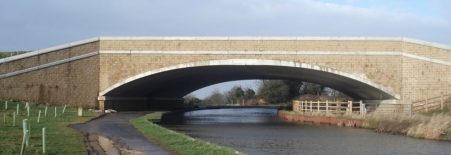
A kilometre of tedious walking brought me to Thurnham Hall, a C17th country house converted into a spa hotel. It looked very smart and there were plenty of people staying in the attached residential block. Walking through I reflected that my life seems very simple compared to others. Escaping by a gate into a field I was wary of proceeding through the large herd of frisky bullocks, so I resorted to an outflanking manoeuvre bringing me back to an ancient green lane. A bridge gave access to the Glasson branch canal. 

 Herons are a common sight on waterways, staring motionless into the water. I have never seen one catch a fish, but today I was lucky this heron had just caught an eel and was having difficulty trying to swallow it whole. The highlight of the day.


*****