Tag Archives: Lancashire

MID-SUMMER MISCELLANEA.

Double rainbow over Longridge out of my window.

Haven’t much to report since arriving back from France, how can I be jet-lagged after an hour and a half flight.

The fields opposite my house are being cut by a flotilla of agricultural vehicles, what a contrast to the old days of hay cutting that I was involved with as a youngster.

The weather here has been predictably hot and dry so I’ve been out bouldering on Longridge Fell at three of my favourite crags – Kemple End, Crowshaw and of course Craig Y Longridge.  These three give me choices of sun or shade at varying times of the day so I can escape the sun if needed. Up at Kemple I ventured onto Hodder Buttress to solo the easy slabs and arriving at the top I was concerned about some loose flakes above the climbs, I had great fun trundling these onto the quarry floor thus making the routes safer. Over on the main wall I found that I was struggling on some of the traverses I normally cruised, I blamed this on lack of confidence since my enforced layoff. The view over the Ribble Valley this evening was splendid.

At Crowshaw I was completing a topo of the problems to the left of the main buttress. The quarry bowl here is a delight as the heather starts to bloom and the bilberries ripen. I am content on an evening just to sit here and listen to the bird song.

After these two backwaters Craigy is hardcore bouldering, 100m of overhanging rock, with a regular clientele. I have a section at the far end that is less severe and I can do circuits on relatively good jugs to keep fit.

Whilst up on the fell I popped into Cardwell Quarry where climbing is now banned because of unsociable behaviour by some ‘climbers’. I was surprised to see that not too much vegetation has returned in the lean years. I must go and have another word with the farmer to try and restore climbing here.

I was out in the Ribble Valley today and popped into Witches Quarry. A secluded limestone venue where you drive into the field and park conveniently under the crag! The rock was in good condition and I traversed a little and then soloed the amenable Cracklap, I’m sure this used to be VD. Strangely a gooseberry was growing from the start of the crack.

NOT THE BEST OF DAYS FOR AN ARNSIDE WALK.


As I came off the motorway my car radio was tuned into Radio Lancashire but as I approached Milnthorpe it automatically retuned to Radio Cumbria. This used to be Lancashire, today Arnside is in Cumbria [South Lakeland] whereas Silverdale is still in Lancashire. All very confusing and not very logical geographically. Poor old Westmorland disappeared altogether.

I was greeted with a cup of coffee and a custard pie from the local bakery on arrival at Sir Hugh’s house. It had been my suggestion that we walk around the coast from Arnside to Silverdale and back by Arnside Tower and Knott. It would be a good chance to catch up on recent trips and news.


We started on the promenade by The Albion where there is a ‘drinking’ fountain erected in memory of a Richard Moberly Clayton Grosvenor by his grandparents. Aged 4yrs sadly appendicitis killed him in 1903. In the background is the railway viaduct over The Kent.

This is a walk I did on past occasions with my young family and friends usually having lunch in the pub on the shore road in Silverdale. It all seemed different today, the coast has changed and where there were sand and grass there is now mud, and where there were a few caravans there is now a caravan metropolis. The first caravan park at New Barns seemed rather ramshackle but we found a way through, possibly not the most direct, We kept seeing the coast, the tide was out, as we followed woodland paths that came out onto small limestone cliffs.  The slippery limestone was unnerving at times but I followed my guide as he sped off into the mist and rain. At one point we came out onto White Creek, a bay with grassy foreshore. The path through the woods was good and we eventually emerged into another far superior caravan park which went on forever. I reckon that the holiday site is larger than Silverdale itself, it has its own pool, gym, bowling, play areas, bar and shops etc so I wonder how much the Arnside/Silverdale area benefits.

Arnside.

New Barns across the mud.

White Creek

Slippy when wet.

Holgate’s caravan city.

Caves in the Cove.

Silverdale Cove with Morecambe Bay beyond.

Humphrey Head with distant Walney Island.

The day had promised brightening skies but we had by now been walking in light rain for a couple of hours. We started to meet people out walking when we arrived in Silverdale, always a popular spot. A few streets later and we were heading back into fields towards Eaves Wood. As we entered the woods my local guide muttered that he [I wasn’t implicated] might not be able to find the Pepper Pot, a prominent landmark. We did and it was a good spot to stop for lunch whilst it was briefly dry giving good views south over Morecambe Bay and the fells to the east of the M6. The Pepper Pot was built in 1887 to commemorate the Golden Jubilee of Queen Victoria, she must have more monuments to her name than any other royal. Also on the escarpment was a view indicator from our present Queen’s Diamond Jubilee, shame they didn’t build a salt cellar.

Artisan gate.

Eaves Wood.

Pepper Pot and viewfinder.

There were paths in all directions, many new to Sir Hugh, and we blundered northwards through trees to suddenly arrive at Arnside Tower one of the medieval Peel towers in the area. [The Scots liked raiding hereabouts] It looked in perilous condition and we gave it a wide birth. The nearby farm had one of the largest herds of cattle in one field that I’ve ever seen.

Head North.

Arnside Tower.

Herds.

Back into the woods and we make our way slowly up Arnside Knott. Nearing the top there is a seat with the best views northwards over to Grange and the Lakeland hills if they had been clear of cloud. We made an obligatory visit to the trig point, one that has been adopted by Arnside Ramblers and given an unusual paint job. There are too many trees up here for views. We found an open field to drop back into Arnside.

Across the Kent to Grange and hidden Lakeland.

Knotted trees.

Adopted Trig

Heading home.

It wasn’t that bad but I need to return when the sun is shining.

*****


A SUNDAY MORNING STROLL.

I can’t say much new about Longridge Fell.

Over coffee I was plotting a route from Brock Bottoms when the phone rang. it was Dave asking if I fancied a walk on Longridge Fell. I couldn’t say no. I’ll put the river walk on hold.

I’ve not seen much of Dave since my PMR episode put rock climbing on hold, and anyway he is abroad most of the time. A quick turn around and we met up at Cardwell House car park at 10am.  He was not familiar with this western end of the fell so I had hoped to give him a good tour. We caught up on our recent relevant excursions. He has just had a successful three week’s climbing trip to the south of France, I’ve mainly been at the doctors. As I waited at the car park I tried out the panoramic mode on my camera with the Bowland Fells over Chipping Vale.

He seemed to be enjoying the route I took trough the forest until we hit an area of tree felling across the track, the next 200m was tedious to say the least. He likened it to anti tank defence terrain from the 2nd WW.

We eventually emerged onto a familiar track up towards the summit but a blocked path forced us onto another rough section.

The views from the trigpoint were exceptional but we didn’t linger as we had already taken much longer than anticipated.

The way back to the car traversed the fell overlooking the Vale of Chipping again on a track he had never used.

It was good to catch up.

*****

The weather was so good that I decamped to Craig Y Longridge on the way home for a bit of bouldering and more catching up with friends who were there, it was busy.Just across the road on a small reservoir a pair of great crested grebes have set up home in reeds within sight of the road. The female is sitting on three eggs so far and the male fussing around extending the nest.

DUNSOP VALLEY AND BURN FELL, ANOTHER BOWLAND TOP.

Burn Fell seen on the approach along the Hodder Valley to Dunsop Bridge.

On the 2nd of January 1945, just before I was born, a Consolidated B-24 Liberator, an American heavy bomber crashed on Burn Fell. The aircraft was being ferried from Seething in Norfolk to Warton near Preston, most of the passengers were a second aircrew who were going to fly another aircraft back to Seething. The crew had become disorientated in low cloud and snow showers, they obtained a radio fix on Warton and the pilot turned onto the appropriate heading to get to Warton and while flying at just 1500ft the aircraft flew into the top of Burn Fell, slewed round demolishing a stone wall and bursting into flames. Most of the aircraft was reduced to ashes, fortunately of the 19 aircrew onboard 15 of them survived the crash and subsequent fire. People from farms below the crash site came to rescue the survivors from the snowy hillside with makeshift stretchers and human strength.

I  passed the site of this disaster on today’s walk in Bowland.

A bright sunny morning, and I was parked up in Dunsop Bridge before most people had stirred. The walk up into the Dunsop Valley is familiar and the water board road gives access to both the Brennand and Whitendale valleys, with the hill of Middle Knoll [not to be confused with nearby Mellor Knoll] between them. Where the roads split there is a small footbridge across the river which takes you onto a track up into Whitendale above the water.

Middle Knoll.

At Costy Clough the track gives way to a narrow path, This is delightful walking with the hills beckoning ahead whilst the water tumbles below. The farm at Whitendale comes into view, part of the royal Duchy Estate. By now I was in fairly remote hill country and using trods through the heather, A sign post erected by the Peak and Northern Footpaths Society showed my options just above Whitendale Farm. I’ve never quite known who they are. From this area I had a view to the southern face of Middle Knoll and was surprised to see how steep and rocky it looked. The lambs around here looked almost newborn, very unsteady on their legs. A zig zagging track started to climb out of the valley onto Dunsop Fell, mainly to visit some shooting butts, but it gave me an easy way up to the watershed especially as the peat was less squelchy than usual. Suddenly there were people ahead of me, I caught them up at the top as they took in the views. A family group from Wigan who seemed to know the area well. Oh, and here is another one of those signs. Where the three went down I contoured and found a path of sorts leading to the trig point on Burn Fell, 431 m. Over to the east were the Three Peaks, Yorkshire’s finest. Below was Stocks Reservoir, Waddington Fell with its mast and behind that the big end of Pendle. I followed the wall past the trig with Totridge Fell ahead and the Hodder Valley stretching out towards Longridge Fell, these Bowland Fells group themselves closely together, I could clearly see the line of my Longridge Skyline Walk coming off Totridge Fell, over Mellor Knoll down to the Hodder, over Birkett Fell to Waddington Fell before dropping to recross the Hodder and finish over Longridge Fell.

Over to Yorkshire with Stocks Reservoir.

A few 100 m past the summit I came across the remains of the B-24, bits of molten metal and glass. A cross has been erected and there is a stone memorial to the four airmen who lost their lives.

A track of sorts through the boggy heather slowly brought me off the fell and down a grassy rake towards Beatrix Farm. It was here that I started to encounter boxes/tunnels designed to trap stoats etc. as I neared pheasant breading copses. Inside each box was a strong spring-loaded trap. I’m not sure of the legality of these traps as any prey would suffer a horrible death. The remains of a ?rabbit in one showed that they are not regularly checked. It was surprisingly how vicious they were when a stone was accidentally dropped onto a trap.

A lane down into Dunsop Bridge gave easy walking after the rough stuff on the fells. Bluebell woods welcomed me into the hamlet at the centre of the Isles. Cups of tea at the café beckoned before my drive home. Today I had seen or heard wagtails, skylarks, oyster catchers, cuckoos, curlews, buzzards and whilst getting into the car a dipper on the stream below.*****


WHIN FELL – ANOTHER BOWLAND CIRCUIT.

Sorry about the photos.

Set off today after lunch and parked at Smelt Mill in the Trough of Bowland, this is the headquarters of the Bowland Pennine Mountain Rescue  team.

Smelt Mill with Mellor Knoll behind.

On the 1:25,000 map I noticed a track leaving the road and zigzagging up  Staple Oak Fell. I found it and was able to follow it through rough ground to a fence just below the 415m summit. I hopped across the fence and went to the highest point, I’m not sure why. It was all much of a sameness. Views kept opening up in all directions and I took loads of photos of the surrounding Bowland Fells. I then simply followed the fence to meet up with the bridleway from the Trough over to Brennand. In the past this was a regular mountain bike route for me taking the thrill a minute ride down Ouster Rake to the Duchy’s farm deep in the Brennand valley. I couldn’t resist a slight diversion today to view that descent, it did look dramatic.

Returning to the col I decided to follow another fence up to the trig point of Whins Brow 478m on Whin Fell. There were some boggy peat haggs to negotiate before the summit. Views to Morecambe Bay, the three Yorkshire Peaks, Pendle, Longridge Fell and the nearer Bowland Fells above Hareden and Langden Valley where I was tramping a few days ago. Splendid.

The Trough of Bowland with Totridge Fell prominent.

I took a beeline off the summit down steep grassy slopes into Rams Clough to meet up with that bridleway coming down from Whin Fell. A winding lane followed the valley down to the Trough Road near a barn. As I walked down the road I recognised a gate leading to the Trough of Bowland Quarry, an esoteric climbing venue I’d not visited for 20 years. The cliff looked remarkably clean and very steep. I recognised some of the lines taking ramps across the face to an unfortunate loose top. I even spied an old peg! I wondered if it was still in the Lancashire Climbing guidebook, yes it is though I doubt many people climb here anymore shame really as it has a lovely situation for a summer’s evening in peace and solitude. It was whilst I was in the quarry that my camera started flashing “memory card damaged” – how could it be. But no it refused to take any more photos and more annoyingly will not download any of today’s pictures.  This cheap camera, a Praktica L212, has always had a problem with the memory card losing the occasional pictures. Wilkinson’s Cameras, Preston, have failed to resolve the problem and I will be down there tomorrow with the latest complaint. Annoyed at loosing some fantastic views today. Took some pics with my phone but even those are poor, not my day.

Trough of Bowland Quarry…

…and nearby lime kiln.

Wandered down the road past Sykes Farm and then the Langden parking spot as the tea van was packing up. Soon back at Smelt Mill.

Sykes Farm.

Trough tea van.                                                                                                                  

PS. The memory card was unreadable but Wilkinson’s gave me a replacement free despite well out of guarantee. Local shop 1 Internet 0.

So my camera back in action but those photos lost forever – a good excuse to repeat what was an outstanding walk.

*****

CICERONE’S LANCASHIRE – LANGDEN AND HAREDEN.

I was so inspired by my last walk in the Bowland Area that I started looking for more  routes around Dunsop Bridge, I soon had several loops that looked promising. Time to try one I haven’t done for years, I enrol JD for some exercise. Simply this is up the Langden Valley, then Bleadale, over a bit of a hill and down Hareden Valley. It happens to be walk 6 in the upcoming Walking In Lancashire guide by Mark Sutcliffe, although I didn’t know it at the time.

The morning was dull and drizzly but promised to improve as we parked up on the Trough road at noon, not a soul about. A relaxing stroll up the valley  gave me a chance to catch up with JD’s recent exploits in various parts of the country – Lakes, Wales and Malham.

We disturbed a pair of Greylag Geese with their clutch of youngsters. There seemed to be plenty of Pheasants about but not much else.

Spot the chick.

On the map two ‘castles’ are marked; Holdron Castle which turns out to be a rocky outcrop and Langden Castle which is a shooting hut. We made for the latter for a place to sit for a bite to eat. The outer ends of the hut are open but despoiled by sheep and humans, the central room is now locked and shuttered although in the past I have bivied in it when my children were young, I remember getting a roaring fire going in the hearth.

The path continues up by Langden Brook into Fiendsdale and over a boggy col to Bleasdale, but today we turn south to enter Bleadale, confused?  The stream crossings here can be hazardous but to-day with all the dry weather we hopped across with ease.

The path up into Bleadale is squeezed in by the stream with a little scrambling in parts but is better than I remember it.

Again this valley could be followed all the way over Saddle Fell and down into Chipping, but we strike off again to climb Zig Zags in a subsidiary clough leading over Hareden Fell.

Higher a path of sorts is found between the peat hags helped by some marker posts near grouse butts, these fells are shooting territory and the estates have come in for some criticism lately for illegal raptor prosecution. We don’t see any birds of prey all day whereas in the past Peregrines, Merlins and Hen harriers were fairly common. [Later in the day we meet a couple of RSPB wardens on patrol, so there must be nesting raptors about.] This is a remote desolate place, and we are glad of the good visibility.

We meet up with the estate Land Rover track leading down into Hareden. Below us to the right is a very steep-sided valley of Hareden Brook and the lower wooded parts are the home to Ring Ousel, I suspect I spotted a female but couldn’t be sure as it flew swiftly past.

We wander down and enjoy a rest by the river just before it enters water treatment plants. The worker’s cottage and garden is obviously well looked after, all is neat and tidy. The bird boxes in the shelter belt of trees are all marked BASC, ironically The British Association for Shooting and Conservation who are generally more focused on shooting.

We passed the houses at Hareden Farm as I had done a couple of days ago, the dogs were still barking. Just after the farms a concessionary path follows the Langden Brook back upstream avoiding the road giving a fitting end to our day of linking brooks. I’m already planning my next Bowland circuit.

*****

MELLOR KNOLL AND THE HODDER.

Totridge Fell and Mellor Knoll from Burholme Bridge at the start of the walk.

Mellor Knoll is a 344m lump in Bowland, I didn’t actually climb it but I came close.

I was in my dormouse mode this morning and stayed in bed with my second coffee looking at maps whilst the day warmed up. Eventually, I stirred and drove out to park at Burholme Bridge on the River Hodder. Early morning cyclists were already returning from their Trough of Bowland circuit, a popular ride with Lancashire cyclists: one of the most prominent I met later in the day. I last cycled it 5 years ago.

A quiet lane leads up into the limestone area of Bowland with its Reef Knolls and caves.  A footpath brought me onto the farm track to Whitmore, a lonely farm at the base of Totridge Fell. In the past there were free-range hens wandering about although today the scattered wooden hen-houses looked deserted.


Welcoming committee.

A bridleway takes off towards the woods on a track that was always muddy but tree felling has opened up the landscape and things are improved. This bridleway cuts through between the cone of Mellor Knoll and the parent fell of Totridge. Contouring the hillside was a joy with bluebells and fresh green beech leaves; views down to the snaking Hodder and the little known Birkett Fell, Waddington Fell and distant Pendle; towering above me was Totridge Fell with stone walls going straight up the steep slopes.

With all this excitement I wandered off course at the col and was heading the wrong way into Hareden Valley, it wouldn’t have mattered on this open ground but I traversed back to the correct track. Up here the hardy sheep only seem to have one lamb as opposed to their lowland softies with twins and triplets. Oh and this is how to mend a wall…

I was now looking down on the farms of Hareden with the Trough of Bowland in the background. The hounds at the farm always give you a greeting long before you arrive.

Crossing Hareden Brook [dippers were seen] and then Langden Brook brought me onto a short stretch of The Trough of Bowland road.

Looking up the ‘Trough’ road.

I followed this for a short way before I could continue across fields to the water board road following the River Dunsop past cottages to the hamlet.

I’m sure these weren’t designed for outdoor seating.

Mellor Knoll above the new houses in Dunsop Bridge.

This is a popular walking area and lots of families were out enjoying the sunny weather and the delights of Dunsop Bridge hamlet – often cited as the geographic centre of Great Britain, although different measurements give different results. I passed the BT phone box which celebrates this fact.

A line of tall pines leads to Thornyholme Hall and farm over a bridge on the Hodder. The last time I passed here in 2013 a chain saw artist was just beginning rendering a stump into a statue of the thinking man and the results were seen today.


There is a lovely stretch along the River Hodder, ducks and their ducklings were swimming by the bridge and further on I watched sand martins going back and forth to their holes in a sandbank. If you click and enlarge the photo I actually caught some of them in flight and at the nest entrances. It was on this stretch I met an elderly couple walking towards me on a short river ramble, somehow the conversation turned to cycling and it transpired that the 80yr old gent was Dave Brown. He had been a prominent racing cyclist with impressive time trial results over all distances, only retiring after he had passed 70yrs. https://www.lancashiretelegraph.co.uk/sport/3829912.east-lancashire-cyclist-retires-after-53-years/  He told me he had written a weekly cycling column in the Lancashire Telegraph for 40 years until they recently decided to scrap it!  We swapped tales of cycling in the past, what a lovely chance encounter.

Soon I was back at Burholme Bridge having completed an interesting, if modest, 7 mile circuit feeling privileged to be living within this beautiful Bowland area.


*****


ZIG ZAGGING UP FAIRSNAPE.

The way to the zig zags.

From Bleasdale if the light is right one can see a zig zag track going up the southern slopes of Fairsnape. Today, Easter Sunday, the sun was strongly shining onto that slope and the way was not obvious but a look at the satellite map shows the track clearly from Higher Fairsnape Farm..Fairsnape is usually climbed from the outskirts of Chipping following tracks over Parlick but I have not used these zig zags and I thought today would be a good time to avoid the crowds. Sure enough when I reached Fell Foot the were already a dozen cars parked up, this is the spot where the paragliders start their trek up the hill. An insignificant footpath pointer on the corner led me into rough fields  where few go, but stiles some more substantial than others link up a pathless route which traverses round below Parlick to above Blindhurst farm.The sound of Lapwings and Curlews was everywhere, a hare popped up directly in front of me before disappearing into the distance. There seem to be an abundance of Orange Tip butterflies this year. There are new-born lambs and in the sky early paragliders. To my right is open access land [rough poor land that the landowners were happy to allow to be designated in the CRoW act] and it struck me that the colour of the land resembled the brown colouring on the 1:25,000 maps.

I dropped into a valley with a tributary of the River Brock and passed a green spot that would be ideal for a wild camp with my youngest grandchild if I could get him off his iPad. There was nobody about at Higher Fairsnape farm except new-born lambs. The buildings look old with mullioned windows and one wonders about the hardships of farming these remote places in the past and even now.

A signpost pointed the way on a concessionary path to reach the start of my zigzags. Once on the open fell I enjoyed a leisurely ascent up the well graded tracks, I always assume these tracks were for bringing peat down from the fells.

At one of the turns was the remains of a building, perhaps a shelter for the workers.

Years ago I can remember a similar structure with a disintegrating roof on the way up nearby Saddle Fell, it has now become a pile of stones but perhaps hides a sombre history.

On 26th March 1962 three siblings left home and travelled by bus to Chipping and walked over the fells, maybe to Langden Castle, on their return over Saddle Fell they were faced with severe winter conditions which result in the two brothers losing their lives due to hypothermia. Their sister Sheila survived to raise the alarm at Saddle End Farm. The brothers probably took shelter in the hut.  There was no Mountain Rescue Team in the area at that time so it was left to the police and locals to search, British Aircraft Corporation loaned their whirlwind helicopter to help. Shortly after this tragedy a South Ribble Rescue team was set up, now the local Bowland Pennine team.

  Above me were paragliders soaring the thermals and lots of people coming up the route from Parlick, I had seen nobody for two hours. My track came onto the plateau only a few hundred yards from the summit. Up here there is a cairn with Paddy’s Pole, a wind shelter and the trig point, 510m. I had a quick look around for a suitable bivi spot in the near future.

I was able to take a summit photo of a couple on their first ascent of Fairsnape and pointed out that the true summit, 520m, was half a mile away NE and that today conditions were perfect for visiting it as the peat hags that guard it have virtually dried up. I met up with them there later. the views were hazy – no Lakeland Hills or Three Peaks, Pendle and Longridge Fell were a blur.

520m summit.

A romp down the wallside and round Parlick. Looking back across Bleasdale towards Fairsnape showed no evidence of my zig zags. I walked below the popular spots for launching parapentes and many were still in the air. I passed a late starter walking up with his load.

The day was finished before lunch back at the road at Fell Foot.

*****


EVEN MORE OF DINKLEY ON A GOOD FRIDAY FAMILY WALK.

The successful walk last week along the Ribble must have been at the back of my mind when some of the family pitched up on Good Friday. So after a quick lunch of soup I suggested something similar as the weather was perfect. Parking at the Marles Wood site was tricky but we luckily managed a space as someone drove away. Since last week the bluebells have moved on a touch and the ‘blue carpet’ was making an appearance in the woods.

Sales Wheel.

A steady stream of walkers made their way through the woods to and from the river at Sales Wheel, early picnickers on the banks had been testing the cold water and were now relaxing with beers – typical Brits on holiday, some will have red skin tonight.

We pressed on to the open area along the river and descended to the shingle beach for a prolonged session of enthusiastic stone skimming. Despite the abundance of perfect flat stones none made it to the opposite bank.

After some time simple stone chucking became the order of the day before a drinks stop.

We admired the new bridge and noticed the plaque from the 1951 opening of the original suspension bridge, which I’d missed last time.

Rather than walk the long way back along the opposite bank, protestations from the grandchild, we decided to head uphill to the road on this side. Looking at the 1:25,000 I spotted a track going virtually all the way without too much road walking. Of course this was not a right of way but looked inviting so we went for it. This worked well and we followed tracks of sorts all the way without obstruction except at the end emerging onto the road where the gate was locked with dire warnings to trespassers. I was particularly pleased with the route which gave magnificent views back down to the river and the bridge as well as more distant views of Hurst Green, Longridge Fell and Pendle Hill, and brought us back to the car without too much family stress – we had only covered two miles in two hours.

‘forgive us our trespasses’


Back to my place for beers, bagatelle and Ratatouille.

*****

MORE OF THE RIBBLE WAY AND DINKLEY BRIDGE.

Following on from last Saturday’s walk from Hurst Green, JD and I decided on a section of the Ribble Way taking in the newly opened Dinkley Bridge.

We parked at Marle Wood carpark and crossed the road away from the river into fields rising above the valley behind what was Salesbury Hall. Unfamiliar views opened up over the Ribble Valley with Longridge Fell in the background as we ascended, and then suddenly Pendle was alongside us. No sooner than we were up, we were down, back at Ribchester Bridge over the Ribble. We were guided alongside properties converted from the former De Tabley Arms.

Downstream past the de Tabley.

Upstream.

Here we joined the Ribble Way, which goes upstream alongside the river as you would expect, but before long is diverted away from it because of anglers ‘rights. This has been a problem for this long-distance path in several places, thus depriving the walker of beautiful stretches of the river, an access problem that was never resolved, and I think resulting in the walk never gaining the popularity it could have. It feels a little neglected now.

The woods hereabout always have evidence of flooding, lots of twigs and logs, along with lots of plastic, but it is a delightful stretch nonetheless. Soon we were at Dinkley Bridge, reopened after several years since flood damage. The old suspension bridge has been replaced with an elegant, modern-looking structure with ramps at either end for access. Hopefully, it stands well above flood levels; it certainly doesn’t wobble like the old one.

I searched my photos for a picture of that suspension bridge in vain, so here is one from Lancashire Life.

On the far side, we rejoined the riverbank for the stroll downstream, which gave the best views of the bridge. We walked through fresh wild garlic, the bluebells were just starting to colour, wood sorrel, celendines and wood anemones were plentiful.   This mile alongside the river is popular because of the car park, which gives access to the shingle banks, goes through Marle Wood and looks over Sale Wheel, a whirlpool on a bend.

Long may this spring weather last.

*****

ANOTHER HURST GREEN CIRCULAR.

JD suggested a walk from Hurst Green, well actually he first suggested a circuit of Fairsnape Fell but I wasn’t feeling up to that but the day was too good to miss.

Our object today was to see if Dinkley Bridge over the Ribble was open again after a major rebuild following damage from Storm Desmond back in 2015 when flood waters buckled the upper part of the 1951 structure.   All pictures from my cheap phone.

We parked up in the village and made our way down to the magic Dean Brook. Just off the path  is a hidden rock face on which we put up a hard route 20 odd years ago, I was keen to have another look to assess any bouldering possibilities. The rock was still a bit green from the winter but there appeared to be plenty of clean rock low down, I will return to investigate.

Our route was to be circuitous to explore some unknown paths.  Searching for the first of these had us wandering into the back garden of the old hunting lodge of Greengore, we hastily retreated into the neighbouring field. Hidden stiles guided us across splendid Lancashire countryside to arrive at Higher Hud Lee Farm where an unlikely route took us through the untidy yards. On our way through we were press-ganged into helping two farmers push a car onto a low loader.

A stroll down the lane brought us to the long closed and now derelict Punch Bowl where another lane left the road heading for Bailey Hall. After a short distance we diverted to follow fields down to the thickly wooded Starling Brook and a footbridge. Once onto the next lane we were on familiar territory, or so we thought as all these lanes have a similar appearance. Strangely a small pond alongside seemed to have the remains of a speedboat embedded in it.

The Ribble Way joined us from the right and we followed the waymarks to Trough House where a diversion to the new Dinkley footbridge was made. What a splendid structure it appears though a trip to the far side would be needed for a proper view, an idea for next week. The old cantilevered structure has been  replaced. We were content to watch the Ribble flowing from the middle of the bridge. A lot of people were out and about enjoying the sunshine, many no doubt attracted by the new bridge’s opening.

The dogs at Trough House were in fine voice. Lambing Clough Lane climbed back up to Hurst Green where a wedding was in progress in The Shireburn Arms – what a day for it.

PS. The tyres on mountain bikes are getting bigger…

*****


LONGRIDGE FELL WANDERINGS.

A rather gloomy Longridge Fell with Pendle in the background.

I rose Phoenixlike from the ashes for a stroll on Longridge Fell. I had not been out for a month due to some chest infection or other and I wheezed my way round today. The weather was not the promised spring sunshine, in fact I wished I had donned an extra layer to cope with the cold wind.

I chose an anticlockwise circuit for some reason but before long this was denied to me by forestry work on wind-blown trees that had closed some paths. Over the last few years there has been a lot of tree felling partly due to fungal diseases attacking the spruce, and the edges of the remaining trees are susceptible to strong winds. I lost a Blue Spruce in my own garden two years ago and wonder whether I brought the disease back from the fell.

The diversions led me into parts of the forest long forgotten and rarely visited.

My favourite tree on the fell.

Approaching problems.

No further.

Deep in the hidden parts.

On the way back I enjoyed a  long open section past the trig point with decent views into Chipping Vale and across to the Bowland Hills. I met the only people I’d seen all day flying an extremely fast model glider.

The Bowland view.

What’s eating this?

The modern non-edible variety.

It was windy.

You can see from my plotted map that I walked an erratic route with some backtracking but managed 7 miles which pleased me.

*****

NORTHING 438. NELSON TO OLDFIELD.

This was a day of two halves, first the transition from industrial Nelson to the complex field paths in its rural hinterland and then second glorious moorland walking over to Yorkshire.

We left the car in a dodgy carpark in Nelson assured by a couple of youths we wouldn’t get clamped. With nervous looks back we climbed modest streets eastwards towards Mecca or was that the local bingo hall. Views back down the streets showed a misty Pendle.

Anyhow we found ourselves in  Marsden Hall Gardens which proved fascinating. Originally owned by the Walton family [more of them later] the estate passed into Nelson Corporation ownership in 1912. The 16th century hall still stands above the gardens. We came through the ‘Egyptian Gate’ a sandstone edifice with interesting carvings, most notably it is known as ‘the wishing gate’ and to this day people place leaves in the carved holes before passing through and making a wish.

Our next goal was an iron age fort marked on the map at Castercliff, despite its obvious size and prominence there was no local signage. It was constructed maybe 500 BC and there is no evidence it was ever occupied. The views from the summit over the towns in the Pendle Valley were hazy but retained the feeling of being up high. The way kept going upwards and ahead of us on a hill in the distance was the prominent monument to the Walton Family.  A Victorian cross place atop a 9th century monolith which would warrant further close investigation.

The next hour or so found us navigating seldom used paths in rough fields between ancient farms. At one stage a Jack Russell harried us noisily for a good half mile through fields from its farm. At the time we were hopelessly lost and the farmer was shouting unclear directions. Things improved as we approached the south of Trawden, walking down a quiet lane we passed the idyllic and listed New Laith Farm. Once on the edge of town we turned off right into the narrow street of White Lee, old cottages gave way to new housing as we turned down an old mill lane to cross Trawden Brook and climb up to more Laith farms, the word meant granary or simply barn and is used a lot in northern England.

A working Will O’ Th’ Moon farm.

Residential New Laith Farm.

The way became rougher as we climbed higher. We found an enclosed track crossing the moorland to the west of Wycoller and lunch was taken high on this  ‘Forest of Trawden’ looking over the Wycoller valley.

We dropped into the valley  and made our way to Parson Lee Farm which we recognised from coming  through on The Bronte Way last year. The winding track climbed slowly up into the moors, our journey pleasantly interrupted by a lengthy conversation with two passionate fell runners enabling Sir Hugh to reminisce on his one and only fell race. A trod took us across a wilderness to reach Watersheddles Reservoir, whereas last time we walked down the dangerous road from here today we found the concessionary path alongside the water. Up here we listened to Oyster Catchers by the shimmering water and Grouse and Curlews further afield, all very evocative.

There was only a short stretch of road before we turned up the quieter side road which gave us panoramic views over the Ponden area. We crossed The Pennine Way back to our car completing a satisfying 10 miles in perfect weather. Somewhere along the way we had crossed from Lancashire into Yorkshire which we will remain in for the rest of our route, so only the two great counties coast to coast.

*****


SKIPTON TO LONGRIDGE 4 – A sunny Longridge Fell.

Longridge Fell from the south, Kemple End is the steep bit at the right.

Higher Hodder Bridge to Longridge.

JD and I are sat in the bus station at Clitheroe waiting for the Skipton bus to arrive with the pieman on board. The alloted time passes and we wonder if we are in the right place, we circle the area in our car but no sign of him or the bus. The phone call elicits that the bus broke down! We look at each other and as the day is dismal and I lack enthusiasm we drive home  for other pastimes,  ie gardening.

Fast forward 24 hours and we are sat in Clitheroe bus station once again. I must admit the weather was far better today so we hoped the pieman would arrive. He did and within 10 minutes we are parked up at Higher Hodder Bridge at the base of Kemple End, the east end of Longridge Fell. After a stretch by the Hodder we start a fairly easy zigzag ascent of the fell. Behind us were views across the Ribble Valley to Pendle and Waddington Fell. We emerged at the road and stripped down to shirts for the rest of the 1000ft ascent in increasing temperatures.

Higher Hodder Bridge.

Climbing Kemple End, Pendle in the background.

Layers coming off.

A mixture of tracks and paths through the forest where there has been a lot of clearances of late, a magic route opened up in front of us. The lighting seemed to transport us to some alpine approach but there were no snowy peaks above. Familiar tracks head up the fell though in some places wind damaged trees create diversions. We came out of the trees at a well known viewpoint overlooking Bowland, the Three Yorkshire Peaks were in haze.

Magic light amongst the trees.

There is a way through.

More uprooted trees.

That viewpoint.

Our guest from Yorkshire is impressed by the scenery and we eventually arrive at Spire Hill the summit of Longridge Fell at 350m. At the trig point is a man talking on short wave radio as part of the Summits on the Air scheme.  He was mainly concerned with radioing his position although he requested a summit photo. Listening in to his pointless conversation with some unknown person made me think why we climb summits. We were sweating from our exertion, ready for lunch, breathing in the air and enjoying the situation and views particulrly of Chipping Vale and the Bowland Hills. It takes all sorts.

Radio ham.

Well deserved lunch with a little Brexit chat.

We had been climbing steadily all morning but from now it was gently downhill. The view over the Fylde was rather hazy but the sunshine became warmer as the day wore on. There was some unavoidable road walking past the golf club. This now popular venue had humble beginnings as a 9 hole course which was amalgamated with Preston Cycling Club at the beginning of the 20th century. They built an early clubhouse shared with the golfers and as time passed the golf developed and the cyclists moved elsewhere but the badge still remembers the joint beginnings.

Heading down with Parlick and Fairsnape in the distance.

When it all started.

Present day signage.

We took to fields again and entered Longridge via the old railway line used by the stone quarries. We had spent the whole time walking Longridge Fell, about 7miles as the crow flies, hence its name. Cutting through the streets we completed our house to house route from Skipton. Well that’s another of my straight lines accomplished and very enjoyable it has been; beautiful varied scenery, interesting history and good companionship with enough exercise on each occasion to fill a winter’s day. But now Spring is upon us thoughts drift to wider horizons.

*****

THE TOLKIEN TRAIL.

                                           THE WINKLEY OAK.

I was weary from my day’s exertions with Sir Hugh on our SD 38 walk which involved quite a bit of travelling time today so I asked JD to sort something out for the morrow whilst I soaked in the bath.

He had researched in a book ‘Birdwatching Walks In Bowland’ by David Hindle…

… and came up with The Tolkien Trail.

Author J.R.R. Tolkien regularly stayed at Stonyhurst College in the Ribble Valley whilst his son was studying there. It is thought, perhaps optimistically, that he derived inspiration for his Lord of the Rings trilogy from the surrounding scenery. So JD had conjured up a historical and ornithological walk for this lovely sunny day, if I’d thought I would have brought my binoculars.  There is plenty of information for The Tolkien Trail on the VisitLancashire web site.

We started in Hurst Green and were surprised at the amount of housing development creeping into the green fields. A well used path into Stonyhurst College sports grounds, but there is a new sport, clay pigeon shooting, and warning signs have been erected as well as a probably ineffective ‘alarm bell’.

I had recently been reading of the original observatory at the college built in 1838 and succeeded by the modern one in 1866. So as we approached the school buildings I was keen to identify them both, old and new.

We walked out past the gardener’s cottage and then the houses of Woodfields were masters live. Pleasant fields take you into Over Hacking Woods and a staircase down to meet the Hodder. We hadn’t seen many birds up to this point, apart from Robins singing full throat, but the woods had a truly Tolkien atmosphere.

Below us were the original ruined changing rooms for the college’s swimming lessons in the river, I think they have an indoor pool nowadays. I mentioned these in a recent post when we passed this way. Up the slope is Hodder Court previously a preparatory school, but now private dwellings with a statue of Gandalf in one of the gardens. shame the trail leaflet doesn’t mention it. See the above post for pictures.

An Australian couple were following us with their friendly dog and it couldn’t wait to get immersed in the river. We saw a few ducks along this wonderful stretch of the Hodder.

This was the third time I’d arrived at Lower Hodder Bridge in a week so didn’t intend to show more views of ‘Cromwell’s Bridge’ however when we joined The Ribble Way and rose above the river there was a good view back down to the two bridges.

We knew about the heronry in the tall trees next to Winkley Hall Farm and sure enough we saw Herons flying in to their nests. Whilst watching them I spotted a small bird flitting through the hedge, a rare sight of a Gold Crest.

Where the Hodder meets the Ribble we found a fisherman’s hut with a bench, a perfect spot for lunch and watching the rivers run by.

Along the next stretch is the site of Hacking Ferry used until 1955, the last boat is in Clitheroe Castle Museum apparently. Across the river is the 17th century Hacking Hall near where the Calder enters the Ribble.

An Egret was spotted on the far bank, a couple of Canada Geese also but no Kingfishers or Dippers.

Before long we left the river and headed back to Hurst Green coming through the car park of the Shireburn Arms, we were tempted by a pint but looking at the state of our muddy boots decided not to. All day Pendle had been brooding in the background.

*****

NORTHING 438. BARROW TO NELSON.

We are out walking our Northing 438 line again. A lane leads steeply out of Barrow through mainly new housing, ribbon development if ever I saw it. Crossing the busy A59 we continued climbing into Wiswell, an interesting little hamlet with a famous gastropub. A van was delivering organic vegetables to houses, one of these expensive subscription ideas where you probably finish each week with a box still full of potatoes and carrots. From here the route became moorland onto a ridge which was really an outlier of Pendle Fell, the mast marked on the map seems to have disappeared. We had climbed 500ft in a mile and were beginning to steam in the mild weather. Sabden could be seen in the distance. Below us was the large hidden valley of Sabden Brook and we slowly made our way down to pick up tracks into the village. I mentioned the famous Sabden Treacle Mines of which Sir Hugh had no knowledge, sadly they are no more and I will leave those with curiosity to investigate. We followed lanes to the 19th-century church and then out past a farm from where a pipe led into the fields. This pipe actually came out of the midden slurry tank and snaked into the fields, a tractor pump was starting up to inflate the pipe which we followed almost hypnotically for several fields. Eventually, the pipe seemed to connect up with another tractor with spreading machinery, but nothing happened. By now we realised we were off track so diverted back onto a rough farm road. This led to the 16th century Dean Farm with its wonderful mullioned windows and incongruous 19th-century extension.  Muddy fields and rough reedy grass below the ridge of the so-called Forest Of Pendle led us to lunch on the wall of Tinedale House. A climb onto the grandly named Rigg of England which was mainly equestrian farms. Up here were good views back to the massive bulk of Pendle and across to Newchurch in Pendle which we had visited on The Lancashire Witches Walk. Below to the south was the industrial Burnley – Nelson – Colne corridor. It didn’t look too bad from up here. Ancient tracks down the hillside brought us into Fence alongside the White Swan pub where I recalled a seasonal wild garlic meal.  Where do these memories unexpectedly come from?

We made a mistake in trying to follow footpaths parallel with the busy road, we were hemmed in by unnecessary plastic ‘hedging’ on the boundary of more equestrian enclosures. Escaping eventually into a large graveyard, where we were surprised by the number of Muslim graves. We started dropping down into the valley alongside a small beck. Surprisingly green paths led us into the heart of the Lomeshaye Industrial Estate. At the large Wellocks complex we enquired what  ‘The perfect ingredient‘ was but unfortunately only Polish was spoken. Subsequently, we discovered that it was a high-end food distribution firm to the restaurant trade founded originally by a potato merchant whom Sir Hugh had known from his Yorkshire days. It was pleasant to enter Nelson through Victoria Park with its bandstand and paths alongside Pendle Water.

Under the motorway, over the canal and then a steep road heading up into Nelson town centre where we found the modern bus station which gave us a busy ride back to Barrow.

*****


SKIPTON TO LONGRIDGE 3 – the two rivers.

Chatburn to Hodder Bridge.

As you may know I’m juggling a couple of routes giving winter walking, the northing SD38 across England with Sir Hugh and this shorter walk with The Pieman between our two towns. We meet up outside Hudson’s Ice Cream Parlour where we finished last time. I’ve enrolled JD [aka Doug] into today’s stroll, The Pieman appears from behind the ice cream cone.

We left the road by the church and followed paths down towards the river. An area popular with dog walkers judging by the number of poo bags hanging in hedges, I’ve given up commenting.

The Ribble was full with last night’s rain and snow melt. We were now on The Ribble Way skirting round the massive Horrocksford complex which produces a significant amount of England’s cement. The first bridge we came to was at West Bradford. After this we entered  a sculpture trail on the outskirts of Clitheroe. I think we missed most of the sculptures but noticed a few. None was outstanding.

After Brungerley Bridge we looked across to the impressive Waddow Hall a 17th century building owned by the Girls Guide Association and nowadays used as a wedding venue.Somewhere along here we passed muddy paddocks and then got sucked into new housing developments, they are everywhere, to arrive back onto the road at the sports centre. In the recreational ground we found a bench to watch the river go by and eat lunch. Edisford Bridge was built, at a former ford, in the 14th century and until 1600 was the only bridge upstream from Preston.

On the far side of the bridge is the eponymous hotel, having eaten we walked on by.

Complicated field paths led across to the complex of buildings at Withgill. All the while Kemple End, the eastern end of Longridge Fell, loomed above us, our onward route for another day.

The scenery improved and the paths became more interesting as we dropped down to the River Hodder.The river was crossed by the Higher Hodder Bridge with its historical boundary markings.This bridge is on our Skipton to Longridge line and from here our route will be up Kemple End and along Longridge Fell. But to finish off today we want to show the Yorkshireman some stunning scenery alongside the Hodder between the bridges.The familiar path undulates above the Hodder in splendid isolation. At one point a cross is seen, it has no inscription and local opinion is that it marks the spot of a drowning.Above us is the Stonyhurst estate and the long established Jesuit College. Down by the river are the remains of bathing houses where pupils changed before a bracing swim.And yet above us are buildings previously used by St. Mary’s Hall, a preparatory school for Stonyhurst College. It was closed in 1970 and converted into high-end living accommodation. There is a connection between Stonyhurst and Tolkien and hence there is a carving of Gandalf, the wizard, in the garden.

All that remained was a stroll alongside the Hodder to the Lower Bridge where the customany diversion was made onto Cromwell’s Bridge.

We had finished for the day. Rather mundane but highly enjoyable.

*****

NORTHING 438. LONGRIDGE TO BARROW [Whalley]

Pendle in all its glory.

A bus runs two hourly back to Longridge from Barrow, there is one at about 5pm.  My bus app says there is one due in 5 minutes, we should be OK.   As we approached we found ourselves in newly developing housing,  we took to the access road only to find it was blocked with that wire fencing erected around building sites. Panic followed as we peered through the fencing at the nearby bus stop. We didn’t have time to burrow Colditz style under the security barrier but with a little lateral thinking we made our escape onto a nearby lane and as we arrived at the road an unidentified bus was approaching. A desperate outstretched hand somehow halted the bus and we clambered on thanking the driver. We were home and dry.

The day had started more sedately with a stroll through housing estates in Longridge until we were level with the quarries at the top of town. The caravan site in the largest quarry was closed for a few weeks and there was no one climbing in the esoteric Craig Y Longridge. Here we left the roads and took to a bridleway below the incongruous ‘chalet’ development that was so controversial when planne, it pales into insignificance with todays developments in the town.The only thing of note was a new seat with an agricultural theme.

Walking on water.

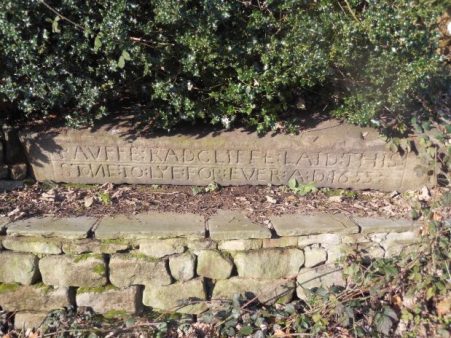
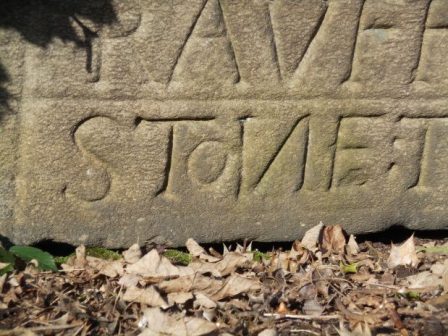
Down the old lane we arrived at ‘The Written Stone’ which I’ve mentioned several times in local blogs.

What I hadn’t noticed before was the typo error where the carver had misspelt stone and added a small o later.  We then spent the morning traversing the southern side of Longridge Fell on paths and tracks between ancient farmsteads crunching through the snow in bright sunshine. One of the first farms, 250year old Hoardsall, has the appearance of years gone by. This morning the farmer was busy splitting logs, his source of fuel, in an outhouse with his black and white cat watching on. We fell into conversation and gleaned a fascinating history of sheep farming in the area. His farm yard was cobbled with local sandstone setts which had been augmented in the past with granite setts removed from Brook Street in Preston. [I knew of an antique  business which purchased old setts, street architecture, pub paraphernalia and red phone boxes etc when Preston was being ‘modernised’] A fascinating encounter which makes me think that these insights should be recorded for posterity.

New Row Cottages in Knowle Green formerly belonged to cotton weavers and are now a peaceful haven away from the main road.

Ahead was a tree topped hillock of unkown origin. Eventually we joined the delightful bridleway alongside Dean Brook into Hurst Green. One of my favourite walks. We lunched on a wall by the Shireburn Almshouses which were first built on Longridge Fell in 1706 but moved and rebuilt in Hurst Green in 1946. The village is closely associated with nearby Stoneyhurst College whose grounds we walked through. Much has been written about this famous Jesuit establishment. https://en.wikipedia.org/wiki/Stonyhurst  All the while a snowy Pendle loomed in the background.

Leaving the grounds we dropped down to cross the River Hodder at the historic border between Yorkshire and Lancashire. You take your life in your hands to view the inscription on the bridge and the nearby ‘Cromwells Bridge’

We did not enjoy the forced road walking into Mitton and were glad to escape into a quieter land leading to the 12th century All Hallows Church. Next door was the stately 17th century Great Mitton Hall. Downhill on the busy road we crossed the River Ribble with more views of an arctic Pendle Hill. This is fantastic Lancashire countryside. Pleasant field paths led us to our debacle with the new housing estate. The best day so far on our SD38 journey.There were signs of spring all along the way.

*****

FURTHER UPDATE ON SHORT WALK OBSTRUCTIONS.

Last June I experienced problems  on one of my regular short walks from home, barbed wire across the path. I reported the obstruction to LCC highway department.  A month later the obstruction had been temporarily removed though no stile provided. Early this month I had an email from the council stating that the fence has been opened up and a gate erected. This morning there was substantial snow and I wasn’t inclined to take the car onto the roads so later in the day, as there was some brightening, I thought it a good idea to do a walk and check the above footpath situation at the same time.

Once off the road I was on virgin snow, nice and crunchy. Surprisingly the first stile which was in good condition had been replaced by a kissing gate. Walking on I could see that the obstructed fence now also had a brand new gate. Problem resolved.

On closer inspection the gate had not been fitted correctly and wouldn’t close so the orange bailing twine was being utilised. Shoddy and no doubt expensive workmanship.

Anyhow I could now proceed with the walk which I continued across fields to Gill Bridge and then quiet back lanes to pass through the grounds of Ferraris Country Hotel. The bad weather had resulted in fewer visitors than usual.https://cdn.ostrovok.ru/t/1024x768/second2/1430170966/852be815eb041e63f83871d98193f8b2.jpg

The sun was making a brief feeble appearance as I walked home past the cricket pitch.

*****

NORTHING 438. INSKIP TO LONGRIDGE.

January 27th.    7 miles.

This is long distance walking in easy stages designed for winter exercise. Todays stage actually finishes in Longridge, my home town, which is convenient for me if not for Sir Hugh who has to travel from Arnside, but it was his idea in the first place. At least today we meet up in the agreed destination, a good start. We are walking by 9.30 on a clear sunny morning with a strong cold wind at our heals. There must have been a lot of rain last night judging by the pools on the road – an ominous sign. We take to footpaths as soon as we can and end up in deep mud similar to where we left off last week. The stiles around Singletons Farm are virtually impassable, blocked by hawthorn, but we push through.Crossing a field we are confronted by the next stile leading into a lake, no way we can go that way so we retreat and hit the minor lane to Cuddy Hill [sounds Scottish] and the well-known Plough Inn. After all the frustrating obstacles I was ready for a drink but of course they hadn’t opened. Eventually we find the onward path and emerge onto a lane which took us over a canal. In the past we have both walked the The Black and White, Lancaster Canal.    but we didn’t recognise the location,

We were on the A6 for a short distance before crossing over onto tracks to end up in fields,  navigational errors had us back tracking to reach Jepps Lane. The A6 seemed like the transition from the flat floodplain of The Fylde to the pleasant countryside of the Ribble Valley. The wind by now had intensified and many of Sir Hugh’s pearls of wisdom were lost. I had never been down the lane to Barton Old Hall before, but it conveniently crossed the motorway for us. The Old Hall was hidden behind trees and the cluster of houses and conversions at the hall were rather depressing.

I think we were deterred from the actual path through the properties, but still found ourselves in rolling countryside alongside the proverbial babbling brooks. Time passed as we weaved our way through the pleasant Lancashire countryside. The Bowland Fells rose in the background and ahead was a glimpse of Longridge Fell.

We passed the stately Goosnargh Lodge, joined some local routes and reached Goosnargh Mill, not the best of conversions.

I was now on home ground and confidently marched across fields finding hidden stiles until we reached one that was in such a dangerous state we had to retreat yet again and find an alternative way. Worse was to come as what had been open fields was divided up by permanent electric fencing, the sort used for equine enclosures, with no regard for any public rights of way. Attempts at crawling under on the wet ground were not pleasant, so we took to dismantling the top wires to step over, there was fortunately no electric current. Reports to LCC  are on their way. A rather sour note towards the end of the day.

He who dares – SAS training.

Just before Longridge we passed Sea View cottages,  and yes you could just about see back to the coast where we had started SD 38.The road into Longridge is now surrounded on all sides by new housing developments, the Fell can just be glimpsed above the roofs. It is no longer the attractive, honest, little town that I moved to all those years ago.

*****